Enterprise Technology Sales in 2026: The Complete Guide
Enterprise technology sales means 6-18 month cycles, double-digit buying committees, and procurement gates that kill good deals. Here's the stage-by-stage playbook, plus the data and tooling that keep pipeline moving.
Enterprise technology sales is the hardest motion in B2B. Cycles run 6 to 18 months. Buying groups pass ten people. This guide maps the stages, the stall points, and the moves that close deals.
TL;DR
- Enterprise technology sales means selling software or infrastructure into large firms. No one person can say yes.
- The shape is steady: 1,000+ employees, six-figure contracts, 6-18 month cycles.
- Deals are won on committee coverage, not demos. Gartner puts a typical B2B buying group at six to ten people. Add security, legal, and procurement and you get eleven or more.
- Most stalls are not lost bids. Budgets move. Champions quit. A security review lands late.
- Pipeline math is brutal. At a 20% win rate and a 9-month cycle, build coverage three quarters early.
- Verified contact data for the whole committee is the cheapest lever most teams skip.
What is enterprise technology sales?#
Enterprise technology sales is complex, multi-party selling into large firms. The purchase needs formal sign-off from several teams. The contract is big enough to pull in procurement, legal, security, and finance.
Here is the plain version. Selling to an SMB is like selling a bicycle. One person tries it, likes it, and buys it. Selling to an enterprise is like asking a city to approve a bridge. The engineer wants it. The budget office pushes back. Legal reads the contract. The safety inspector holds a veto. The mayor takes the credit. You are not trying to win one person. You are arming the insider who wants the bridge built.
Enterprise technology sales joins three things that rarely appear together:
- A technical review — a POC or pilot where your product meets real data and real engineers.
- A commercial deal — multi-year terms, volume tiers, custom SLAs, and a buyer paid to squeeze you.
- A risk review — SOC 2, ISO 27001, DPAs, pen test summaries, and long vendor forms.
Skip any one of the three and the deal does not close. It just goes quiet.
How is enterprise tech sales different from SMB and mid-market?#
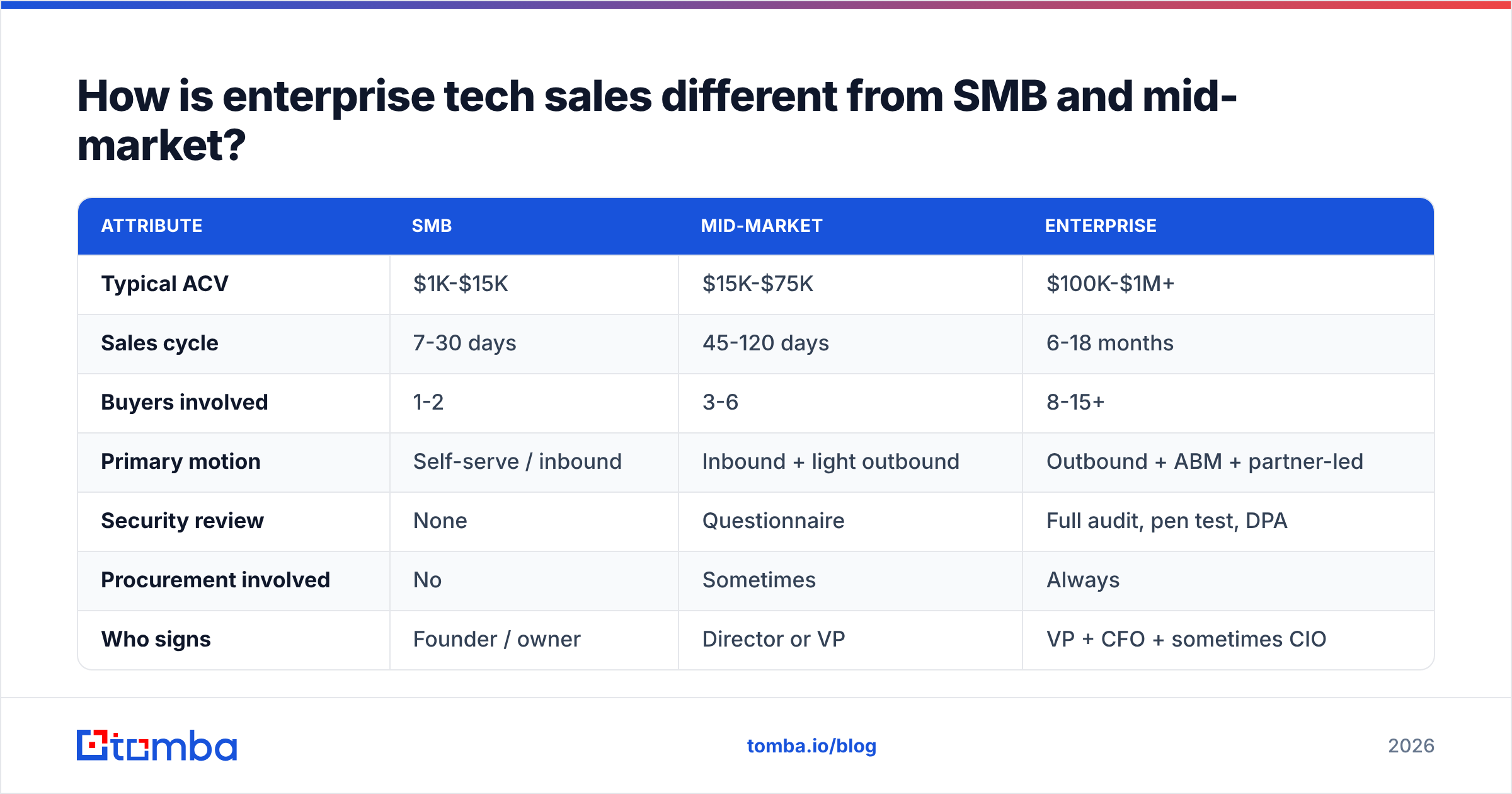
The gap is not just bigger numbers. The process differs, and so do the ways it breaks. Here is what changes as you move upmarket:
| Attribute | SMB | Mid-market | Enterprise |
|---|---|---|---|
| Typical ACV | $1K-$15K | $15K-$75K | $100K-$1M+ |
| Sales cycle | 7-30 days | 45-120 days | 6-18 months |
| Buyers involved | 1-2 | 3-6 | 8-15+ |
| Primary motion | Self-serve / inbound | Inbound + light outbound | Outbound + ABM + partner-led |
| Security review | None | Questionnaire | Full audit, pen test, DPA |
| Procurement involved | No | Sometimes | Always |
| Who signs | Founder / owner | Director or VP | VP + CFO + sometimes CIO |
| Churn driver | Price | Adoption | Executive sponsor turnover |
| CAC payback | 3-9 months | 12-18 months | 18-30 months |
| Rep profile | Volume closer | Full-cycle AE | AE + SE + solutions architect |
Two things follow from that table. Enterprise reps carry fewer deals — 12 to 25 open, not 90. And a bad-fit deal costs far more, because a dead 9-month cycle eats a quarter of your year. In enterprise technology sales, tight qualification beats raw activity.
Who actually sits on the enterprise buying committee?#
Map six roles by name and email before you build a business case. A blank slot is your next action. Not your next demo.
Win these three:
The champion — a director or manager who owns the pain. They sell for you inside. Give them a deck they can forward as is. Champions leave at about 20% a year, so never rely on one.
The economic buyer — the exec who owns the budget line. They care about outcomes and risk, not features. If you have not met them by the midpoint, your forecast is fiction.
The technical evaluator — the architect or staff engineer who will try to break your product. Win them with clean docs and a good API, not a slide about innovation.
Manage these three:
The security reviewer — InfoSec, GRC, or privacy counsel. They hold a veto and gain nothing from a yes. Send your trust center, SOC 2 report, and subprocessor list in week one.
Procurement — paid to cut price and cut risk. Expect a bid requirement, a redline round, and a stall near quarter end.
The blocker — the owner of the current tool or the in-house build. Find them early. You do not convert a blocker. You scope around them, or the economic buyer overrules them.
Most CRM gaps in big deals trace back to this list. If your CRM holds three contacts on a $250K deal, you do not have a deal. You have a chat.

What does the enterprise sales cycle look like stage by stage?#
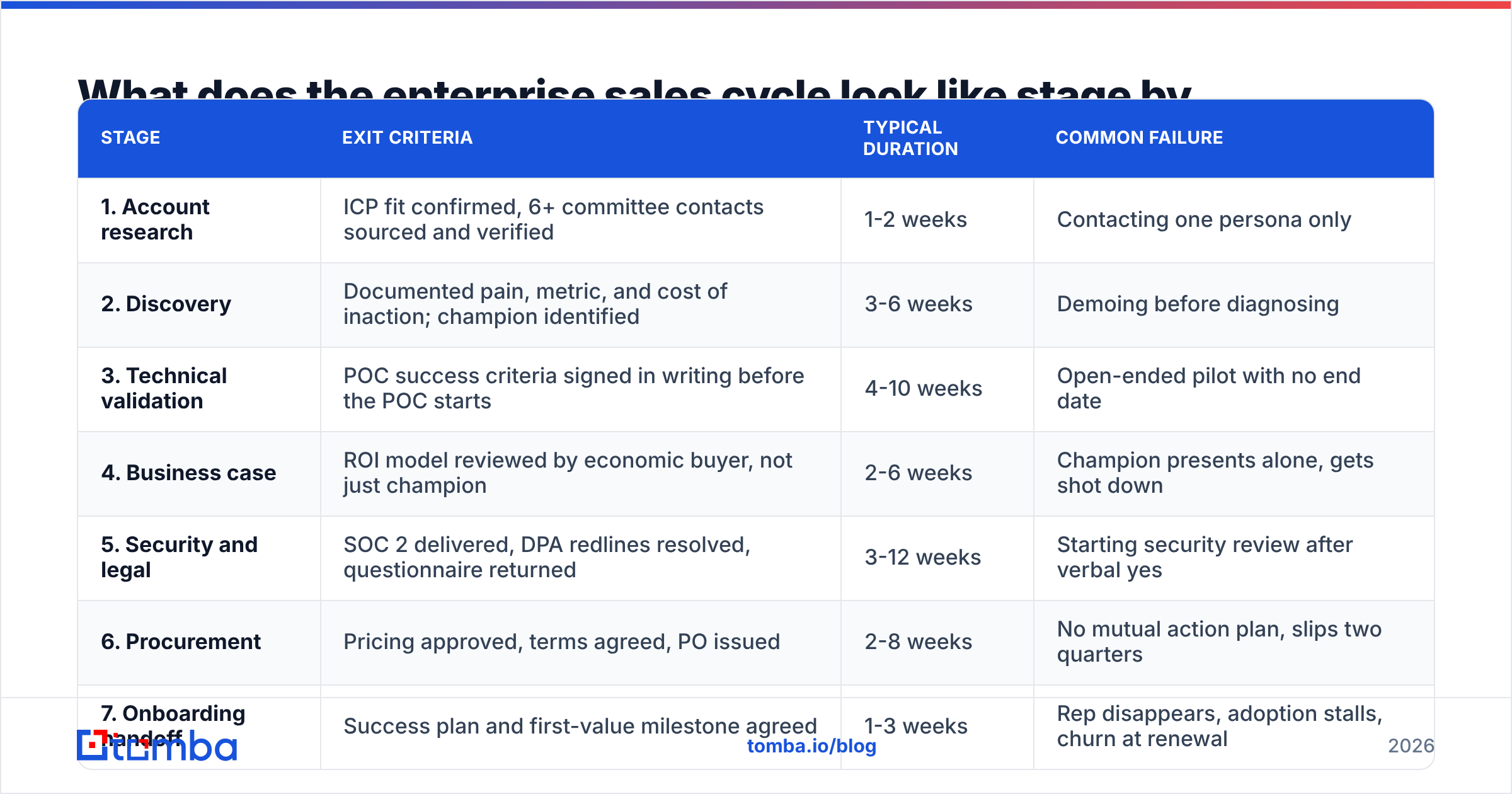
Stages mean nothing without exit criteria. "Discovery" is not a stage. "Discovery ends when we know the metric they are judged on" is a stage. Here is a model you can copy:
| Stage | Exit criteria | Typical duration | Common failure |
|---|---|---|---|
| 1. Account research | ICP fit confirmed, 6+ committee contacts sourced and verified | 1-2 weeks | Contacting one persona only |
| 2. Discovery | Documented pain, metric, and cost of inaction; champion identified | 3-6 weeks | Demoing before diagnosing |
| 3. Technical validation | POC success criteria signed in writing before the POC starts | 4-10 weeks | Open-ended pilot with no end date |
| 4. Business case | ROI model reviewed by economic buyer, not just champion | 2-6 weeks | Champion presents alone, gets shot down |
| 5. Security and legal | SOC 2 delivered, DPA redlines resolved, questionnaire returned | 3-12 weeks | Starting security review after verbal yes |
| 6. Procurement | Pricing approved, terms agreed, PO issued | 2-8 weeks | No mutual action plan, slips two quarters |
| 7. Onboarding handoff | Success plan and first-value milestone agreed | 1-3 weeks | Rep disappears, adoption stalls, churn at renewal |
The mutual action plan is the best artifact in enterprise technology sales. It lists every step left, the owner on each side, and the date. It turns "let's reconnect in Q3" into a claim you can test. If the buyer will not co-own dates, you have interest, not intent.
How do you build enterprise pipeline that does not evaporate?#
Enterprise technology sales pipeline is built account-first, not lead-first. Pick 50-150 named accounts per rep. Work every relevant persona inside them. Email, phone, LinkedIn, events, partners.
That only works if the contact data holds up. Three requirements:
Full committee coverage. You need the VP of Engineering, the security lead, the architect, and the ops director. Same account, same week. A domain search surfaces the pattern and the people fast.
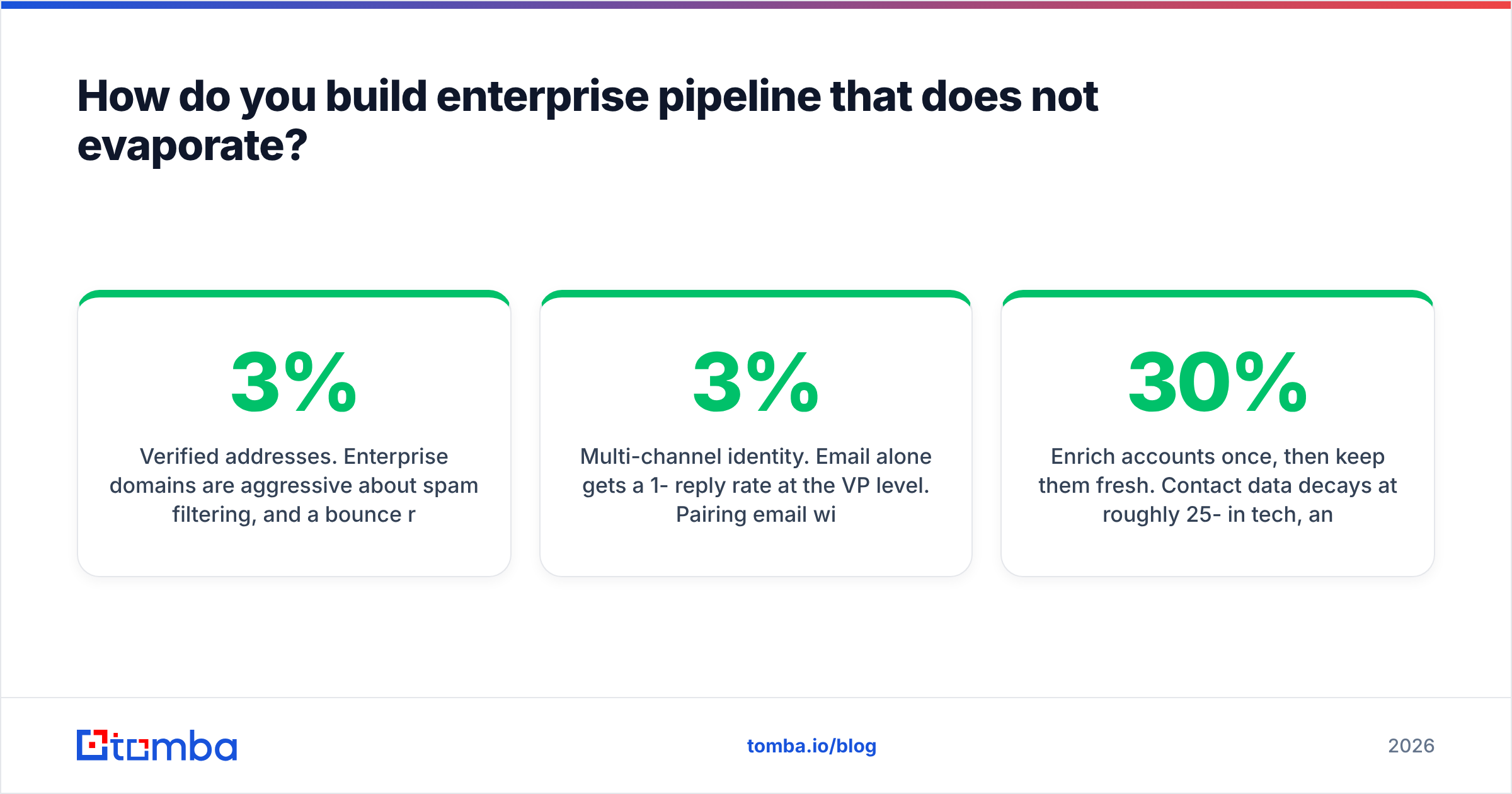
Verified addresses. Big domains filter hard. A bounce rate above 2-3% hurts your sender score everywhere. Run every address through an email verifier first. Handle catch-all domains with a catch-all verifier.
More than email. Email alone gets a 1-3% reply rate at VP level. A direct dial roughly doubles connect rates. Keep a phone finder in the stack.
Enrich once, then keep it fresh. Contact data decays 25-30% a year in tech. It decays fastest at senior level, where people get promoted and poached. A quarterly refresh of your account list costs less than one dead deal.
At scale, contact enrichment by API beats manual research. It fills the five missing committee members for you. No SDR spends forty minutes per account.

Why do enterprise technology deals stall?#
Ask an enterprise AE to name their top competitor. The honest answer is "no decision." Work from Forrester and Gartner keeps finding the same thing. A large share of good deals end with no decision, not a loss. Most enterprise technology sales stalls come from six causes:
- No cost of inaction. They want it. They do not need it this year. You sold value, not urgency.
- Champion turnover. Your one contact takes a new job in month seven. Everything resets.
- A surprise security review. InfoSec shows up in month five and asks for a pen test summary you lack.
- Procurement leverage. The buyer learns your quarter-end date and waits. Never show close pressure.
- Scope creep. The champion adds asks to justify the spend. The deal grows past their sign-off limit.
- No exec sponsor on your side. Buyers read a missing VP as a signal that they do not matter.
The fix is the same for most of them. Go earlier, go wider, and put it in writing.
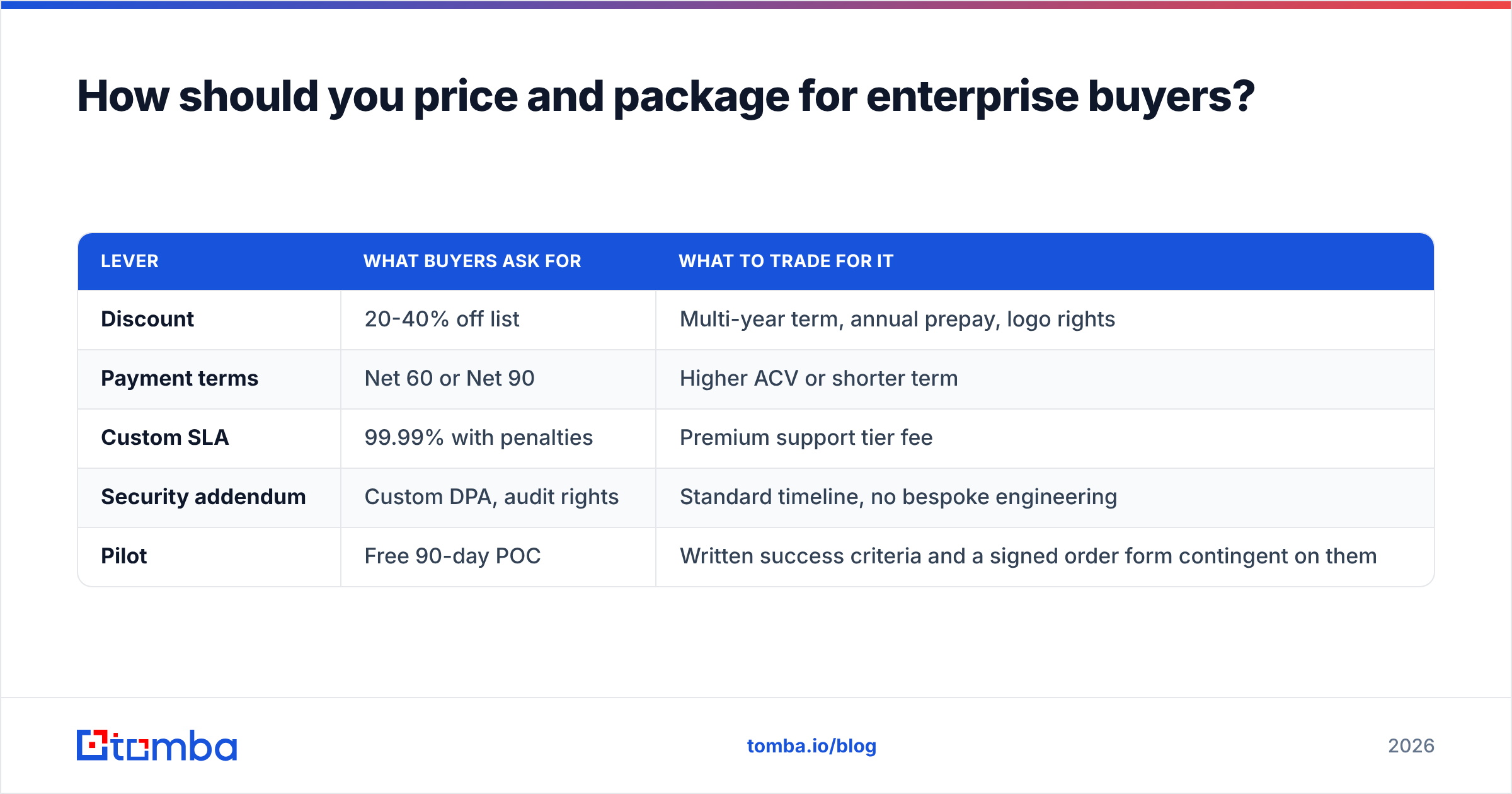
How should you price and package for enterprise buyers?#
Enterprise buyers care less about price than you think. They care about risk and process. Here is what moves a deal:
| Lever | What buyers ask for | What to trade for it |
|---|---|---|
| Discount | 20-40% off list | Multi-year term, annual prepay, logo rights |
| Payment terms | Net 60 or Net 90 | Higher ACV or shorter term |
| Custom SLA | 99.99% with penalties | Premium support tier fee |
| Security addendum | Custom DPA, audit rights | Standard timeline, no bespoke engineering |
| Pilot | Free 90-day POC | Written success criteria and a signed order form contingent on them |
Two rules survive contact with procurement. First, never give a concession for free. One-way concessions teach buyers that waiting pays. Second, publish a price anchor. Buyers check pricing details before they book a call. Vendors who hide every number get cut from the shortlist early.
What metrics actually matter in enterprise sales?#
Activity metrics mislead in enterprise technology sales. Track these instead:
- Committee coverage rate — share of open deals with 5+ verified contacts engaged. Aim for 70%.
- Multi-threading depth — average contacts per open deal. Below three, the forecast is at risk.
- Stage-to-stage conversion — where deals die, not where you think they die.
- Cycle time by stage — a security stage of 11 weeks is a product problem, not a sales one.
- Slipped-deal rate — share of committed deals that move a quarter. Above 30%, qualification is broken.
- Win rate against no-decision — track it apart from lost bids. The fixes differ.
How is AI changing enterprise technology sales in 2026?#
AI has sped up research and widened reach. It has not changed the core limit. Enterprise buying is a consensus problem, and consensus is human.
Research and enrichment automation does work. An agent reads the 10-K, pulls the tech stack, names the six personas, finds verified emails and dials, and drafts an account plan. Ninety seconds, not ninety minutes. Teams that wire this through a Tomba API call inside the CRM save hours per rep each week.
Bulk AI outreach does not work. Senior buyers get dozens of near-identical LLM emails a week. Their filters, human and technical, have caught up. Peer sites like G2 still drive more shortlist entries than cold sequences. Use AI to know more before you reach out. Not to reach out more.
Where should you start?#
Pick twenty target accounts. For each, list the six committee roles above. Fill in names, verified emails, and direct dials. The cells you cannot fill are the size of your pipeline problem. That gap is fixable in an afternoon.
The Tomba Email Finder is built for this step. Give it a domain and a name. Get a verified address with a confidence score and its sources. Start free at 25 searches a month. Move to Starter at $49/mo or Growth at $99/mo once your enterprise technology sales motion needs full committee coverage. Fill the missing seats before your competitor does.
Related guides#
Ready to find emails that actually work?
Join 150,000+ professionals who stopped guessing and started sending. Free credits on signup — no credit card required.
Get the Tomba newsletter
Practical outbound tactics and product updates — once every two weeks.
About the author