EspoCRM Pricing Reviews Pros and Cons: 2026 Buyer Guide
EspoCRM looks almost free until you price the hosting, extensions, and admin hours. Here is the real 2026 cost, what reviewers actually complain about, and who should skip it.
EspoCRM pricing reviews pros and cons, in one place. This guide prices the real 2026 setup, weighs what reviewers praise, and flags what they complain about. Short version: the licence is cheap, the running costs are not.
TL;DR
- EspoCRM's self-hosted Community edition is genuinely free (AGPL-3.0), but "free" means you pay in server costs, sysadmin hours, and paid extensions that cover features rivals bundle by default.
- Cloud pricing starts around $15/user/month billed annually, which undercuts HubSpot and Salesforce — until you add the Advanced Pack, Sales Pack, or VoIP extensions, each a separate one-off or subscription fee.
- Reviews on G2 and Capterra cluster around the same verdict: excellent customisation and value, weak out-of-the-box reporting, dated UI, and support that assumes you can read a stack trace.
- Best fit: technical teams with 5–50 seats who want to own their data. Worst fit: non-technical sales teams who need a CRM working on Monday.
- A CRM stores contacts; it does not find them. Pair EspoCRM with a dedicated data layer — that gap is where most EspoCRM deployments stall.
What is EspoCRM and who actually uses it?#
EspoCRM is an open-source CRM built in PHP, with a Backbone-based frontend. It first shipped in 2014. A small European team still maintains it. Think of it as the IKEA of CRM software: the parts are good, the price is low, and the result depends on whether you enjoy assembly.
It ships with the standard CRM objects — Accounts, Contacts, Leads, Opportunities, Cases, Activities. On top of that sits an Entity Manager. It lets you build custom entities, fields, relationships, and layouts from the admin UI, with no code. That tool is the single most-praised feature in every review corpus we read. It is also why agencies, MSPs, manufacturers, and non-profits keep picking EspoCRM over Salesforce.
Who it is not for: teams that expect AI scoring, native sequencing, or a marketplace with 1,500 apps. EspoCRM's extension directory has dozens of entries, not thousands.
How much does EspoCRM cost in 2026?#
Two delivery models, two very different cost curves.
Self-hosted (Community edition) — $0 licence, AGPL-3.0. You supply a LAMP/LEMP stack, MySQL 8 or MariaDB, cron, and backups. Realistic infrastructure cost for a 20-user instance on a managed VPS: $30–$80/month. Realistic admin cost: 3–8 hours/month once stable, far more during setup.
Cloud (hosted by EspoCRM) — starts at roughly $15/user/month on annual billing, with a small monthly premium if you pay month-to-month. Includes hosting, updates, and backups. Extensions are billed separately.
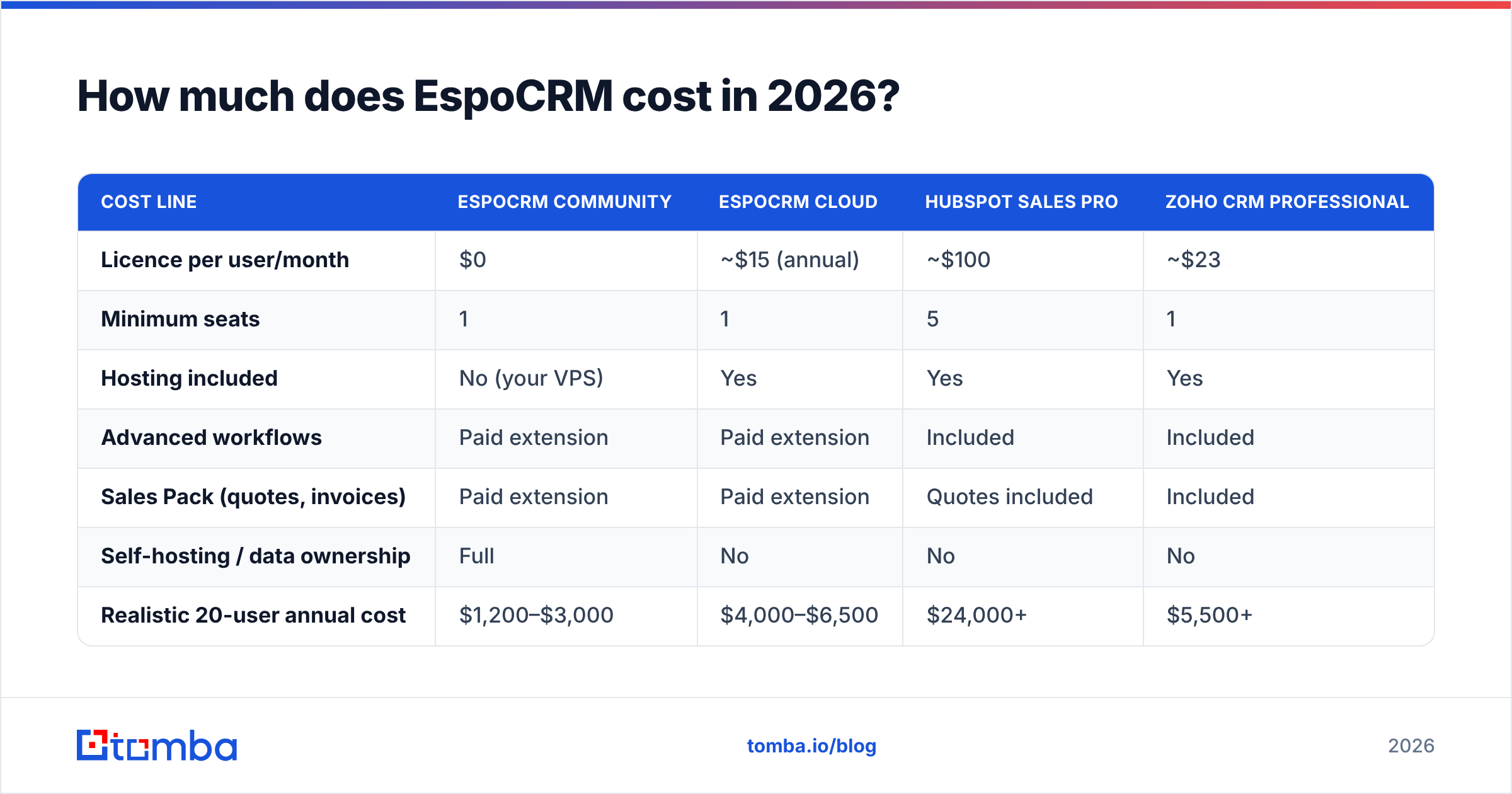
| Cost line | EspoCRM Community | EspoCRM Cloud | HubSpot Sales Pro | Zoho CRM Professional |
|---|---|---|---|---|
| Licence per user/month | $0 | ~$15 (annual) | ~$100 | ~$23 |
| Minimum seats | 1 | 1 | 5 | 1 |
| Hosting included | No (your VPS) | Yes | Yes | Yes |
| Advanced workflows | Paid extension | Paid extension | Included | Included |
| Sales Pack (quotes, invoices) | Paid extension | Paid extension | Quotes included | Included |
| Self-hosting / data ownership | Full | No | No | No |
| Realistic 20-user annual cost | $1,200–$3,000 | $4,000–$6,500 | $24,000+ | $5,500+ |
The extension math is where budgets break. The Advanced Pack (BPM workflows, approvals), Sales Pack (quotes, invoices, orders), Real Estate Pack, and VoIP integrations are each priced on their own. A 20-seat deployment that wants BPM plus quoting can add roughly $1,000–$2,000 in one-off extension licences on top of seats. Still cheap next to Salesforce — not "free."
What do EspoCRM reviews actually say?#
We read public review corpora on G2 and Capterra, plus the project's own community forum. The sentiment is remarkably consistent, which is unusual for a CRM.
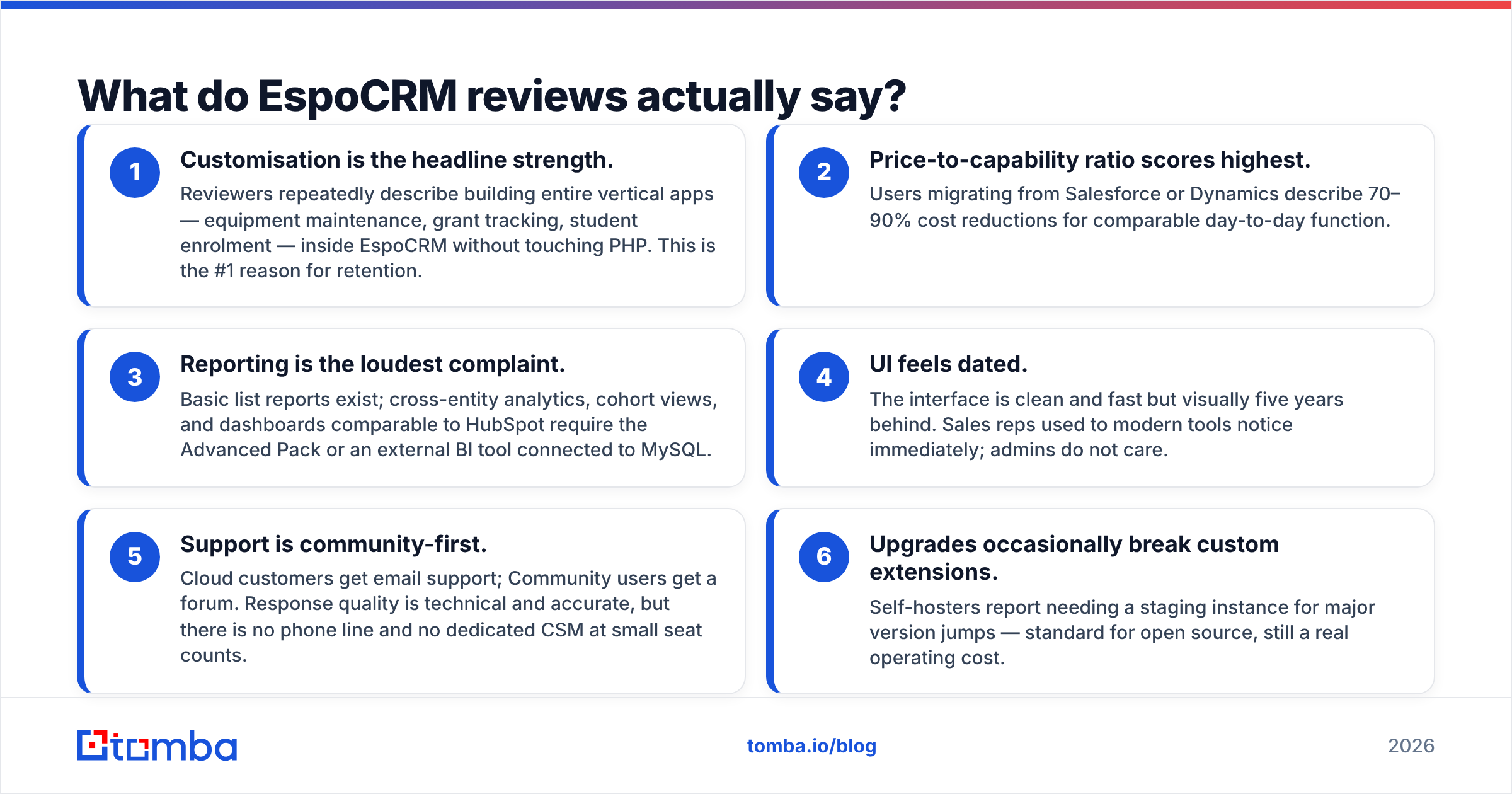
- Customisation is the headline strength. Reviewers describe building entire vertical apps — equipment maintenance, grant tracking, student enrolment — inside EspoCRM without touching PHP. This is the #1 reason for retention.
- Price-to-capability ratio scores highest. Users migrating from Salesforce or Dynamics report 70–90% cost cuts for comparable day-to-day function.
The complaints are just as consistent:
- Reporting is the loudest one. Basic list reports exist. Cross-entity analytics, cohort views, and HubSpot-grade dashboards need the Advanced Pack or an external BI tool wired to MySQL.
- UI feels dated. The interface is clean and fast, but it looks five years behind. Sales reps used to modern tools notice at once; admins do not care.
- Support is community-first. Cloud customers get email support. Community users get a forum. The answers are technical and accurate, but there is no phone line and no dedicated CSM at small seat counts.
- Upgrades occasionally break custom extensions. Self-hosters report needing a staging instance for major version jumps — standard for open source, still a real operating cost.
The pattern: technical evaluators rate it 4.5+, non-technical end users rate it around 4.0, and the gap is almost entirely UI and reporting.
What are the pros and cons of EspoCRM?#
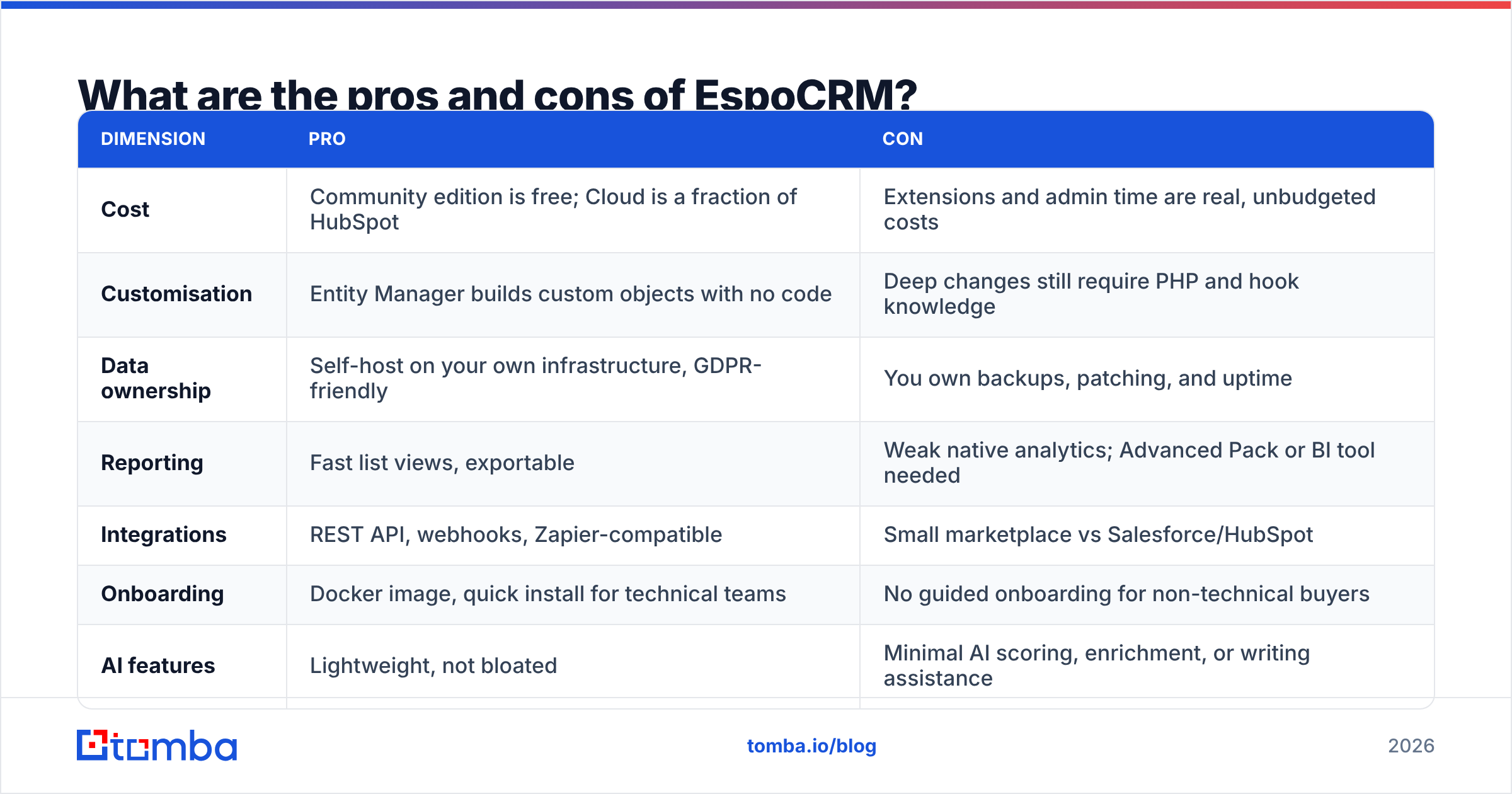
Here is the EspoCRM pricing reviews pros and cons scorecard, side by side.
| Dimension | Pro | Con |
|---|---|---|
| Cost | Community edition is free; Cloud is a fraction of HubSpot | Extensions and admin time are real, unbudgeted costs |
| Customisation | Entity Manager builds custom objects with no code | Deep changes still require PHP and hook knowledge |
| Data ownership | Self-host on your own infrastructure, GDPR-friendly | You own backups, patching, and uptime |
| Reporting | Fast list views, exportable | Weak native analytics; Advanced Pack or BI tool needed |
| Integrations | REST API, webhooks, Zapier-compatible | Small marketplace vs Salesforce/HubSpot |
| Onboarding | Docker image, quick install for technical teams | No guided onboarding for non-technical buyers |
| AI features | Lightweight, not bloated | Minimal AI scoring, enrichment, or writing assistance |
The honest summary: EspoCRM is an excellent system of record and a mediocre system of engagement. Is your pain "we need structured data about customers, and we refuse to pay $100/user"? Then it is close to unbeatable. Is your pain "our reps need to find, contact, and sequence 500 new prospects this quarter"? Then EspoCRM alone will not solve it.
Is EspoCRM better than the alternatives?#
Depends on which axis you optimise for.
Versus HubSpot — HubSpot wins on usability, marketing automation, and ecosystem. EspoCRM wins on cost and data control by a wide margin. If you have a marketing team that will actually use workflows and landing pages, HubSpot's premium is defensible. If the CRM is a database with pipeline views, it is not.
Versus Zoho CRM — closest commercial comparison. Zoho is cheap, hosted, and far more feature-complete out of the box (forecasting, telephony, AI assistant). EspoCRM wins only if self-hosting or unlimited custom entities matter. For most non-technical SMBs, Zoho is the safer pick.
Versus SuiteCRM — the other major open-source option. SuiteCRM has more legacy enterprise features (SugarCRM lineage) but heavier code and a slower UI. EspoCRM is the modern, lighter choice; SuiteCRM is the choice when you need specific legacy modules.
Versus Odoo CRM — Odoo wins if you want CRM inside a full ERP (inventory, accounting, manufacturing). EspoCRM wins if you want CRM only, without ERP complexity.
Versus a spreadsheet — genuinely relevant for teams under five people. If your process fits in a well-maintained sheet, adopting EspoCRM buys you audit trails, permissions, and relationship modelling. It does not buy you revenue on its own.
What is the hidden cost most EspoCRM buyers miss?#
Empty records. A CRM's value is a function of the data inside it, and EspoCRM ships with zero contact data — no built-in prospecting database, no enrichment, no email discovery. Compare that to Apollo or Seamless.AI, where the database is the product.
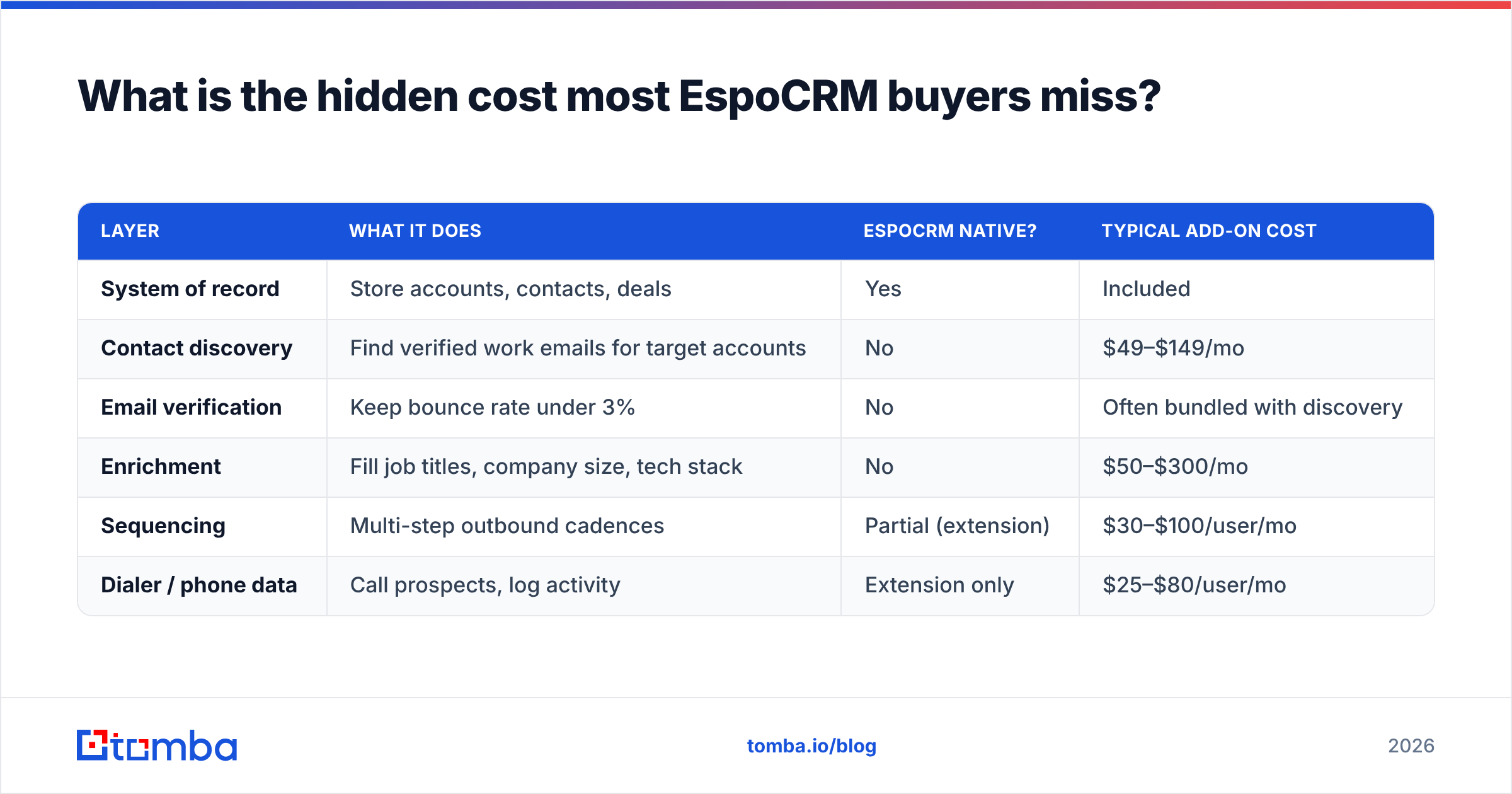
That means the true stack cost looks like this:
| Layer | What it does | EspoCRM native? | Typical add-on cost |
|---|---|---|---|
| System of record | Store accounts, contacts, deals | Yes | Included |
| Contact discovery | Find verified work emails for target accounts | No | $49–$149/mo |
| Email verification | Keep bounce rate under 3% | No | Often bundled with discovery |
| Enrichment | Fill job titles, company size, tech stack | No | $50–$300/mo |
| Sequencing | Multi-step outbound cadences | Partial (extension) | $30–$100/user/mo |
| Dialer / phone data | Call prospects, log activity | Extension only | $25–$80/user/mo |
Budget accordingly. A 10-seat EspoCRM Cloud instance at $150/month with a serious outbound motion realistically runs $400–$700/month all-in — still dramatically under HubSpot Sales Pro, but not the $0 that "open source" implies.
This is where a dedicated data layer earns its keep. Tomba's email finder and domain search close the discovery gap. Point them at a target company domain and pull the verified addresses of the roles you sell to. Push those records into EspoCRM through the Tomba API or a Zapier hop. Run the list through an email verifier before the first send, and your sender reputation survives contact with reality.
How should you evaluate EspoCRM before committing?#
Run a two-week structured trial rather than a feature-checklist comparison.
- Model your hardest object first. Not Contacts — the weird one. Subscriptions, service contracts, grant cycles, whatever your business revolves around. If Entity Manager handles it in an afternoon, EspoCRM is viable. If it does not, stop there.
- Build the report your CEO asks for monthly. If it needs the Advanced Pack or a BI tool, add that cost to the model now, not in month four.
- Import 500 real records. Test the CSV importer, duplicate handling, and field mapping with messy production data, not a clean sample.
Then stress-test the operational side:
- Time a full upgrade cycle. Self-hosters: spin up staging, apply a minor version bump, measure the hours. Multiply by four upgrades a year.
- Price the extensions you will actually buy. Advanced Pack, Sales Pack, VoIP, Google/Outlook integration — list them, sum them, compare to Zoho's all-in seat price.
- Test the API against your data source. Push 100 enriched contacts from your prospecting tool into EspoCRM programmatically. If that pipeline is painful, daily use will be worse.
Check the official EspoCRM site for current extension pricing before you model anything — the per-extension fees change more often than seat prices do.
Who should choose EspoCRM, and who should not?#
Choose EspoCRM if: you have in-house technical capacity, you need custom entities that commercial CRMs charge enterprise rates for, data residency or GDPR self-hosting is a hard requirement, or your seat count is high enough that per-user pricing hurts (50+ users makes the math overwhelming in EspoCRM's favour).
Skip EspoCRM if: nobody on the team can restart a MySQL service, your buying committee expects polished reporting on day one, you need native marketing automation, or your primary bottleneck is finding prospects rather than organising them. In that last case a CRM decision is the wrong decision — you have a data problem wearing a software costume.
The middle path most teams land on: EspoCRM Cloud for the record layer, a dedicated prospecting and verification stack feeding it, and a lightweight sequencer on top. Total cost lands near Zoho, with far more schema freedom.
EspoCRM pricing reviews pros and cons: the bottom line#
EspoCRM in 2026 is one of the best value buys in CRM — for the right buyer. The pricing is honest. The customisation is genuinely deep. The reviews reflect a product that does what it claims without overselling. The cons are just as real: reporting, UI polish, and the need for someone technical in the room.
What it will never be is a source of contacts. Whatever CRM you land on, the pipeline is only as good as the addresses inside it. Start with the Tomba Email Finder to pull verified, deliverable work emails for your target accounts. Verify them before the first send, and push clean records into EspoCRM from day one. The free tier gives you 25 searches a month to test the workflow; paid plans start at $49/month — see Tomba pricing for the full breakdown. A cheap CRM full of good data beats an expensive CRM full of bounces every quarter.
Related guides#
Ready to find emails that actually work?
Join 150,000+ professionals who stopped guessing and started sending. Free credits on signup — no credit card required.
Get the Tomba newsletter
Practical outbound tactics and product updates — once every two weeks.
About the author