EspoCRM vs SuiteCRM: Open-Source CRM Comparison for 2026
Both are free, self-hostable, GPL-licensed CRMs — and they pull in opposite directions. Here's how EspoCRM and SuiteCRM compare on modules, speed, customization, upkeep, and true cost of ownership.
TL;DR
- EspoCRM is the lighter, faster, cleaner build. Modern PHP backend, snappy UI, excellent Entity Manager for no-code custom objects. You add advanced features through paid extension packs.
- SuiteCRM is the heavier, more complete build. Everything ships in the box — quotes, invoices, contracts, projects, campaigns, security groups — at zero license cost, on an older codebase.
- Neither charges per seat if you self-host. Your real cost is hosting, upgrades, and the developer hours you spend on both.
- Pick EspoCRM if you want a CRM your reps will actually open daily and you have modest process complexity. Pick SuiteCRM if you need deep out-of-the-box modules, granular record-level permissions, or you're migrating off SugarCRM.
- The CRM choice matters less than what you put in it. Both die the same way: stale, unverified contact data.
What are EspoCRM and SuiteCRM?#
Both are open-source, self-hostable CRMs licensed under GPLv3. Both run on a PHP + MySQL/MariaDB stack. Both give you contacts, accounts, leads, opportunities, activities, and email — free, forever, on your own server. That's where the similarity ends.
EspoCRM launched in 2014 as a ground-up rewrite of what a lightweight CRM should be. It was never a fork of anything. The result is a codebase that feels like it was designed in this decade: a REST API that's genuinely pleasant to work with, a single-page frontend that loads fast, and an Entity Manager that lets an admin create a custom object with fields, relationships, and layouts without writing a line of PHP. The trade-off is scope — the free core is deliberately narrow, and features like advanced workflow automation, sales quoting, and reporting live in paid extension packs.
SuiteCRM is a fork of SugarCRM Community Edition 6.5, maintained by SalesAgility since 2013 after SugarCRM discontinued its open-source edition. It inherited a mature, sprawling feature set — and a mature, sprawling codebase. SuiteCRM 8 introduced an Angular-based frontend, but large parts of the legacy 7.x interface still surface when you dig into admin screens. The upside is enormous: workflow engine, security groups, quotes, invoices, contracts, events, projects, and a full campaign module, all included, all free.
The short version: EspoCRM optimizes for the person using the CRM. SuiteCRM optimizes for the organization that needs every module checked off in an RFP.
How do EspoCRM and SuiteCRM compare feature by feature?#
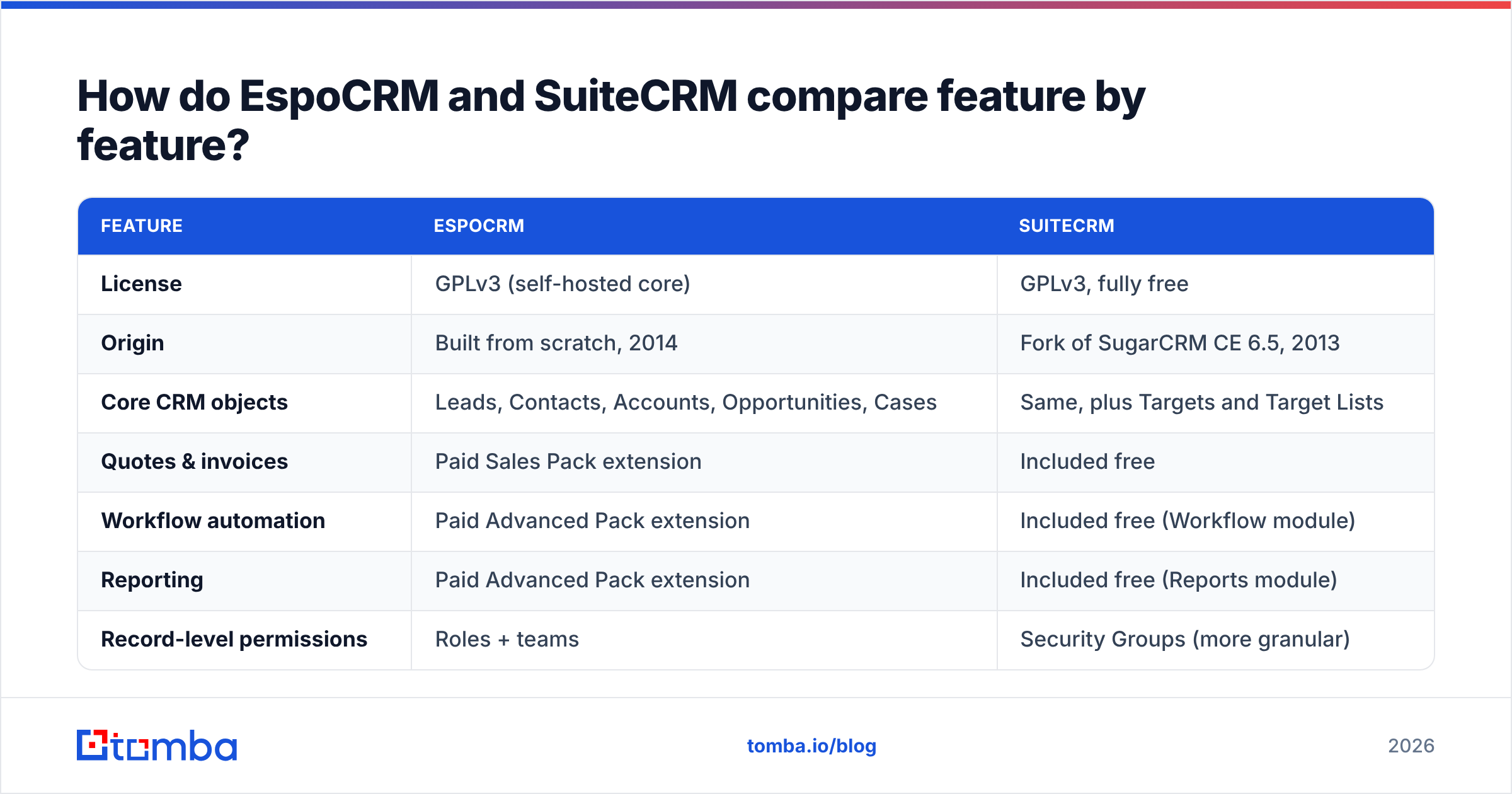
| Feature | EspoCRM | SuiteCRM |
|---|---|---|
| License | GPLv3 (self-hosted core) | GPLv3, fully free |
| Origin | Built from scratch, 2014 | Fork of SugarCRM CE 6.5, 2013 |
| Core CRM objects | Leads, Contacts, Accounts, Opportunities, Cases | Same, plus Targets and Target Lists |
| Quotes & invoices | Paid Sales Pack extension | Included free |
| Workflow automation | Paid Advanced Pack extension | Included free (Workflow module) |
| Reporting | Paid Advanced Pack extension | Included free (Reports module) |
| Record-level permissions | Roles + teams | Security Groups (more granular) |
| Custom objects, no code | Entity Manager (best in class) | Studio + Module Builder (functional, clunkier) |
| REST API quality | Modern, well documented | V8 API works; legacy V4.1 still common in the wild |
| UI responsiveness | Fast SPA, mobile-friendly | Improved in v8, still heavier |
| Mobile app | Official iOS/Android (paid) | Third-party options |
| Hosted/cloud option | Official EspoCRM Cloud | SuiteCRM OnDemand via SalesAgility |
| Best fit | Lean sales teams, custom internal apps | Feature-heavy orgs, Sugar migrations |
Two rows deserve expansion, because they drive most buying decisions.
Extension packs vs. everything-included. EspoCRM's Advanced Pack (workflows, BPM, reports) and Sales Pack (quotes, invoices, orders) are one-time purchases per instance, not per seat, in the low hundreds of dollars each at list price — check the vendor's extension store for current numbers. That's cheap compared to per-seat SaaS, but it's a real line item people miss when they say "EspoCRM is free." SuiteCRM ships all of that at zero cost. If your budget is literally zero and you need workflow rules on day one, SuiteCRM wins that argument outright.
Permissions granularity. SuiteCRM's Security Groups module is more capable than most people expect from free software: group-based record access, inheritance from parent records, per-module role overrides. EspoCRM's roles-and-teams model is cleaner to reason about but less surgical. If you're a 40-person org with overlapping territories and compliance requirements, SuiteCRM's model bends further before it breaks.
Which one is easier to install and maintain?#
EspoCRM, by a wide margin — and it's not close.
An EspoCRM install on a clean LAMP box is a download, an unzip, a permissions fix, and a browser-based installer. Version upgrades are typically an upload-and-run affair. The codebase is small enough that a competent PHP developer can trace a bug end to end in an afternoon.
SuiteCRM installs fine too, but the maintenance curve is steeper. The 7.x → 8.x migration path caught a lot of teams off guard: it's not a drop-in upgrade, and heavily customized instances often need real remediation work. Legacy code paths, a large file footprint, and cron-driven schedulers mean SuiteCRM benefits from someone who actually owns the server rather than someone who checks on it quarterly.
Practical resourcing guidance:
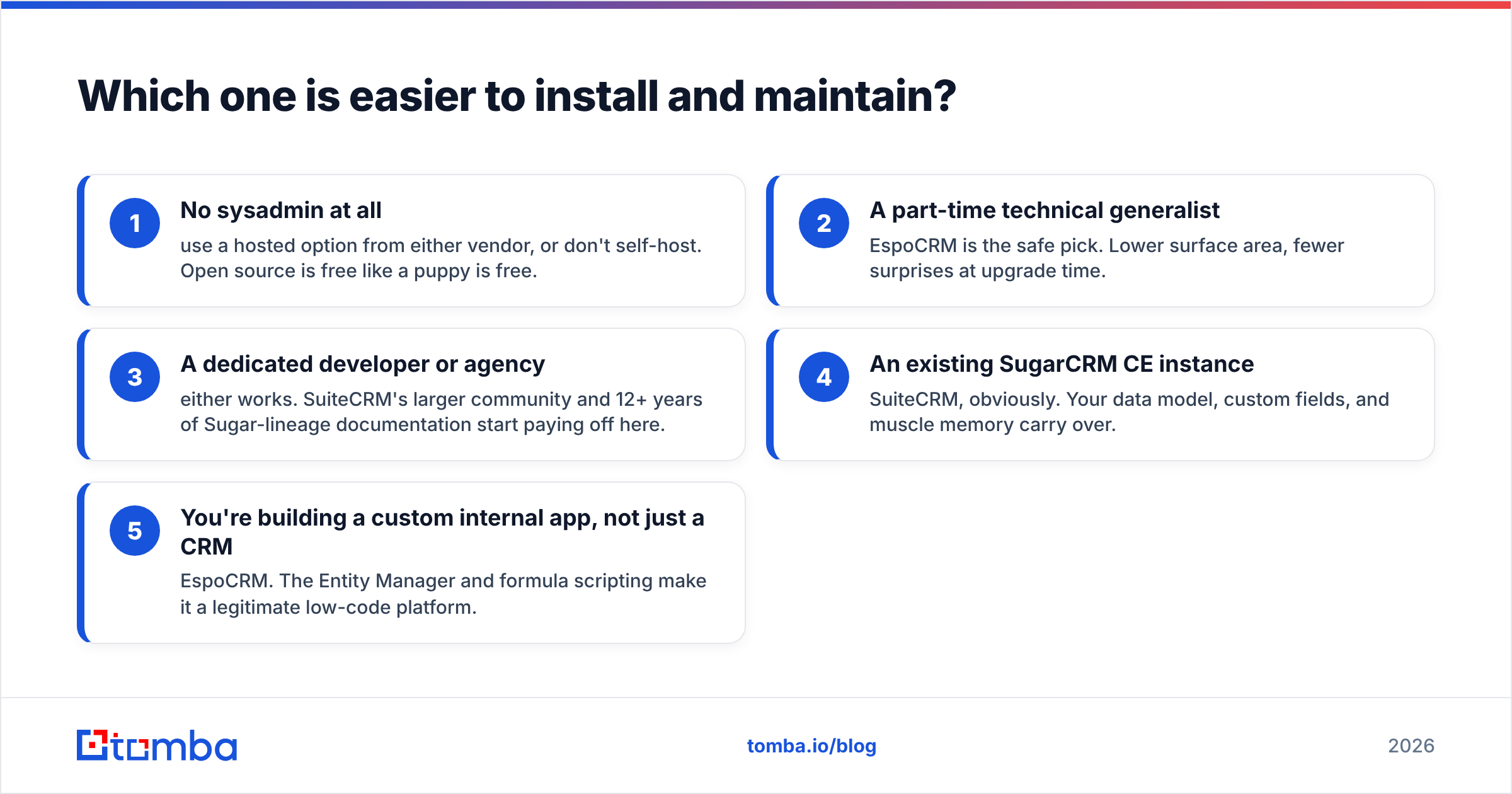
- No sysadmin at all — use a hosted option from either vendor, or don't self-host. Open source is free like a puppy is free.
- A part-time technical generalist — EspoCRM is the safe pick. Lower surface area, fewer surprises at upgrade time.
- A dedicated developer or agency — either works. SuiteCRM's larger community and 12+ years of Sugar-lineage documentation start paying off here.
- An existing SugarCRM CE instance — SuiteCRM, obviously. Your data model, custom fields, and muscle memory carry over.
- You're building a custom internal app, not just a CRM — EspoCRM. The Entity Manager and formula scripting make it a legitimate low-code platform.
What does each actually cost to run in 2026?#
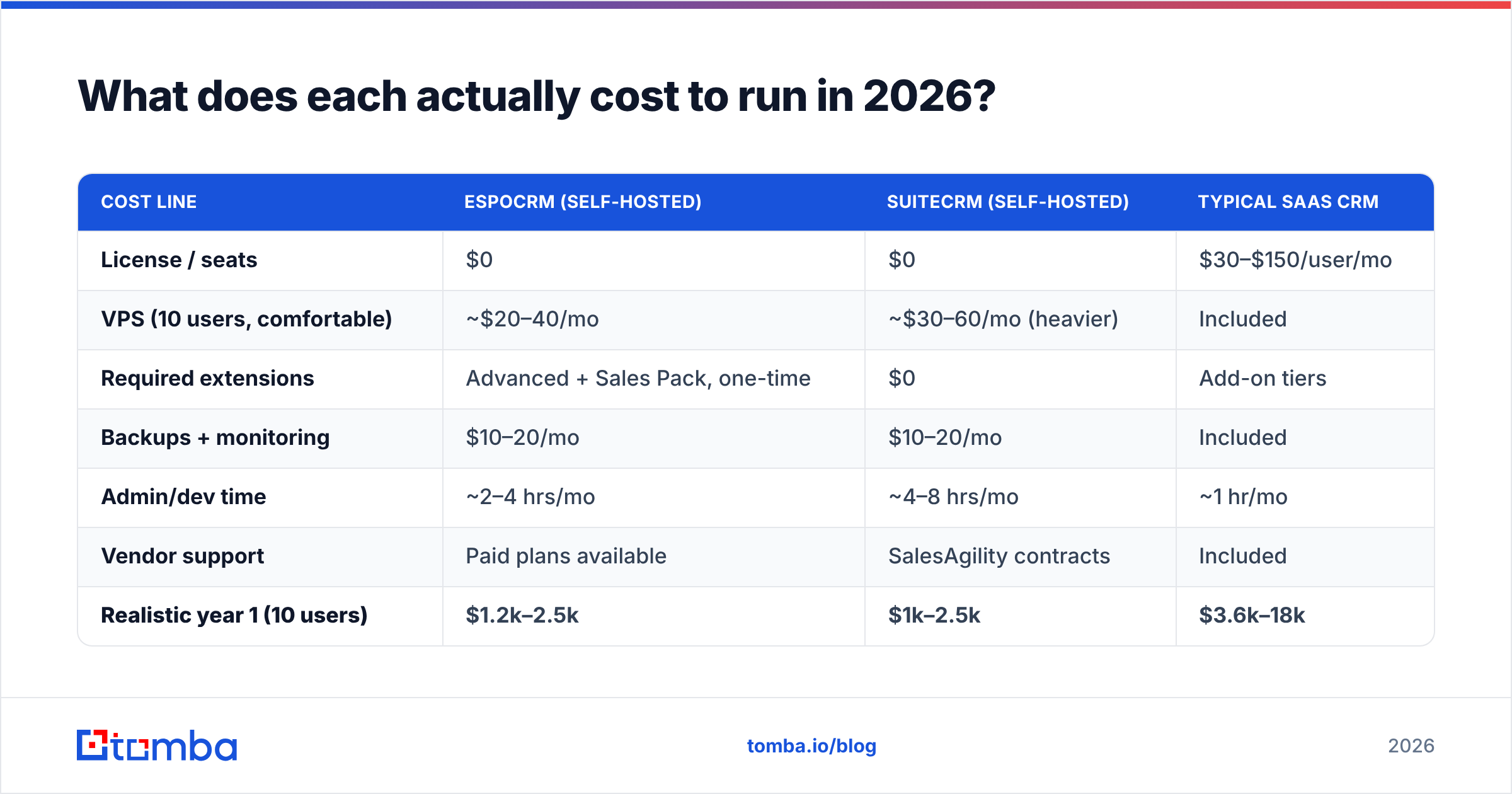
Self-hosting doesn't mean free. It means you've traded a license fee for infrastructure and labor. Here's the honest math for a 10-user team.
| Cost line | EspoCRM (self-hosted) | SuiteCRM (self-hosted) | Typical SaaS CRM |
|---|---|---|---|
| License / seats | $0 | $0 | $30–$150/user/mo |
| VPS (10 users, comfortable) | ~$20–40/mo | ~$30–60/mo (heavier) | Included |
| Required extensions | Advanced + Sales Pack, one-time | $0 | Add-on tiers |
| Backups + monitoring | $10–20/mo | $10–20/mo | Included |
| Admin/dev time | ~2–4 hrs/mo | ~4–8 hrs/mo | ~1 hr/mo |
| Vendor support | Paid plans available | SalesAgility contracts | Included |
| Realistic year 1 (10 users) | $1.2k–2.5k | $1k–2.5k | $3.6k–18k |
The headline is that both open-source options cut a 10-seat CRM bill by 60–90% versus mainstream SaaS. The footnote is that the savings arrive as engineering time, not as a check you don't write. If your developer bills at $80/hour and SuiteCRM eats six hours a month, you spent $5,760 a year on "free" software.
Check current numbers on G2's CRM category before you build a business case — cloud plans on both sides have shifted more than once in the last two years.
Is EspoCRM better than SuiteCRM for sales teams?#
For a pure sales use case with under 25 reps: yes, usually.
The reason is adoption, not features. A CRM your team avoids is worth zero regardless of how many modules it has. EspoCRM's interface loads fast, the stream view keeps activity visible, and creating a record takes fewer clicks. Reps stop treating it as an admin tax. SuiteCRM 8 narrowed the gap, but it still feels like software that grew by accretion — screens that look different from each other, admin panels that drop you into a 2014 aesthetic.
Where SuiteCRM pulls back ahead:
- Quote-to-cash inside the CRM. Native quotes, invoices, products, and contracts. EspoCRM needs the Sales Pack for the same thing.
- Campaign management. Target lists, email campaigns with tracking, and non-email campaign types are all built in.
- Complex account hierarchies. Deep parent/child account relationships with permission inheritance.
- Case and project management. If support and delivery live in the same system as sales, SuiteCRM covers more ground natively.
A useful heuristic: if your sales motion is find prospect → qualify → demo → close, EspoCRM is enough and will be pleasanter to live in. If your motion involves formal quoting, multi-stage approvals, and post-sale project delivery, SuiteCRM saves you from bolting three tools together.
Which one should you pick?#
Match the system to your actual constraint, not to the longer feature list.
- Constraint is adoption — EspoCRM. Speed and UI clarity win the daily-usage battle.
- Constraint is budget, and you need workflows now — SuiteCRM. No extension purchase required.
- Constraint is compliance or permissions — SuiteCRM. Security Groups give you finer control.
- Constraint is engineering time — EspoCRM. Smaller surface, easier upgrades, better API.
- Constraint is migration from SugarCRM CE — SuiteCRM. Everything else is a rebuild.
- You want to build custom business objects, not just track deals — EspoCRM. The Entity Manager is the strongest no-code modeling tool in either product.
There's no wrong answer here in the way there is with proprietary CRMs. Both are GPLv3, both let you export everything, both can be migrated away from. The switching cost is measured in weeks, not in vendor lock-in.
Does your CRM choice fix bad data?#
No. And this is the part most EspoCRM vs SuiteCRM comparisons skip entirely.
Neither system ships with a contact database. Neither validates that the email address on a lead record still resolves to a mailbox. Neither notices when your champion changes jobs. Both will happily store 40,000 rows of decaying contact data and render it in a beautiful list view.
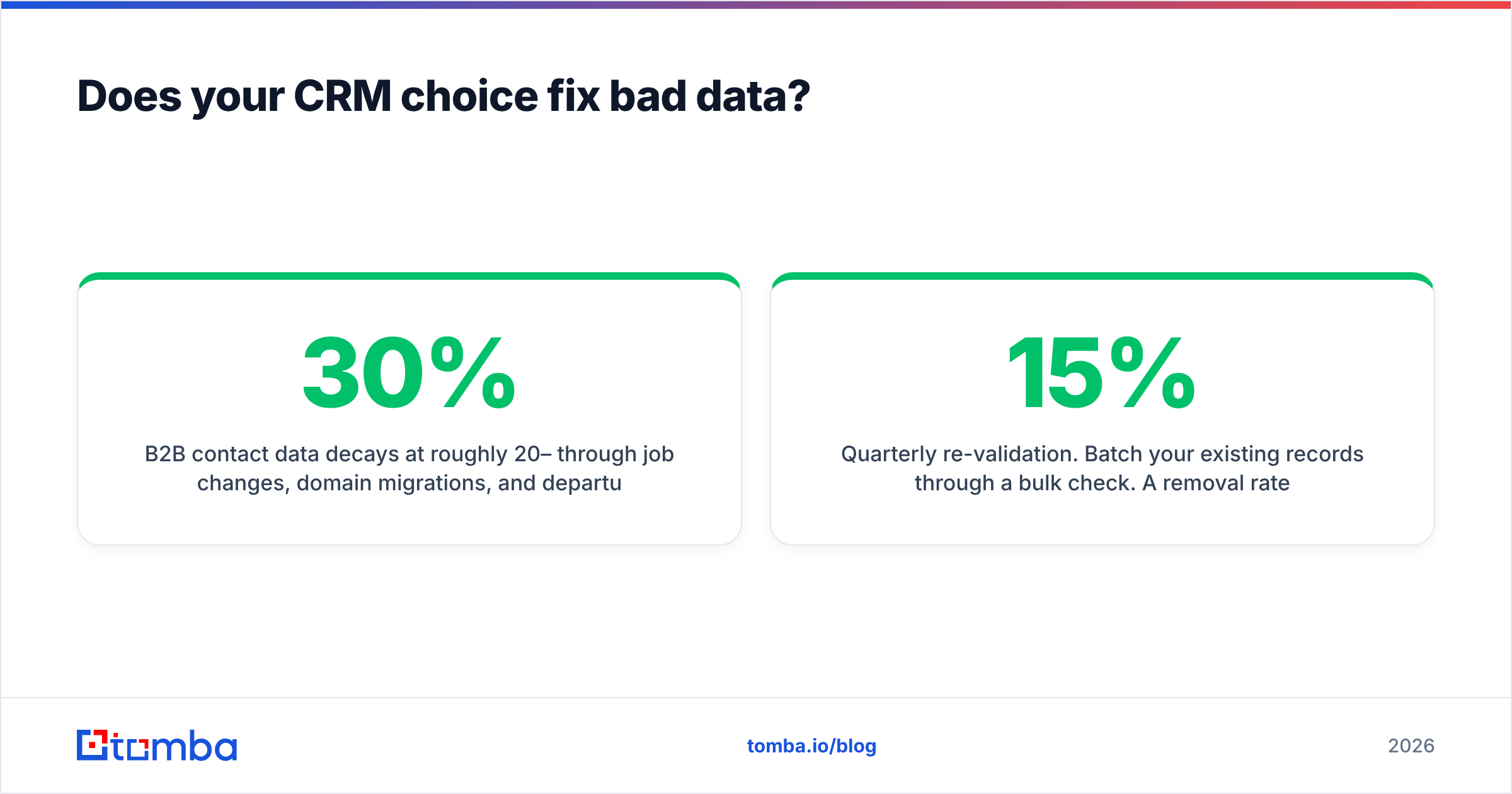
B2B contact data decays at roughly 20–30% per year through job changes, domain migrations, and departures. A CRM with 20,000 contacts and no hygiene process is carrying thousands of dead records inside 12 months. The visible symptoms are the ones that hurt: bounce rates climbing past 5%, sender reputation sinking, and pipeline reports built on records nobody can reach.
Whichever CRM you land on, wire in three things:
- Verification on entry. Run every new email through an email verifier before it becomes a record. Both EspoCRM and SuiteCRM expose REST APIs and webhook-capable workflows, so this can be automated rather than remembered.
- Enrichment on create. When a rep adds a company and a name, data enrichment fills the rest — role, verified work email, company size, social profiles. Manual entry is where CRM data quality goes to die.
- Quarterly re-validation. Batch your existing records through a bulk check. A 15% removal rate on a two-year-old list is normal, not alarming.
Both CRMs make this straightforward from an integration standpoint. EspoCRM's API is the more pleasant of the two to script against; SuiteCRM's V8 API works fine once you get past OAuth2 setup. Either way, the Tomba API plugs into a workflow rule or a cron job in an afternoon.
What's the verdict on EspoCRM vs SuiteCRM?#
EspoCRM for teams that value speed, clarity, and low maintenance overhead — and are fine buying an extension pack or two. SuiteCRM for organizations that need maximum functionality at zero license cost and have the technical capacity to maintain it.
Both beat paying $75 per seat per month for features you don't use. Both are genuinely production-grade — these aren't hobby projects. And both will underperform a mediocre SaaS CRM if the records inside them are wrong.
Start with the CRM that fits your constraint, then spend the money you saved on data quality. That's where the pipeline actually comes from.
Fill your open-source CRM with contacts that are real. Tomba Email Finder returns verified professional email addresses by name, company, or domain — with confidence scores and source attribution — and pushes straight into EspoCRM or SuiteCRM through the API. Start on the free tier with 25 searches a month, or move to Starter at $49/mo when you're ready to run volume. See full Tomba pricing for details.
Related guides#
Ready to find emails that actually work?
Join 150,000+ professionals who stopped guessing and started sending. Free credits on signup — no credit card required.
Get the Tomba newsletter
Practical outbound tactics and product updates — once every two weeks.
About the author