European B2B Search Engine: How to Find EU Company Data in 2026
US-first B2B databases collapse the moment you cross into Germany, France, or the Nordics. Here is how European B2B search engines actually work, what GDPR changes, and which tool fits your EU pipeline.
TL;DR
- A European B2B search engine is any tool that indexes EU company and contact data from local sources — national business registries, EU-hosted web crawls, local job boards — rather than reselling a US-centric database with a Europe filter bolted on.
- US-first platforms typically show 60-80% coverage on Fortune 500-adjacent accounts but fall off a cliff for the German Mittelstand, French PME, and Nordic SMBs that make up most of the EU addressable market.
- GDPR does not ban B2B prospecting. It requires a documented lawful basis (usually legitimate interest), a real opt-out, and honest data-source disclosure — all of which change which vendors you can safely use.
- The practical stack is usually two layers: a company-discovery layer (registry data, firmographics, tech signals) plus a contact-resolution layer (verified work emails, phone numbers).
- Pricing spread is wide: verified-contact tools start near $49/mo, while registry-grade intelligence platforms often start in the four figures per year.
What is a European B2B search engine?#
A European B2B search engine is a database and query layer built specifically to find companies and business contacts inside the EU, EEA, UK, and Switzerland. The distinction that matters is not the marketing copy — it is where the data comes from.
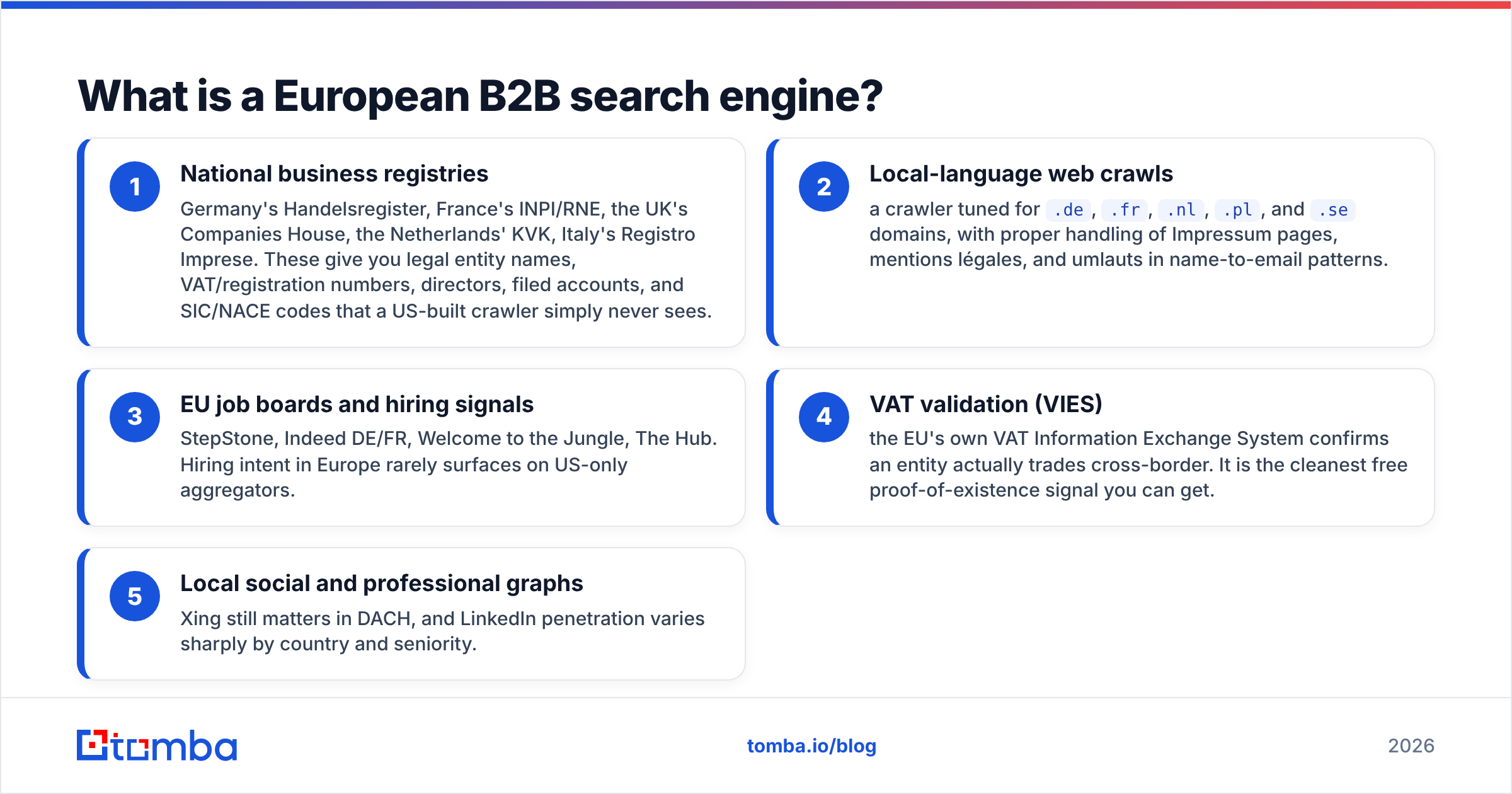
Genuinely European tools pull from sources that only exist in Europe:
- National business registries — Germany's Handelsregister, France's INPI/RNE, the UK's Companies House, the Netherlands' KVK, Italy's Registro Imprese. These give you legal entity names, VAT/registration numbers, directors, filed accounts, and SIC/NACE codes that a US-built crawler simply never sees.
- Local-language web crawls — a crawler tuned for
.de,.fr,.nl,.pl, and.sedomains, with proper handling of Impressum pages, mentions légales, and umlauts in name-to-email patterns. - EU job boards and hiring signals — StepStone, Indeed DE/FR, Welcome to the Jungle, The Hub. Hiring intent in Europe rarely surfaces on US-only aggregators.
- VAT validation (VIES) — the EU's own VAT Information Exchange System confirms an entity actually trades cross-border. It is the cleanest free proof-of-existence signal you can get.
- Local social and professional graphs — Xing still matters in DACH, and LinkedIn penetration varies sharply by country and seniority.
A US database with a "Country = Germany" dropdown gives you none of that. It gives you the subset of German companies that happened to appear in an American crawl — usually enterprise, usually English-language, usually already saturated with outreach.
Why do US-built B2B databases underperform in Europe?#
Four structural reasons, and none of them get fixed by a bigger crawl budget.
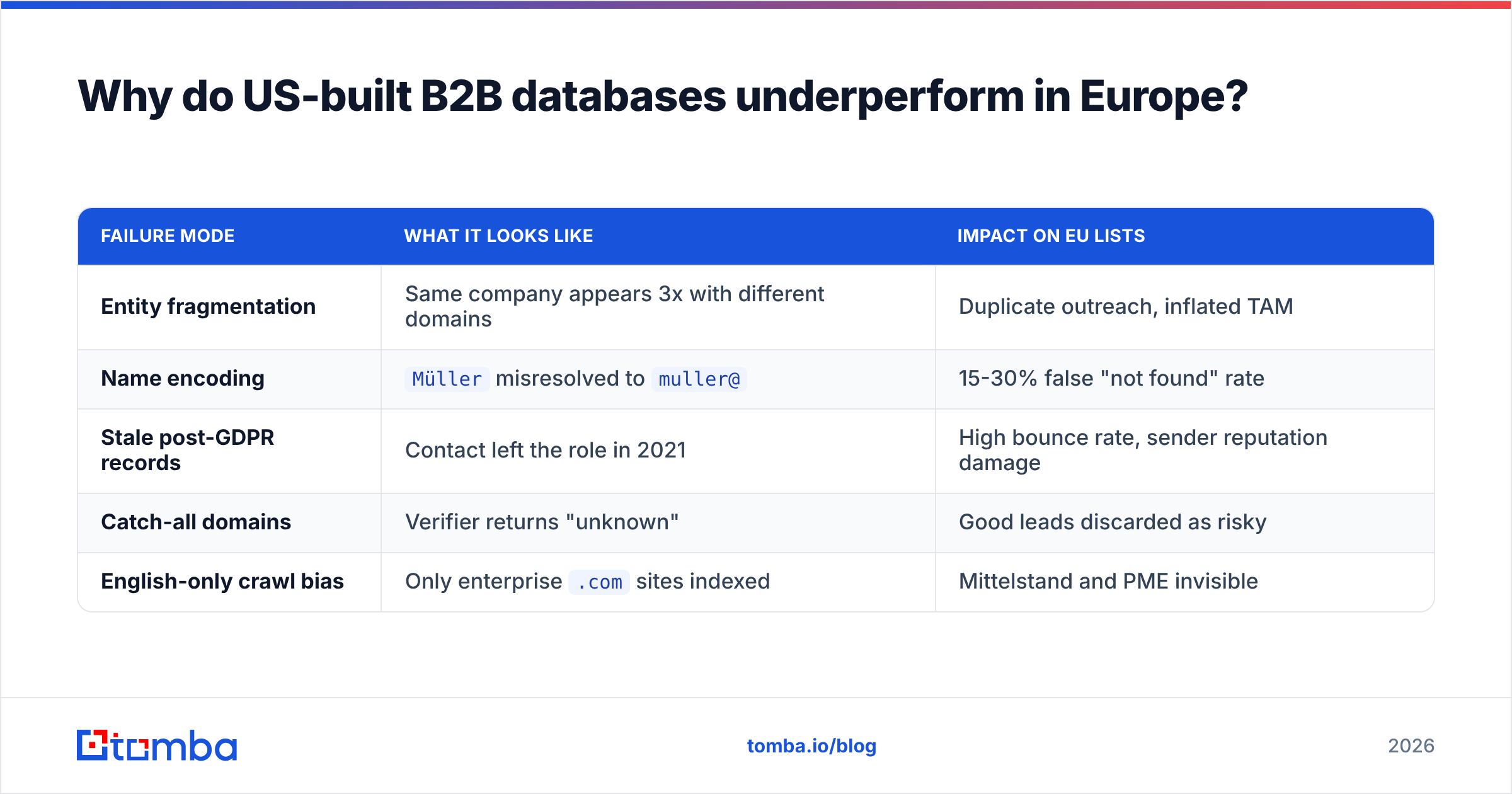
Entity fragmentation. A single German group may operate as GmbH, GmbH & Co. KG, and AG entities with different registration numbers and different domains. US matching logic collapses them into one row or splits them into five ghosts. Registry-linked tools resolve them correctly because they key on the registration number, not the brand string.
Language and encoding. Email pattern inference breaks on Müller → mueller vs muller vs m.muller. Nordic and Polish names compound the problem. Tools trained on English name distributions guess the wrong permutation and then report a "not found" that was actually a pattern failure. If you want to see how many variants exist for a single name, run one through an email permutator and count.
Privacy-driven data suppression. Since GDPR enforcement matured, many EU professionals removed direct contact details from public profiles, and several data brokers stopped selling EU personal data outright. Databases that were assembled pre-2018 have quietly rotting EU segments.
Catch-all prevalence. European corporate mail servers accept-all far more often than US ones — partly Microsoft 365 tenant defaults, partly deliberate anti-harvesting configuration. That means a standard SMTP check returns "unknown" instead of "valid," and naive tools mark the address as risky and discard a perfectly good lead. This is where a dedicated catch-all verifier changes your usable-lead count more than any other single upgrade.
| Failure mode | What it looks like | Impact on EU lists |
|---|---|---|
| Entity fragmentation | Same company appears 3x with different domains | Duplicate outreach, inflated TAM |
| Name encoding | Müller misresolved to muller@ |
15-30% false "not found" rate |
| Stale post-GDPR records | Contact left the role in 2021 | High bounce rate, sender reputation damage |
| Catch-all domains | Verifier returns "unknown" | Good leads discarded as risky |
| English-only crawl bias | Only enterprise .com sites indexed |
Mittelstand and PME invisible |
Is B2B prospecting in Europe legal under GDPR?#
Yes, with conditions. GDPR regulates personal data, and a named work email like anna.schmidt@company.de is personal data — but the regulation explicitly contemplates direct marketing as a legitimate interest (Recital 47). The official GDPR text is worth reading once rather than trusting summaries.
What you actually need in place:
- A documented legitimate interest assessment (LIA). Three parts: the purpose, why it is necessary, and a balancing test against the recipient's rights. One page. Written before you send, not after a complaint.
- A source disclosure. If someone asks where you got their address, you must answer specifically. "We use a B2B data provider" is thin; naming the provider and the collection method is defensible. Check whether your vendor publishes its data sources publicly — most do not.
- A working opt-out in every message. Not buried, not a reply-only mechanism if you can help it.
- Deletion on request, within a month. Which means your CRM needs a suppression list that actually blocks re-import.
- Country overlays. Germany's UWG has historically been read strictly on unsolicited commercial email; Italy and Spain have their own national quirks. The ePrivacy Directive sits alongside GDPR and applies to the sending channel.
Role-based addresses (info@, sales@, kontakt@) are treated more leniently in most member states because they are not tied to an identified individual. That is a genuine strategic advantage in Europe: a domain search that returns generic departmental addresses alongside named contacts gives you a lower-risk first-touch option for markets where you want to be conservative.
The pragmatic read: GDPR does not kill EU outbound. It kills bulk-scraped, unverified, unsourced lists — which were producing terrible results anyway.
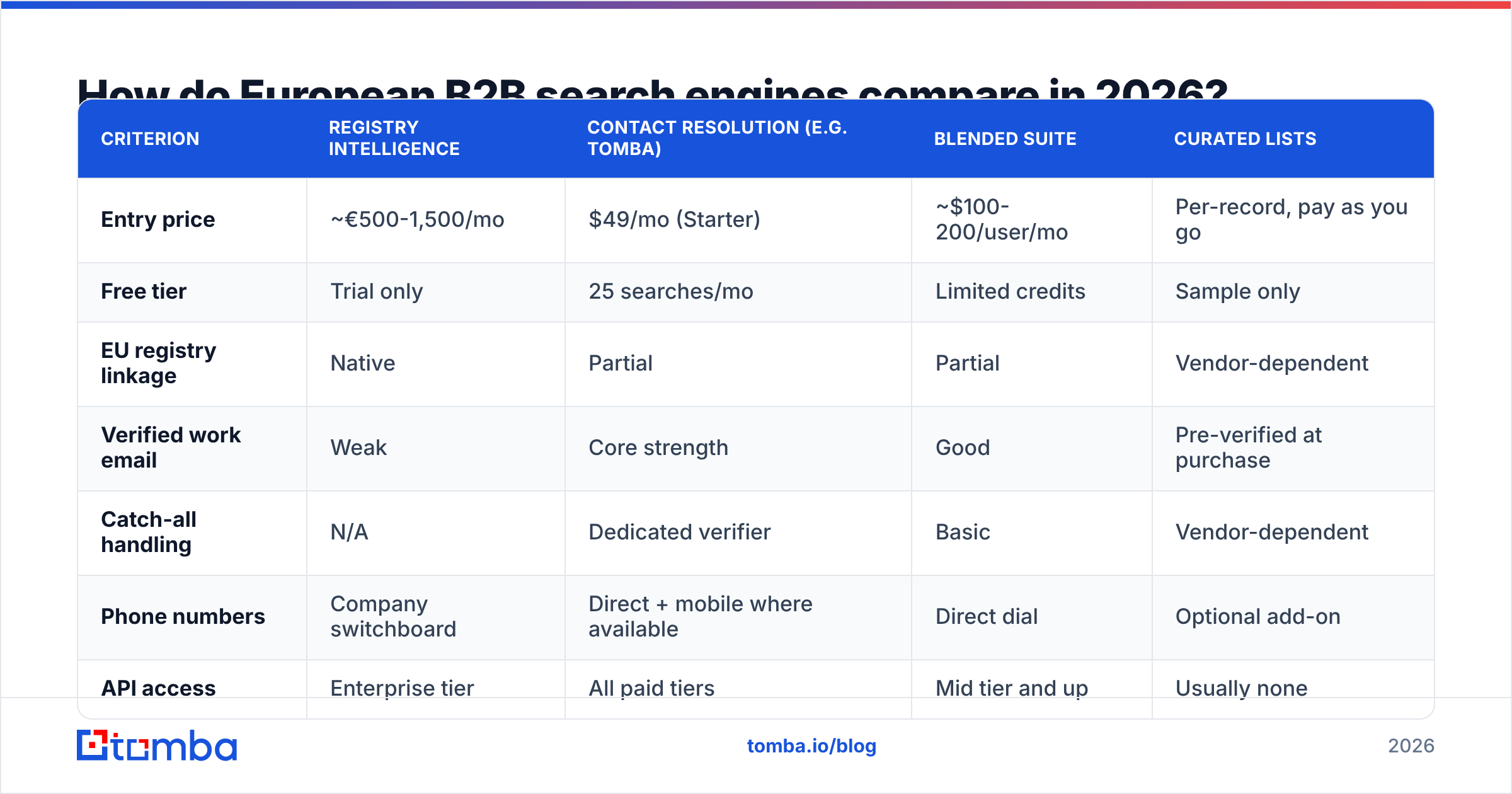
How do European B2B search engines compare in 2026?#
Categories first, because comparing a registry-intelligence platform to an email finder is comparing a land registry to a phonebook.
Registry and firmographic intelligence — Vainu (Nordics-strong), Dealfront (formerly Echobot + Leadfeeder, DACH-strong), Creditsafe. These excel at company-level truth: legal entities, financials, ownership, risk scores. They are weaker and pricier on individual contact resolution.
Contact resolution and email finding — Tomba, Hunter, Findymail, Kaspr (phone-heavy in France). These start from a domain or a person and return verifiable contact points.
Blended prospecting suites — Apollo, Cognism, Lusha. Broad coverage, contact plus company, with Cognism specifically positioned around EU/DACH compliance and phone-verified data.
Curated list vendors — BookYourData and similar, where you buy a pre-filtered, human-checked list rather than running searches yourself. Genuinely useful when you need a defined ICP slice fast and do not want to run enrichment infrastructure.
| Criterion | Registry intelligence | Contact resolution (e.g. Tomba) | Blended suite | Curated lists |
|---|---|---|---|---|
| Entry price | ~€500-1,500/mo | $49/mo (Starter) | ~$100-200/user/mo | Per-record, pay as you go |
| Free tier | Trial only | 25 searches/mo | Limited credits | Sample only |
| EU registry linkage | Native | Partial | Partial | Vendor-dependent |
| Verified work email | Weak | Core strength | Good | Pre-verified at purchase |
| Catch-all handling | N/A | Dedicated verifier | Basic | Vendor-dependent |
| Phone numbers | Company switchboard | Direct + mobile where available | Direct dial | Optional add-on |
| API access | Enterprise tier | All paid tiers | Mid tier and up | Usually none |
| Best for | Account selection, credit risk | Reaching named people | One-tool teams | Fast, defined ICP slices |
Two honest caveats on that table. First, "EU registry linkage: partial" is accurate for most contact-resolution tools including Tomba — they infer company identity from the domain rather than the Handelsregister number. If your workflow depends on legal-entity precision (procurement, financial services, credit exposure), pair a registry tool with a contact tool rather than expecting one to do both. Second, curated-list vendors like BookYourData are frequently the correct answer for a one-off campaign into a narrow vertical; running your own enrichment only pays off at sustained volume.
What does a working EU prospecting stack look like?#
Here is the sequence that survives contact with a real European pipeline.
Step 1 — Define the account list from registry or firmographic data. NACE code, headcount band, country, revenue band. Do not start from contacts. In Europe, account selection is where most of the waste is eliminated, because the entity fragmentation problem means a naive contact-first search returns the same company under four names.
Step 2 — Validate the entity exists and trades. Run VAT numbers through VIES for cross-border sellers. It is free, official, and catches dormant shells that still appear in commercial databases.
Step 3 — Resolve the company email pattern before you resolve people. One correct pattern unlocks the whole org. Confirm it against two known-good addresses, not one — European subsidiaries frequently use a different pattern from the parent (vorname.nachname@de.company.com vs flast@company.com).
Step 4 — Find named contacts. Use an email finder that returns a confidence score and the source evidence, not a bare address. On EU domains, a tool that tells you why it believes an address is valid is worth more than one claiming a higher raw hit rate, because you need that provenance for your GDPR source disclosure anyway.
Step 5 — Verify, including catch-alls. Standard verification plus a catch-all pass. Discarding every catch-all domain in a German list can remove a third of your addressable accounts. Verify rather than discard.
Step 6 — Enrich for personalization inputs. Job title in the local language, recent hiring signals, tech stack. Data enrichment at this stage is what makes a German-language first line possible.
Step 7 — Send from a warmed, properly authenticated domain. SPF, DKIM, DMARC all aligned. EU corporate filters — especially in DACH — are less forgiving of authentication gaps than US ones. Google's sender guidelines are the baseline, and most European enterprise filters are stricter still.
Step 8 — Log source, timestamp, and lawful basis per contact. This is the step everyone skips. It takes one extra CRM field and it is the entire difference between a five-minute response to a data subject access request and a panicked afternoon.
Which tool should you actually pick?#
Match the tool to the constraint you actually have.
- You need legal-entity precision and financial risk data. Go registry-first: Dealfront for DACH, Vainu for Nordics, Creditsafe for pan-European credit. Budget four to five figures annually. Add a contact tool on top.
- You have an account list and need to reach named humans. A contact-resolution tool is the whole job. Tomba pricing starts free at 25 searches/mo, then $49/mo Starter, $99/mo Growth, $249/mo Pro — which is the right shape when your bottleneck is contact coverage, not company discovery.
- You are a small team that wants one tool. A blended suite (Apollo, Cognism) trades depth for convenience. Check EU coverage on your actual ICP during the trial, not the vendor's sample. Pull 50 target companies you already know and count the hits.
- You need a specific vertical slice this quarter, once. A curated list vendor such as BookYourData is faster and cheaper than standing up enrichment infrastructure for a single campaign.
- You are engineering-led. Skip the UI entirely. An email finder API plus your own registry ingestion gives you exactly the schema you want, and you control the audit trail that GDPR compliance depends on.
The benchmark that matters is not published coverage percentages. It is your own list. Take 50 companies you know well — real ones from your pipeline, ideally including at least ten non-English-language mid-market accounts — and run them through every tool on your shortlist during the trial. Count verified hits, count bounces after sending, and compare the cost per usable contact rather than cost per credit. In European markets that number routinely differs from the headline pricing by 3-4x, and always in the direction the vendor does not advertise.
Also test the catch-all path specifically. Pick five domains you know accept-all and see what each tool reports. The ones that return "unknown" and stop are quietly costing you a large share of the German and Nordic market.
Where should you start this week?#
Pick ten target accounts in your weakest European market — the country where your current database returns the thinnest results. Run them through your existing tool, note the gaps, then run the same ten through a European-capable alternative. The delta will be obvious within an hour, and it will be larger than you expect.
If your bottleneck is reaching named people at EU companies rather than discovering the companies themselves, start with the Tomba Email Finder. The free tier gives you 25 searches a month — enough to run exactly the ten-account benchmark above, check the confidence scores and source evidence on each result, and see how it handles the umlauts, catch-alls, and subsidiary patterns that break US-first databases. If it holds up on your list, $49/mo Starter scales it. If it does not, you have lost an hour and learned something specific about your market.
Related guides#
Ready to find emails that actually work?
Join 150,000+ professionals who stopped guessing and started sending. Free credits on signup — no credit card required.
Get the Tomba newsletter
Practical outbound tactics and product updates — once every two weeks.
About the author