7 Best EvaluAgent Alternatives for Contact Center QA in 2026
EvaluAgent is solid QA software, but it is not the right fit for every contact center. Here are seven alternatives compared on pricing model, AI auto-scoring, coaching depth, and how long they actually take to roll out.
TL;DR
- EvaluAgent is a genuinely good contact center QA platform — the usual reasons teams leave are per-agent pricing at scale, limited native CCaaS connectors, or wanting AI auto-scoring on 100% of conversations rather than a sampled slice.
- The strongest EvaluAgent alternatives in 2026 split into three camps: lightweight QA (Zendesk QA, Scorebuddy), QA + coaching depth (MaestroQA, Playvox), and conversation intelligence first (Observe.AI, Level AI, Calabrio ONE).
- Published per-agent pricing is rare above the entry tier. Most enterprise-grade vendors are quote-only and often carry seat minimums that turn a "$35/agent" mental model into a five-figure annual commitment.
- The switching cost is not the software — it is your scorecard history, calibration records, and appeals workflow. Export those before you sign anything.
- Pick based on where your conversations live (voice vs. ticket vs. chat) and how much of your volume you actually need scored. That single question eliminates half the shortlist.
What is EvaluAgent, and who is it actually for?#
EvaluAgent is a quality assurance and agent-performance platform for contact centers. You build scorecards, evaluate calls and tickets against them, run calibration sessions so evaluators score consistently, and push the results into coaching plans, agent dashboards, and (in newer releases) AI-assisted auto-scoring across a wider share of conversations.
Its sweet spot is the mid-market support or service org — roughly 40 to 400 agents — that has outgrown a QA spreadsheet but does not want a full workforce-engagement-management (WEM) suite. The product leans hard into the people side: coaching workflows, agent-visible scorecards, gamification, and an appeals process that keeps QA from feeling like surveillance. You can see their current positioning on the EvaluAgent site.
That focus is also why people shop around. If you need deep voice analytics, real-time agent assist, or omnichannel WFM in the same contract, you are asking EvaluAgent to be a category it never claimed to be.
Why do teams look for EvaluAgent alternatives?#
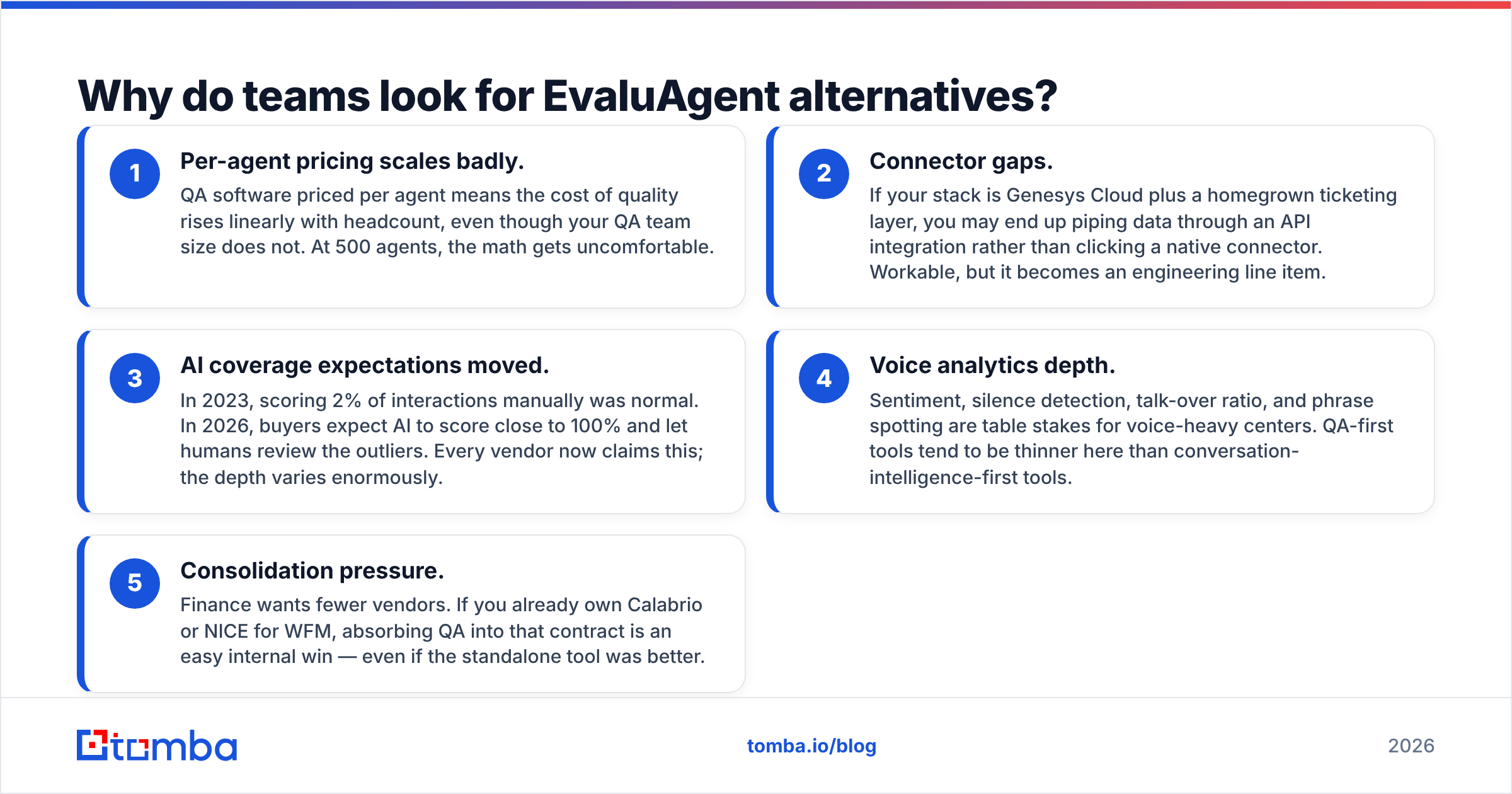
Five reasons come up repeatedly in review sites and procurement conversations:
- Per-agent pricing scales badly. QA software priced per agent means the cost of quality rises linearly with headcount, even though your QA team size does not. At 500 agents, the math gets uncomfortable.
- Connector gaps. If your stack is Genesys Cloud plus a homegrown ticketing layer, you may end up piping data through an API integration rather than clicking a native connector. Workable, but it becomes an engineering line item.
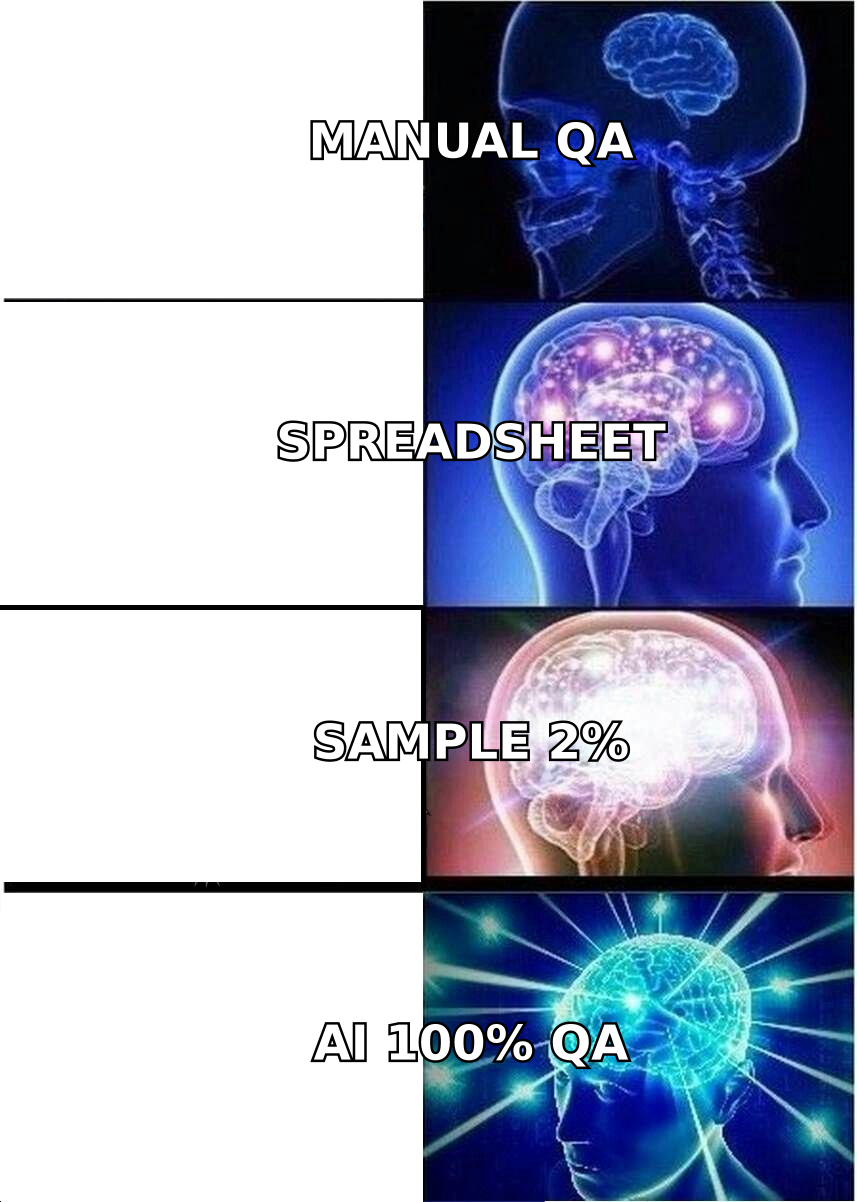
- AI coverage expectations moved. In 2023, scoring 2% of interactions manually was normal. In 2026, buyers expect AI to score close to 100% and let humans review the outliers. Every vendor now claims this; the depth varies enormously.
- Voice analytics depth. Sentiment, silence detection, talk-over ratio, and phrase spotting are table stakes for voice-heavy centers. QA-first tools tend to be thinner here than conversation-intelligence-first tools.
- Consolidation pressure. Finance wants fewer vendors. If you already own Calabrio or NICE for WFM, absorbing QA into that contract is an easy internal win — even if the standalone tool was better.
What should you compare before you switch?#
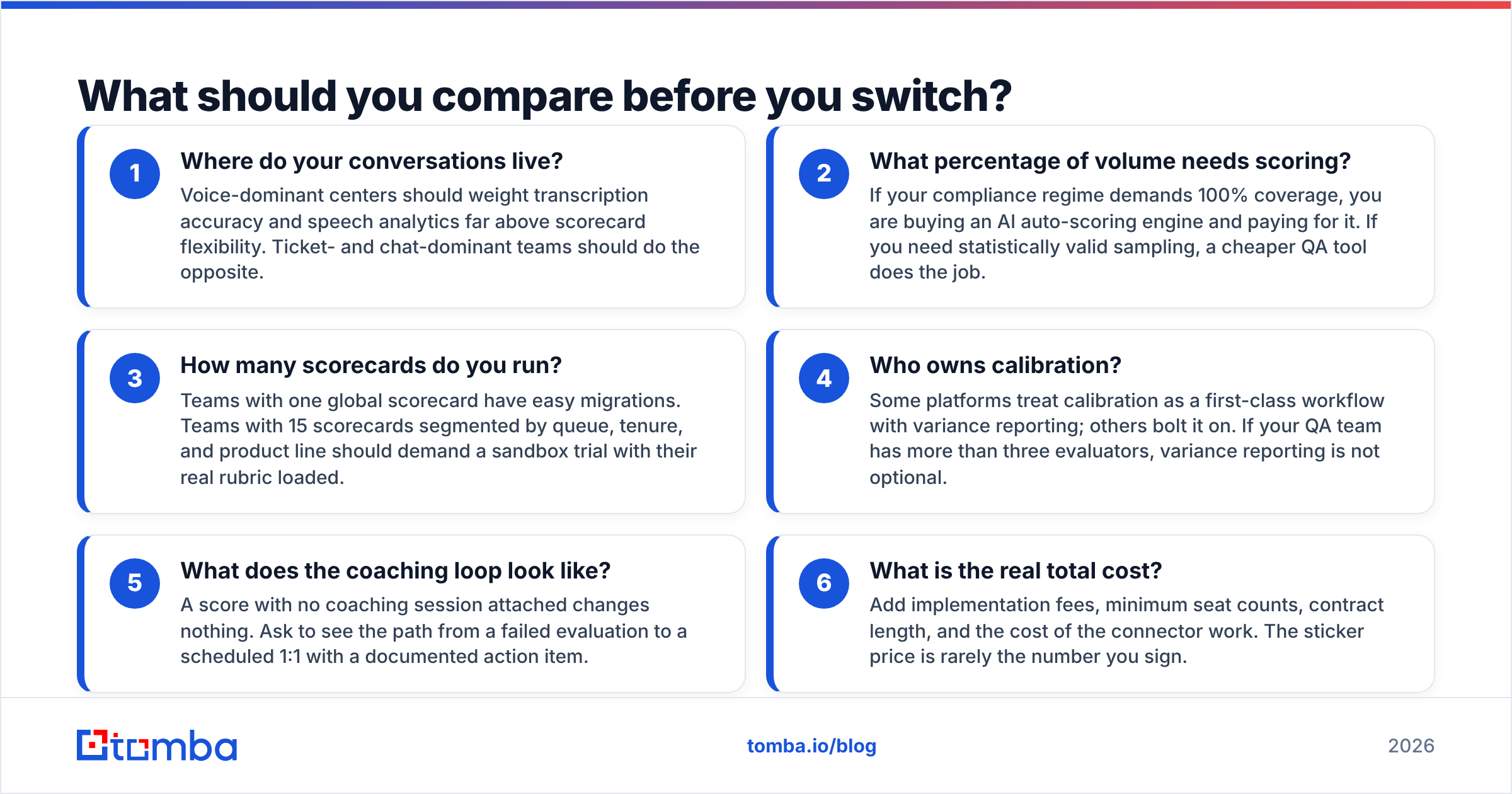
Do not start with a feature grid. Start with these six questions, in this order:
- Where do your conversations live? Voice-dominant centers should weight transcription accuracy and speech analytics far above scorecard flexibility. Ticket- and chat-dominant teams should do the opposite.
- What percentage of volume needs scoring? If your compliance regime demands 100% coverage, you are buying an AI auto-scoring engine and paying for it. If you need statistically valid sampling, a cheaper QA tool does the job.
- How many scorecards do you run? Teams with one global scorecard have easy migrations. Teams with 15 scorecards segmented by queue, tenure, and product line should demand a sandbox trial with their real rubric loaded.
- Who owns calibration? Some platforms treat calibration as a first-class workflow with variance reporting; others bolt it on. If your QA team has more than three evaluators, variance reporting is not optional.
- What does the coaching loop look like? A score with no coaching session attached changes nothing. Ask to see the path from a failed evaluation to a scheduled 1:1 with a documented action item.
- What is the real total cost? Add implementation fees, minimum seat counts, contract length, and the cost of the connector work. The sticker price is rarely the number you sign.
What are the best EvaluAgent alternatives in 2026?#
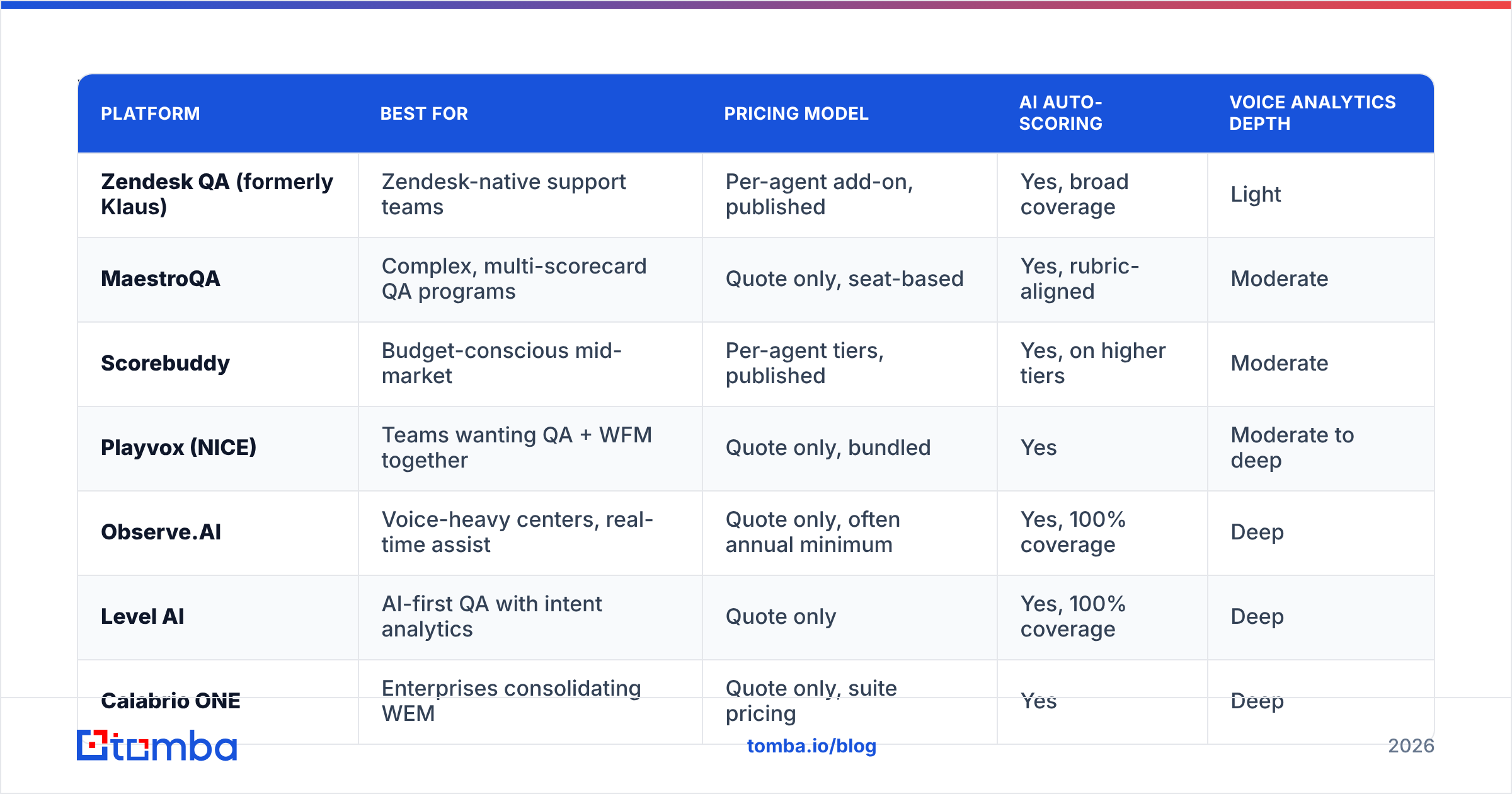
| Platform | Best for | Pricing model | AI auto-scoring | Voice analytics depth |
|---|---|---|---|---|
| Zendesk QA (formerly Klaus) | Zendesk-native support teams | Per-agent add-on, published | Yes, broad coverage | Light |
| MaestroQA | Complex, multi-scorecard QA programs | Quote only, seat-based | Yes, rubric-aligned | Moderate |
| Scorebuddy | Budget-conscious mid-market | Per-agent tiers, published | Yes, on higher tiers | Moderate |
| Playvox (NICE) | Teams wanting QA + WFM together | Quote only, bundled | Yes | Moderate to deep |
| Observe.AI | Voice-heavy centers, real-time assist | Quote only, often annual minimum | Yes, 100% coverage | Deep |
| Level AI | AI-first QA with intent analytics | Quote only | Yes, 100% coverage | Deep |
| Calabrio ONE | Enterprises consolidating WEM | Quote only, suite pricing | Yes | Deep |
Pricing models above reflect what vendors published or commonly quoted as of early 2026. Anything marked "quote only" should be treated as negotiable — and as carrying a minimum.
Zendesk QA — the easiest swap if you already run Zendesk#
Formerly Klaus, now folded into Zendesk's service suite. The pitch is zero-friction: conversations are already in the system, so there is no connector project. Scorecards are clean and fast to build, AI spotlights surface conversations worth reviewing, and the reviewer UX is among the best in the category.
The trade-off is gravity. It is excellent for Zendesk tickets and chat, acceptable for other sources, and thin on true voice analytics. If your center is 70% phone, look elsewhere. Details on the Zendesk QA product page.
Choose it if: you are a Zendesk shop, ticket-first, and want QA live in two weeks.
MaestroQA — the choice when your rubric is complicated#
MaestroQA has built its reputation on flexibility. Conditional scorecard logic, custom grading workflows, appeals, calibration with variance reporting, and analytics that let a QA manager slice results by agent, queue, tenure, and reason code without exporting to a BI tool.
It is the closest philosophical match to EvaluAgent — QA-first, coaching-aware — with more room at the complex end. Pricing is quote-only and tends to sit above the lightweight tools.
Choose it if: you run multiple scorecards, need audit-defensible QA, and your program has a dedicated owner.
Scorebuddy — the value pick#
Scorebuddy publishes per-agent tiers, which alone puts it ahead on procurement simplicity. You get scorecards, auto-fail logic, coaching, learning modules, and dashboards — a genuinely complete QA program at a price that does not require a business case.
The ceiling is lower. Very large deployments and heavy voice analytics push you toward the enterprise tier, where the value advantage narrows.
Choose it if: you are moving off spreadsheets, under 200 agents, and budget is the binding constraint.
Playvox (part of NICE) — QA inside a WEM suite#
Playvox covers QA, coaching, learning, and workforce management, and it now sits inside NICE. That is either the main attraction or the main risk, depending on how you feel about buying into a suite roadmap.
The QA module is capable and the coaching workflows are mature. Standalone buyers sometimes find the pricing conversation drifts toward a broader platform deal.
Choose it if: you want QA and WFM under one contract and one vendor relationship.
Observe.AI — voice first, everything else second#
Observe.AI starts from the call. Transcription, sentiment, talk ratios, silence, script adherence, and real-time agent assist that prompts reps mid-conversation. Auto-scoring runs across effectively all interactions, so QA shifts from sampling to exception review.
It is not a cheap tool and it is not a light one. Implementation is a project, not a signup.
Choose it if: you are voice-dominant, compliance-heavy, and want QA coverage at 100% rather than 2%.
Level AI — intent analytics as the organizing idea#
Level AI's differentiator is semantic understanding: it classifies why customers contacted you, then ties QA scores to those intents. That connection between quality and contact drivers is what operations leaders actually want — not just "agents scored 87%" but "the 13% we lose is concentrated in billing disputes."
Quote-only, enterprise-oriented, strongest in centers with high call volume and messy contact reasons.
Choose it if: you want QA data that feeds operational decisions, not just agent scorecards.
Calabrio ONE — the consolidation play#
Calabrio bundles WFM, QA, analytics, and reporting for enterprises that would rather manage one vendor than five. The QA module will not out-flex MaestroQA on rubric design, but it does not need to — it needs to be good enough while sharing data with forecasting and scheduling.
Choose it if: you are 500+ agents, already evaluating WEM, and consolidation is a stated goal.
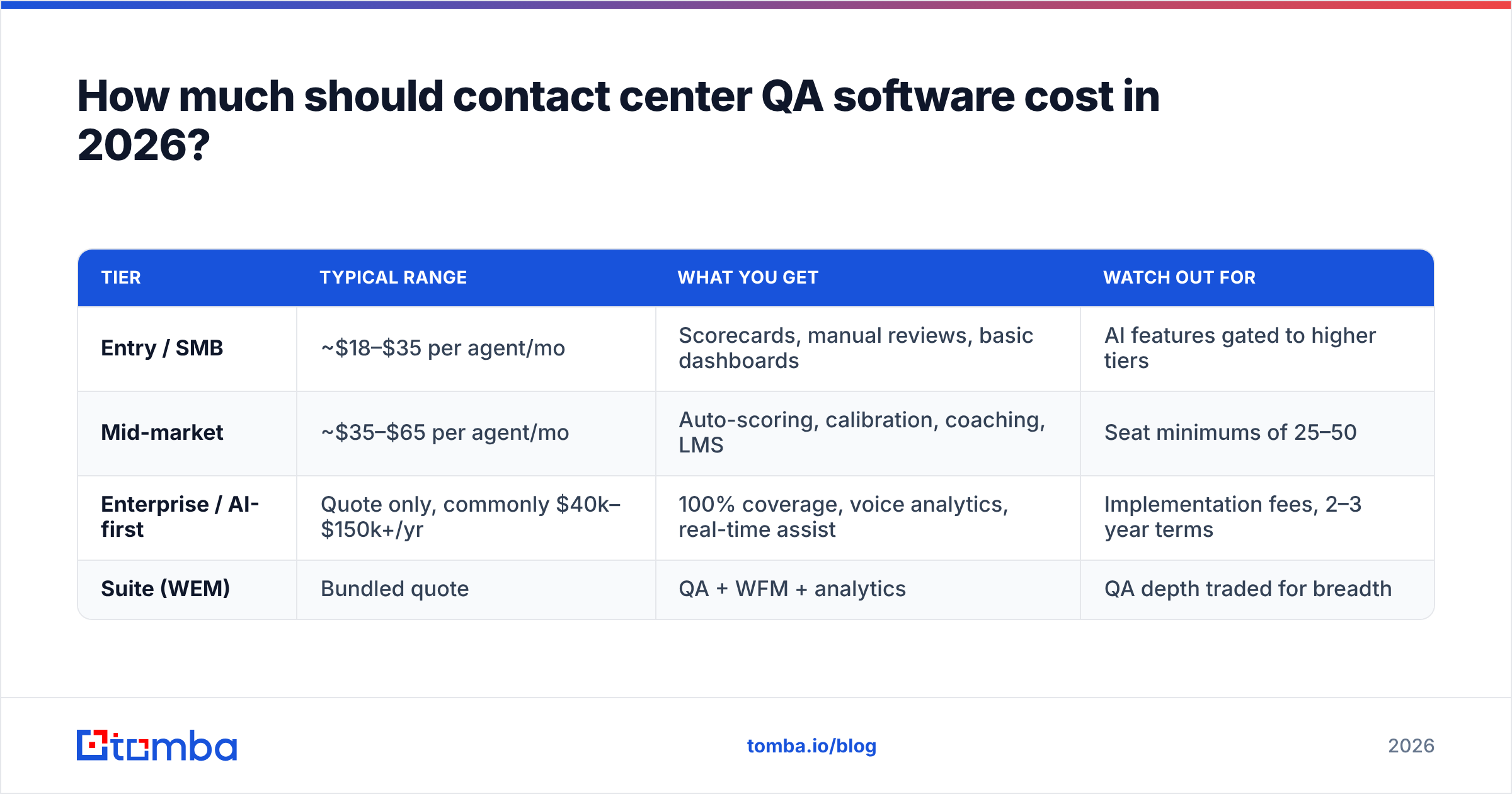
How much should contact center QA software cost in 2026?#
Here is the honest version of the pricing landscape.
| Tier | Typical range | What you get | Watch out for |
|---|---|---|---|
| Entry / SMB | ~$18–$35 per agent/mo | Scorecards, manual reviews, basic dashboards | AI features gated to higher tiers |
| Mid-market | ~$35–$65 per agent/mo | Auto-scoring, calibration, coaching, LMS | Seat minimums of 25–50 |
| Enterprise / AI-first | Quote only, commonly $40k–$150k+/yr | 100% coverage, voice analytics, real-time assist | Implementation fees, 2–3 year terms |
| Suite (WEM) | Bundled quote | QA + WFM + analytics | QA depth traded for breadth |
Ranges are directional, drawn from published tiers and commonly reported quotes; verify with the vendor. Cross-checking recent reviews on G2's contact center QA category is a useful sanity check before you take a first quote seriously.
The pattern that catches teams out: a vendor quotes a friendly per-agent number, then attaches a minimum commitment that assumes double your headcount. Always ask for the annual contract value, not the per-agent price.

How do you switch without losing your QA history?#
Migrations fail on data, not features. Work through this before you sign:
- Export raw evaluation records — not summary dashboards. You want per-question scores, evaluator IDs, timestamps, and comments in CSV or via API.
- Snapshot your scorecards including weightings, auto-fail rules, and any conditional logic. Rebuild them in the new tool's sandbox before committing.
- Preserve calibration sessions. These are your evidence that scoring was consistent. If you are in a regulated vertical, losing them is a real audit problem.
- Run both tools in parallel for one cycle. Score the same 50 interactions in each. If the new platform's AI disagrees with your human evaluators by more than a few points on average, the rubric needs retuning — not the agents.
- Re-baseline before you communicate scores to agents. A tool change that silently drops the average by six points destroys trust in the QA program overnight.
- Keep the appeals path open throughout. Agents will contest scores generated by a system they did not see arrive.
Which EvaluAgent alternative is right for your team?#
Short version, by profile:
- Zendesk-native, ticket-first, under 100 agents → Zendesk QA.
- Complex rubrics, dedicated QA function → MaestroQA.
- Tight budget, coming off spreadsheets → Scorebuddy.
- Want QA + WFM in one contract → Playvox or Calabrio ONE.
- Voice-dominant with compliance requirements → Observe.AI.
- Want QA tied to contact-driver analytics → Level AI.
- Happy with coaching-first QA and mid-market pricing → stay on EvaluAgent. It remains a strong product, and switching costs are real.
That last line matters. A lot of "alternatives" content assumes the incumbent must go. Often the right answer is renegotiating your renewal with two competing quotes in hand.
Where does prospecting data fit into this?#
QA software improves the conversations you are already having. It does not create them. If you are on the vendor side — selling QA, CCaaS, or WEM into contact centers — the bottleneck is usually finding the VP of Customer Experience or Head of Quality at the accounts you want, not scoring the calls afterward.
That is a different tool category. A domain search surfaces the verified contacts inside a target company, data enrichment fills in the role and seniority fields your CRM is missing, and an email verifier keeps your bounce rate low enough that your outbound domain stays healthy. Tomba's plans start free at 25 searches per month, with Starter at $49/mo and Growth at $99/mo — see Tomba pricing for the full breakdown.
If you are building a target list of contact centers evaluating QA platforms this year, start with the Tomba Email Finder. Drop in a company domain, get verified work emails for the quality and CX leaders who own the budget, and spend your time on the conversation instead of the search. The free tier is enough to test the data quality against accounts you already know before you commit to anything.
Related guides#
Ready to find emails that actually work?
Join 150,000+ professionals who stopped guessing and started sending. Free credits on signup — no credit card required.
Get the Tomba newsletter
Practical outbound tactics and product updates — once every two weeks.
About the author