Evolve IP Pricing, Reviews, Pros and Cons (2026 Guide)
Evolve IP never publishes a price list, which makes budgeting a guessing game. Here is how its quote-only model actually works, what reviewers praise and complain about, and when a simpler stack wins.
TL;DR
- Evolve IP does not publish a public price list. Every number you see online is an estimate, and the only real number is the one on your quote.
- Publicly reported ranges land around $20–$40 per user/month for UCaaS seats and $50–$120+ per user/month for hosted desktops (DaaS), before onboarding, hardware, and telecom surcharges.
- Reviewers consistently praise the bundled "workspace" approach and named support engineers, and consistently complain about long contract terms, slow provisioning, and billing that is hard to audit.
- The right buyer is a 100–1,000 seat regulated org (healthcare, legal, finance) that wants voice, contact center, and virtual desktops from one throat to choke. Small teams almost always overpay.
- If your goal is pipeline rather than infrastructure, spend the budget on data and outreach tooling first — a $49/mo email finder moves revenue faster than a phone system migration.
What is Evolve IP and who actually buys it?#
Evolve IP is a cloud workspace provider. Instead of selling one product, it bundles several: hosted voice (UCaaS) built largely on Cisco Webex and Microsoft Teams integrations, contact center (CCaaS), virtual desktops (DaaS), identity, and managed collaboration — all delivered as a single subscription with a single support contract.
Think of it like a serviced office building versus renting four separate rooms across town. You pay more per square foot, but the elevator, HVAC, security desk, and cleaning crew are one contract and one phone number when something breaks. That bundling is the entire value proposition, and it is also the entire reason the pricing is opaque.
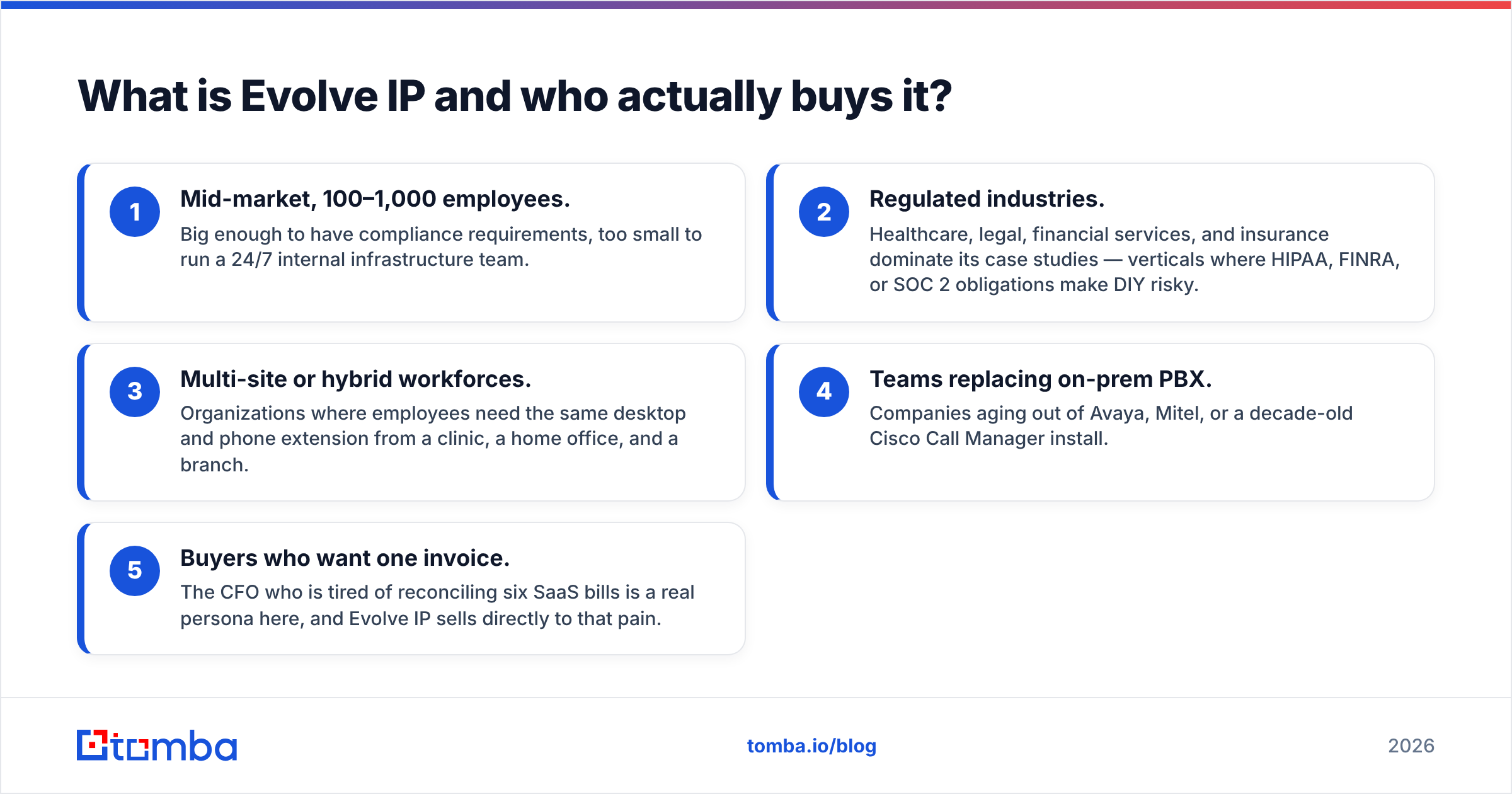
The typical buyer profile looks like this:
- Mid-market, 100–1,000 employees. Big enough to have compliance requirements, too small to run a 24/7 internal infrastructure team.
- Regulated industries. Healthcare, legal, financial services, and insurance dominate its case studies — verticals where HIPAA, FINRA, or SOC 2 obligations make DIY risky.
- Multi-site or hybrid workforces. Organizations where employees need the same desktop and phone extension from a clinic, a home office, and a branch.
- Teams replacing on-prem PBX. Companies aging out of Avaya, Mitel, or a decade-old Cisco Call Manager install.
- Buyers who want one invoice. The CFO who is tired of reconciling six SaaS bills is a real persona here, and Evolve IP sells directly to that pain.
If you are a 12-person sales team looking for cheap outbound calling, you are not the buyer. You will get a quote built for an enterprise deployment, and the pricing math will never work in your favor.
How does Evolve IP pricing actually work in 2026?#
Short answer: it is quote-only, per-user, per-month, on a multi-year term — and the sticker is only about 60–70% of what you actually pay in year one.
There is no self-serve checkout, no published rate card, and no free trial you can sign up for at 11pm. You book a discovery call, a solutions engineer scopes your environment, and you receive a proposal. That proposal is assembled from several stacked line items.
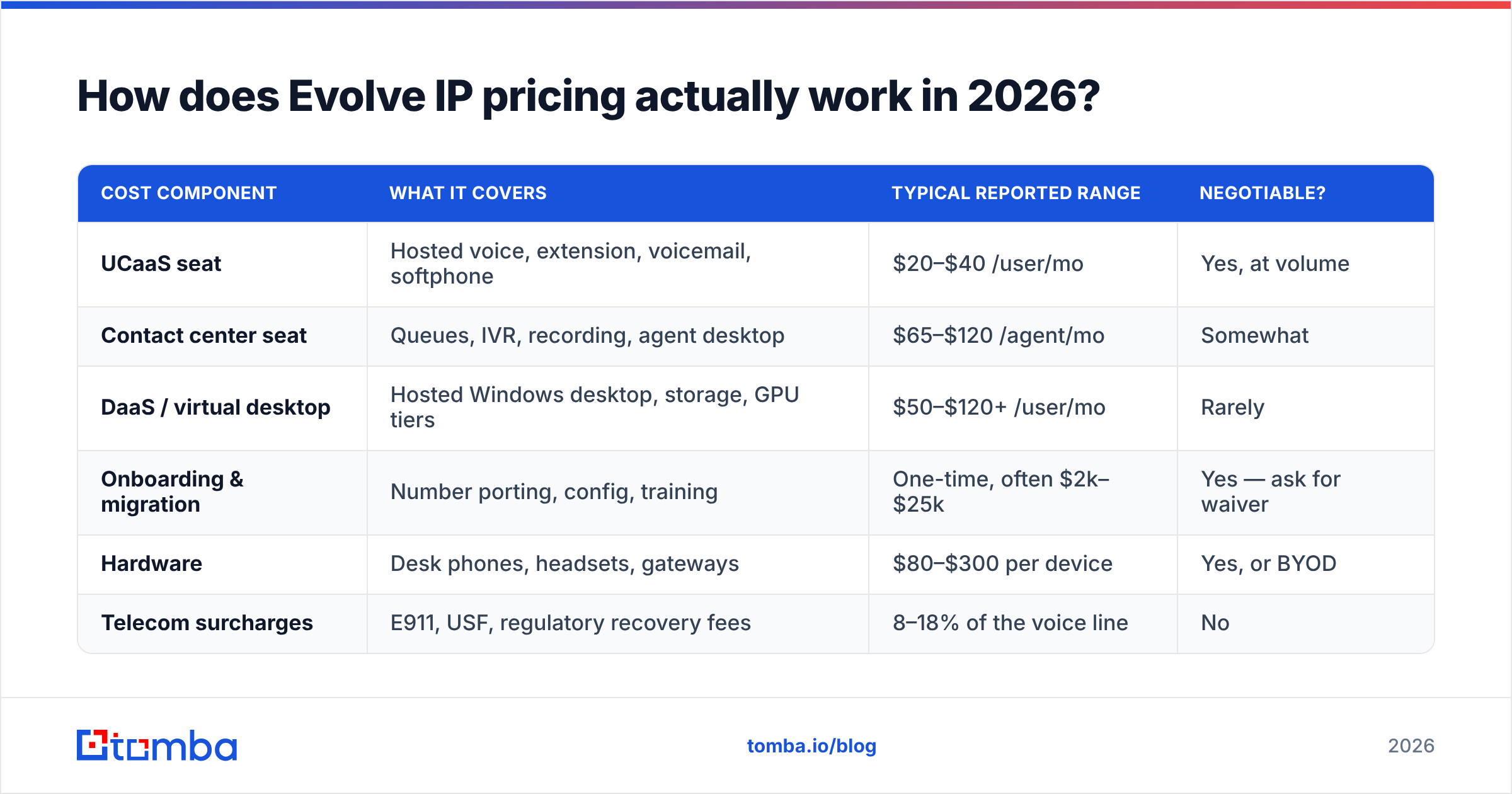
| Cost component | What it covers | Typical reported range | Negotiable? |
|---|---|---|---|
| UCaaS seat | Hosted voice, extension, voicemail, softphone | $20–$40 /user/mo | Yes, at volume |
| Contact center seat | Queues, IVR, recording, agent desktop | $65–$120 /agent/mo | Somewhat |
| DaaS / virtual desktop | Hosted Windows desktop, storage, GPU tiers | $50–$120+ /user/mo | Rarely |
| Onboarding & migration | Number porting, config, training | One-time, often $2k–$25k | Yes — ask for waiver |
| Hardware | Desk phones, headsets, gateways | $80–$300 per device | Yes, or BYOD |
| Telecom surcharges | E911, USF, regulatory recovery fees | 8–18% of the voice line | No |
Two things in that table cause most of the surprise on the first invoice.
The first is surcharges. Regulatory and universal service fees are pass-through on any real telecom product, but they are rarely in the proposal's headline number. A $28/seat quote can bill at $32–$33 once fees land. That is normal for the industry — it is just not what you budgeted.
The second is term length. Evolve IP quotes are commonly structured on 36-month terms, with 12-month options priced at a meaningful premium. The discount you are shown is usually the 36-month discount. Ask for both side by side before you compare against a month-to-month competitor, or you are comparing a mortgage to a hotel room.

What is not included in the quote?#
- Internet and SD-WAN circuits unless you explicitly buy their managed network add-on.
- Microsoft 365 licensing. Teams integration assumes you already own the licenses, including the Phone System entitlement where applicable.
- Third-party integrations into your CRM. Connectors exist, but professional services hours to wire them up are usually separate.
- Overage on storage or recording retention. Call recording retention beyond the standard window is a line item, and it grows quietly.
What do Evolve IP reviews say?#
Peer review sites are the only honest window into a quote-only vendor, because buyers post what they were actually charged. Across Gartner Peer Insights' UCaaS market and G2's UCaaS category, the sentiment on Evolve IP clusters into a consistent shape.
What reviewers repeatedly praise:
- Named support contacts. Reviewers who stay long-term almost always cite a specific engineer or account manager. When the relationship is good, satisfaction is high.
- Genuine bundling. Getting voice, contact center, and virtual desktop from one vendor removes the vendor-blaming loop when something breaks between systems.
- Compliance posture. HIPAA and SOC 2 documentation is available and taken seriously, which matters enormously to their core verticals.
- Uptime on the voice platform. Complaints skew toward provisioning and billing, not toward dropped calls.
What reviewers repeatedly criticize:
- Onboarding timelines. Multi-week to multi-month implementations are common, particularly when number porting from a legacy carrier is involved.
- Invoice clarity. Multi-page invoices with stacked surcharges are a recurring theme. Several reviewers describe needing account-manager help to explain their own bill.
- Contract rigidity. Reducing seat count mid-term is difficult. Growth is easy; shrinking is not.
- Admin console learning curve. The portal is powerful and not intuitive. Expect to designate an internal owner.
The pattern is telling. Almost nobody says the technology is bad. The friction is commercial and operational — which is exactly the friction you can negotiate away if you know it is coming.
What are the real pros of Evolve IP?#
One vendor, one SLA, one escalation path. If your team has ever spent a Tuesday morning with a phone vendor and a desktop vendor each insisting the problem belongs to the other, this alone justifies a premium. Consolidated accountability is a real, measurable operational saving.
Genuine DaaS capability. Plenty of UCaaS vendors bolt on collaboration features. Very few offer production-grade hosted Windows desktops alongside voice. If you need both — a claims processing team, a distributed clinic network, a law firm with contract staff — the shortlist of vendors who do both well is short.
Human-scale support model. Evolve IP sells against the hyperscaler experience explicitly: you get people, not a ticket queue. In the mid-market this is a defensible differentiator, and reviews back it up.
Compliance done for you. For a 300-person healthcare org, "the vendor signs a BAA and hands us the audit artifacts" removes weeks of internal work. That has a dollar value even if it never appears on the quote.
Flexibility across Cisco and Microsoft ecosystems. You are not forced to abandon Teams or Webex investments to adopt the platform, which lowers change-management resistance.
What are the real cons of Evolve IP?#
Opaque pricing costs you leverage. When there is no public rate card, you cannot benchmark without running a competitive process. Vendors know this. Always get at least two competing quotes before signing — the second quote is worth more than any negotiation tactic.
Long terms lock in a moving market. Communications pricing has trended down for a decade. A 36-month lock at 2026 rates means you are paying 2026 prices in 2029. Push for a mid-term price review clause or a 24-month term with renewal options.
Not built for small teams. Below roughly 50 seats, the per-user economics and the implementation overhead rarely pencil out against self-serve competitors.
Implementation is a project, not a signup. Budget internal hours. Someone on your team will own number porting, extension mapping, and user training whether you planned for it or not.
Feature depth varies by module. The voice platform is mature. Some adjacent modules feel like integrations rather than native products. Demo the specific module you care about, not the marketing bundle.

How does Evolve IP compare to other options?#
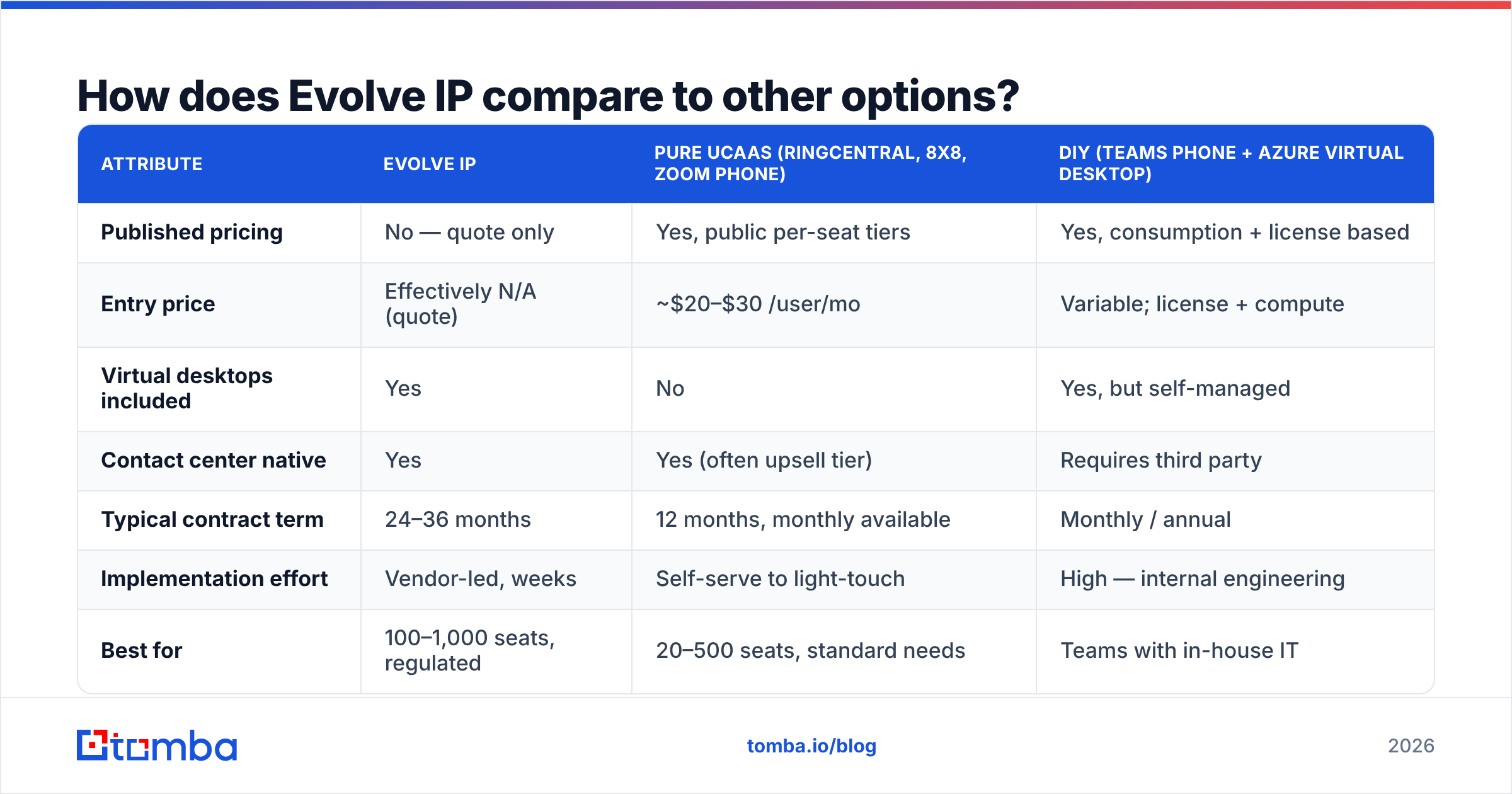
Direct comparison is difficult precisely because Evolve IP sells a bundle and most competitors sell a slice. Here is how the categories stack up on the attributes buyers actually weigh.
| Attribute | Evolve IP | Pure UCaaS (RingCentral, 8x8, Zoom Phone) | DIY (Teams Phone + Azure Virtual Desktop) |
|---|---|---|---|
| Published pricing | No — quote only | Yes, public per-seat tiers | Yes, consumption + license based |
| Entry price | Effectively N/A (quote) | ~$20–$30 /user/mo | Variable; license + compute |
| Virtual desktops included | Yes | No | Yes, but self-managed |
| Contact center native | Yes | Yes (often upsell tier) | Requires third party |
| Typical contract term | 24–36 months | 12 months, monthly available | Monthly / annual |
| Implementation effort | Vendor-led, weeks | Self-serve to light-touch | High — internal engineering |
| Best for | 100–1,000 seats, regulated | 20–500 seats, standard needs | Teams with in-house IT |
| Support model | Named engineers | Tiered / ticket queue | Microsoft support + you |
The decision rule is simple. If you need hosted desktops and voice together and you do not have an infrastructure team, Evolve IP is on your shortlist. If you only need phones, a public-priced UCaaS vendor will almost always be cheaper and faster. If you have real IT engineering capacity and heavy Microsoft investment, assembling it yourself will be cheapest — and the most work.
For a broader primer on how this category is defined and where it is heading, the UCaaS overview on Wikipedia is a decent neutral starting point, and you can review the vendor's own positioning at evolveip.com.
How do you negotiate a better Evolve IP contract?#
Treat the first proposal as an opening position, because it is one. Six moves that reliably move the number:
- Bring a competing quote. Nothing else compresses price the way a named alternative does. Get one from a public-priced vendor so you can point at a rate card.
- Ask for the onboarding fee to be waived or amortized. This is the most frequently conceded line item in the entire proposal.
- Request the 12, 24, and 36-month quotes in writing. Compare the total cost of ownership across the full term, not the monthly figure.
- Negotiate a seat-reduction floor. Ask for the right to reduce seats by 10–15% annually without penalty. Headcount does not only go up.
- Cap the annual uplift. Get a written maximum on renewal increases — 3% or CPI, whichever is lower, is a reasonable ask.
- Buy hardware separately. Marked-up desk phones are an easy place to lose a few thousand dollars. Source them yourself or go BYOD with softphones.
Get every concession into the order form itself. A promise in an email from a rep who leaves in eight months is worth exactly nothing at renewal.
Is Evolve IP worth it in 2026?#
Yes, if you are a 100–1,000 seat regulated organization that needs voice, contact center, and virtual desktops under one contract and does not have an infrastructure team to build it. In that scenario, the premium over a la carte pricing buys you accountability, and accountability is what you are actually short of.
No, if you are under 50 seats, if you only need phones, or if you cannot tolerate a multi-year commitment. The quote-only model, the term length, and the implementation overhead all work against smaller and faster-moving teams. A publicly priced UCaaS vendor gets you live in days at a price you can read on a website.
The uncomfortable truth for most revenue teams evaluating this: your communications infrastructure is rarely the bottleneck on pipeline. If you are choosing between a six-figure platform migration and better prospecting data, the data almost always wins on payback period. Infrastructure is a cost you optimize; contact data is an input you compound.
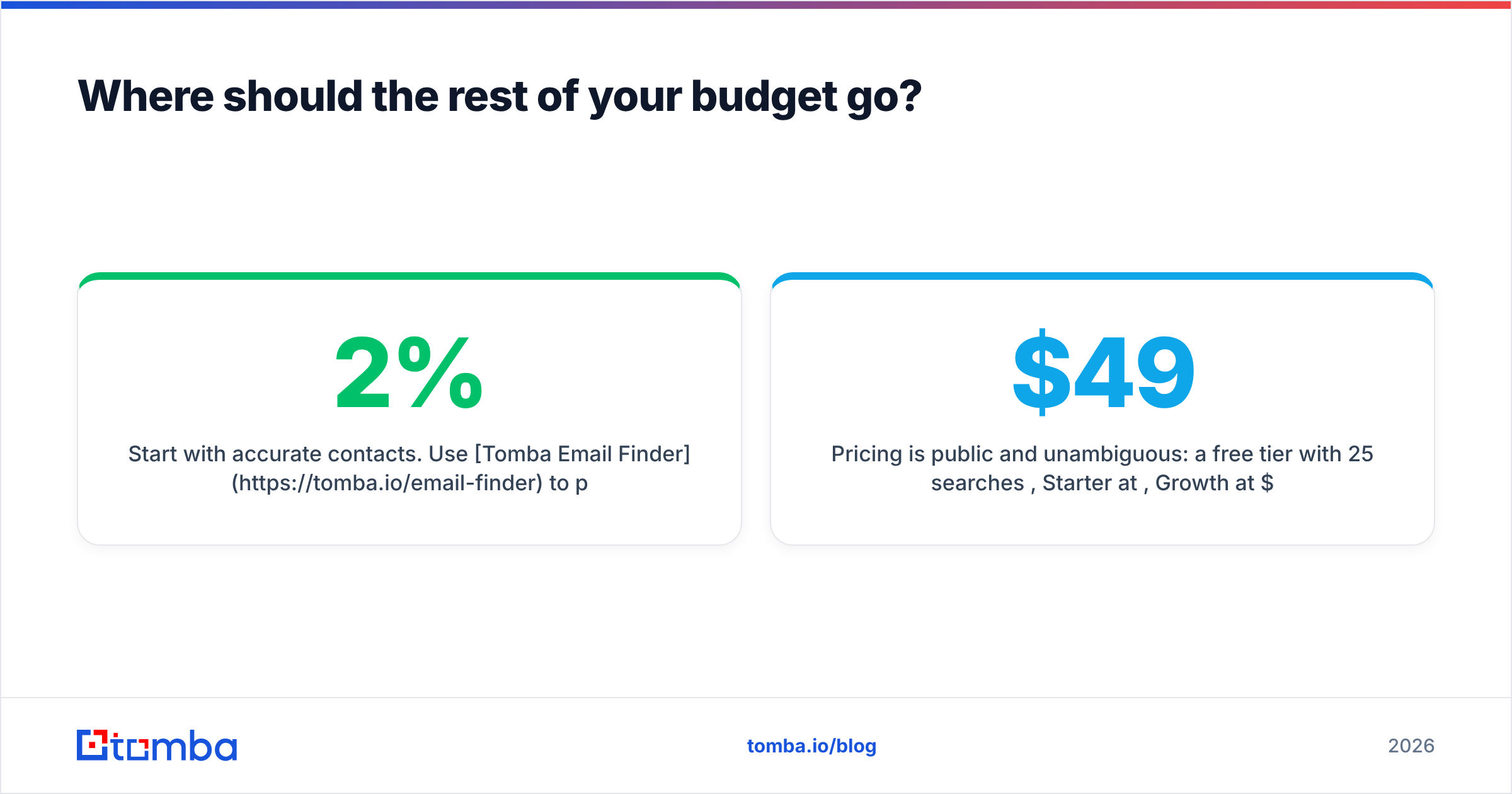
Where should the rest of your budget go?#
Once your comms stack is settled, the leverage moves back to who you are calling and emailing. That is a data problem, not a phone problem.
Start with accurate contacts. Use Tomba Email Finder to pull verified professional addresses by domain or name, run the list through the email verifier so your bounce rate stays under 2%, and layer in data enrichment to add job titles, company size, and technographics before the first touch. If your team works the phones as hard as the inbox, the phone finder closes the loop on direct dials.
Pricing is public and unambiguous: a free tier with 25 searches per month, Starter at $49/mo, Growth at $99/mo, Pro at $249/mo, and custom Enterprise terms. No discovery call required to see the number — which, after a week of reading quote-only proposals, is its own kind of relief. Start free at tomba.io/email-finder and put the savings toward the seats you actually need.
Related guides#
Ready to find emails that actually work?
Join 150,000+ professionals who stopped guessing and started sending. Free credits on signup — no credit card required.
Get the Tomba newsletter
Practical outbound tactics and product updates — once every two weeks.
About the author