Exact Data vs Salesbot (2026): Which B2B Data Tool Wins?
One sells you a static list. The other tries to run your outreach for you. Here's an honest breakdown of Exact Data vs Salesbot — data model, accuracy, pricing, and who each one actually fits in 2026.
TL;DR
- Exact Data and Salesbot are not really competitors — they solve different halves of the same problem. Exact Data sells you records; Salesbot tries to work the records for you.
- Exact Data is a US list-brokerage model: bulk consumer and business files, quote-based pricing, one-time delivery. Great for direct mail and volume campaigns, weak for real-time accuracy.
- Salesbot sits in the AI-SDR / outreach-automation category: it wants to source, message, and follow up. Useful if you have no outbound motion at all, risky if you care about who your brand emails.
- Neither one is a substitute for a verification layer. A purchased or AI-assembled list that hasn't been re-checked at send time will burn your domain.
- If your real need is "give me accurate, current work emails for a defined set of companies," a query-based finder plus verification is usually cheaper and safer than either.
What are Exact Data and Salesbot, exactly?#
Different products with different business models, sold to the same buyer.
Exact Data (exactdata.com) is a US-based data compiler and list broker. You tell them a target — industry, employee count, job function, geography, sometimes consumer attributes — and they return a file. The heritage here is direct-mail list brokerage extended into email and telemarketing. The delivery mechanism is a count, a quote, and then a CSV or a licensed file. Some records are theirs; some are aggregated from partner compilers. That's normal for the category and it's how most of the older data-broker world works.
Salesbot (salesbot.io) is a newer, software-first product in the AI sales-agent space. The pitch is automation: identify prospects, generate the message, run the sequence, handle replies. Instead of "here is your file," the pitch is "here is your pipeline activity." Note that "Salesbot" is also the name Kommo uses for its in-CRM chatbot, so make sure you're evaluating the right product before you book a demo — the two get confused constantly in search results.
That difference matters more than any feature checkbox. One is a data purchase. The other is a workflow subscription. Comparing them straight across is like comparing a lumber yard to a general contractor.
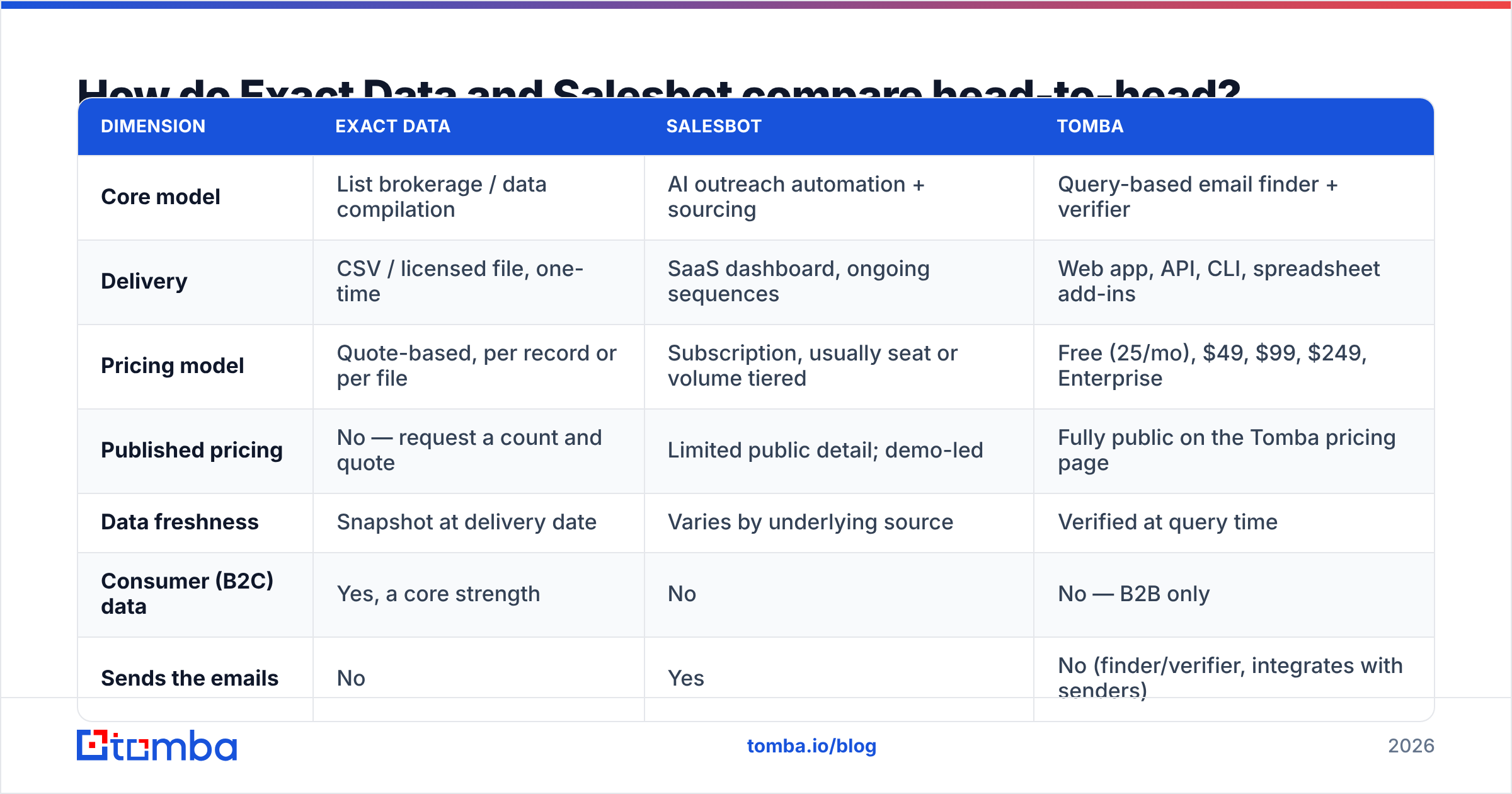
How do Exact Data and Salesbot compare head-to-head?#
| Dimension | Exact Data | Salesbot | Tomba |
|---|---|---|---|
| Core model | List brokerage / data compilation | AI outreach automation + sourcing | Query-based email finder + verifier |
| Delivery | CSV / licensed file, one-time | SaaS dashboard, ongoing sequences | Web app, API, CLI, spreadsheet add-ins |
| Pricing model | Quote-based, per record or per file | Subscription, usually seat or volume tiered | Free (25/mo), $49, $99, $249, Enterprise |
| Published pricing | No — request a count and quote | Limited public detail; demo-led | Fully public on the Tomba pricing page |
| Data freshness | Snapshot at delivery date | Varies by underlying source | Verified at query time |
| Consumer (B2C) data | Yes, a core strength | No | No — B2B only |
| Sends the emails | No | Yes | No (finder/verifier, integrates with senders) |
| Best fit | Direct mail, high-volume campaigns | Teams with no SDR capacity | Precision B2B prospecting at known accounts |
| Biggest risk | Stale records at delivery | Generic AI messaging, brand risk | Not a full sequencer — you bring the sender |
The honest read: if you're running a postal campaign to 200,000 US small businesses, Salesbot is irrelevant and Exact Data is genuinely the right kind of vendor. If you're a two-person startup that needs someone to run outbound and has nobody to do it, Salesbot's proposition makes sense. If you're a B2B team that already knows which 400 companies you want, neither model is efficient — you want targeted lookups, not a bulk file or an autopilot.
What does Exact Data actually do well?#
Four things, and they're real:
- Breadth of selects. Traditional compilers let you filter on attributes that software-first tools don't carry — SIC codes, years in business, credit-ish firmographics, consumer demographics. If your ICP is defined in those terms, this is hard to replicate elsewhere.
- Volume economics. Per-record cost on a 100k-record file from a broker is usually lower than 100k individual API lookups. That math is real, as long as you accept the accuracy trade.
- Multichannel records. Postal address, phone, and email in one row. Most modern B2B tools have quietly abandoned postal entirely.
- Compliance posture. Established brokers have documented data sourcing and suppression handling. That's a checkbox your legal team may care about. See Wikipedia's overview of data brokers for how the category is structured and regulated.
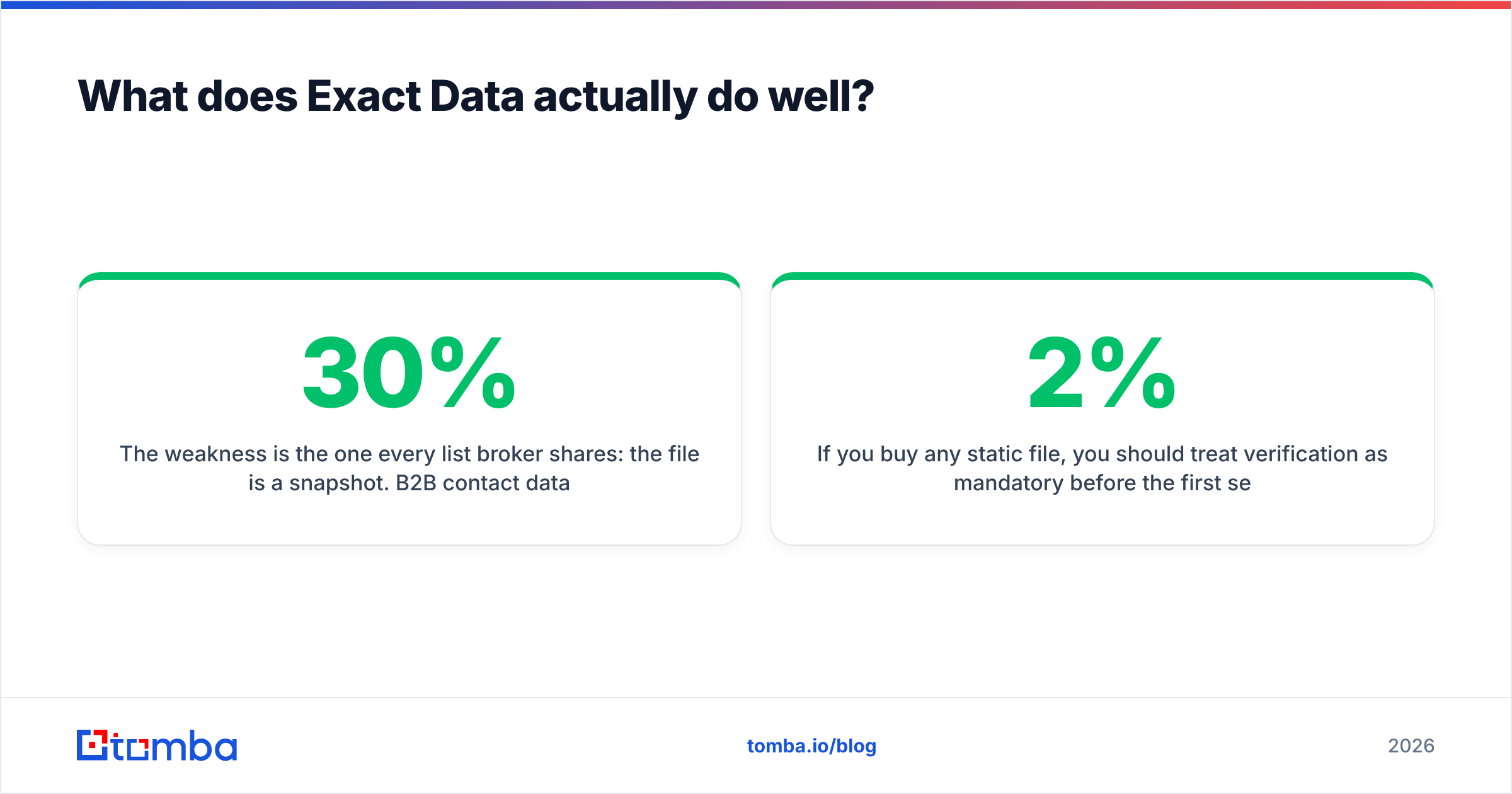
The weakness is the one every list broker shares: the file is a snapshot. B2B contact data decays somewhere in the 25–30% per year range by most industry estimates — people change jobs, companies get acquired, domains migrate. A file delivered in January is measurably worse in June, and there's no mechanism inside a one-time purchase to fix that. That's not a knock on Exact Data specifically; it's structural to the model.
If you buy any static file, you should treat verification as mandatory before the first send. Running the file through an email verifier and dropping everything that doesn't return a clean result is the difference between a 2% bounce rate and a 14% one — and at 14% you're not deliverable anymore, you're blacklisted.
Where does Salesbot fit better?#
Salesbot's category — AI sales agents — is genuinely useful in one specific situation: you have a product, a small list, and zero outbound capacity. Instead of hiring an SDR at $60k+ fully loaded, you're paying software to draft, send, and follow up. For a founder-led motion in month three, that's a rational trade.
Where it gets uncomfortable:
- Message quality is your brand. AI-generated first-touch copy converges on the same handful of patterns. Prospects have learned to spot them. If your differentiation is credibility, autopiloted copy actively costs you.
- Sourcing quality is opaque. When a tool both finds the contact and sends to it, you lose the checkpoint where a human looks at the list and says "wait, these aren't our buyers." Bad targeting compounds silently.
- Deliverability sits on your domain. The automation runs, the bounces land on your sending reputation. Any tool that sends at volume needs to be paired with real email deliverability hygiene — SPF, DKIM, DMARC, warmed inboxes, and a hard cap on daily volume.
Check current user reviews on G2 before committing to any AI-SDR product; this category churns fast, and a tool's 2024 reputation is a poor guide to its 2026 behavior.

How accurate is the data on each side?#
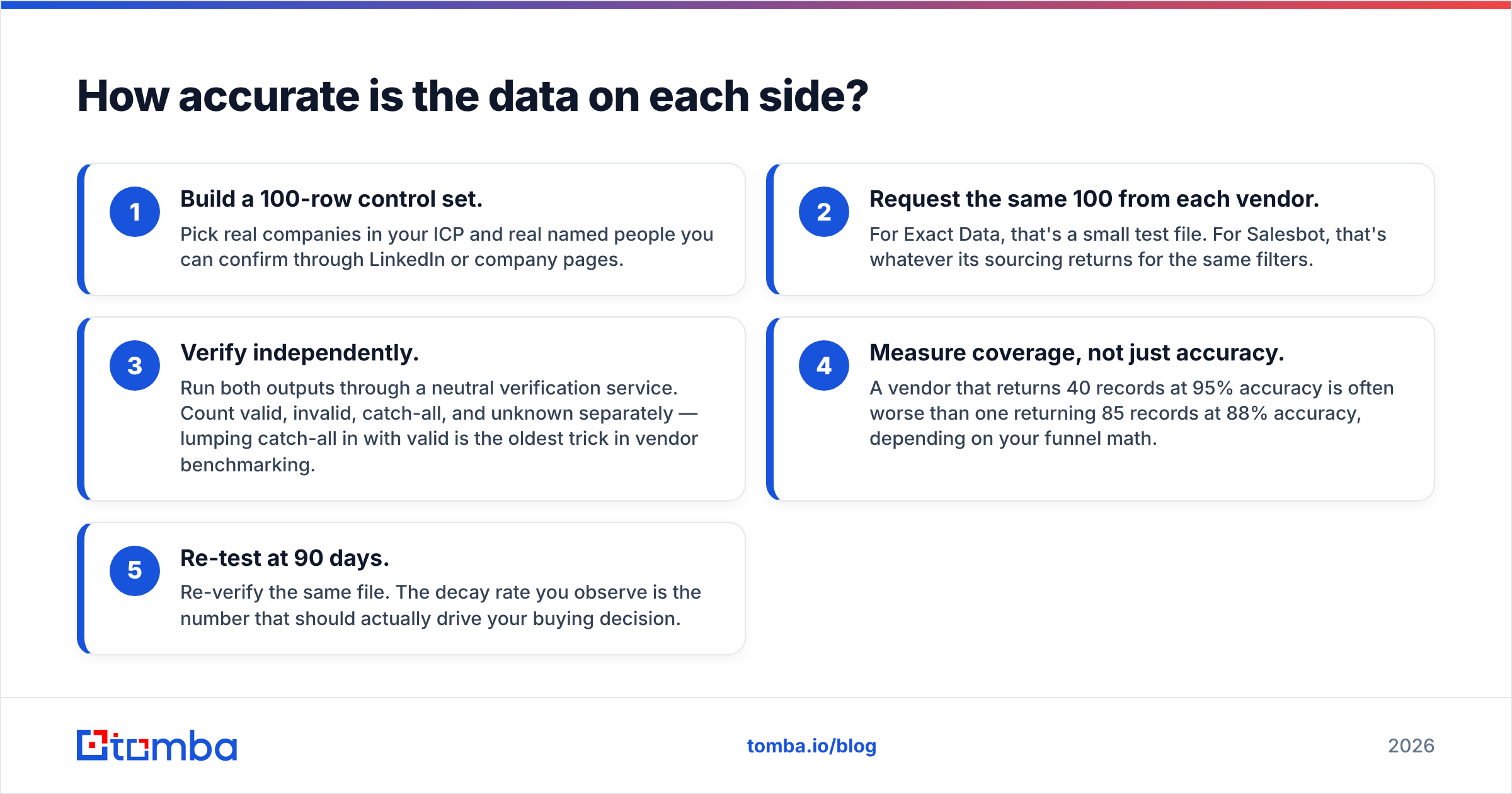
Nobody in this space publishes an audited accuracy number, so treat every vendor claim — including the marketing on both sites — as unverified until you test it. What you can do is run the same test on both:
- Build a 100-row control set. Pick real companies in your ICP and real named people you can confirm through LinkedIn or company pages.
- Request the same 100 from each vendor. For Exact Data, that's a small test file. For Salesbot, that's whatever its sourcing returns for the same filters.
- Verify independently. Run both outputs through a neutral verification service. Count valid, invalid, catch-all, and unknown separately — lumping catch-all in with valid is the oldest trick in vendor benchmarking.
- Measure coverage, not just accuracy. A vendor that returns 40 records at 95% accuracy is often worse than one returning 85 records at 88% accuracy, depending on your funnel math.
- Re-test at 90 days. Re-verify the same file. The decay rate you observe is the number that should actually drive your buying decision.
Catch-all domains deserve their own step here. A large share of enterprise domains accept everything at the SMTP layer, which means a naive verifier marks them "valid" and your bounce rate lies to you until send day. A dedicated catch-all verifier resolves those separately instead of guessing.
What do Exact Data and Salesbot cost in 2026?#
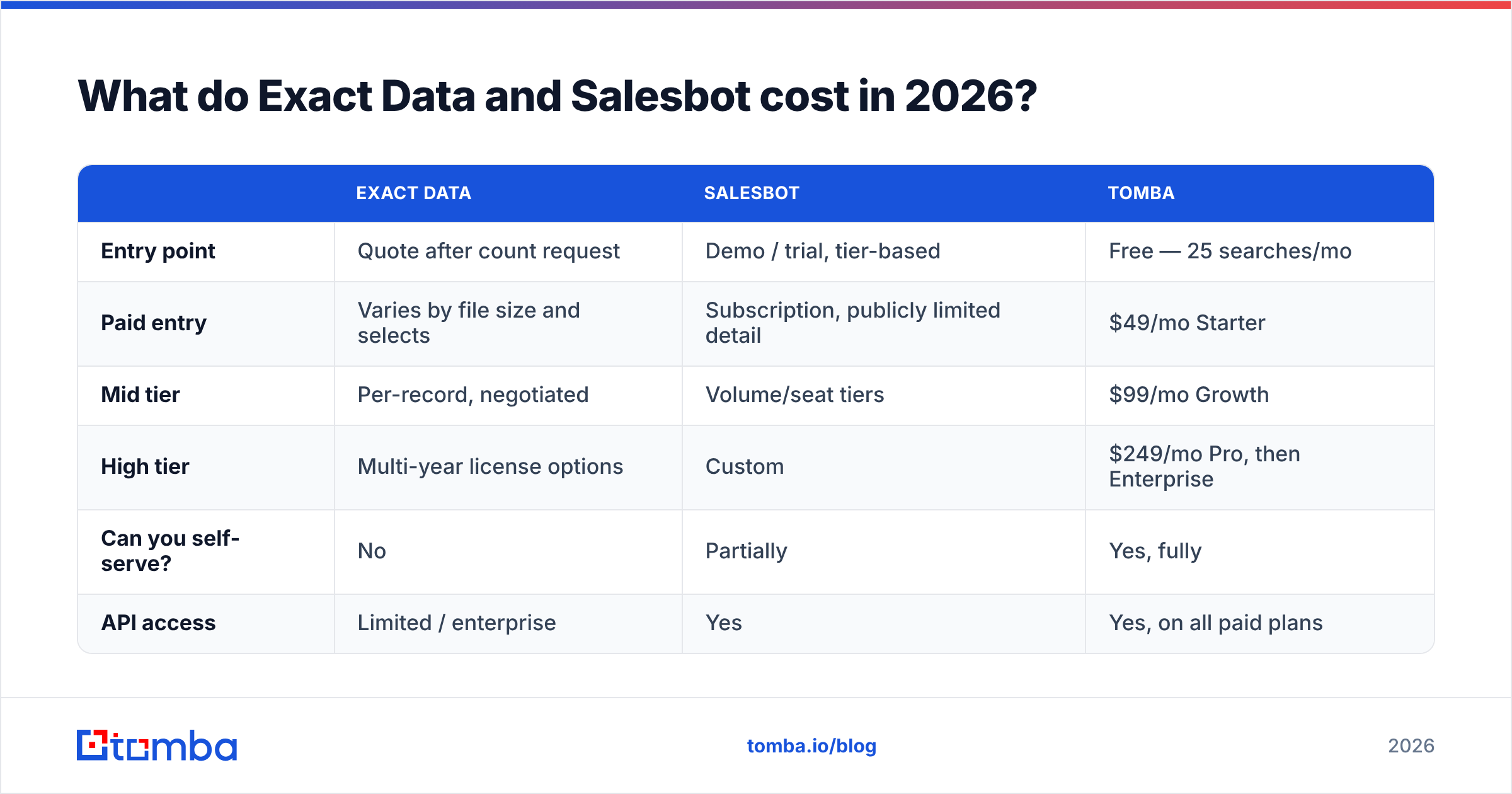
Neither publishes complete pricing, which is itself a signal about how they sell.
| Exact Data | Salesbot | Tomba | |
|---|---|---|---|
| Entry point | Quote after count request | Demo / trial, tier-based | Free — 25 searches/mo |
| Paid entry | Varies by file size and selects | Subscription, publicly limited detail | $49/mo Starter |
| Mid tier | Per-record, negotiated | Volume/seat tiers | $99/mo Growth |
| High tier | Multi-year license options | Custom | $249/mo Pro, then Enterprise |
| Can you self-serve? | No | Partially | Yes, fully |
| API access | Limited / enterprise | Yes | Yes, on all paid plans |
Quote-based pricing isn't inherently bad — it's how brokerage works and you can negotiate. But it does mean you can't compare cost-per-usable-record until you've spent two weeks in a sales cycle. Budget for that.
For self-serve buyers, the practical comparison is cost per verified contact, not cost per row. A $0.02/record file where 30% is dead costs $0.029 per usable contact plus your verification spend plus the deliverability damage from whatever slipped through.
Which one should you pick?#
Match the tool to the motion, not to the feature list:
- Choose Exact Data if you need postal or consumer data, you're running volume campaigns where a 10–20% miss rate is acceptable, or your ICP is defined in traditional compiler selects (SIC, revenue band, years in business).
- Choose Salesbot if you have no outbound headcount, your ACV is low enough that fully automated sequences make economic sense, and you're willing to accept generic first-touch copy.
- Choose a finder + verifier stack if you already know your accounts, you sell into named targets, or your deal size is high enough that one wrong email costs you the meeting. This is where Tomba and comparable tools fit — you query per company or per person and get a verified result now, not a snapshot from last quarter.
- Choose a modern list vendor if you want bulk B2B records with self-serve pricing and modern verification baked in. BookYourData is a solid option in that middle ground — bulk-file convenience without the brokerage sales cycle.
Most teams that end up happy run a hybrid: a bulk source for top-of-funnel breadth, and a live lookup layer for the accounts that actually matter. Pair that with data enrichment to fill in firmographics on whatever rows come back thin, and you get the coverage of a list purchase with the accuracy of on-demand lookup.
What should you check before signing either contract?#
- Ask for a test file, not a demo. 100 records against your real ICP tells you more than an hour of screen-share.
- Ask where the data comes from. "Proprietary compilation" is not an answer. Any vendor should be able to describe categories of sources.
- Ask about refresh cadence. Monthly? Quarterly? On request? A vendor that can't answer is selling you an archive.
- Ask about replacement policy. Reputable brokers replace records that hard-bounce above a stated threshold. Get that threshold in writing.
- Ask who owns the data after termination. For SaaS-model tools especially, check whether you keep the contacts you sourced.
- Ask about suppression and opt-out handling. This is the question that keeps you out of regulatory trouble.
The bottom line#
Exact Data and Salesbot answer different questions. Exact Data answers "where do I get 50,000 records?" Salesbot answers "who's going to email them?" Neither answers "how do I know this address is still good on the day I hit send" — and in 2026 that's the question that decides whether your campaign lands in the inbox or the spam folder.
If your outbound depends on precision rather than volume, start with the lookup layer. The Tomba Email Finder returns verified professional emails by domain, name, or company, with a free tier at 25 searches a month so you can benchmark it against whatever file a broker quotes you — before you commit to a contract you can't unwind. Run the same 100-row test on all three. Let the bounce rate pick your vendor.
Related guides#
Ready to find emails that actually work?
Join 150,000+ professionals who stopped guessing and started sending. Free credits on signup — no credit card required.
Get the Tomba newsletter
Practical outbound tactics and product updates — once every two weeks.
About the author