Exact Data vs SalesIntel: Which B2B Data Provider Wins in 2026?
One sells you a list. The other sells you a subscription with intent signals attached. Here is how Exact Data and SalesIntel actually compare on pricing, accuracy, coverage and refresh cadence — and when neither is the right buy.
Exact Data vs SalesIntel is not really a feature fight. It is a choice between two business models. One sells you a file. The other rents you a live database. Pick the wrong one and you pay for data you cannot use.
TL;DR
- Exact Data is a list broker. You buy a file — postal, phone, or email records — priced per record, delivered as a download. It is transactional, cheap at small volumes, and strongest for direct mail and consumer-adjacent B2B campaigns.
- SalesIntel is a subscription data platform. Human-verified B2B contacts, direct dials, technographics and Bombora intent, delivered through a UI, Chrome extension and CRM sync. Annual contracts, quote-based pricing.
- Different buyers, not competing products. Exact Data wins on upfront cost and mailing-list breadth. SalesIntel wins on refresh cadence, direct dials, and anything resembling account-based marketing.
- Both decay. A purchased list starts rotting the day it lands. Whatever you buy, verify before you send — bounce rates above 3% will cost you more than the data did.
- A third path exists. If you only need accurate work emails at the moment you need them, a per-search email finder beats both on cost-per-usable-contact.
What are Exact Data and SalesIntel, exactly?#
They sell data. That is where the similarity ends.
Exact Data is a Chicago-based list brokerage and compiler. You filter by industry, job title, SIC code, region, employee count or revenue. The site shows a live count of matching records. You buy that file, as a CSV or a direct-mail-ready file. There is no dashboard to log into afterward, no seat licenses, and no ongoing relationship unless you buy again. It is the digital version of the list-rental business that dates back to the 1960s. That is both its strength and its limit.
SalesIntel is a modern B2B contact and company intelligence platform. Its pitch is human verification. A research team re-checks contacts on a rolling schedule instead of trusting machine guesses. The company markets a 95% accuracy standard on human-verified records. On top of the contact layer sit direct dial numbers, firmographics, technographics, and buyer intent via a Bombora partnership. You use it through a web app and a Chrome extension over LinkedIn. It also pushes records straight into Salesforce, HubSpot, Outreach and Salesloft.
The mental model: Exact Data is a wholesaler. SalesIntel is a utility you pay monthly to keep the tap running.
How do their data models actually differ?#
Most comparison posts skip this part. It is the part that decides whether your campaign works.
Start with where the records come from.
- Sourcing. Exact Data compiles from public records, directories, surveys, subscription and registration data, and partner list owners. SalesIntel blends machine-collected data with a human research team that confirms records by hand. That is slower and costs more per record, but it holds up better.
- Refresh cadence. A brokered list is a snapshot at the time of purchase. SalesIntel re-checks contacts on a rolling schedule — the platform markets roughly quarterly re-verification on human-verified records. The same contact gets rechecked while you keep paying.
- Field depth. Exact Data is broad on postal and demographic selects. SalesIntel is deep on the fields sales teams use: direct dials, mobile numbers, department, seniority, install base, funding, headcount growth.
Then look at how the data reaches you, and what you are allowed to do with it.
- Delivery surface. File download versus API, extension, CRM sync, and enrichment jobs. If your workflow lives inside a CRM, the delivery surface matters more than the record count.
- Licensing. List brokerage often licenses a file for a defined use. Read the terms before you assume you own the records forever. Platform subscriptions license access for the contract term, and exported records usually stay with you, subject to the agreement.
- Intent. Exact Data has none. SalesIntel treats intent as a headline feature. If you do not run account-based programs, that feature is dead weight in your invoice.
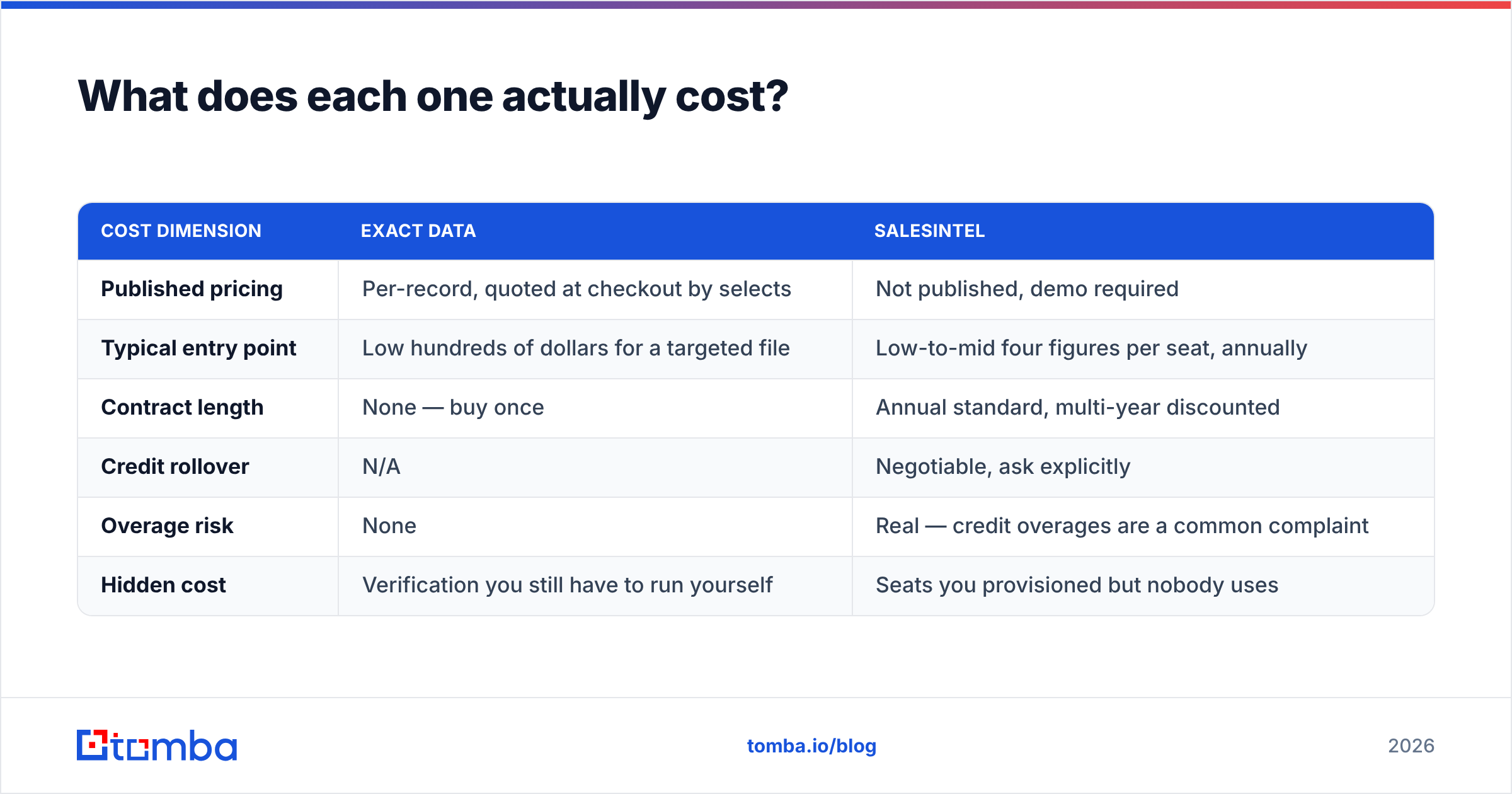
Exact Data vs SalesIntel: how do they compare head to head?#
| Attribute | Exact Data | SalesIntel |
|---|---|---|
| Business model | List broker / compiler, one-off purchase | SaaS subscription, annual contract |
| Primary buyer | Direct mail, telemarketing, SMB marketers | SDR teams, demand gen, RevOps |
| Pricing model | Per record, order minimum applies | Per seat + credits, quote-based |
| Entry cost | Low — hundreds of dollars for a targeted file | High — typically four to five figures annually |
| Self-serve checkout | Yes, counts and pricing shown live | No, sales-led demo and quote |
| Human verification | No dedicated verification team | Yes, core differentiator |
| Direct dials / mobiles | Limited | Strong, a headline feature |
| Buyer intent data | No | Yes, via Bombora |
| Technographics | No | Yes |
| CRM native sync | No | Salesforce, HubSpot, Outreach, Salesloft |
| Chrome extension | No | Yes |
| API access | Limited | Yes |
| Postal / direct mail selects | Extensive | Minimal |
| Best for | Cheap volume, offline channels | Ongoing pipeline generation |
Two things jump out. First, the two tools barely overlap in the workflow layer. One hands you a file. The other lives inside your stack. Second, the cost gap is close to tenfold. So the real question is rarely "which is better." It is "which problem do I have."
What does each one actually cost?#
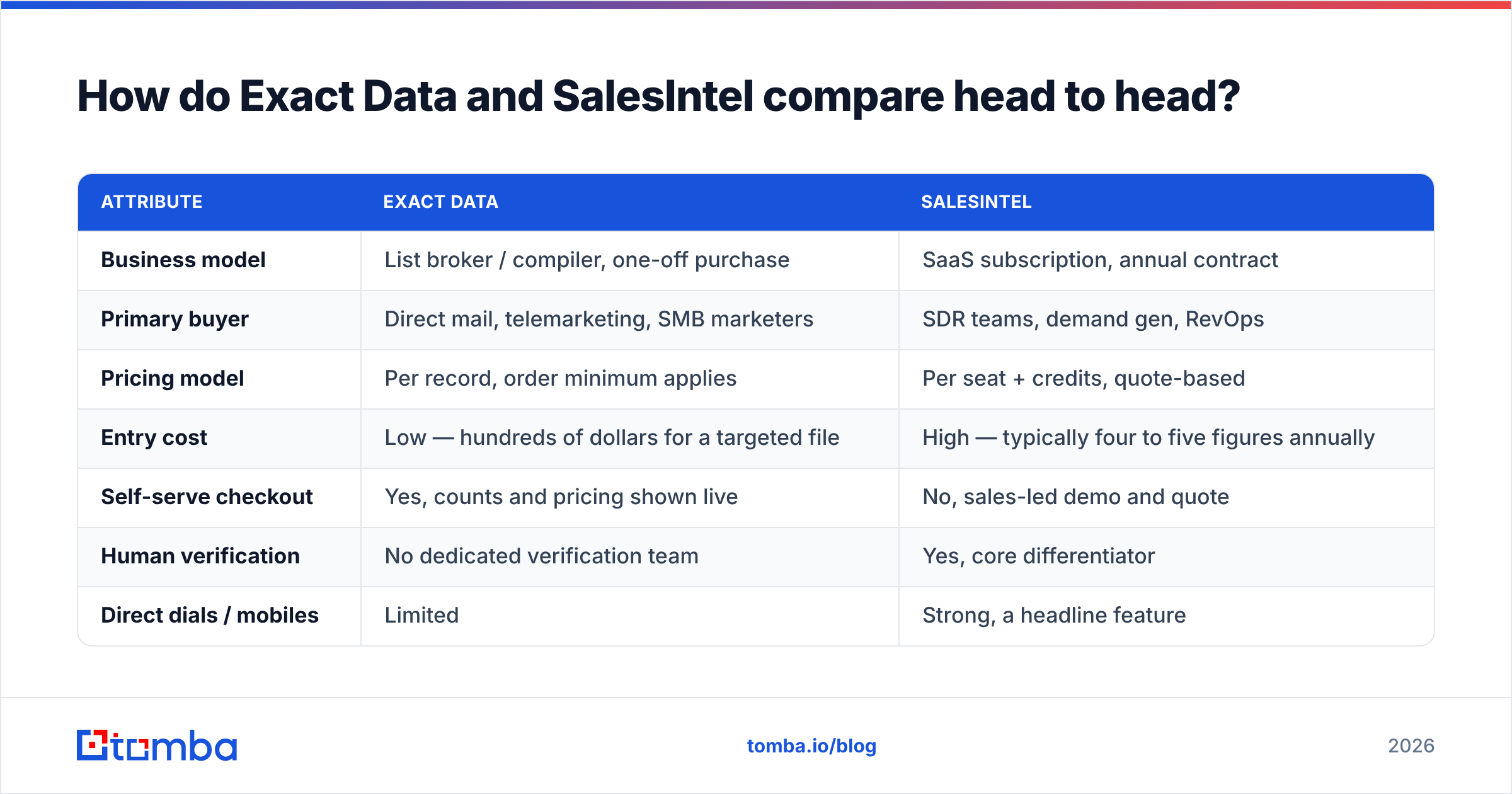
Neither vendor publishes a clean, fixed price list. Treat every number below as a starting point to confirm in writing before you sign.
| Cost dimension | Exact Data | SalesIntel |
|---|---|---|
| Published pricing | Per-record, quoted at checkout by selects | Not published, demo required |
| Typical entry point | Low hundreds of dollars for a targeted file | Low-to-mid four figures per seat, annually |
| Contract length | None — buy once | Annual standard, multi-year discounted |
| Credit rollover | N/A | Negotiable, ask explicitly |
| Overage risk | None | Real — credit overages are a common complaint |
| Hidden cost | Verification you still have to run yourself | Seats you provisioned but nobody uses |
The trap on the brokerage side is that the sticker price excludes cleanup. A file at ten cents a record looks unbeatable. Then 22% of it bounces. Your real cost per usable contact is far higher, and that is before the email deliverability damage. Run every purchased file through an email verifier before it touches your sending domain. That is not optional in 2026. Google and Yahoo now enforce spam-complaint limits on bulk senders.
The trap on the platform side is seat inflation. SalesIntel is sold per user with credit pools. Teams routinely buy twelve seats and use five. At renewal they learn the unused seats are not refundable. Ask for a mid-term seat-reduction clause. Vendors say no by default and yes when pushed.
Which one has more accurate data?#
SalesIntel, on B2B contact accuracy — but with a caveat worth understanding.
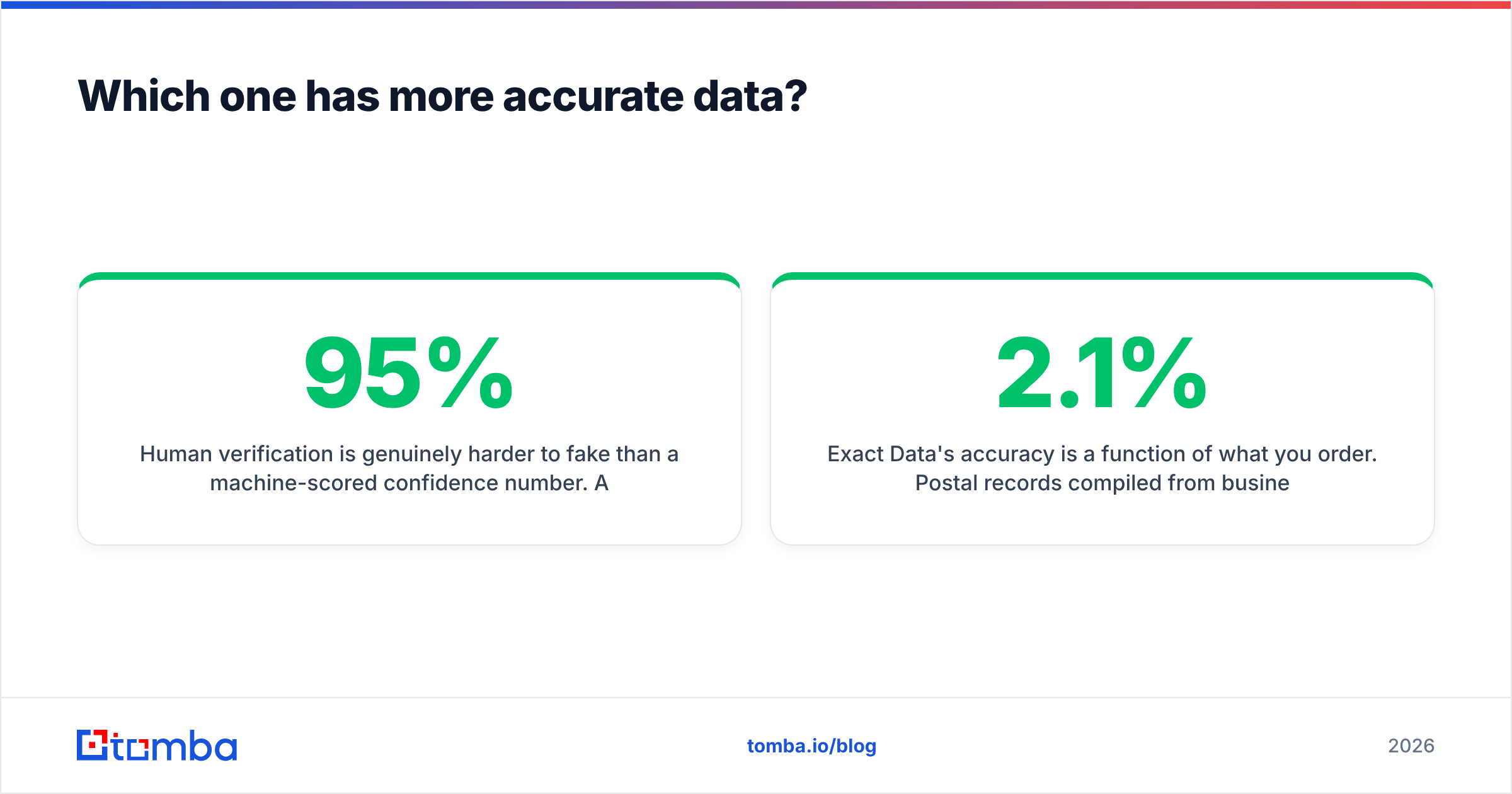
Human verification is harder to fake than a machine-scored confidence number. A researcher confirms a title and a phone number by hand. That record holds up in the real world far more often than a guessed one. The 95% accuracy figure is a vendor claim, not an audited number. Still, the process behind it is real, and buyer reviews on G2 single out the direct dials. Dials are the hardest data type to get right, and that is where the premium is easiest to defend.
Exact Data's accuracy depends on what you order. Postal records compiled from business registries hold up well, because physical addresses change slowly. Email records in a compiled B2B file are the weak spot. Work email is the fastest-decaying field in the entire B2B record. B2B data decays by roughly 2.1% to 2.5% a month. Over a year, about a quarter of a contact file goes bad. A list assembled eighteen months before you bought it is not a database. It is an archaeological artifact.
The honest conclusion: SalesIntel is more accurate on B2B contacts, Exact Data is competitive on postal, and neither one excuses you from verifying before you send. Treat any purchased data as raw material.
Is SalesIntel's intent data worth the premium?#
Only if you have the motion to act on it.
Intent data tells you which accounts are researching topics in your category. That helps when picking targets is your bottleneck. Eight SDRs working 4,000 accounts need to know which 200 to call this week. It is close to worthless when volume is your bottleneck. Three in-market accounts will not fill a thirty-meeting month.
Ask three questions before paying for intent:
- Do you have account-level territory assignment? If reps work inbound leads only, intent has nowhere to land.
- Can your CRM route on an intent score? Signals that arrive as a weekly CSV nobody opens are a line item, not a capability.
- Is your topic taxonomy specific enough? Broad topics generate surge noise. Narrow ones generate a handful of accounts a month and prove nothing.
If you answered no to two of the three, buy the contact data and skip the intent tier. You can add it at renewal once the motion exists.
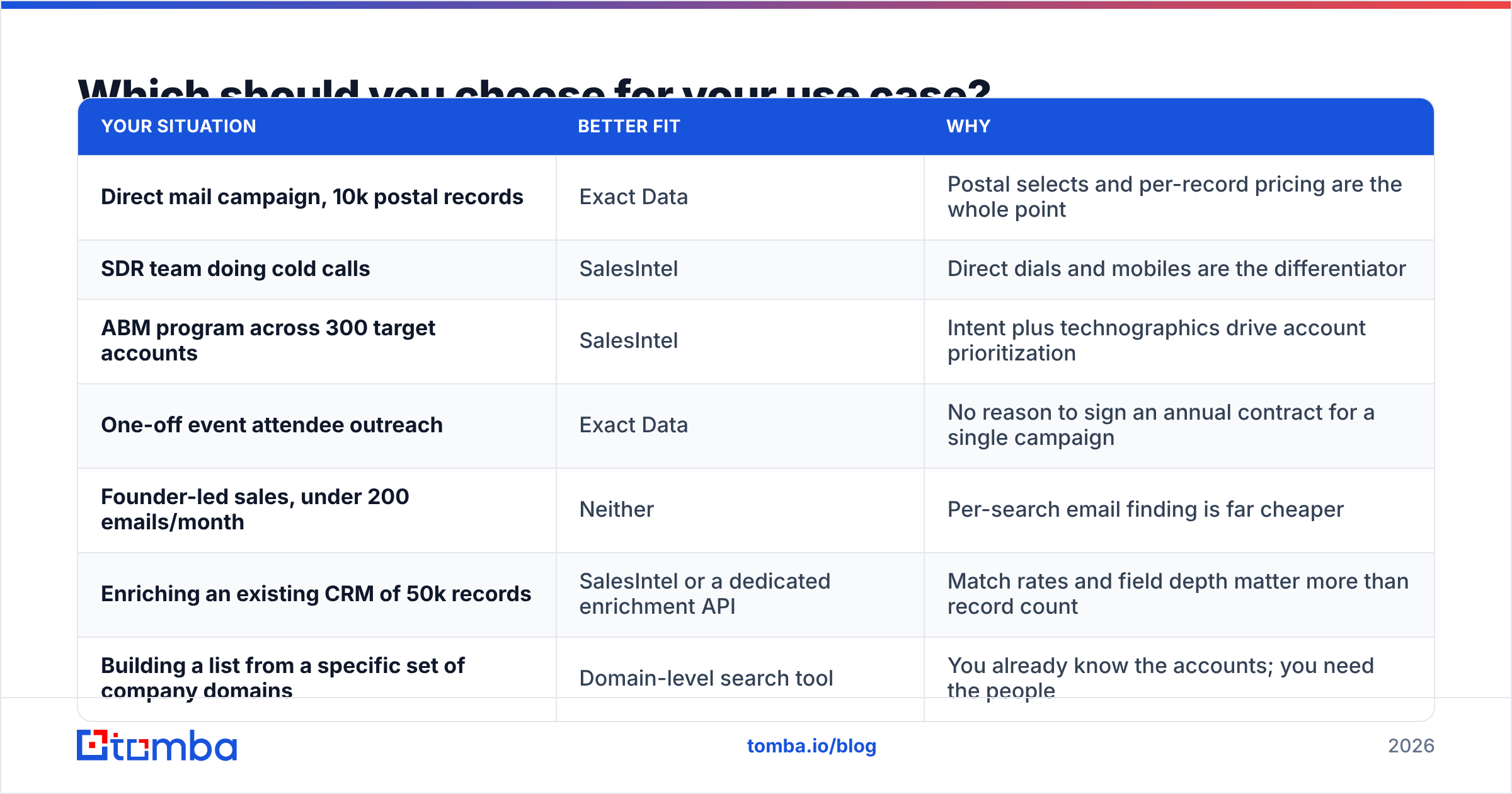
Which should you choose for your use case?#
| Your situation | Better fit | Why |
|---|---|---|
| Direct mail campaign, 10k postal records | Exact Data | Postal selects and per-record pricing are the whole point |
| SDR team doing cold calls | SalesIntel | Direct dials and mobiles are the differentiator |
| ABM program across 300 target accounts | SalesIntel | Intent plus technographics drive account prioritization |
| One-off event attendee outreach | Exact Data | No reason to sign an annual contract for a single campaign |
| Founder-led sales, under 200 emails/month | Neither | Per-search email finding is far cheaper |
| Enriching an existing CRM of 50k records | SalesIntel or a dedicated enrichment API | Match rates and field depth matter more than record count |
| Building a list from a specific set of company domains | Domain-level search tool | You already know the accounts; you need the people |
That second-to-last row is where most small teams get burned. If your CRM already has the companies, you are not buying a list. You are filling gaps. And data enrichment priced per successful match is a far better deal than a seat license.
What do buyers complain about?#
For Exact Data, three themes repeat. Email fields go stale. The count shown at checkout shrinks once you dedupe. And support mostly ends when the payment clears. It is a transaction, and it behaves like one.
For SalesIntel, buyers flag four things. Pricing is opaque. Credits burn faster than expected. Coverage thins outside North America. And you sit through a sales process when you just want to test the data. Pressure-test international coverage hardest. If half your ICP sits in EMEA or APAC, run a sample match on 200 of your own known contacts before you sign. Every vendor will agree to this. If one refuses, that is your answer.
Are there better alternatives to both?#
Depends what you are optimizing for.
Want a self-serve list purchase with a sharper B2B focus than a general compiler? BookYourData sits in the same transactional category. It offers clean filters, per-record pricing, and a reputation for accuracy guarantees on B2B contacts.
If you want a full sales-intelligence suite, ZoomInfo and Apollo are the obvious comparison points against SalesIntel — bigger databases, bigger contracts, and their own trade-offs on data hygiene.
And if the job is narrower, the economics change entirely. You know the companies. You know the roles. You just need reachable work emails. Tomba pricing starts free at 25 searches a month, with Starter at $49/mo, Growth at $99/mo, and Pro at $249/mo. Against a four-figure annual seat license, that is a different category of spend. Use domain search to pull the contact map for a target company, verify what you find, and stop paying for 40 million records you will never touch.
How do you buy either one without regretting it?#
Four rules, learned expensively:
- Sample before you sign. Request 100 records matching your exact ICP. Verify them independently. Calculate real deliverability, not vendor-claimed accuracy.
- Read the license. Single-use versus perpetual, seat transferability, what happens to exported data at contract end. These clauses are where the surprises live.
- Budget for verification. Assume 8–20% of any purchased email file is undeliverable. Price that in before you compare vendors, and run bulk verification on anything over a thousand records.
- Buy for the next two quarters, not the next two years. Data vendors change fast. A shorter contract at a worse rate usually beats a three-year lock-in at a discount.
The bottom line#
Exact Data vs SalesIntel is a workflow choice, not a feature race. Exact Data is the right call when you need volume in an offline channel at a low upfront cost. You are buying a snapshot, and you know it. SalesIntel is the right call when a sales team needs fresh contacts, direct dials and intent signals wired into a CRM, and the pipeline justifies the contract.
If neither model fits, start smaller. Point the Tomba Email Finder at the companies you already want to reach. Verify every address before it enters a sequence. Then spend the difference on the campaign instead of the license. The free tier is 25 searches a month — enough to test whether you needed a list vendor at all.
Related guides#
Ready to find emails that actually work?
Join 150,000+ professionals who stopped guessing and started sending. Free credits on signup — no credit card required.
Get the Tomba newsletter
Practical outbound tactics and product updates — once every two weeks.
About the author