Exact Data vs SeamlessAI: B2B Data Compared for 2026
One is a 20-year-old list broker selling records by the file. The other is an AI search engine selling credits by the seat. Here's how Exact Data and Seamless.AI actually compare on accuracy, pricing, and workflow fit in 2026.
Exact Data vs SeamlessAI comes down to one question: do you want to buy a list, or look up contacts one at a time? Exact Data sells files. Seamless.AI sells seats and credits. Here is how the two compare on accuracy, pricing, and workflow fit — plus a cheaper third option.
TL;DR
- Exact Data is a traditional list broker. You buy a one-time file of records (postal, phone, email) filtered by firmographic or demographic criteria. Good for direct mail and broad TAM builds, weak for real-time, person-level prospecting.
- Seamless.AI is a subscription search engine: seats, credits, a Chrome extension, and a CRM push. Good for reps working accounts live. Users do complain about credit burn, hard annual contracts, and uneven email quality.
- Neither publishes clear self-serve pricing. Exact Data quotes per record. Seamless.AI quotes per seat per year after a demo call. Budget planning is painful with both.
- If your real job is "get a verified work email for this person or domain, now," a focused email finder with published pricing and an API — like Tomba at $49/mo — solves it for a fraction of either contract.
- Whichever you pick, verify before you send. Bought and AI-guessed records both decay. A verification pass is the cheapest insurance in outbound.
What are Exact Data and Seamless.AI?#
They solve overlapping problems from opposite ends of the market.
Exact Data is a data compiler and list brokerage. You tell them the audience — SIC code, employee count, geography, job title, revenue band — and they return a file. The model is decades old: license or buy records, download a CSV, load it into your ESP, dialer, or direct-mail house. Business lists sit next to a large consumer database, which tells you where the company's center of gravity has been.
Seamless.AI is the modern version of the same promise. Instead of a brokered file, you get a web app and a browser extension. They search the public web in real time, guess and validate contact details, then push them into HubSpot, Salesforce, or Outreach. You buy seats and credits, not files.
The practical difference: Exact Data sells you a snapshot; Seamless.AI sells you a lookup engine. Snapshots decay from the moment they land. Lookup engines decay too, but you can re-run them.
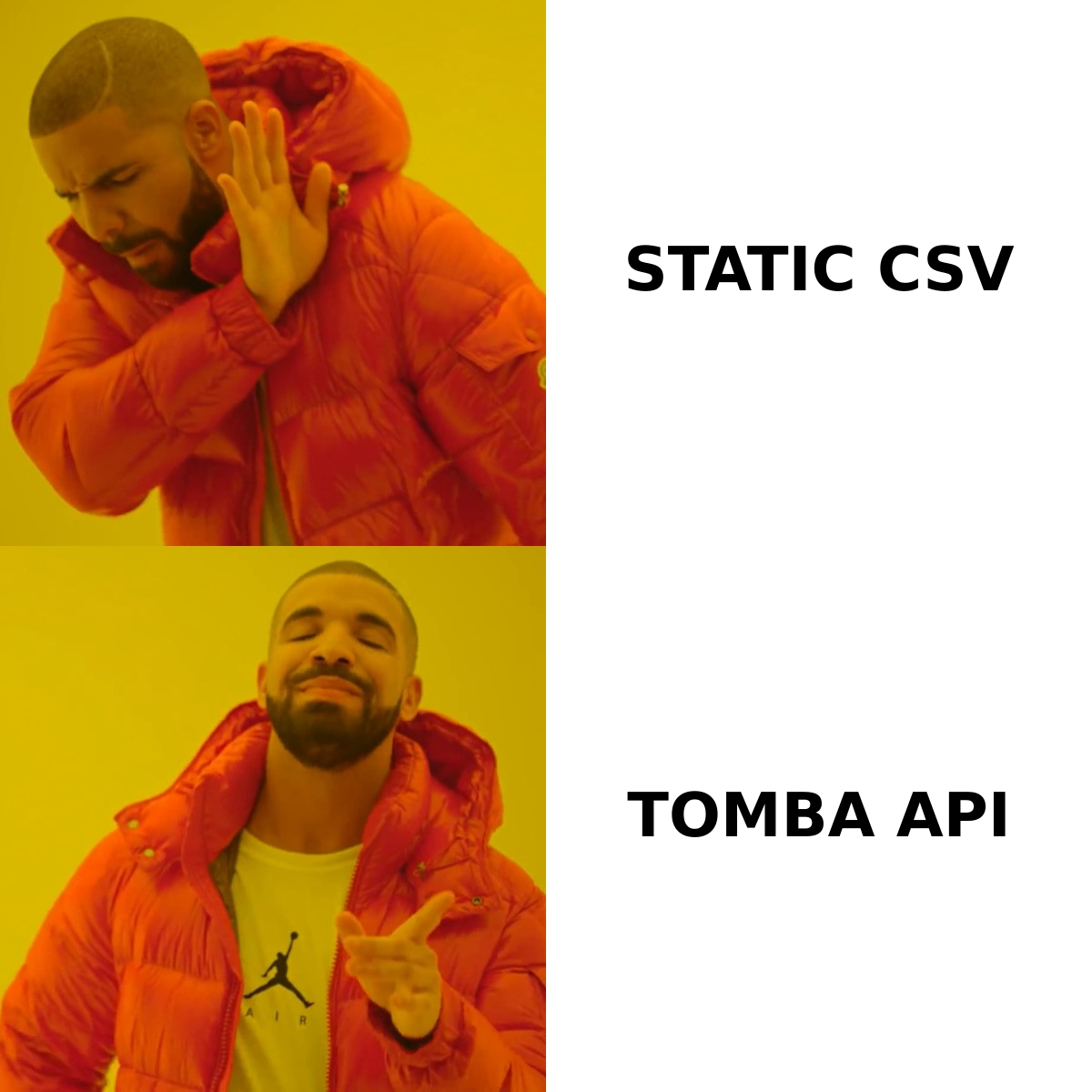
Exact Data vs SeamlessAI: how do they compare head to head?#
| Attribute | Exact Data | Seamless.AI | Tomba |
|---|---|---|---|
| Model | List brokerage / data compiler | AI search engine + Chrome extension | Email finder + verifier API |
| Pricing | Quote-based, per record | Quote-based, per seat/year | Published: Free, $49, $99, $249/mo |
| Free tier | No | Limited free credits | 25 searches/mo |
| Self-serve signup | No — sales call required | Partial — free tier, then sales | Yes |
| Real-time lookup | No | Yes | Yes |
| Bulk enrichment | Yes (as a delivered file) | Yes (credit-metered) | Yes, via bulk tools and API |
| Built-in verification | Varies by order | Basic | Dedicated verifier + catch-all handling |
| API access | Limited | Available on higher tiers | Core product, all paid plans |
| Postal / direct mail data | Strong | Not a focus | Not offered |
| Contract length | Per order | Typically annual | Monthly or annual |
The table exposes the real decision. These are not three versions of the same product. They are three different purchases.
Which one has better data accuracy?#
Neither vendor publishes an audited accuracy figure, so treat any number in a sales deck as marketing. What you can do is reason about how each source is built. That predicts the failure modes.
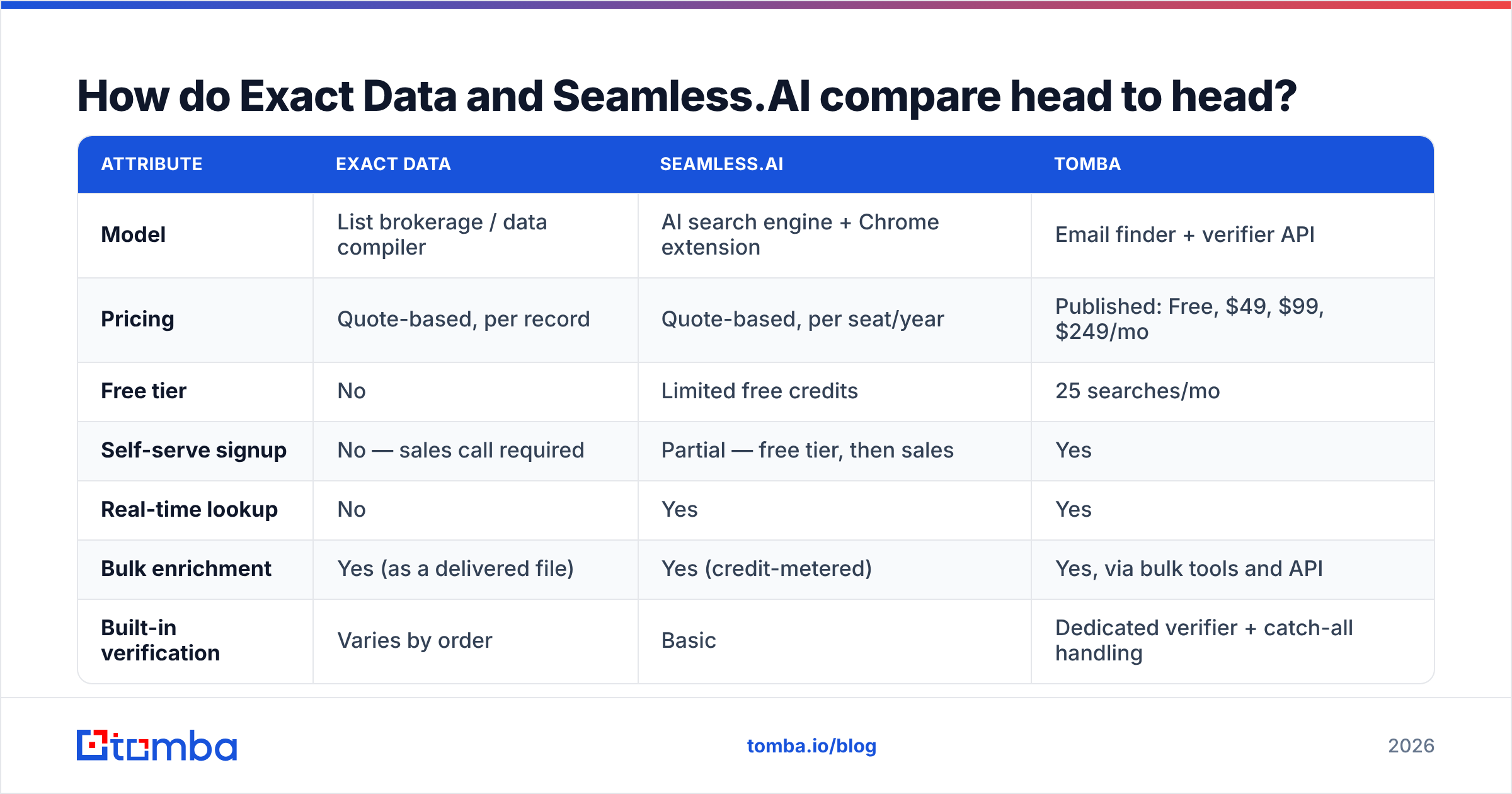
Exact Data's records come from compiled sources — public filings, directories, survey and registration data, partner feeds. Compiled data is broad and cheap per record. It also ages fast. B2B contact data decays at roughly 25-30% per year through job changes alone, and that clock starts before the file reaches you. A list built last quarter and sold to you this quarter is already partly wrong.
What that costs you depends on the channel. For postal mail it is survivable: mail forwards, and a wrong name at the right company still lands in the building. For cold email it is expensive. Every dead address is a bounce against your sender reputation.
Seamless.AI generates and validates contacts on demand. That is better for freshness. But the "AI" part means a real share of returned emails are pattern guesses — first.last@, f.last@, firstinitiallast@ — scored for confidence rather than confirmed.
Read the G2 reviews and the pattern is consistent. Reviewers praise the coverage and speed, then flag bad emails, credits burned on non-results, and trouble exiting the annual contract. Every provider has one-star reviews, so that alone is not damning. The volume and consistency of the accuracy and billing complaints are worth weighing.

The uncomfortable truth: accuracy is not a property of a vendor, it is a property of your workflow. A 90%-accurate source that you verify before sending beats a 95%-accurate source you blast straight from the CSV.
So run every list through an email verifier — bought, generated, or scraped. Mailbox providers now treat bounce rate as a primary reputation signal. Google and Yahoo's bulk-sender rules put a hard ceiling on how sloppy you are allowed to be.
What does each one actually cost?#
This is where both vendors get frustrating, and where you should budget more time than you expect.
Exact Data prices per record, with order minimums. Compiled B2B records typically fall in the low tens of cents each. The price rises as you add selects — title seniority, technology installed, revenue band — and falls with volume. A 10,000-record targeted business file is a four-figure purchase, not a subscription. There is no free tier and no way to test the data before you commit, though brokers will usually send a small sample.
Seamless.AI sells seats on annual contracts, with credit allocations attached. Public pricing left the site years ago; you get a number after a demo. Reported figures from review sites and buyer communities cluster in the low thousands per seat per year for the paid tiers.
Watch the credit reset schedule as closely as the price. On some plans credits reset annually rather than monthly. If your credits reset yearly, a heavy Q1 leaves you rationing in Q3.
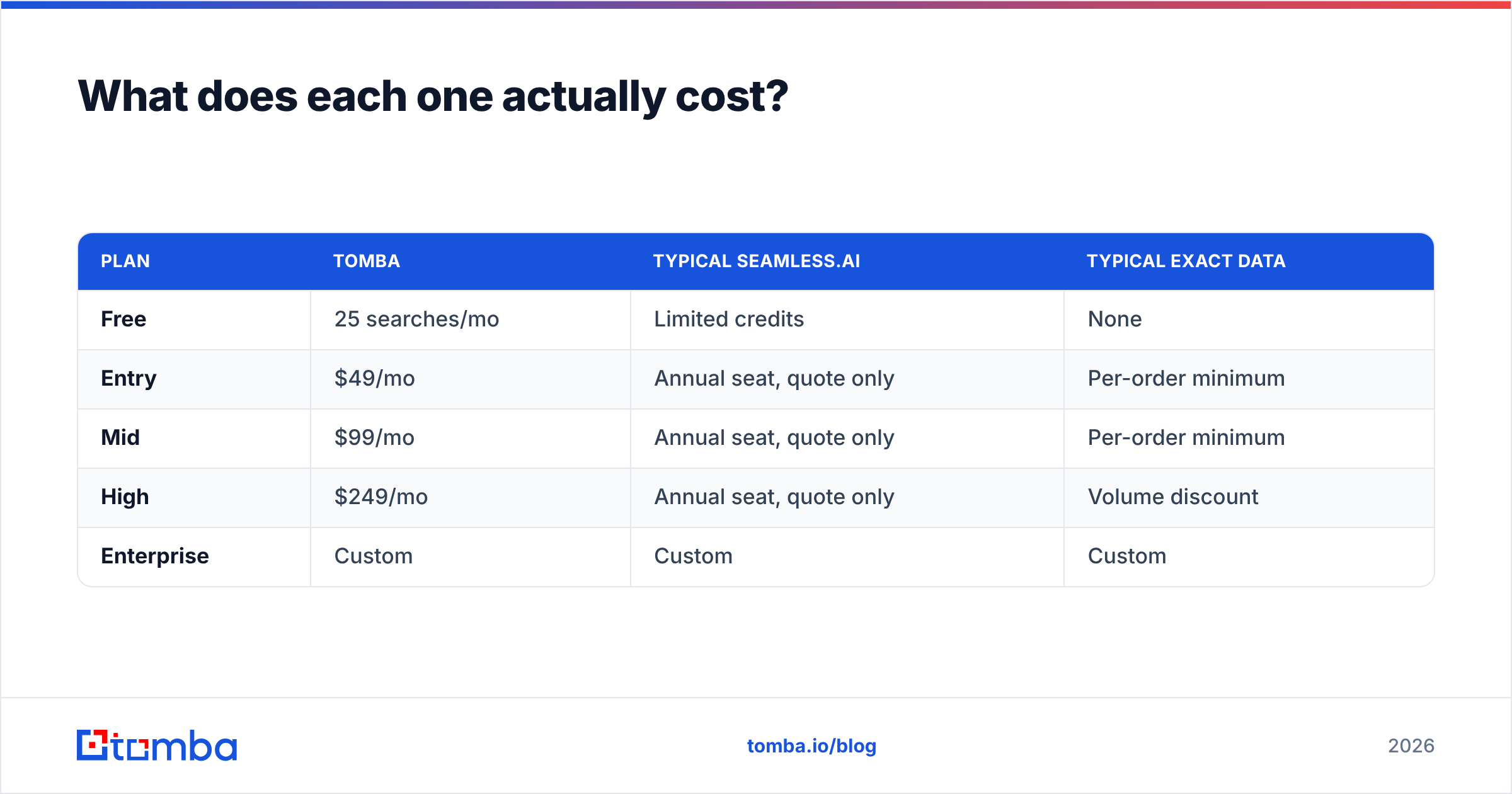
Compare that to published, self-serve pricing:
| Plan | Tomba | Typical Seamless.AI | Typical Exact Data |
|---|---|---|---|
| Free | 25 searches/mo | Limited credits | None |
| Entry | $49/mo | Annual seat, quote only | Per-order minimum |
| Mid | $99/mo | Annual seat, quote only | Per-order minimum |
| High | $249/mo | Annual seat, quote only | Volume discount |
| Enterprise | Custom | Custom | Custom |
You can see full Tomba pricing without a call. That transparency is itself a feature when you are building a budget or comparing three vendors in a week.
When should you buy from a list broker like Exact Data?#
There are real cases where a compiled list beats a lookup tool:
- Direct mail campaigns. If you are printing 5,000 dimensional mailers, you need postal addresses at scale with deliverability guarantees. Seamless.AI and email finders do not compete here at all.
- TAM sizing and market research. When you need to know how many US manufacturers with 50-200 employees exist in three states, a compiled count is fast and cheap. You may not even need the records — just the count.
- Territory planning and account list building. Broad firmographic coverage for account selection, where you will source individual contacts later with a different tool.
- Multi-channel campaigns with postal and phone. Compilers carry landline and mailing data that web-scraped sources simply do not have.
- Regulated or niche verticals where the compiler has depth a general-purpose engine lacks.
What a list broker is bad at: person-level, just-in-time prospecting. If a rep is on a company's website right now and needs the VP of Engineering's email in the next 15 seconds, a CSV bought last month cannot help.
When is Seamless.AI the better fit?#
Seamless.AI earns its place when you have a seat-based SDR motion. Specifically:
- Reps prospect inside the browser. The Chrome extension on LinkedIn and company sites is the core value. It collapses research and capture into one action.
- You want contacts and firmographics in one subscription. Seamless bundles company data, intent-style signals, and contacts, so you are not stitching three vendors together.
- CRM push matters more than raw accuracy. If your workflow is find, enrich, sequence, sync, a bundled platform cuts friction even at a quality cost.
- You have budget certainty. Annual contracts are fine when headcount and quota are stable. They are a trap when they are not.
Where it breaks down: engineering-driven workflows. If you want to enrich 50,000 rows nightly or embed lookups in your product, a seat-licensed UI tool with credit caps is the wrong shape. That is an API problem. It is why teams increasingly split the stack — a platform for reps, an email finder API for systems.

Is there a better option than either one?#
For a lot of teams, yes — because most teams do not need what either vendor sells. They need a reliable way to turn a name and a domain into a deliverable work email.
That is a narrower problem, and narrower problems have cheaper answers. A dedicated email finder does one thing: given a person and a company, return the verified address. No seat licenses, no annual lock-in, no per-record minimums.
Tomba layers pattern detection, source confirmation, and SMTP-level checks, with documented data sources rather than a black box. Domain search pulls every discoverable address at a company. The catch-all verifier handles domains that break naive SMTP checks. Bulk processing covers list-scale work without a sales call.

Worth naming the other serious options so this is not a two-horse race:
- BookYourData — a strong choice if you want pay-as-you-go B2B lists with a bounce guarantee and no subscription. Credit packs, no annual contract, solid coverage on US and EU business contacts. If Exact Data appeals to you but the brokerage sales cycle does not, this is the modern equivalent worth quoting alongside it.
- Apollo.io — the default all-in-one for teams that want database plus sequencer in one seat. Broad, cheap per contact, quality varies by segment. See our notes on Apollo alternatives if you have already outgrown it.
- Clay / enrichment waterfalls — for RevOps teams comfortable orchestrating multiple providers, waterfall enrichment beats any single source on coverage, at the cost of complexity and per-lookup spend.
How should you actually run the evaluation?#
Do not compare feature lists. Compare outputs on your accounts. A one-week test that costs a few hundred dollars will tell you more than any review site.
- Build a 100-row gold-standard set. Pull real target accounts from your ICP, with names and domains you already have confirmed emails for (past customers, inbound leads, conference contacts). This is your answer key.
- Run the same 100 rows through each vendor. For Exact Data, request a sample against your criteria. For Seamless.AI, use the free tier or a trial. For Tomba, the free plan covers 25 searches — enough for a first read.
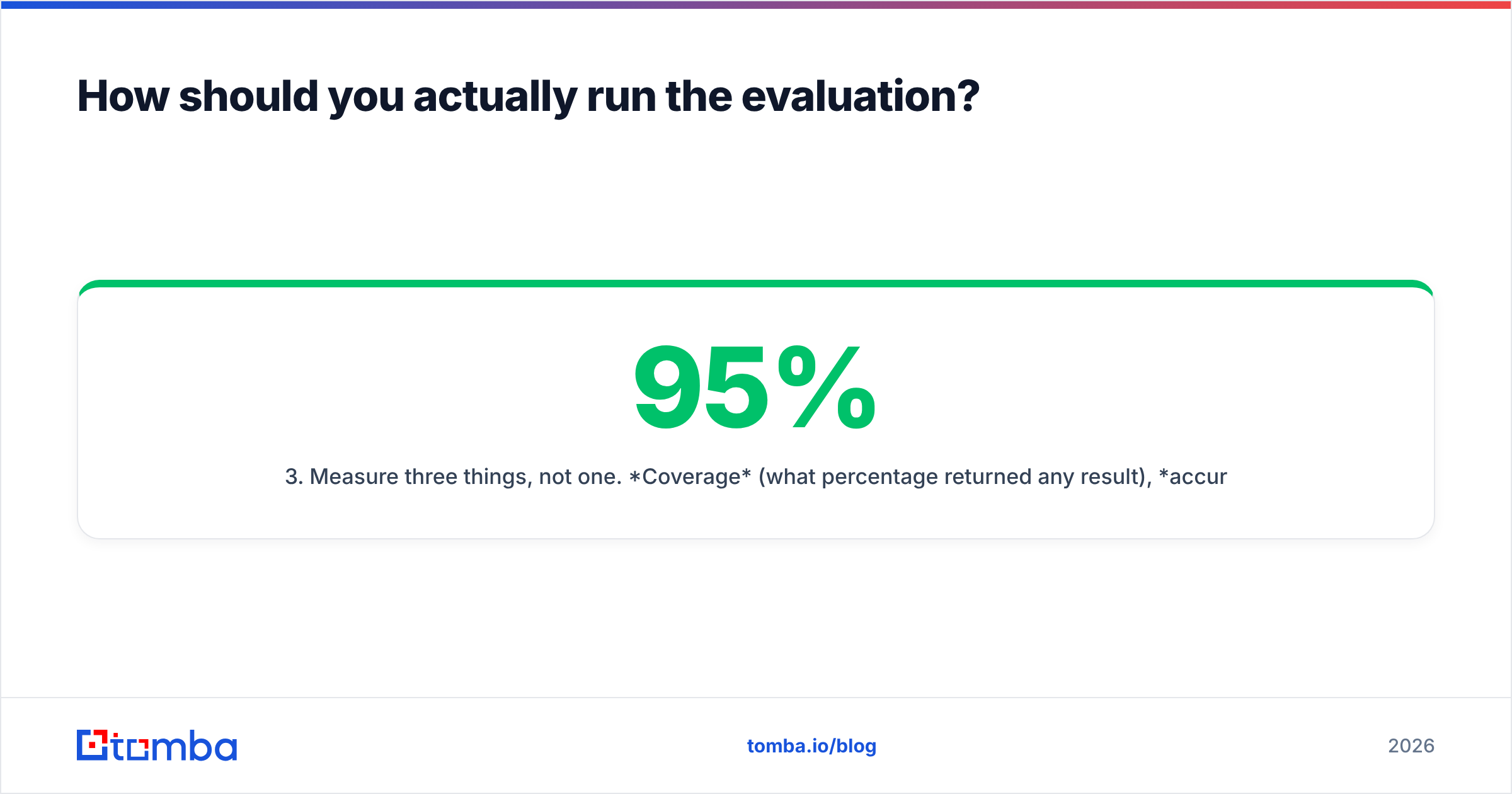
- Measure three things, not one. Coverage (what share returned any result), accuracy (what share matched your answer key), and cost per correct record (the only number that belongs in a budget deck). A tool with 95% coverage and 60% accuracy is worse than one with 70% coverage and 95% accuracy.
- Verify everything, from every source. Push all results through a verification pass and record the invalid rate. This is where bought files usually lose badly, and where the true cost of "cheap per record" shows up.
- Test the exit. Ask directly: what is the cancellation term, do unused credits roll over, can you export what you have already pulled? Get it in writing before signing anything annual.
Run that and the Exact Data vs SeamlessAI question usually answers itself. Often it does so by revealing that you needed neither, or that you needed one of them for exactly one job rather than as your whole data stack.
What's the verdict?#
The Exact Data vs SeamlessAI call is really three calls, not two.
Choose Exact Data if your campaigns are postal-first, if you need compiled firmographics at market-research scale, or if you work in a vertical where their depth is hard to replicate. Accept that the file is a snapshot, and budget for a verification pass on day one.
Choose Seamless.AI if you run a seat-based SDR team that lives in the browser, you value bundled workflow over per-record quality, and you can commit to an annual number without flinching. Negotiate the credit reset schedule, not just the price.
Choose a focused email finder if your actual bottleneck is deliverable work emails at a predictable cost — which, for most B2B teams under 50 reps, it is.
Start with the Tomba Email Finder: 25 free searches a month with no card, $49/mo when you are ready to scale, verification built into the same platform, and an API that drops straight into your enrichment pipeline. Run it against the same 100-row gold set you use to test Exact Data and Seamless.AI, and let cost-per-correct-record pick the winner.
Related guides#
Ready to find emails that actually work?
Join 150,000+ professionals who stopped guessing and started sending. Free credits on signup — no credit card required.
Get the Tomba newsletter
Practical outbound tactics and product updates — once every two weeks.
About the author