Exact Data vs UpLead: Which B2B Data Provider Wins in 2026?
Exact Data sells list volume. UpLead sells verified accuracy. We compared pricing, verification, coverage and export limits to show which one actually fits your outbound motion — and when neither is the right buy.
TL;DR
- Exact Data is a list broker: you buy a static file of records (consumer and B2B) by count, filtered by demographic and firmographic criteria. Volume is cheap; freshness is your problem after purchase.
- UpLead is a self-serve B2B prospecting database with real-time email verification, starting at $99/mo for 170 credits — accuracy-first, volume-second.
- If you send cold email, UpLead's verify-on-reveal model protects your domain far better than a bulk purchased file from Exact Data.
- If you run direct mail, telemarketing, or consumer-side campaigns at scale, Exact Data's list depth and per-record pricing is hard to beat.
- Most outbound teams end up needing a third thing: a per-domain email finder + verifier they can call from a script. That's where Tomba fits, at $49/mo instead of $99.
What is Exact Data and who actually buys it?#
Exact Data is a Chicago-based list brokerage and data compiler. You define an audience — SIC code, revenue band, employee count, job title, or on the consumer side, homeowner status, income, age, purchase intent — and the platform returns a count. You pay for that count and receive a file: CSV or direct integration into an ESP.
The business model matters more than the feature list. A broker's incentive is to sell records, and a record counts as sold whether or not the email behind it still resolves. Exact Data publishes accuracy guarantees on some list types (typically a 90%+ deliverability commitment with credits for excess bounces), but the guarantee is a refund mechanism, not a prevention mechanism. Your domain still absorbed the bounces before you claimed it.
Who buys it: direct mail operators, insurance and mortgage lead buyers, event marketers, and agencies that need 50,000 postal records this week and don't care about SaaS-style tooling. If your channel is physical mail or an outbound call floor, the calculus is different from cold email — a bad postal address costs you a stamp, not your sender reputation.
Correction on the image above — here it is properly:
What is UpLead and how is its model different?#
UpLead is a self-serve B2B contact database, closer in shape to Apollo or ZoomInfo than to a broker. You search 160M+ contacts across 50+ filters, preview matches, and spend a credit only when you reveal a contact. The differentiator UpLead markets hardest is real-time verification: it pings the mail server at reveal time rather than serving you a record verified eighteen months ago.
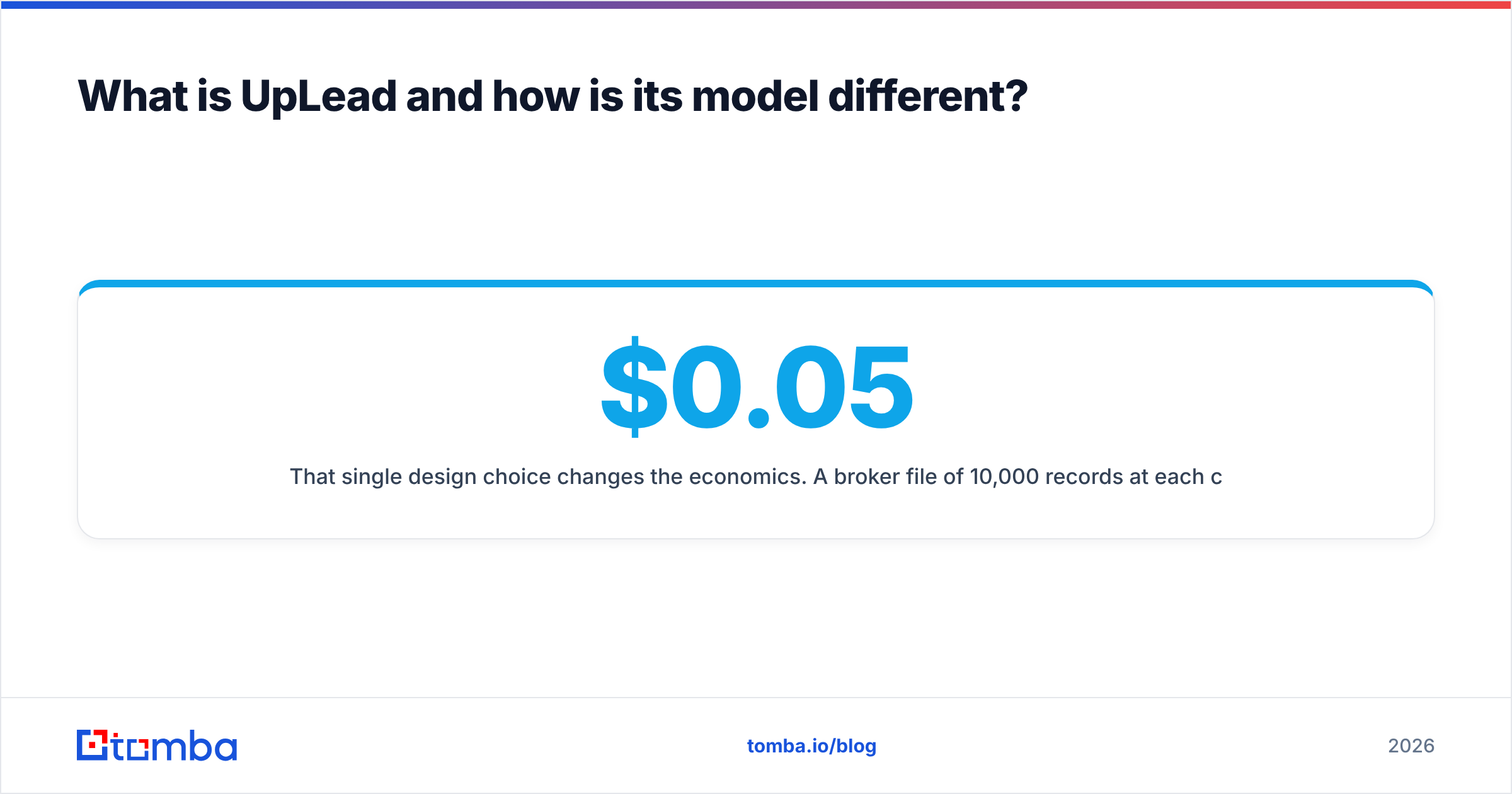
That single design choice changes the economics. A broker file of 10,000 records at $0.05 each costs $500 and might be 70% deliverable — 3,000 dead addresses hitting your sending domain. UpLead charges roughly $0.58 per credit on its entry plan, but you only burn the credit on a live-verified hit. Higher unit price, lower waste, dramatically lower bounce risk.
The trade-offs are real. UpLead's credits are use-it-or-lose-it on monthly plans (they roll over on annual). Its coverage skews North American and mid-market SaaS. And phone/mobile data sits behind higher tiers. Independent reviews on G2 consistently praise accuracy while flagging credit burn on broad searches.
Exact Data vs UpLead: how do they compare on the numbers?#
Here is the head-to-head on the attributes that actually change a buying decision. Tomba is included as a third column because most teams evaluating these two are really asking "what's the cheapest way to get valid emails at scale?"
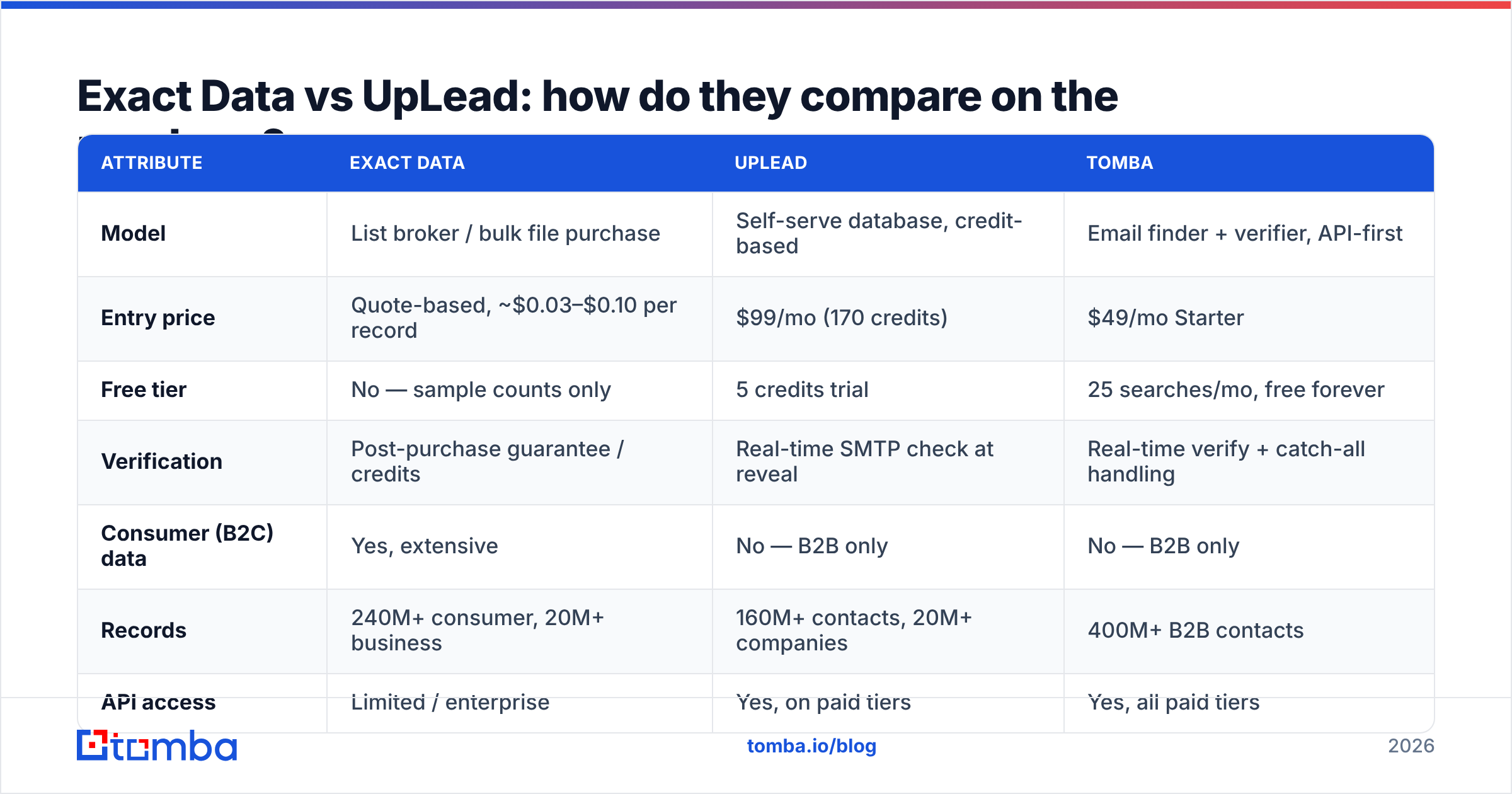
| Attribute | Exact Data | UpLead | Tomba |
|---|---|---|---|
| Model | List broker / bulk file purchase | Self-serve database, credit-based | Email finder + verifier, API-first |
| Entry price | Quote-based, ~$0.03–$0.10 per record | $99/mo (170 credits) | $49/mo Starter |
| Free tier | No — sample counts only | 5 credits trial | 25 searches/mo, free forever |
| Verification | Post-purchase guarantee / credits | Real-time SMTP check at reveal | Real-time verify + catch-all handling |
| Consumer (B2C) data | Yes, extensive | No — B2B only | No — B2B only |
| Records | 240M+ consumer, 20M+ business | 160M+ contacts, 20M+ companies | 400M+ B2B contacts |
| API access | Limited / enterprise | Yes, on paid tiers | Yes, all paid tiers |
| Bulk processing | Native (that's the product) | CSV enrichment, credit-metered | Bulk finder + bulk verifier |
| Best for | Direct mail, telemarketing, B2C | B2B cold email, ICP-filtered lists | Domain-level sourcing + verification at scale |
| Worst for | Cold email deliverability | Cheap high-volume list buys | Consumer/B2C audiences |
Two things jump out. First, these products barely overlap in intended channel — comparing them straight across is a category error most "X vs Y" posts commit. Second, the per-contact economics only make sense once you price in bounce cost.
Which one protects your deliverability better?#
UpLead, decisively — and it isn't close.
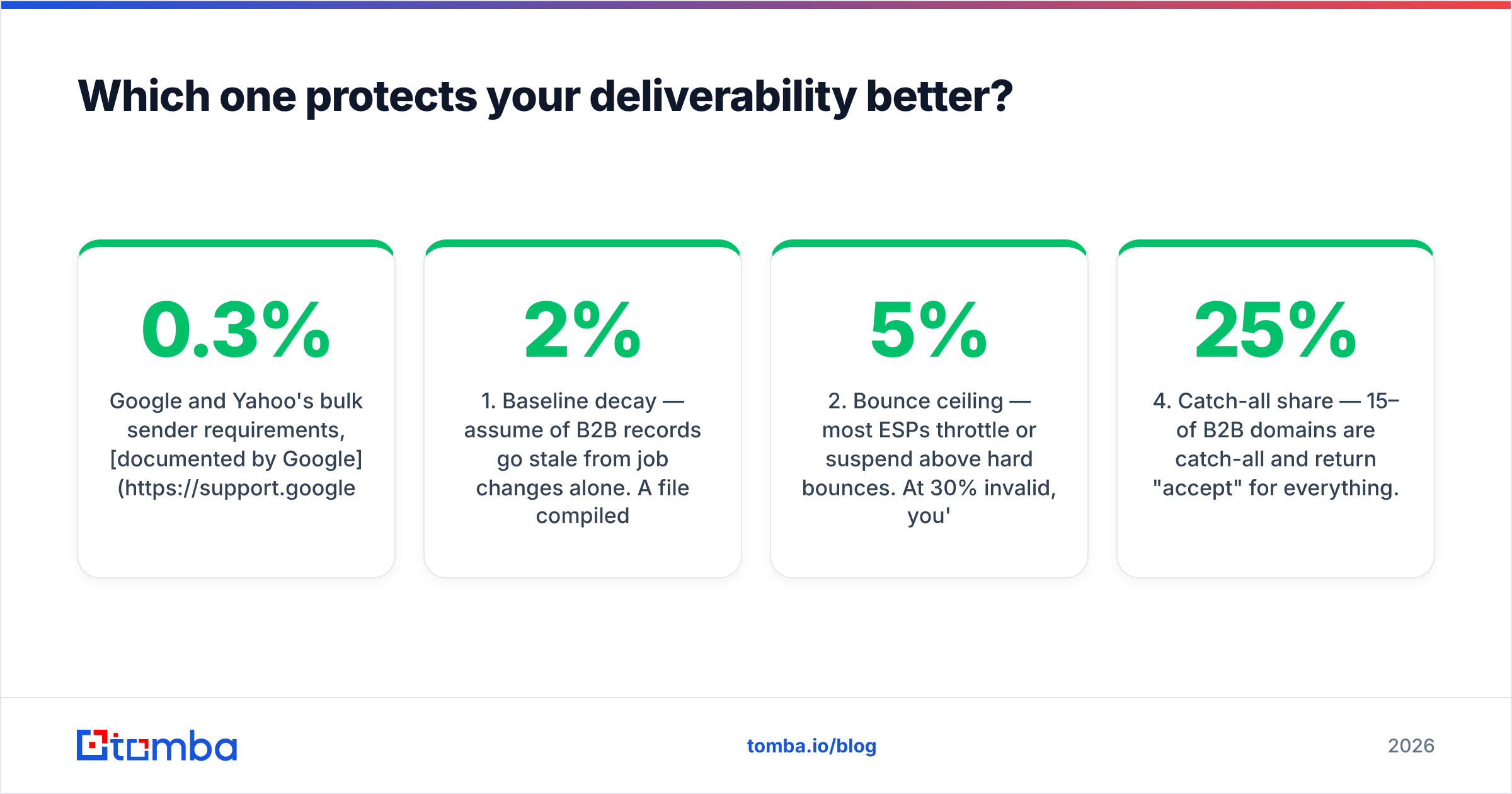
Google and Yahoo's bulk sender requirements, documented by Google, hold you under a 0.3% spam complaint rate and penalize high bounce volume. A purchased static file routinely runs 15–30% invalid after twelve months of natural decay: people change jobs at roughly 20% annually, companies rebrand domains, catch-all servers flip to reject-all. Push that file into a cold sequence and you burn the domain before campaign two.
The math to run before any list purchase:
- Baseline decay — assume 2% of B2B records go stale per month from job changes alone. A file compiled 18 months ago is ~30% dead before anyone touched it.
- Bounce ceiling — most ESPs throttle or suspend above 5% hard bounces. At 30% invalid, you're suspended in the first send.
- Re-verification cost — running 10,000 purchased records through an email verifier costs a few dollars and is non-optional. Budget it into the list price, not after.
- Catch-all share — 15–25% of B2B domains are catch-all and return "accept" for everything. A basic SMTP check calls these valid. You need a catch-all verifier to separate real mailboxes from black holes.
- Warmup runway — a fresh sending domain needs 3–4 weeks of ramp regardless of list quality. Buying volume you can't send doesn't accelerate anything.
Point four is where a lot of "verified" lists quietly fail. Vendors that report catch-all domains as valid inflate their accuracy stat without delivering a single extra inbox placement.
Is Exact Data ever the right choice over UpLead?#
Yes, in three situations.
You're running direct mail or postal campaigns. UpLead doesn't sell postal-optimized consumer files. Exact Data does, at volumes and price points a SaaS database can't touch. A wrong address costs you print and postage — a contained, predictable loss.
You need B2C audiences. Homeowners in three ZIP codes with income over $150k, or new-mover lists for a local services business. UpLead is B2B-only by design; this request is outside its product entirely.
You need 100,000+ records in a single transaction. Credit-based platforms make large one-time pulls expensive and slow. Brokers are built for exactly this, and the per-record price falls sharply with volume.
Outside those three, UpLead wins on the metric that determines whether outbound works at all: does the message reach a human.
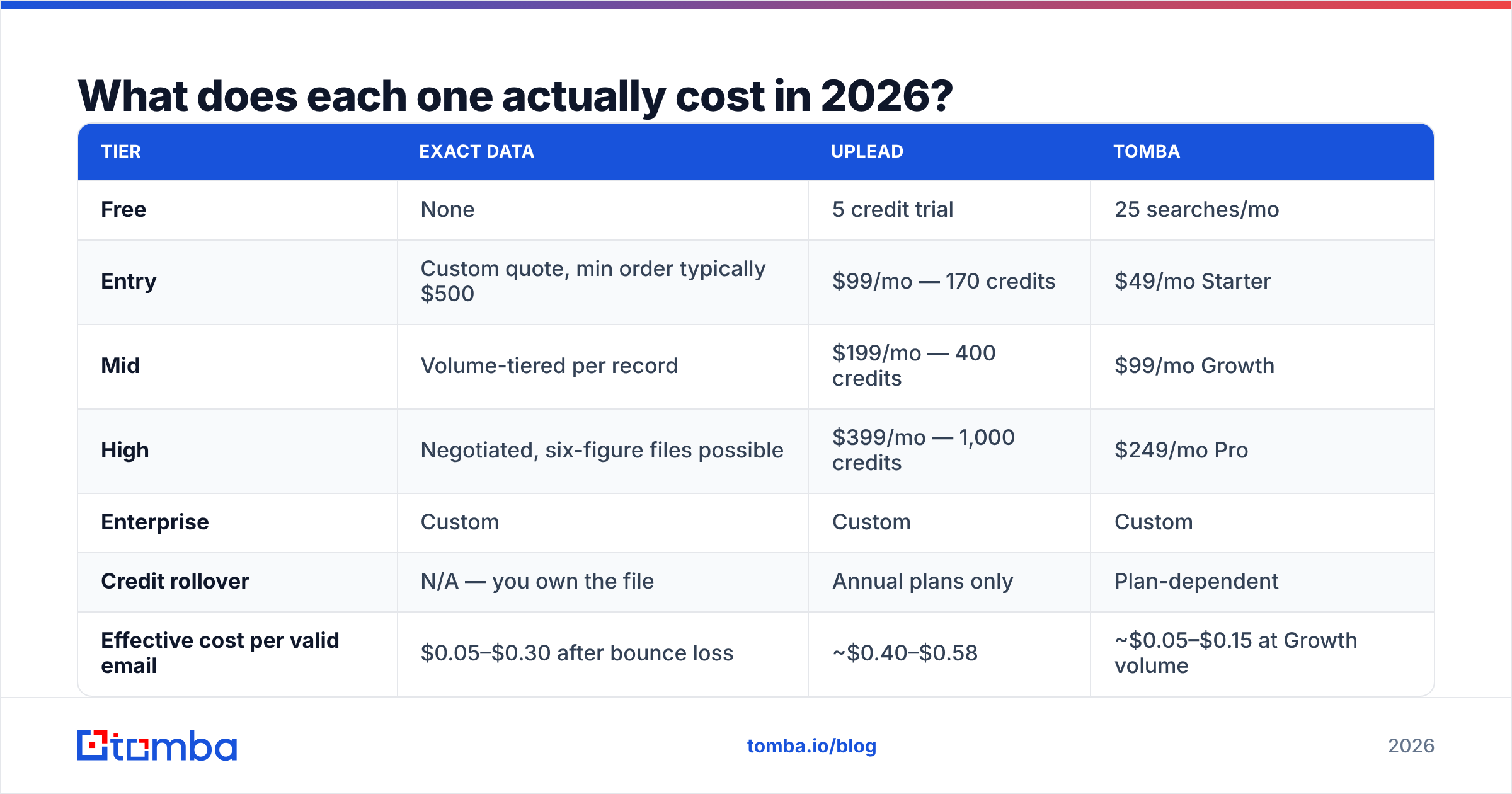
What does each one actually cost in 2026?#
| Tier | Exact Data | UpLead | Tomba |
|---|---|---|---|
| Free | None | 5 credit trial | 25 searches/mo |
| Entry | Custom quote, min order typically $500 | $99/mo — 170 credits | $49/mo Starter |
| Mid | Volume-tiered per record | $199/mo — 400 credits | $99/mo Growth |
| High | Negotiated, six-figure files possible | $399/mo — 1,000 credits | $249/mo Pro |
| Enterprise | Custom | Custom | Custom |
| Credit rollover | N/A — you own the file | Annual plans only | Plan-dependent |
| Effective cost per valid email | $0.05–$0.30 after bounce loss | ~$0.40–$0.58 | ~$0.05–$0.15 at Growth volume |
That bottom row is the one to argue about. Exact Data's headline per-record price looks unbeatable until you divide by the share that actually delivers — a $0.05 record that's 60% valid is really $0.083, before the cost of re-verification and the reputational damage of the failures. Full Tomba pricing is public, which is itself a differentiator in a category where "contact sales" is the norm.
How do you decide between them for your team?#
Match the tool to the channel, not to the feature list.
- Cold email, B2B, ICP-driven, under 5,000 contacts/mo → UpLead. Real-time verification is worth the premium, and the filter depth is genuinely good.
- Direct mail, telemarketing, or any B2C audience → Exact Data. UpLead can't serve this and won't pretend to.
- You already know your target accounts and need contacts at those domains → neither. You want a domain search that returns every published address at a company, plus verification, for a fraction of database pricing.
- You're enriching an existing CRM list with missing emails → an enrichment API, not a database subscription. Paying for a search UI you never open is waste.
- You need programmatic access inside a workflow → check API access before you buy. Broker files aren't APIs, and database platforms often gate the API behind higher tiers.
The fourth and fifth cases describe more teams than vendors like to admit. If you have a list of 2,000 target companies from a conference, a funding-round tracker, or your CRM, you don't need a 160M-contact search index. You need a function that turns company.com + Jane Doe into a verified address — that's what an email finder API does, and it costs an order of magnitude less than a seat-based database.
What about accuracy claims — can you verify them?#
Treat every published accuracy number as a marketing claim until you test it yourself. Vendors compute accuracy differently: some count catch-all accepts as valid, some exclude records they declined to return, some measure at compile time rather than delivery time.
The only honest test is a bake-off you run:
- Pull 100 contacts you can independently confirm — your own customers, LinkedIn connections, people whose addresses appear on their company site.
- Run the same 100 through each candidate vendor.
- Score three buckets: correct, wrong, and not found. Do not let "not found" hide inside the accuracy denominator — a tool that returns nothing 40% of the time can claim 98% accuracy on the 60% it answers.
- Send a small warm batch and measure actual bounce rate. This is the only number that matters.
Run this before signing an annual contract. It takes an afternoon and routinely reorders the shortlist. Vendors that publish where their data comes from tend to survive this test better than those that don't.
What's the honest verdict?#
UpLead beats Exact Data for B2B cold email. Real-time verification, transparent self-serve pricing, and no minimum order make it the safer buy for anyone whose primary channel is the inbox. The $99/mo entry point is steep per credit, but credits you don't waste on dead records are credits you didn't really pay a premium for.
Exact Data beats UpLead for volume, B2C, and non-email channels. If you're mailing, calling, or targeting consumers, UpLead isn't a substitute at any price.
Neither is optimal if your workflow is domain-first. Teams that already know their accounts — from ABM lists, funding data, review-site scrapes, or their own CRM — are buying a search interface they don't need. Point an email finder at the domains you already have, verify the results, and skip the database subscription entirely.
Where does Tomba fit?#
Tomba isn't a list broker and isn't a 160M-record search index. It's the layer underneath both: given a domain, a name, or a LinkedIn profile, return a verified professional email — via web app, API, CLI, Chrome extension, or Google Sheets.
That's the right shape when your target list already exists and the missing piece is contact data. Start on the free tier at 25 searches per month, test it against your own 100-contact bake-off, and move to Starter at $49/mo — half UpLead's entry price — if the accuracy holds up. Try the Tomba Email Finder and score it against whatever you're paying for today.
Related guides#
Ready to find emails that actually work?
Join 150,000+ professionals who stopped guessing and started sending. Free credits on signup — no credit card required.
Get the Tomba newsletter
Practical outbound tactics and product updates — once every two weeks.
About the author