Exact Data vs Warpleads (2026): Which B2B Lead Source Wins?
Exact Data sells brokered lists by the record. Warpleads sells unlimited exports by the month. They fail in completely different ways — here is which one fits your outbound, and the third option most teams end up on.
TL;DR
- Exact data vs warpleads is not an apples-to-apples fight. Exact Data is a list broker. Warpleads is a subscription lead database.
- Exact Data sells you a one-time file. You brief a rep, they pull a segment, you get a CSV. Great for postal mail. Awkward for modern cold email.
- Warpleads sells volume. Its pitch is unlimited exports on a flat monthly fee. That changes the cost of list building. It does not fix data quality.
- Neither vendor removes your verification step. Static files decay 2–3% per month. Unlimited exports just let you download that decay faster.
- Cost per usable contact is the only metric that matters. A $0.15 record at a 70% deliverable rate really costs $0.21. A cheap export at 55% can cost you your sending domain.
- The pragmatic 2026 stack is a narrow ICP list from either vendor. Run it through a real-time finder and verifier before you send.
What are Exact Data and Warpleads, actually?#
They are not the same kind of company. Most comparison pages get that wrong.
Exact Data is a Chicago-based direct-marketing data company. It has been in the list business for about two decades. Its model is a classic list broker and compiler hybrid.
It gathers consumer and business files from public records, surveys, subscription data, sign-up forms, and other compilers. Then it sells you a slice of that pool.
The buying flow is human. You talk to a salesperson and describe your target: SIC code, employee count, geography, job function. You get a count and a quote, then a file. Postal addresses are a first-class citizen here. Email and phone cost extra per record.
Warpleads is a newer, self-serve B2B lead platform. It is built for cold-email operators.
Its differentiator is the export model. Rather than metering credits tightly, it markets unlimited or very high-volume exports on a monthly plan. It also enriches lists you bring yourself. The typical buyer is an agency or SDR team running many inboxes and burning tens of thousands of contacts a month.
So the honest framing of exact data vs warpleads is not "which database is better." It is simpler. Do you want a curated, brokered, multichannel file? Or a high-volume self-serve faucet?
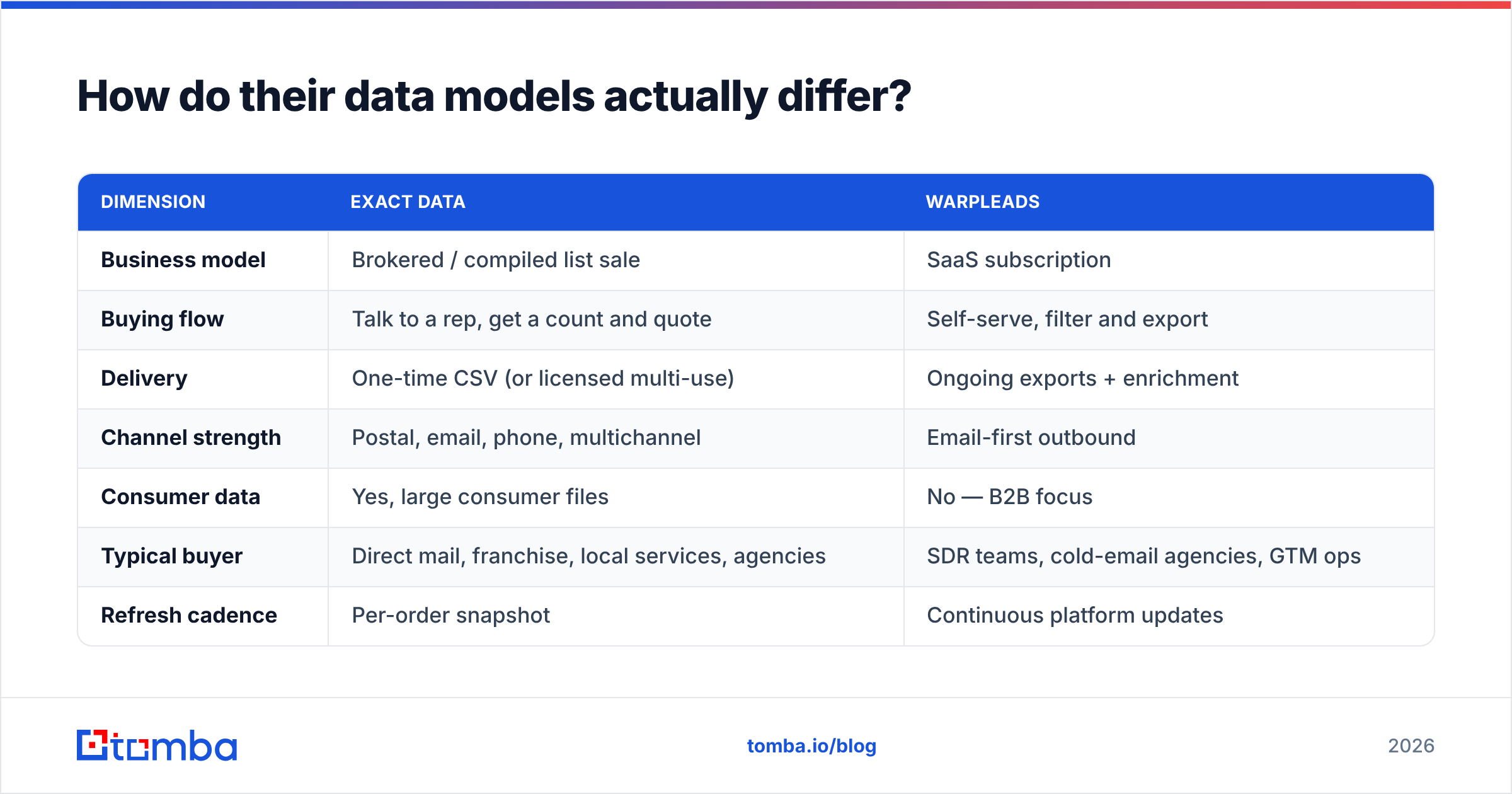
Exact data vs warpleads: how the data models differ#
| Dimension | Exact Data | Warpleads |
|---|---|---|
| Business model | Brokered / compiled list sale | SaaS subscription |
| Buying flow | Talk to a rep, get a count and quote | Self-serve, filter and export |
| Delivery | One-time CSV (or licensed multi-use) | Ongoing exports + enrichment |
| Channel strength | Postal, email, phone, multichannel | Email-first outbound |
| Consumer data | Yes, large consumer files | No — B2B focus |
| Typical buyer | Direct mail, franchise, local services, agencies | SDR teams, cold-email agencies, GTM ops |
| Refresh cadence | Per-order snapshot | Continuous platform updates |
| Minimum commitment | Order minimums common | Monthly plan |
| API access | Limited / enterprise | Yes, for enrichment workflows |
The practical result is easy to state. Exact Data wins when your campaign has a physical piece. It also wins when you need consumer traits no B2B tool carries.
Warpleads wins when the bottleneck is different: "I need 40,000 more SaaS founders in the US by Thursday."
That split also decides how each one fails.
A brokered file fails silently. You get 10,000 rows, they look fine, and 30% of the email column has been dead since 2023.
An unlimited-export platform fails loudly. You dump 50,000 contacts, blast them, and your bounce rate tells you within the hour.
What does exact data vs warpleads cost in 2026?#
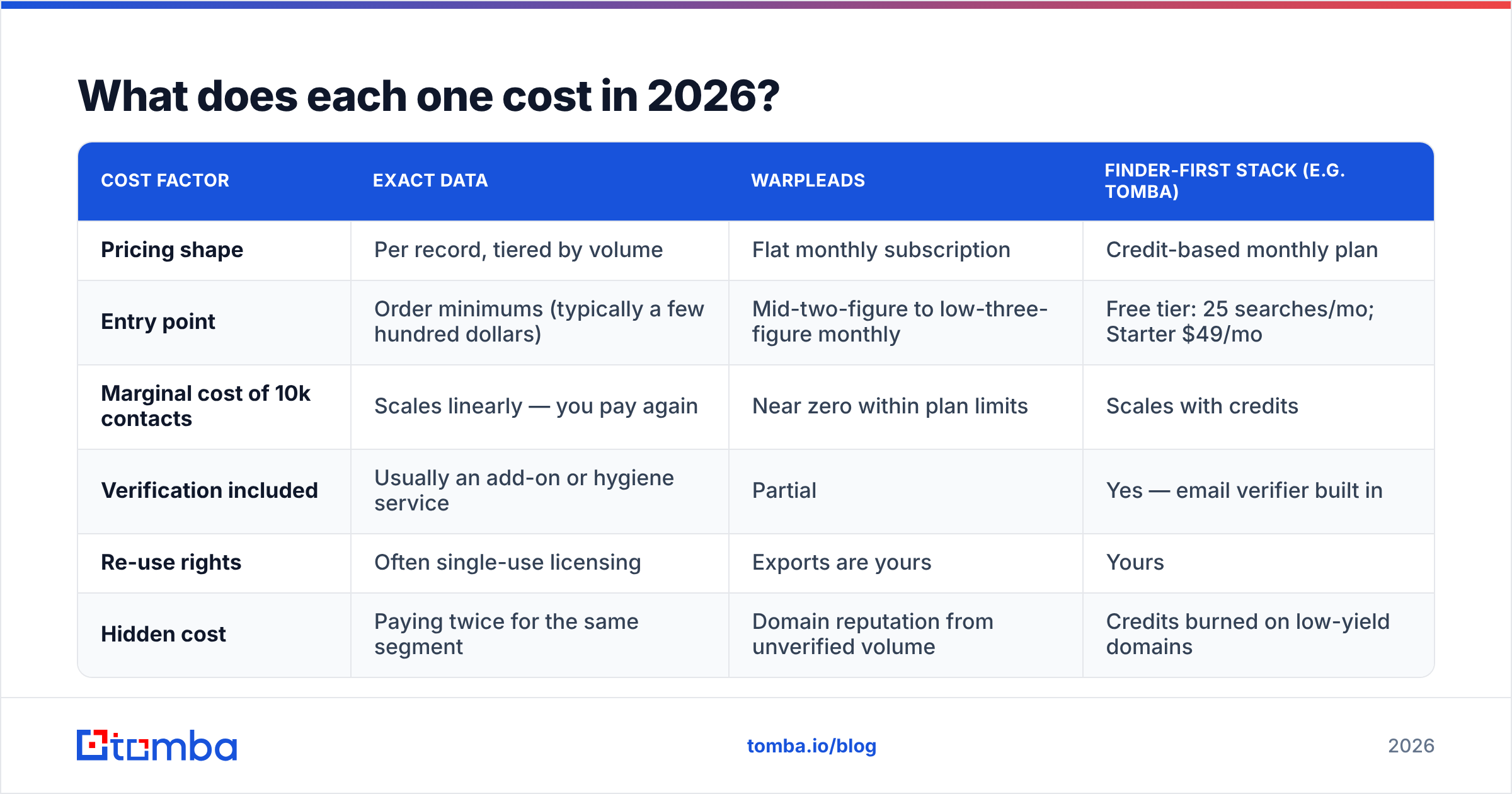
Neither vendor publishes a clean public price grid. Treat the numbers below as directional. Confirm with each vendor before you commit budget.
| Cost factor | Exact Data | Warpleads | Finder-first stack (e.g. Tomba) |
|---|---|---|---|
| Pricing shape | Per record, tiered by volume | Flat monthly subscription | Credit-based monthly plan |
| Entry point | Order minimums (typically a few hundred dollars) | Mid-two-figure to low-three-figure monthly | Free tier: 25 searches/mo; Starter $49/mo |
| Marginal cost of 10k contacts | Scales linearly — you pay again | Near zero within plan limits | Scales with credits |
| Verification included | Usually an add-on or hygiene service | Partial | Yes — email verifier built in |
| Re-use rights | Often single-use licensing | Exports are yours | Yours |
| Hidden cost | Paying twice for the same segment | Domain reputation from unverified volume | Credits burned on low-yield domains |
Most exact data vs warpleads comparisons stop at the sticker price. That is the wrong number.
The metric that matters is cost per usable contact, not cost per row. Run the math on your own data.
- Start with the raw price per record. Exact Data at $0.12 per record for 10,000 records is $1,200. Warpleads at a flat $99 a month works out to about $0.0099 per record. That is a 12x nominal advantage.
- Apply the deliverable rate. Say the brokered file verifies at 78% and the bulk export at 58%. Your real costs become $0.154 and $0.017. The gap narrows, but the bulk export still wins on price.
- Add the verification pass. Both files need one. Budget roughly $0.003 to $0.008 per check, based on your provider and volume.
- Price the reputation risk. This is where cheap gets expensive. Every 1% of bounces above the 2% line pushes you toward spam filtering. A burned domain costs weeks of warmup plus lost pipeline.
- Divide by reply-rate quality. A tight brokered segment can out-reply a generic export by 2–3x. That flips the cost-per-meeting math, even when cost per contact favors volume.
Do that arithmetic before you argue about price. Most teams find the two vendors land within 30% of each other on cost per booked meeting. The invoice gap can still be 10x.
How accurate is the data on each side?#
Accuracy is where both models get uncomfortable. Independent measurement beats vendor claims every time.

Watch for three failure modes.
Staleness. B2B contact data decays 2–3% per month. People change jobs. Companies rebrand, move domains, or cut staff. A file built in Q3 and sold to you in Q1 is already 15–18% wrong. Exact Data snapshots at order time, so the decay clock starts on delivery day. Warpleads updates all the time. But "the platform is updated" is not the same as "your record was re-checked this month."
Pattern-guessed emails. Many databases fill gaps by guessing first.last@domain.com from a name and a company. That guess lands maybe 60–70% of the time at firms with one clear format. It is far worse elsewhere. If a vendor cannot tell you whether an email was seen or guessed, assume guessed. Tomba's data sources page shows the kind of sourcing detail you should demand.
Catch-all masking. Many B2B domains accept every address at the SMTP layer. A naive verifier marks them "valid," and the bounce shows up two weeks later. Both vendors will count those as deliverable. A dedicated catch-all verifier is the only way to tell real inboxes from black holes.
None of this is unique to these two vendors. It is the normal state of bought B2B data in 2026. So the useful question in exact data vs warpleads is not "whose file is cleanest." It is "what does my pipeline do to the file before I send?"
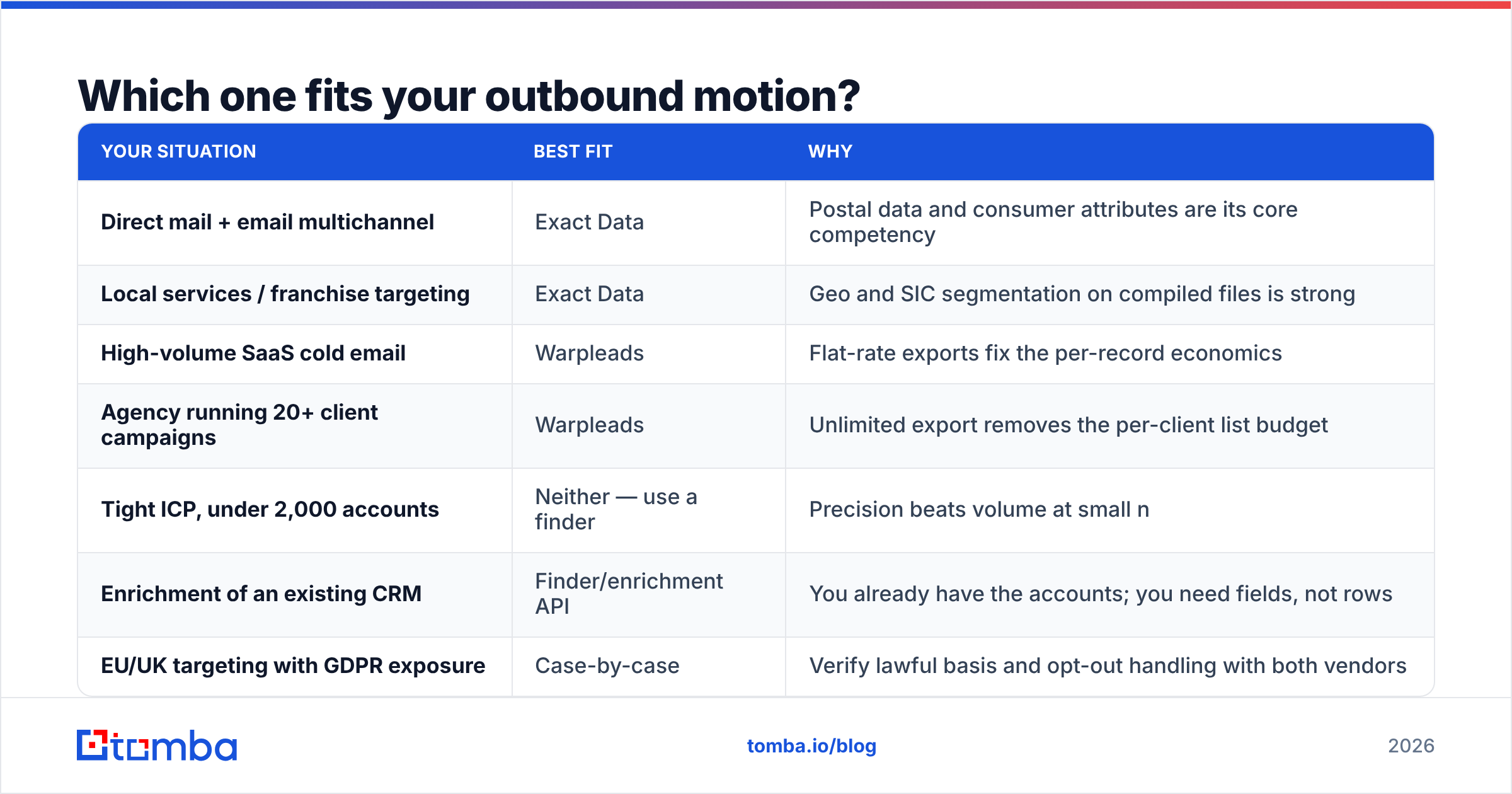
Which one fits your outbound motion?#

| Your situation | Best fit | Why |
|---|---|---|
| Direct mail + email multichannel | Exact Data | Postal data and consumer attributes are its core competency |
| Local services / franchise targeting | Exact Data | Geo and SIC segmentation on compiled files is strong |
| High-volume SaaS cold email | Warpleads | Flat-rate exports fix the per-record economics |
| Agency running 20+ client campaigns | Warpleads | Unlimited export removes the per-client list budget |
| Tight ICP, under 2,000 accounts | Neither — use a finder | Precision beats volume at small n |
| Enrichment of an existing CRM | Finder/enrichment API | You already have the accounts; you need fields, not rows |
| EU/UK targeting with GDPR exposure | Case-by-case | Verify lawful basis and opt-out handling with both vendors |
| You need phone as well as email | Exact Data or a dedicated phone finder | Bulk email exports rarely carry reliable direct dials |
One more point rarely makes an exact data vs warpleads write-up: licensing.
Brokered lists are often sold single-use or time-limited. Read the license before you buy. It matters if you plan to keep contacts in your CRM, re-market every quarter, or resell enriched data to clients.
Subscription platforms usually grant broader rights to what you export. For an agency, that is a real advantage.
What do buyers actually complain about?#
Look past the marketing pages. On review sites like G2, the same themes repeat across this whole category:
- Counts shrink after suppression. You are quoted 14,000 records. After deduping against your CRM and dropping role accounts and catch-alls, you have 6,800 sendable contacts. Ask for the count after deliverable filtering, not before.
- Job-title mismatch. Titles in compiled files are often the title at capture time. A "VP of Marketing" from 2023 may be a director somewhere else now.
- Support is lopsided. Brokers give you a human, but turnaround is slow. Self-serve platforms give you instant access, then ticket-based support when an export is wrong.
- Refund friction on data quality. Most vendors offer a bounce credit above a stated threshold. But you often must verify with their preferred tool and submit logs inside a short window. Read that clause before you buy.
Do you even need a bulk list vendor?#
Here is the uncomfortable question. If your ICP is 1,500 accounts, a 50,000-row database is not leverage. It is noise you now have to filter.
Many teams comparing exact data vs warpleads would get better results building the list from the account side:
- Define the account list first. Pull it from an intent source, a funding tracker, a conference page, a tech-stack query, or your own closed-lost deals. No vendor can do this for you.
- Resolve contacts per account. Use domain search to see who works there and what the company's email pattern is.
- Find the specific people you named. An email finder keyed to first name, last name, and domain returns a confidence score and sources. That is the difference between a lead and a guess.
- Verify everything, catch-alls included. This one is non-negotiable. A bounce rate above 2% is a deliverability problem, not a data problem you can apologize for later.
- Enrich the survivors. Add firmographics, tech stack, and LinkedIn URLs with data enrichment so your copy has something concrete to use.
- Push to your sequencer in batches. Small, verified, well-segmented batches beat one giant import. They also make attribution readable.
This workflow costs less than most people assume. On Tomba's pricing, the Free tier gives you 25 searches a month. Starter is $49/mo, Growth is $99/mo, and Pro is $249/mo. The bulk email finder handles the batches that justify it.
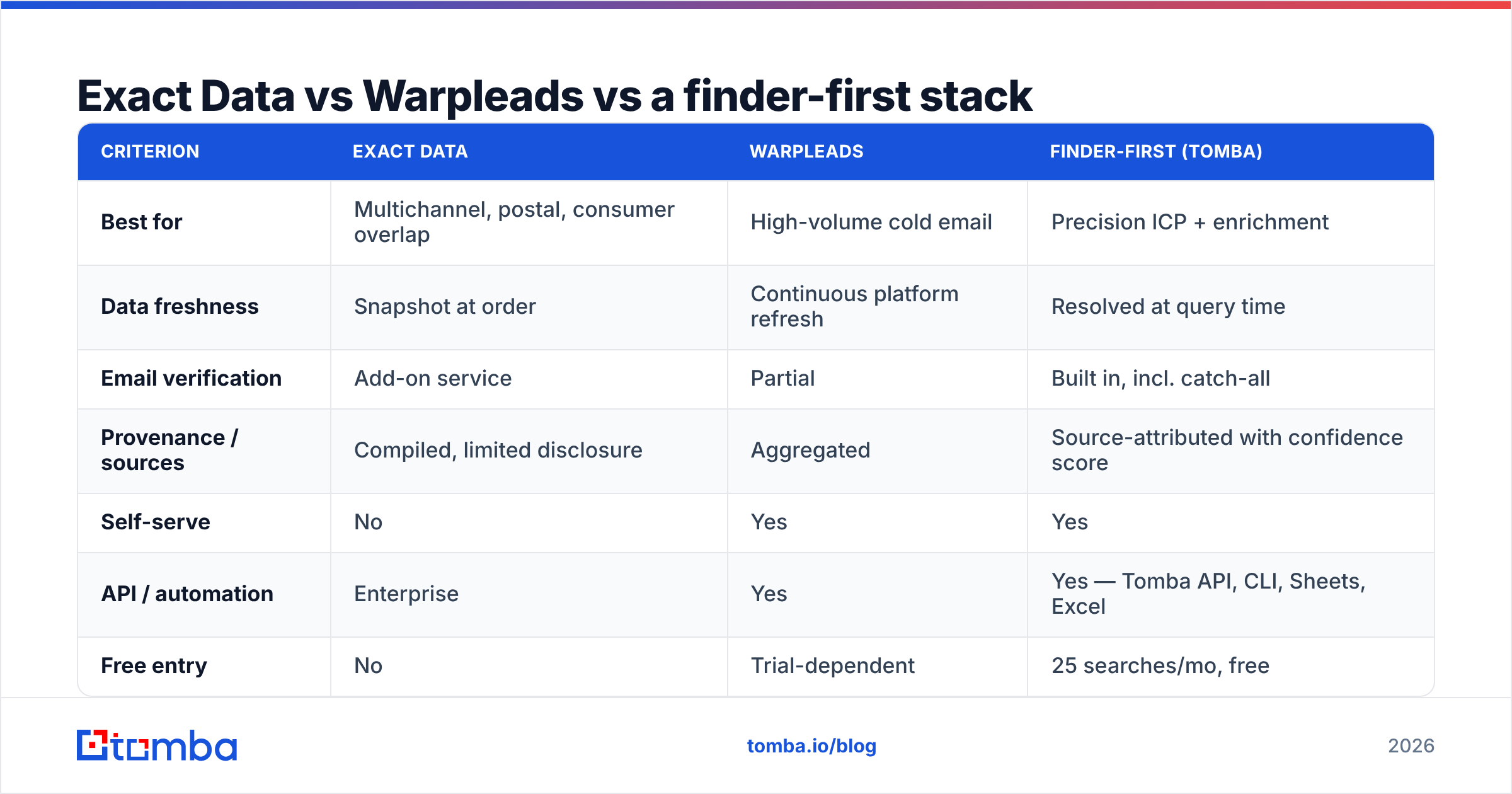
Exact Data vs Warpleads vs a finder-first stack#
| Criterion | Exact Data | Warpleads | Finder-first (Tomba) |
|---|---|---|---|
| Best for | Multichannel, postal, consumer overlap | High-volume cold email | Precision ICP + enrichment |
| Data freshness | Snapshot at order | Continuous platform refresh | Resolved at query time |
| Email verification | Add-on service | Partial | Built in, incl. catch-all |
| Provenance / sources | Compiled, limited disclosure | Aggregated | Source-attributed with confidence score |
| Self-serve | No | Yes | Yes |
| API / automation | Enterprise | Yes | Yes — Tomba API, CLI, Sheets, Excel |
| Free entry | No | Trial-dependent | 25 searches/mo, free |
| Where it breaks | Stale rows, single-use licensing | Volume without precision | Not a substitute for account research |
Want a fourth option? BookYourData is a solid pay-as-you-go choice. It suits teams that want brokered-style B2B contact data without a subscription. It sits between the two vendors here, so request a quote alongside them.
Exact data vs warpleads: what should you do next?#
Run a controlled test instead of a debate.
Pick 500 accounts you genuinely want. Order or export those same accounts from both vendors. Then build a third list yourself with a finder. Run all three files through the same verifier and the same suppression rules.
Now compare four numbers: sendable rate, bounce rate, reply rate, and cost per booked meeting. That test costs a few hundred dollars. It settles exact data vs warpleads for your ICP, permanently.
For most B2B teams in 2026, the winner is not one vendor. It is a narrow account list you control, resolved contact by contact, and verified before send. Start with the Tomba Email Finder. The free tier covers 25 searches — enough to check whether a vendor's file is telling you the truth about the accounts you care about most.
Related guides#
Ready to find emails that actually work?
Join 150,000+ professionals who stopped guessing and started sending. Free credits on signup — no credit card required.
Get the Tomba newsletter
Practical outbound tactics and product updates — once every two weeks.
About the author