ExactVerify Pricing Review: Costs, Pros and Cons (2026)
A neutral breakdown of ExactVerify pricing, what real reviewers say about accuracy and support, and the pros and cons that matter before you move your list verification to it.
This ExactVerify pricing review covers three things: what the credits cost, how accurate the tool is, and who it suits. Here is the short version first.
TL;DR
- ExactVerify is a bulk email verification service with credit-based pricing. You buy credits, upload a list or call the API, and pay per address checked.
- The pricing model suits spiky workloads. There is no monthly seat to pay for if you only clean a list once a quarter.
- The weak point is scope. ExactVerify checks emails, but it does not find them. If you need discovery and validation, you pay two vendors.
- Reviews are thin next to ZeroBounce or NeverBounce. Treat any accuracy number, theirs or a rival's, as a claim to test.
- Run a 500-address control list through any verifier first. That one test tells you more than every review page combined.
What is ExactVerify?#
ExactVerify is an email verification tool. You give it a list of addresses. It tells you which ones are deliverable and which will hard bounce. It also flags role accounts (info@, sales@), disposable addresses, and catch-all domains. On a catch-all domain, no verifier can give a firm answer over SMTP.
That is the whole job. It is a narrow product, and narrow is not an insult. Verification is a fiddly problem, and many sales platforms do it badly as a bolt-on. A dedicated verifier runs its own SMTP infrastructure. It rotates IPs so mailbox providers do not throttle the probes. It keeps a disposable-domain blocklist current. It also handles the greylisting and tarpitting that make naive checks return garbage.
What ExactVerify does not do is prospecting. There is no way to say "give me the marketing directors at these 400 companies." You bring the list. That gap drives most of the cost analysis below. The real question is rarely "is this verifier cheap?" It is "what does my whole find-plus-verify stack cost per usable contact?"
You can check the current feature set on the official ExactVerify site. That is also the only reliable source for live pricing. Verification vendors change their rate cards more often than most SaaS categories.
ExactVerify pricing review: how do the credits work?#
Credit-based, with volume discounts. That is the short version, and it is standard for this category. Here is how the model behaves in practice.
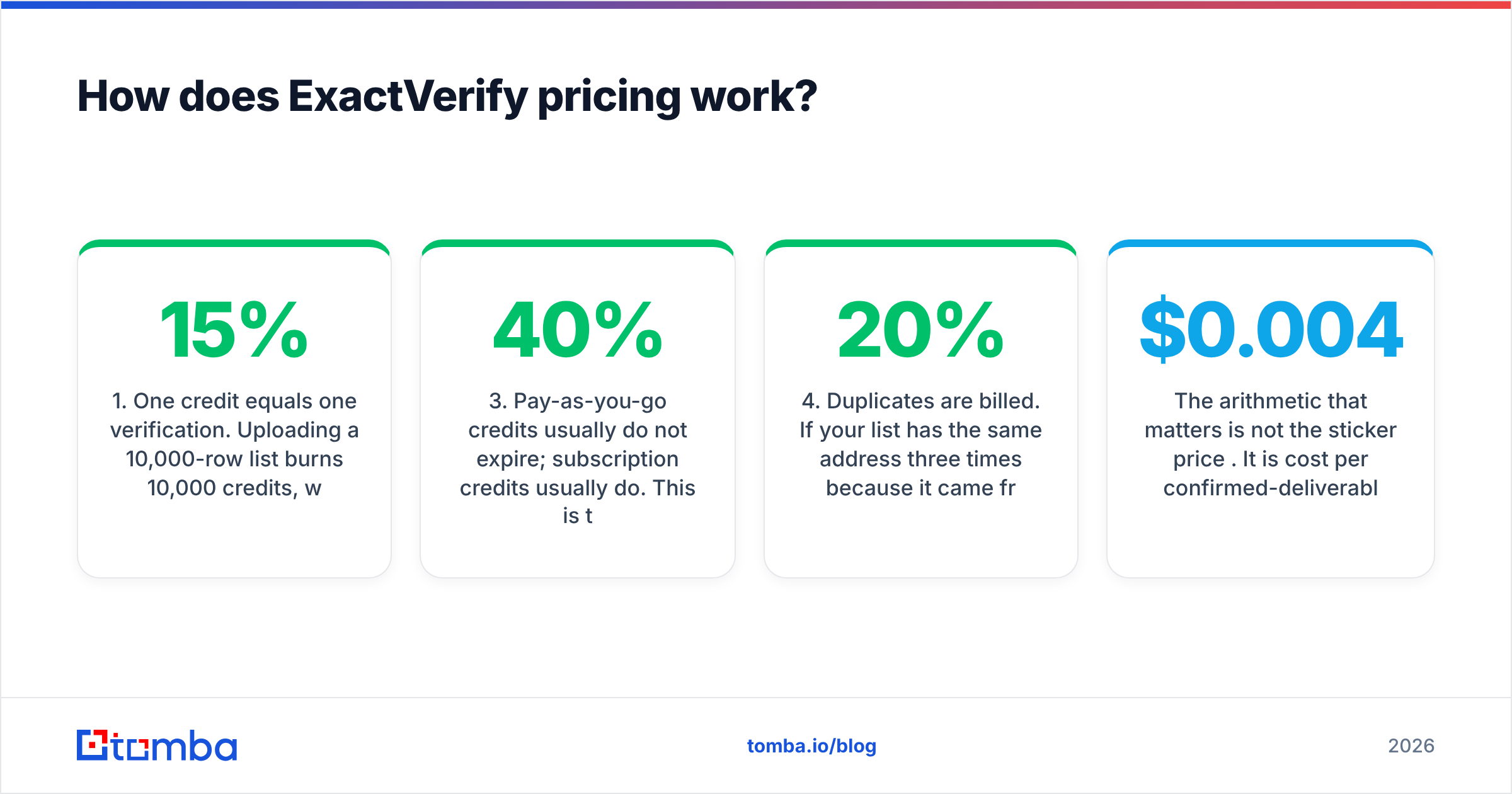
- One credit equals one verification. A 10,000-row list burns 10,000 credits. You pay whether the result is "valid," "invalid," or "unknown." Some vendors refund unknowns. Most do not. Ask before you buy, because unknowns can hit 8–15% of a messy file.
- Unit price falls as volume rises. Small packs sit in the sub-cent range, and large packs go well below that. The gap between the smallest and largest tier is usually 3–5x. Buying in dribs is the most expensive way to use any verifier.
- Pay-as-you-go credits usually last; subscription credits usually expire. This is the biggest hidden cost in the category. A monthly plan you use at 40% capacity is a plan you overpaid for by 60%.

Three more line items catch people out.
- Duplicates are billed. If the same address appears three times because it came from three exports, you pay three times. Deduplicate first. A remove duplicates pass costs nothing and can cut 5–20% off a verification bill.
- API calls and dashboard uploads draw from the same pool. That is good news, because there is no separate API tier to buy. It also means an automation loop with a retry bug can drain your balance overnight. Cap it.
- Free trial credits exist, and they are small. They are enough to sanity-check the interface, not enough to benchmark accuracy. Plan to spend real money on a real test.
The arithmetic that matters is not the sticker price per credit. It is cost per confirmed-deliverable contact. Say one verifier charges $0.004 per check but returns 30% "unknown" on your list. It costs more than a $0.007 tool that resolves the same list cleanly. Those unknowns either bounce when you send to them, or you throw them away and paid for nothing.
What do ExactVerify reviews actually say?#
Cautiously positive, and sparse. Search the email verification category on G2 or Capterra. You will find hundreds of reviews for ZeroBounce, NeverBounce, and Bouncer, and a much thinner file for ExactVerify. That is a signal about market share, not always about quality. It does mean you have less crowd data to lean on.
A few themes recur in the reviews that do exist.
What reviewers like:
- Speed on bulk uploads. Large files come back in minutes rather than hours. That matters when verification sits inside a same-day campaign workflow.
- Simple interface. Upload, map a column, download. No onboarding call required.
- No forced subscription. The pay-as-you-go path is genuinely usable, not a token option buried behind an enterprise plan.
What reviewers complain about:
- Catch-all ambiguity. Every verifier struggles here. Reviewers still want more detail than a flat "unknown."
- Support depth. Email-only support with a lag is fine for a $30 credit pack. It hurts when a 200,000-row job stalls.
- Reporting. The breakdown of why an address failed is thinner than what the larger vendors ship.
Read reviews structurally, not emotionally. A one-star review saying "half my list came back invalid" is usually a review of the list. A three-star review saying "unknowns were 22% and support could not explain the classification" is a real product signal.

How accurate is ExactVerify, really?#
No one can answer that from the outside. ExactVerify's own marketing page cannot either, and that is not a dig at them. Accuracy claims in this category are unfalsifiable unless the vendor publishes the test list. None of them do.
Published numbers drift from your experience for three reasons.
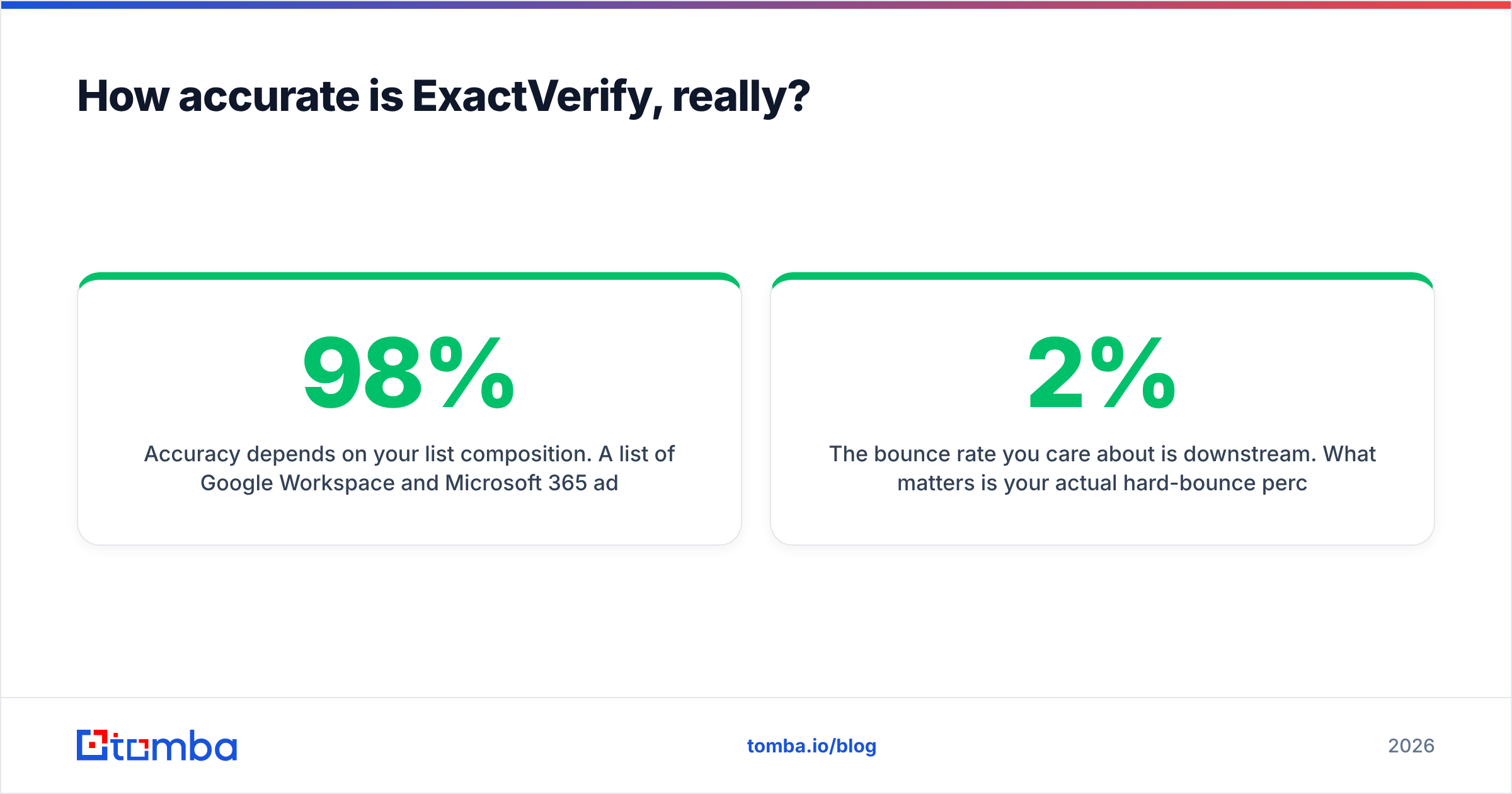
- Accuracy depends on your list. Google Workspace and Microsoft 365 addresses verify cleanly. Catch-all domains, small self-hosted mail servers, and regional providers do not. The same tool can score 98% on one list and 89% on another.
- "Valid" is a probability, not a fact. SMTP verification asks a mail server a question. That server is under no obligation to answer honestly. Anti-harvesting setups return "accept all" on purpose to defeat verification.
- The bounce rate you care about is downstream. What matters is your hard-bounce rate after you send. If the "valid" bucket bounces above 2%, the accuracy claim failed.
The honest test takes an afternoon. Assemble 300–500 addresses where you already know the truth. Use confirmed-reply contacts from your CRM, plus known-dead addresses from past bounces. Run them through the verifier. Then measure false positives and false negatives separately. False positives, meaning dead addresses marked valid, are the expensive error. False negatives only cost you reach.
Need a second opinion on a single address during that test? A free email checker lets you spot-check disagreements without burning credits.
ExactVerify vs the alternatives: how does it compare?#
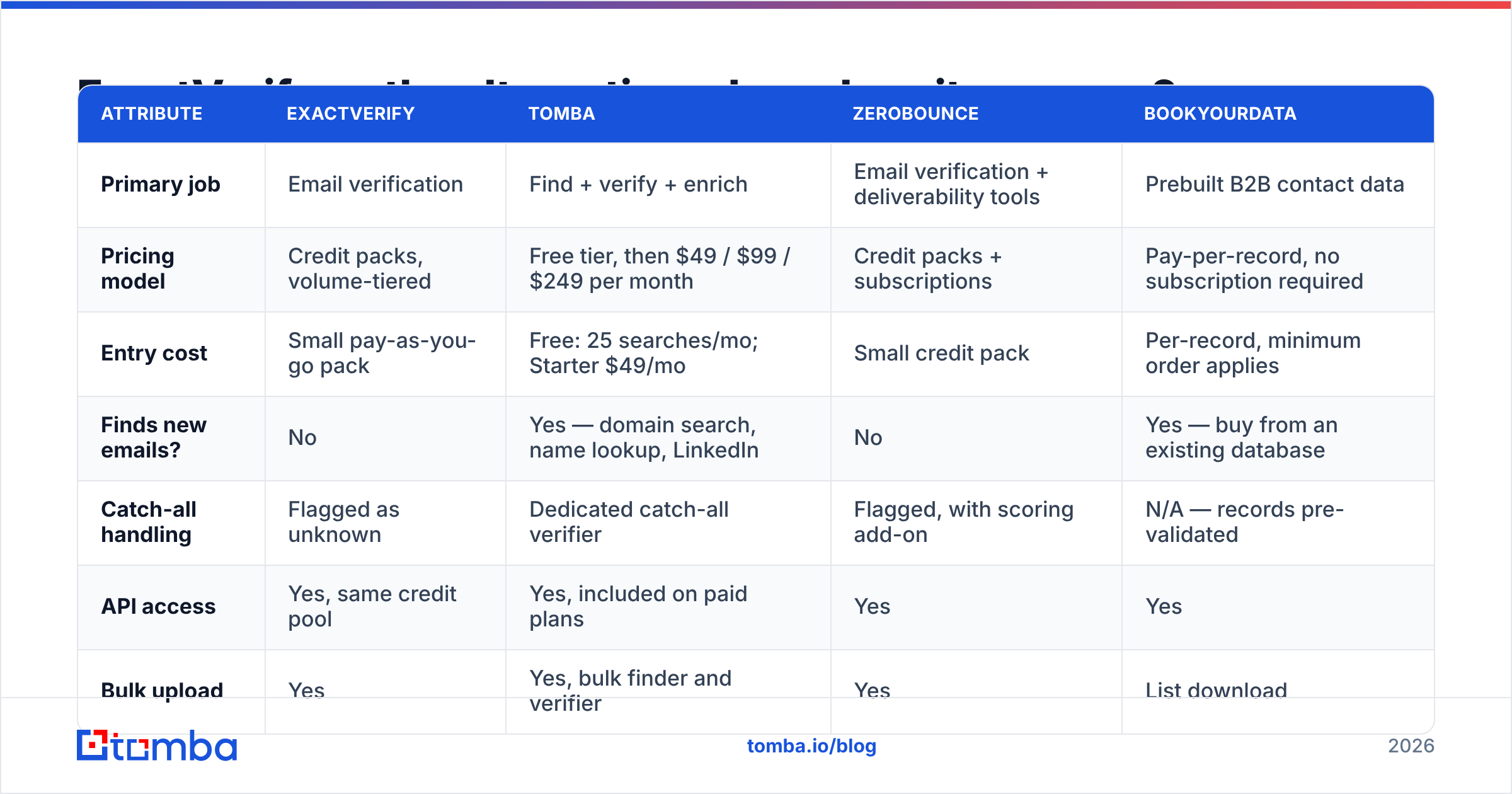
The table below compares model and scope. It is not a horse race on accuracy percentages that nobody can verify. Prices and credit rates change, so confirm on each vendor's page before you buy.
| Attribute | ExactVerify | Tomba | ZeroBounce | BookYourData |
|---|---|---|---|---|
| Primary job | Email verification | Find + verify + enrich | Email verification + deliverability tools | Prebuilt B2B contact data |
| Pricing model | Credit packs, volume-tiered | Free tier, then $49 / $99 / $249 per month | Credit packs + subscriptions | Pay-per-record, no subscription required |
| Entry cost | Small pay-as-you-go pack | Free: 25 searches/mo; Starter $49/mo | Small credit pack | Per-record, minimum order applies |
| Finds new emails? | No | Yes — domain search, name lookup, LinkedIn | No | Yes — buy from an existing database |
| Catch-all handling | Flagged as unknown | Dedicated catch-all verifier | Flagged, with scoring add-on | N/A — records pre-validated |
| API access | Yes, same credit pool | Yes, included on paid plans | Yes | Yes |
| Bulk upload | Yes | Yes, bulk finder and verifier | Yes | List download |
| Best fit | Periodic list hygiene | Teams that need discovery and validation in one stack | Enterprise deliverability programs | Teams that want a ready list, fast |
Three things fall out of that grid.
If you already have lists, ExactVerify is a reasonable line item. You are buying a utility, and utilities should be cheap and boring. Pay-as-you-go credits with no seat fee fit quarterly list hygiene well.
If you are building lists, a verifier alone is half a stack. You still need something to produce addresses. That is where the two-vendor math bites. A verification credit is cheap, but the discovery tool upstream is where the budget goes. One platform removes a step and a bill, because an email finder result arrives already validated. Tomba pricing starts free at 25 searches a month and moves to $49/mo, covering find, verify, and enrich in one place.
If you want to skip discovery, buy records instead. A curated database vendor like BookYourData is a legitimate answer. Records arrive pre-validated, and you pay per record rather than per search. It is a different tradeoff, not a worse one: less control over targeting, far less setup time.

What are the pros and cons of ExactVerify?#
Pros
- No subscription trap. Credits without a monthly commitment fit teams that verify in bursts: quarterly cleans, pre-campaign scrubs, post-event imports.
- Fast bulk processing. Reviewers report quick turnaround on large files. That is not universal in this category.
- Low learning curve. The product does one thing, so there is nothing to configure wrong.
- API on the same credit pool. You can wire verification into a signup form or CRM flow without paying for a developer tier.
- Cheap to trial. The downside risk of testing it is a small credit pack, not an annual contract.
Cons
- Verification only. No prospecting, no enrichment, no phone data. It is one tool in a stack you still have to assemble and pay for.
- Thin review corpus. There is less third-party evidence than the category leaders offer, so your own testing matters more.
- Catch-all results stay ambiguous. You need a separate plan for catch-all domains. Use a dedicated catch-all verifier, or send to them from a warmed, low-volume inbox.
- Support is asynchronous. Fine for routine use, frustrating during an active incident.
- Credits reward big purchases. The cheapest rates need volume upfront, which undoes part of the flexibility.

Who should buy ExactVerify, and who should not?#
Buy it if you maintain an owned list and need periodic hygiene. Think newsletter subscribers, CRM contacts, or event registrations. Your lists arrive from elsewhere and your volume is spiky. You do not want a $79/month line item sitting idle two months out of three. The credit model fits that shape, and you should not overthink it.
Look elsewhere if your team builds lists from scratch every week. Cold outbound teams generate addresses all the time. Bolting a standalone verifier onto a standalone finder means two dashboards, two credit balances, and two support queues. It also adds an export-import step that someone will eventually get wrong. Consolidated platforms exist because that seam causes errors. A bulk email finder that verifies inline removes the handoff.
Also look elsewhere if verification is a symptom of a bigger deliverability problem. Stale data bounces just like fake data does. Verification cleans the symptom while the list keeps decaying. B2B contact data goes bad at roughly 25–30% a year through job changes alone. Data enrichment refreshes those records, and that is the real fix. Verification only confirms the damage.
How should you test any email verifier before buying?#
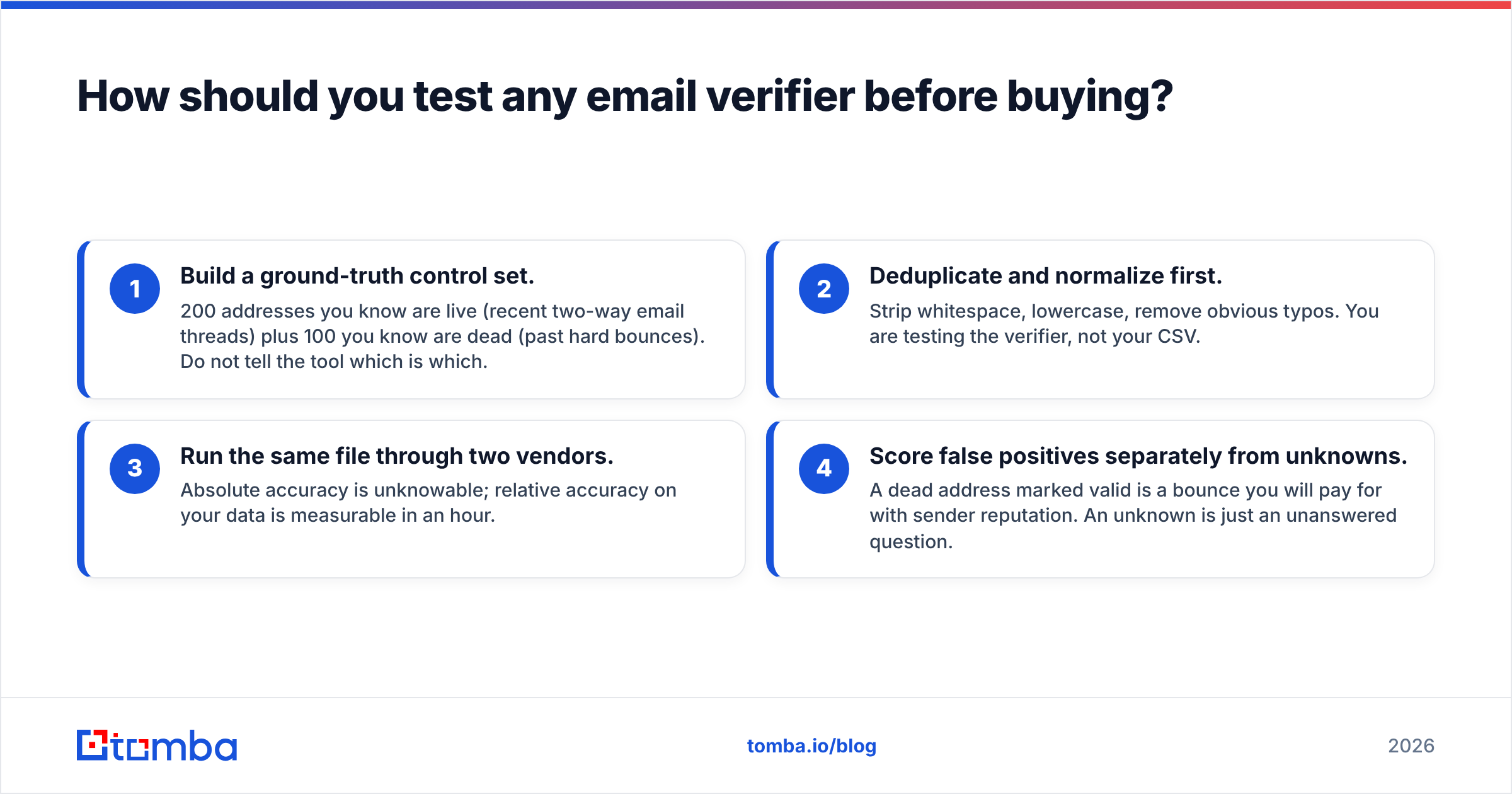
Same protocol for every vendor. Four steps, one afternoon.
- Build a ground-truth control set. Take 200 addresses you know are live, from recent two-way threads. Add 100 you know are dead, from past hard bounces. Do not tell the tool which is which.
- Deduplicate and normalize first. Strip whitespace, lowercase everything, and remove obvious typos. You are testing the verifier, not your CSV.
- Run the same file through two vendors. Absolute accuracy is unknowable. Relative accuracy on your own data takes an hour to measure.
- Score false positives separately from unknowns. A dead address marked valid becomes a bounce, and you pay for it with sender reputation. An unknown is just an unanswered question.
Then send a small batch and check the real bounce rate. That number is the only accuracy metric that has ever mattered.
The bottom line#
ExactVerify is a competent, narrow verifier, and its pricing suits intermittent use. Nothing about it is wrong. Nothing about it solves the harder half of the problem either, which is getting accurate addresses in the first place.
If your bottleneck is a dirty list, buy credits and move on. If your bottleneck is not having enough of the right contacts, verification is the last step of a process you have not built yet. That is the honest close to any ExactVerify pricing review.
Tomba Email Finder fits right there. Search by domain, company, or name. Addresses come back with a confidence score and verification already applied, so you skip the export-verify-reimport loop. Start on the free tier with 25 searches a month. Test it against whatever you use today, and let the bounce rate on your next campaign settle the argument.
Related guides#
Ready to find emails that actually work?
Join 150,000+ professionals who stopped guessing and started sending. Free credits on signup — no credit card required.
Get the Tomba newsletter
Practical outbound tactics and product updates — once every two weeks.
About the author