ExactVerify vs Leadzen.ai: Which B2B Data Tool Wins in 2026?
One tool cleans lists, the other builds them. We compare ExactVerify and Leadzen.ai on accuracy, coverage, pricing, and API depth so you can pick the right side of your outbound stack — or skip both.
ExactVerify vs Leadzen.ai is not a fair fight, because the two tools do different jobs. One cleans lists. The other builds them. Here is the short version before the detail.
TL;DR
- They are not the same category. ExactVerify is an email verification and list-hygiene tool. Leadzen.ai is a lead intelligence and prospecting database. Comparing them head-to-head only makes sense if you're deciding where to spend one budget line.
- Pick ExactVerify if you already have lists (from scrapes, events, or a CRM) and your problem is bounce rate.
- Pick Leadzen.ai if your problem is finding contacts in the first place, especially in India and APAC where its coverage is strongest.
- Neither one covers both jobs well. Verification-only tools still need a separate data source. Intelligence platforms rarely verify to SMTP depth before export.
- The combined option is find, verify, and enrich in one API. Tools like Tomba, Findymail, and BookYourData sit here, usually at a lower blended cost per usable contact.
What are ExactVerify and Leadzen.ai?#
ExactVerify is an email validation service. You upload a CSV or hit an API endpoint, and it returns a deliverability verdict per address: valid, invalid, catch-all, role-based, disposable, or unknown. Its value is downstream — it protects your sender reputation after you've already sourced contacts. There's no prospecting database behind it. If you give it nothing, it finds nothing.
Leadzen.ai sits at the opposite end. It's a lead intelligence platform with a searchable B2B contact database. You can filter by industry, headcount, funding, and location, and a Chrome extension pulls profiles off LinkedIn. It's built and marketed heavily in India, and the data shows it. Coverage of Indian SMBs and mid-market companies is genuinely good. Coverage of US and EU mid-market is thinner than the incumbents.
The mental model: ExactVerify is the water filter. Leadzen.ai is the well. You need both, and buying one does not get you the other.

ExactVerify vs Leadzen.ai: how do they compare head-to-head?#
Here's the practical breakdown. Pricing reflects publicly listed plans at time of writing — both vendors adjust tiers, so confirm on their own pages before you commit budget.
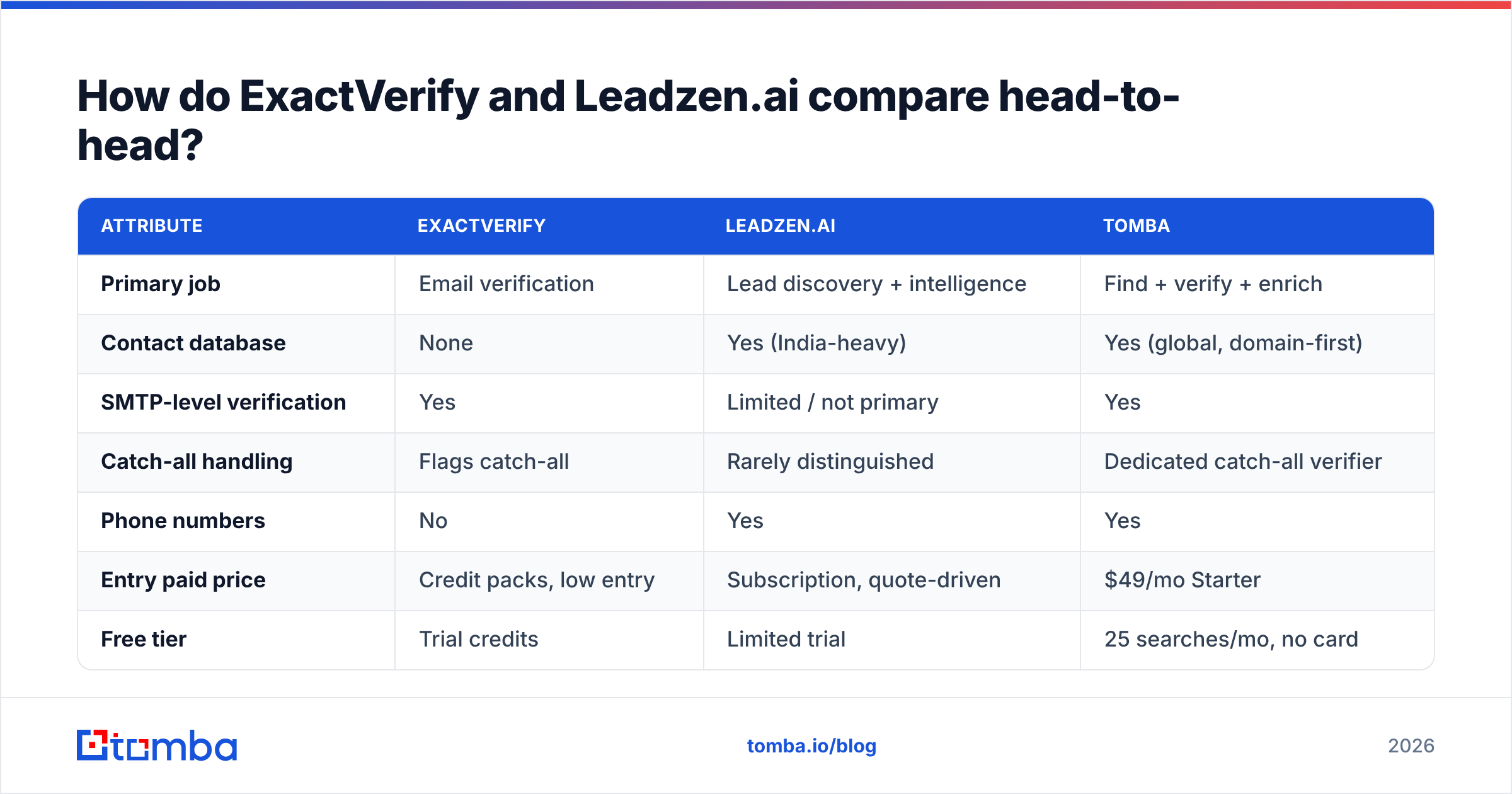
| Attribute | ExactVerify | Leadzen.ai | Tomba |
|---|---|---|---|
| Primary job | Email verification | Lead discovery + intelligence | Find + verify + enrich |
| Contact database | None | Yes (India-heavy) | Yes (global, domain-first) |
| SMTP-level verification | Yes | Limited / not primary | Yes |
| Catch-all handling | Flags catch-all | Rarely distinguished | Dedicated catch-all verifier |
| Phone numbers | No | Yes | Yes |
| Entry paid price | Credit packs, low entry | Subscription, quote-driven | $49/mo Starter |
| Free tier | Trial credits | Limited trial | 25 searches/mo, no card |
| Public API | Yes | Yes | Yes, plus CLI and MCP |
| Bulk CSV processing | Core strength | Export-based | Bulk finder + verifier |
| Best for | Cleaning owned lists | APAC prospecting | End-to-end outbound data |
The table makes the real decision obvious. You're not choosing between two versions of the same product. You're choosing which half of the problem to solve with money, and which half to solve with duct tape.
Which one is more accurate?#
Accuracy means two different things here, and conflating them is how teams end up disappointed.
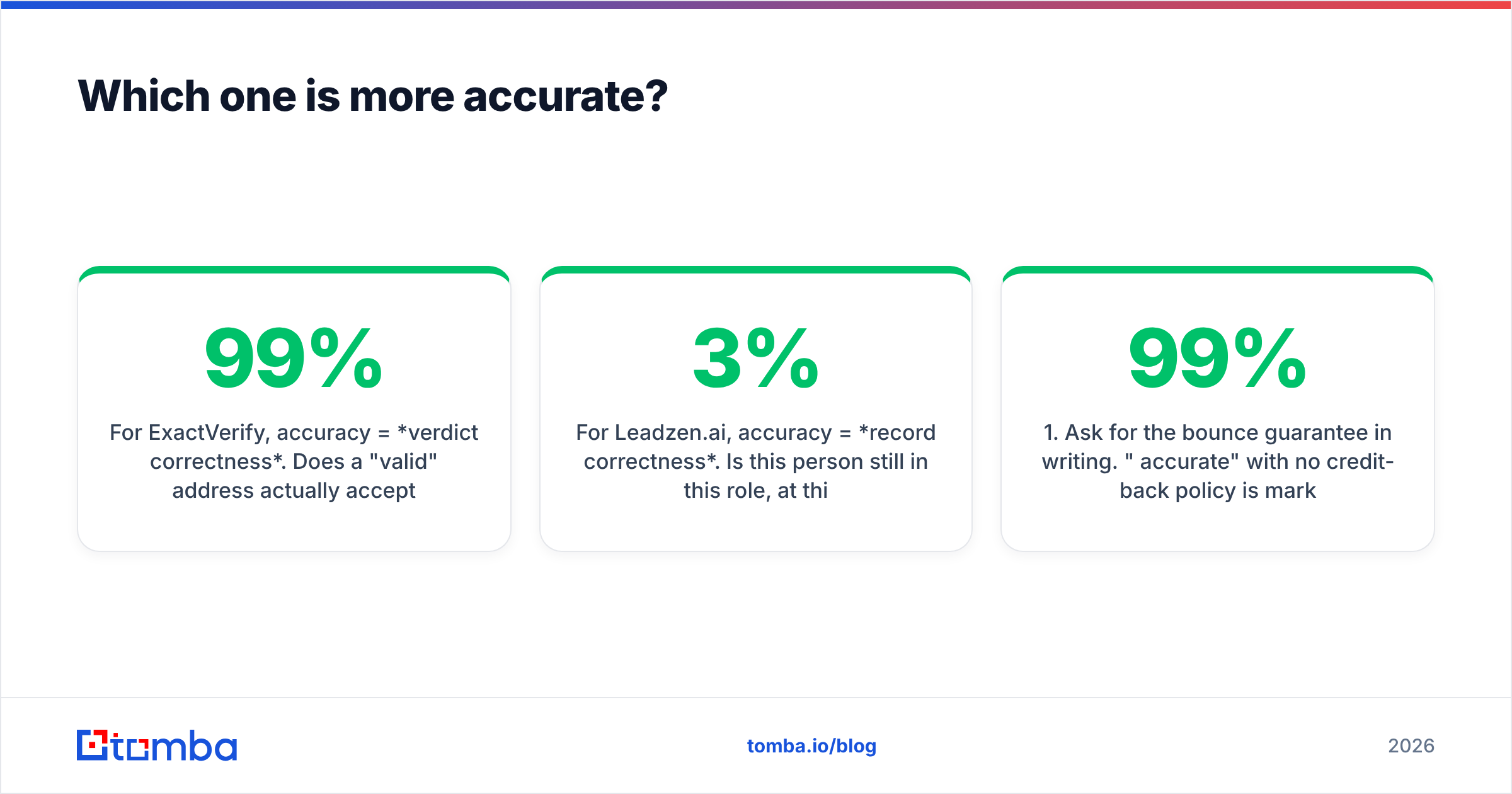
For ExactVerify, accuracy = verdict correctness. Does a "valid" address actually accept mail? Verification vendors cluster in the 95–99% range on clean, non-catch-all domains. But the happy path is not the differentiator. What matters is catch-all domains, which now cover roughly a third of B2B mailboxes thanks to Microsoft 365 defaults. Most verifiers return "unknown" or "accept-all" and hand the risk back to you. If a large share of your list sits behind catch-all MX records, a headline accuracy number tells you very little.
For Leadzen.ai, accuracy = record correctness. Is this person still in this role, at this company, reachable at this address? Database platforms decay by 2–3% per month on contact-level data. A record that was right when it was scraped is measurably wrong a quarter later. Leadzen refreshes, but like every database vendor, refresh cadence varies wildly by geography and company size.

The practical implication: a verified-but-stale record and an unverified-but-fresh record both bounce. You need freshness and verification. That's why single-purpose tools get stacked rather than chosen.
Five things to check before you trust any accuracy claim from either vendor:
- Ask for the bounce guarantee in writing. "99% accurate" with no credit-back policy is marketing. A refund clause is a claim the vendor is willing to pay for.
- Test on catch-all domains specifically. Pull 100 addresses at Microsoft 365 companies and compare verdicts against a real send. This is where verifiers diverge most.
- Check whether "unknown" burns a credit. Some vendors charge for results they can't determine. Over a 50k list that's a real number.
- Look at record recency, not database size. "300M contacts" is a vanity metric. Ask what percentage was re-validated in the last 90 days.
- Run the same 50 target accounts through both. Your ICP is the only benchmark that matters. Public accuracy tables rarely match your specific vertical and geography.
What do ExactVerify and Leadzen.ai actually cost?#
ExactVerify prices on credits — you pay per address checked, typically with volume discounts that make large one-off cleans cheap. That model suits agencies and teams that verify in bursts before a campaign, not continuously.
Leadzen.ai prices on subscription with credit allocations for reveals and exports, and pushes larger teams toward custom quotes. The cost trap in database platforms is not the sticker price. It's the credit burn. Every unlock of a contact you end up discarding is spend you can't recover. Export caps add to it, because you often pay for seats you're not fully using.
For comparison, Tomba pricing is flat and public: a free tier at 25 searches/month, Starter at $49/mo, Growth at $99/mo, Pro at $249/mo, and custom Enterprise. Finding and verification sit under the same credit pool, so you aren't paying two vendors to hand data to each other.
Blended cost per usable contact is the number to model, not cost per credit:
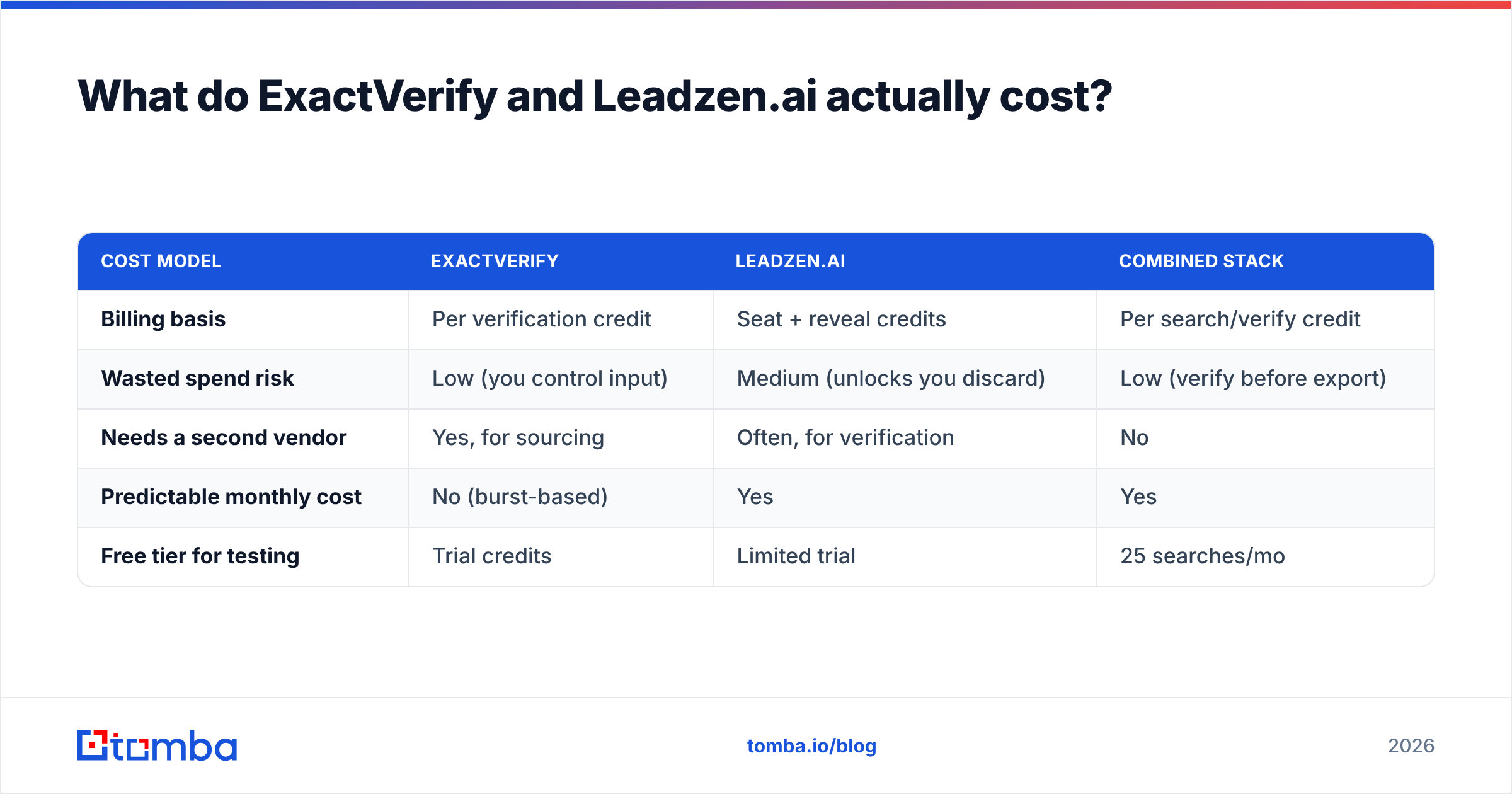
| Cost model | ExactVerify | Leadzen.ai | Combined stack |
|---|---|---|---|
| Billing basis | Per verification credit | Seat + reveal credits | Per search/verify credit |
| Wasted spend risk | Low (you control input) | Medium (unlocks you discard) | Low (verify before export) |
| Needs a second vendor | Yes, for sourcing | Often, for verification | No |
| Predictable monthly cost | No (burst-based) | Yes | Yes |
| Free tier for testing | Trial credits | Limited trial | 25 searches/mo |

Who should choose ExactVerify?#
Choose ExactVerify when your data problem is already narrowed to hygiene:
- You inherited a CRM with 80,000 contacts of unknown age and you need to know what's safe to mail.
- You run event or webinar lists where addresses are typed by hand and typo rates are high.
- You're an agency cleaning client lists and you want a per-credit, no-subscription cost structure.
- Your ESP is throttling you and you need bounce rate under 2% before the next send.
What it will not do is fill a pipeline. If you're staring at an empty prospect list, a verifier is the wrong purchase. You'd be buying a filter with no water going through it. In that case, a domain search is the more direct route. It returns every public address at a target company, already verified.
Who should choose Leadzen.ai?#
Choose Leadzen.ai when discovery is the bottleneck and your ICP skews toward its coverage strengths:
- You're selling into India, Southeast Asia, or Middle East markets where global incumbents thin out.
- You want firmographic filters and intent-style signals in one search interface rather than piecing them together.
- Your reps live in LinkedIn and want a browser extension that surfaces contact details in-flow.
- You value a single searchable database over stitching APIs together.
The caveat is verification depth. Most intelligence platforms return an address with a confidence score, not an SMTP-tested verdict, and confidence scores are a different animal. Before a single record from any database platform hits your sequencer, run it through a dedicated email verifier. The marginal cost is cents. The cost of a domain-level reputation hit is weeks of recovery. If you're unsure how bad the damage can get, the basics of email deliverability are worth twenty minutes of your time.
Where do both tools fall short?#
Both products are honest about their scope, which is more than can be said for a lot of the category. The gaps show up when you zoom out to the full workflow.
ExactVerify's gap is upstream. It has no opinion on where your addresses came from. Feed it a bad list and it will tell you, accurately, that the list is bad. That's useful. But you already spent time and money sourcing garbage. Verification is a checkpoint, not a strategy.
Leadzen.ai's gap is downstream. Getting a record out of a database is step one. Confirming it's live, deduplicating against your CRM, appending a mobile number, and pushing it into a sequence are four more steps. Outside its home geography, the platform handles some of them better than others.
Both share a third gap: catch-all domains. Neither treats accept-all mailboxes as a first-class problem to solve. They treat them as a status to report. That matters, because a growing share of your best-fit accounts live behind exactly those MX records. Tools with a dedicated catch-all verifier recover contacts that both of these would flag as unknown and effectively throw away.
Is a combined find-and-verify stack better than either?#
For most outbound teams, yes — on cost and on cycle time.
The two-vendor pattern (database + verifier) means two contracts, two credit pools, two support queues, and a CSV shuttling between them. Every handoff is latency, and latency is decay. A record verified 11 days after it was pulled is measurably worse than one verified at the moment of retrieval.
A consolidated approach does discovery and validation in one call. You search a company domain, you get addresses back with verification status attached, and you export only what passed. Nothing is paid for twice, nothing sits in a staging file getting older.
Worth noting: this isn't a Tomba-only argument. BookYourData takes a similar bundled position, with a strong bounce guarantee on its verified B2B lists. It's a solid pick if you'd rather buy a pre-built list than run searches. Findymail and Clearout occupy adjacent slices. The point is architectural, not brand-specific — fewer handoffs, fresher data, one bill. And before you commit, check real user reviews on G2. It's still the fastest way to test a vendor's claims against your own segment.
What's the verdict?#
ExactVerify vs Leadzen.ai, if you must pick one: ExactVerify wins on list hygiene at burst volumes. Leadzen.ai wins on APAC-focused discovery. Neither wins the general outbound-data category, because neither is trying to.
If you're building a stack from scratch in 2026, start with a tool that finds and verifies in the same operation. Then add a specialist only where you hit a wall — a dedicated verifier for legacy CRM cleanup, or a regional database for a market your primary vendor doesn't cover. That order keeps your baseline cost predictable and your data fresh, instead of paying two subscriptions to do half a job each.
Start with the sourcing side, since that's the half that's harder to bolt on later. The Tomba Email Finder returns verified professional addresses by domain, name, or company. SMTP validation and catch-all handling are built into the same request. The free tier gives you 25 searches a month, no card required. Run your 50 hardest target accounts through it, compare the hit rate against whatever you're using now, and let the numbers decide.
Related guides#
Ready to find emails that actually work?
Join 150,000+ professionals who stopped guessing and started sending. Free credits on signup — no credit card required.
Get the Tomba newsletter
Practical outbound tactics and product updates — once every two weeks.
About the author