ExactVerify vs SalesIntel: Which B2B Data Tool Wins?
One tool cleans the list you already have. The other sells you the list. Here's an honest breakdown of ExactVerify vs SalesIntel — accuracy, pricing model, coverage, and which one your outbound motion actually needs.
ExactVerify vs SalesIntel comes up in almost every outbound tool search. The two products do not do the same job. One cleans the list you have. The other builds you a new one. Here is the plain breakdown.
TL;DR
- They sit in different categories. ExactVerify is an email verification engine. It grades a list you already own. SalesIntel is a B2B data provider. It sells you contacts, company data, tech stacks, and intent signals, with a human-checked layer on top.
- Pick ExactVerify if your problem is bounce rate. Pick SalesIntel if your problem is "we have no one to email."
- The pricing models are worlds apart. Verifiers sell cheap credits, priced in fractions of a cent per email. Data platforms sell annual seats and credit blocks. Those start in the four figures, and the price is quoted, not published.
- Neither one covers the middle. The middle job is finding one person's work email at one domain, on demand, at a price a small team can absorb. That is what a dedicated email finder with built-in verification is for.
- The honest verdict on ExactVerify vs SalesIntel: buy the tool that fixes your current bottleneck. If you are mid-market with a clear ICP and no data budget, a finder-plus-verifier stack at $49–$99/mo beats either single purchase.
ExactVerify vs SalesIntel: what does each tool do?#
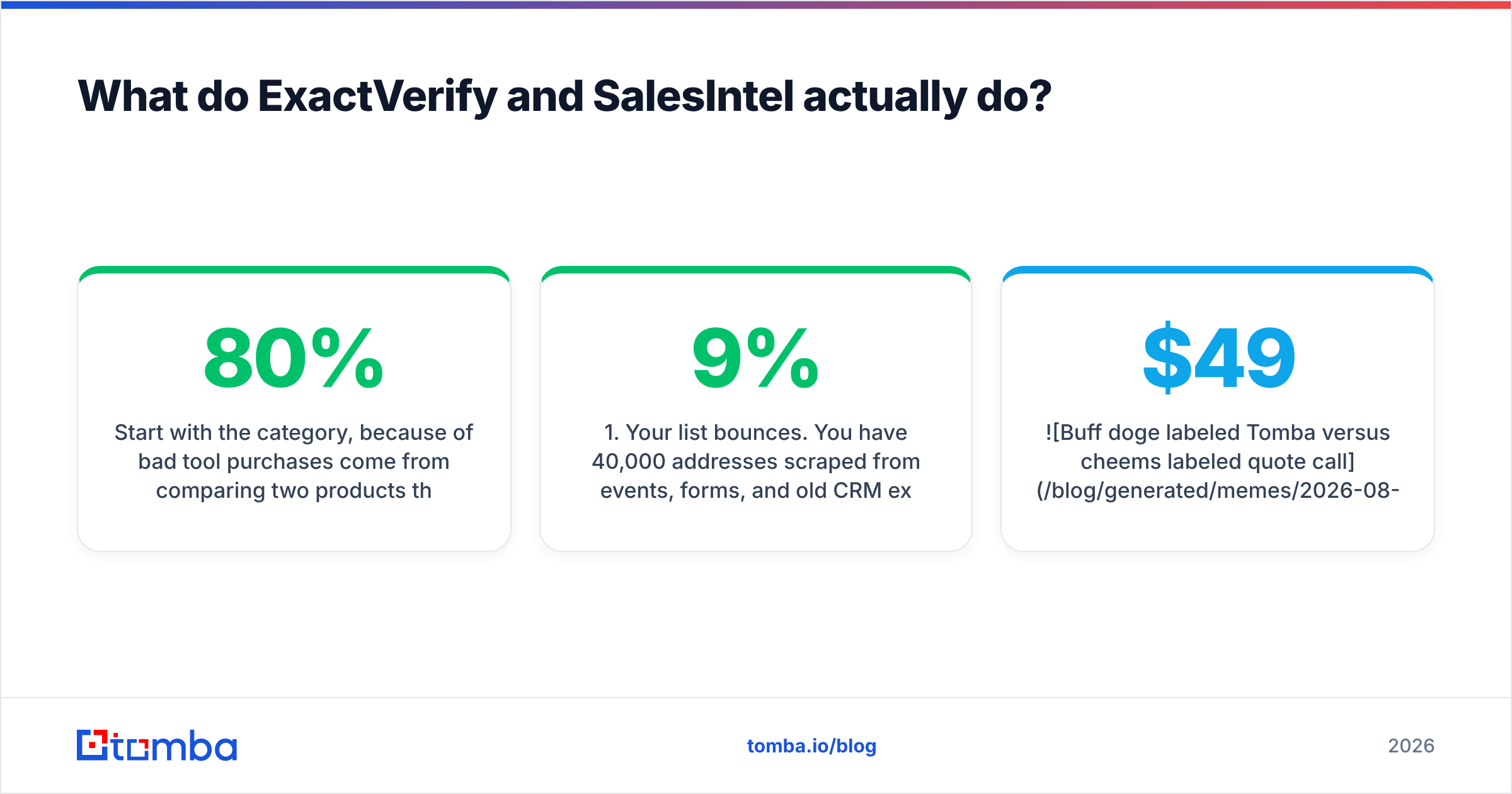
Start with the category. Most bad tool purchases come from comparing two products that never competed for the same job.
ExactVerify is an email validation service. You upload a CSV or call an API. It returns a status for each address: valid, invalid, risky, catch-all, disposable, or role-based. Under the hood it runs a chain of checks. It parses the syntax, looks up the MX record, matches known throwaway domains, and opens an SMTP handshake.
It also has to guess at catch-all servers, which accept every address and tell you nothing. ExactVerify does not source contacts. It has no view on whether the CFO of a 200-person logistics firm is worth an email. It only tells you if the mailbox exists.
SalesIntel is a B2B contact and company database. Its selling point has always been the human layer. A research team re-checks part of the contact records on a rolling cycle, on top of the automated pipeline.
You get direct dials and mobile numbers, company data, tech-stack data, and buying-intent signals. It also ships CRM integrations and a Chrome extension. You can read the vendor's own pitch at salesintel.io.
So the real question in ExactVerify vs SalesIntel is not "which is better." It is "which half of the pipeline are you trying to fix?"
Two failure modes, two tools:
- Your list bounces. You have 40,000 addresses from events, forms, and old CRM exports. Your bounce rate is 9%. Google and Microsoft now throttle you. That is a verification problem, and it is ExactVerify's lane.
- You have no list. You know your ICP: Series B fintech, 50–200 staff, US, running Snowflake. You need 3,000 named people with titles and phone numbers. That is a sourcing problem, and it is SalesIntel's lane.
- You have accounts but not people. You have 800 target domains from a partner list. You need the VP of Ops at each one. Neither product treats this as its main job. A domain search tool does.
- You have people but not reachability. You have names and profiles, but no way to email them. That is an enrichment problem, and again a middle-lane job.

ExactVerify vs SalesIntel: how do the features compare?#
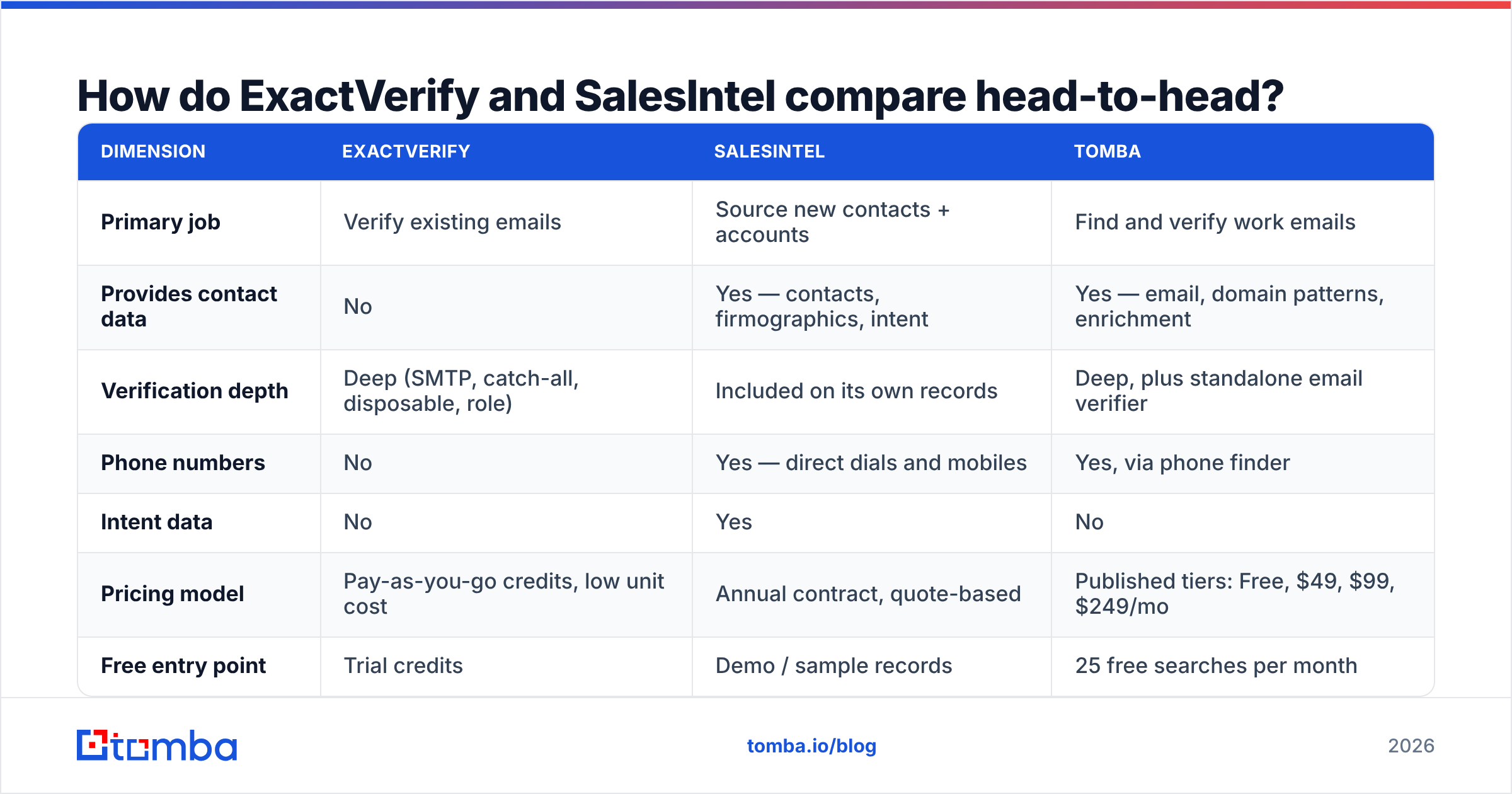
Here is the practical breakdown. Pricing for data platforms is quote-based. It shifts with seat count, region, and credit block. Treat the cost row as a shape, not a signed contract, and confirm current numbers with each vendor.
| Dimension | ExactVerify | SalesIntel | Tomba |
|---|---|---|---|
| Primary job | Verify existing emails | Source new contacts + accounts | Find and verify work emails |
| Provides contact data | No | Yes — contacts, firmographics, intent | Yes — email, domain patterns, enrichment |
| Verification depth | Deep (SMTP, catch-all, disposable, role) | Included on its own records | Deep, plus standalone email verifier |
| Phone numbers | No | Yes — direct dials and mobiles | Yes, via phone finder |
| Intent data | No | Yes | No |
| Pricing model | Pay-as-you-go credits, low unit cost | Annual contract, quote-based | Published tiers: Free, $49, $99, $249/mo |
| Free entry point | Trial credits | Demo / sample records | 25 free searches per month |
| API | Yes | Yes | Yes — Tomba API, CLI, MCP |
| Best fit | Deliverability cleanup | Enterprise ABM and full-funnel GTM | SMB/mid-market outbound teams |
| Typical buyer | Email ops, growth, agencies | Enterprise sales ops, RevOps | Founders, SDR teams, agencies |

The table shows how thin the overlap is. The only row where both tools really compete is verification quality. Even there they differ. SalesIntel verifies its own records. ExactVerify verifies anything you send it.
ExactVerify vs SalesIntel accuracy: which one can you trust?#
Accuracy claims mean little without a definition. Each vendor measures a different thing.
- A verifier's accuracy = does the verdict match reality? If it says "valid," does the message land? If it says "invalid," would it have bounced? False negatives cost you money, because you delete buyers you could have reached.
- A data provider's accuracy = is this person still in this role, at this company, with this email? A record can be deliverable and still stale. Someone left in March. The mailbox stays alive for a year.
- A finder's accuracy = of the queries you run, how many return a correct, deliverable address? That number predicts your reply volume better than any other.

SalesIntel's human-check pitch is a real edge on the second definition. A researcher who confirms a title beats a scraper that last saw the profile eighteen months ago. The gap widens in fields with high turnover or a thin web presence, such as manufacturing, healthcare ops, and regional services. That research labor is also why the contract costs what it costs.
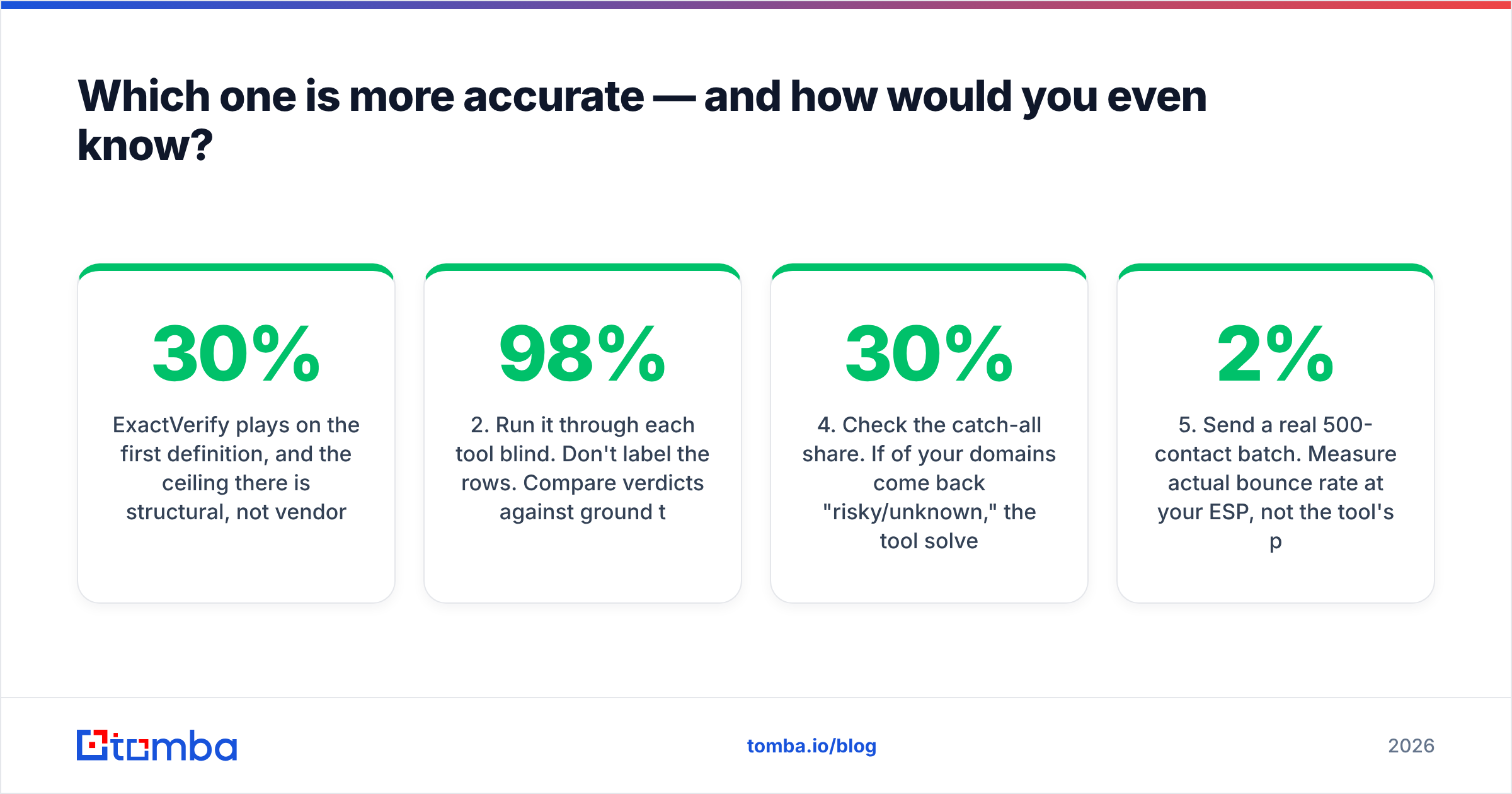
ExactVerify plays on the first definition. Its ceiling is structural, not a vendor flaw. Every verifier hits a wall on catch-all domains. These servers accept mail for every address, real or not. In some segments they are 15–30% of B2B domains. No SMTP handshake settles them. Only pattern data and past engagement narrow the odds. That is why a catch-all verifier is a separate skill, not a checkbox.
How to test both before you sign:
- Build a 200-row truth set. Use addresses you know are live: colleagues, partners, and customers who replied last quarter. Add addresses you know are dead.
- Run the rows through each tool blind. Do not label them. Compare the verdicts against the truth. Score false positives and false negatives on their own. A single "98% accurate" figure hides which error you are buying.
- Test coverage on your real ICP. Ask for 100 records in your exact segment, not "SaaS in California." Coverage in US enterprise tech is not coverage in German mid-market logistics.
- Check the catch-all share. If 30% of your domains come back "risky" or "unknown," the tool solved less of your problem than the marketing page implied.
- Send a real 500-contact batch. Measure the bounce rate at your ESP, not the tool's forecast. Under 2% is the working target. Above 4%, the email deliverability damage compounds fast.
ExactVerify vs SalesIntel pricing: what does each one cost?#
This is where the comparison stops being academic.
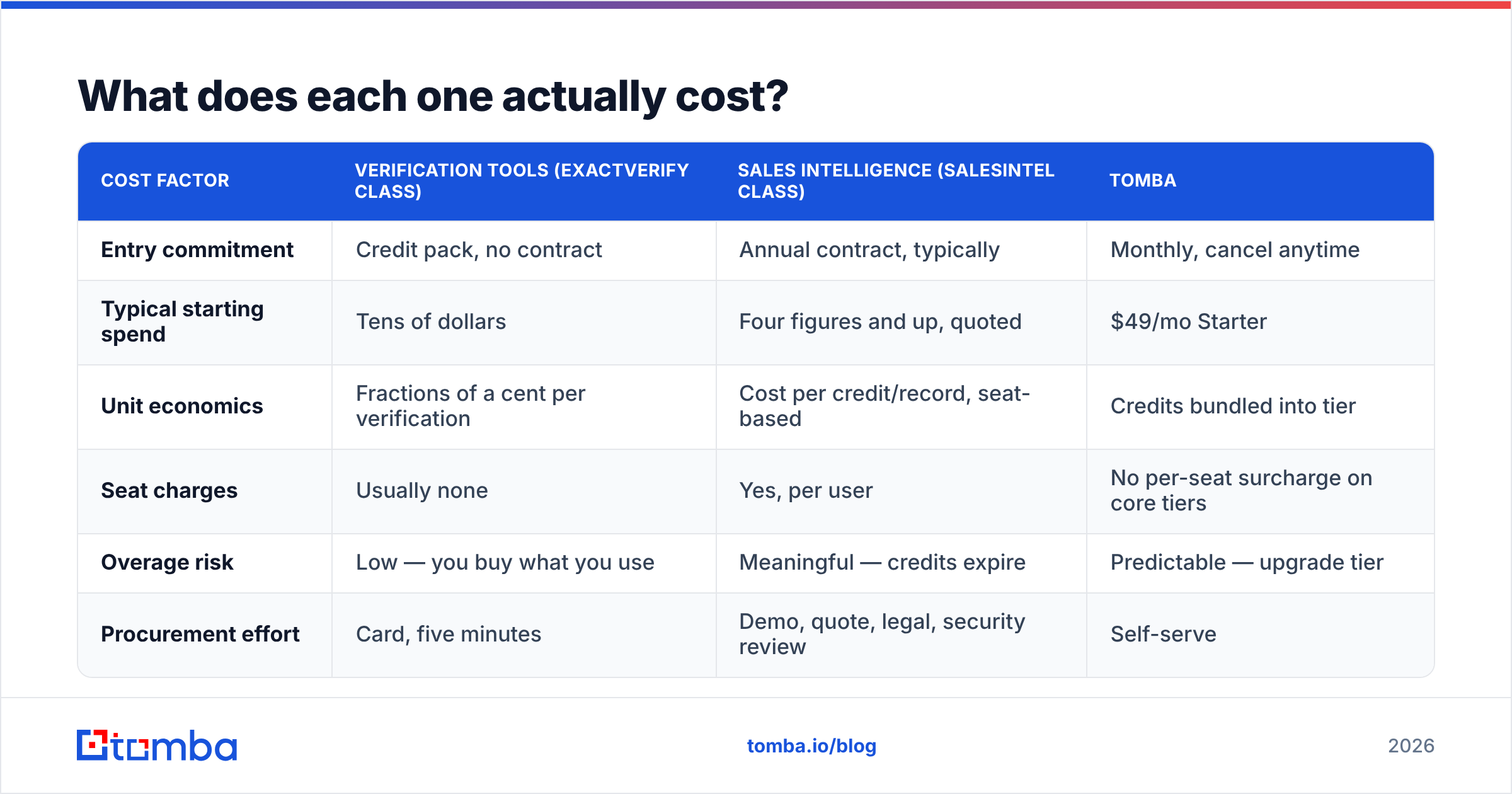
| Cost factor | Verification tools (ExactVerify class) | Sales intelligence (SalesIntel class) | Tomba |
|---|---|---|---|
| Entry commitment | Credit pack, no contract | Annual contract, typically | Monthly, cancel anytime |
| Typical starting spend | Tens of dollars | Four figures and up, quoted | $49/mo Starter |
| Unit economics | Fractions of a cent per verification | Cost per credit/record, seat-based | Credits bundled into tier |
| Seat charges | Usually none | Yes, per user | No per-seat surcharge on core tiers |
| Overage risk | Low — you buy what you use | Meaningful — credits expire | Predictable — upgrade tier |
| Procurement effort | Card, five minutes | Demo, quote, legal, security review | Self-serve |
Two things follow from this table.
First, you can trial a verifier this afternoon. A data platform takes about three weeks to get live. If your quarter is already burning, that gap matters more than any feature.
Second, annual contracts punish uncertainty. If you are still testing whether outbound works for your product, a five-figure data contract is an expensive way to find out. Buyer reviews on G2's email verification category are worth an hour of reading. The repeat complaints are rarely about data quality. They are about credit expiry, seat minimums, and renewal terms.
Who should pick ExactVerify?#
In the ExactVerify vs SalesIntel choice, take the verification-first path when:
- You already have volume. A CRM with 50k+ contacts, a webinar list, an inherited database. The contacts exist. Their reliability does not.
- Your bounce rate is the emergency. You are getting throttled and your domain reputation is sliding. You need the list clean before the next send. Verification fixes that in hours.
- You are an agency handling client lists. You did not source the data, so you validate everything on intake as standard practice.
- You want zero procurement friction. Credits, an API key, done.
- You have a separate sourcing motion. Inbound, events, partnerships, or a scraper already fills the top of the funnel.
What you accept: no new contacts, no phone numbers, no intent signals, and a hard ceiling on catch-all domains. Pair it with a bulk email finder if you also need to create addresses, not just judge them.
Who should pick SalesIntel?#
Take the data-platform path when:
- Sourcing is the bottleneck, not hygiene. You need net-new accounts and named people at scale, every month.
- Phone matters as much as email. Direct dials and mobiles are a fair reason to pay platform prices. Most finders and all verifiers are weaker here.
- You run account-based motions. Intent data, tech-stack data, and account hierarchies feed real ABM plays. If you are building a serious revenue operations function, that structured layer earns its keep.
- You sell into hard-to-scrape segments. Human research wins where the web footprint is thin.
- You have a real data budget and a CRM to sync into. A platform contract without CRM discipline becomes an expensive, unused database within two quarters.
What you accept: an annual commitment, per-seat costs, credit expiry, and a procurement cycle. Respected peers share this lane too. BookYourData takes a pay-as-you-go approach to verified B2B contact data. That suits teams who want database breadth without an annual contract. It is a fair third option to price out.
Is there a middle path in the ExactVerify vs SalesIntel debate?#
Yes. It is where most teams under 200 people actually live.
The common scenario: you know exactly who you want to reach. You have company names, domains, maybe profiles. You do not need a 200-million-record database or intent scoring. You need reliable work emails for a short, defined list, verified before you send.
That is the finder-plus-verifier lane:
- Find by domain, name, or company. A domain search returns the people at a company plus its email pattern.
- Verify in the same pass, so you never export an address you have not graded.
- Enrich what you own. Data enrichment fills gaps in CRM records instead of duplicating them.
- Automate it with an API, CLI, Chrome extension, or a Google Sheets add-on, so the work happens where your team already sits.
Tomba prices this at Free (25 searches/month), $49/mo Starter, $99/mo Growth, and $249/mo Pro, with Enterprise quoted. Full details sit on the Tomba pricing page.
It will not give you intent data or a research team confirming titles by phone. If those are core to your motion, SalesIntel is the honest pick. But for a team running 2,000–20,000 targeted touches a month, the middle lane covers sourcing and hygiene for about the cost of one platform seat.
ExactVerify vs SalesIntel: what should you do next?#
Map your bottleneck before you map vendors. Run this in order:
- Measure your current bounce rate at the ESP level over the last 30 days. Above 4% means hygiene is the emergency. Buy verification first.
- Count your addressable list. Fewer than 5,000 known targets? You do not need a database. You need a finder.
- Check whether phone is required. If half your pipeline comes from dials, a data platform is justified.
- Price the full year, not the month. Seats, credit expiry, and overage often double the sticker figure.
- Trial both on the same 200-row truth set. Compare error types, not headline accuracy claims.
Most teams find the answer is not ExactVerify or SalesIntel. It is a finder that verifies as it goes, plus a targeted database purchase later, once outbound is proven and the math is boring.
If that is you, start with the Tomba Email Finder. The free tier gives you 25 searches a month to test hit rate on your own ICP. No demo call, no quote, no annual commitment. Run your truth set through it, compare the verdicts, and let the bounce rate decide.
Related guides#
Ready to find emails that actually work?
Join 150,000+ professionals who stopped guessing and started sending. Free credits on signup — no credit card required.
Get the Tomba newsletter
Practical outbound tactics and product updates — once every two weeks.
About the author