Exactverify vs Zintlr: Verifier vs Sales Database (2026)
Exactverify cleans lists. Zintlr sells contacts and intent context. They solve different halves of the same problem — here's how they compare on data, pricing model, and where each one actually breaks.
Exactverify vs Zintlr is a strange matchup. One tool cleans your email list. The other builds it. Here is what each one does, what it costs, and which fits your outbound stack.
TL;DR
- Exactverify vs Zintlr is not a like-for-like fight. Exactverify is a bulk email verification service. Zintlr is a B2B contact database with sales intelligence on top.
- Bounce rate at 9% and your domain burning? Pick the verifier. No list at all? Pick the database.
- Zintlr's edge is personality and intent context on each contact record. Exactverify's edge is throughput and price per check on large uploads.
- Buy both and you get two contracts, two credit pools, and two APIs. Most teams under 20 reps pick one platform that finds and verifies.
- Verify anything you did not source yourself. Database exports go stale by roughly 2–2.5% a month as people change jobs.
What is Exactverify and what does it actually do?#
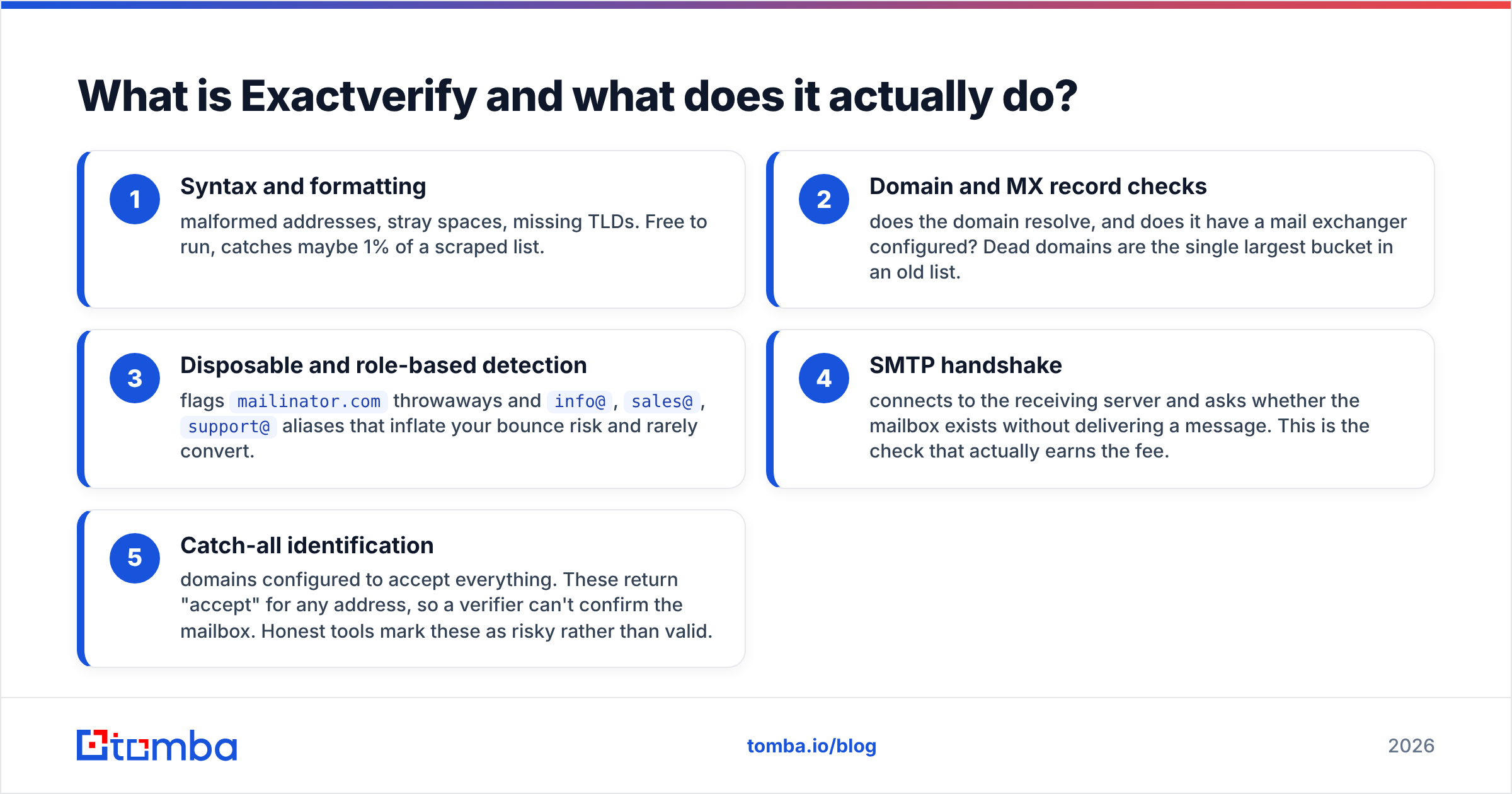
Exactverify is an email verification tool. You upload a CSV or call the API. It runs each address through a chain of checks, then tells you whether sending is safe.
The pipeline is standard across the category. Understanding it matters more than the marketing copy:
- Syntax and formatting — malformed addresses, stray spaces, missing TLDs. Free to run. It catches maybe 1% of a scraped list.
- Domain and MX record checks — does the domain resolve, and does it have a mail server? Dead domains are the largest bucket in an old list.
- Disposable and role-based detection — flags
mailinator.comthrowaways andinfo@,sales@,support@aliases. Those inflate bounce risk and rarely convert. - SMTP handshake — it connects to the receiving server and asks whether the mailbox exists. No message is sent. This is the check you are paying for.
- Catch-all identification — some domains accept every address. A verifier cannot confirm a mailbox there. Honest tools mark these as risky rather than valid.
That last one is where verifiers quietly differ. A tool that reports catch-alls as valid shows you a lovely 98% pass rate. Then the list bounces. A tool that flags them looks worse on paper and does better in the inbox. So check the catch-all handling before you check the price.
Exactverify sells on volume economics: bulk uploads, pay-as-you-go credits, and an API for teams that want verification inside their own pipeline. You can review current plans at exactverify.com.
What is Zintlr and who is it built for?#
Zintlr sits in a different aisle. It is a B2B prospecting platform. You search a contact database by company, title, geography, and industry. A browser extension pulls contacts while you browse LinkedIn or company sites.
Its standout feature is personality intelligence. Zintlr adds behavioral profiling to contact records. It suggests how a prospect prefers to be approached: direct, analytical, or relationship-first. Whether that lifts your reply rate is an open question. Still, it is a real differentiator in a market where everyone else sells the same three columns: name, title, email.
Zintlr is packaged as seat-based SaaS with credit allotments. It aims at SDR teams that want one login for search, enrichment, and outreach context. You can see the current feature set at zintlr.com. Reviews on G2 give a rough read on support and data coverage by region. That is worth checking, since coverage varies sharply between North America, EMEA, and APAC.
One limit matters. For a database platform, verification is a courtesy layer, not a specialty. Vendors verify at index time, then serve you that record months later. That is fine for a name and a company. It is not fine for an email you are about to send 500 of.
Exactverify vs Zintlr: how do they compare head-to-head?#
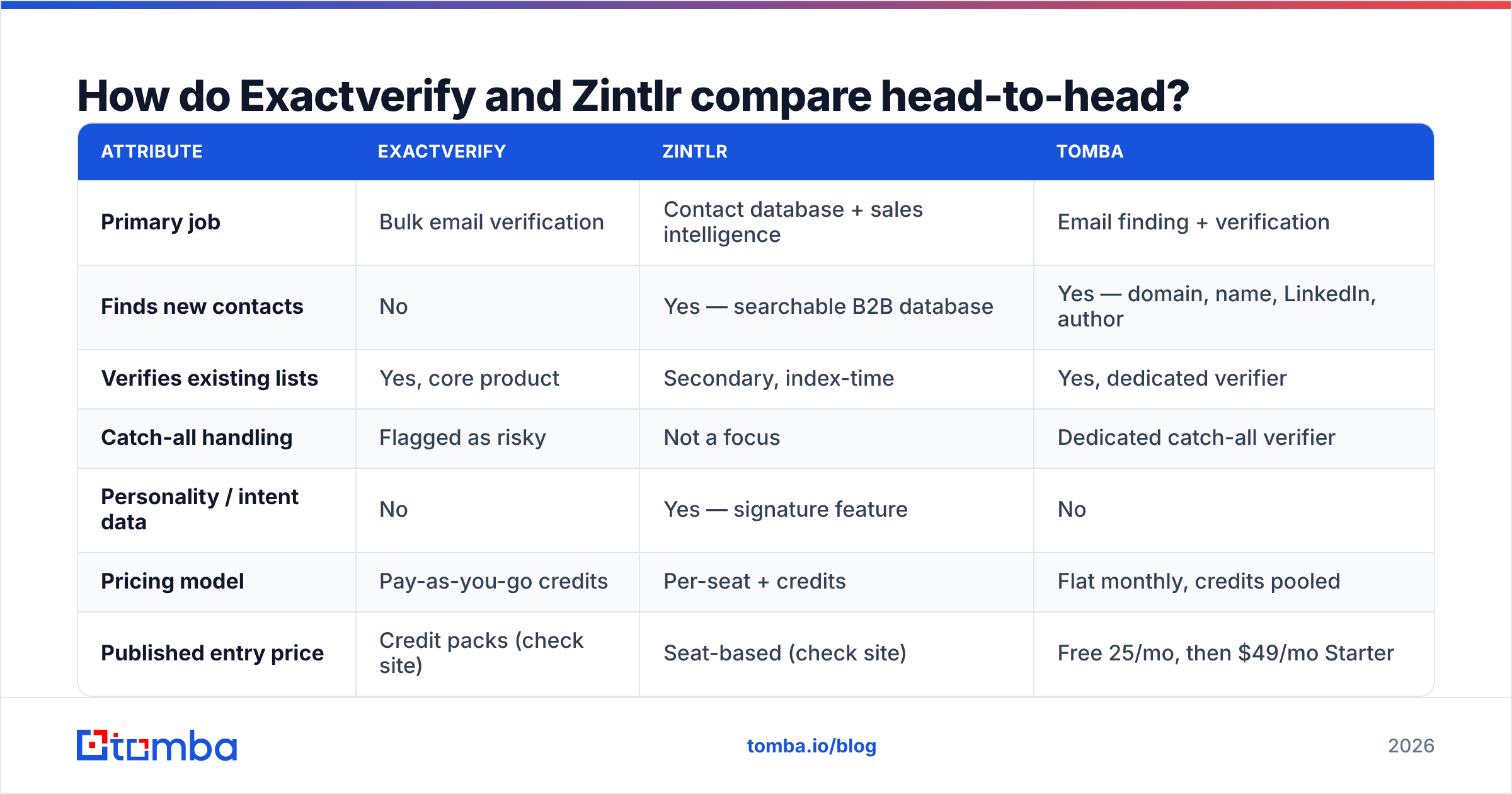
Here is the honest structural comparison. Published pricing changes often and varies by contract. Treat the pricing rows as model comparisons, not quotes, and confirm current numbers on each vendor's page before you buy.
| Attribute | Exactverify | Zintlr | Tomba |
|---|---|---|---|
| Primary job | Bulk email verification | Contact database + sales intelligence | Email finding + verification |
| Finds new contacts | No | Yes — searchable B2B database | Yes — domain, name, LinkedIn, author |
| Verifies existing lists | Yes, core product | Secondary, index-time | Yes, dedicated verifier |
| Catch-all handling | Flagged as risky | Not a focus | Dedicated catch-all verifier |
| Personality / intent data | No | Yes — signature feature | No |
| Pricing model | Pay-as-you-go credits | Per-seat + credits | Flat monthly, credits pooled |
| Published entry price | Credit packs (check site) | Seat-based (check site) | Free 25/mo, then $49/mo Starter |
| API access | Yes | Yes, plan-dependent | Yes, all paid plans |
| Phone numbers | No | Yes | Yes, phone finder |
| Best for | Cleaning a list you already own | Building a list from scratch | Doing both in one credit pool |
The row that decides most purchases is not accuracy. It is the pricing model. Pay-as-you-go credits suit spiky usage: a quarterly list clean, a one-off migration, an agency scrubbing a client import. Per-seat plans suit steady daily use by a fixed team. Three SDRs prospecting every day? Seats are cheaper. One ops person cleaning 200k records twice a year? Seats are a waste.
Which one is more accurate?#
Take neither vendor's published accuracy number at face value. Each one is computed on the vendor's own test set, using the vendor's own definition of valid.

Two vendors can both claim 99% accuracy and still disagree about half your list. Three reasons:
- The denominator differs. Some vendors drop catch-alls, unknowns, and greylisted domains from the math. Remove the hard cases and everyone scores well.
- The test set differs. A list full of Google Workspace and Microsoft 365 domains verifies cleanly. A list of self-hosted mail servers at mid-market European manufacturers does not.
- Accurate is not the same as deliverable. An address can exist and still land in a spam trap, a shared inbox nobody reads, or the mailbox of someone who left in March.
The only accuracy number that matters is the one you measure. Take 500 addresses with known outcomes from a past send. Run them through each tool. Compare each verdict against your real bounce log. That takes an afternoon, and it beats every comparison article online, this one included.
One more signal: look for a published methodology page. Tomba documents where its data comes from. Vendors that will not say usually have a reason.
What does the full tool comparison look like?#
Widen the frame past these two, and the segment sorts by job to be done:

- Pure verifiers (Exactverify, ZeroBounce, Bouncer, DeBounce) — you bring the list, they clean it. Cheapest per check, no sourcing at all.
- Databases with enrichment (Zintlr, Apollo, Lusha, RocketReach) — you bring a filter, they bring the contacts. Strong for volume, weaker on freshness per record.
- Finder-first platforms (Tomba, Hunter, Findymail) — you bring a domain or a name, they resolve and verify on demand. Live lookup, not a static index.
- Full outbound suites (Instantly, Smartlead, Outreach) — sequencing and inbox management, with data bolted on as an upsell.
Mixing categories is normal and often correct. The expensive mistake is mixing them by accident. You end up with a database plan, a verifier plan, and an outreach plan. All three charge for enrichment. None of them talk to each other.

Should you buy Exactverify, Zintlr, or something else?#
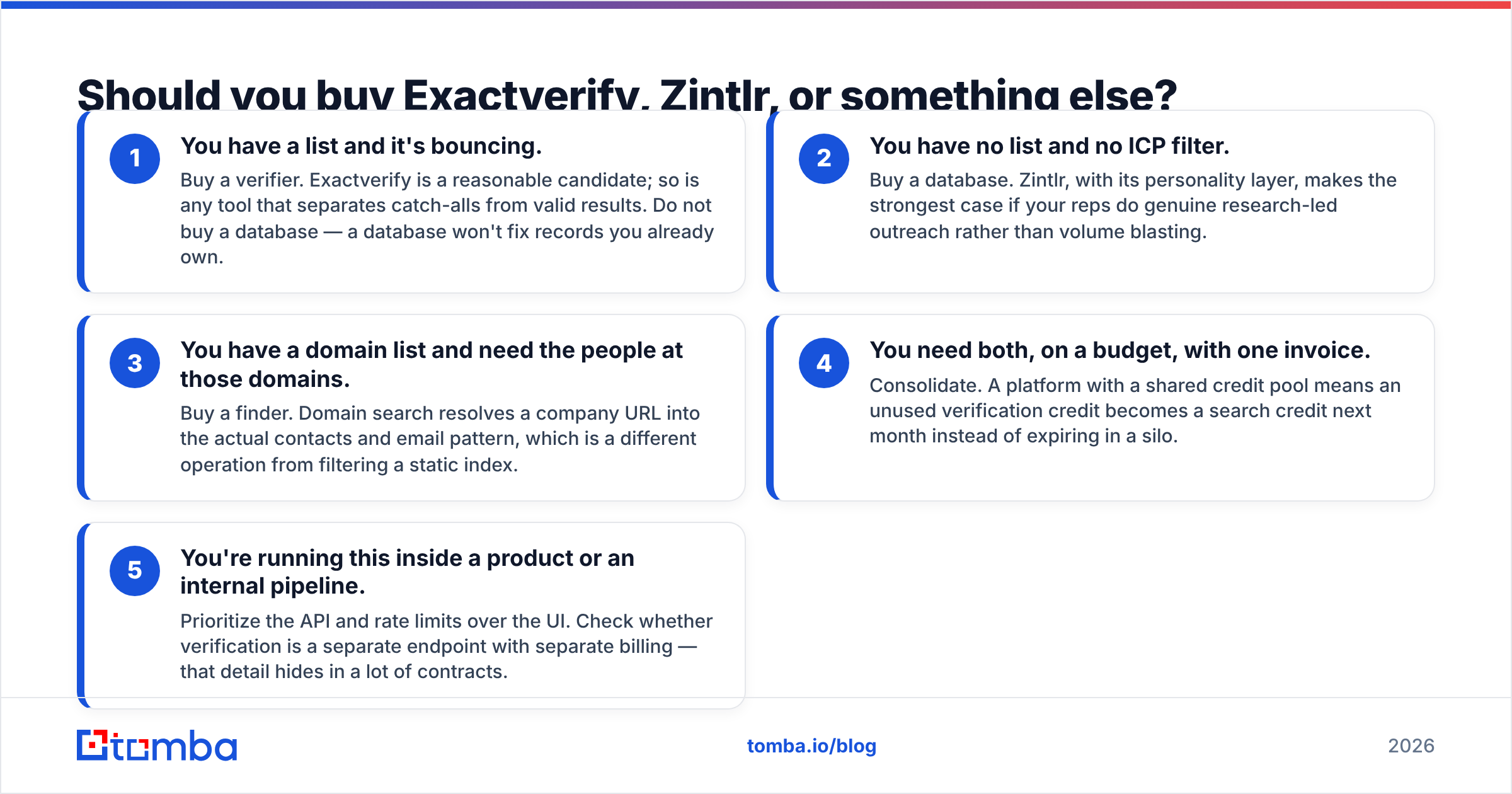
The Exactverify vs Zintlr decision gets simple once you name your real constraint:
- You have a list and it is bouncing. Buy a verifier. Exactverify is a fair candidate, as is any tool that separates catch-alls from valid results. A database will not fix records you already own.
- You have no list and no ICP filter. Buy a database. Zintlr makes the strongest case here if your reps do research-led outreach rather than volume blasting.
- You have a domain list and need the people at those domains. Buy a finder. Domain search turns a company URL into real contacts and the email pattern. That is a different job from filtering a static index.
- You need both, on a budget, with one invoice. Consolidate. With a shared credit pool, an unused verification credit becomes a search credit next month instead of expiring.
- You are running this inside a product or pipeline. Put the API and rate limits ahead of the UI. Check whether verification is a separate endpoint with separate billing. That detail hides in a lot of contracts.
One rule holds either way: verify before every send, not once at import. B2B contact data decays by roughly 2–2.5% a month from job changes alone. A list verified in January and sent in June carries 12–15% rot. Mailbox providers will notice long before you do. Run your export through an email verifier as the last step, every time.
How does Tomba compare on price and scope?#
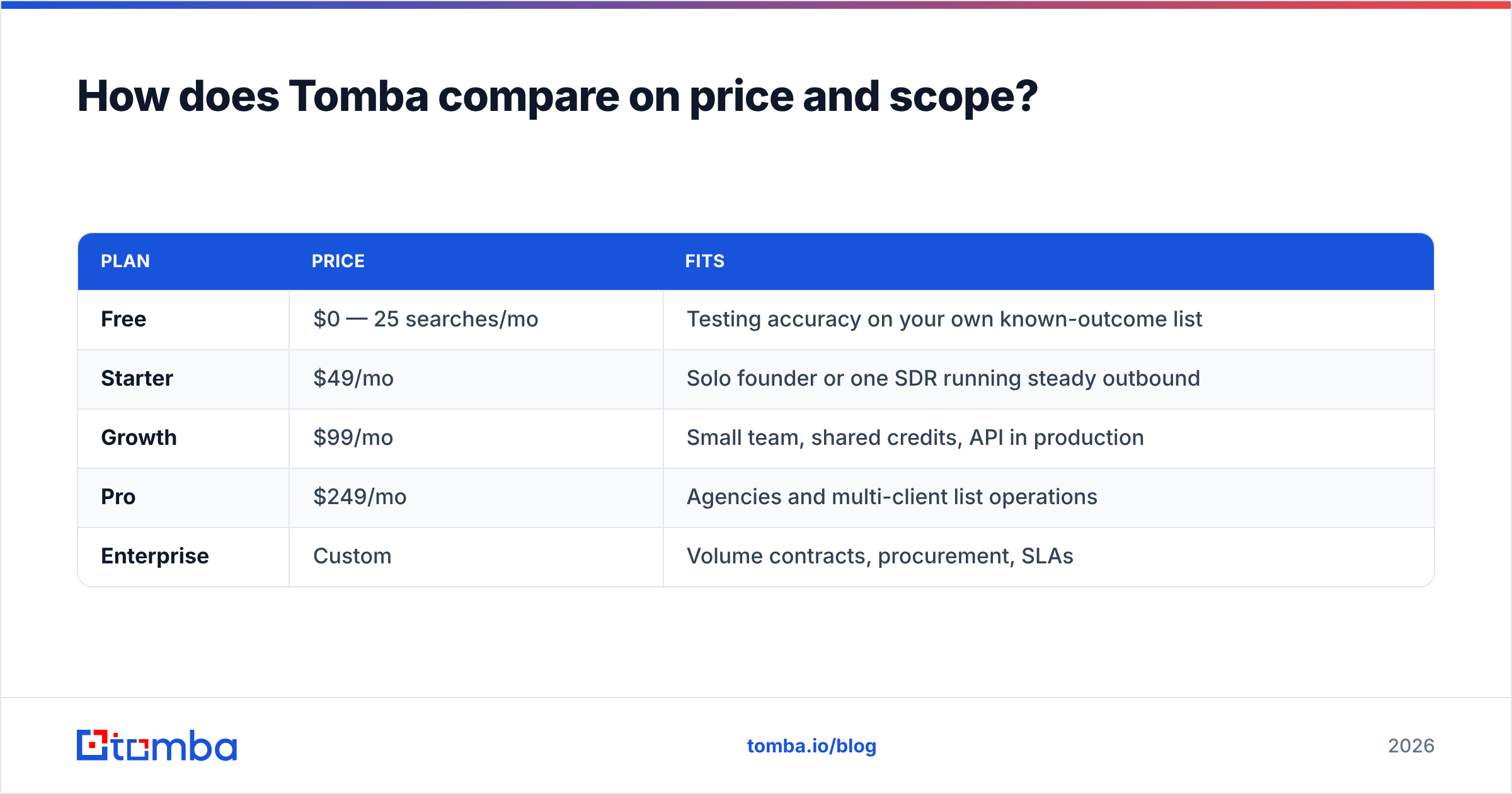
Tomba is a finder-first platform. It looks like Zintlr on sourcing and like Exactverify on verification. The difference is that both sit behind one credit pool.
| Plan | Price | Fits |
|---|---|---|
| Free | $0 — 25 searches/mo | Testing accuracy on your own known-outcome list |
| Starter | $49/mo | Solo founder or one SDR running steady outbound |
| Growth | $99/mo | Small team, shared credits, API in production |
| Pro | $249/mo | Agencies and multi-client list operations |
| Enterprise | Custom | Volume contracts, procurement, SLAs |
Full details sit on the Tomba pricing page. The case for consolidation is not that one Tomba feature beats a specialist on its own axis. A dedicated verifier will always have more tuning knobs. It is that most teams under 20 reps do not need those knobs, and they do need to stop reconciling three credit balances across three renewal dates.
Already committed to Zintlr for sourcing? Run its exports through a dedicated verification step before each campaign. That is sound architecture. Already committed to Exactverify for cleaning? You still need a sourcing layer, and that is the gap worth pricing out.
Where should you start?#
Start by measuring, not by subscribing. Pull 500 addresses with known bounce outcomes. Run them through each candidate's free tier. Compare the verdicts against reality. Then price the winner against your actual monthly volume, not the volume you hope to hit next year.
If your bottleneck is finding the contacts at all, start with the Tomba Email Finder. The free tier gives you 25 searches a month with no card. That is enough to run the accuracy test above on your own domains before you commit a dollar to Tomba, Exactverify, Zintlr, or anyone else.
Related guides#
Ready to find emails that actually work?
Join 150,000+ professionals who stopped guessing and started sending. Free credits on signup — no credit card required.
Get the Tomba newsletter
Practical outbound tactics and product updates — once every two weeks.
About the author