ExactVerify vs ZoomInfo: Which B2B Data Tool Wins in 2026?
ExactVerify verifies the emails you already have. ZoomInfo sells you the contacts in the first place. Here is where each one earns its price in 2026 — and where a cheaper stack beats both.
ExactVerify vs ZoomInfo comes down to one question. Do you need to clean a list, or build one?
TL;DR
- ExactVerify vs ZoomInfo is not a like-for-like fight. ExactVerify verifies email lists. ZoomInfo is a full B2B data platform: contacts, firmographics, intent, CRM sync. It is a water filter next to a well.
- ExactVerify wins on cost per record and on cleaning lists you already own. Credits cost fractions of a cent. No annual lock-in.
- ZoomInfo wins on discovery. You can build a target list from scratch. It also costs the most: buyer reports put entry contracts near $15,000 a year.
- Need verified emails for a set list of companies? A finder-plus-verifier combo (Tomba, BookYourData, and similar) beats both on price.
- Rule of thumb: have data and doubt it, buy ExactVerify. Have budget and no data, buy ZoomInfo. Have domains and need people, buy a finder.
ExactVerify vs ZoomInfo: what does each tool do?#
Start here. Most "ExactVerify vs ZoomInfo" posts quietly pretend these products do the same job. They don't.
ExactVerify (exactverify.com) is an email verification engine. You upload a CSV, or call the API with addresses you already own. It returns a status for each one: valid, invalid, catch-all, role-based, disposable, or unknown. Under the hood it checks syntax, looks up MX records, runs SMTP handshakes, and matches throwaway domains. It will not tell you who works at Stripe. It tells you whether jane@stripe.com will bounce.
ZoomInfo (zoominfo.com) is a B2B data platform. It sells access to a contact and company database: hundreds of millions of profiles, direct dials, org charts, tech stacks, and buyer intent signals. The data comes from its contributor network and from web crawling. You search by industry, headcount, title, tech stack, or funding event, then export contacts you never had.
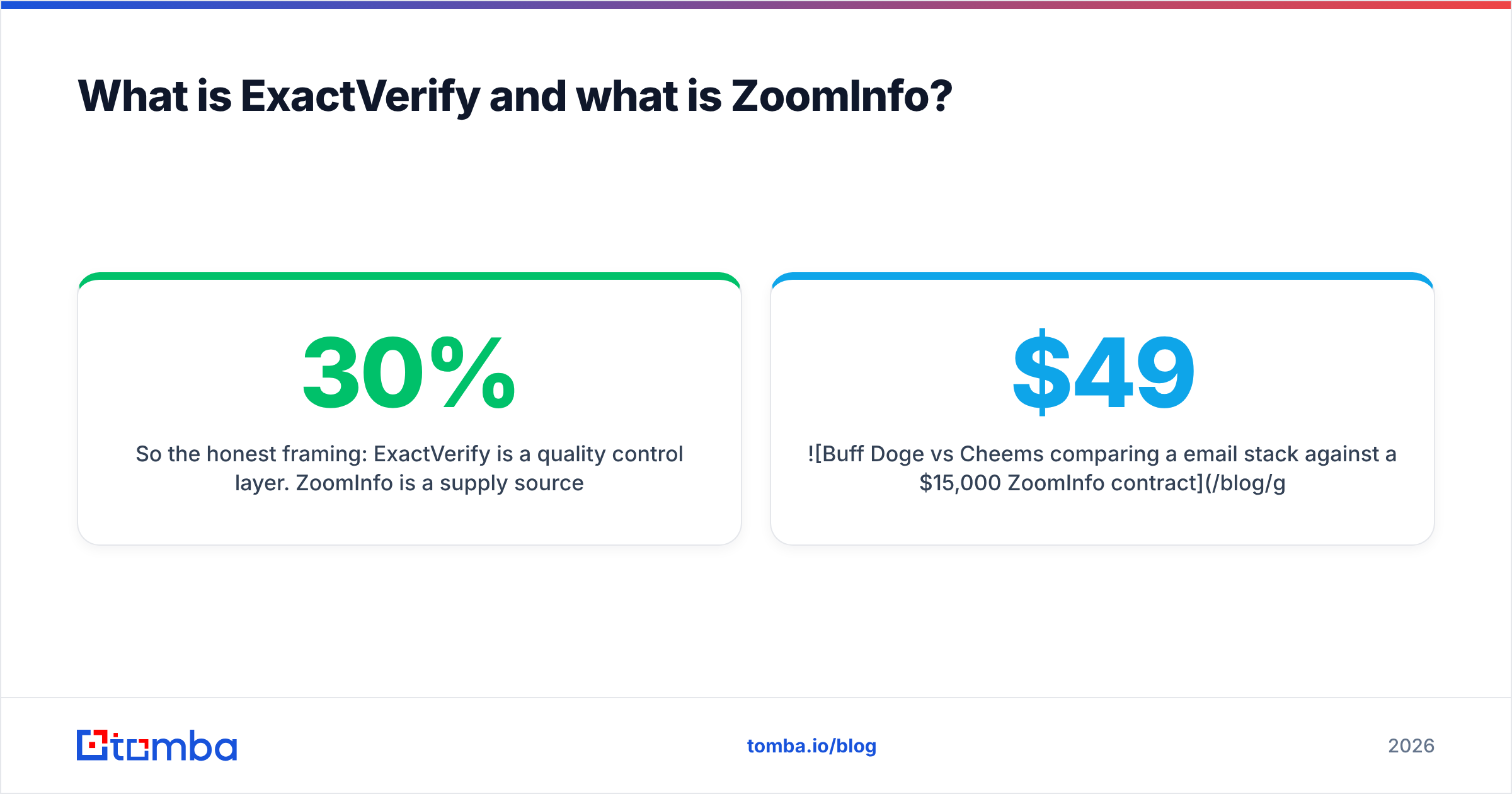
So the honest framing. ExactVerify is a quality control layer. ZoomInfo is a supply source. Even a team with a ZoomInfo contract still needs verification, because no database stays fresh. Job-change churn alone rots B2B contact data by 25–30% a year.

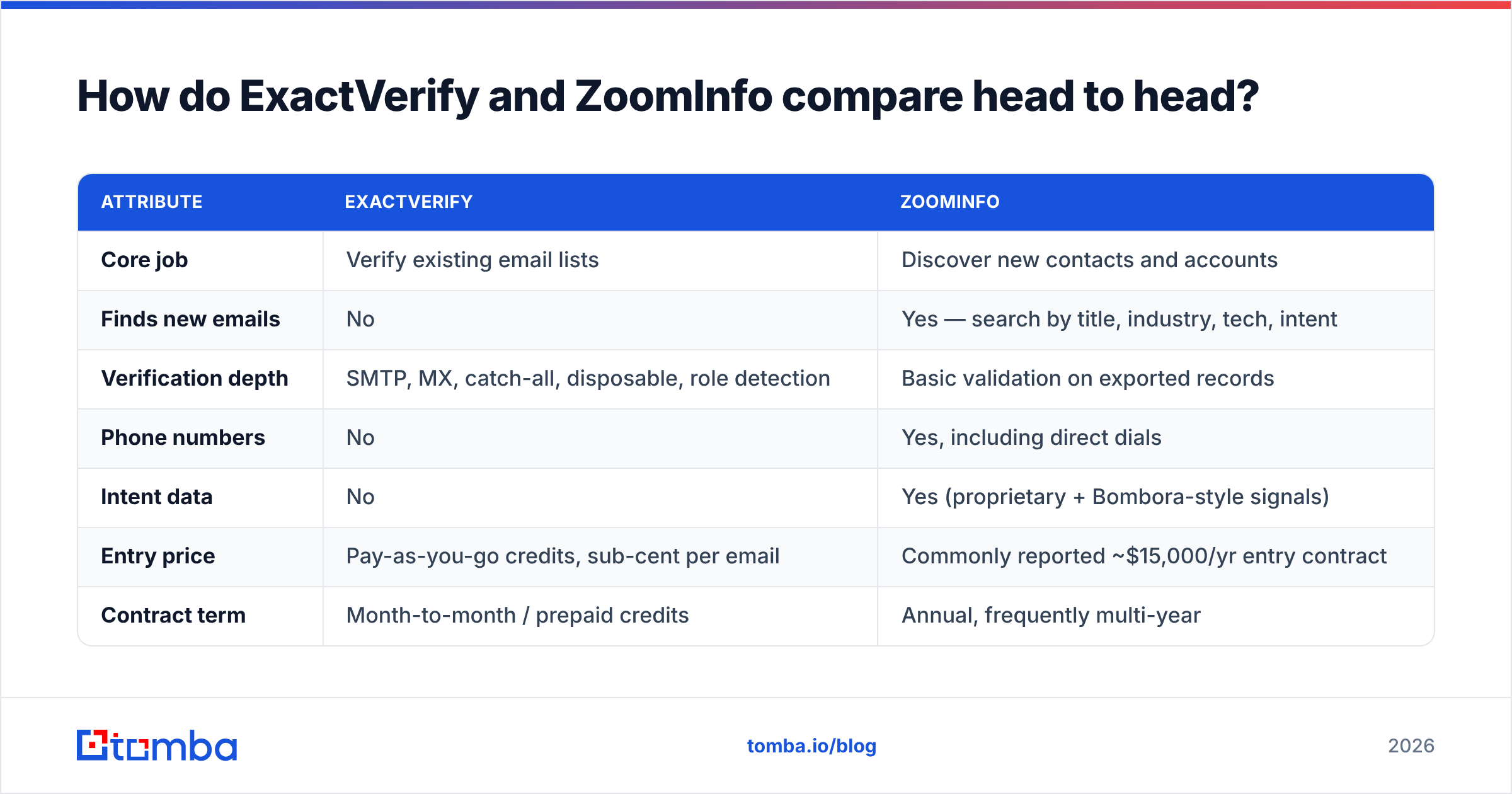
ExactVerify vs ZoomInfo: the head-to-head comparison#
Here is the practical side-by-side. Prices reflect public rates and commonly reported contract ranges as of early 2026. ZoomInfo does not publish list pricing. Treat that row as a directional estimate from buyer reports on G2 and procurement forums, not a quote.
| Attribute | ExactVerify | ZoomInfo |
|---|---|---|
| Core job | Verify existing email lists | Discover new contacts and accounts |
| Finds new emails | No | Yes — search by title, industry, tech, intent |
| Verification depth | SMTP, MX, catch-all, disposable, role detection | Basic validation on exported records |
| Phone numbers | No | Yes, including direct dials |
| Intent data | No | Yes (proprietary + Bombora-style signals) |
| Entry price | Pay-as-you-go credits, sub-cent per email | Commonly reported ~$15,000/yr entry contract |
| Contract term | Month-to-month / prepaid credits | Annual, frequently multi-year |
| Free tier | Trial credits | No self-serve free tier |
| API access | Yes, on paid plans | Yes, usually at higher tiers or added cost |
| CRM integration | Limited (CSV, API, Zapier-class) | Deep native Salesforce, HubSpot, Dynamics sync |
| Best fit | Marketers cleaning lists before send | Enterprise SDR teams building TAM from zero |
| Worst fit | Teams with no list yet | Solo founders and sub-10-seat teams |
The table settles the choice for most teams. The awkward middle is the team with some data, some budget, and a need for both jobs. A third path usually wins there. More on that below.
ExactVerify vs ZoomInfo accuracy: what the word really means#
Accuracy means two different things here, and vendors exploit the gap.
For ExactVerify, accuracy means bounce prediction. Of the addresses it marked valid, how many actually delivered? Tools in this class advertise 98–99%. The honest ones admit the number leaves out catch-all domains, and catch-alls are where the real work sits.
A catch-all server accepts every address at the SMTP layer, so a plain handshake proves nothing. Mark catch-alls valid and the headline accuracy is inflated. Mark them invalid and you throw away good leads. The right answer is a separate status plus a deeper probe. That is why a dedicated catch-all verifier matters more than a headline percentage.
For ZoomInfo, accuracy means record correctness. Is this person still in this role, at this company, reachable at this address? The contributor network and refresh cadence are strong for US enterprise and mid-market. Coverage thins for EMEA SMB, non-English markets, and companies under 50 people. Reviewers report both extremes: excellent direct dials for US VPs, stale records for European startups.

The practical test is the same either way. Pull 200 records. Send a real campaign from a warmed domain. Count the hard bounces. Vendor accuracy is a marketing number. Your bounce rate is the only benchmark that pays the bills.
ExactVerify vs ZoomInfo pricing in 2026#
Cost is where the two products split hardest. It is also where buyers get surprised.
ExactVerify follows the standard verification curve. You buy credits. One credit checks one email. The unit price drops as volume rises. Small packs land near a tenth of a cent per email, and large packs go lower. Credits usually roll over or expire on a long window. There are no seats to pay for. A 100,000-record cleanup costs a few hundred dollars, once.
ZoomInfo prices per seat, per data package, per module. The base Sales package is only the entry point. Intent data, WebSights visitor identification, Engage sequencing, and extra export credits are usually separate line items. Buyers report three friction points:
- No self-serve tier. You go through sales, a demo, and a quote. Budget approval takes weeks.
- Export credit caps. Your seat does not include unlimited exports. Run out mid-quarter and you get an upsell call.
- Auto-renewal terms. Cancellation windows are tight, and they are enforced. Read the clause before you sign, not in month eleven.
None of that makes ZoomInfo a bad product. It makes it an enterprise product. With 15 SDRs and a defined TAM, the math works. With a three-person GTM team, you pay for features you never open.
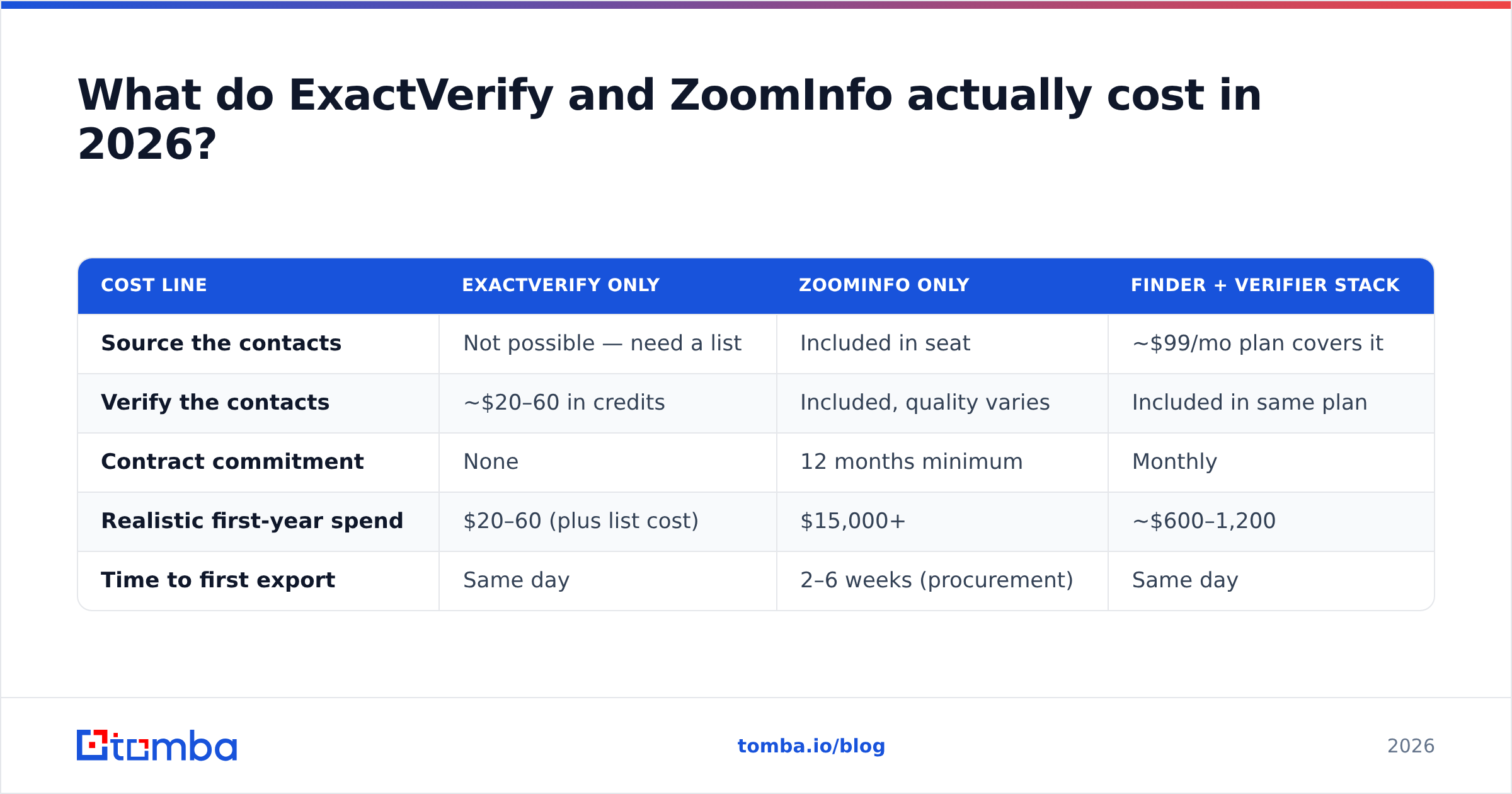
Here is the cost picture for one common task: building and cleaning a 10,000-contact list of mid-market SaaS operations leaders.
| Cost line | ExactVerify only | ZoomInfo only | Finder + verifier stack |
|---|---|---|---|
| Source the contacts | Not possible — need a list | Included in seat | ~$99/mo plan covers it |
| Verify the contacts | ~$20–60 in credits | Included, quality varies | Included in same plan |
| Contract commitment | None | 12 months minimum | Monthly |
| Realistic first-year spend | $20–60 (plus list cost) | $15,000+ | ~$600–1,200 |
| Time to first export | Same day | 2–6 weeks (procurement) | Same day |
When should you choose ExactVerify?#
Pick ExactVerify when all of these are true.
- You already own the list. Webinar sign-ups, a scraped conference roster, an inherited CRM export, an old newsletter file. The contacts exist. Their validity doesn't.
- Your bounce rate is the problem. Above 3% hard bounces, mailbox providers throttle you. No amount of copy testing fixes that. Verification does.
- You want zero commitment. Prepaid credits, no seats, no annual term, no procurement cycle.
- You're moving to a new email platform. Most platforms charge by list size and punish bad sends. Cleaning before import pays for itself.
- You need a compliance-safe cleanup. Dropping role accounts (
info@,sales@) and known spam traps cuts complaint risk on the next send.
What ExactVerify won't do is build you a pipeline. It is a filter, not a faucet.
When should you choose ZoomInfo?#
Pick ZoomInfo when all of these are true.
- You're starting from zero. No CRM history worth mining, no inbound, no database.
- Your ICP is US mid-market or enterprise. That is where coverage and direct-dial quality peak.
- You have 8 or more reps. Seat pricing only works when enough people use it every day.
- You need intent, not just contacts. Knowing an account is researching your category is a real edge. No verifier or finder copies it.
- You need deep CRM automation. Native Salesforce enrichment, auto de-duping, and territory routing are genuine strengths.
If fewer than three of those apply, you are about to overpay by an order of magnitude.

Is there a middle path between ExactVerify and ZoomInfo?#
Yes. Most teams land on it after their first ZoomInfo renewal quote.
The gap both tools leave open is a very common job: "I know which companies I want. I need the right people's verified emails, cheaply, this week." Verification alone cannot source them. A full data platform can, but it charges enterprise rates for a mid-market task.
That is the slot email finders fill. You supply a domain, or a name plus a company. The tool returns a verified professional address, with confidence scoring and pattern detection behind the scenes.
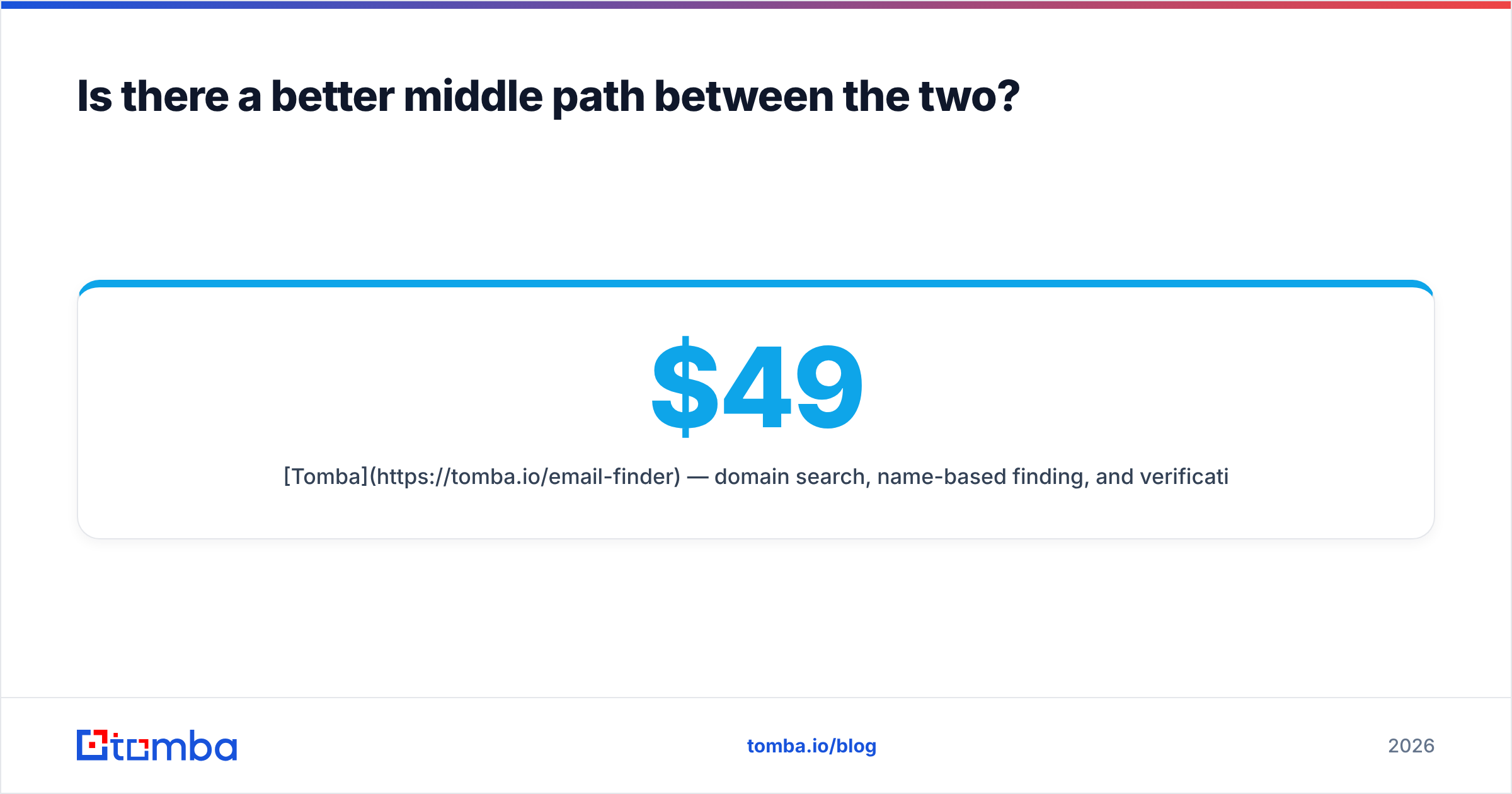
- Tomba — domain search, name-based finding, and verification in one workspace. Free tier at 25 searches a month, Starter at $49/mo, Growth at $99/mo, Pro at $249/mo, Enterprise custom. Verification is bundled rather than sold separately, and the Tomba API puts finder and verifier on the same key.
- BookYourData — a strong pay-as-you-go option with a prebuilt B2B database and an accuracy guarantee. Good when you want to buy a targeted list outright. No subscription to babysit.
- ZoomInfo — still the right answer at real enterprise scale, especially when intent data drives the motion.
- ExactVerify — still the right answer as a cleanup layer on top of whatever source you use.
These are not mutually exclusive. A pragmatic 2026 stack looks like this: source with a finder or a bought list, verify with a dedicated email verifier before every send, and save platform spend for the accounts that justify it.

What does the right stack look like by team size?#
Four common setups, with the reasoning behind each.
- Solo founder / first 100 customers. Free-tier finder plus manual verification. You need 30 good conversations, not 30,000 records. Cost: $0–49/mo. Skip ExactVerify volume packs and ZoomInfo entirely.
- 2–5 person GTM team. A finder plan with bundled verification, around $99/mo, plus bulk processing for list uploads. Add pay-as-you-go credits only if you import outside lists often.
- 6–15 reps, defined ICP. A finder plus a dedicated verifier as a second opinion on high-value segments. Consider ZoomInfo only if intent data would change how you rank accounts. Otherwise spend the budget on more sending domains.
- 15+ reps, enterprise motion. ZoomInfo (or a peer) for discovery and intent, plus a verifier before anything hits a sequence. Never trust a platform export blind. A verification pass costs pennies and protects your sender reputation, which is the expensive asset.
What are the real risks with each tool?#
ExactVerify risk: trusting a green "valid" on catch-all domains. Roughly 15–20% of B2B domains are catch-all, and they cluster in larger companies — exactly the accounts you care about. If your verifier cannot sort these properly, you either bounce or bin good leads. Ask how catch-alls are handled before you buy volume.
ZoomInfo risk: the contract, not the data. The common complaints are procurement-flavored. Export limits hit mid-quarter. Seats you stopped using still bill. Renewal needs written notice inside a narrow window. Negotiate export credits and the cancellation clause at signing. The data will mostly do what the demo showed. The invoice is where the surprises live.
Shared risk: treating any one vendor as ground truth. Every B2B database decays, including the best-funded ones. Build verification into the send workflow as a repeating step, not a one-time project.
ExactVerify vs ZoomInfo: the verdict#
Have a list and need it clean? ExactVerify does that job well and cheaply, with no contract to negotiate. Have budget, headcount, and no data? ZoomInfo is still the most complete discovery platform on the market, and it earns its price at scale. Most teams reading an ExactVerify vs ZoomInfo comparison sit between the two. They want targeted, verified contacts without an annual commitment. That is a finder's job.
Start with the Tomba Email Finder if that sounds like you. The free tier gives you 25 searches a month, so you can test real accuracy against your own ICP before spending anything. Verification is included, not metered. Paid plans start at $49/mo with no annual lock-in. Run 50 of your actual target accounts through it, send the campaign, and measure the bounce rate. Then decide whether you need a $15,000 contract or a $49 one. The Tomba pricing page has the full tier breakdown.
Related guides#
Ready to find emails that actually work?
Join 150,000+ professionals who stopped guessing and started sending. Free credits on signup — no credit card required.
Get the Tomba newsletter
Practical outbound tactics and product updates — once every two weeks.
About the author