Exellius Pros and Cons: An Honest 2026 Review for B2B Teams
A neutral breakdown of Exellius: where the waterfall enrichment actually earns its price, where the credit math turns ugly, and which teams should pick something cheaper instead.
TL;DR
- Exellius is a waterfall-style B2B contact enrichment platform: it queries multiple data vendors per lookup and returns the best result, which pushes coverage higher than any single-source tool.
- The biggest pro is hit rate on hard-to-find contacts — mid-market and non-US records where a single provider typically returns nothing.
- The biggest con is cost opacity. Waterfall pricing means one contact can burn several credits, so your effective cost per verified email is rarely the number on the pricing page.
- Teams doing under ~5,000 lookups a month usually overpay. A flat-rate finder plus a verifier covers the same ground for less.
- Best fit: RevOps teams with a real enrichment budget and a CRM that already has thousands of half-empty records. Worst fit: a two-person SDR team that just needs emails for a target list.
What Is Exellius and How Does It Actually Work?#
Exellius sits in the B2B data enrichment category — the layer between your CRM and the raw contact data market. Instead of maintaining one proprietary database and serving results from it, Exellius uses a waterfall model: a single lookup request is passed to provider 1, then provider 2, then provider 3, until one returns a match.
The everyday analogy: it's like calling three locksmiths instead of one. You will almost certainly get your door open, but you pay for the calls, and you don't control which locksmith picks up.
Technically, that architecture has three consequences you should price in before signing anything:
- Coverage goes up, predictably. Each additional provider in the chain adds incremental matches. Going from one source to four typically lifts hit rate 20–35 percentage points on messy lists.
- Cost per record goes up, unpredictably. An easy contact (well-known SaaS company, standard first.last format) resolves on the first hop and costs one credit. A hard contact might hit four providers before a match — or hit four and return nothing, depending on the vendor's billing policy.
- Quality becomes non-uniform. Data from provider 4 is not the same grade as data from provider 1. Waterfall tools rarely tell you which source a given record came from, so your verification step matters more, not less.
That third point is where most teams get burned. A high hit rate is not the same as a high deliverable rate. If you are not running results through an email verifier before they enter a sequence, you are converting coverage gains into bounce-rate losses.
What Are the Real Pros of Exellius?#
Hit rate on difficult records. This is the honest headline. On lists dominated by companies under 200 employees, non-English domains, or roles below VP, single-source tools return a lot of blanks. Waterfall closes most of that gap. If your ICP lives in that territory, the coverage delta is real and measurable.
Enrichment breadth beyond email. Exellius returns firmographic and technographic attributes alongside contact data — company size, funding stage, tech stack signals. For a RevOps team building lead scoring rules, that's a genuine time saver versus stitching three vendors together yourself.
CRM-first workflow. The product is built around bulk enrichment of existing records rather than one-off lookups. If your Salesforce or HubSpot instance has 40,000 contacts with empty email fields, that's the use case the tool was designed for.
No per-vendor contract sprawl. Buying four data providers separately means four contracts, four minimum commitments, four security reviews. One waterfall vendor collapses that into one line item. Procurement genuinely likes this.

API and automation coverage. Enrichment that only works in a UI is enrichment you'll stop doing by week three. Programmatic access matters; make sure whatever you buy has it, the same way a Tomba API key lets you wire lookups directly into your own pipeline rather than exporting CSVs by hand.
What Are the Cons You Should Weigh Seriously?#
Credit math is the number one complaint. The pricing page shows a monthly credit allowance. It does not show your effective cost, which is:
effective cost per usable contact =
  (monthly price / credits) x (avg credits burned per lookup) / (deliverable rate)
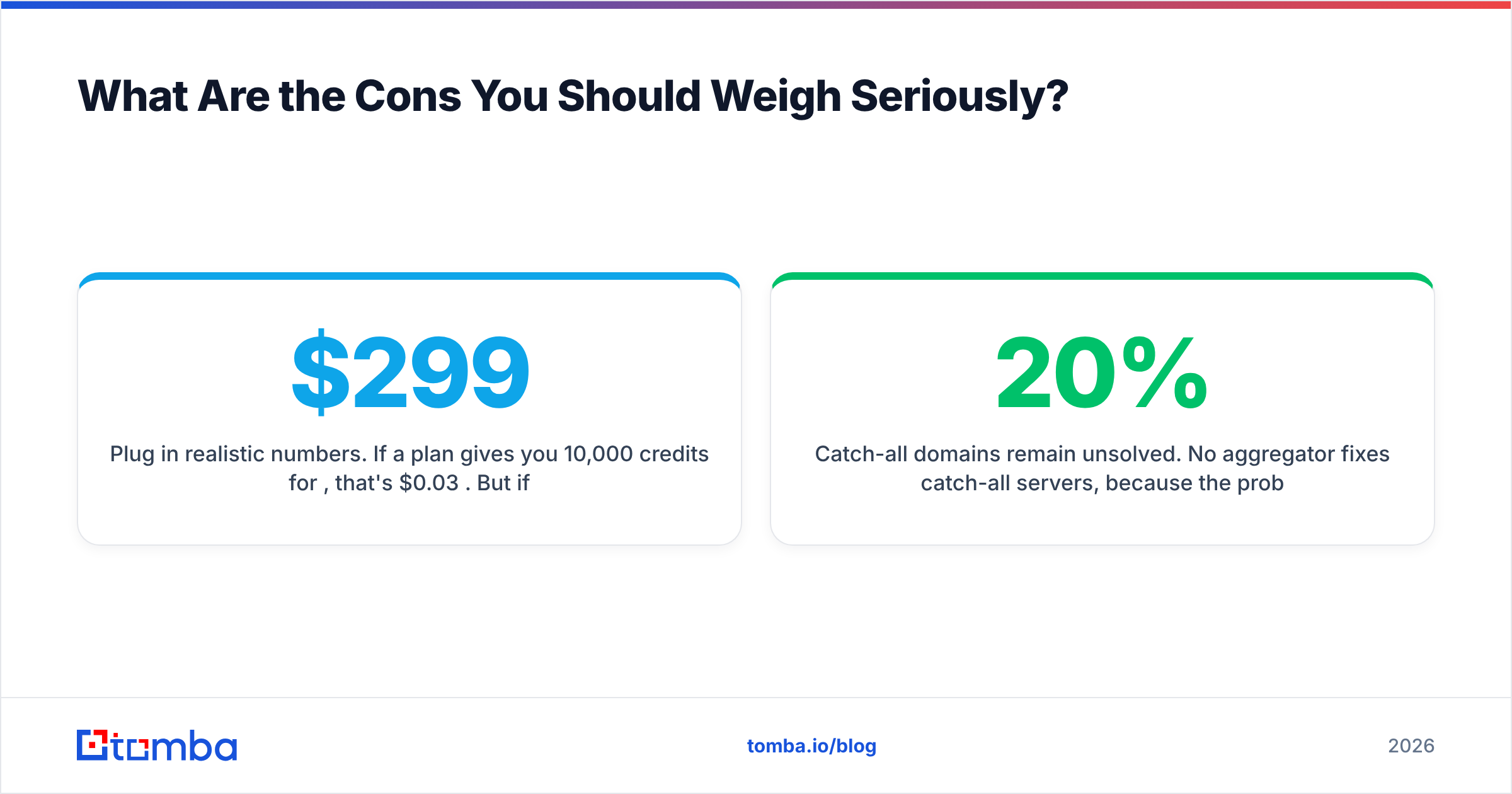
Plug in realistic numbers. If a plan gives you 10,000 credits for $299, that's $0.03 per credit. But if hard records average 2.4 credits and your deliverable rate after verification is 82%, your true cost is roughly $0.09 per usable contact — triple the sticker figure. Nobody is lying to you; the math is just several steps removed from the marketing.
You inherit someone else's data quality. Waterfall vendors are aggregators. Their accuracy ceiling is the accuracy of their worst enabled provider, and you usually cannot see or disable individual sources. When a bad record bounces, root-cause analysis stops at "the waterfall returned it."
Catch-all domains remain unsolved. No aggregator fixes catch-all servers, because the problem is at the receiving mail server, not the data layer. Any tool that marks a catch-all address as "valid" without qualification is guessing. You still need a dedicated catch-all verifier step, and roughly 15–20% of B2B domains are catch-all configured.
Overage pricing punishes spiky usage. Enrichment demand is not smooth. A single large list import can blow through a monthly allowance in an afternoon, and overage rates are typically 1.5–3x the in-plan rate.
Onboarding overhead is non-trivial. Field mapping, dedupe rules, and enrichment triggers take a RevOps person real days to configure. If you don't have that person, the tool underdelivers regardless of data quality.

How Does Exellius Compare to the Alternatives?#
Here is the practical comparison. Prices are list rates as published by each vendor and change often — verify before you buy.
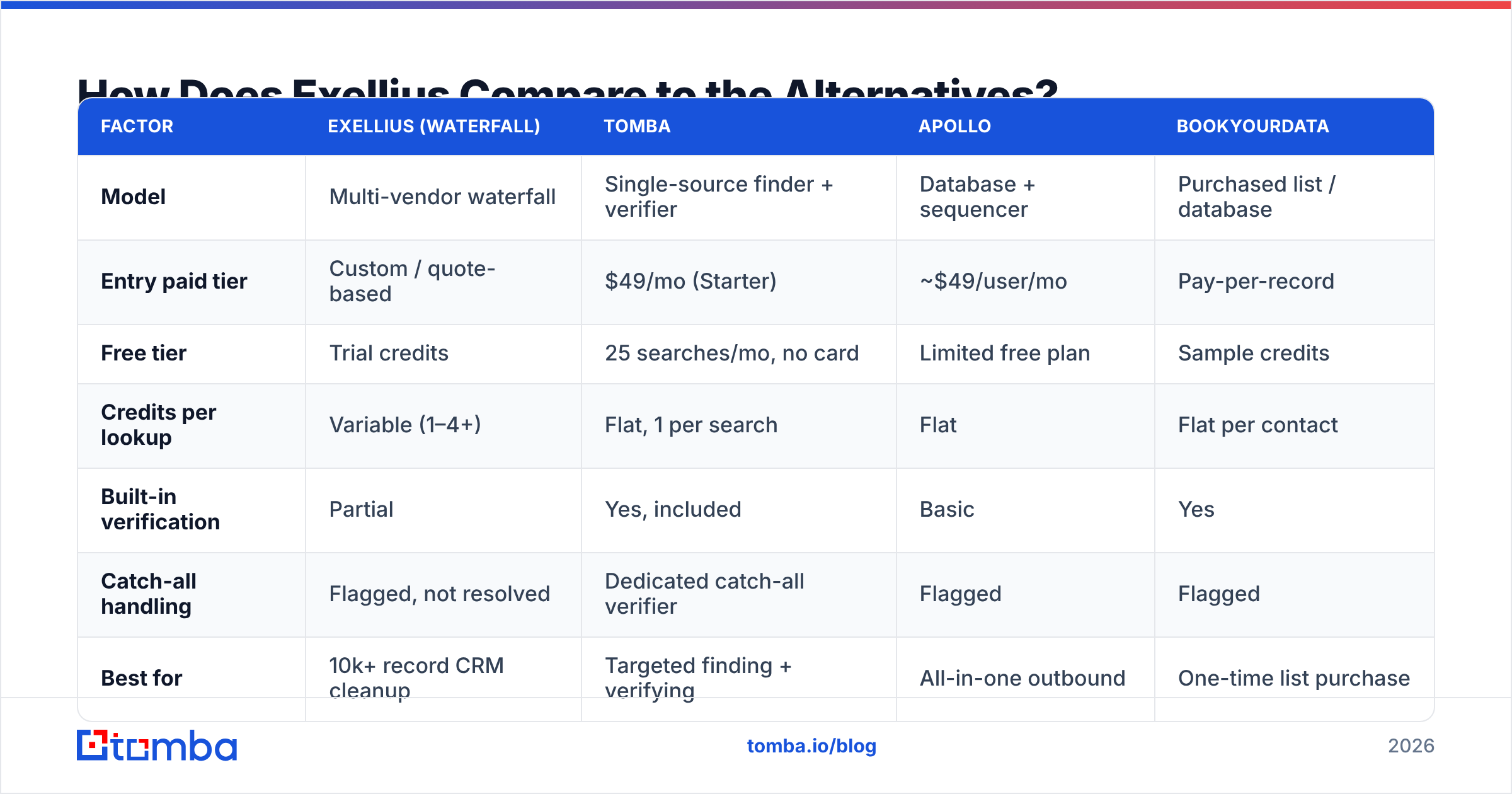
| Factor | Exellius (waterfall) | Tomba | Apollo | BookYourData |
|---|---|---|---|---|
| Model | Multi-vendor waterfall | Single-source finder + verifier | Database + sequencer | Purchased list / database |
| Entry paid tier | Custom / quote-based | $49/mo (Starter) | ~$49/user/mo | Pay-per-record |
| Free tier | Trial credits | 25 searches/mo, no card | Limited free plan | Sample credits |
| Credits per lookup | Variable (1–4+) | Flat, 1 per search | Flat | Flat per contact |
| Built-in verification | Partial | Yes, included | Basic | Yes |
| Catch-all handling | Flagged, not resolved | Dedicated catch-all verifier | Flagged | Flagged |
| Best for | 10k+ record CRM cleanup | Targeted finding + verifying | All-in-one outbound | One-time list purchase |
| Cost predictability | Low | High | Medium | High per record |
The pattern in that table matters more than any single row: you are choosing between coverage and predictability. Waterfall buys coverage at the cost of predictability. Flat-rate finders buy predictability at the cost of some coverage on hard records. BookYourData sits in a different lane entirely — it's a strong option when you want a defined, pre-built list rather than an ongoing enrichment engine, and its per-record model makes budgeting straightforward.
Four decision rules that hold up in practice:
- Under 5,000 lookups/month → flat rate wins. The waterfall premium never pays back at low volume. A $49/mo plan with a bundled verifier covers it.
- Over 20,000 records of legacy CRM sludge → waterfall wins. Coverage on stale records is where multi-source genuinely outperforms.
- Outbound sequences already running → verification matters more than coverage. Bad addresses cost you sender reputation, which costs you every future campaign. Coverage is cheap; reputation is not.
- Non-US or SMB-heavy ICP → test both on the same 500 records. Regional coverage varies wildly by vendor. Never buy on a demo list the vendor picked.
Is the Accuracy Claim Credible?#
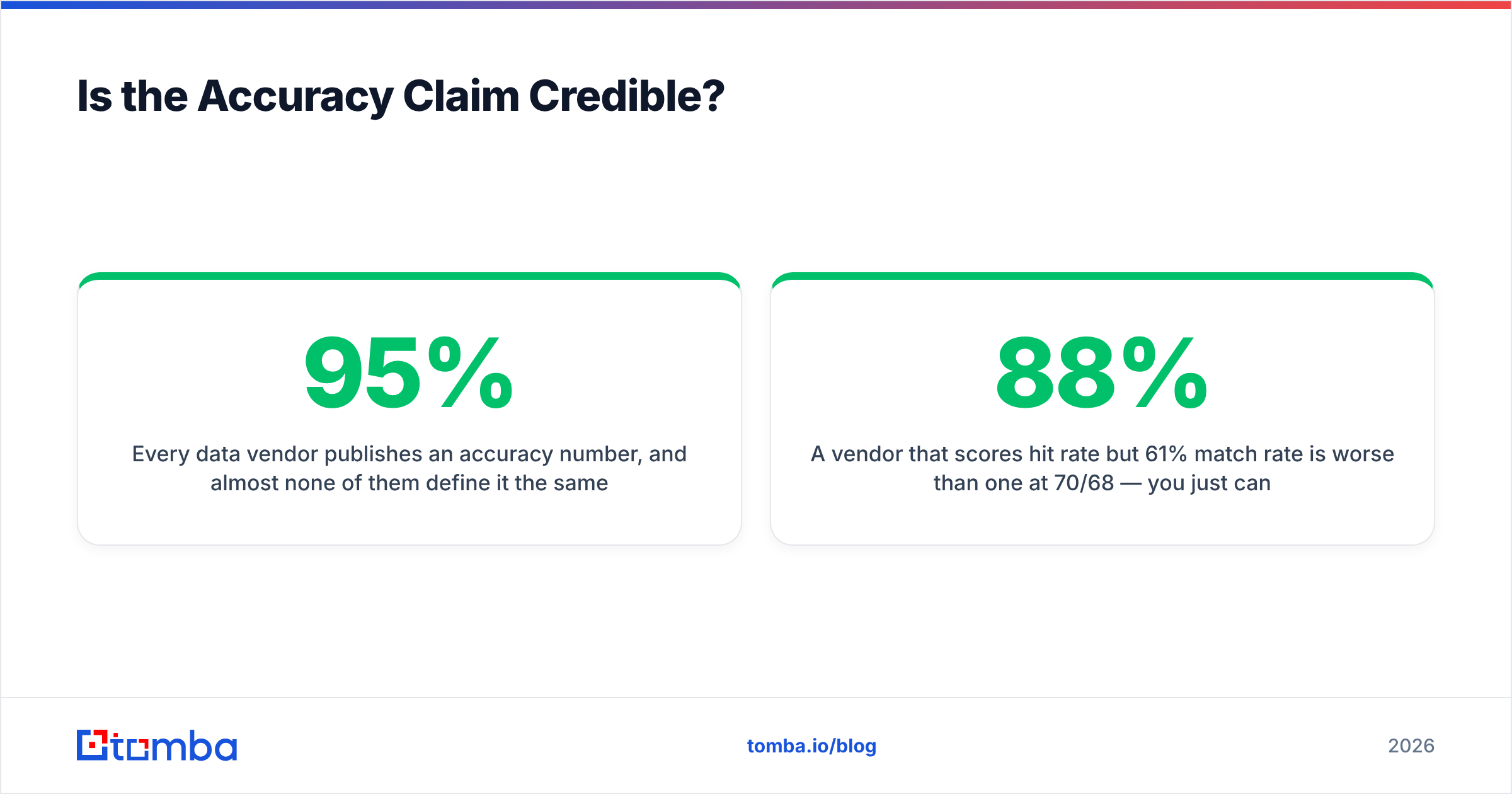
Every data vendor publishes an accuracy number, and almost none of them define it the same way. "95% accurate" can mean 95% of returned records are syntactically plausible, or 95% pass SMTP checks, or 95% were correct as of the last database refresh. Those are wildly different claims.
Run your own test before you commit. The method takes an afternoon:
- Build a control list. 300–500 contacts you can independently confirm — customers, past leads, people whose email you already have in a closed-won record.
- Strip the emails. Feed the vendor only name + company domain.
- Measure three numbers, not one: hit rate (returned something), match rate (returned the right address), and deliverable rate (survives verification and doesn't bounce).
- Repeat on a hard segment. Rerun with sub-100-employee companies outside the US. This is where vendor differences actually show up.
- Price the result. Divide total spend by the count of records that passed all three checks. That's your real number.
A vendor that scores 88% hit rate but 61% match rate is worse than one at 70/68 — you just can't see it from the dashboard. Independent review data on G2's data enrichment category is useful directional context, but nothing substitutes for testing on your own ICP.
For the underlying question of where any of this data comes from, it's worth reading vendor documentation on sourcing directly — Tomba publishes its data sources openly, and you should expect the same transparency from anyone you pay.
Who Should Buy Exellius and Who Shouldn't?#
Buy it if:
- You have 15,000+ CRM records with meaningful field gaps and a mandate to fix them.
- A dedicated RevOps or ops-engineering person owns enrichment as part of their job.
- Your ICP skews toward hard-to-find segments where single-source coverage genuinely fails.
- You've modeled the credit burn on a real sample and the effective cost still clears your CAC math.
Skip it if:
- You need a few hundred verified emails a month for targeted outbound. Use a bulk email finder on a flat plan and put the savings into copy and volume.
- Budget predictability matters more than the last 15 points of coverage — which is true for most bootstrapped teams.
- You have no one to own configuration. Unconfigured enrichment tools are shelfware.
- Your bounce problem is actually a verification problem. Adding more sources to an unverified pipeline makes deliverability worse, not better.
The honest framing: Exellius is not overpriced for what it does. It's frequently mismatched to the buyer. Waterfall enrichment is an infrastructure purchase for teams operating at data scale. Most teams asking "should I buy this?" are actually asking "how do I get 2,000 good emails this quarter?" — and that's a different, cheaper problem.
What Does a Sensible Stack Look Like Instead?#
If you land on the "skip it" side, the replacement stack is simple and costs a fraction:
- Finding: a flat-credit finder for name + domain → email, plus domain search to pull every public address at a target company in one call.
- Verifying: a real verification pass on everything before it touches a sequence, with explicit catch-all handling rather than a silent "valid."
- Enriching: data enrichment on the records that actually made it into the pipeline — not on your entire database, which is where enrichment budgets go to die.
- Automating: API or spreadsheet integration so the workflow survives the person who set it up.
That stack is deliberately boring. Boring is the point: predictable cost, one place to debug, no surprise invoice at month end. You can compare it against waterfall pricing on the Tomba pricing page, where Starter runs $49/mo, Growth $99/mo, and Pro $249/mo — flat, with the verifier included rather than metered separately. For reference on how the broader category is structured, HubSpot's overview of data enrichment is a reasonable neutral primer.
Where Should You Start?#
Start with the control-list test described above, on two vendors, same 500 records, same week. It costs you an afternoon and it will settle the question more definitively than any review — including this one.
If the test tells you that flat-rate finding plus rigorous verification covers your ICP, the Tomba Email Finder is the direct place to run it: 25 free searches a month with no card, flat credit consumption so one lookup is always one credit, and built-in verification so what you export is what actually lands. Run your own hard-segment list through it before you commit a dollar to a waterfall contract — the comparison is the whole point.
Related guides#
Ready to find emails that actually work?
Join 150,000+ professionals who stopped guessing and started sending. Free credits on signup — no credit card required.
Get the Tomba newsletter
Practical outbound tactics and product updates — once every two weeks.
About the author