Exellius vs GrowMeOrganic: Which B2B Lead Tool Wins in 2026?
Exellius sells done-for-you lead generation. GrowMeOrganic sells a self-serve prospecting suite. Here is how the two actually compare on data accuracy, pricing transparency, and what happens to your bounce rate.
Exellius vs GrowMeOrganic is really one question: do you hire a team, or do you buy a tool? Exellius sells the team. GrowMeOrganic sells the tool. Here is how the two compare on price, data quality, and risk.
TL;DR
- Exellius is a done-for-you lead generation partner. You brief a team, they build and deliver the list, and they often run the outreach too. Pricing is by quote, not published.
- GrowMeOrganic is a self-serve prospecting suite. One seat price covers a LinkedIn and email extractor, a B2B database, and a cold email sender.
- The real question in Exellius vs GrowMeOrganic is not which tool is better. It is whether you want to rent a team or rent software. Those are different budgets, and they fail in different ways.
- Neither vendor publishes an independent accuracy test. Whatever you buy, run the list through a third-party email verifier first. Do it before the list touches your sending domain.
- If you mostly need accurate contact data and already own your sequencer, a finder plus verifier stack (Tomba starts at $49/mo) is usually cheaper than either option.
What are Exellius and GrowMeOrganic, actually?#
They get compared because they show up in the same searches — "B2B lead generation," "find prospect emails," "outbound at scale." Under the hood they sell different things.
Exellius sells B2B lead generation as a service. You describe your ideal customer. Their team builds the account and contact list. In most deals they also book appointments or run the campaign. You are buying meetings, not a login. Pricing is negotiated per project, which is normal for this category. It is also the thing to watch: you cannot compare a quote you have not received.
GrowMeOrganic is software. It bundles a Chrome extension that pulls contacts from LinkedIn and Sales Navigator, a B2B contact database, an email finder and verifier, and a cold email tool with drip sequences. The pitch is a flat seat price instead of metered credits. You do the work; the tool removes the copy-paste.
That difference drives everything else here. A service scales with your budget. Software scales with your operator's skill.

Exellius vs GrowMeOrganic: the head-to-head table#
Here is the honest side-by-side. Where a vendor does not publish a number, this table says so instead of inventing one. Treat any competitor blog that quotes exact Exellius pricing with suspicion.
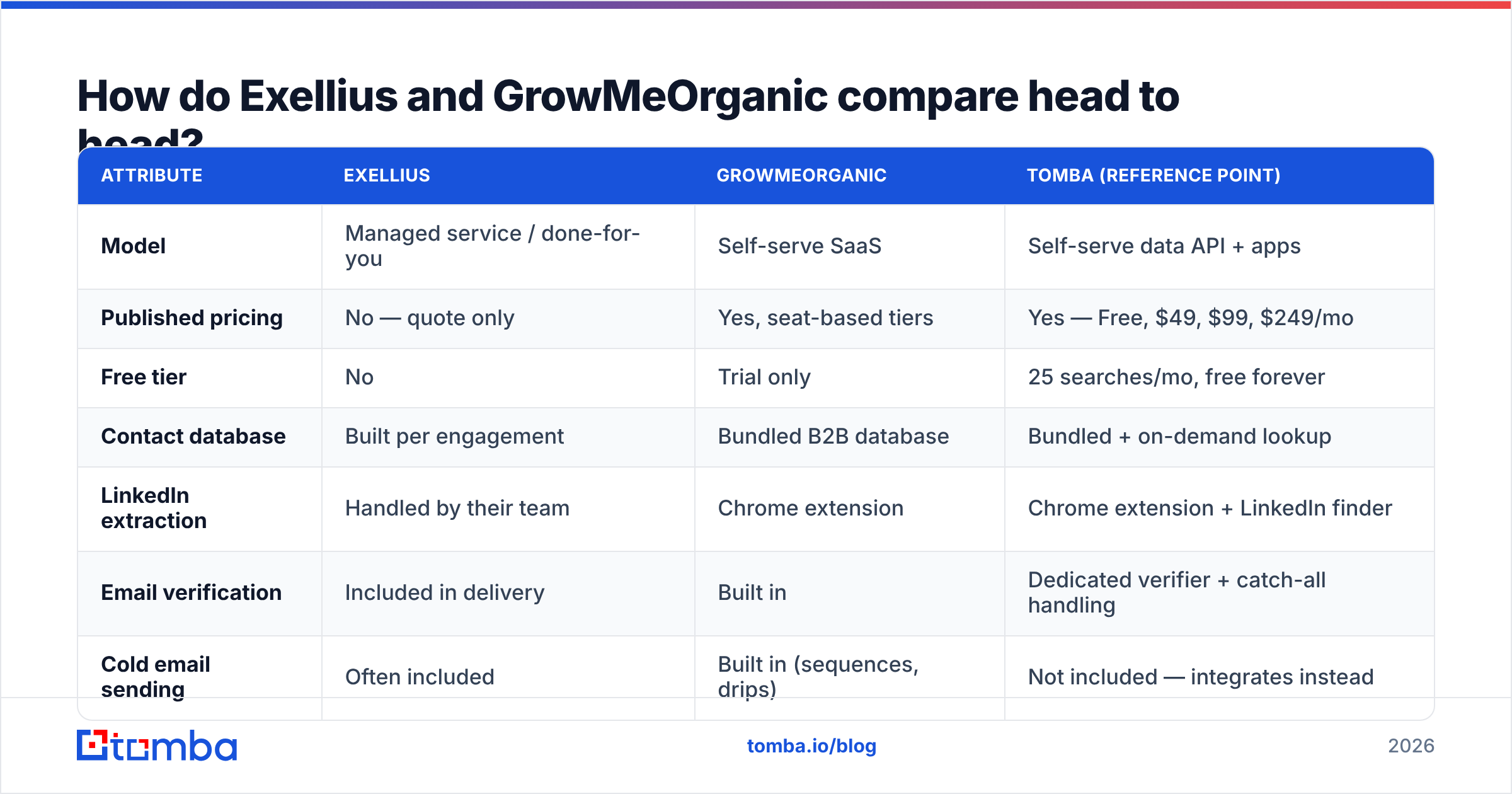
| Attribute | Exellius | GrowMeOrganic | Tomba (reference point) |
|---|---|---|---|
| Model | Managed service / done-for-you | Self-serve SaaS | Self-serve data API + apps |
| Published pricing | No — quote only | Yes, seat-based tiers | Yes — Free, $49, $99, $249/mo |
| Free tier | No | Trial only | 25 searches/mo, free forever |
| Contact database | Built per engagement | Bundled B2B database | Bundled + on-demand lookup |
| LinkedIn extraction | Handled by their team | Chrome extension | Chrome extension + LinkedIn finder |
| Email verification | Included in delivery | Built in | Dedicated verifier + catch-all handling |
| Cold email sending | Often included | Built in (sequences, drips) | Not included — integrates instead |
| API access | Limited / not core | Available on higher tiers | Core product, documented |
| Time to first list | Days to weeks (onboarding) | Same day | Minutes |
| Best for | Teams with budget, no SDR bandwidth | Solo founders and small teams doing it themselves | Teams that need clean data feeding an existing stack |
Read that table twice before you look at price. Half of these decisions go wrong for one reason. Someone compares a $99/mo tool to a $4,000/mo service and calls the tool cheaper. It is cheaper. It is also not the same purchase.
Exellius vs GrowMeOrganic: which one has better data?#
Be skeptical of both vendors here — and of every comparison post, including this one.
Neither company publishes a repeatable accuracy test with a public method. Managed providers like Exellius usually promise a replacement rate. If X% of the contacts bounce, they send you new ones. That is a refund policy, not an accuracy score. It also does not protect your sender reputation, because the bounces already landed on your domain.
GrowMeOrganic builds verification into the workflow, which is the right design. Reviews on G2 read like most bundled verifiers: fine on big corporate domains, weaker on catch-all domains, small companies, and markets outside the US. That pattern is not unique to GrowMeOrganic. Bundled verifiers are built to protect the vendor's own sending, not to beat a standalone tool.

The practical rules hold either way:
- Never trust a single source. Cross-check a 200-contact sample against a second provider before you buy the full list.
- Isolate catch-all domains. They are the biggest source of "verified" addresses that still bounce. A dedicated catch-all verifier treats them differently from a standard SMTP check.
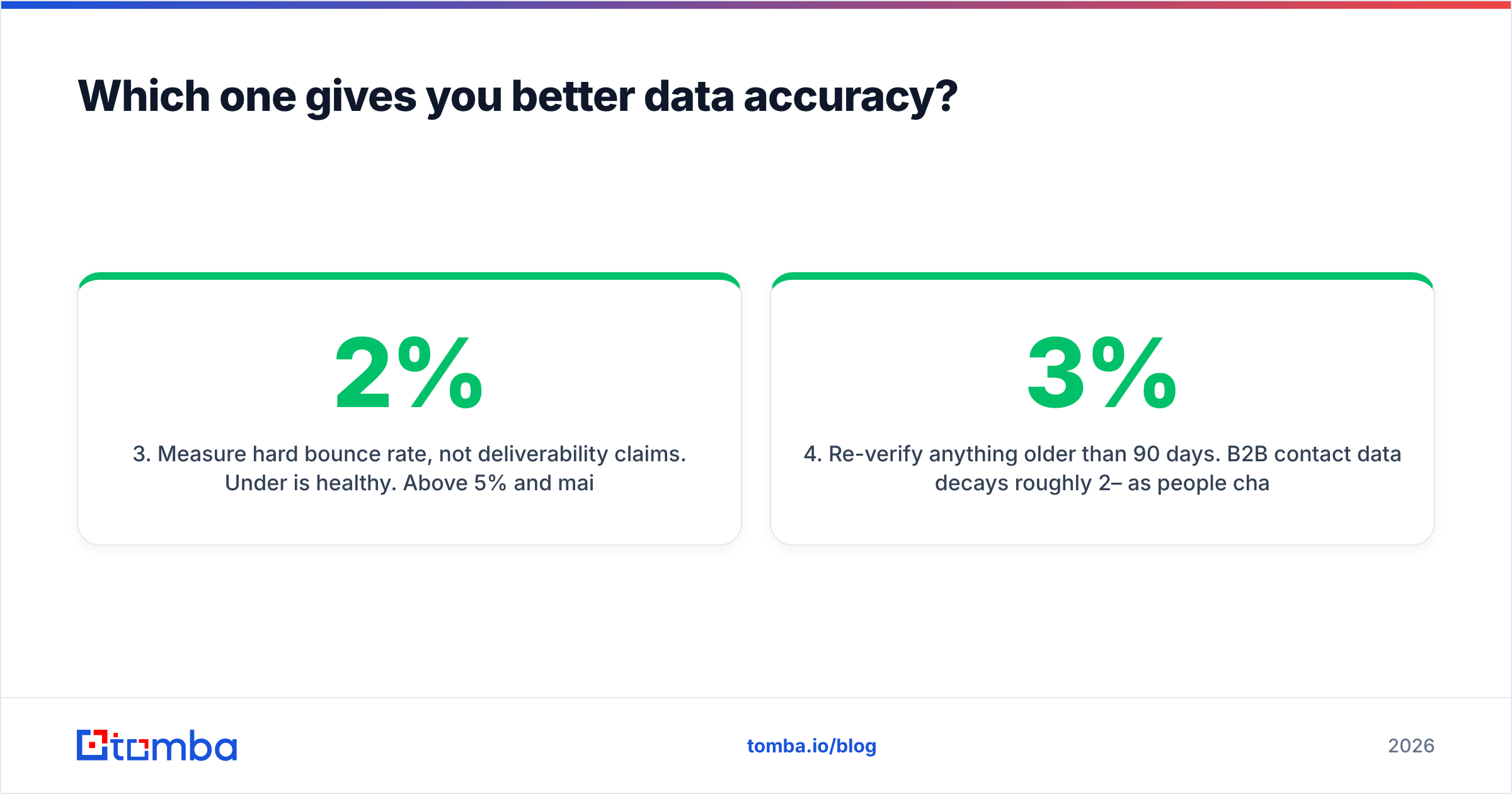
- Measure hard bounce rate, not marketing claims. Under 2% is healthy. Above 5%, mailbox providers start throttling you.
- Re-verify anything older than 90 days. B2B contact data decays about 2–3% per month as people change jobs.
- Keep a control list. Use ten addresses you know are valid. If a provider marks a known-good address invalid, its scoring is off.
Is Exellius worth it for your team?#
Exellius fits one situation. You have revenue targets, you have budget, and you do not have people. A managed provider takes over the work that eats junior SDR time — list building, data cleanup, first sequences — and hands back meetings.
Where a managed model wins:
- You are entering a new market and do not know what the account map looks like. A research team beats a database query here.
- Your ideal customer is narrow and odd. "Facilities directors at cold-storage warehouses with 3+ sites" is not a filter in any self-serve database. It is a research project.
- You need volume next quarter. Hiring and ramping an SDR takes five or six months. A vendor takes three weeks.
Where it goes wrong:
- You never build the muscle. When the contract ends, you have a spreadsheet and no process.
- You cannot tell what failed. If the provider also runs outreach, splitting "bad list" from "bad messaging" is nearly impossible.
- Cost per meeting balloons at low volume. Below a certain deal size, a done-for-you contract cannot work out. Do the math with your real close rate and deal size before you sign.
HubSpot's sales research points the same way. The teams that get the most from outsourced lead gen already have a sales motion that works. They are buying capacity, not hoping a vendor will invent one.
Is GrowMeOrganic worth it for your team?#
GrowMeOrganic sells consolidation. One subscription replaces a data tool, a verifier, and a sending tool. For a two-person startup that is genuinely appealing: fewer contracts, fewer integrations, one bill.
Check these details on their site before you buy, because tiers move:
- Seat-based pricing with generous caps instead of tight credit metering. Check what "unlimited" leaves out. It is usually enrichment or database exports, not extension pulls.
- Sending is included, so your email accounts connect directly. That is simple, but it concentrates risk. If the platform's IP reputation drops, your campaigns feel it.
- The Chrome extension is the strongest piece. Most users start there for LinkedIn extraction and grow into the rest.
Where it goes wrong:
- All-in-one means average at everything. The verifier is looser than a dedicated one. The sequencer is thinner than Instantly or Smartlead. The database is narrower than Apollo's.
- API depth is limited next to data-first vendors. If you want to enrich records inside your own product or CRM, check the endpoints first.
- Data quality outside North America and Western Europe is the common complaint across every mid-market B2B database. GrowMeOrganic is not exempt.
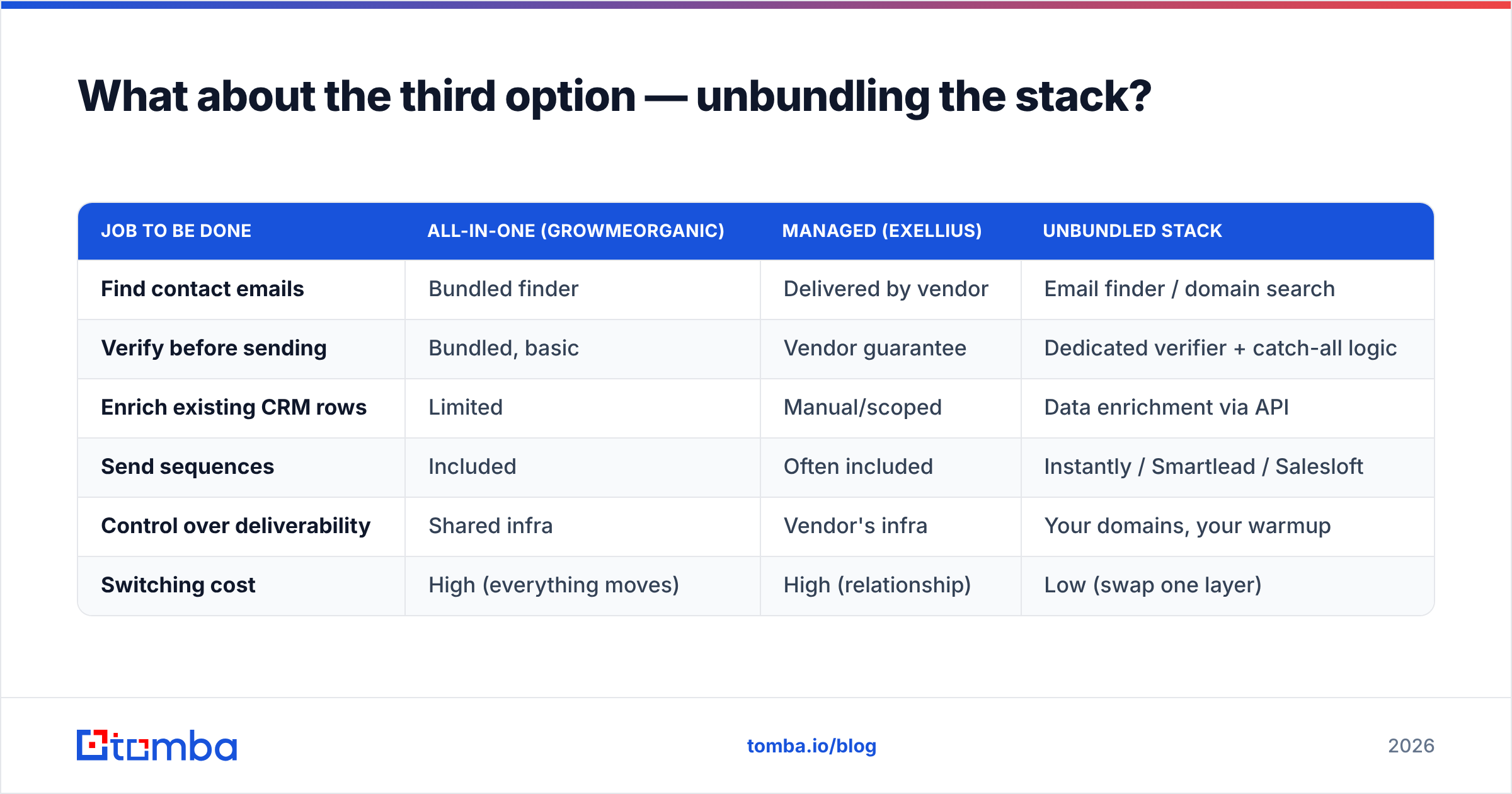
What about the third option — unbundling the stack?#
The comparison most teams should actually run is not Exellius vs GrowMeOrganic. It is bundle vs unbundle.
An unbundled stack has three parts: a data source, a verifier, and a sender. It adds line items and usually costs less in total. You can also swap one piece without moving everything.
| Job to be done | All-in-one (GrowMeOrganic) | Managed (Exellius) | Unbundled stack |
|---|---|---|---|
| Find contact emails | Bundled finder | Delivered by vendor | Email finder / domain search |
| Verify before sending | Bundled, basic | Vendor guarantee | Dedicated verifier + catch-all logic |
| Enrich existing CRM rows | Limited | Manual/scoped | Data enrichment via API |
| Send sequences | Included | Often included | Instantly / Smartlead / Salesloft |
| Control over deliverability | Shared infra | Vendor's infra | Your domains, your warmup |
| Switching cost | High (everything moves) | High (relationship) | Low (swap one layer) |

Unbundling also fixes the worst flaw in bundled tools. When one vendor finds the address, verifies it, and sends to it, nobody is grading the homework. An independent verifier catches what the finder got wrong. That is the whole point of keeping them apart.
If you want a middle path, vendors like BookYourData sell verified B2B lists with a bounce guarantee, pay as you go. That helps when you need one clean list without a subscription or a contract.
How should you run the actual evaluation?#
Do not evaluate on demos. Evaluate on the same 100 accounts, side by side, in one week.
- Pick 100 real target accounts from your ideal customer list. Skip household names — every provider has data on Salesforce and Shopify.
- Ask each option for the same deliverable. From Exellius, a paid or trial pilot list. From GrowMeOrganic, a trial export. For an unbundled stack, run the same domains through a bulk email finder.
- Measure coverage first. What share of your 100 target roles returned a contact at all? Coverage gaps between providers are usually wider than accuracy gaps.
- Measure accuracy second. Send a small, warmed, low-volume campaign and record the hard bounce rate per source.
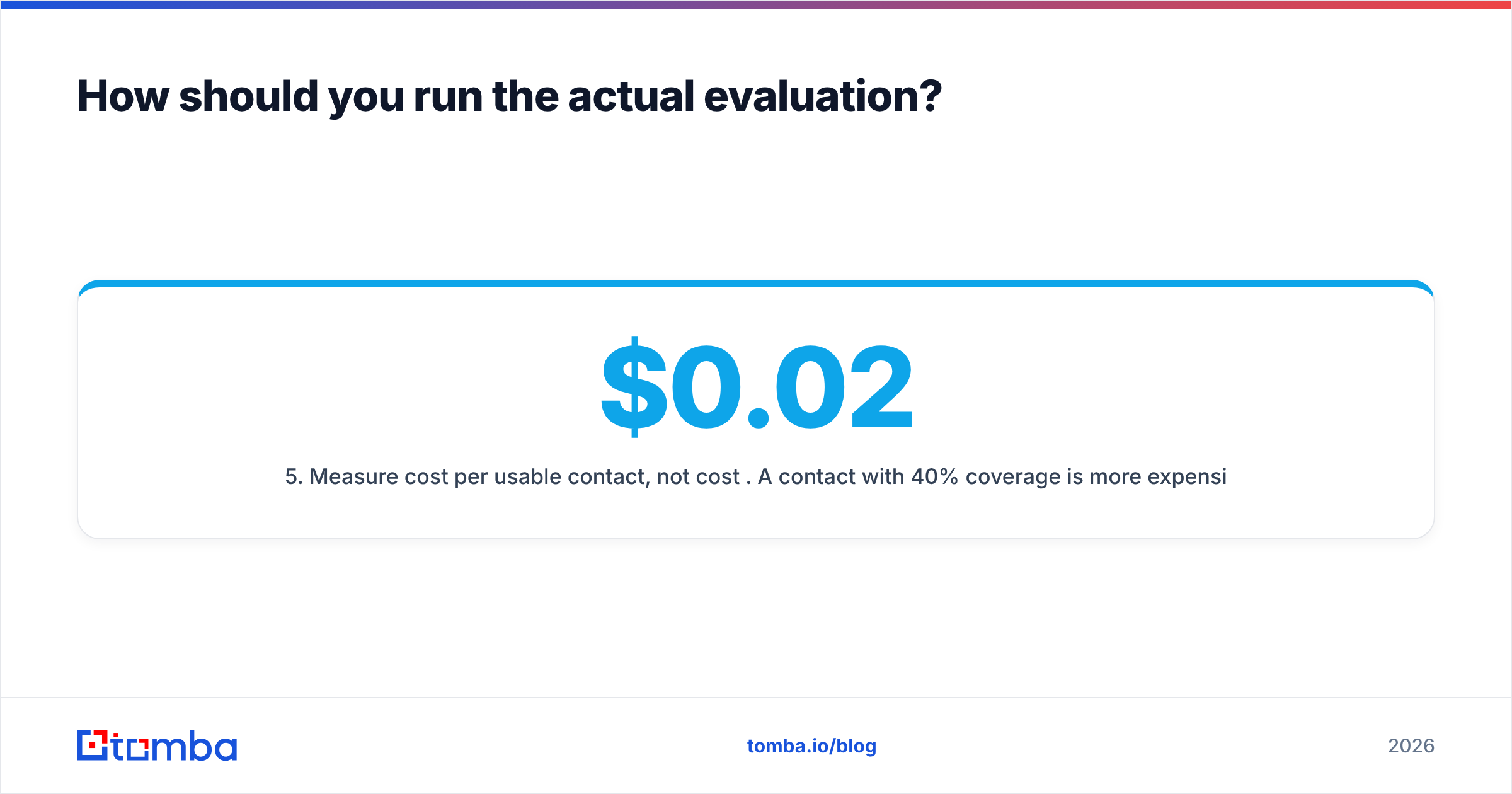
- Measure cost per usable contact, not cost per credit. A $0.02 contact with 40% coverage costs more than a $0.08 contact with 90% coverage.
- Measure time. How many hours of your team's week did each option eat? That number justifies a managed service, or kills it.
Write down what you find, with the numbers. Six months from now, when a rep says "our data provider is terrible," you want a baseline to argue from.
Exellius vs GrowMeOrganic: so which one should you pick?#
Pick Exellius if you have budget, a sales motion that works, a hard-to-source customer profile, and no time to build lists in-house. You are buying research capacity. Insist on a paid pilot and a written replacement policy before any annual deal.
Pick GrowMeOrganic if you are a founder or a small team doing outbound yourself, you want one subscription instead of four, and your buyers sit in well-covered markets. The Chrome extension plus built-in sequencing is an efficient way to work your first thousand prospects.
Pick an unbundled stack if data quality is the bottleneck, you already like your sequencer, or you need contact data inside your own systems through an API. Most teams land here by year two. It is the only setup where you can fix one broken layer without replacing all of them.
Ready to test the data layer on its own?#
Before you sign a service contract or a bundled subscription, find out how much of your problem is just a data problem. Tomba's Email Finder gives you 25 free searches a month with no card. That is enough to run a real coverage test on your top accounts. If the numbers hold up, paid plans start at $49/mo, and the same data is available through the Tomba API, Chrome extension, Google Sheets, and bulk uploads. Compare the full Tomba pricing against the quote in your inbox. Then decide whether you are buying data, software, or a team.
Related guides#
Ready to find emails that actually work?
Join 150,000+ professionals who stopped guessing and started sending. Free credits on signup — no credit card required.
Get the Tomba newsletter
Practical outbound tactics and product updates — once every two weeks.
About the author