Exellius vs Noparam: Which Email Finder Wins in 2026?
Exellius and Noparam both promise verified B2B emails from a name and a domain. We break down coverage, accuracy, credit models, catch-all handling and API depth — and where each one quietly falls short.
TL;DR
- Exellius leans on waterfall-style enrichment: it queries multiple upstream data sources per contact and returns the best hit, which helps coverage on hard-to-find prospects but makes cost-per-verified-email unpredictable.
- Noparam is a leaner, verification-first email finder built around clean single lookups and bulk CSV runs. Fewer moving parts, fewer surprises, less depth on enrichment attributes.
- Neither tool wins on every axis. Exellius wins on coverage breadth, Noparam wins on simplicity and predictable credit burn.
- The real decision driver is how you consume the data: UI-first teams and API-first teams should not pick the same tool.
- If you want both coverage and a documented API without a per-source billing puzzle, a platform like Tomba at $49/mo Starter sits between the two.
What are Exellius and Noparam?#
Both are B2B email-finding tools. You give them a person and a company; they give you back a work email address and a confidence signal. That is where the similarity ends.
Exellius positions itself as a multi-source lead-sourcing and enrichment layer. The pitch is coverage: instead of relying on one database, it chains providers so a contact that misses in source A can still resolve in source B or C. This is the "waterfall enrichment" pattern that has become standard in RevOps stacks over the past two years.
Noparam takes the opposite posture. It is a focused email finder and verifier — find the address, verify it, hand it over. The interface is deliberately thin, the workflow is search or upload, and the value proposition is that you are not paying for a data platform you will never fully use.
Put crudely: Exellius is a funnel of many databases, Noparam is one clean pipe. Which one you want depends entirely on whether your bottleneck today is finding contacts or trusting the contacts you already find.
How do Exellius and Noparam actually find emails?#
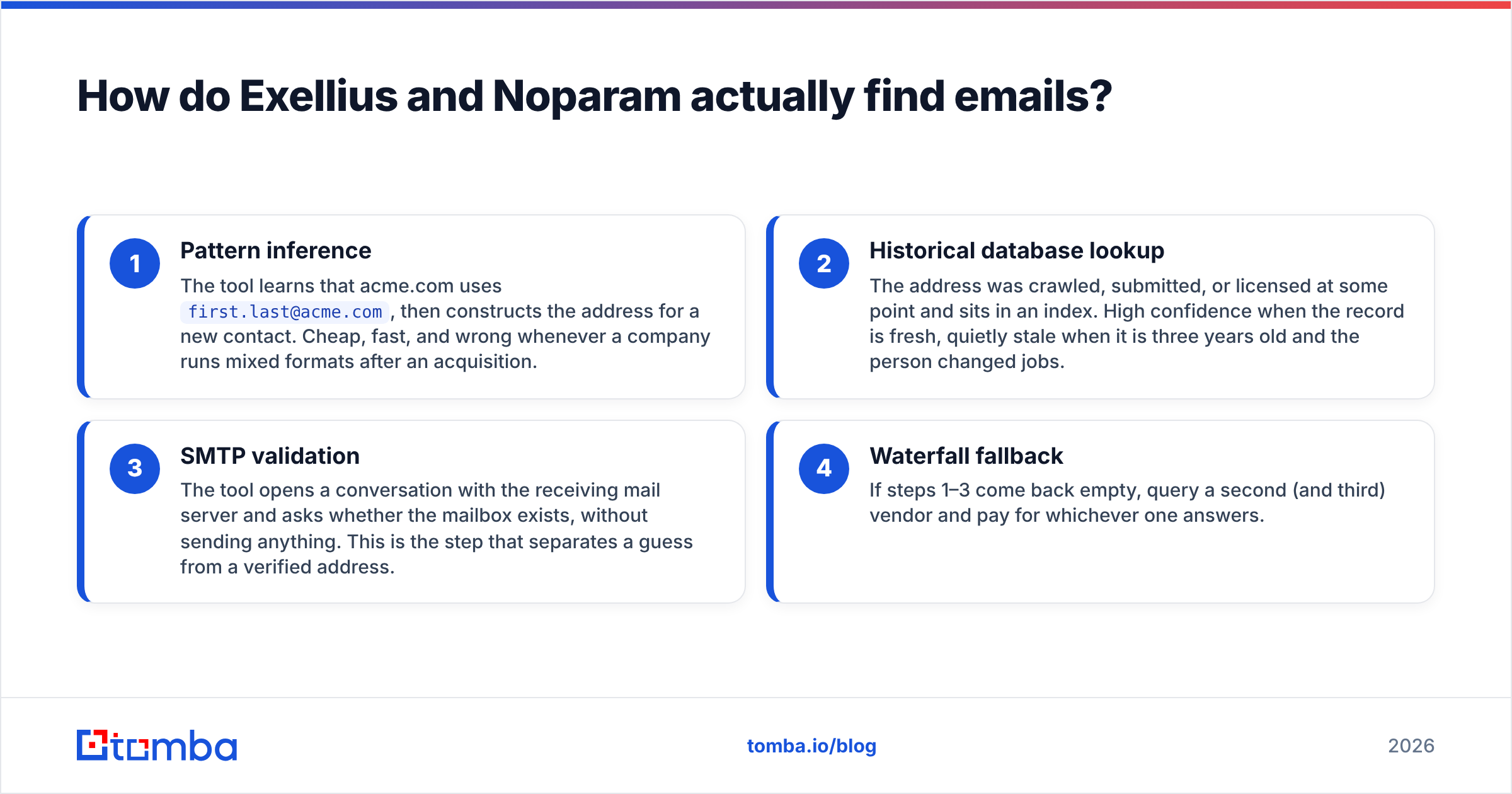
Every email finder does some combination of four things. Understanding which combination each vendor emphasises explains almost all the price and accuracy differences you will see in a trial.
- Pattern inference — The tool learns that acme.com uses
first.last@acme.com, then constructs the address for a new contact. Cheap, fast, and wrong whenever a company runs mixed formats after an acquisition. - Historical database lookup — The address was crawled, submitted, or licensed at some point and sits in an index. High confidence when the record is fresh, quietly stale when it is three years old and the person changed jobs.
- SMTP validation — The tool opens a conversation with the receiving mail server and asks whether the mailbox exists, without sending anything. This is the step that separates a guess from a verified address.
- Waterfall fallback — If steps 1–3 come back empty, query a second (and third) vendor and pay for whichever one answers.
Exellius emphasises 2 and 4. Noparam emphasises 1 and 3. That single sentence predicts most of what you will experience: Exellius will find more obscure contacts and charge you unevenly for them; Noparam will find fewer but return a cleaner, more consistently verified list.

Is Exellius more accurate than Noparam?#
Accuracy is the wrong single number. Split it into two, because vendors love to blur them:
- Hit rate (coverage) — of 1,000 prospects submitted, how many came back with any address at all?
- Validity rate (accuracy) — of the addresses returned, how many actually accepted mail?
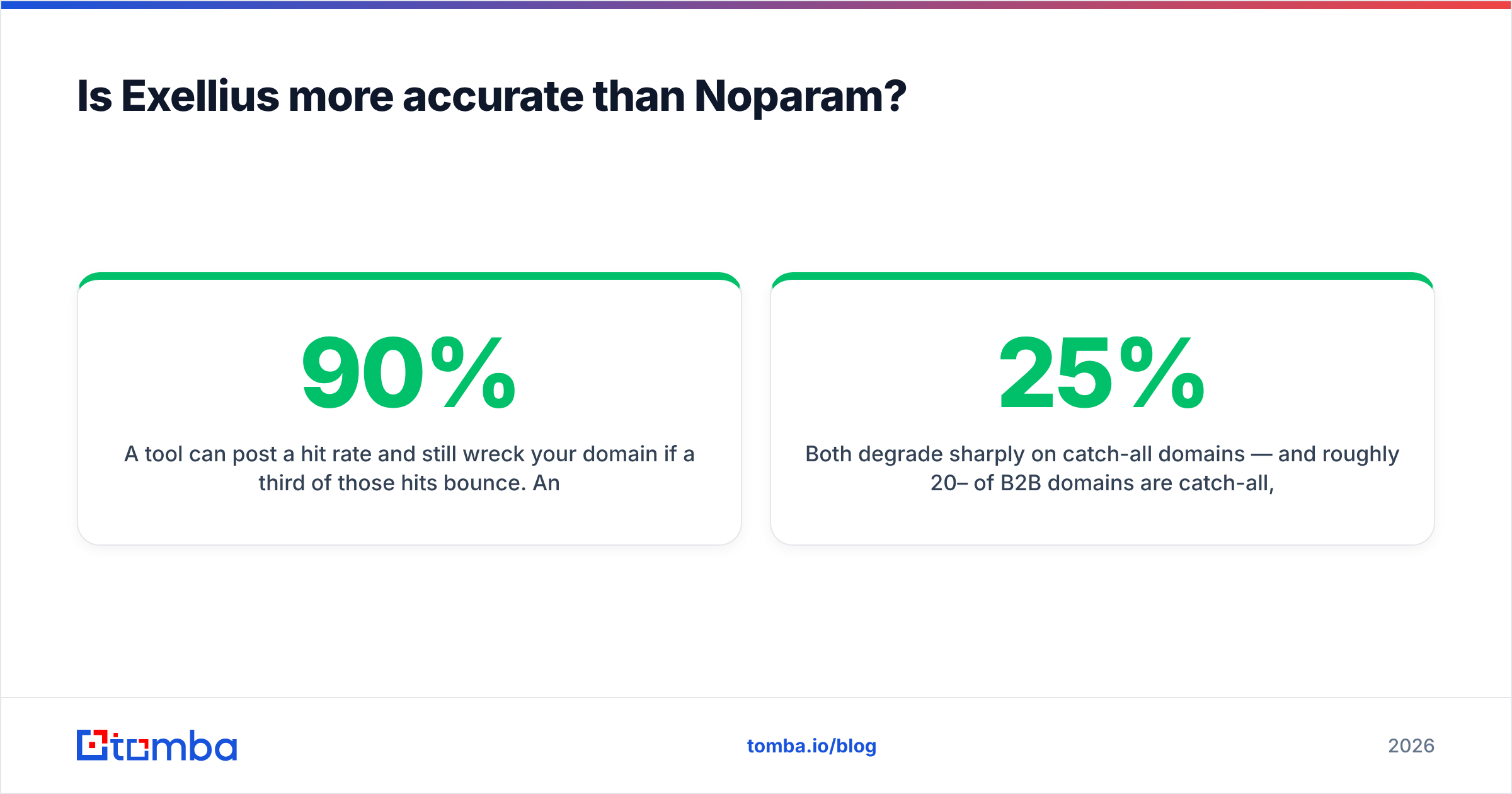
A tool can post a 90% hit rate and still wreck your domain if a third of those hits bounce. Another tool can post a modest 55% hit rate where 98% of results land. The second tool is usually the better business decision, because a bounce costs you more than a miss — it damages sender reputation, and reputation damage is slow to repair.
In practice, across the mid-market SaaS and agency segments where both tools compete:
- Exellius tends to lead on hit rate, especially for non-US domains, smaller companies, and roles that never appear in public directories. The waterfall is doing real work there.
- Noparam tends to lead on validity rate on the subset it does return, because it is more willing to say "not found" instead of returning a low-confidence guess.
- Both degrade sharply on catch-all domains — and roughly 20–25% of B2B domains are catch-all, so this is not an edge case.
Run your own test before you believe any vendor's marketing number. Take 200 contacts you already have confirmed addresses for, strip the emails, and feed the names and domains to both tools. Measure hit rate and match rate against your known-good list. That takes an afternoon and beats every comparison post on the internet, including this one.

How do Exellius and Noparam compare feature by feature?#
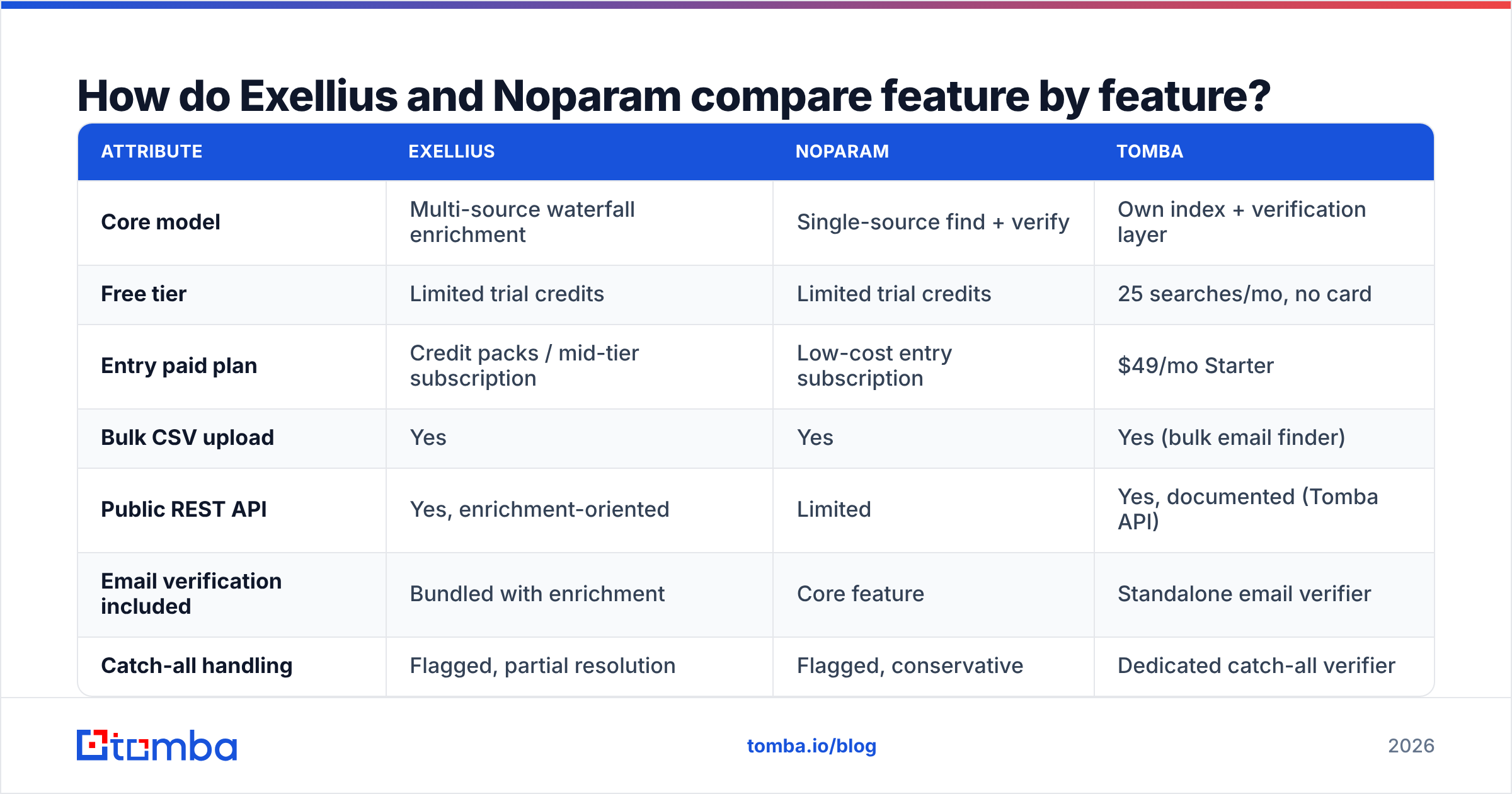
Here is the head-to-head on the attributes that actually change your workflow. Pricing and limits move — check each vendor's current page before you commit budget.
| Attribute | Exellius | Noparam | Tomba |
|---|---|---|---|
| Core model | Multi-source waterfall enrichment | Single-source find + verify | Own index + verification layer |
| Free tier | Limited trial credits | Limited trial credits | 25 searches/mo, no card |
| Entry paid plan | Credit packs / mid-tier subscription | Low-cost entry subscription | $49/mo Starter |
| Bulk CSV upload | Yes | Yes | Yes (bulk email finder) |
| Public REST API | Yes, enrichment-oriented | Limited | Yes, documented (Tomba API) |
| Email verification included | Bundled with enrichment | Core feature | Standalone email verifier |
| Catch-all handling | Flagged, partial resolution | Flagged, conservative | Dedicated catch-all verifier |
| Domain-wide search | Yes | Limited | Yes, full domain search |
| Phone numbers | Via partner sources | No | Yes |
| Credit predictability | Variable — depends on which source answers | Predictable per lookup | Predictable per search |
| Best fit | Hard-to-find contacts, enrichment-heavy RevOps | Small teams that want clean lists fast | Teams needing API + verification in one bill |

Two rows deserve elaboration.
Credit predictability is the sleeper issue with waterfall tools. When a lookup cascades through three providers, your effective cost per verified contact is not the sticker price — it is the sticker price times the average number of sources consulted. Teams routinely budget for 10,000 contacts and burn the credits at 6,500. Ask any waterfall vendor for the average sources consumed per successful match on accounts like yours. If they cannot answer, that is your answer.
API depth is where thin tools show their limits. If your plan is to enrich inside HubSpot, Clay, n8n, or your own service, a UI-only tool becomes a person copying CSVs. That is a headcount cost hiding inside a software decision.
What does each one cost in practice?#
Sticker price is close to meaningless in this category. Compute cost per usable contact instead:
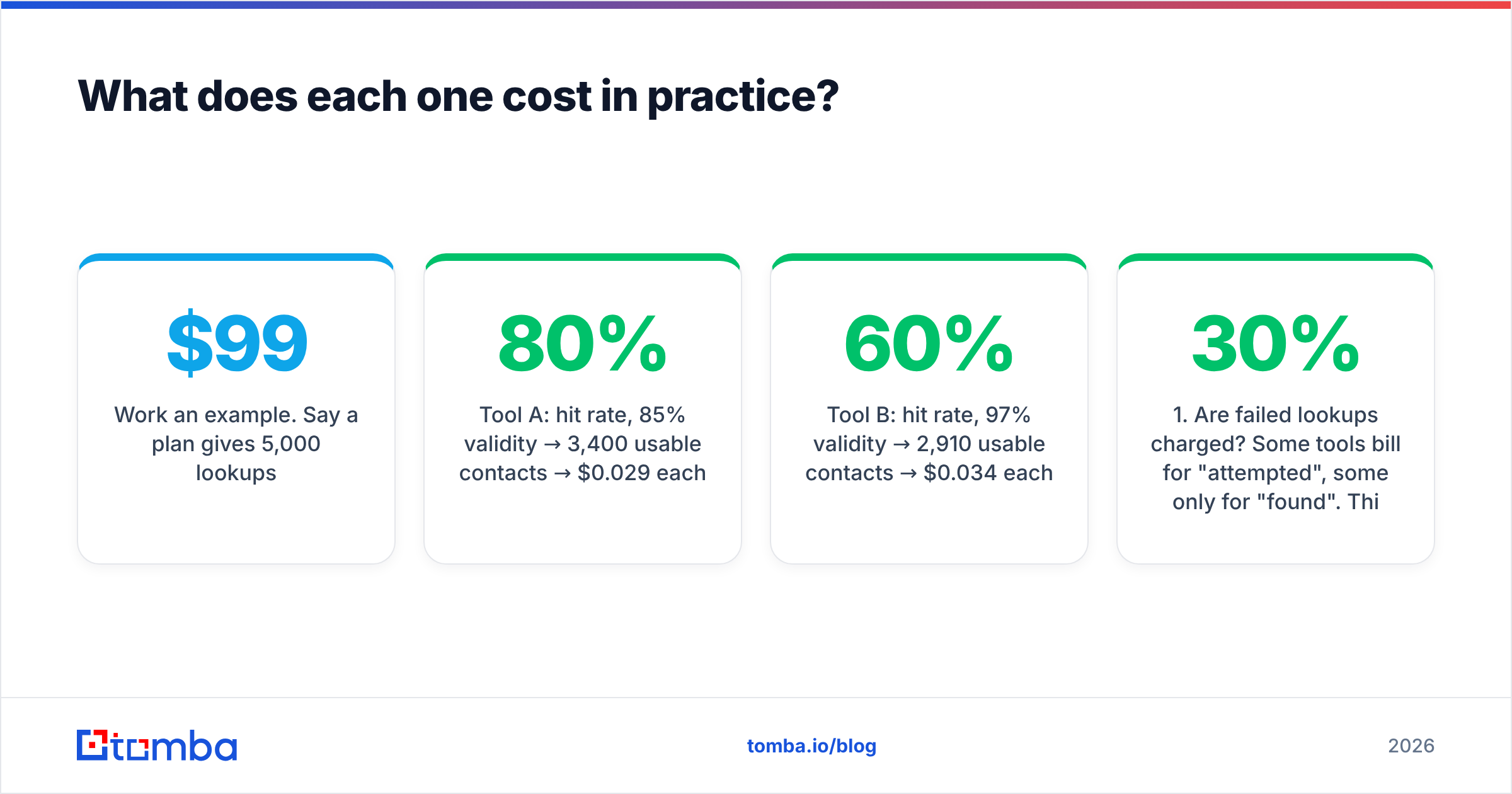
cost per usable contact = plan price / (contacts submitted × hit rate × validity rate)Work an example. Say a $99/month plan gives 5,000 lookups.
- Tool A: 80% hit rate, 85% validity → 3,400 usable contacts → $0.029 each
- Tool B: 60% hit rate, 97% validity → 2,910 usable contacts → $0.034 each
Tool A looks cheaper — until you count the 510 bad addresses Tool A shipped that Tool B did not. At a typical cold-outreach volume, that bounce load is the difference between a healthy inbox and a throttled one. Reputation cost is real cost; it just does not appear on the invoice.
Also check these five billing details on both vendors before signing:
- Are failed lookups charged? Some tools bill for "attempted", some only for "found". This alone can swing effective price 30%.
- Do credits roll over? Most do not. Seasonal outbound teams overpay badly here.
- Is verification a separate credit? Find + verify billed twice is the most common hidden doubling.
- What is the annual discount and the lock-in? Data quality varies quarter to quarter; a 12-month prepay removes your leverage.
- What happens on overage? Hard stop, or auto-charge? Ask before your first big campaign, not after.
Tomba's pricing is deliberately flat on this axis — Free (25 searches/mo), Starter $49/mo, Growth $99/mo, Pro $249/mo, Enterprise custom — with no per-source cascade to model.
Which tool should you pick for your team?#
- Pick Exellius if your prospect list skews toward companies under 200 employees, non-US markets, or roles that never post publicly, and you have someone in RevOps who will actually monitor credit consumption per source. The coverage advantage is real and it matters most exactly where other tools go quiet.
- Pick Noparam if you are a small team, you buy tools you can learn in ten minutes, and your target accounts are mid-market and up where email formats are conventional. You will find fewer edge-case contacts and you will send cleaner lists.
- Pick neither if your workflow is API-first. Both are viable, but this is where a general-purpose platform with a fully documented API and a single credit currency usually wins on total cost of ownership.
- Run both in parallel if your ACV is high enough that one extra meeting per month justifies the second subscription. Waterfall on top of waterfall is a legitimate strategy when a closed deal is worth five figures.
How should you handle catch-all domains?#
This is where both tools — and honestly most tools — get uncomfortable, so treat it as its own decision.
A catch-all domain accepts mail to every address, valid or not. SMTP verification returns "accepted" for asdfgh@company.com, so a naive verifier marks a fabricated address as valid. That is how a list with a reported 98% validity score produces a 15% bounce rate in the wild.
What to do:
- Never treat catch-all as verified. Segment it. Keep it out of your main sending domain's warm-up campaigns.
- Look for probabilistic resolution. Better tools cross-check catch-all addresses against historical engagement or secondary sources instead of shrugging. A catch-all verifier that gives you a graded confidence score is far more useful than a binary flag.
- Cap catch-all volume per send. Ten to fifteen percent of a batch is a reasonable ceiling while you monitor bounce telemetry.
- Watch your bounce rate weekly, not monthly. Google and Microsoft both tightened bulk-sender enforcement, and the feedback loop is fast. Industry guidance on this is well documented — HubSpot's deliverability resources are a reasonable starting point if you need to brief a non-technical stakeholder.
Ask both Exellius and Noparam directly how they score catch-all results during your trial. The quality of that answer is a strong proxy for the quality of the engineering behind the product.
What do reviews and peers actually say?#
Do not skip third-party signal, but read it correctly. On G2's lead intelligence category, the useful reviews are the three-star ones — five-star reviews are frequently incentivised and one-star reviews are usually billing disputes. Filter by company size closest to yours, because a 20-person agency and a 2,000-person enterprise are effectively evaluating different products.
The pattern that repeats across reviews of waterfall tools like Exellius: strong coverage praise, recurring complaints about credit transparency. The pattern for lean tools like Noparam: praise for speed and cleanliness, recurring requests for a deeper API and more enrichment fields. Both patterns are consistent with the architectural differences described above, which is a good sign the reviews are describing something real.
Where does Tomba fit into this comparison?#
Honestly: Tomba is not the widest waterfall on the market, and it does not try to be. What it does offer is the combination most teams comparing Exellius and Noparam are actually shopping for — solid coverage, verification built into the same product rather than billed as a separate subscription, a documented REST API, and a credit model you can forecast without a spreadsheet.
If your evaluation criteria are "find the impossible contact at any cost," Exellius deserves a trial slot. If they are "give me a clean list with zero learning curve," Noparam is a fair pick. If they are "one predictable bill, an API my engineers will not hate, and verification I can trust before I send," that is the gap Tomba was built for.
Start with the free tier — 25 searches, no card — and run the same 200-contact benchmark against all three. Whichever tool returns the most deliverable addresses wins, and it should be your data making that call, not a comparison table.
Ready to benchmark it yourself? Run your prospect list through the Tomba Email Finder, compare hit rate and validity rate against Exellius and Noparam side by side, and keep whichever one your bounce log agrees with.
Related guides#
Ready to find emails that actually work?
Join 150,000+ professionals who stopped guessing and started sending. Free credits on signup — no credit card required.
Get the Tomba newsletter
Practical outbound tactics and product updates — once every two weeks.
About the author