Exellius vs OutboundView 2026: Which B2B Lead Gen Agency Wins?
Both promise booked meetings from outbound. One leans multichannel and offshore-priced; the other leans US-based appointment setting. Here's how Exellius and OutboundView actually differ on price, data, and risk.
TL;DR
- Exellius and OutboundView are both outsourced B2B lead generation providers, not software. You are buying an SDR team, a list, and a calendar full of meetings — not a tool you keep.
- OutboundView is the more traditional US-based appointment-setting and outbound agency: email + phone, named SDRs, monthly retainer, usually a multi-month commitment.
- Exellius positions itself as a multichannel demand-gen and appointment-setting partner with heavier LinkedIn and account-research emphasis, typically at a lower blended rate.
- The real cost gap is not the retainer — it is who owns the data when the contract ends. Most agency deals leave you with a CRM full of contacts you cannot re-verify.
- If you already have a rep who can send email, the cheaper path is owning the data layer yourself: an email finder plus verification runs a fraction of a single month of agency retainer.
Outsourcing outbound is one of the few B2B decisions where the two options in front of you look nearly identical on the website and behave nothing alike in month three. Exellius and OutboundView both sell "qualified meetings." The difference shows up in who does the sending, where the contact data comes from, and what happens when you want to leave.
This is a neutral breakdown — pricing structures, delivery models, data quality, contract risk, and the scenarios where neither agency is the right answer.
What is Exellius and what is OutboundView?#
Exellius (Exellius Systems) is a B2B lead generation and demand generation firm. Its pitch centers on multichannel outbound — cold email, LinkedIn, and content syndication — with account research done for you. The delivery team is largely offshore, which is why blended hourly economics land below US-agency norms. Typical engagements are framed around appointments delivered or SQLs sourced rather than pure hours.
OutboundView is a US-based outbound sales agency operating out of Indianapolis. It runs appointment setting, outbound SDR programs, and inbound lead follow-up for mid-market and SMB clients. The distinguishing feature is that it will actually pick up the phone — cold calling is a first-class channel, not an afterthought. Reps are US-based, which raises the rate and, for some ICPs, raises the connect quality.
Both are services businesses. Neither hands you a product license. That framing matters more than any feature list, because services scale linearly with spend and software does not.
How do Exellius and OutboundView compare head-to-head?#
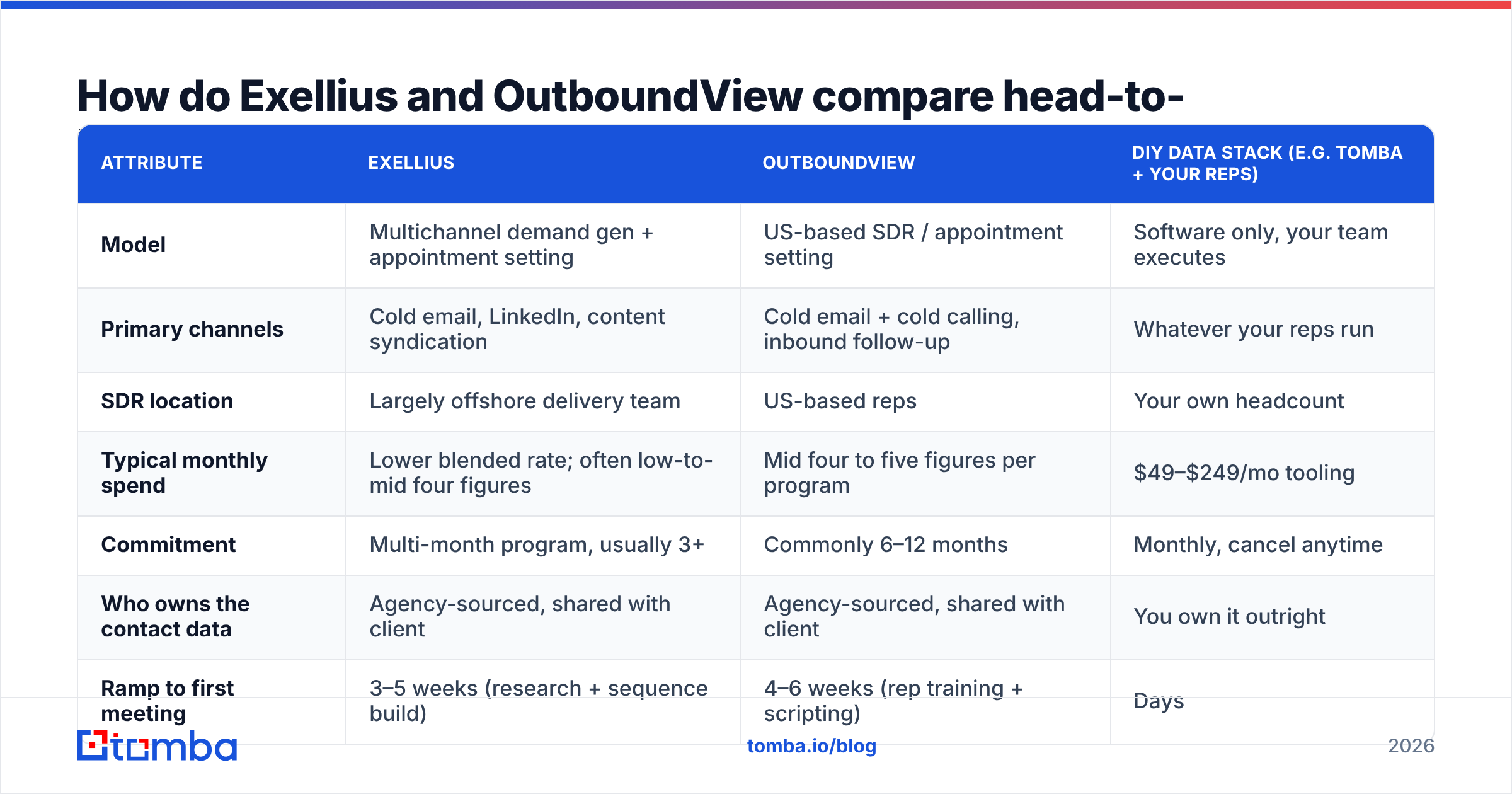
Here is the practical side-by-side. Figures reflect publicly discussed engagement ranges and common agency structures in this category — always confirm current terms directly, because outbound agencies quote per program, not per menu.
| Attribute | Exellius | OutboundView | DIY data stack (e.g. Tomba + your reps) |
|---|---|---|---|
| Model | Multichannel demand gen + appointment setting | US-based SDR / appointment setting | Software only, your team executes |
| Primary channels | Cold email, LinkedIn, content syndication | Cold email + cold calling, inbound follow-up | Whatever your reps run |
| SDR location | Largely offshore delivery team | US-based reps | Your own headcount |
| Typical monthly spend | Lower blended rate; often low-to-mid four figures | Mid four to five figures per program | $49–$249/mo tooling |
| Commitment | Multi-month program, usually 3+ | Commonly 6–12 months | Monthly, cancel anytime |
| Who owns the contact data | Agency-sourced, shared with client | Agency-sourced, shared with client | You own it outright |
| Ramp to first meeting | 3–5 weeks (research + sequence build) | 4–6 weeks (rep training + scripting) | Days |
| Best fit | Broad ICP, low ACV, volume plays | Complex sales, phone-responsive buyers | Teams with a rep who can already sell |
| Weakest at | Phone-heavy verticals, nuanced technical pitches | Cost efficiency at high volume | Teams with zero outbound experience |
The table gives you the shape of the decision. Exellius is optimized for volume per dollar. OutboundView is optimized for conversation quality per meeting. Neither is universally better; they are priced for different buyers.
What does each one actually cost you?#
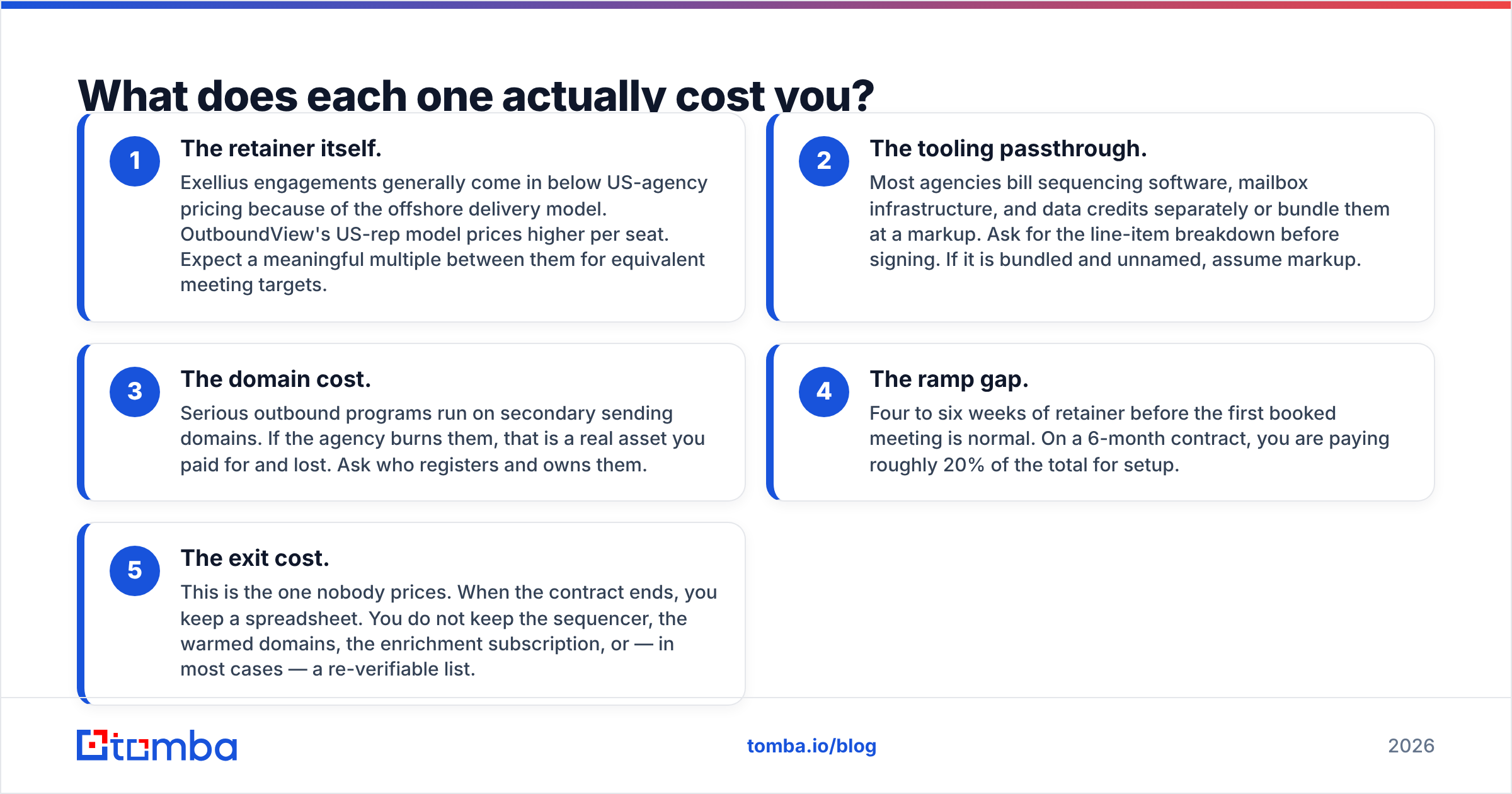
Retainer is the number you see. It is rarely the number you pay.
- The retainer itself. Exellius engagements generally come in below US-agency pricing because of the offshore delivery model. OutboundView's US-rep model prices higher per seat. Expect a meaningful multiple between them for equivalent meeting targets.
- The tooling passthrough. Most agencies bill sequencing software, mailbox infrastructure, and data credits separately or bundle them at a markup. Ask for the line-item breakdown before signing. If it is bundled and unnamed, assume markup.
- The domain cost. Serious outbound programs run on secondary sending domains. If the agency burns them, that is a real asset you paid for and lost. Ask who registers and owns them.
- The ramp gap. Four to six weeks of retainer before the first booked meeting is normal. On a 6-month contract, you are paying roughly 20% of the total for setup.
- The exit cost. This is the one nobody prices. When the contract ends, you keep a spreadsheet. You do not keep the sequencer, the warmed domains, the enrichment subscription, or — in most cases — a re-verifiable list.
Point five is where most post-mortems land. A CRM full of 18-month-old agency-sourced contacts decays at roughly 25–30% per year through job changes alone. Without a way to re-check those records, you are re-buying the same data next year.
Is an outsourced SDR agency better than building the list yourself?#
It depends entirely on which bottleneck you actually have.
Agencies solve an execution bottleneck — nobody on your team has time to send 400 emails a week and chase 60 no-shows. They do not solve a positioning bottleneck. If your message does not land, an agency will discover that on your dime, slowly, and then ask for a longer runway.
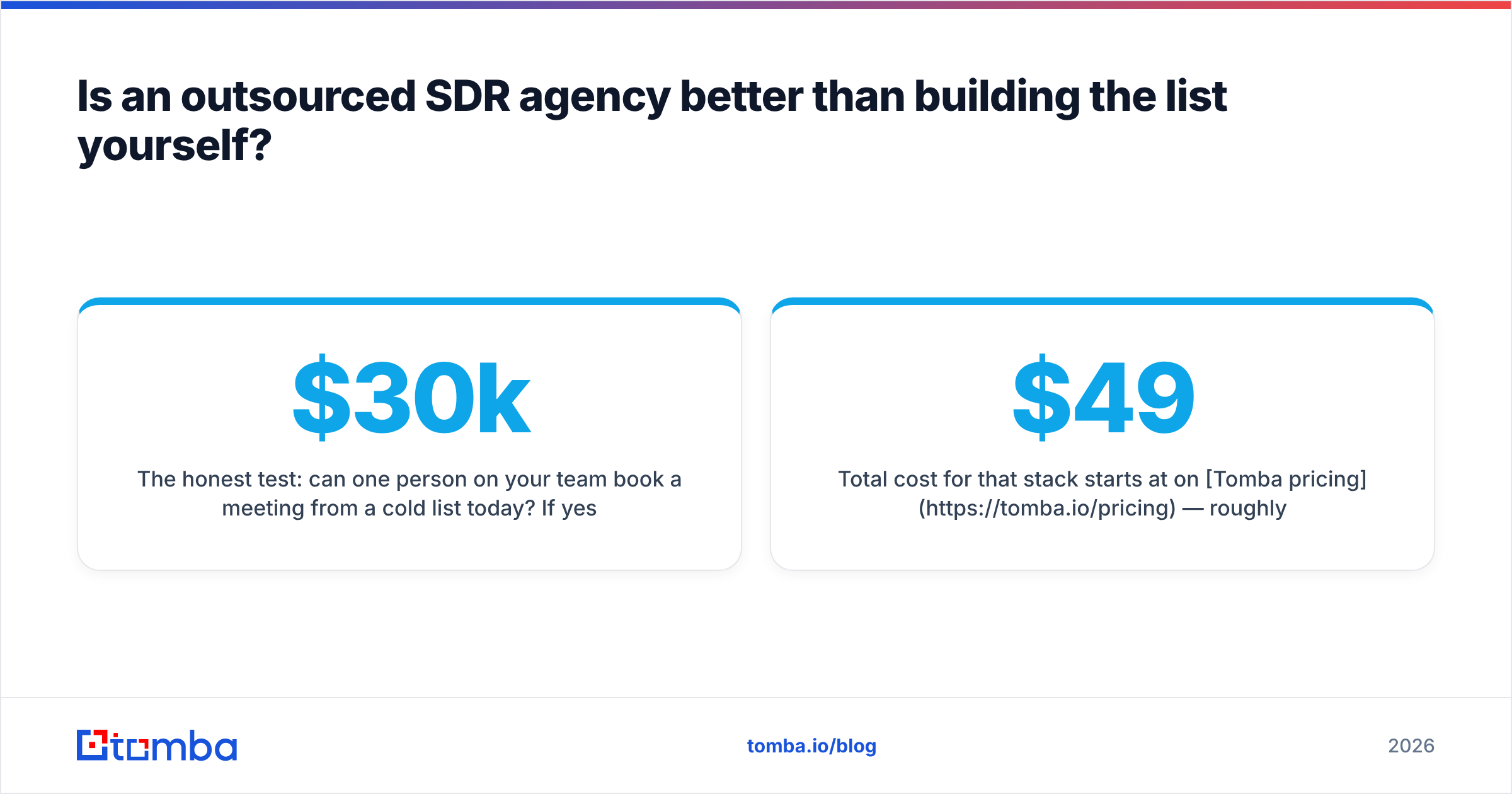
The honest test: can one person on your team book a meeting from a cold list today? If yes, you have a capacity problem and an agency (or a junior SDR) fixes it. If no, an agency will burn six months proving your offer needs work — and you will have paid $30k–$60k for that finding.
There is also a middle path that most comparison posts skip. You can keep execution in-house and buy only the data layer:
- Find the contacts — a domain search returns the verified addresses at a target account without a researcher manually digging through LinkedIn.
- Verify before sending — an email verifier pass drops the invalids that would otherwise wreck your bounce rate and, with it, your email deliverability.
- Enrich what you already have — contact enrichment fills firmographics and titles on the CRM records you already paid for.
Total cost for that stack starts at $49/month on Tomba pricing — roughly one-hundredth of a mid-tier agency retainer, with the difference that the data stays yours.
Which one fits your go-to-market motion?#
Pick by ICP behavior, not by which website looked better.
- Choose OutboundView if your buyers answer phones. Ops leaders, plant managers, healthcare administrators, regional franchise owners, and most non-tech mid-market roles still respond to a call far better than a fourth cold email. US-based reps also matter when the pitch requires industry fluency mid-conversation.
- Choose Exellius if your ICP is broad, your ACV is moderate, and volume is the lever. Multichannel email plus LinkedIn at a lower blended cost is a rational way to test 5,000 accounts instead of 500. It is also the better fit if your buyers are international and time-zone coverage matters.
- Choose neither if your ACV is under about $3,000 and your sales cycle is short. The agency math does not clear — you need self-serve or product-led motion, not a retainer.
- Choose neither if you have fewer than ~2,000 realistic target accounts. A tightly defined TAM is better served by one good rep with a bulk email finder and a disciplined sequence than by an agency that needs volume to hit its own margin.
- Run both, briefly, if you have budget to pilot. A 90-day parallel test with matched ICP slices tells you more than any reference call. Just insist on identical target lists so you are comparing execution, not luck.

What do buyers actually complain about with each?#
Read reviews on G2 and Clutch with a filter for the specific complaint, not the star rating. In this category, the recurring themes are consistent across nearly every agency:
Common to both:
- Meeting quality drift after month two, once the easiest accounts in the list are exhausted.
- "Qualified" definitions that expand quietly. Get the qualification criteria in writing, with a rejection process, before signing.
- No-show rates that get counted as delivered meetings. Insist on a held-meeting metric.
More often raised about offshore-delivery providers (Exellius's model):
- Copy that reads slightly off-register for US buyers, requiring more client editing than expected.
- Slower turnaround when a message needs a fast pivot mid-campaign.
More often raised about US-rep agencies (OutboundView's model):
- Cost per meeting that is hard to justify once volume rises.
- Rep turnover mid-engagement, resetting the learning curve you already paid for.
None of this is disqualifying. Every outsourced outbound program has these failure modes. The point is to write the mitigations into the SOW rather than discovering them in the QBR.
How do you decide in 20 minutes?#
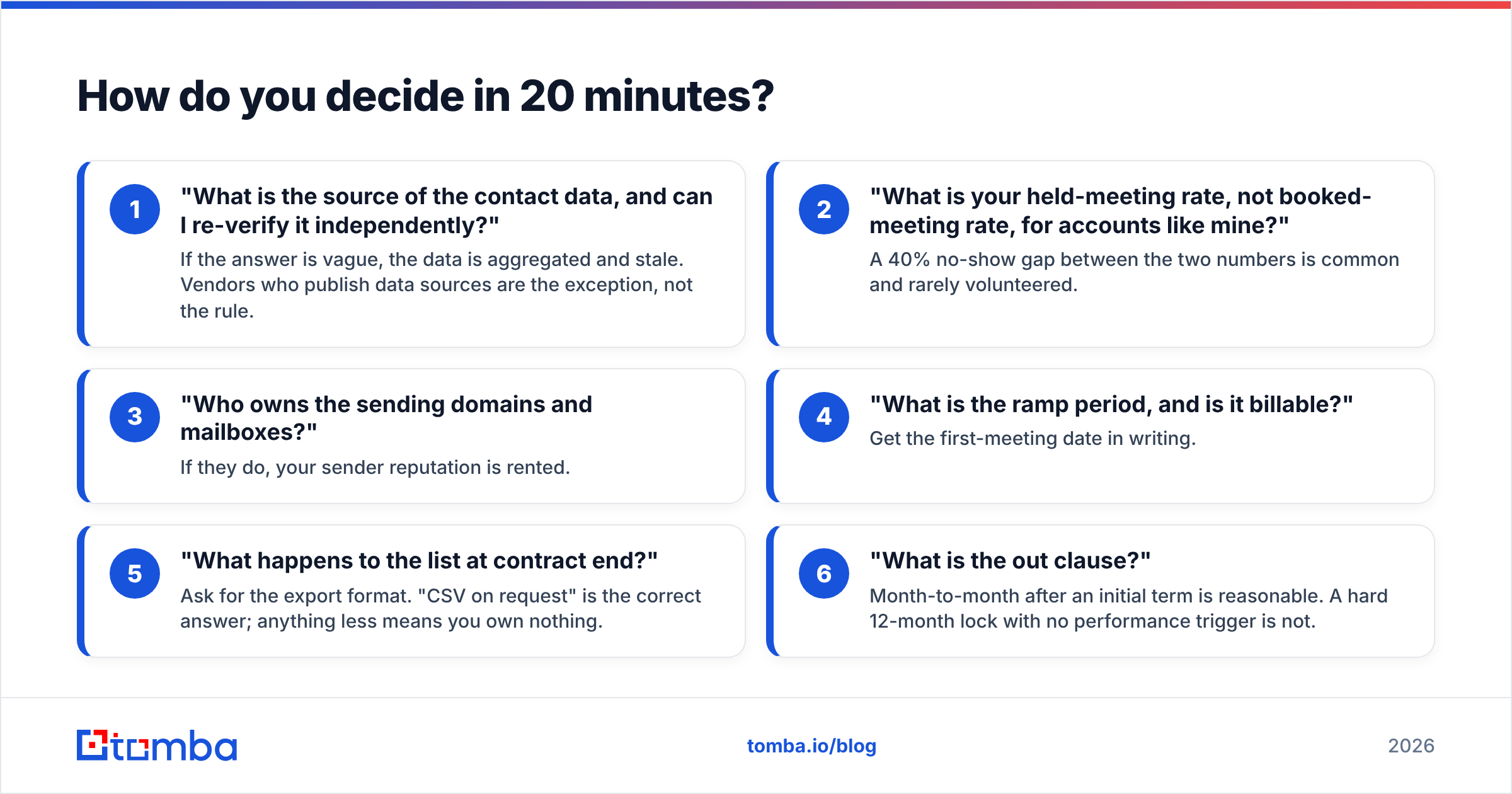
Ask both providers the same six questions and compare the answers, not the decks:
- "What is the source of the contact data, and can I re-verify it independently?" If the answer is vague, the data is aggregated and stale. Vendors who publish data sources are the exception, not the rule.
- "What is your held-meeting rate, not booked-meeting rate, for accounts like mine?" A 40% no-show gap between the two numbers is common and rarely volunteered.
- "Who owns the sending domains and mailboxes?" If they do, your sender reputation is rented.
- "What is the ramp period, and is it billable?" Get the first-meeting date in writing.
- "What happens to the list at contract end?" Ask for the export format. "CSV on request" is the correct answer; anything less means you own nothing.
- "What is the out clause?" Month-to-month after an initial term is reasonable. A hard 12-month lock with no performance trigger is not.
If both answers are acceptable, pick on channel fit — phones favor OutboundView, volume favors Exellius. If either answer is evasive on questions 1 or 5, that is the tiebreaker, and it is not close.
What should you do before you sign either contract?#
Run one cheap experiment first. It takes a week and it will change your negotiating position.
Pull 300 accounts that match your ICP. Use a company email search to get decision-maker addresses, run them through verification, and have one rep send a plain three-touch sequence. Track replies, not opens — Apple Mail Privacy Protection made open rates fiction years ago, and Gartner's own guidance on outbound benchmarking says the same.
If that test produces two or three real conversations, you have a working message and an agency is buying you scale — a good trade. If it produces nothing, no retainer on earth will fix it, and you have just saved yourself a five-figure lesson. Either way you enter the agency conversation with data instead of hope.
The verdict#
Exellius vs OutboundView comes down to price-per-touch versus quality-per-touch. OutboundView is the safer pick when your buyers are phone-responsive and the sale requires a human who can hold a technical conversation. Exellius is the more efficient pick when your ICP is wide, your budget is finite, and email plus LinkedIn is genuinely where your buyers live.
But before you commit six months of retainer to either, be clear about what you are actually short of. If it is time, outsource. If it is a list — accurate, verified, exportable, yours — that problem is solvable for the price of a team lunch.
Own your data layer first. Tomba's Email Finder returns verified professional addresses by domain, name, or company, with a free tier at 25 searches a month and paid plans from $49/mo — no annual lock, no shared ownership, and every record exportable the day you decide to stop. Whether you end up hiring Exellius, OutboundView, or nobody at all, the contacts stay on your side of the table.
Related guides#
Ready to find emails that actually work?
Join 150,000+ professionals who stopped guessing and started sending. Free credits on signup — no credit card required.
Get the Tomba newsletter
Practical outbound tactics and product updates — once every two weeks.
About the author