Exellius vs Salesbot (2026): Which Sales Tool Wins?
Exellius and Salesbot get pitched as rivals, but they solve different halves of outbound. Here's an honest breakdown of data quality, automation depth, pricing models, and which one belongs in your stack in 2026.
Exellius vs Salesbot comes down to one question: is your gap data, or follow-up? Exellius finds contacts. Salesbot works the leads you already have. Here is the honest breakdown of both.
TL;DR
- They are not the same product. Exellius handles data and contact discovery. Salesbot handles conversations and automation.
- Short on accurate contacts? Exellius-class tooling fits. Leads pile up unanswered? Salesbot-class tooling fits.
- Neither tool covers both halves. Skip one and you get great data nobody works, or slick automation firing at dead addresses.
- Public pricing is thin and changes often. Treat any number here as a starting point and verify it on the vendor's page.
- Verify addresses before they hit a sequence. A clean list beats a clever bot every time.
What are Exellius and Salesbot?#
Start by separating the two. The naming collision does real damage to buying decisions.
Exellius is a B2B contact-discovery and lead-intelligence platform. The core loop is simple. Define an ideal customer profile, pull matching companies and people, resolve business emails and firmographics, then push the result into your CRM or sequencer. It competes with the broad prospecting-database category — Apollo, RocketReach, Lusha, and ZoomInfo at the enterprise end.
Salesbot is a conversational sales-automation layer. The name appears across several vendors, including as a bundled feature inside CRM suites. In practice it means an AI or rules-based bot. It engages site visitors, qualifies them with scripted questions, books meetings, and hands warm chats to a rep. The pitch is speed-to-lead and after-hours coverage, not data volume.
That split drives everything below. One fills the top of the funnel with names. The other works the traffic and replies you already have.
One limitation, stated plainly: both vendors publish little hard spec publicly. The numbers below show the category's normal ranges. Confirm current terms on the vendor's pricing page, or on a review site like G2 or Capterra, before you sign.

Exellius vs Salesbot: how do they compare head-to-head?#
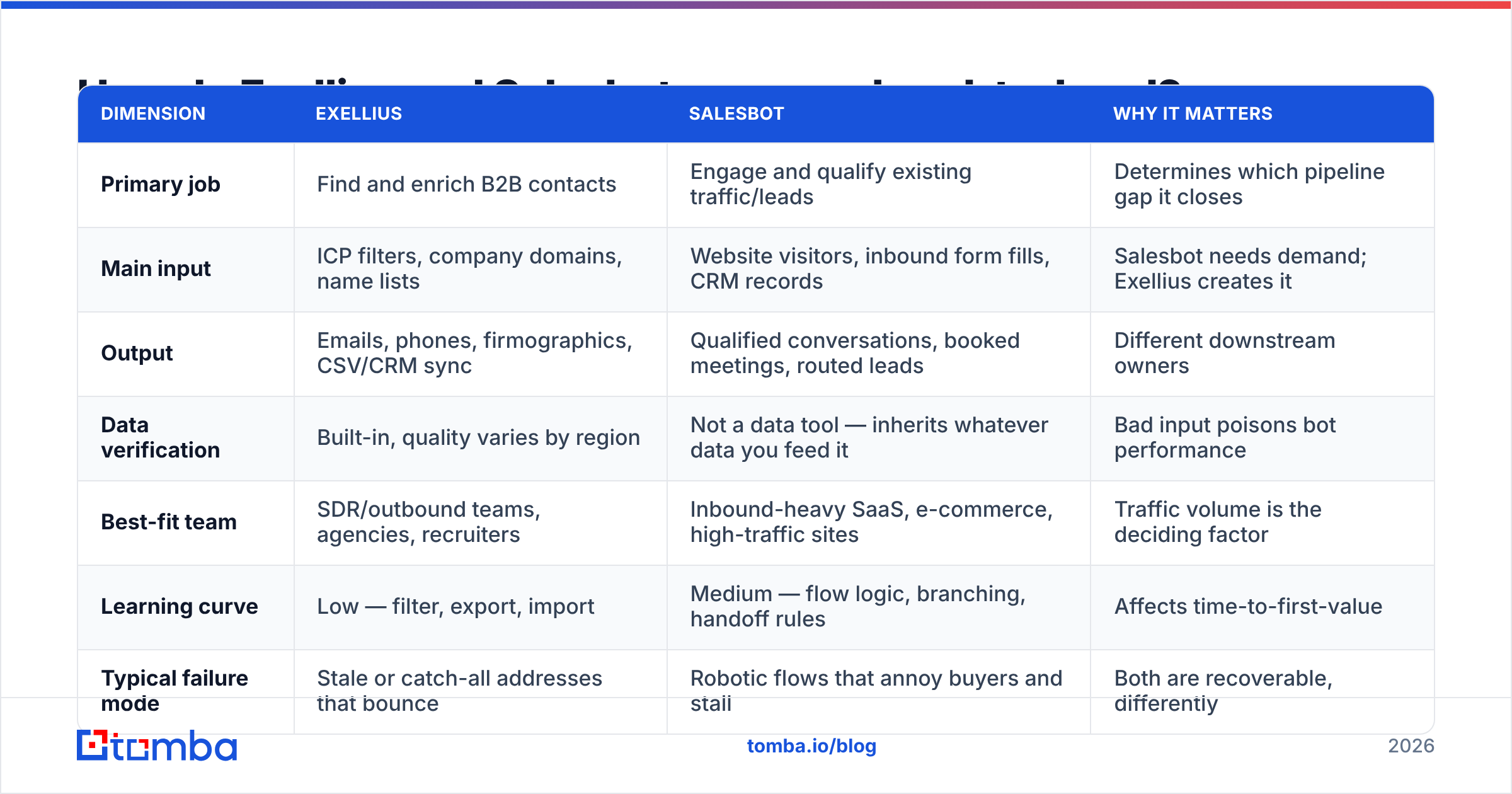
Here is the side-by-side across the dimensions that change your outcome.
| Dimension | Exellius | Salesbot | Why it matters |
|---|---|---|---|
| Primary job | Find and enrich B2B contacts | Engage and qualify existing traffic/leads | Determines which pipeline gap it closes |
| Main input | ICP filters, company domains, name lists | Website visitors, inbound form fills, CRM records | Salesbot needs demand; Exellius creates it |
| Output | Emails, phones, firmographics, CSV/CRM sync | Qualified conversations, booked meetings, routed leads | Different downstream owners |
| Data verification | Built-in, quality varies by region | Not a data tool — inherits whatever data you feed it | Bad input poisons bot performance |
| Best-fit team | SDR/outbound teams, agencies, recruiters | Inbound-heavy SaaS, e-commerce, high-traffic sites | Traffic volume is the deciding factor |
| Learning curve | Low — filter, export, import | Medium — flow logic, branching, handoff rules | Affects time-to-first-value |
| Typical failure mode | Stale or catch-all addresses that bounce | Robotic flows that annoy buyers and stall | Both are recoverable, differently |
| API depth | Central to the product | Usually secondary to the visual flow builder | Matters for RevOps automation |
Read that table twice. If both columns look useful, that is not indecision. It is a correct read. Most mature outbound stacks run one of each.
Is Exellius better than Salesbot for outbound prospecting?#
For pure cold outbound, yes. It is not close, because Salesbot is not built for that job.
Cold outbound needs three things, in order. A defensible target list. Verified contact details. A sequencing engine. A prospecting database covers the first two. A conversational bot covers none of them. There is no conversation to have until someone replies.
A bot still earns its place on the response side. A cold email lands and the prospect replies at 11pm. A qualification bot on your booking page turns that reply into a calendar hold before a human touches it. That is a real gain. It is the second act, not the first.
On any data vendor, Exellius included, do not scrutinize database size. Scrutinize the hit rate on your own ICP. A tool with 200 million contacts and 55% deliverable coverage in your niche is worse than one with 40 million and 92%. So run a controlled test. Take 100 companies you know well, pull contacts from each candidate tool, and count how many resolve to a real inbox. That is the only benchmark that predicts your bounce rate.
Want a second opinion in that test? Run both exports through an independent email verifier. It shows you which vendor pads its coverage numbers with risky and catch-all addresses.
What does each one actually cost?#
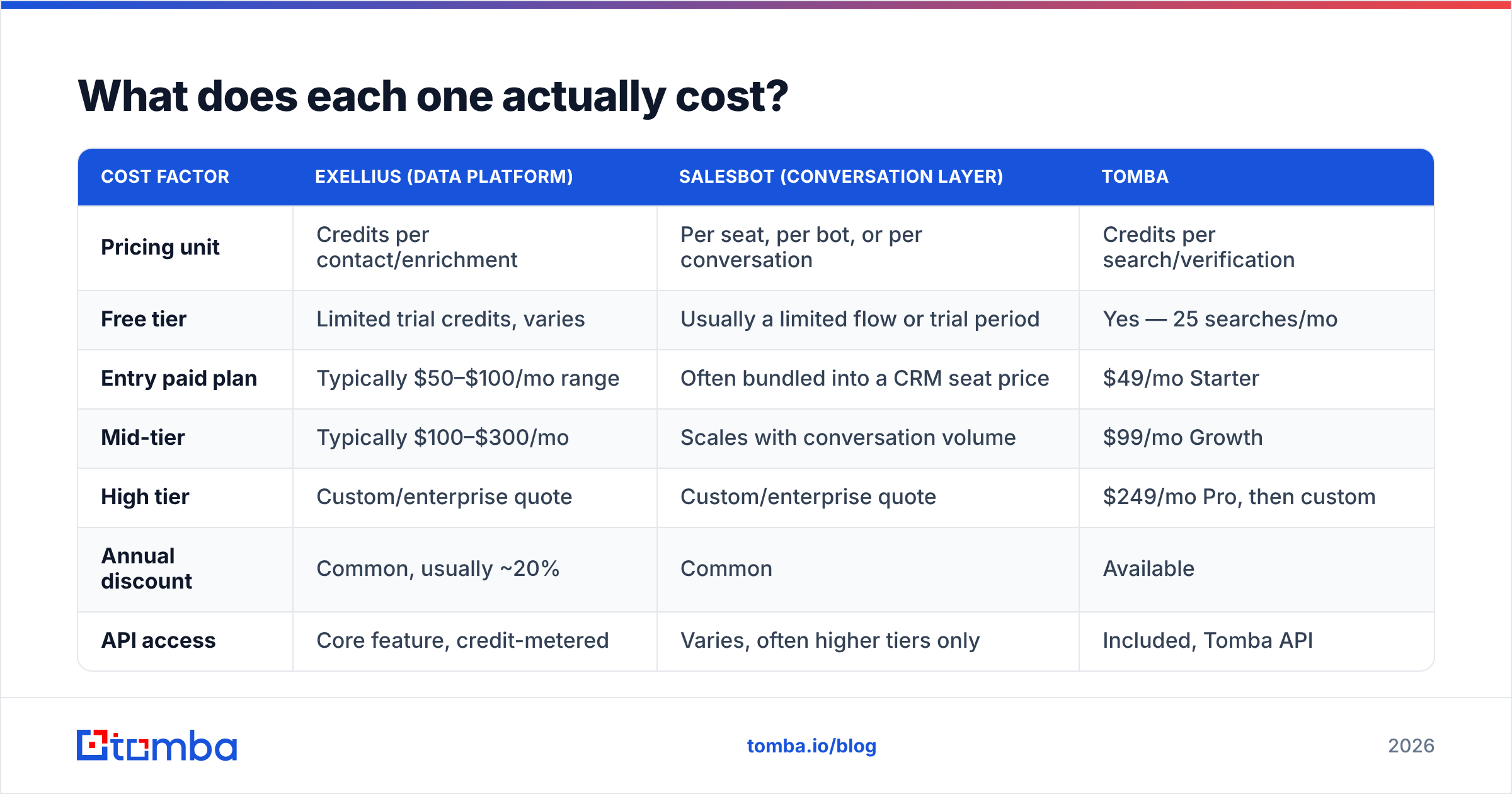
Both vendors gate pricing behind a demo. That is normal here, and it is the main reason buyers overpay. Below is how the cost models differ, with Tomba as a transparent reference point because its numbers are published in full.
| Cost factor | Exellius (data platform) | Salesbot (conversation layer) | Tomba |
|---|---|---|---|
| Pricing unit | Credits per contact/enrichment | Per seat, per bot, or per conversation | Credits per search/verification |
| Free tier | Limited trial credits, varies | Usually a limited flow or trial period | Yes — 25 searches/mo |
| Entry paid plan | Typically $50–$100/mo range | Often bundled into a CRM seat price | $49/mo Starter |
| Mid-tier | Typically $100–$300/mo | Scales with conversation volume | $99/mo Growth |
| High tier | Custom/enterprise quote | Custom/enterprise quote | $249/mo Pro, then custom |
| Annual discount | Common, usually ~20% | Common | Available |
| API access | Core feature, credit-metered | Varies, often higher tiers only | Included, Tomba API |
| Overage behavior | Credit top-ups | Conversation overage fees | Credit top-ups |
Two cost traps are worth naming.
First, credit burn on failed lookups. Some data vendors deduct a credit even when they return nothing usable. Others charge only on a deliverable result. Over 10,000 monthly lookups, that difference is your whole budget line. Ask about it during the trial, in writing.
Second, seat inflation on the bot side. Per-seat conversation tools get expensive fast. You add AEs, then support, then a manager who only wants read access. Check whether view-only seats are free before you roll it out company-wide. See Tomba pricing for a model where the meter is usage, not headcount.
When should you pick Exellius?#
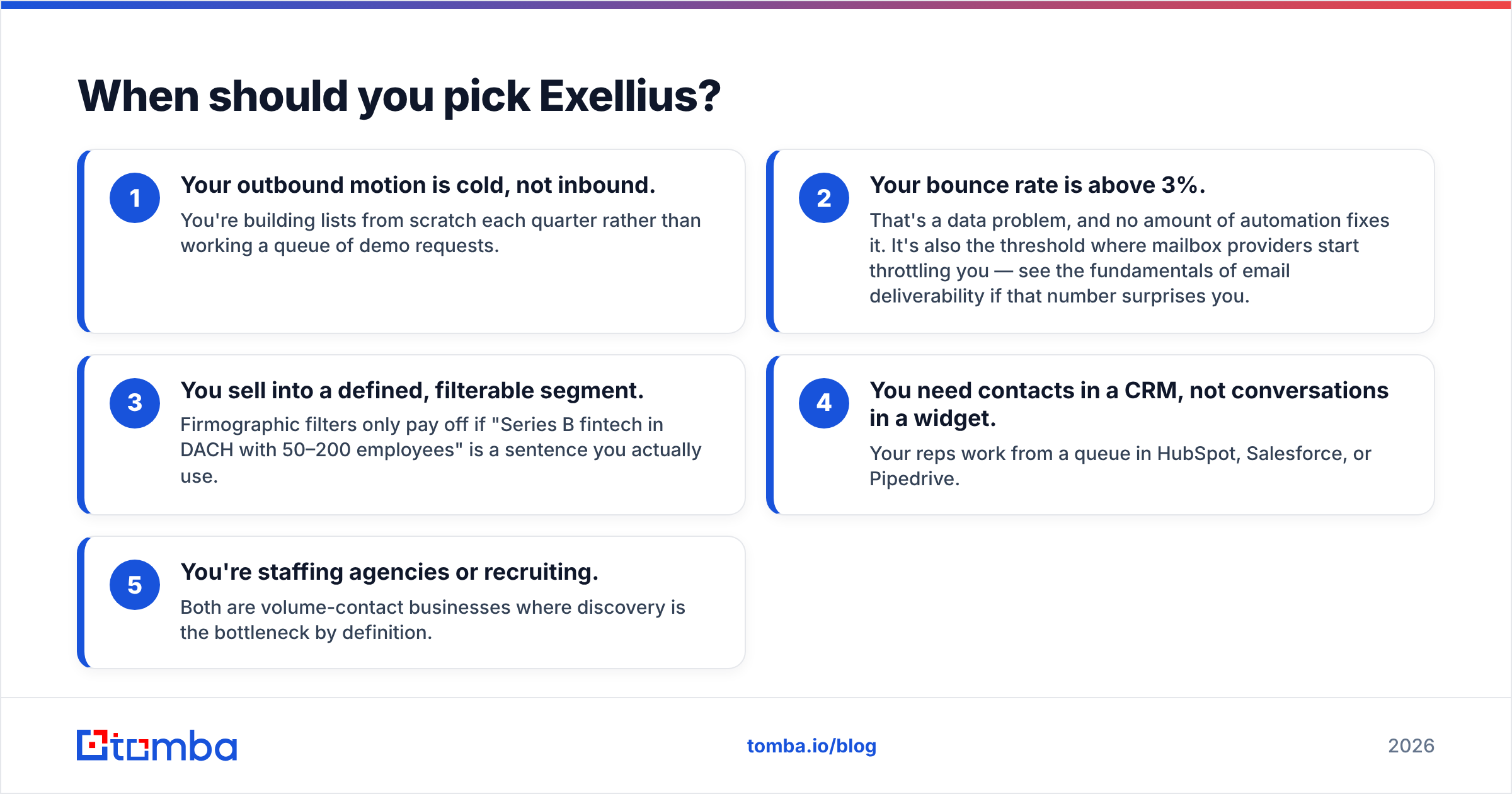
Choose the data side when these describe you:
- Your motion is cold, not inbound. You build lists from scratch each quarter instead of working a queue of demo requests.
- Your bounce rate is above 3%. That is a data problem, and automation will not fix it. It is also where mailbox providers start throttling you. See email deliverability if that surprises you.
- You sell into a filterable segment. Firmographic filters pay off only if "Series B fintech in DACH, 50–200 staff" is a sentence you use.
- You need contacts in a CRM, not chats in a widget. Your reps work a queue in HubSpot, Salesforce, or Pipedrive.
- You run staffing or recruiting. Both are volume-contact businesses. Discovery is the bottleneck by definition.
If three or more land, buy the data tool first. The bot can wait a quarter.
When does Salesbot make more sense?#
Flip the criteria:
- You get real website traffic. Roughly 5,000+ relevant monthly visitors, and most leave without identifying themselves.
- Your speed-to-lead is measured in hours, not minutes. HubSpot's sales research has tracked how sharply conversion decays with response delay. A bot that answers at 2am recovers leads a human roster never will.
- Your qualification criteria are stable. Budget, headcount, use case, timeline. If the questions rarely change, a flow can ask them.
- Your reps waste time on unqualified demos. A gating flow ahead of the calendar is the cheapest fix available.
The honest caveat: bots underperform when the buying process is consultative. If your average deal needs a discovery call just to scope it, a bot mostly annoys people on the way to that same call.

What do both tools leave you to solve?#
Most comparison posts skip this section. It is where budgets die. Neither category covers these alone:
- Verification hygiene at send time. Contact data decays 2–3% per month as people change jobs. A list pulled in January is materially worse by April. You need re-verification in the workflow, not a one-time export. Running exports through a bulk email finder and verifier before each campaign is cheap insurance.
- Catch-all domains. Many enterprise domains accept everything at the SMTP layer, so a naive "valid" result means nothing. Use a dedicated catch-all verifier, or you will blast a domain that silently discards every message.
- Domain and sender warmup. Neither a database nor a bot protects your sending reputation. That means SPF, DKIM, DMARC, a gradual volume ramp, and monitoring. Separate discipline, separate tooling.
- Deduplication and CRM hygiene. Pulling from two sources creates duplicates at once. Pick your matching key before you import anything. Usually work email, sometimes domain plus LinkedIn URL.
- Compliance. GDPR, CCPA, and regional rules govern what you can store and why. Vendors will call themselves compliant. That does not move the obligation off your company. The GDPR overview on Wikipedia is a fair primer before you talk to counsel.
Can you run Exellius and Salesbot together?#
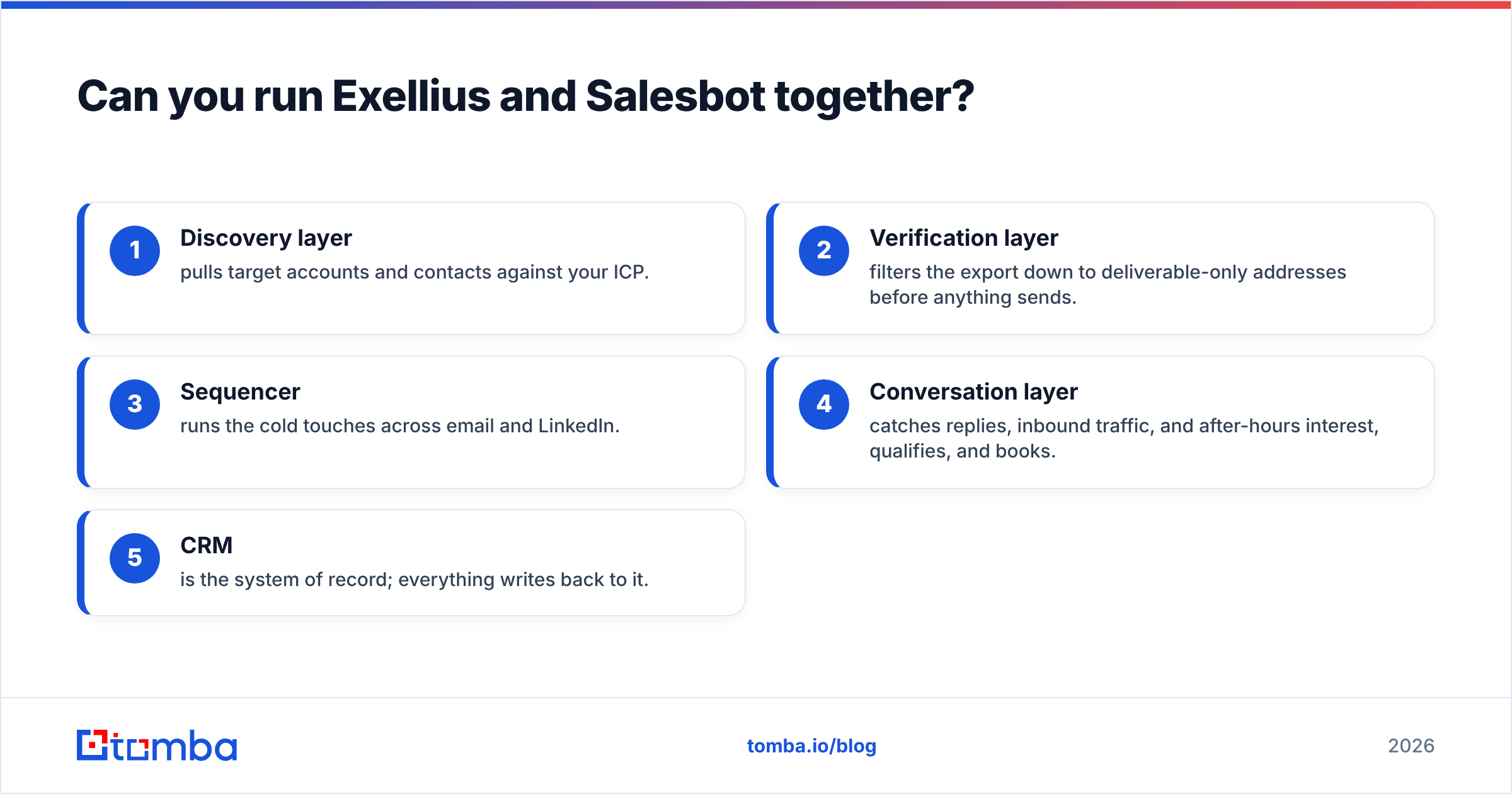
Yes. For most teams above roughly 10 reps, that is the right answer. The clean architecture looks like this:
- Discovery layer pulls target accounts and contacts against your ICP.
- Verification layer filters the export to deliverable-only addresses before anything sends.
- Sequencer runs the cold touches across email and LinkedIn.
- Conversation layer catches replies, inbound traffic, and after-hours interest, then qualifies and books.
- CRM is the system of record. Everything writes back to it.
The failure mode is skipping step 2. Teams wire the database straight into the sequencer. They hit a 12% bounce rate in week three. Then they spend two months rebuilding a burned sending domain. Keep verification as a hard gate between discovery and send. It costs a fraction of a credit and saves the program.
For a leaner stack, one platform can cover steps 1 and 2. Tomba's email finder and verifier run in the same workflow. The export you download is already filtered, which removes a tool and a handoff from the diagram.
Which should you buy first in 2026?#
Buy for the bottleneck you can measure, not the feature list you find impressive.
Pull two numbers from last quarter. How many net-new qualified contacts did your team add to sequences? And what share of inbound leads got a reply within five minutes? If the first number is your constraint, buy data. If the second is, buy the conversation layer. If both are broken, fix data first. A bot with nothing to talk to is a very expensive widget.
Whichever way the Exellius vs Salesbot call goes, run the 100-account bake-off before you sign an annual contract. Vendors quote coverage percentages that were true on someone else's ICP. Ten minutes of testing against your own account list beats every comparison table online, including the ones above.
Start with the data layer. Is your outbound stalling on contact quality rather than conversation speed? Test the Tomba Email Finder against whatever you use now. The free tier gives you 25 searches a month with no card, and Starter is $49/mo. Every result runs through verification before it lands in your export, so what you download is what actually delivers. Run it against 100 of your own target accounts and compare hit rates. That test takes an afternoon and tells you more than any vendor demo.
Related guides#
Ready to find emails that actually work?
Join 150,000+ professionals who stopped guessing and started sending. Free credits on signup — no credit card required.
Get the Tomba newsletter
Practical outbound tactics and product updates — once every two weeks.
About the author