Exellius vs Smarte (2026): Which B2B Data Tool Wins?
Exellius sells custom-built, human-verified contact lists. Smarte sells self-serve, compliance-first contact data. They solve different problems — here is which one fits your motion, and what each really costs.
Exellius vs Smarte is a choice between two very different ways to buy B2B contact data. One sends you a hand-built list. The other hands you a login and a database. This guide covers data quality, real cost, compliance, and which team each one fits.
TL;DR
- Exellius is a managed B2B data service: you brief them, humans build and verify a list to your ICP, you receive a file. Pricing is quote-based and project-shaped.
- Smarte is a self-serve contact data platform with a Chrome extension, GDPR/CCPA-oriented sourcing, and seat-plus-credit pricing. You do the pulling yourself.
- Neither publishes public pricing. For teams under 20 reps, that is the biggest friction point.
Quick rule of thumb:
- Choose Exellius when your ICP is narrow, regional, or listed nowhere.
- Choose Smarte when your ICP is standard tech or enterprise and you need volume on demand.
- If you mostly need verified work emails at a predictable price, an API-first email finder covers the same job for a fraction of the spend.
What are Exellius and Smarte, and why do they get compared?#
They get compared because both answer the same question — where do I get contact data for people who fit my ICP? — with opposite architectures.
Exellius Systems operates as a data-as-a-service partner. You submit an ideal customer profile: industry, headcount, geography, job titles, sometimes tech stack or intent signals. Their research team then builds a list against it, usually with a manual verification pass before delivery.
The output is a file or a CRM push, not a dashboard you log into every morning. Think of it like hiring a tailor instead of buying off the rack. It is slower and costs more per unit, and it fits when nothing off the shelf does.
Smarte is the off-the-rack option. It is a self-serve B2B contact and account data platform. A browser extension pulls contacts while you browse LinkedIn or company sites, filters build lists inside the app, and CRM or sequencer integrations move the data onward. Its positioning leans heavily on compliance — sourcing designed around GDPR and CCPA obligations — which matters if you sell into the EU or face procurement reviews.
The practical difference: with Exellius, a human is accountable for your list. With Smarte, a database is. That one distinction drives cost, speed, and everything downstream.
Exellius vs Smarte: how do they compare head-to-head?#
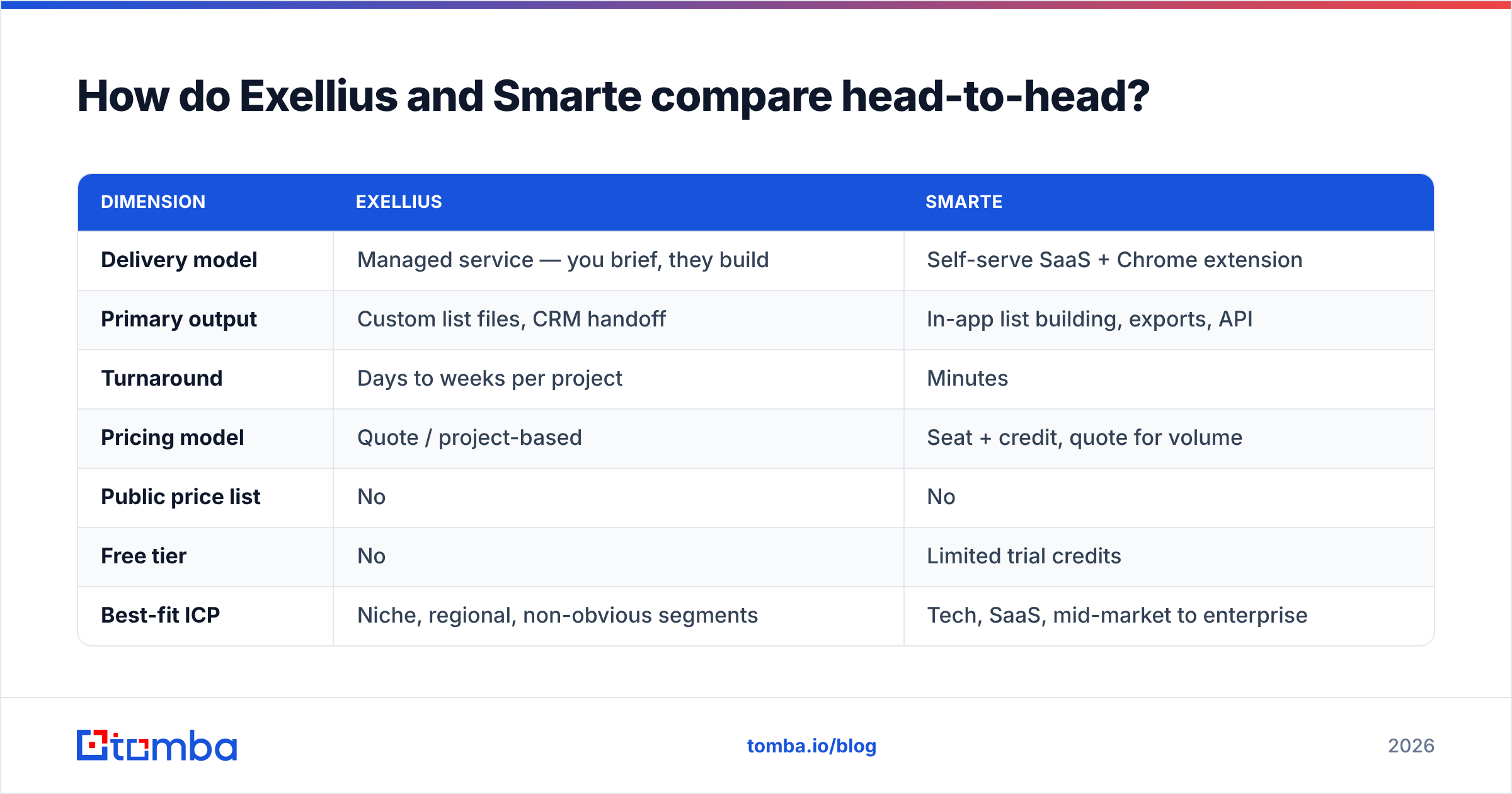
| Dimension | Exellius | Smarte |
|---|---|---|
| Delivery model | Managed service — you brief, they build | Self-serve SaaS + Chrome extension |
| Primary output | Custom list files, CRM handoff | In-app list building, exports, API |
| Turnaround | Days to weeks per project | Minutes |
| Pricing model | Quote / project-based | Seat + credit, quote for volume |
| Public price list | No | No |
| Free tier | No | Limited trial credits |
| Best-fit ICP | Niche, regional, non-obvious segments | Tech, SaaS, mid-market to enterprise |
| Compliance posture | Contractual, per-engagement | GDPR/CCPA-oriented sourcing baked in |
| Phone numbers | Available on request | Included in most plans |
| Scales with headcount? | No — scales with budget | Yes — per-seat |
| Who owns accuracy | The vendor's research team | You, at export time |
Read that last row twice. It is the thing teams underestimate. In a managed model, a bad record is the vendor's problem and you can escalate it. In a self-serve model, a bad record is your bounce, your sender reputation, and your problem.

Which one has better data accuracy?#
Neither vendor publishes an audited accuracy figure. Treat any number in a sales deck as a marketing claim until you test it yourself.
What you can reason about is the mechanism behind each dataset:
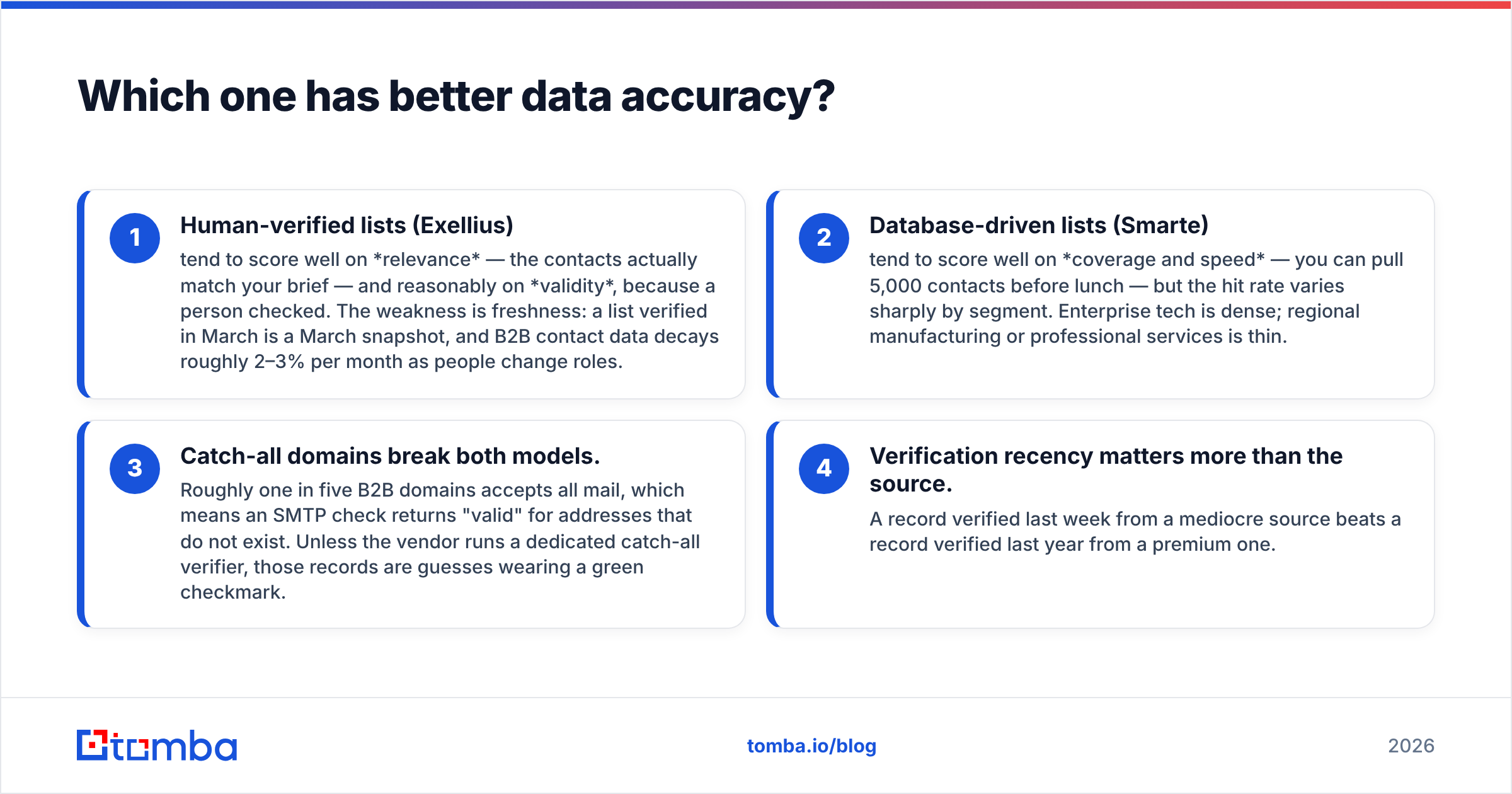
- Human-verified lists (Exellius) score well on relevance — the contacts match your brief — and reasonably on validity, because a person checked. The weakness is freshness. A list verified in March is a March snapshot, and B2B contact data decays roughly 2–3% per month as people change roles.
- Database-driven lists (Smarte) score well on coverage and speed. You can pull 5,000 contacts before lunch. But the hit rate varies sharply by segment: enterprise tech is dense, while regional manufacturing or professional services is thin.
Two more factors cut across both models:
- Catch-all domains break both. Roughly one in five B2B domains accepts all mail, so an SMTP check returns "valid" for addresses that do not exist. Unless the vendor runs a dedicated catch-all verifier, those records are guesses wearing a green checkmark.
- Verification recency matters more than the source. A record verified last week from a mediocre source beats a record verified last year from a premium one.

The only accuracy test worth running is your own. Take 200 accounts you already know well, ideally ones with confirmed contacts in your CRM, and ask both vendors to fill them. Then score three things: match rate, title accuracy, and bounce rate after a real send.
Run every list through an independent email verifier before you send, whichever vendor you pick. Vendor-supplied verification and third-party verification disagree more often than you would expect.
What do Exellius and Smarte actually cost?#
Exellius vs Smarte pricing is hard to compare, because both hide it behind a form. The honest answer is that it depends on your volume and your negotiating position. Here is the shape of the market as of 2026, with a transparent reference point for calibration.
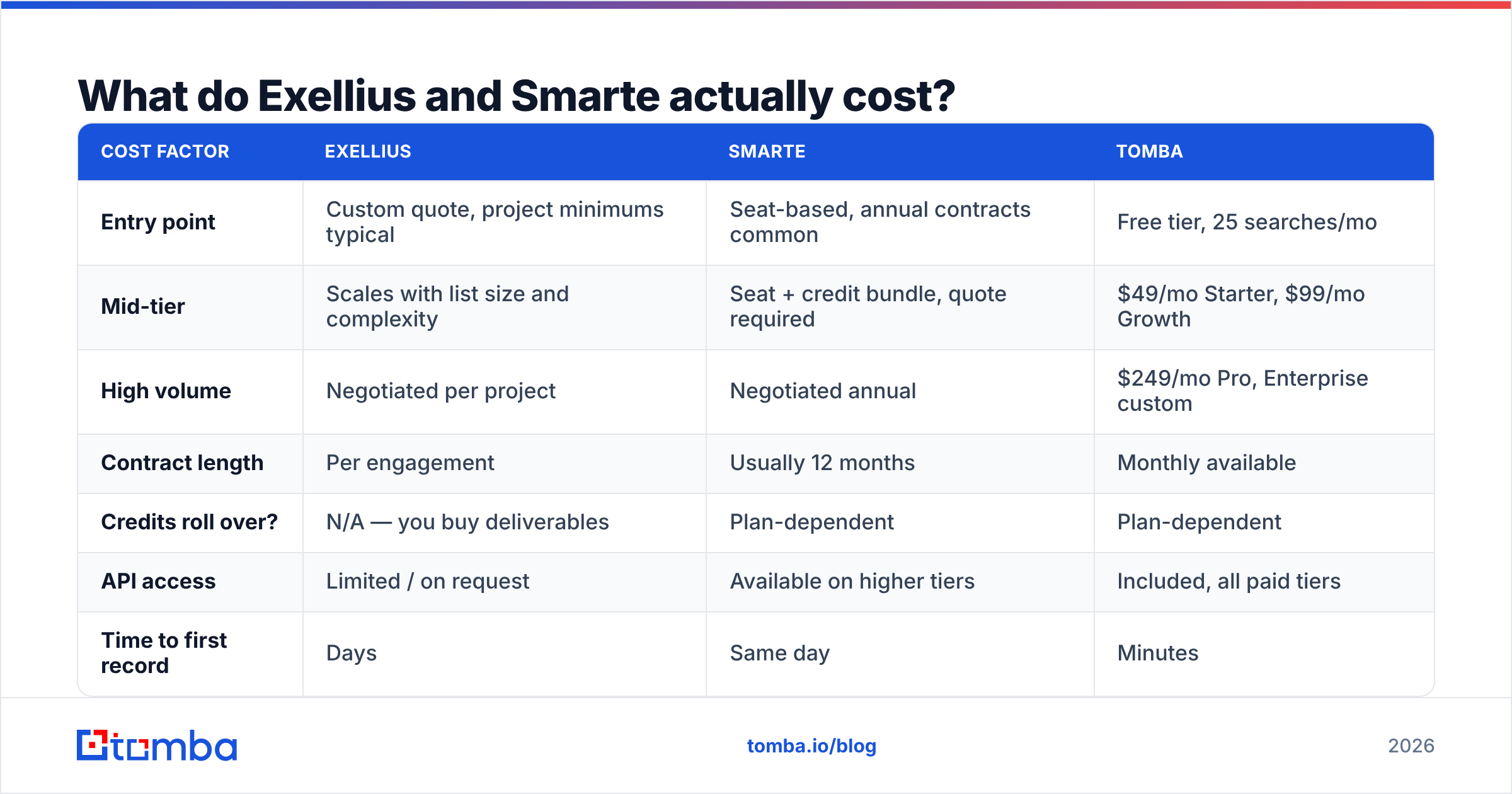
| Cost factor | Exellius | Smarte | Tomba |
|---|---|---|---|
| Entry point | Custom quote, project minimums typical | Seat-based, annual contracts common | Free tier, 25 searches/mo |
| Mid-tier | Scales with list size and complexity | Seat + credit bundle, quote required | $49/mo Starter, $99/mo Growth |
| High volume | Negotiated per project | Negotiated annual | $249/mo Pro, Enterprise custom |
| Contract length | Per engagement | Usually 12 months | Monthly available |
| Credits roll over? | N/A — you buy deliverables | Plan-dependent | Plan-dependent |
| API access | Limited / on request | Available on higher tiers | Included, all paid tiers |
| Time to first record | Days | Same day | Minutes |
Two patterns show up again and again in buyer conversations. First, managed-service invoices are lumpy. A single 10,000-record project can eat a quarter's data budget, and a re-run six months later costs nearly the same again, because the snapshot went stale.
Second, seat-based platforms punish small teams. Two SDRs and a founder who all need occasional access pay for three seats to run what is really one workflow.
Want a sanity check on what data should cost per contact? Tomba pricing is public and unit-based: Free at 25 searches/month, $49/mo Starter, $99/mo Growth, $249/mo Pro. You can divide credits by dollars and get a number. Try doing that with a quote-based vendor before the second sales call.

Which should you choose for your specific motion?#
Skip the feature checklist. Match the tool to how you actually prospect.
- You sell into a niche nobody has databased. Regional logistics operators, specialty clinics, family-owned manufacturers, public-sector suppliers in one country. Databases are thin here and filters return noise. Exellius wins — a human researcher will beat a query.
- You sell into tech, SaaS, or enterprise IT. These segments are the most heavily covered in every commercial database. You do not need a custom build. You need a filter and an export. Smarte wins, and so does any competent self-serve provider.
- You run high-volume outbound and burn lists fast. Managed delivery cycles cannot keep pace with a team sending 3,000 emails a week. You need on-demand pulls and a real API. Smarte wins, with an honest caveat about seat costs.
Three more motions where the answer shifts:
- You run account-based outbound on 50–200 named accounts. You do not need volume. You need depth on specific people. Either tool works, but you are overpaying for both. A targeted domain search plus manual research usually beats both on cost per booked meeting.
- You need EU coverage with a documented lawful basis. Procurement will ask where the data came from. Smarte's compliance positioning is a genuine differentiator here. Ask Exellius for equivalent contractual assurances in writing.
- You need contacts inside your product or CRM automatically. Managed files do not enrich in real time. You need an API or a native integration — check the integrations list of whatever you choose before signing.

Where do both Exellius and Smarte fall short?#
Being fair to both: these are real vendors solving real problems. The gaps below are structural to their categories, not defects.
Shared weaknesses:
- No public pricing. Every evaluation starts with a discovery call, which adds one to two weeks before you see a single record. For a team that needs 500 verified emails this month, that is the whole project timeline.
- Verification opacity. Neither publishes what "verified" means in mechanical terms: syntax check, MX lookup, SMTP handshake, catch-all handling, or human confirmation. Ask specifically. Answers vary wildly across the industry.
- Weak long-tail coverage. Both thin out in SMB, non-English markets, and companies under 20 employees. This is universal across B2B data, but it will still surprise you if your ICP lives there.
Exellius-specific limits: the snapshot problem, since lists age from day one. No self-serve exploration before you commit. Turnaround that does not fit a fast-moving pipeline. You also cannot test-drive the data quality without a paid engagement.
Smarte-specific limits: seat-based pricing that scales awkwardly for small teams. Annual commitments that lock you in before you have measured bounce rates. And, like every database, coverage that is excellent in its strong segments and merely adequate outside them.
Both leave one gap open: a predictable per-contact cost with an API you can call from anything. If your real need is "given a company domain and a person's name, return a verified work email," that is a narrow problem. It does not require a research team or a 12-month seat contract. Cross-referencing options on G2 will show you a dozen tools sitting in that gap, priced by usage instead of by seat.
How do you run a fair 30-day evaluation?#
Do this before you sign anything, and run it against three vendors, not two.
- Freeze a test set. 200 accounts from your real ICP, including at least 40 you consider hard: small, regional, or non-English.
- Request the same brief from everyone. Same titles, same geography, same size band. Any vendor that quietly widens the brief to inflate match rate has told you something useful.
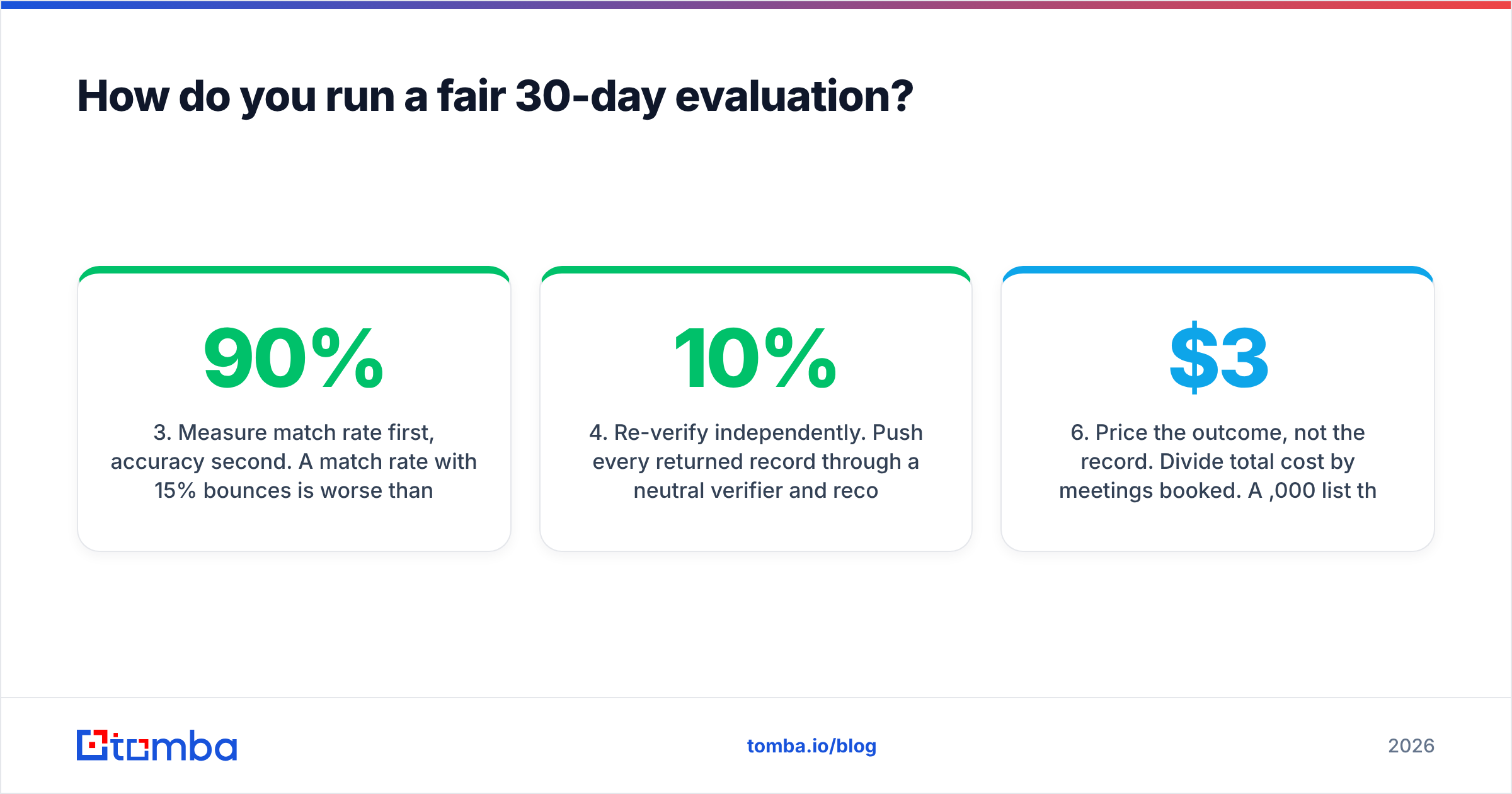
- Measure match rate first, accuracy second. A 90% match rate with 15% bounces is worse than a 60% match rate with 1% bounces.
Then test what actually pays you:
- Re-verify independently. Push every returned record through a neutral verifier and record the disagreement rate. Above 10% disagreement, discount the vendor's own quality claims.
- Send a real 100-contact campaign. Bounce rate, spam complaints, and reply rate are the only metrics that matter. Everything before this step is a proxy.
- Price the outcome, not the record. Divide total cost by meetings booked. A $3,000 list that produces four meetings costs $750 a meeting. A $99/month tool that produces two costs $50.
Feed the survivors into your CRM through proper data enrichment rather than a one-time CSV import, so records keep refreshing instead of decaying quietly in a field nobody checks.
The verdict: Exellius or Smarte?#
The Exellius vs Smarte decision comes down to one question: does your ICP already exist in a database?
Choose Exellius if it genuinely does not, and you have the budget and timeline to have a list built by hand. That is a real scenario, and paying for research is the correct answer when it applies.
Choose Smarte if you sell into well-covered segments, need data on demand, and compliance documentation is part of your procurement reality. It is the faster, more operational choice for standard B2B outbound.
Choose neither if what you actually need is verified work emails at a predictable, published price. That describes most teams under 20 reps. It is the majority case, and it is the one both vendors are built well past.
If your bottleneck is simply finding and verifying business email addresses without a sales call or an annual contract, start with the Tomba Email Finder. Search by domain, name, or company. Verify every result before it hits your sequencer, and pull it all through the Tomba API when you are ready to automate. The free tier gives you 25 searches a month, so run the 200-account test above before you commit a dollar to anyone, including us.
Related guides#
Ready to find emails that actually work?
Join 150,000+ professionals who stopped guessing and started sending. Free credits on signup — no credit card required.
Get the Tomba newsletter
Practical outbound tactics and product updates — once every two weeks.
About the author