Exellius vs ZoomInfo: Which B2B Data Tool Wins in 2026?
Exellius sells AI-driven prospecting on a startup budget. ZoomInfo sells the biggest B2B database on the market at enterprise prices. Here is where each one actually wins — and where a cheaper email finder beats both.
Exellius vs ZoomInfo really comes down to one question. Do you need a database, or do you just need contact data? Here is the short answer, then the detail.
TL;DR
- ZoomInfo is the market leader. It owns the deepest B2B contact and intent data, plus org charts and a sales outreach layer.
- The catch is the deal. Annual contracts, seat minimums, and five-figure entry prices.
- Exellius is a newer AI-first tool. It buys data from other vendors, then adds list building and outreach.
- It costs less and starts faster. It is also far less proven at scale.
- Need intent data, org charts, and a paper trail for ABM? ZoomInfo wins.
- Need verified emails for a list you already have? Both are overkill.
- A finder plus a verifier costs far less. It also lands more mail per dollar.
What are Exellius and ZoomInfo, actually?#
Two very different bets on the same problem.
ZoomInfo began as DiscoverOrg. It grew into the default B2B data tool for large sales teams. Its pitch is coverage. You get hundreds of millions of work profiles, company size and tech stack data, and org charts. Since the Clickagy deal, it also sells intent signals. Those flag the accounts that are looking at your category right now. On top sit Copilot for AI account scoring, SalesOS for outreach, and links into every major CRM.
Exellius is much younger and AI-first. The model is simple: it pulls records from other data vendors and fills the gaps. An AI layer then builds lists from a plain-English note about your ICP, and drafts the emails too. The target user is a founder, an agency, or a small sales team.
One gap matters more than any feature list. ZoomInfo owns its data and runs its own research team. Exellius mostly resells other people's data. That single fact drives cost, freshness, coverage in odd markets, and what happens when a record is wrong.

How do Exellius vs ZoomInfo compare head to head?#
Here is the short version. Treat the prices as rough. ZoomInfo quotes in private, and Exellius changes its packaging often.
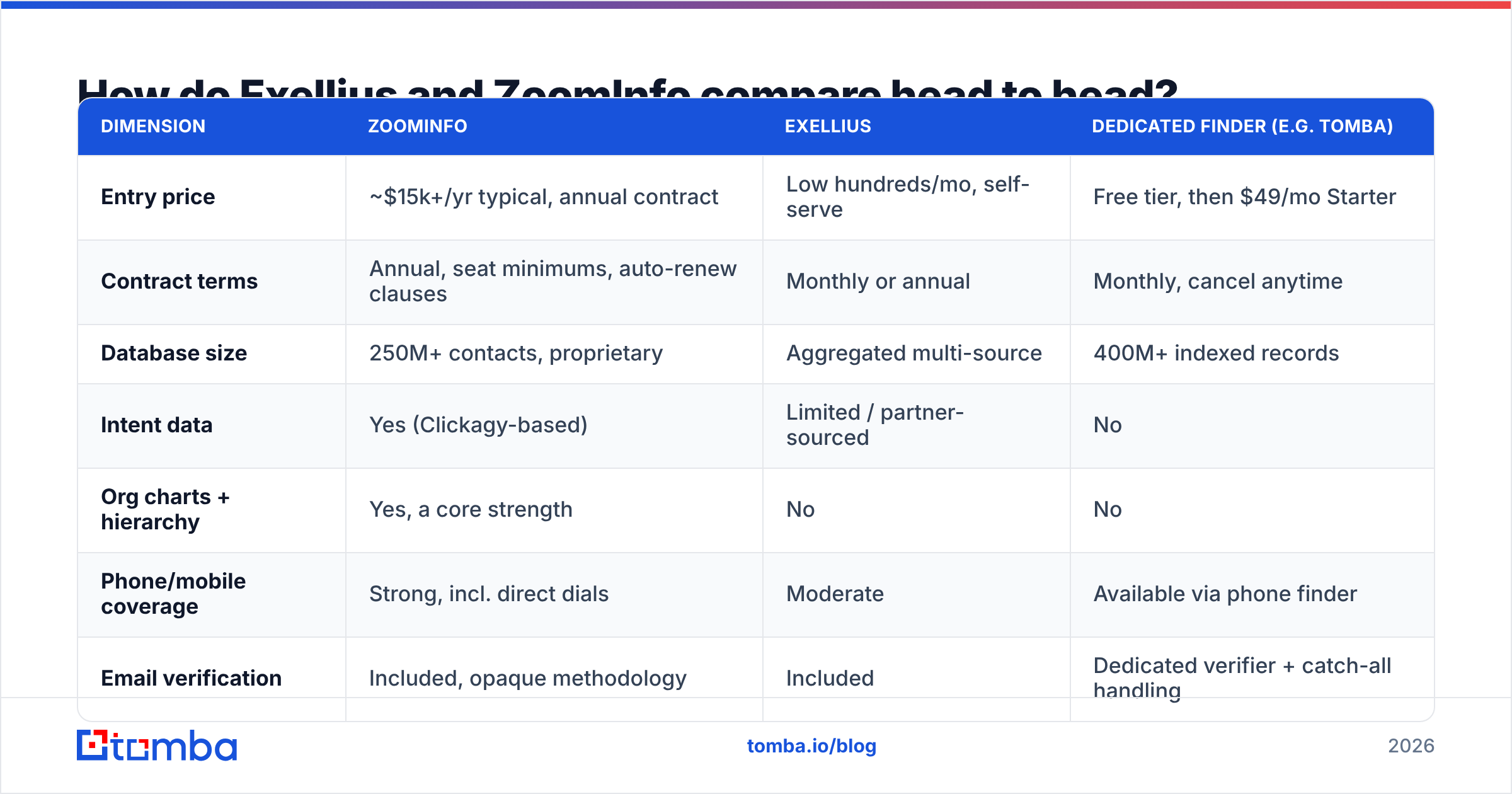
| Dimension | ZoomInfo | Exellius | Dedicated finder (e.g. Tomba) |
|---|---|---|---|
| Entry price | ~$15k+/yr, annual deal | Low hundreds/mo, self-serve | Free tier, then $49/mo |
| Contract | Annual, seat minimums | Monthly or annual | Monthly, cancel anytime |
| Database | 250M+ contacts, its own | Resold, multi-source | 400M+ records |
| Intent data | Yes | Limited | No |
| Org charts | Yes, a core strength | No | No |
| Phone coverage | Strong, direct dials | Moderate | Via phone finder |
| Verification | Bundled, opaque | Bundled | Verifier plus catch-all logic |
| API access | Top tiers only | Yes | Yes, all paid plans |
| Time to first list | Days | Under an hour | Minutes |
| Best fit | Enterprise ABM, 50+ reps | SMB and agency | Targeted outbound |
Three things jump out.
One: the price gap is not 2x. It is closer to 20x. Public filings and G2 reviews put most mid-market deals at $15k–$40k once you add seats and credit packs. Exellius sits in self-serve pricing. Is the gap worth it? Only if you use the intent and org-chart layers, which are the parts you cannot rebuild on the cheap.
Two: the contract is a bigger risk than the data. The top ZoomInfo gripe on G2 is not accuracy. It is renewal friction, credits that expire, and seats nobody uses. Exellius has the opposite problem. It is easy to leave, and it has less to hold you.
Three: neither tool is built for the job you do most. Most teams ask one question all day. What is the email for this person at this company? That is a lookup, not a database.
Is Exellius accurate enough to replace ZoomInfo?#
That depends on your bar. It is also the wrong question.
Resellers inherit the quality of their sources. When those sources agree, hit rates are strong. A VP of Sales at a 500-person US SaaS firm is easy for both. The gap shows up in the tail. Think non-English markets, firms under 50 staff, and deep technical roles. Add anyone who changed jobs in the last 90 days.
ZoomInfo does better there, thanks to its own contributor network and research team. That team is costly to run, which is why the price is what it is.
One point applies to both tools. Every static database rots. Most estimates put B2B data decay at 25–30% a year. The 2023–2025 layoffs pushed job changes higher still. A record that was true at import may be dead now. So the smarter setup looks like this:
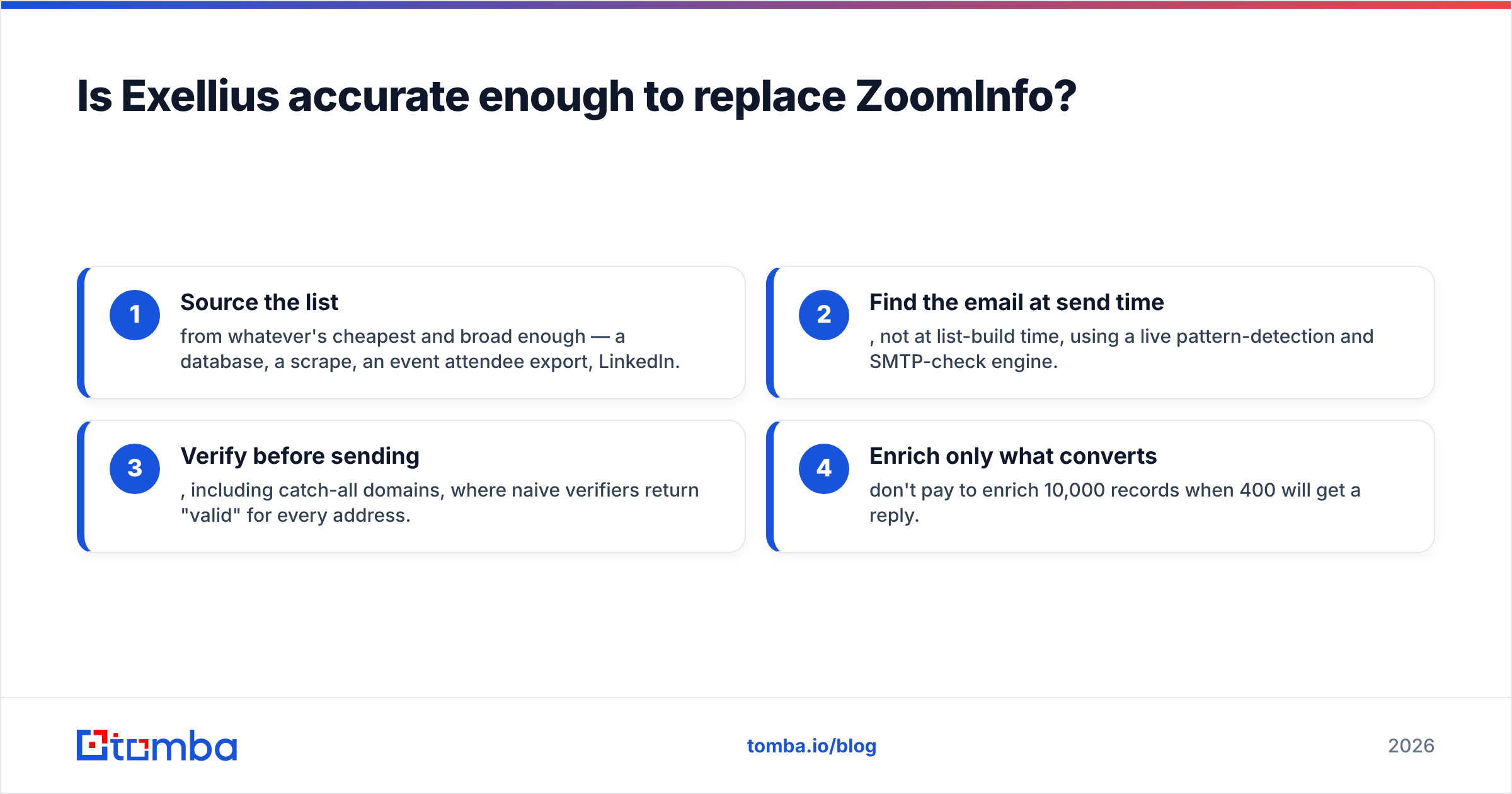
- Source the list from anything cheap and broad. A database, a scrape, an event export, LinkedIn.
- Find the email at send time. Not at list-build time. Use live pattern checks and an SMTP test.
- Verify before you send. Watch catch-all domains. Weak tools call every address there valid.
- Enrich only what converts. Do not top up 10,000 records when 400 will reply.
That loop is why teams pair a cheap data source with a real email verifier. Verification is where deliverability is won or lost. Big suites treat it as a checkbox.
Do you sell into catch-all-heavy markets? Agencies, schools, and government suppliers all qualify. Then a catch-all verifier is not optional. On this point Exellius vs ZoomInfo makes no difference. Both will mark those addresses valid, and your bounce rate finds the truth later.
When should you actually buy ZoomInfo?#
Buy ZoomInfo when at least three of these are true.
- You run ABM at scale. Intent plus company filters is hard to copy with small tools.
- You sell into large, complex firms. Org charts and reporting lines speed up multi-threading. Nothing cheap matches this.
- You have 20+ reps and a RevOps owner. Without an owner, seats sit idle and credits expire.
- Legal wants a compliance story. ZoomInfo publishes GDPR and CCPA processes and DPAs that pass review. Small resellers often cannot.
- Your CRM needs constant top-ups. Its Salesforce and HubSpot syncs are mature. HubSpot's data-quality guide sets a fair bar.
Skip it if you run founder-led sales. Skip it if you are an agency with client campaigns. Skip it if you already know your 500 target firms. You would pay enterprise rates for a search box.
When is Exellius the better call?#
Exellius fits a narrow but real window.
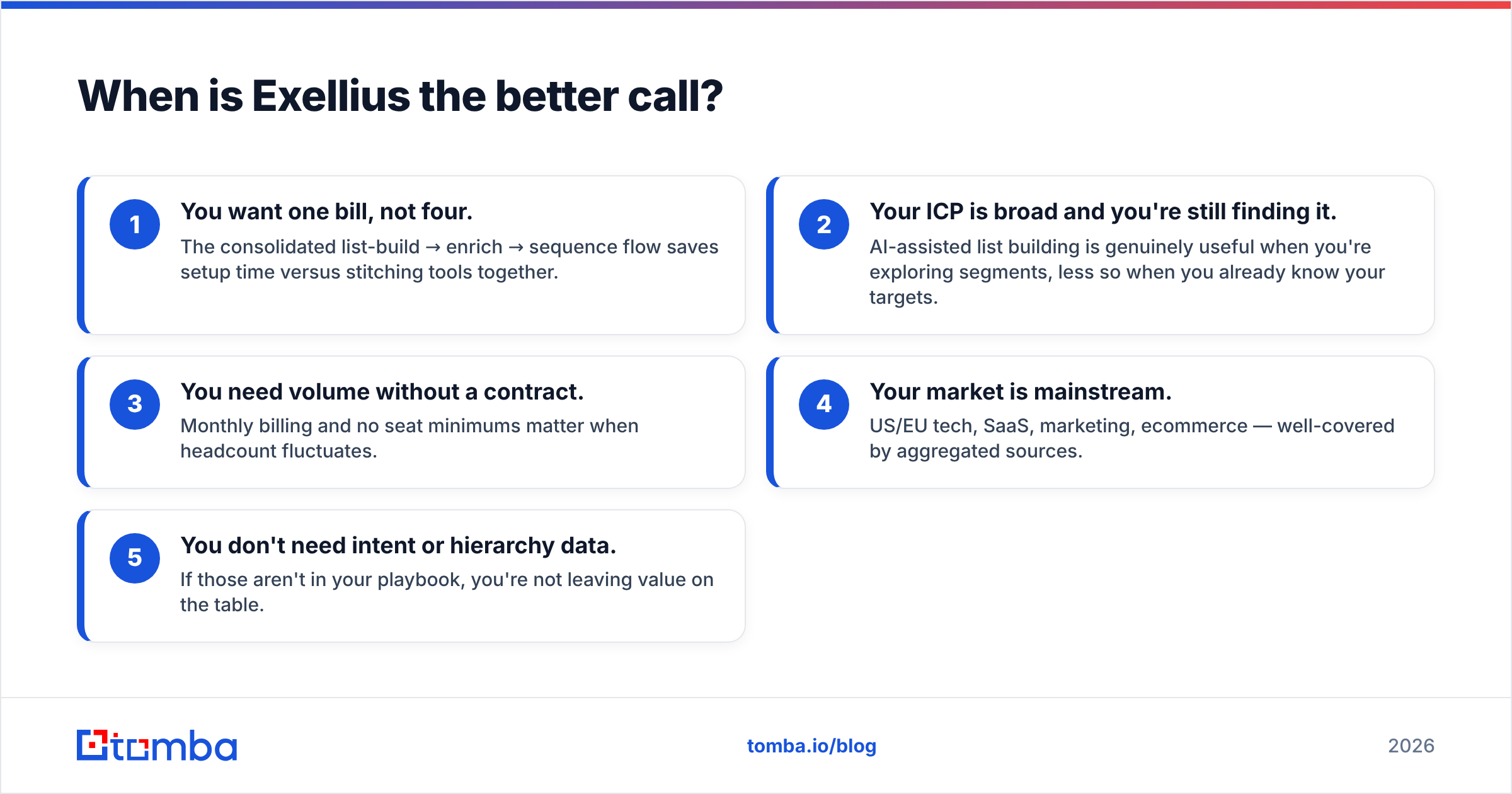
- You want one bill, not four. Build, enrich, and send in one flow. That beats gluing four tools together.
- Your ICP is still fuzzy. AI list building helps most while you explore segments.
- You need volume without a contract. Monthly billing matters when headcount moves.
- Your market is mainstream. US and EU tech, SaaS, marketing, and ecommerce are well covered.
- You skip intent and org charts. If they are not in your playbook, you lose nothing.
Where it strains: tail markets, heavy API use, and any job that needs an audit trail. Reselling hides where a record came from. That hurts when a prospect asks how you got their details. Under GDPR, "our vendor's vendor had it" is a weak answer.
What does the cheaper stack look like?#
Most Exellius vs ZoomInfo posts skip this option. It breaks the head-to-head frame.
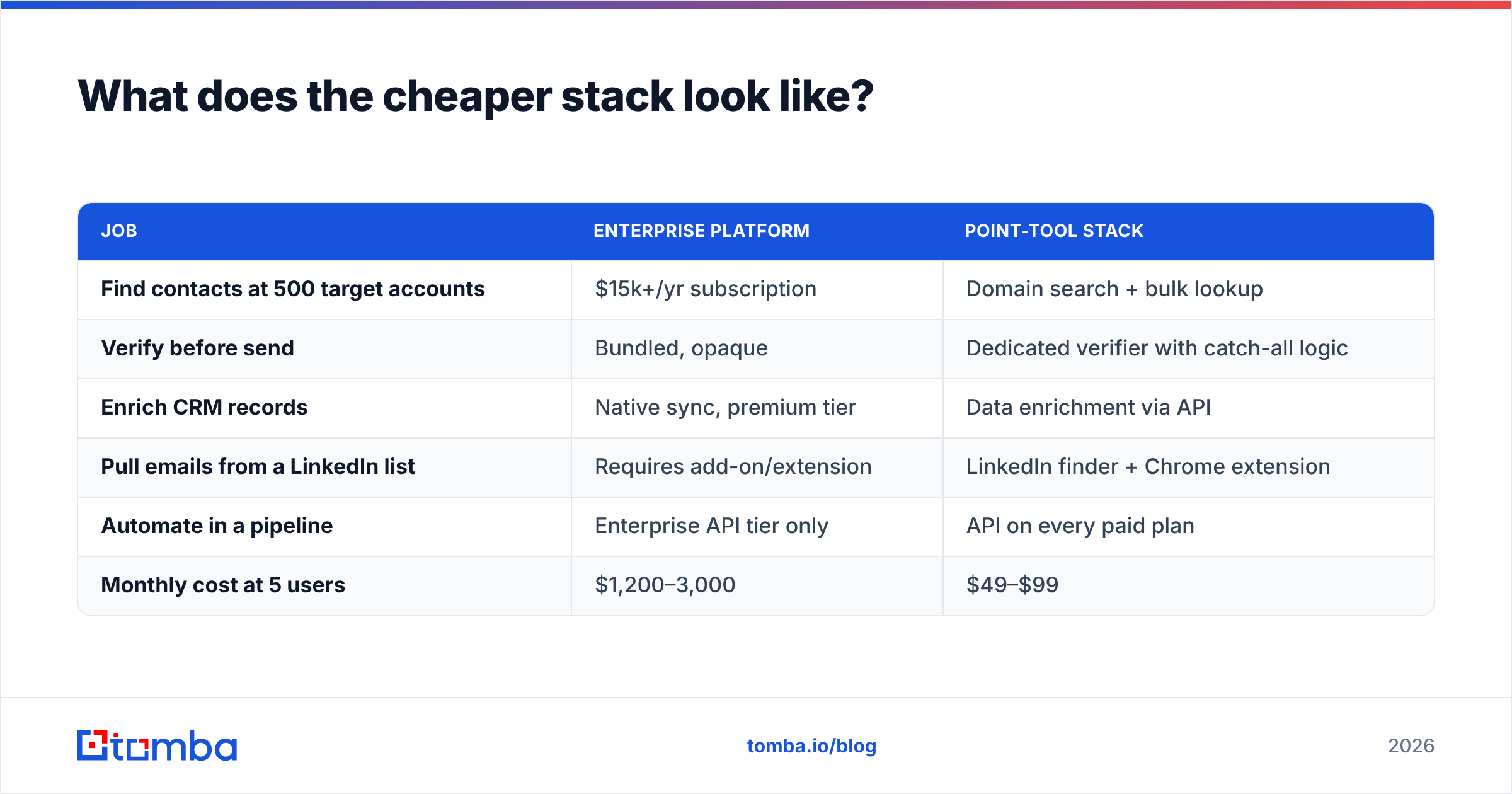
Say you run targeted outbound. You know the firms and the roles. Then you do not need a database plan at all. You need three things. A way to find emails from a domain and a name. A way to verify them. A way to do both in bulk or by API.
| Job | Enterprise platform | Point-tool stack |
|---|---|---|
| Find contacts at 500 accounts | $15k+/yr plan | Domain search plus bulk lookup |
| Verify before send | Bundled, opaque | Verifier with catch-all logic |
| Enrich CRM records | Native sync, top tier | Data enrichment by API |
| Pull emails from LinkedIn | Needs an add-on | LinkedIn finder plus extension |
| Automate in a pipeline | Top API tier only | API on every paid plan |
| Monthly cost at 5 users | $1,200–3,000 | $49–$99 |
The trade-off is honest. You lose intent data, org charts, and one place to look. You gain a 90%+ cost cut, and in most head-to-head tests you gain accuracy too. A tool that only finds emails tunes harder on pattern checks and SMTP tests. On a big suite, email is one field out of 200.
Tomba pricing shows the gap. The free tier gives 25 searches a month, then Starter is $49/mo, Growth $99/mo, and Pro $249/mo. Pro costs less per year than one ZoomInfo seat at most negotiated rates.
One peer is worth a look. BookYourData plays a different game: pay-as-you-go verified lists with no plan at all. That suits teams who buy data in bursts. If your use is spiky, price it too.

How do you test these tools without wasting a quarter?#
Run the same test on every vendor. Do not take demo data.
- Build a 100-row truth list. Use people you can check: customers, partners, past repliers.
- Run it through each trial. Track match rate, hit rate, and bounces on a real send.
- Weight accuracy over match rate. 60 emails at 97% beat 90 at 70%.
- Guard your sender reputation. One bad send costs you for months.
- Test your tail, not your core. Everyone finds Fortune 500 VPs. Test the 30-person firms.
- Price the real usage. Ask for cost per usable contact, not cost per credit.
- Read the renewal clause. Auto-renew, rollover, and seat cuts decide year two.
Analyst notes from Forrester help you build a shortlist. No grid tells you how a vendor does on your ICP. The 100-row test does.
What is the verdict on Exellius vs ZoomInfo?#
ZoomInfo wins for enterprise teams with an ABM motion, a RevOps owner, and budget. The intent layer and org charts are hard to copy. Nothing mid-market matches them. Just know that the contract is the product. Push hard on credit rollover and seat terms before you sign.
Exellius wins for small teams that want build, enrich, and send in one self-serve tool. No procurement cycle needed. Check coverage on your segment first. And do not assume resold data ages better than owned data. It usually ages worse.
Neither wins if your real job is verified emails for people you already named. That is solved at a tenth of the price. Paying suite rates for it is the most common budget leak in outbound.
So judge Exellius vs ZoomInfo by this week's work. Building an account list from scratch with intent? Price out ZoomInfo. Exploring segments with AI on a startup budget? Trial Exellius. Turning names and domains into verified addresses? Use the Tomba Email Finder. The free tier gives 25 searches to test against your own list. The Tomba API ships on every paid plan.
Related guides#
Ready to find emails that actually work?
Join 150,000+ professionals who stopped guessing and started sending. Free credits on signup — no credit card required.
Get the Tomba newsletter
Practical outbound tactics and product updates — once every two weeks.
About the author