8 Best Exotel Alternatives for Sales Teams in 2026
Exotel is strong in India and solid for IVR, but it is not the right fit for every outbound team. Here are eight Exotel alternatives compared on pricing, global coverage, API depth, and dialer quality.
TL;DR
- Exotel is a strong India-first cloud telephony and contact-center platform. It gets weak fast the moment your calling footprint moves outside APAC or your engineers want raw CPaaS primitives.
- The best Exotel alternatives split into three groups: developer CPaaS (Twilio, Plivo, Sinch), sales-team dialers (JustCall, CallHippo, Aircall), and regional contact-center suites (Ozonetel, MyOperator, Acefone).
- Price is not the real differentiator. Per-minute rates cluster within a few cents of each other; the gap shows up in number provisioning, API latency, and support SLAs.
- Switching platforms will not fix a bad connect rate. Wrong or stale phone numbers cause more dead dials than any carrier route does.
- Fix the data layer first with a phone finder and phone validator, then pick the platform that matches your engineering appetite.
What is Exotel and who actually outgrows it?#
Exotel is a cloud communications platform out of Bengaluru that sells voice, SMS, WhatsApp, and a full contact-center product on top of Indian telecom infrastructure. Its core strengths are real: virtual numbers, IVR flows, call masking, number masking for marketplaces, and TRAI-compliant call recording — all things that are genuinely painful to build yourself against Indian carriers. Check exotel.com and you will see the positioning is explicit: customer engagement for India and Southeast Asia.
Teams outgrow it in four predictable ways.
You go global. Exotel's number inventory and routing quality are excellent in India, decent across Southeast Asia and the Middle East, and thin in North America and Western Europe. If half your pipeline is US-based, you will end up running two vendors.
Your engineers want primitives, not products. Exotel ships opinionated flows. Developers who want a programmable voice layer — call control objects, media streams, SIP trunks they can bend — tend to find the abstraction too high.
You need a dialer, not a PBX. Outbound SDR teams want power dialing, local presence, automatic CRM logging, and call coaching. That is a different product category than cloud PBX, and Exotel is not primarily built for it.
Procurement gets involved. Enterprise buyers start asking for SOC 2 Type II, HIPAA BAAs, regional data residency, and 99.99% SLAs with financial penalties. The larger CPaaS vendors have those documents on the shelf.
None of that makes Exotel a bad product. It makes it a product with a shape. Your job is to match the shape.

Why do teams look for Exotel alternatives in 2026?#
Three market shifts drove most of the migration conversations we see this year.
- Regulatory drag on outbound. India's DLT registration regime for SMS and the tightening of TRAI rules around promotional voice added friction that some global teams simply route around by calling from non-Indian numbers.
- AI voice agents became a buying criterion. Every serious vendor now ships some form of streaming audio API so you can bolt a real-time LLM onto a live call. Platforms without low-latency media streaming got quietly disqualified from shortlists.
- Consolidation pressure. RevOps leaders are cutting the tool count. A dialer that natively writes to your CRM beats a telephony platform plus a middleware layer plus a Zapier bill.
There is also the unglamorous reason: pricing opacity. Custom-quote-only pricing is a real cost, because it means every renewal is a negotiation and every forecast is a guess.
What are the best Exotel alternatives right now?#
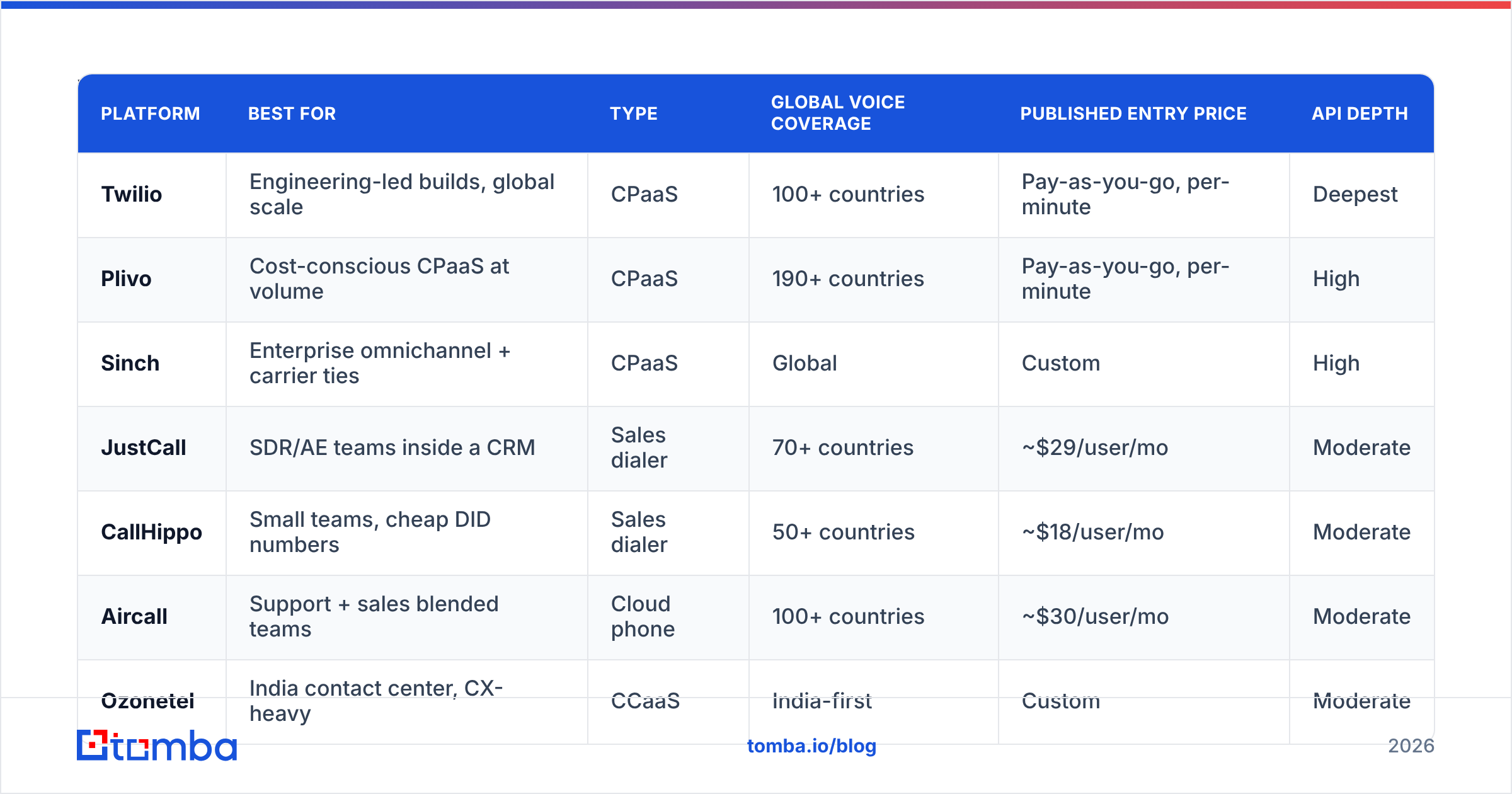
Here is the full shortlist, grouped by what the platform is actually for.
| Platform | Best for | Type | Global voice coverage | Published entry price | API depth |
|---|---|---|---|---|---|
| Twilio | Engineering-led builds, global scale | CPaaS | 100+ countries | Pay-as-you-go, per-minute | Deepest |
| Plivo | Cost-conscious CPaaS at volume | CPaaS | 190+ countries | Pay-as-you-go, per-minute | High |
| Sinch | Enterprise omnichannel + carrier ties | CPaaS | Global | Custom | High |
| JustCall | SDR/AE teams inside a CRM | Sales dialer | 70+ countries | ~$29/user/mo | Moderate |
| CallHippo | Small teams, cheap DID numbers | Sales dialer | 50+ countries | ~$18/user/mo | Moderate |
| Aircall | Support + sales blended teams | Cloud phone | 100+ countries | ~$30/user/mo | Moderate |
| Ozonetel | India contact center, CX-heavy | CCaaS | India-first | Custom | Moderate |
| MyOperator | Indian SMBs, IVR and call tracking | Cloud PBX | India-first | Custom / tiered | Basic |
Note the pattern: the CPaaS vendors publish per-minute usage pricing with no seat minimum, while the dialer vendors publish per-seat pricing. Those two models are not comparable line by line, and vendors know it. A 12-person SDR team burning 4,000 minutes a month will land in wildly different places depending on which model they pick.
Twilio — the default engineering answer#
Twilio is what you pick when your team can write code and you want no ceiling. Programmable Voice, SIP trunking, media streams for real-time AI, Verify for OTP, and the largest partner ecosystem in the category. The tradeoffs are equally well known: costs creep as you add products, support is a paid add-on at lower tiers, and you are building the interface your reps use. Best for: product companies embedding voice in their own app.
Plivo — Twilio's economics rival#
Plivo covers nearly the same surface area with lower published per-minute and per-message rates in many corridors, plus a serviceable contact-center product. Documentation is good, the API design is clean, and the pricing page is honest. Best for: teams that already know they want CPaaS and are optimizing unit economics at volume.
Sinch — the enterprise carrier play#
Sinch owns significant carrier relationships and sells voice, SMS, email, and WhatsApp under one contract. If your procurement team wants a single MSA covering global omnichannel, this is the shape that fits. Expect custom pricing and an enterprise sales cycle.
JustCall — the SDR-native pick#

JustCall is built for revenue teams: power dialer, sales dialer, AI call scoring, and native two-way sync with HubSpot, Pipedrive, and Salesforce. If your reps live in the CRM, this removes the logging tax entirely. It is per-seat, so cost scales with headcount rather than usage.
CallHippo — the budget dialer#
Cheapest credible entry point on this list. Number provisioning across 50+ countries, basic power dialing, and workflow automation. Feature depth is thinner than JustCall and call quality reviews are more mixed — worth reading the current G2 reviews before committing a whole team.
Aircall — blended support and sales#
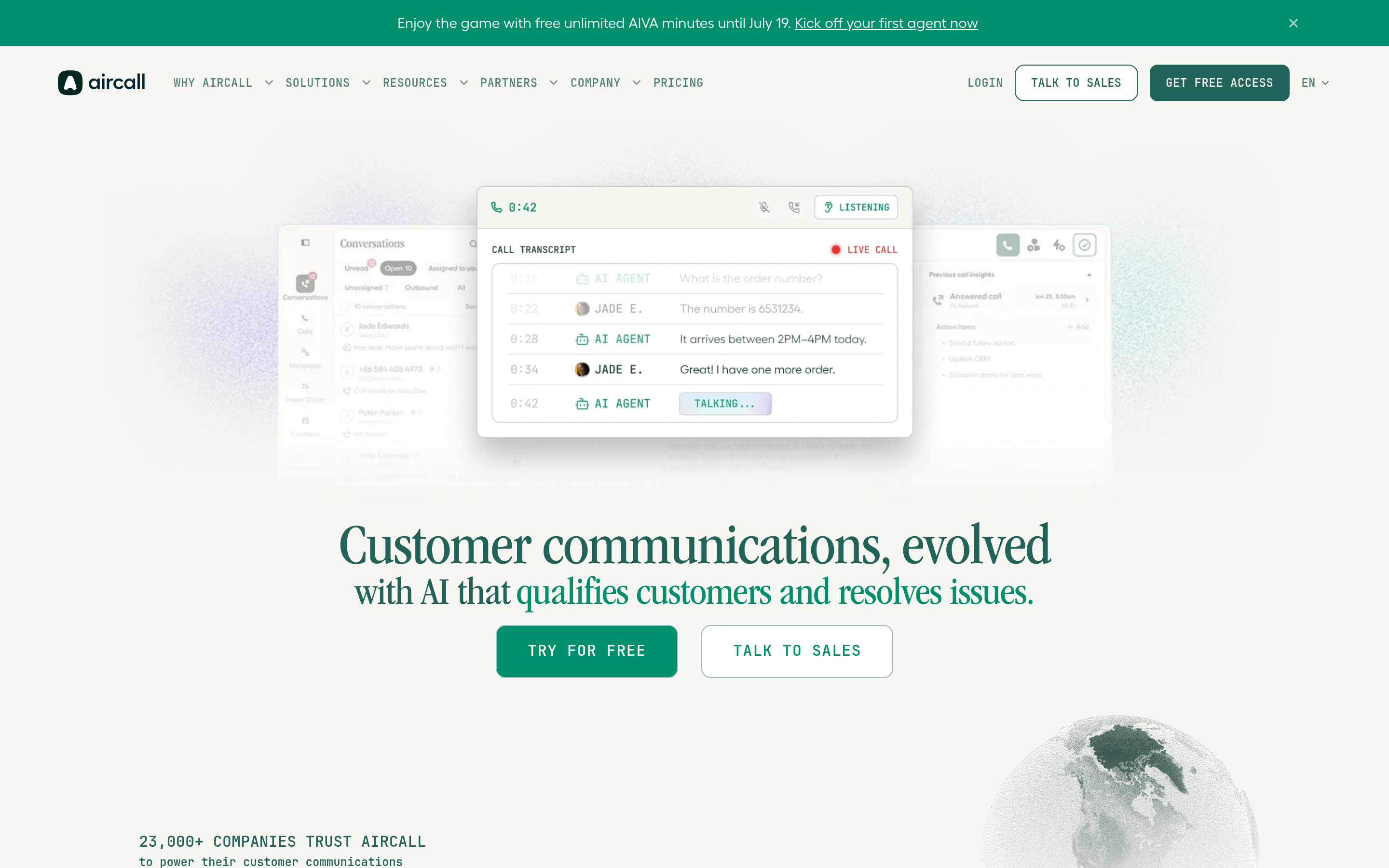
Aircall's strength is the shared-inbox model for phone: queues, warm transfers, real-time coaching, and a clean admin UI. Sales teams that also handle inbound support get more value here than pure outbound shops.
Ozonetel and MyOperator — the India-first peers#
If you are leaving Exotel but staying in India, these are the closest like-for-like swaps. Ozonetel leans contact-center and CX with strong inbound routing; MyOperator leans SMB IVR, call tracking, and lead management. Both understand DLT and TRAI compliance natively, which is not a trivial thing to replicate on a global platform.
How should you actually choose between them?#
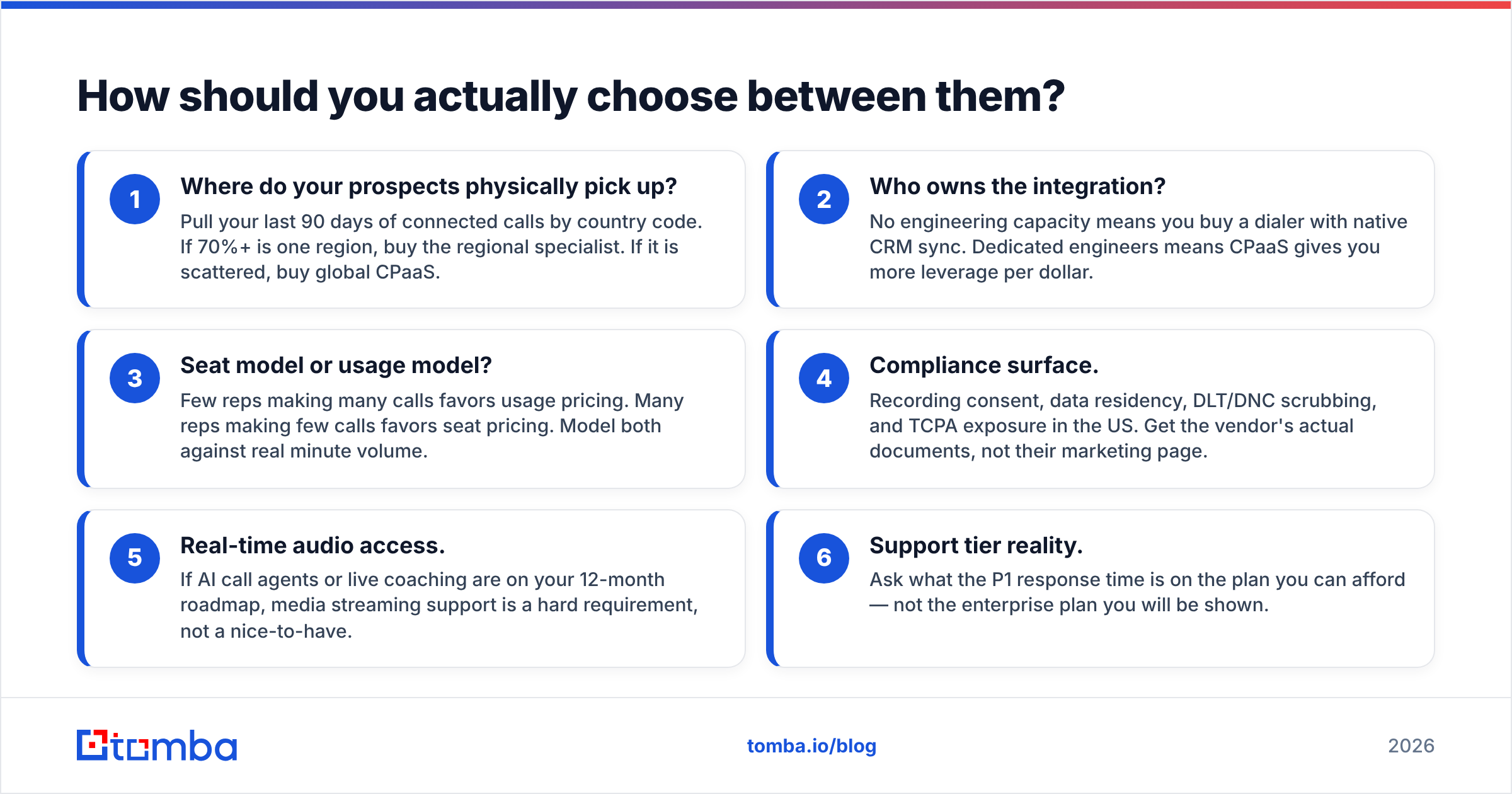
Score the shortlist against these six criteria in this order. Most teams get this backwards and start with price.
- Where do your prospects physically pick up? Pull your last 90 days of connected calls by country code. If 70%+ is one region, buy the regional specialist. If it is scattered, buy global CPaaS.
- Who owns the integration? No engineering capacity means you buy a dialer with native CRM sync. Dedicated engineers means CPaaS gives you more leverage per dollar.
- Seat model or usage model? Few reps making many calls favors usage pricing. Many reps making few calls favors seat pricing. Model both against real minute volume.
- Compliance surface. Recording consent, data residency, DLT/DNC scrubbing, and TCPA exposure in the US. Get the vendor's actual documents, not their marketing page.
- Real-time audio access. If AI call agents or live coaching are on your 12-month roadmap, media streaming support is a hard requirement, not a nice-to-have.
- Support tier reality. Ask what the P1 response time is on the plan you can afford — not the enterprise plan you will be shown.
Does switching telephony platforms actually fix your connect rate?#
No. And this is the expensive mistake in the whole category.
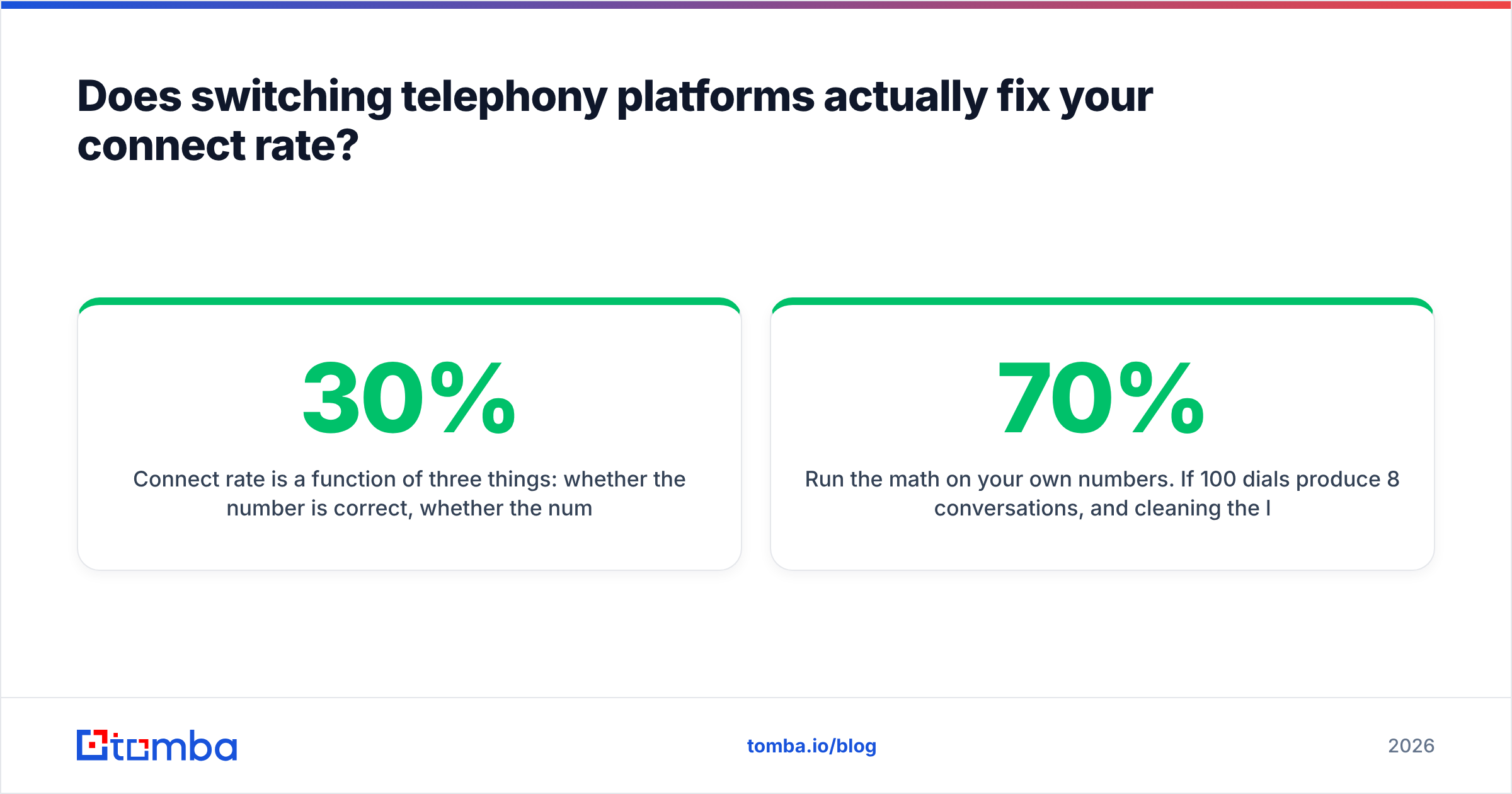
Connect rate is a function of three things: whether the number is correct, whether the number is reachable, and whether the recipient answers. A telephony vendor only influences the third one, and only slightly, through local presence and carrier reputation. If 30% of your list carries stale, wrong-format, or switchboard-only numbers, you can migrate to the best carrier routing on earth and still watch reps burn a morning on dead dials.
The fix sits upstream in the data layer:
- Source direct dials, not switchboards. A company main line routed through reception is not a sales number. Use a phone finder that returns contact-level numbers tied to a named person.
- Validate before you dial. Line type, carrier, portability status, and country formatting all matter. A phone validator strips invalid and unreachable numbers before they ever hit your dialer, which also protects your outbound reputation metrics.
- Enrich for context, not just contact. Title, company size, and tech stack decide whether the call is worth making. Data enrichment turns a raw list into a prioritized one.
- Keep email as the parallel channel. Phone-only sequences underperform. Pairing a validated number with a verified email address roughly doubles your touch surface per prospect.

Run the math on your own numbers. If 100 dials produce 8 conversations, and cleaning the list lifts reachable numbers from 70% to 92%, you gain roughly 2.5 extra conversations per 100 dials with zero change to your telephony vendor and zero change to rep behavior. No platform migration delivers that.
How do you migrate off Exotel without dropping calls?#
A staged cutover over three to four weeks, not a weekend flip.
Week 1 — inventory. Export every active number, IVR flow, routing rule, recording retention setting, and integration webhook. Document which numbers are advertised publicly; those are the ones you cannot afford to break.
Week 2 — parallel run. Provision new numbers on the target platform and route a single team or single campaign through them. Compare answer rate, mean opinion score, and drop rate against your Exotel baseline on the same list. Same list is the important part — otherwise you are comparing data quality, not carriers.
Week 3 — port the numbers that matter. Number portability timelines vary by country and can run one to four weeks in India. Start the paperwork early and keep the old numbers live and forwarding until the port completes.
Week 4 — decommission. Kill the old webhooks, revoke API keys, confirm recording archives are exported (retention obligations do not transfer with you), and close the contract at the renewal boundary rather than mid-term.
Throughout, keep your dial list clean. Bulk-process the whole database through a bulk email finder and validation pass before it lands in the new dialer, so you are not migrating garbage into a fresh system. If your stack is code-driven, the Tomba API lets you validate contact records at insert time rather than in a quarterly cleanup sprint.
Which Exotel alternative should you pick?#
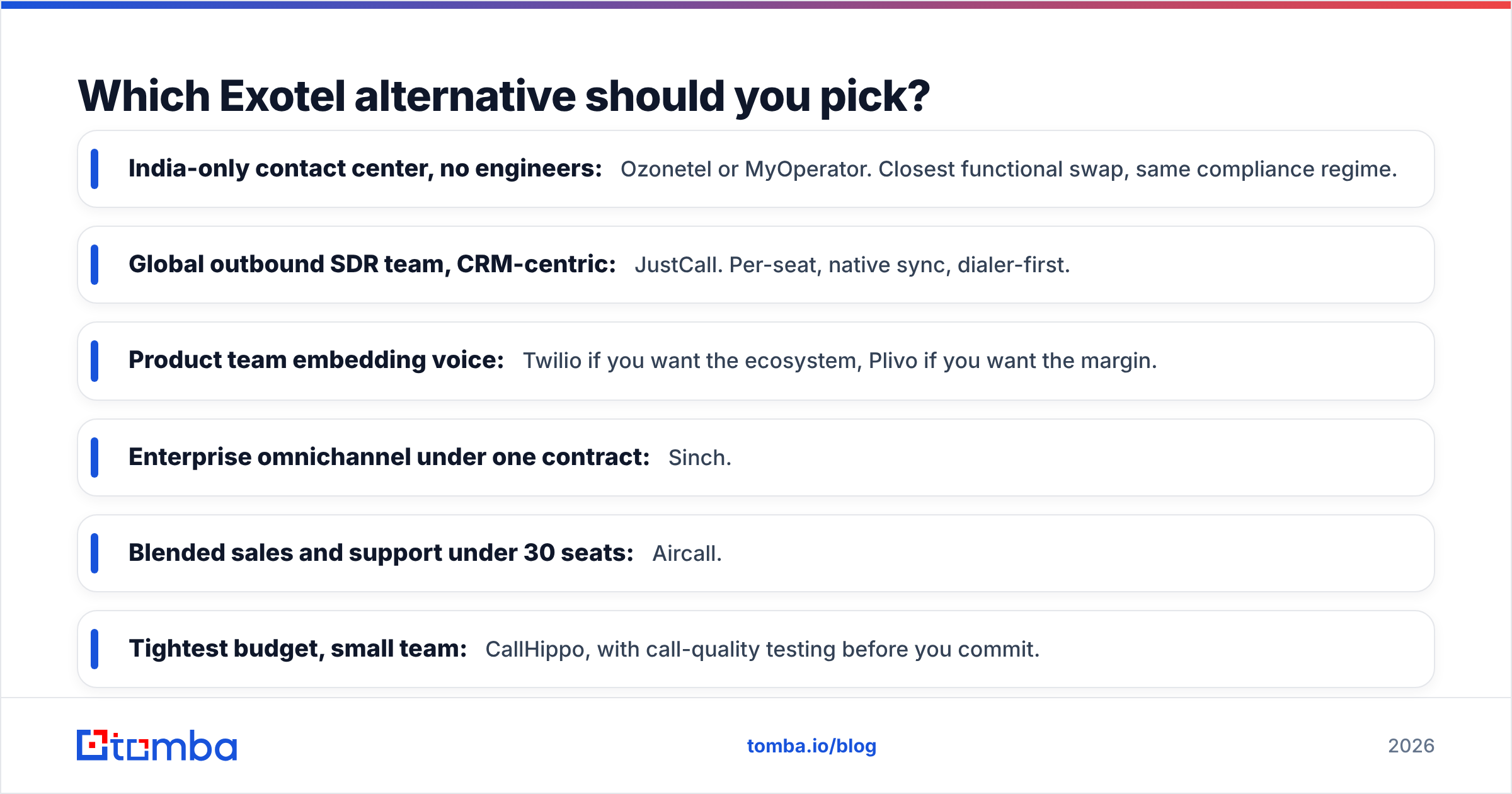
Short version, by team shape:
- India-only contact center, no engineers: Ozonetel or MyOperator. Closest functional swap, same compliance regime.
- Global outbound SDR team, CRM-centric: JustCall. Per-seat, native sync, dialer-first.
- Product team embedding voice: Twilio if you want the ecosystem, Plivo if you want the margin.
- Enterprise omnichannel under one contract: Sinch.
- Blended sales and support under 30 seats: Aircall.
- Tightest budget, small team: CallHippo, with call-quality testing before you commit.
And regardless of which you pick: the platform is the pipe, not the water. Vendors compete on routing, uptime, and API surface — none of which help if the number in the record is wrong.
Before you sign anything, run a sample of 500 records from your current list through Tomba Email Finder and pair it with phone lookup and validation. You will see immediately what share of your database is actually reachable, and that number should drive the telephony decision — not the other way around. Tomba's free tier covers 25 searches a month, with paid plans starting at $49/mo; full Tomba pricing is public, no quote required.
Related guides#
Ready to find emails that actually work?
Join 150,000+ professionals who stopped guessing and started sending. Free credits on signup — no credit card required.
Get the Tomba newsletter
Practical outbound tactics and product updates — once every two weeks.
About the author