Exotel vs Knowlarity: Cloud Telephony Compared for 2026
Exotel and Knowlarity both sell cloud telephony to Indian sales teams, but they diverge sharply on contact-center depth, API ergonomics, and how much you pay before you ever place a call. Here is the honest breakdown.
TL;DR
- Exotel is the heavier platform. After absorbing Ameyo, it sells a full contact-centre stack — IVR, dialers, omnichannel routing, WhatsApp — and prices like enterprise infrastructure.
- Knowlarity is the lighter, faster-to-deploy option. Now part of Gupshup, it leans toward SMB and mid-market teams that want virtual numbers, IVR, and click-to-call live in days, not quarters.
- Neither publishes clean self-serve pricing. Both route you through sales for anything past the entry tier, so budget comparisons only get real after two demos and a quote.
- APIs are the real differentiator. Exotel's developer surface is broader and better documented; Knowlarity's is simpler and gets a small team shipping quicker.
- Both are dial-tone, not data. Whichever you buy, your connect rate is capped by the quality of the phone numbers and emails you feed it — that layer is a separate purchase.
What are Exotel and Knowlarity?#
Both are cloud communication platforms built for the Indian market, both started roughly a decade and a half ago, and both now sit inside larger parent companies. That is where the similarity stops.
Exotel launched in 2011 out of Bangalore as a virtual-number and IVR provider. Its trajectory has been consolidation: it acquired contact-centre vendor Ameyo and has since positioned itself as a customer-engagement platform rather than a telephony utility. Today it sells to banks, fintechs, healthcare networks, and large marketplaces — organisations that need call recording, compliance controls, agent supervision, and thousands of concurrent channels.
Knowlarity started in 2009 with a similar product wedge — cloud IVR and virtual numbers — and was acquired by conversational-messaging company Gupshup in 2021. That acquisition pushed Knowlarity's centre of gravity toward messaging-plus-voice bundles for growth-stage companies, and it remains the easier of the two to buy, configure, and run without a dedicated telecom ops person.
The practical framing: Exotel is what you pick when telephony is core infrastructure for a large operation. Knowlarity is what you pick when telephony is a feature your sales or support team needs working by Friday.
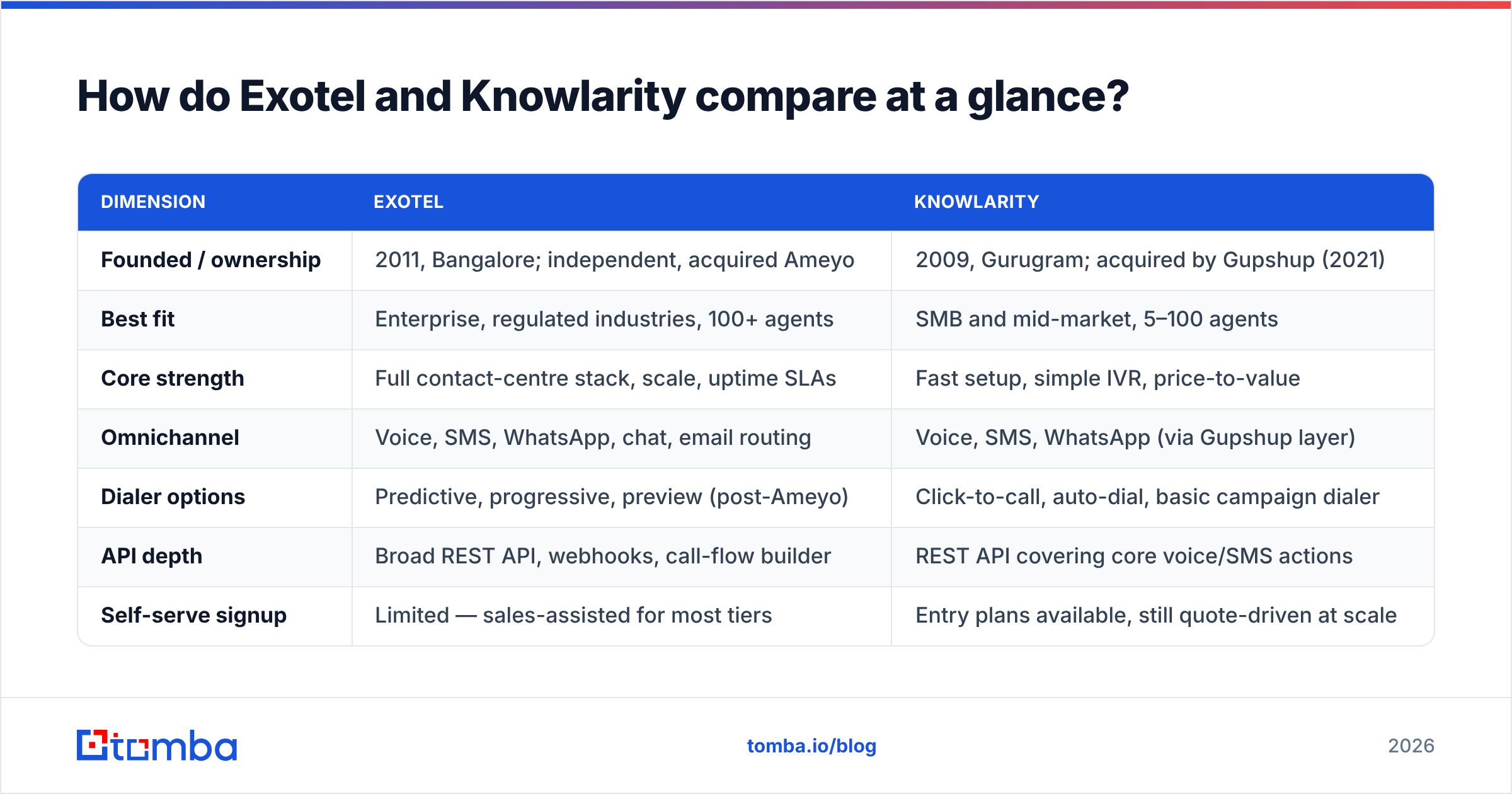
How do Exotel and Knowlarity compare at a glance?#
| Dimension | Exotel | Knowlarity |
|---|---|---|
| Founded / ownership | 2011, Bangalore; independent, acquired Ameyo | 2009, Gurugram; acquired by Gupshup (2021) |
| Best fit | Enterprise, regulated industries, 100+ agents | SMB and mid-market, 5–100 agents |
| Core strength | Full contact-centre stack, scale, uptime SLAs | Fast setup, simple IVR, price-to-value |
| Omnichannel | Voice, SMS, WhatsApp, chat, email routing | Voice, SMS, WhatsApp (via Gupshup layer) |
| Dialer options | Predictive, progressive, preview (post-Ameyo) | Click-to-call, auto-dial, basic campaign dialer |
| API depth | Broad REST API, webhooks, call-flow builder | REST API covering core voice/SMS actions |
| Self-serve signup | Limited — sales-assisted for most tiers | Entry plans available, still quote-driven at scale |
| Typical deployment time | 2–6 weeks with solution engineering | Days to two weeks |
| Support model | Named CSM on enterprise contracts | Shared support, priority on higher tiers |
Treat deployment times as directional. A regulated fintech onboarding 400 agents onto Exotel is a quarter-long project regardless of the vendor's marketing; a ten-person team spinning up an IVR on Knowlarity really can be live the same week.

What does each platform actually do best?#
Rather than a feature checklist that both vendors would claim to pass, here is where each one genuinely pulls ahead:
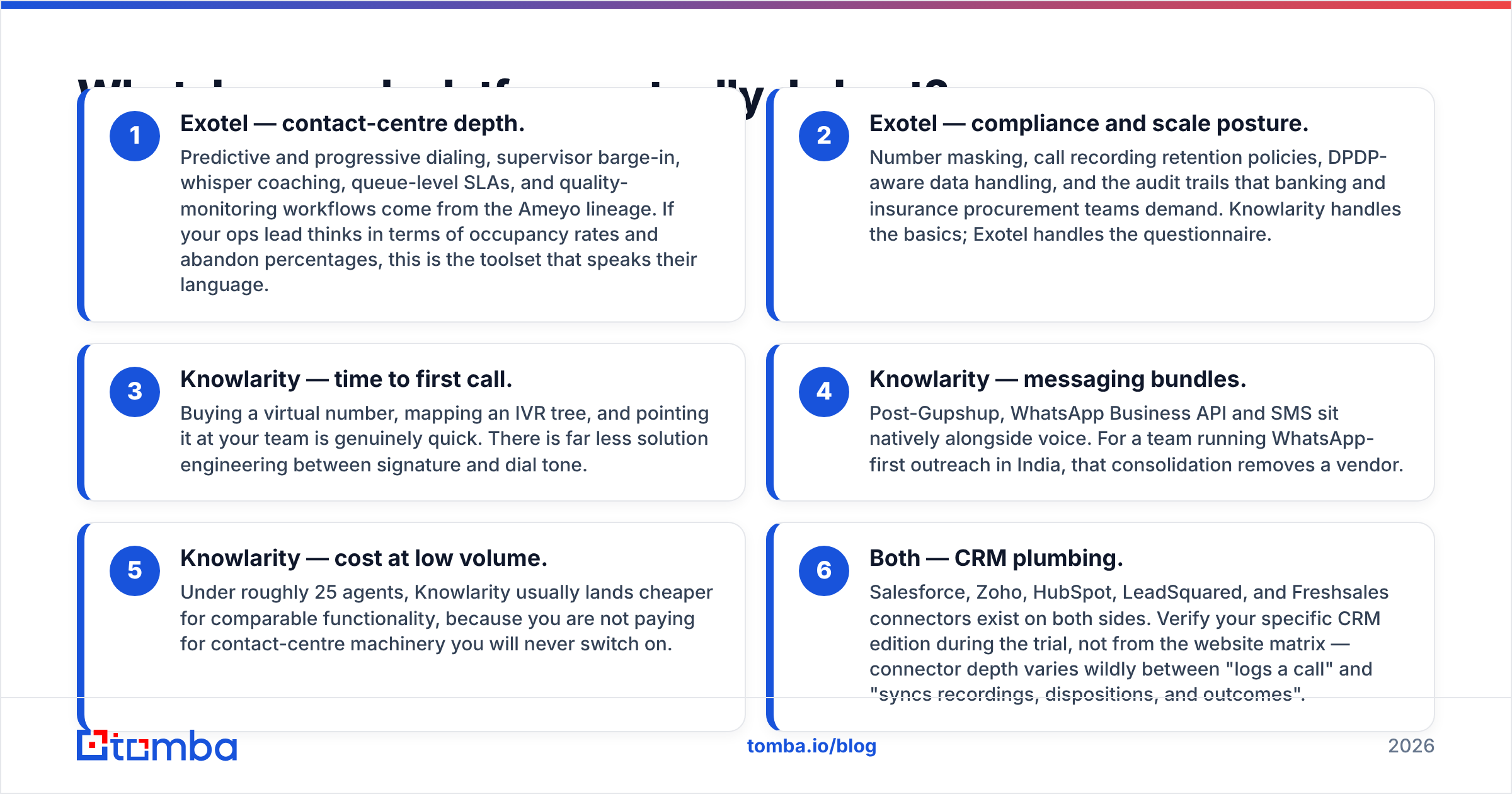
- Exotel — contact-centre depth. Predictive and progressive dialing, supervisor barge-in, whisper coaching, queue-level SLAs, and quality-monitoring workflows come from the Ameyo lineage. If your ops lead thinks in terms of occupancy rates and abandon percentages, this is the toolset that speaks their language.
- Exotel — compliance and scale posture. Number masking, call recording retention policies, DPDP-aware data handling, and the audit trails that banking and insurance procurement teams demand. Knowlarity handles the basics; Exotel handles the questionnaire.
- Knowlarity — time to first call. Buying a virtual number, mapping an IVR tree, and pointing it at your team is genuinely quick. There is far less solution engineering between signature and dial tone.
- Knowlarity — messaging bundles. Post-Gupshup, WhatsApp Business API and SMS sit natively alongside voice. For a team running WhatsApp-first outreach in India, that consolidation removes a vendor.
- Knowlarity — cost at low volume. Under roughly 25 agents, Knowlarity usually lands cheaper for comparable functionality, because you are not paying for contact-centre machinery you will never switch on.
- Both — CRM plumbing. Salesforce, Zoho, HubSpot, LeadSquared, and Freshsales connectors exist on both sides. Verify your specific CRM edition during the trial, not from the website matrix — connector depth varies wildly between "logs a call" and "syncs recordings, dispositions, and outcomes".
How does pricing compare between Exotel and Knowlarity?#
Honest answer: you cannot fully price either platform from a webpage, and any blog quoting exact per-minute rates for 2026 is guessing. Both vendors run quote-driven motions with regional rate cards, volume commitments, and telecom pass-through charges that move independently of the software fee.
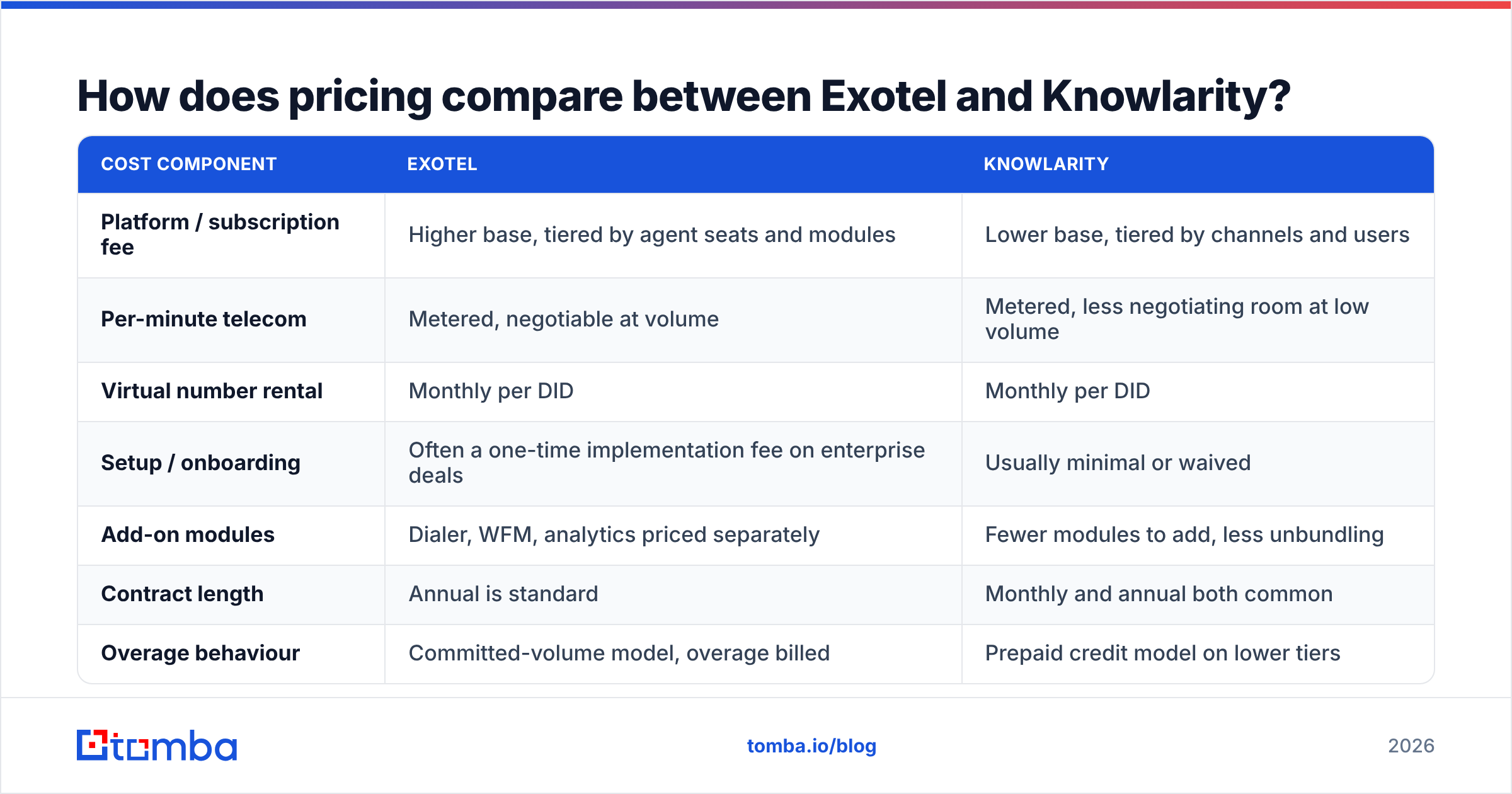
What you can compare is the shape of the bill.
| Cost component | Exotel | Knowlarity |
|---|---|---|
| Platform / subscription fee | Higher base, tiered by agent seats and modules | Lower base, tiered by channels and users |
| Per-minute telecom | Metered, negotiable at volume | Metered, less negotiating room at low volume |
| Virtual number rental | Monthly per DID | Monthly per DID |
| Setup / onboarding | Often a one-time implementation fee on enterprise deals | Usually minimal or waived |
| Add-on modules | Dialer, WFM, analytics priced separately | Fewer modules to add, less unbundling |
| Contract length | Annual is standard | Monthly and annual both common |
| Overage behaviour | Committed-volume model, overage billed | Prepaid credit model on lower tiers |
Three rules when you request quotes:
- Ask for a fully loaded 12-month estimate at your projected call volume, not a per-seat headline.
- Ask what happens at 2x your volume — that is where committed-volume discounts and overage penalties diverge sharply.
- Ask for the number-porting cost and timeline in writing. This is the single most underestimated line item in any telephony migration.

Which one has better call quality and reliability?#
Neither vendor "owns" call quality — both ride the same underlying Indian carrier infrastructure, so raw audio quality on a domestic mobile leg is largely a wash. The differences show up in three places:
Carrier redundancy. Exotel's larger footprint means more carrier relationships and more aggressive least-cost routing with failover. On high-volume days, that matters. Knowlarity is stable but has fewer paths to reroute around a carrier incident.
Concurrency headroom. If you are running 300 simultaneous outbound calls in a campaign burst, Exotel's architecture is provisioned for it as a default expectation. Knowlarity can do it, but you will be having a capacity conversation first.
Status transparency. Check each vendor's public status page and incident history before signing. A provider that publishes postmortems is telling you something about its engineering culture. Peer reviews on G2 are useful here too — filter for reviewers at your company size, because enterprise complaints about Exotel and SMB complaints about Knowlarity describe two entirely different products.
One thing both platforms share: DND and TRAI compliance is your problem, not theirs. Dialing numbers on the national Do Not Disturb registry, or running unregistered promotional campaigns, gets your numbers flagged regardless of which logo is on the dashboard. Build scrubbing into your pipeline before it reaches either dialer.
Which API is easier to build on?#
If your team is embedding calling into a product rather than just staffing a call centre, this section decides the purchase.
Exotel's API is the broader of the two. You get programmatic control over call flows, campaigns, number provisioning, recordings, and events, plus a visual flow builder for non-developers and webhook coverage that is detailed enough to drive real-time CRM updates. The documentation is thorough. The trade-off is surface area — there is more to learn, and more concepts (applets, flows, virtual number pools) to model correctly.
Knowlarity's API covers the essentials cleanly: place a call, bridge two legs, trigger an IVR, send an SMS, fetch call detail records. A competent backend developer gets click-to-call working in an afternoon. Where it runs out of road is complex conditional routing and granular real-time event streams — you can build around the gaps, but you are building.
A useful test during evaluation: hand both sandbox accounts to one engineer and ask for the same three things — click-to-call from your CRM, a webhook that writes call outcome back to a lead record, and a call-recording fetch job. Whichever vendor produces working code faster with less support-ticket friction is the one your team will actually keep using. The same logic applies to any data layer you bolt on; a well-documented email finder API or telephony API saves more engineering hours over a year than a 10% discount ever will.
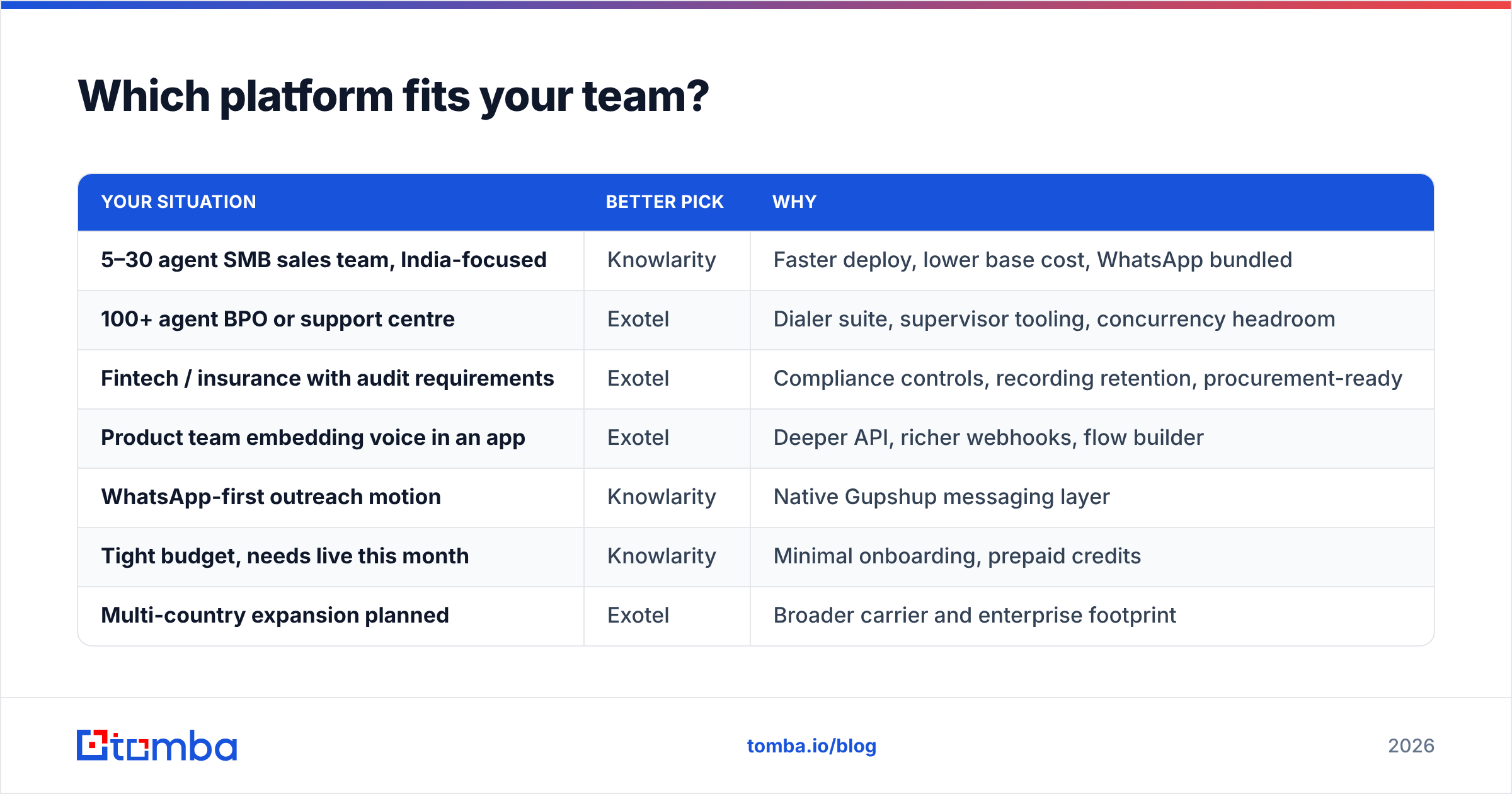
Which platform fits your team?#
| Your situation | Better pick | Why |
|---|---|---|
| 5–30 agent SMB sales team, India-focused | Knowlarity | Faster deploy, lower base cost, WhatsApp bundled |
| 100+ agent BPO or support centre | Exotel | Dialer suite, supervisor tooling, concurrency headroom |
| Fintech / insurance with audit requirements | Exotel | Compliance controls, recording retention, procurement-ready |
| Product team embedding voice in an app | Exotel | Deeper API, richer webhooks, flow builder |
| WhatsApp-first outreach motion | Knowlarity | Native Gupshup messaging layer |
| Tight budget, needs live this month | Knowlarity | Minimal onboarding, prepaid credits |
| Multi-country expansion planned | Exotel | Broader carrier and enterprise footprint |
| Running high-volume outbound campaigns | Exotel | Predictive dialer, least-cost routing |
If your answer straddles two rows, weight toward the one that matches where you will be in 18 months. Migrating telephony mid-growth is painful — porting numbers, retraining agents, rewriting integrations, and re-establishing carrier reputation all at once.
What do neither Exotel nor Knowlarity solve?#
The data.
Both platforms are transport. They connect a number you already have to an agent you already employ. Neither one tells you whether that number belongs to the VP of Operations you are trying to reach, whether it is still in service, or whether the decision-maker moved companies eight months ago.
This is where most outbound programmes actually break. Teams benchmark dialers obsessively, then feed them lists where 30–40% of the numbers are stale, wrong-department, or disconnected. The result reads like a telephony problem — low connect rates, high abandon, agents idle — but it is a data problem wearing a telephony costume.
Fix the input layer first:
- Validate before you dial. Run every number through a phone validator to strip disconnected, invalid, and mistyped entries. Dialing dead numbers burns agent minutes and drags your carrier metrics down.
- Source direct numbers, not switchboards. A phone finder that returns direct dials beats a database of front-desk numbers by an order of magnitude on connect rate.
- Pair voice with a verified email channel. Most B2B sequences that work in India are voice and email, not voice alone. Verified addresses from an email finder give your reps a second touch that costs nothing per attempt.
- Enrich before routing. Contact enrichment — title, seniority, company size, tech stack — lets you route the right lead to the right agent instead of dialing alphabetically.
Do that, and the Exotel-versus-Knowlarity decision matters far less than it seemed, because both platforms perform dramatically better on clean input.
What is the verdict on Exotel vs Knowlarity?#
Choose Exotel if telephony is infrastructure. Large agent count, regulated industry, complex routing, product-embedded voice, multi-region ambitions. You will pay more and wait longer to go live, and you will get a platform that does not become the bottleneck at scale.
Choose Knowlarity if telephony is a tool. Small-to-mid sales or support team, India-focused, WhatsApp in the mix, a budget that cannot absorb an implementation fee. You will be live faster and spend less, and you will hit ceilings around advanced dialing and real-time event handling — ceilings most teams under 50 agents never touch.
Run both trials in parallel. Same three API tasks, same test list, same two weeks. Track connect rate, setup hours consumed, and support response time. The winner is usually obvious by day nine, and it is not always the one with the better feature matrix.
And whichever way it goes, do not let the dialer decision distract from the list decision. A mediocre platform dialing verified direct numbers of qualified decision-makers will outperform a best-in-class platform dialing a scraped spreadsheet every single quarter.
Start with the input layer. Use Tomba Email Finder to build verified contact lists — direct emails, matched company data, and phone numbers you can validate before they ever reach your dialer. The free tier gives you 25 searches a month to test accuracy on your own accounts, and paid plans start at $49/mo; see Tomba pricing for the full breakdown. Get the data right, then let Exotel or Knowlarity do the part they are actually good at.
Related guides#
Ready to find emails that actually work?
Join 150,000+ professionals who stopped guessing and started sending. Free credits on signup — no credit card required.
Get the Tomba newsletter
Practical outbound tactics and product updates — once every two weeks.
About the author