Exotel vs Ozonetel (2026): Full Cloud Telephony Comparison
Exotel and Ozonetel both sell cloud telephony to Indian and global sales teams, but they optimise for different jobs. Here is the honest breakdown of pricing models, dialer depth, APIs and who should pick which.
Exotel vs Ozonetel comes down to one question: is calling part of your product, or is calling your whole business?
TL;DR
- Exotel is the broader platform: voice, SMS, WhatsApp, contact centre, and a large API set. Pick it when calling is one piece of a wider customer stack.
- Ozonetel is the deeper contact centre product: predictive and progressive dialers, agent scripts, quality checks, and CX reports. Pick it when the calling floor is the business.
- Neither one posts simple prices for real volume. Both quote on agents, minutes, and numbers. Your true cost tracks talk time and concurrency, not the sticker.
- Exotel wins on developer experience and channel breadth. Ozonetel wins on outbound dialing and supervisor tools.
- Either way, the dialer is only as good as the numbers in it. Bad contact data is the biggest cause of low connect rates.
Most teams weighing Exotel vs Ozonetel run a phone-heavy motion in India, Southeast Asia, or the Gulf. They have also outgrown a basic VoIP dialer bolted onto a CRM. Both vendors fix that. They just start from opposite ends of the stack.
What are Exotel and Ozonetel?#
Exotel began as cloud telephony plumbing: virtual numbers, call masking, IVR, and programmable voice. It then grew into a full customer engagement platform. Today it bundles voice, SMS, WhatsApp Business, and a contact centre product (Exotel Contact Center, built on its Ameyo acquisition) under one roof. Its DNA is API-first. Developers wire calls straight into their own product flows.
Ozonetel began at the other end. Its CloudAgent product is a contact centre platform first: ACD, IVR, dialers, an agent desktop, supervisor dashboards, call recording, and quality tools. It sells to teams whose core job is making or taking a lot of calls. It has APIs too. But the heart of the product is the agent console and the supervisor wallboard.
That difference in origin explains almost every Exotel vs Ozonetel trade-off below. Exotel asks how to get voice into your product. Ozonetel asks how to make your calling floor more productive today.
Exotel vs Ozonetel: how do they compare at a glance?#
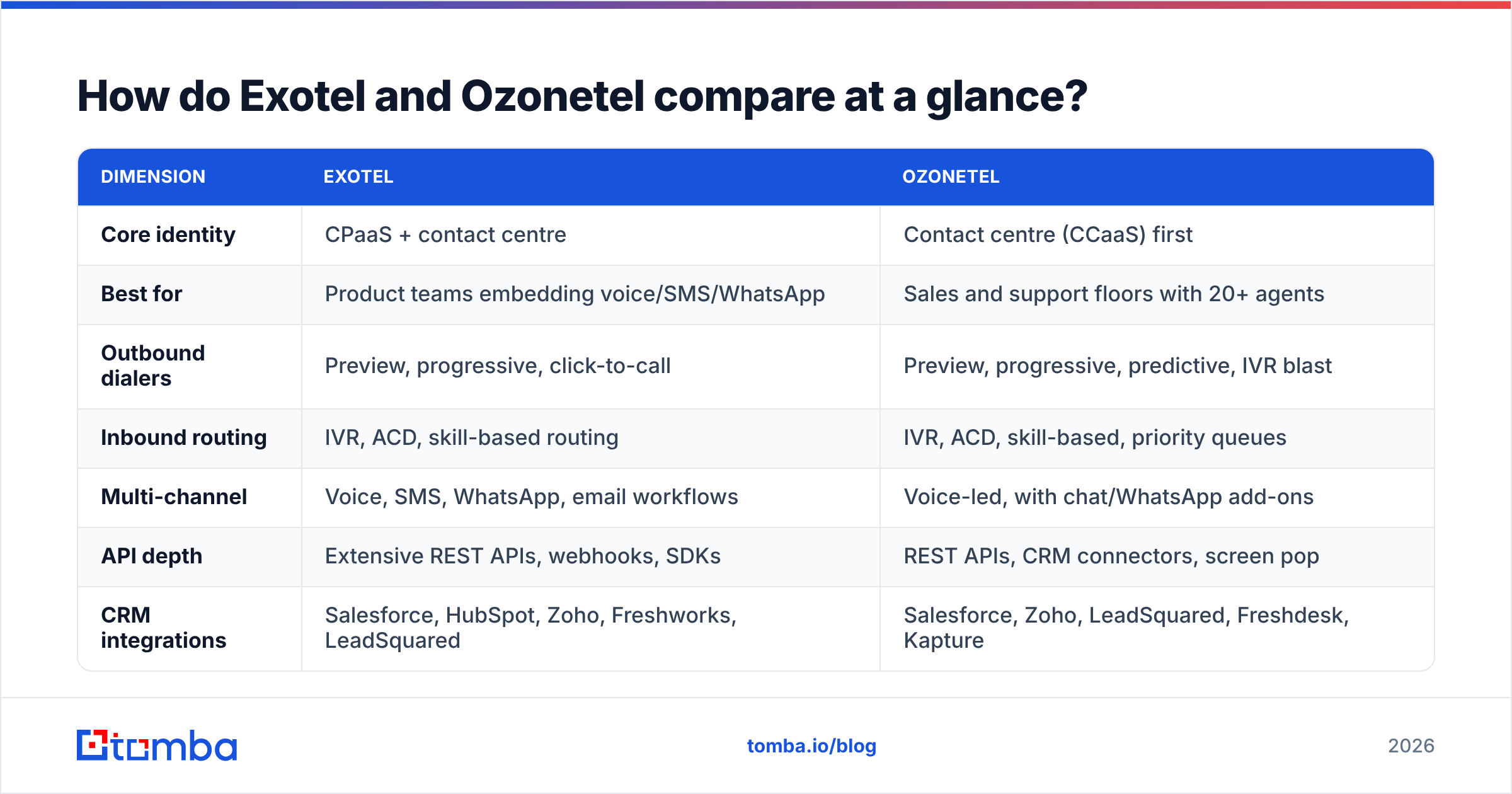
| Dimension | Exotel | Ozonetel |
|---|---|---|
| Core identity | CPaaS + contact centre | Contact centre (CCaaS) first |
| Best for | Product teams embedding voice/SMS/WhatsApp | Sales and support floors with 20+ agents |
| Outbound dialers | Preview, progressive, click-to-call | Preview, progressive, predictive, IVR blast |
| Inbound routing | IVR, ACD, skill-based routing | IVR, ACD, skill-based, priority queues |
| Multi-channel | Voice, SMS, WhatsApp, email workflows | Voice-led, with chat/WhatsApp add-ons |
| API depth | Extensive REST APIs, webhooks, SDKs | REST APIs, CRM connectors, screen pop |
| CRM integrations | Salesforce, HubSpot, Zoho, Freshworks, LeadSquared | Salesforce, Zoho, LeadSquared, Freshdesk, Kapture |
| Analytics | Call analytics, campaign reporting | Deeper agent/QA analytics, speech analytics tier |
| Pricing model | Per-number + per-minute + platform fee | Per-agent (concurrent) + per-minute |
| Typical buyer | Engineering / product / growth | Sales ops / contact centre ops |
| Compliance | TRAI/DLT-aware, ISO, SOC 2 posture | TRAI/DLT-aware, ISO, PCI-oriented deployments |
Read that table as a map, not a scorecard. Both platforms can run a 30-seat inside-sales team. They just feel different doing it.

Exotel vs Ozonetel pricing: how does the bill work?#
Neither vendor's public page tells you what you will pay at scale. Any rupee figure in a blog post goes stale within a quarter. What stays stable is the shape of the bill.
| Cost component | Exotel | Ozonetel | What drives it up |
|---|---|---|---|
| Platform / licence | Monthly platform fee, tier-based | Per concurrent agent seat | Seat count, feature tier |
| Voice minutes | Billed per minute, inbound + outbound | Billed per minute, inbound + outbound | Talk time, IVR hold time |
| Numbers (DIDs) | Per virtual number per month | Per number per month | Toll-free, multi-city presence |
| Recording + storage | Included tier, then per-GB | Included tier, then per-GB | Retention policy, QA needs |
| Add-ons | WhatsApp, SMS, verification APIs | Speech analytics, WFM, dialer tiers | Analytics ambitions |
| Setup | One-time onboarding | One-time onboarding + config | Custom routing, integrations |
Two notes matter here. First, Ozonetel's concurrent-agent pricing rewards shift-based teams. If 40 reps share 25 live seats across shifts, you pay for 25. Second, per-minute pricing punishes bad data. Every ring-out to a dead number burns dial attempts and rep time. Hold time on a misrouted inbound call costs the same as a real conversation. That is where most Exotel vs Ozonetel cost models go wrong.
Before you sign, ask both vendors to quote the same model month. Give them agent count, average handle time, expected connect rate, number count, and recording retention. The winner often flips, depending on whether seats or minutes are your bottleneck.
Exotel vs Ozonetel for outbound sales calling#
Ozonetel, in most cases. This is where its contact centre roots show.
Ozonetel's dialer set is more detailed. Predictive dialing with pacing control, abandon-rate limits, answering-machine detection, campaign list management, and callback scheduling all ship as core features. You do not have to assemble them. Supervisors also get live monitoring, barge-in, whisper coaching, and agent-state dashboards without extra tools.
Exotel handles outbound well too. Click-to-call from the CRM, progressive campaigns, and call masking for marketplace models all work. Its programmable voice shines when a product event triggers the call instead of a rep working a list. But say you run a 60-seat floor and 8,000 dials a day. Then Ozonetel's pacing and QA controls are what you will miss if you go the other way.
One honest caveat. Predictive dialing is regulated, and it puts your numbers at risk. In India, DLT registration and TRAI rules on unwanted marketing calls apply to every vendor. High abandon rates and heavy dialing on one number set will get those numbers flagged as spam by carriers and phone apps. No platform saves you from that. Both give you the levers to manage it.
Exotel vs Ozonetel for inbound support and IVR#
This one is close. Exotel edges ahead on programmable flows. Ozonetel edges ahead on agent depth.
- Exotel shines when your IVR has to talk to your own systems mid-call. Pull an order status, check an OTP, or route by account tier from your API. The flow builder and webhooks make that simple. Its number masking is also widely used by marketplaces and delivery apps.
- Ozonetel shines once a human picks up. Skill-based routing, queue priorities, wrap-up codes, disposition trees, quality scorecards, and speech analytics on the higher tiers give support managers far more to work with.
Is your inbound volume modest, with your edge in self-service? Pick Exotel. Do you staff a real support desk with SLAs and QA reviews? Pick Ozonetel.
How do the APIs and integrations compare?#
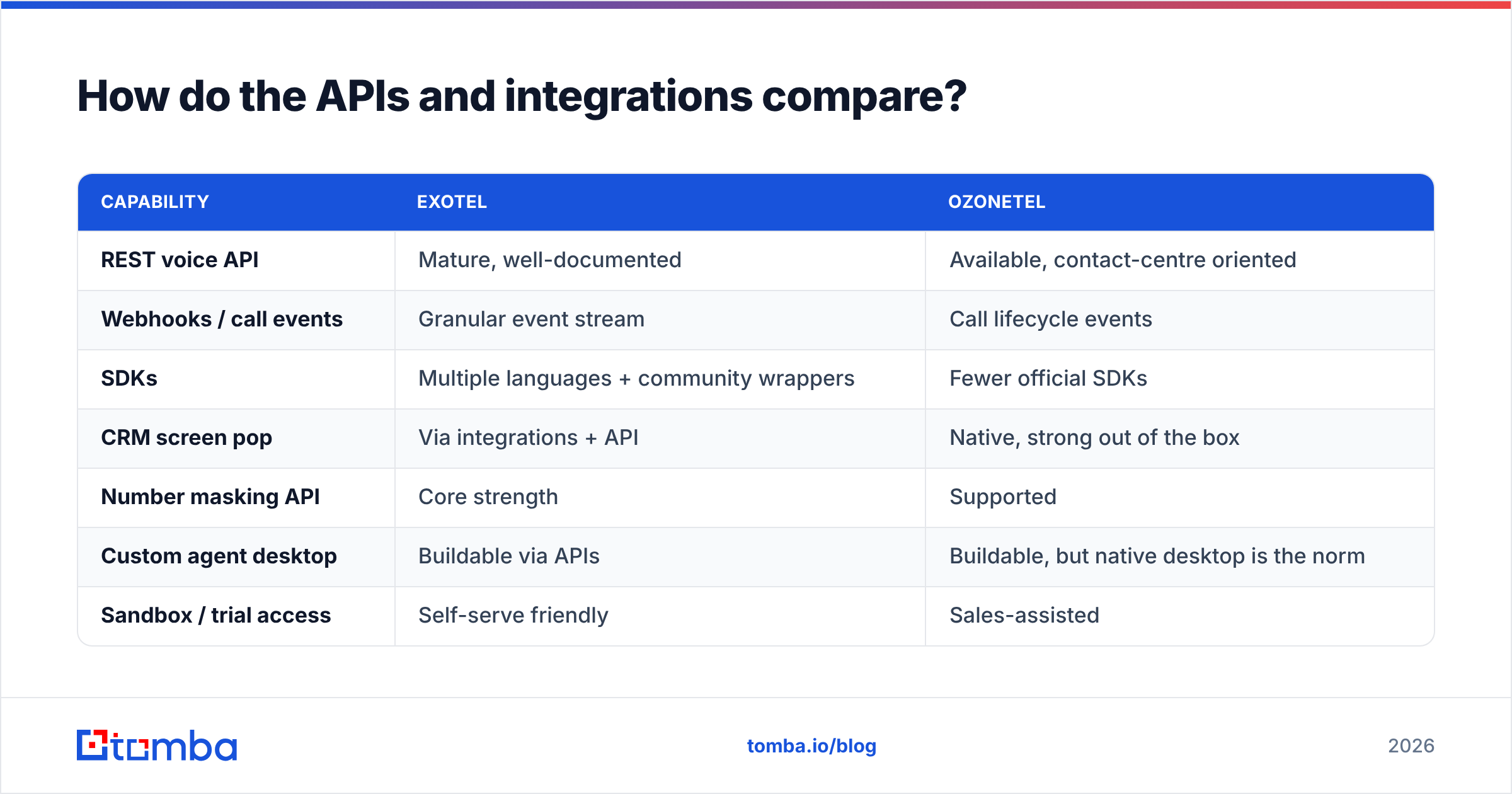
| Capability | Exotel | Ozonetel |
|---|---|---|
| REST voice API | Mature, well-documented | Available, contact-centre oriented |
| Webhooks / call events | Granular event stream | Call lifecycle events |
| SDKs | Multiple languages + community wrappers | Fewer official SDKs |
| CRM screen pop | Via integrations + API | Native, strong out of the box |
| Number masking API | Core strength | Supported |
| Custom agent desktop | Buildable via APIs | Buildable, but native desktop is the norm |
| Sandbox / trial access | Self-serve friendly | Sales-assisted |
Engineering-led teams will find Exotel easier. You can build a masked-call flow in an afternoon. Sales-ops-led teams will prefer Ozonetel. Its native CRM connectors and ready-made agent desktop mean you need no engineering time at all, and that is often the real constraint.
What do reviewers actually say?#
Before you sign an Exotel vs Ozonetel contract, check both on G2 and Capterra. Read the one-star reviews first. The same themes come up for both vendors, year after year:
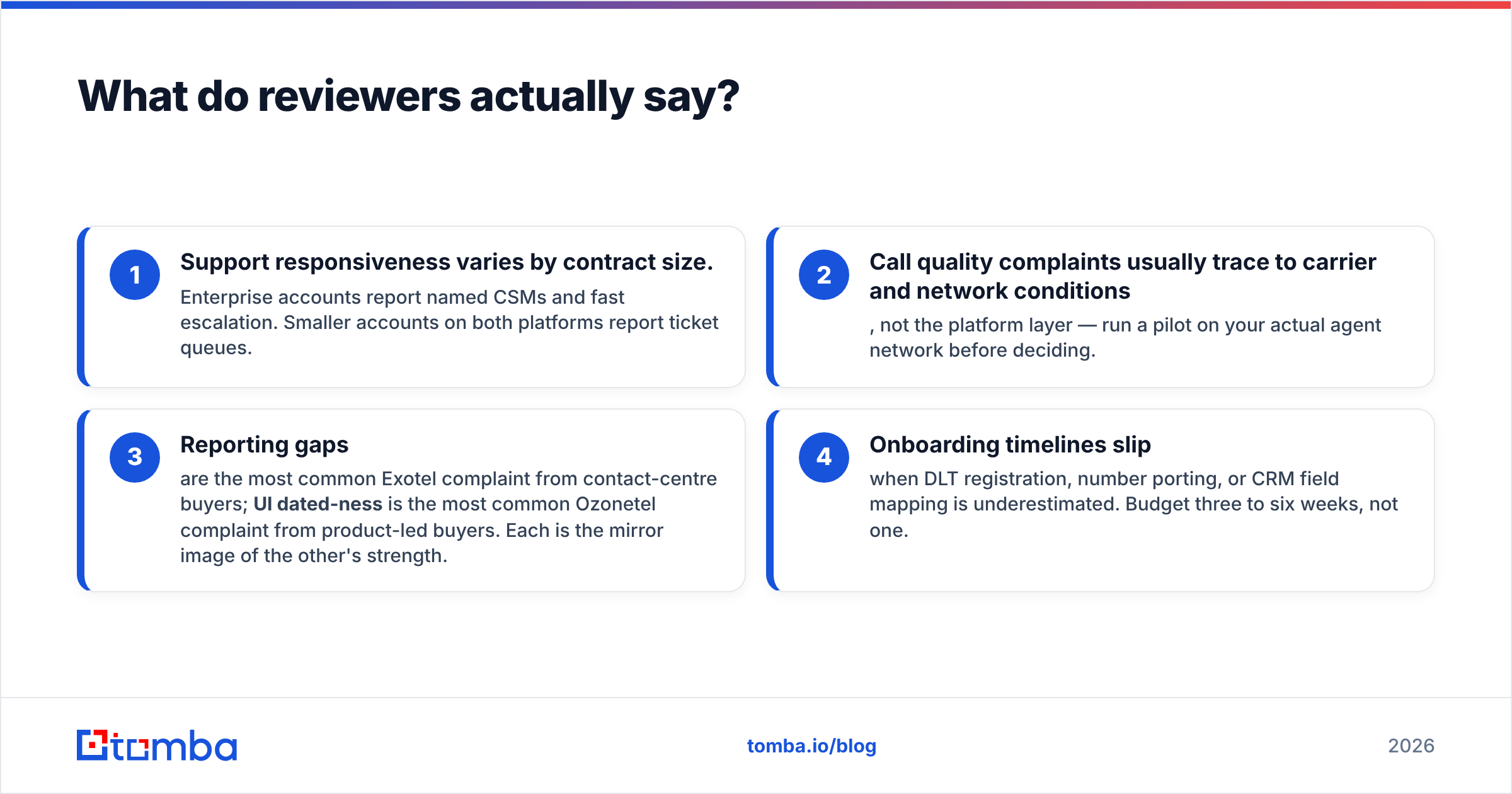
- Support speed tracks contract size. Big accounts report named CSMs and fast escalation. Small accounts on both platforms report ticket queues.
- Call quality complaints usually trace back to the carrier and the network, not the platform. Run a pilot on your real agent network before you decide.
- Reporting gaps are the top Exotel complaint from contact centre buyers. A dated UI is the top Ozonetel complaint from product-led buyers. Each is the mirror image of the other's strength.
- Onboarding slips when teams underestimate DLT registration, number porting, or CRM field mapping. Budget three to six weeks, not one.
Reviews age fast in this category. Weight anything older than 18 months lightly.

Exotel vs Ozonetel: which should you choose?#
Pick by the shape of your operation, not by feature count.
- You embed voice into a product flow (marketplace, logistics, fintech) — Exotel. Number masking, programmable IVR, and event-driven calls are its home turf.
- You run an inside-sales floor of 25+ reps on lead lists — Ozonetel. Predictive dialing, pacing control, and supervisor tools pay for themselves in connect rate.
- You run omnichannel campaigns where WhatsApp and SMS matter as much as voice — Exotel. The channels live in one platform and one bill.
- You run a regulated support desk that needs QA scoring and speech analytics — Ozonetel, on the higher tiers.
- You are a small team under 10 seats — start with whichever gives you the faster pilot. That is usually Exotel, because self-serve onboarding is smoother.
- You already run Ameyo or an old on-prem PBX — Exotel's contact centre line has the clearer migration path.
What actually determines your connect rate?#
Here is the part most Exotel vs Ozonetel comparisons skip. The platform is rarely the bottleneck.
Picture a great predictive dialer working a list where 35% of the numbers are wrong, dead, or belong to someone who left two years ago. It will lose to plain click-to-call on a clean list. No dialer can invent a right party contact.
Three things move the number more than a platform switch:
- Number validity. Run every list through a phone validator before it hits a campaign. Line type, carrier, and reachability checks strip out dials that were never going to connect.
- Contact accuracy. A direct dial beats a switchboard number every time. A phone finder that gets you a named person at a named company skips the gatekeeper problem.
- Context before the dial. Reps who open with a real reason for calling beat reps who open with a script. Data enrichment — role, seniority, company size, tech stack — makes that opener possible at scale.
Building lists in volume? Run the whole set through a bulk email finder and a validation pass first. Then your Exotel or Ozonetel minutes go to people who exist, answer, and can buy.
Frequently asked questions#
Is Exotel or Ozonetel cheaper? It depends on your shape. Concurrent-seat pricing (Ozonetel) suits shift-based teams with fewer live agents. Per-minute plus platform pricing (Exotel) suits low talk time and heavy automation. Model both against the same month.
Do both support Indian DLT and TRAI rules? Yes. Both are established Indian providers with compliance workflows built in. You still own registration and consent.
Can either one replace a CRM? No. Both plug into Salesforce, Zoho, HubSpot, LeadSquared, and Freshworks. Keep the CRM as your system of record.
Which has better international coverage? Exotel has pushed harder into Southeast Asia and the Middle East. Ozonetel has a US presence next to India. Check number availability for your target countries. Coverage claims change.
Can I run both? Some teams do. Exotel handles product-triggered voice and masking, while Ozonetel runs the sales floor. It doubles vendor management, so only do it if the use cases really diverge.
Where to go from here#
Run a two-week pilot on both. Use the same reps, the same list, and the same script. Measure connect rate, average handle time, dials per rep-hour, and how fast your team gets a supervisor report it trusts. That test will tell you more than any Exotel vs Ozonetel feature grid, including this one.
Then fix the input. Before your reps dial a number on either platform, make sure the list deserves the minutes. Tomba Email Finder finds verified work contacts by name, company, or domain. It pairs with Tomba's phone and enrichment tools, so your outbound starts with real people instead of guesses. The free tier gives you 25 searches a month to test the data quality yourself. Paid plans start at $49/mo — see Tomba pricing for the full breakdown. Clean data first, dialer second.
Related guides#
Ready to find emails that actually work?
Join 150,000+ professionals who stopped guessing and started sending. Free credits on signup — no credit card required.
Get the Tomba newsletter
Practical outbound tactics and product updates — once every two weeks.
About the author