Expandi Cyance Pricing 2026: Reviews, Pros and Cons
Expandi runs LinkedIn automation, Cyance runs intent data — and both bill in ways their pricing pages downplay. Here's what each really costs, where they break, and the cheaper stack most teams should run.
Expandi Cyance pricing is a confusing pair to compare. One tool sends LinkedIn messages. The other tells you which accounts to chase. This guide breaks down what each one costs in 2026, where the bills grow, and which stack is cheaper for most teams.
TL;DR
- Expandi is a cloud LinkedIn automation tool. You pay per connected LinkedIn account — about $99 per month, or near $79–$89 on annual billing. There is no real free tier. The cost grows with headcount, not with results.
- Cyance is an intent-data and ABM platform. It sells annual contracts only. There is no public price list. Deals usually start in the five figures per year, quoted per market, per persona set, and per seat.
- The two tools solve different problems. Expandi runs the outreach. Cyance tells you who to target. Compare them only when you are deciding where the next $10k of budget goes.
- Both hide cost in the same way. Expandi grows through seat sprawl. Cyance adds contract minimums and data-activation services.
- Most mid-market teams gain more revenue by fixing contact data first. A $49 per month email finder plus a verifier beats either entry tier.
What are Expandi and Cyance, actually?#
Expandi is a cloud LinkedIn automation platform. You connect a LinkedIn account. It then runs from a dedicated residential IP and sends connection requests, message sequences, InMails, and profile views on a schedule. Its edge is smart sequences that branch on whether someone accepts, replies, or ignores you. It also does image and GIF personalization. See expandi.io for the current feature list.
Cyance is a B2B intent-data and account-based marketing platform. It reads buyer signals such as content consumption, search behaviour, and technographic shifts. It then scores accounts and contacts against your ideal customer profile. Prioritized target lists get pushed into your CRM or ad platforms. It sits in the same category as 6sense, Demandbase, and Bombora. Its own site is cyance.com.
The honest framing: Cyance is a targeting layer. Expandi is an execution layer. Buying both is coherent. Buying either without solid contact data underneath is not.

How much does Expandi cost in 2026?#
Expandi keeps pricing simple on the surface. In practice it is not.
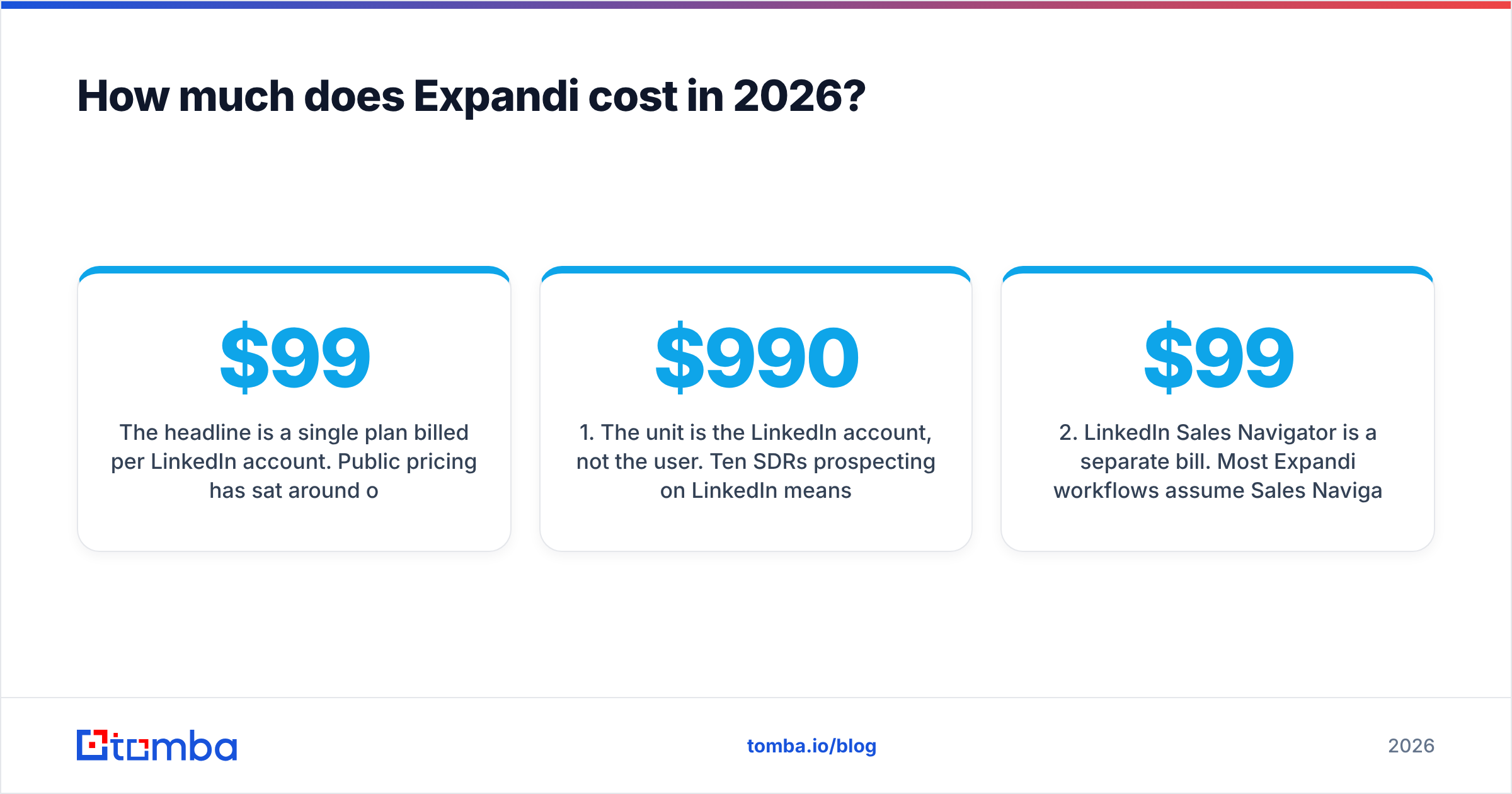
There is one plan, billed per LinkedIn account. Public pricing has sat near $99 per month per seat on monthly billing. Annual prepay drops that to roughly $79–$89 per month. Agencies and resellers get volume tiers past ten seats. You get a 7-day trial, not a free tier.
What the pricing page does not put up front:
- The unit is the LinkedIn account, not the user. Ten SDRs on LinkedIn means ten seats. That is about $990 per month before you send a single email.
- LinkedIn Sales Navigator is a separate bill. Most Expandi workflows use Sales Navigator search as the list source. Add about $99 per month per user.
- Email steps need their own sending stack. Expandi's multichannel steps need your own SMTP or an integrated sender, plus warmup. Budget for it.
- Contact data is not included. Expandi only scrapes what is visible on LinkedIn profiles. Verified work emails and direct dials come from elsewhere. That is where an email finder or LinkedIn finder fits in.
- Account-safety risk is a real cost. Push the limits and LinkedIn restricts accounts. The dedicated-IP model lowers that risk. It does not remove it.
How much does Cyance cost in 2026?#
Cyance does not publish prices. That is normal for intent-data vendors. It is also the most important fact about its pricing.
Buyer reports on G2 and similar intent platforms point to this structure:
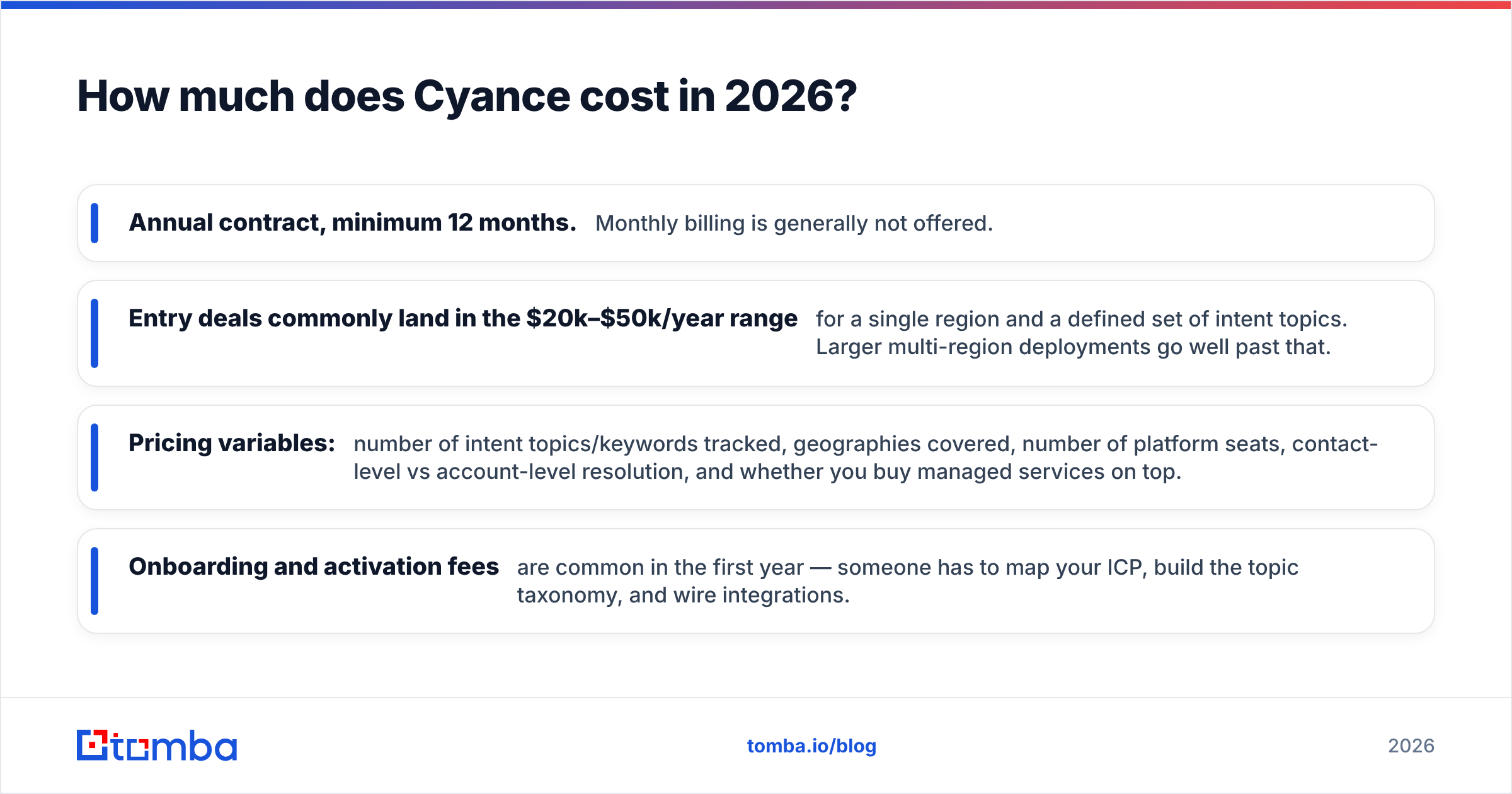
- Annual contract, 12-month minimum. Monthly billing is rarely offered.
- Entry deals often land in the $20k–$50k per year range. That covers one region and a set list of intent topics. Multi-region rollouts cost far more.
- Price drivers: number of intent topics tracked, geographies covered, platform seats, contact-level versus account-level resolution, and any managed services.
- Onboarding and activation fees are common in year one. Someone has to map your ICP, build the topic taxonomy, and wire up integrations.
So you cannot pilot Cyance for a month with a credit card. Every evaluation turns into a procurement project. The real cost includes several weeks of your team's time before any value shows up.
Expandi Cyance pricing vs a data-first stack: how do they compare?#
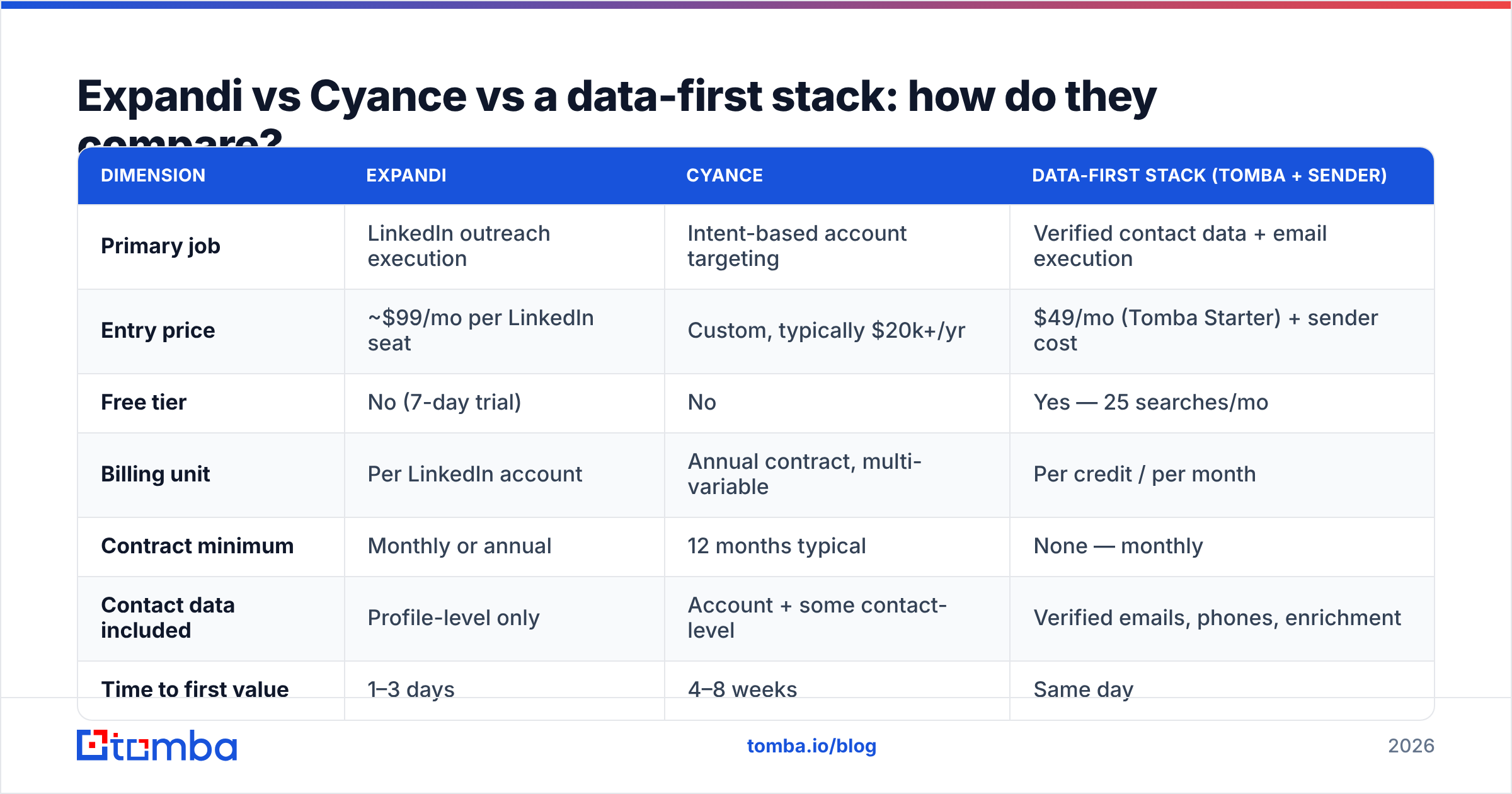
| Dimension | Expandi | Cyance | Data-first stack (Tomba + sender) |
|---|---|---|---|
| Primary job | LinkedIn outreach execution | Intent-based account targeting | Verified contact data + email execution |
| Entry price | ~$99/mo per LinkedIn seat | Custom, typically $20k+/yr | $49/mo (Tomba Starter) + sender cost |
| Free tier | No (7-day trial) | No | Yes — 25 searches/mo |
| Billing unit | Per LinkedIn account | Annual contract, multi-variable | Per credit / per month |
| Contract minimum | Monthly or annual | 12 months typical | None — monthly |
| Contact data included | Profile-level only | Account + some contact-level | Verified emails, phones, enrichment |
| Time to first value | 1–3 days | 4–8 weeks | Same day |
| Best for | SDR teams living in LinkedIn | Enterprise ABM with a defined ICP | Any team that needs reachable contacts |
| Main risk | LinkedIn account restrictions | Intent signal noise, contract lock-in | Requires your own sequencing tool |
Expandi Cyance pricing looks like a head-to-head. Read that table as three budget decisions instead, not three competitors. If your reps already book meetings and just need volume, pick Expandi. If your TAM is large and you cannot tell which 200 accounts are in-market this quarter, look at Cyance. If your bounce rate is above 5% and half your list has no direct contact, fix the data layer first.
What are the pros and cons of Expandi?#
Pros
- Genuinely good sequence logic. Branching on accept, reply, or no-reply is what separates it from cheap Chrome-extension tools.
- Cloud-based with a dedicated IP. Nothing runs on your laptop. The session profile stays steady, which lowers restriction risk.
- Agency-friendly. Multi-account dashboards, white-label reports, and client seat management all come standard. That is why agencies dominate its user base.
- Fast setup. You can have a live campaign in an afternoon, not a quarter.
Cons
- Per-seat pricing punishes growth. Double the SDR team and you double the bill. No volume break arrives until about ten seats.
- LinkedIn dependency is a single point of failure. Policy changes, connection limits, and account restrictions sit outside your control.
- No native contact data. You still need verified emails for the multichannel steps that lift reply rates.
- Reporting stops at campaign level. Tying results back to pipeline is your CRM's job.
If per-seat LinkedIn pricing is the sticking point, the market has options. Compare an Expandi alternative with a Dripify alternative or a Waalaxy alternative before you sign for a year.
What are the pros and cons of Cyance?#
Pros
- Signal quality is the product, and it is decent. You get behavioural intent with contact-level resolution in supported regions, not just account-level topic spikes.
- Strong EMEA coverage. Its European data depth beats most US-centric intent vendors. That alone is a fair reason to pick it.
- Managed-service layer. Teams without an ABM analyst get real help during onboarding, not just an upsell.
- Fits existing GTM plumbing. It connects to your CRM, MAP, and ad platforms, so the signal reaches the people who act on it.
Cons
- Opaque pricing means long sales cycles. There is no self-serve path and no month-to-month pilot.
- Intent data has a noise floor. A spike in topic reading is not a buying committee. Treat scores as gospel and your reps stop trusting them.
- It needs operational maturity. Without a clear ICP, routing rules, and a rep motion tied to signals, you are paying for a dashboard.
- Contract lock-in. A 12-month deal on an unproven channel is the most common regret in this category.

Are the reviews for Expandi and Cyance any good?#
Review sentiment splits along predictable lines.
Expandi reviewers praise setup speed and sequence flexibility. The recurring gripes are the per-seat price for solo operators, sync delays with LinkedIn, and slow support at peak times. Ratings sit in the 4.4–4.6 range on directories like Capterra.
Cyance has a much smaller review footprint. That is normal for enterprise ABM vendors, where deals number in the hundreds. Reviews lean positive on account management and EMEA data quality. The usual caveats show up too: long implementation timelines and real work to turn signals into action.
Read both sets with care. Agencies write most Expandi reviews, and their economics differ from an in-house team's. Enterprises with RevOps staff write most Cyance reviews. Neither group looks like a five-person startup.
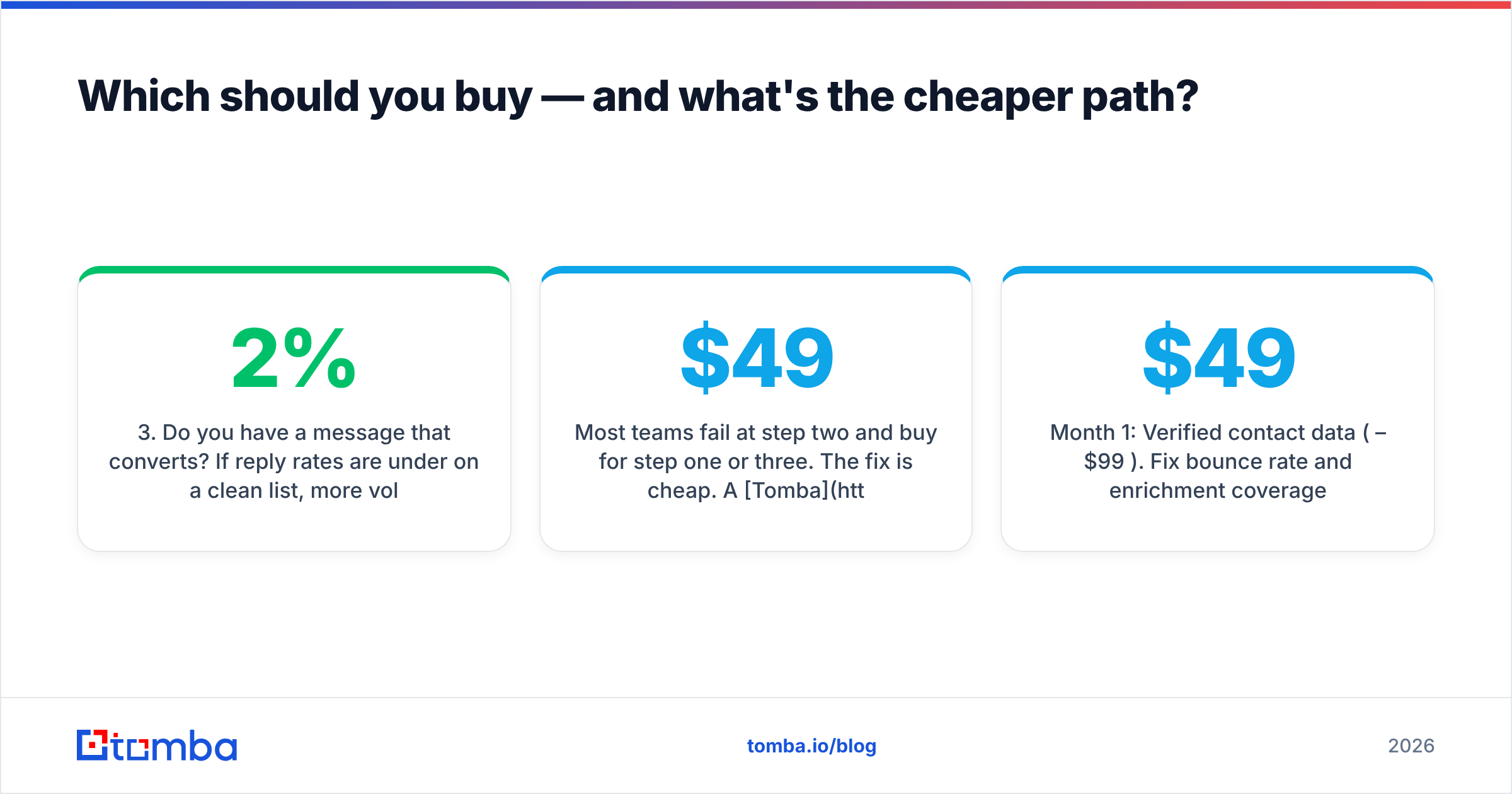
Which should you buy — and what's the cheaper path?#
Answer three questions in order.
- Do you know who to target? If not, intent data helps. Still, test the idea with a cheap manual list before you sign a Cyance-sized contract.
- Can you reach them? If your list is LinkedIn URLs and generic info@ addresses, no automation tool saves you. This is the data layer.
- Do you have a message that converts? If reply rates sit under 2% on a clean list, more volume just burns your domain reputation faster.
Most teams fail at step two but buy for step one or three. The fix is cheap. A Tomba Starter plan at $49 per month plus an email verifier pass costs less than half of one Expandi seat. It usually drops hard bounces below 2%, which protects the email deliverability every other tool depends on.
A pragmatic order of spend for a team under 20 people:
- Month 1: Verified contact data ($49–$99/mo). Fix bounce rate and enrichment coverage.
- Month 2: One sending tool plus warmup. Build a repeatable sequence.
- Month 3: Add LinkedIn automation on two seats — your best two reps — not the whole team.
- Month 6+: Evaluate intent data only after the channels are proven. By then you will know which signals track your closed-won accounts.
Teams that want account-level targeting without an enterprise contract often start with website visitor reveal. It is a narrower signal than full intent data. It is also first-party, immediate, and far cheaper than an ABM platform.
For a wider view of what enterprise ABM platforms claim versus deliver, Gartner peer reviews in the ABM category are more candid than vendor case studies.
Start with the layer everything else depends on#
Whatever you decide on Expandi Cyance pricing, both tools are multipliers on your contact data. A multiplier on bad data just makes bad results arrive faster. Before you sign anything annual, run your current target list through the Tomba Email Finder. Find verified work emails by domain, name, or company. Check your coverage gap honestly. Then decide whether the next budget line goes to execution or targeting. The free tier gives you 25 searches a month, so you can test it on a list you already have. No contract, no procurement cycle.
Related guides#
Ready to find emails that actually work?
Join 150,000+ professionals who stopped guessing and started sending. Free credits on signup — no credit card required.
Get the Tomba newsletter
Practical outbound tactics and product updates — once every two weeks.
About the author