Expertise AI Chatsimple Pricing, Reviews, Pros and Cons
Chatsimple markets itself as an AI sales agent that turns website visitors into booked meetings. Here is what the plans actually cost in 2026, what reviewers praise and complain about, and when a chatbot is the wrong line item.
TL;DR
- Chatsimple is an AI chat agent you drop on your website to answer questions, qualify visitors, and book meetings. Directory listings like Expertise AI aggregate its specs, but the numbers there go stale fast — always confirm against the vendor's own page.
- List pricing at the time of writing runs from a free tier through roughly $79/mo (Pro) and $249/mo (Business), with custom Enterprise deals and a meaningful annual discount.
- The pricing metric that actually matters is messages/credits, not seats. A viral blog post or a bot-scraped site can burn a month's allowance in days.
- Reviewers consistently praise setup speed and multilingual support; the recurring complaints are answer accuracy on niche content, limited deep CRM logic, and overage surprises.
- A chatbot only captures the visitors who choose to talk. The other 95% of your traffic still needs outbound — which means real contact data, not just conversations.
What is Chatsimple, and why does it show up on Expertise AI?#
Chatsimple is an AI chat agent — a script tag on your site that reads your content, answers visitor questions in natural language, captures lead details, and hands qualified conversations to a human or a calendar link. Think of it as a hotel concierge who has memorised the entire hotel binder: fast and tireless on anything written down, useless on anything that isn't.
Expertise AI, like G2, Capterra, and dozens of AI-tool directories, is an aggregator. It lists Chatsimple alongside competitors with a specs blurb, a star rating, and a pricing summary. That summary is the problem. Directory pricing tables are frequently six to eighteen months behind the vendor, and AI tooling repackages faster than almost any other SaaS category. Treat directories as a discovery layer and the official Chatsimple site as the source of truth on cost.
The genuinely useful part of directories is the review corpus. Cross-reference what people say on G2 and Capterra with your own trial, and you get a much more honest picture than any single listing.
How much does Chatsimple cost in 2026?#
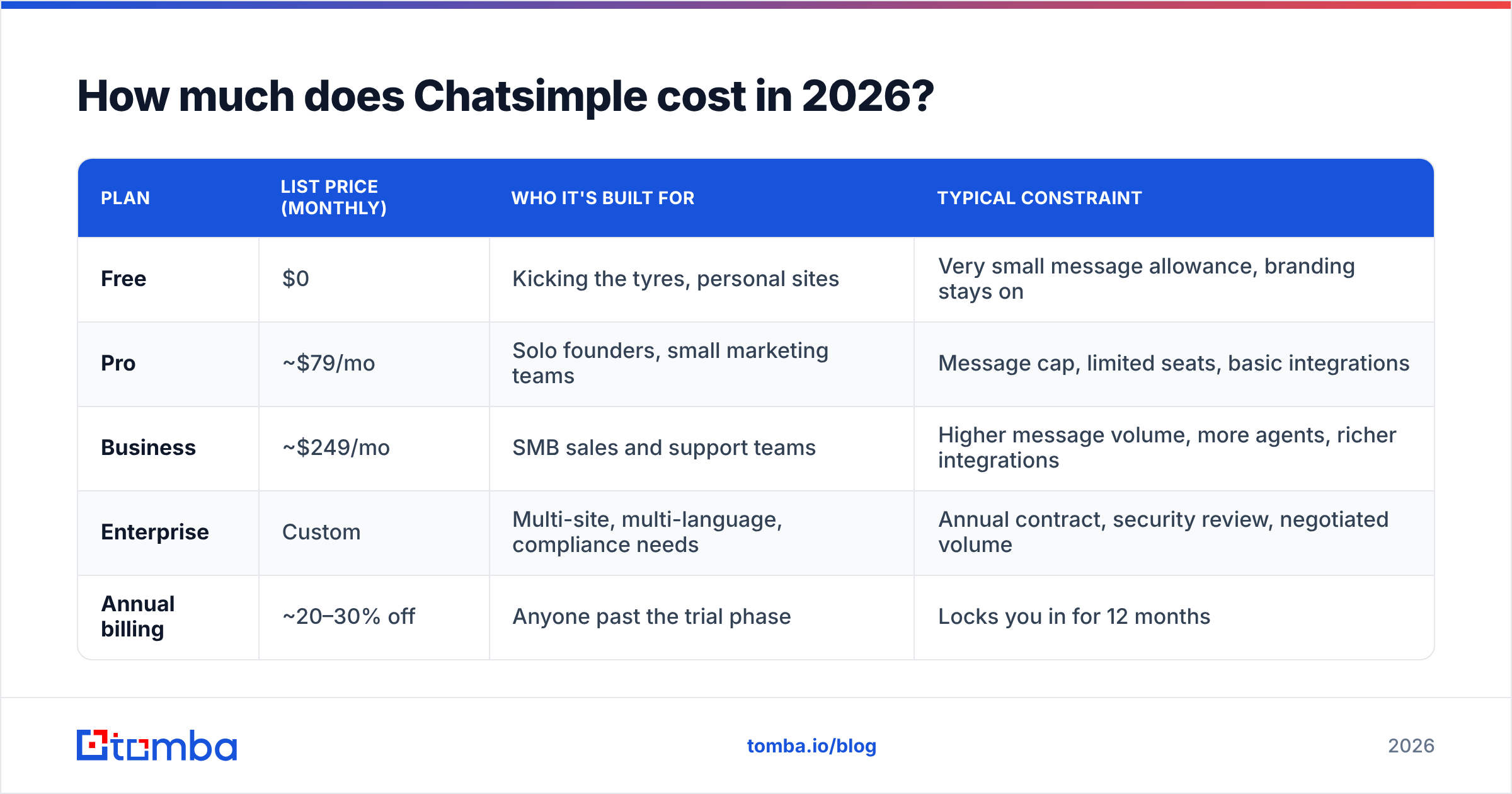
Here is the shape of the pricing, as published at the time of writing. Chatsimple has re-packaged its tiers before, so verify the exact numbers before you budget.
| Plan | List price (monthly) | Who it's built for | Typical constraint |
|---|---|---|---|
| Free | $0 | Kicking the tyres, personal sites | Very small message allowance, branding stays on |
| Pro | ~$79/mo | Solo founders, small marketing teams | Message cap, limited seats, basic integrations |
| Business | ~$249/mo | SMB sales and support teams | Higher message volume, more agents, richer integrations |
| Enterprise | Custom | Multi-site, multi-language, compliance needs | Annual contract, security review, negotiated volume |
| Annual billing | ~20–30% off | Anyone past the trial phase | Locks you in for 12 months |
Two structural notes.
First, this is usage-priced software wearing a seat-priced costume. The plan name gates features, but the number that decides your bill is messages (sometimes called credits or conversations). A message is one exchange in a conversation, and one visitor can easily consume ten to thirty.
Second, the annual discount is real but front-loads risk. Chat agent value is highly dependent on traffic quality. If you don't yet know your monthly conversation volume, pay monthly for a quarter, measure, then commit.
What do you actually get at each tier?#
The feature grid is where directory listings mislead most, because every vendor labels the same capability differently. Here is what to actually check before you pay:
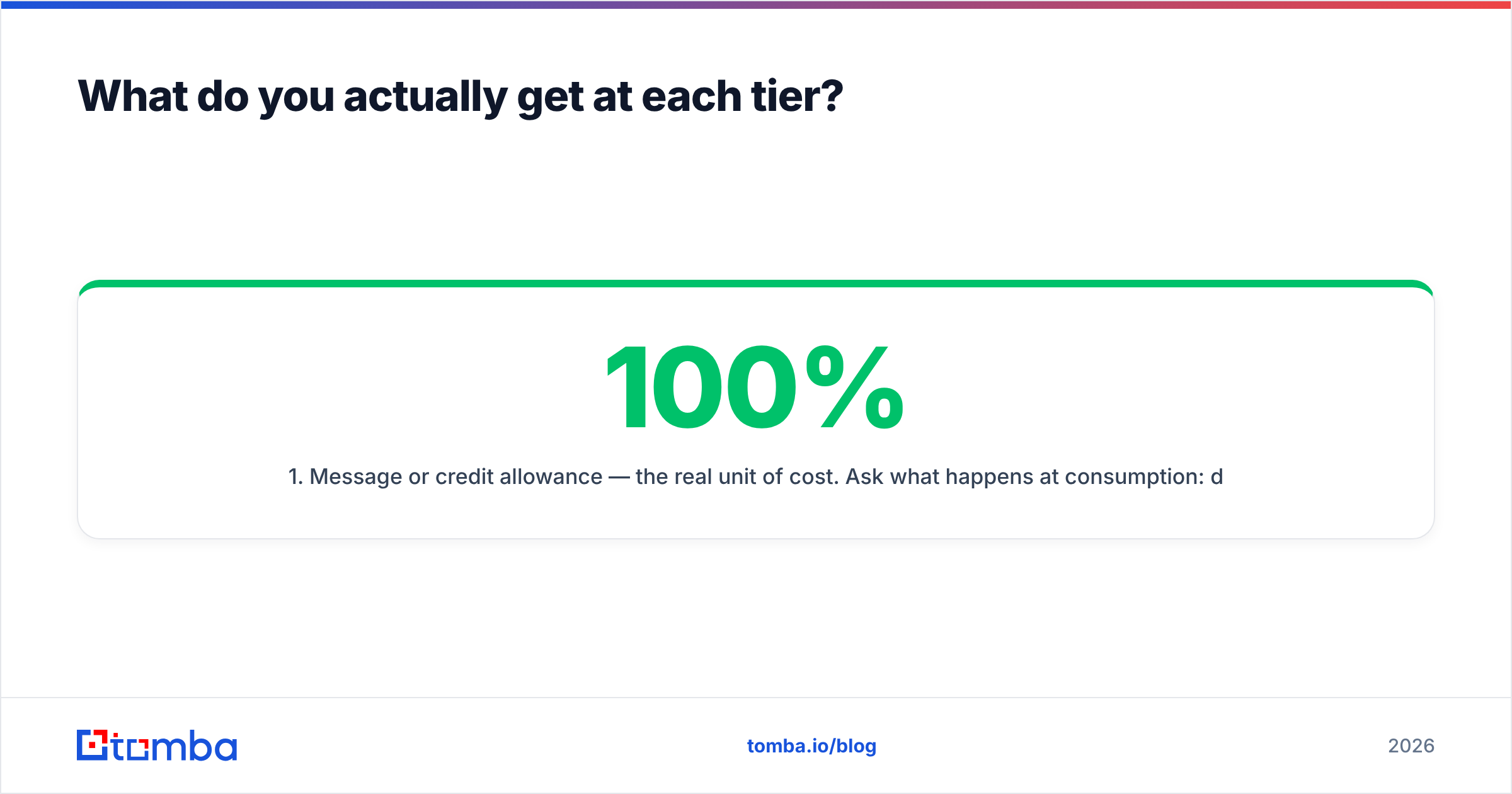
- Message or credit allowance — the real unit of cost. Ask what happens at 100% consumption: does the bot stop responding, degrade to a form, or does the account auto-upgrade? Auto-upgrade is how a $79 plan becomes a $400 invoice.
- Number of AI agents (bots) — one per domain, or one per use case? Agencies and multi-brand companies burn through this limit first.
- Knowledge sources — crawled URLs, uploaded PDFs, sitemaps, help-centre sync. Look for the page cap and the re-crawl frequency, since a stale index is the number-one cause of wrong answers.
- Lead capture and routing — can it push a captured lead into your CRM with the fields you need, or is it email notifications and a CSV export?
- Languages and channels — Chatsimple's multilingual support is a genuine strength; confirm whether WhatsApp, Messenger, or Instagram channels are included at your tier or cost extra.
- Branding removal and analytics depth — "remove Chatsimple branding" and conversation-level analytics are almost always paywalled above the entry plan.
Score a trial against those six, not against the marketing page. If the vendor can't answer #1 precisely, that's your answer.
Is Chatsimple worth it compared to alternatives?#
Chatsimple sits in a crowded middle: cheaper and faster to deploy than enterprise support suites, more sales-oriented than pure knowledge-base bots.
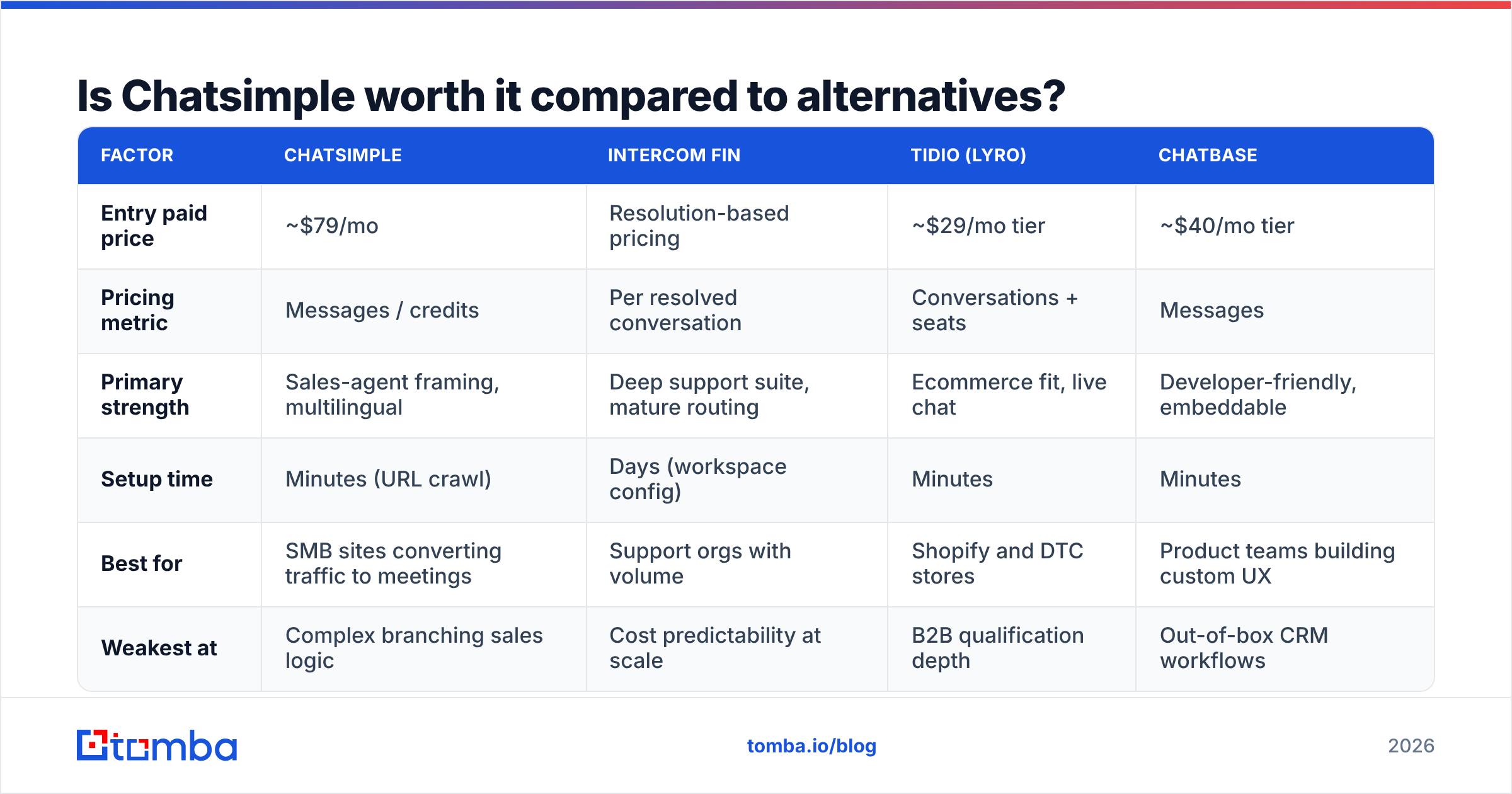
| Factor | Chatsimple | Intercom Fin | Tidio (Lyro) | Chatbase |
|---|---|---|---|---|
| Entry paid price | ~$79/mo | Resolution-based pricing | ~$29/mo tier | ~$40/mo tier |
| Pricing metric | Messages / credits | Per resolved conversation | Conversations + seats | Messages |
| Primary strength | Sales-agent framing, multilingual | Deep support suite, mature routing | Ecommerce fit, live chat | Developer-friendly, embeddable |
| Setup time | Minutes (URL crawl) | Days (workspace config) | Minutes | Minutes |
| Best for | SMB sites converting traffic to meetings | Support orgs with volume | Shopify and DTC stores | Product teams building custom UX |
| Weakest at | Complex branching sales logic | Cost predictability at scale | B2B qualification depth | Out-of-box CRM workflows |
The honest read: if your goal is "answer pre-sales questions and book demos from existing traffic," Chatsimple is competitively priced and unusually quick to stand up. If your goal is deflecting thousands of support tickets with SLA guarantees, you will outgrow it and end up in a resolution-priced enterprise tool anyway.
What do reviews say — the real pros and cons?#
Pulling together the recurring themes from public review sites and hands-on trials:
Pros
- Time to first value is genuinely short. Point it at your domain, let it crawl, and you have a working agent the same afternoon. That matters more than feature depth for a five-person team.
- Multilingual answers out of the box. For companies selling across EMEA or LATAM, this removes a translation project.
- Sales framing, not just support framing. Proactive prompts, lead capture, and calendar handoff are treated as first-class rather than bolted on.
- Reasonable entry price. Under $100/mo for a functioning AI agent is defensible against the cost of one extra SDR hour per day.
Cons
- Accuracy degrades on thin or contradictory content. The bot is a mirror of your site. If your pricing page is vague, the agent will be vague — then confidently wrong.
- Credit anxiety is real. Several reviewers describe watching the usage meter rather than the pipeline. Bot traffic and scrapers consume messages that will never buy anything.
- Shallow CRM logic. Field mapping and conditional routing are lighter than in mature revenue platforms; complex qualification usually ends up handled downstream.
- Analytics tell you about conversations, not revenue. You'll still need to stitch conversation data to closed-won yourself.
- Support responsiveness varies by tier. Entry-plan users report slower turnaround, which is standard for the category but worth budgeting patience for.
None of these are disqualifying. They just define the job: Chatsimple is a conversion layer on traffic you already have, not a demand-generation engine.
What are the hidden costs nobody puts in the pricing table?#
Four line items that don't appear on any plan comparison:
- Content debt. An AI agent trained on a neglected site produces neglected answers. Budget a week of someone rewriting the FAQ, pricing, and integration pages properly. This is the single highest-ROI thing you can do post-purchase.
- Wasted credits from non-humans. Bots, competitors, and job seekers consume the same allowance as buyers. Filtering helps; it never fully solves it.
- Data cleanup on captured leads. Visitors typo their addresses, use burner Gmails, or paste a personal domain. Every one of those becomes a bounce in your sequence, which erodes sender reputation. Running captured addresses through an email verifier before they hit your sending tool is not optional.
- The annual lock-in. A 25% discount is a bad trade if you churn in month four. Prove the channel first.
Who should buy Chatsimple — and who should skip it?#
Buy it if: you get at least a few thousand relevant visitors a month, your product needs explaining before someone books, and your site content is already decent. The math is simple — if the agent books two extra qualified meetings a month, a $79 plan has paid for itself several times over.
Skip it if: your traffic is under a thousand visits a month. A chatbot on an empty site is a very expensive way to talk to yourself. At that stage, every dollar belongs in outbound: building a target list, finding the right contacts, and sending sequences that a human wrote.
Skip it also if your sales motion is entirely outbound-led — enterprise accounts, long cycles, named-account plays. Those buyers don't chat with a widget at 11pm; they get referred, or they get prospected.
How do you turn chatbot conversations into actual pipeline?#
Here's the gap most teams miss. A chat agent converts the small slice of visitors who self-identify. Everyone else — the researcher who read three pages and left, the buying-committee member who never types — stays anonymous. Chatsimple doesn't solve that, and it doesn't claim to.
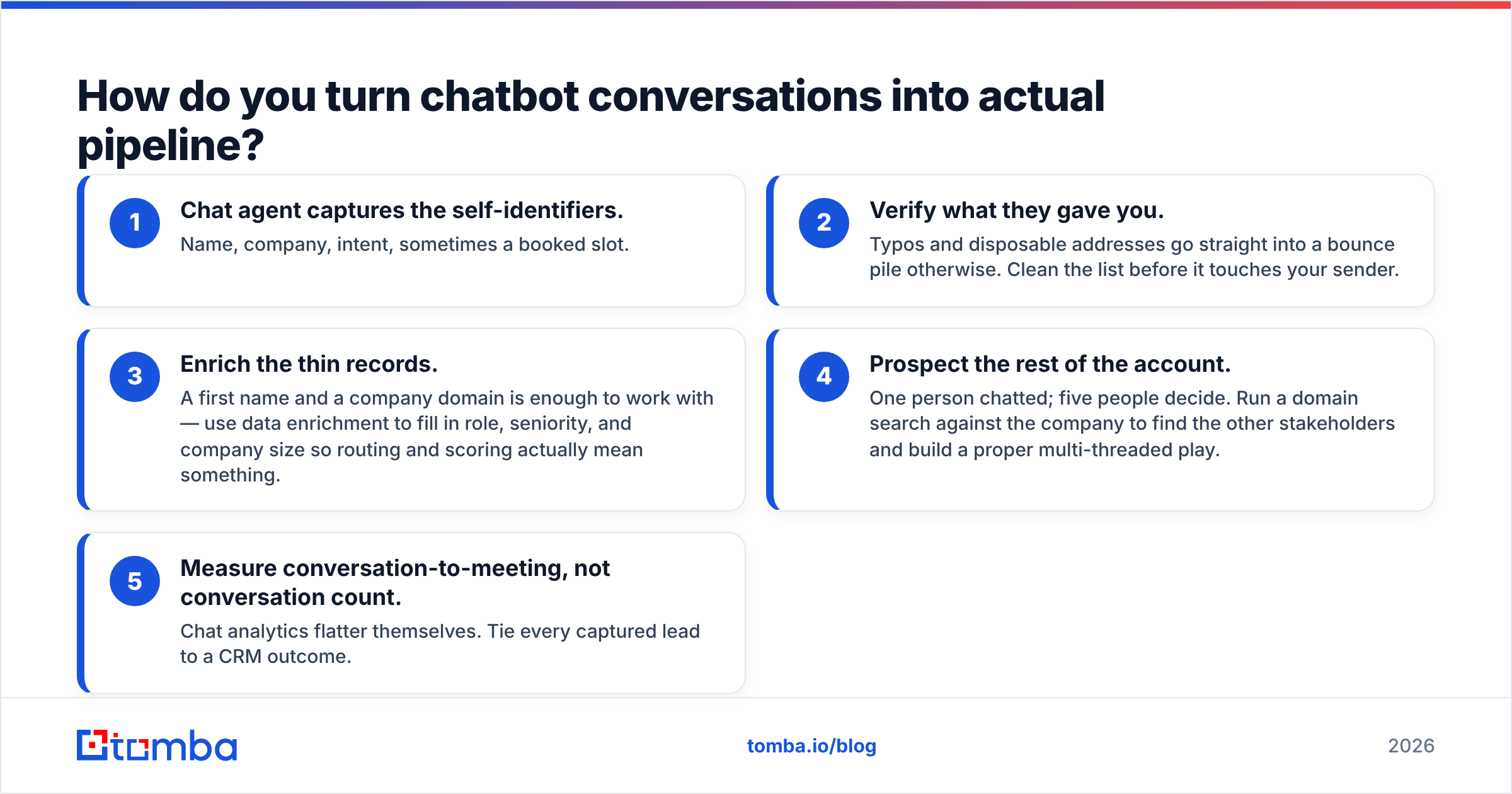
A workable stack looks like this:
- Chat agent captures the self-identifiers. Name, company, intent, sometimes a booked slot.
- Verify what they gave you. Typos and disposable addresses go straight into a bounce pile otherwise. Clean the list before it touches your sender.
- Enrich the thin records. A first name and a company domain is enough to work with — use data enrichment to fill in role, seniority, and company size so routing and scoring actually mean something.
- Prospect the rest of the account. One person chatted; five people decide. Run a domain search against the company to find the other stakeholders and build a proper multi-threaded play.
- Measure conversation-to-meeting, not conversation count. Chat analytics flatter themselves. Tie every captured lead to a CRM outcome.
Step 4 is where the compounding happens. Every chat conversation is a signal that an account is in-market. Treating it as one lead instead of one account opening is the most common way teams under-earn from a chatbot subscription.
Frequently asked questions about Chatsimple pricing#
Does Chatsimple have a free plan? Yes — a free tier exists with a small message allowance and Chatsimple branding retained. It's enough to evaluate answer quality on your own content, which is the only test that matters.
Is the annual discount worth taking? Only after you've measured a full month of real traffic against your message allowance. Discounts of 20–30% are attractive; a year of an unused seat is not.
What happens when I run out of messages? Behaviour varies by plan and has changed across versions. Ask support directly, in writing, before you buy. This is the most common source of billing surprises in the category.
Can it replace an SDR? No. It replaces the first ninety seconds of an SDR's job — answering "do you integrate with X" and "how much is it." Qualification depth, objection handling, and account research remain human work.
Is Expertise AI's listing accurate? Use it for discovery and review sentiment. Use the vendor's pricing page for numbers.
The bottom line#
Chatsimple is fairly priced for what it is: a fast-to-deploy AI agent that converts existing website traffic into conversations and meetings. Its weaknesses are the category's weaknesses — credit-based billing that punishes traffic spikes, answer quality that mirrors your content quality, and analytics that stop short of revenue.
Just don't mistake it for a pipeline strategy. A chat agent harvests demand; it doesn't create it. The teams that get real return from Chatsimple are the ones already generating traffic and already running outbound alongside it.
If you're building the outbound half of that equation, start with contacts you can actually reach. Tomba's Email Finder finds verified professional email addresses by name, domain, or company — so the accounts that chat with your bot, and the ones that never do, both end up in a sequence that lands. The free tier covers 25 searches a month, and paid plans start at $49/mo; see Tomba pricing for the full breakdown.
Related guides#
Ready to find emails that actually work?
Join 150,000+ professionals who stopped guessing and started sending. Free credits on signup — no credit card required.
Get the Tomba newsletter
Practical outbound tactics and product updates — once every two weeks.
About the author