Explicit vs Implicit Buying Signals: A 2026 Sales Guide
One signal type tells you a buyer raised their hand. The other tells you they are thinking about it. Here is how explicit and implicit buying signals differ, how to score both, and which one should decide who you contact first.
TL;DR
- Explicit buying signals are stated: a demo request, a pricing question, a filled form, a "send me a proposal" reply. High confidence, low volume, and they arrive late.
- Implicit buying signals are inferred: repeat pricing-page visits, a new VP of Sales hire, a job post mentioning your competitor, review-site browsing. Lower confidence, far higher volume, and they arrive early.
- Explicit signals win on conversion rate. Implicit signals win on pipeline coverage. Teams that pick one and ignore the other either starve or drown.
- The practical fix is a two-axis model: score intent strength on one axis, fit on the other, and route only the high-intent/high-fit quadrant to a rep.
- Signals are worthless without contactable people behind them. Resolving an anonymous account into a verified decision-maker email is the step most teams skip.
What are buying signals, and why split them into explicit and implicit?#
A buying signal is any observable behavior that shifts your estimate of whether an account will buy. Think of it like a doctor's office. An explicit signal is the patient saying "my chest hurts." An implicit signal is the nurse noticing an elevated heart rate on the monitor. The first is easier to act on. The second is available far earlier, on far more patients, and often points at the same thing.
The split matters because the two types behave differently in almost every dimension that affects your pipeline: volume, latency, precision, decay speed, and who owns the follow-up. Treating them as one bucket called "intent" is the reason so many lead scoring models produce a ranked list nobody trusts.
Most B2B teams are structurally biased toward explicit signals because they are the ones a CRM records by default. Forms, replies, and meeting bookings all leave a row in a table. Implicit signals require instrumentation — visitor identification, hiring-data feeds, technographic monitoring — which means somebody has to go build the pipe before the signal exists at all.
What counts as an explicit buying signal?#
Explicit signals are ones where the prospect deliberately communicates purchase interest. There is no inference step — you are reading the words they typed or the button they pressed.
- Inbound demo or trial requests. The strongest signal you will ever get. The buyer has self-identified, self-qualified, and accepted that a sales conversation follows.
- Pricing and contract questions. "What does this cost at 40 seats?" or "Do you offer annual billing?" Explicit budget-stage language, whether it lands in a form, an email reply, or a live chat.
- RFP and vendor-questionnaire participation. Formal, procurement-driven, and usually a sign that a shortlist already exists — which may mean you are column fodder unless you shaped the requirements.
- Positive reply to an outbound sequence. "Interested, send me info" is explicit even if you initiated the conversation.
- Stated timeline or renewal date. "Our contract with the incumbent ends in Q3" is a scheduling instruction disguised as small talk.
- Referral or intro request. A champion asking to loop in their CFO is an explicit escalation signal.
The catch: explicit signals are rare and late. By the time someone requests a demo, most of the evaluation has already happened without you. Multiple B2B buying studies over the last decade have converged on the same uncomfortable finding — buyers complete the majority of their research before contacting a vendor, and a large share of the buying committee never fills out anything at all. Gartner's sales research has been making a version of this argument for years.
What counts as an implicit buying signal?#
Implicit signals are inferred from behavior, org changes, or public data. Nobody told you anything; you noticed something.
- Website behavior. Repeat visits to pricing, integrations, or security pages. A single homepage view means nothing. Three pricing-page sessions in eight days from the same company means a lot.
- Hiring signals. A company posting for "SDR Manager" or "RevOps Lead" is about to buy a stack. Job descriptions frequently name the exact tools they run — free technographic data hiding in plain sight.
- Leadership changes. A new VP or CMO typically re-evaluates vendors within their first two quarters. New-executive triggers are among the highest-converting implicit signals in outbound.
- Technographic shifts. They added a CRM, dropped a competitor's script, or installed a marketing-automation tag. Each change opens or closes a specific pitch.
- Funding and expansion events. A Series B, a new office, a headcount jump. Budget exists that did not exist last quarter.
- Third-party research activity. Category browsing on review sites, comparison-page views, or content syndication downloads.
- Social and community behavior. Following your competitor's product pages, engaging with category content, or asking peers for tool recommendations. This is where social selling crosses into signal collection.
Implicit signals are early and abundant. They are also noisy: a pricing-page visit could be a competitor, a job candidate, or an analyst. That noise is the entire cost of the earlier timing.
Explicit vs implicit buying signals: how do they actually compare?#
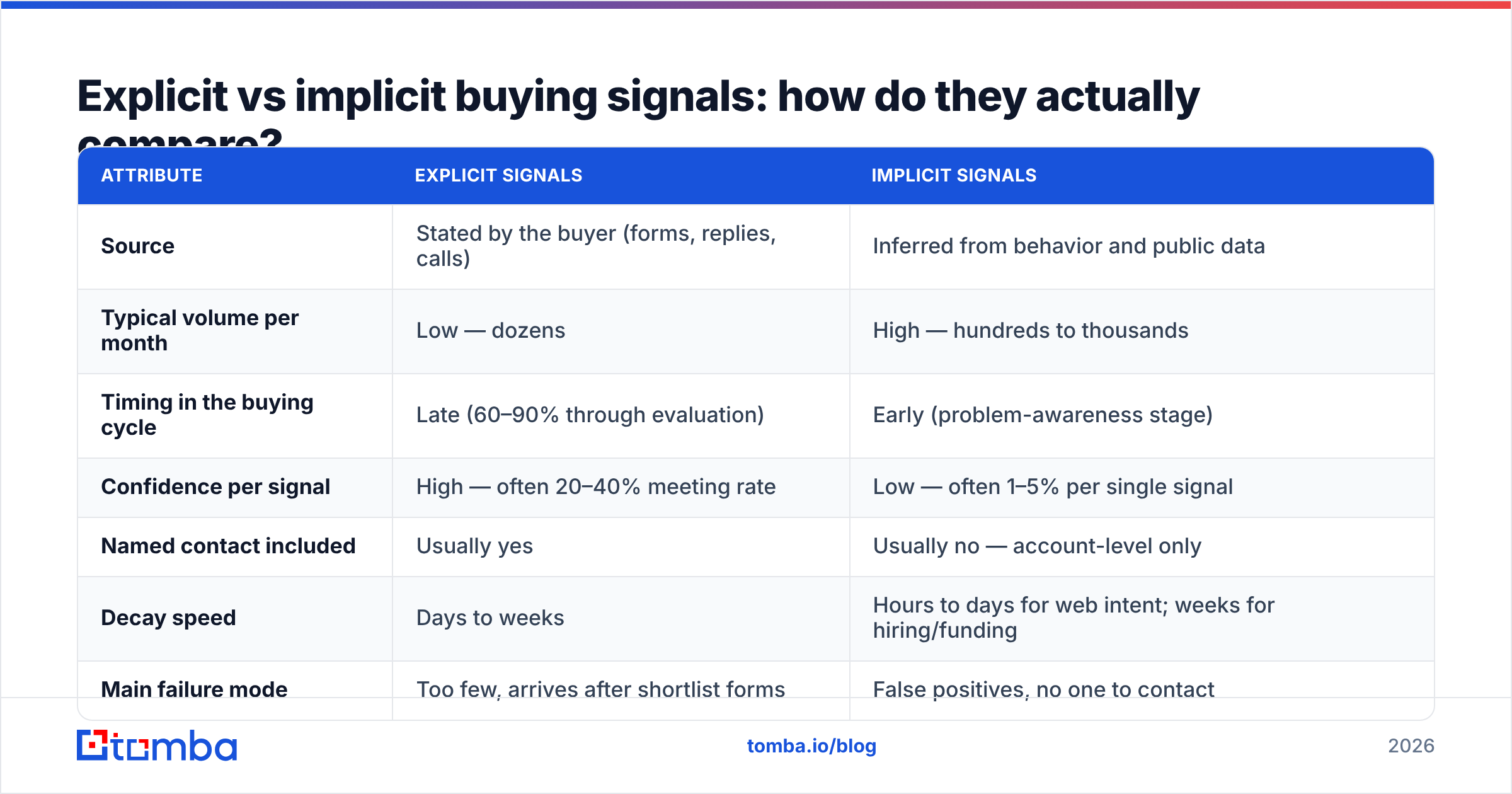
Here is the side-by-side that matters when you decide where to spend budget and rep hours.
| Attribute | Explicit signals | Implicit signals |
|---|---|---|
| Source | Stated by the buyer (forms, replies, calls) | Inferred from behavior and public data |
| Typical volume per month | Low — dozens | High — hundreds to thousands |
| Timing in the buying cycle | Late (60–90% through evaluation) | Early (problem-awareness stage) |
| Confidence per signal | High — often 20–40% meeting rate | Low — often 1–5% per single signal |
| Named contact included | Usually yes | Usually no — account-level only |
| Decay speed | Days to weeks | Hours to days for web intent; weeks for hiring/funding |
| Main failure mode | Too few, arrives after shortlist forms | False positives, no one to contact |
| Best-fit motion | Fast inbound follow-up, SDR-to-AE handoff | Triggered outbound sequences, ABM plays |
| Data cost | Near zero (your own CRM) | Moderate — enrichment and visitor tooling |
| Who should own it | Inbound SDR / AE | Outbound SDR / growth / RevOps |
Read the table and the strategy falls out on its own. Explicit signals do not need a scoring model — they need a response-time SLA. Implicit signals do not need urgency — they need aggregation, because one weak signal is noise and four correlated weak signals are a play.
Which signal type actually predicts revenue?#
Explicit wins per signal. Implicit wins per quarter.
If you measure conversion rate alone, explicit signals look unbeatable: an inbound demo request converts to a meeting several times better than any behavioral trigger. But conversion rate is the wrong denominator. What you care about is sourced pipeline, which is conversion rate multiplied by volume — and implicit signals typically outnumber explicit ones by 20:1 or more.
There is a second, sneakier reason implicit signals earn their budget: positioning. When you reach an account during the problem-awareness stage, you influence the requirements list. When you arrive on an RFP, you answer someone else's requirements list. The first deal has a materially better win rate than the second, which is why win rate analysis by first-touch source almost always favors early triggered outbound over late inbound RFPs.
The honest caveat: implicit-signal programs fail more often than explicit-signal programs, and they fail for a boring reason. The account is identified, nobody knows who to email, and the play dies in a spreadsheet. Signal quality is a data problem before it is a strategy problem.
How do you score both signal types in one model?#
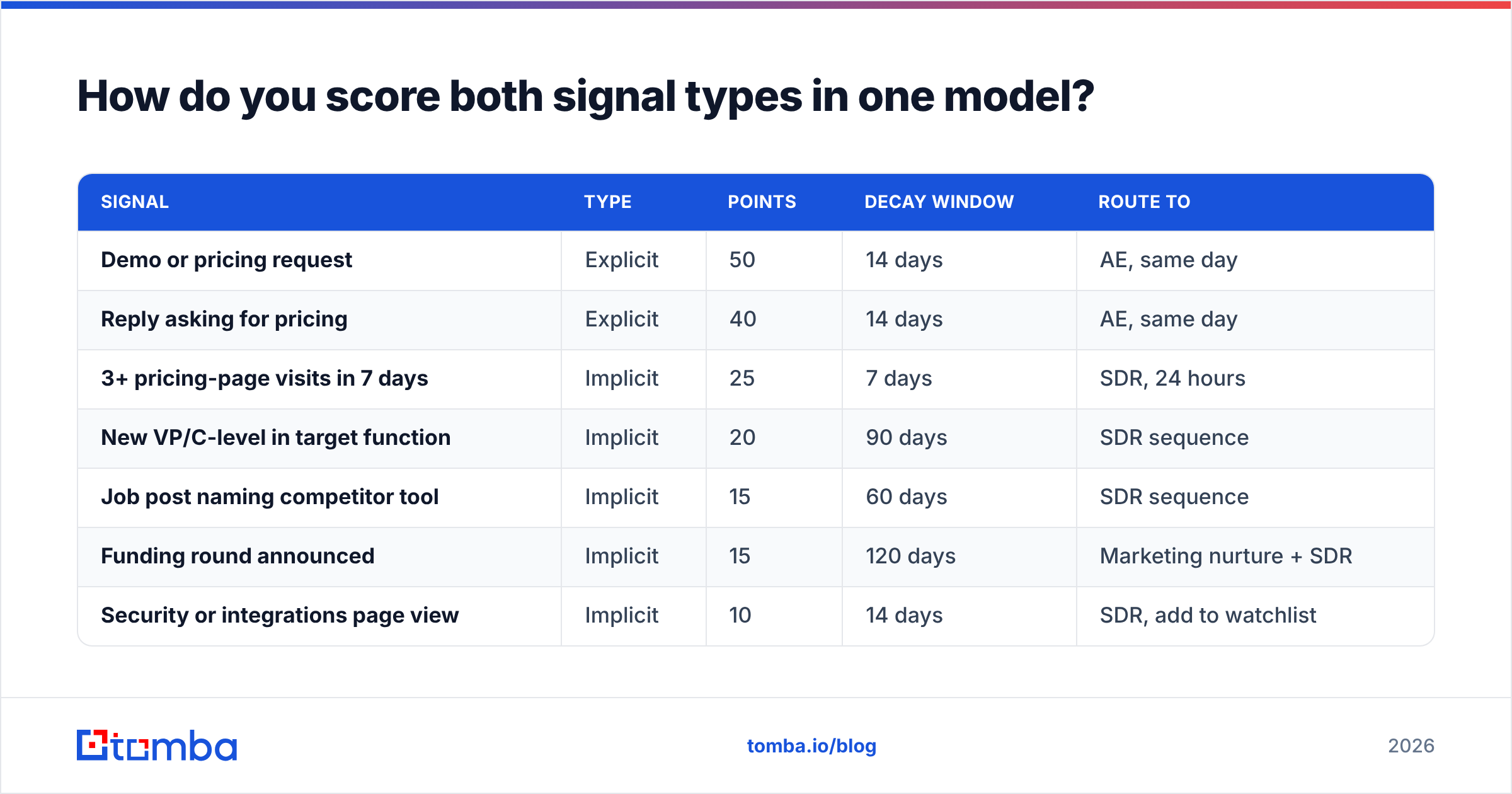
Use additive points with time decay, and separate intent from fit. Fit answers "should we ever sell to them"; intent answers "should we call them today." A perfect-fit account with zero intent is a nurture target, not a call.
| Signal | Type | Points | Decay window | Route to |
|---|---|---|---|---|
| Demo or pricing request | Explicit | 50 | 14 days | AE, same day |
| Reply asking for pricing | Explicit | 40 | 14 days | AE, same day |
| 3+ pricing-page visits in 7 days | Implicit | 25 | 7 days | SDR, 24 hours |
| New VP/C-level in target function | Implicit | 20 | 90 days | SDR sequence |
| Job post naming competitor tool | Implicit | 15 | 60 days | SDR sequence |
| Funding round announced | Implicit | 15 | 120 days | Marketing nurture + SDR |
| Security or integrations page view | Implicit | 10 | 14 days | SDR, add to watchlist |
| Newsletter open only | Implicit | 2 | 30 days | No action |
Two rules keep this model honest. First, decay is not optional — a pricing-page visit from March is not evidence in August, and models without decay slowly promote everyone to hot. Second, cap any single implicit category so one noisy source (usually web analytics) cannot manufacture a hot account by itself. Require at least two independent signal families before a rep is allowed to spend an hour.
If your team distinguishes between an MQL and a sales-accepted lead, this is where the definition should live: an MQL is a threshold score, not a form fill.

Where does the signal data actually come from?#
You need four separate pipes, and most stacks are missing at least two.
- First-party web data. Your analytics tool tells you a session happened; it does not tell you which company. Reverse-IP and identity resolution turn anonymous sessions into named accounts — that is what website visitor reveal is for. Expect to identify a meaningful minority of B2B traffic, not all of it.
- Public firmographic and hiring data. Job boards, press releases, and company pages. Cheap, high-signal, and underused because it requires scheduled scraping rather than a purchase order.
- Third-party intent providers. Aggregated research activity across publisher networks. Useful for topic-level coverage; treat account-level precision claims with healthy skepticism and validate against your own closed-won data.
- Contact resolution and enrichment. The step that converts an account-level signal into a person you can email. This is where a data enrichment layer earns its keep — you take a domain and a role, and get back a verified, deliverable address for the person who actually owns the problem.
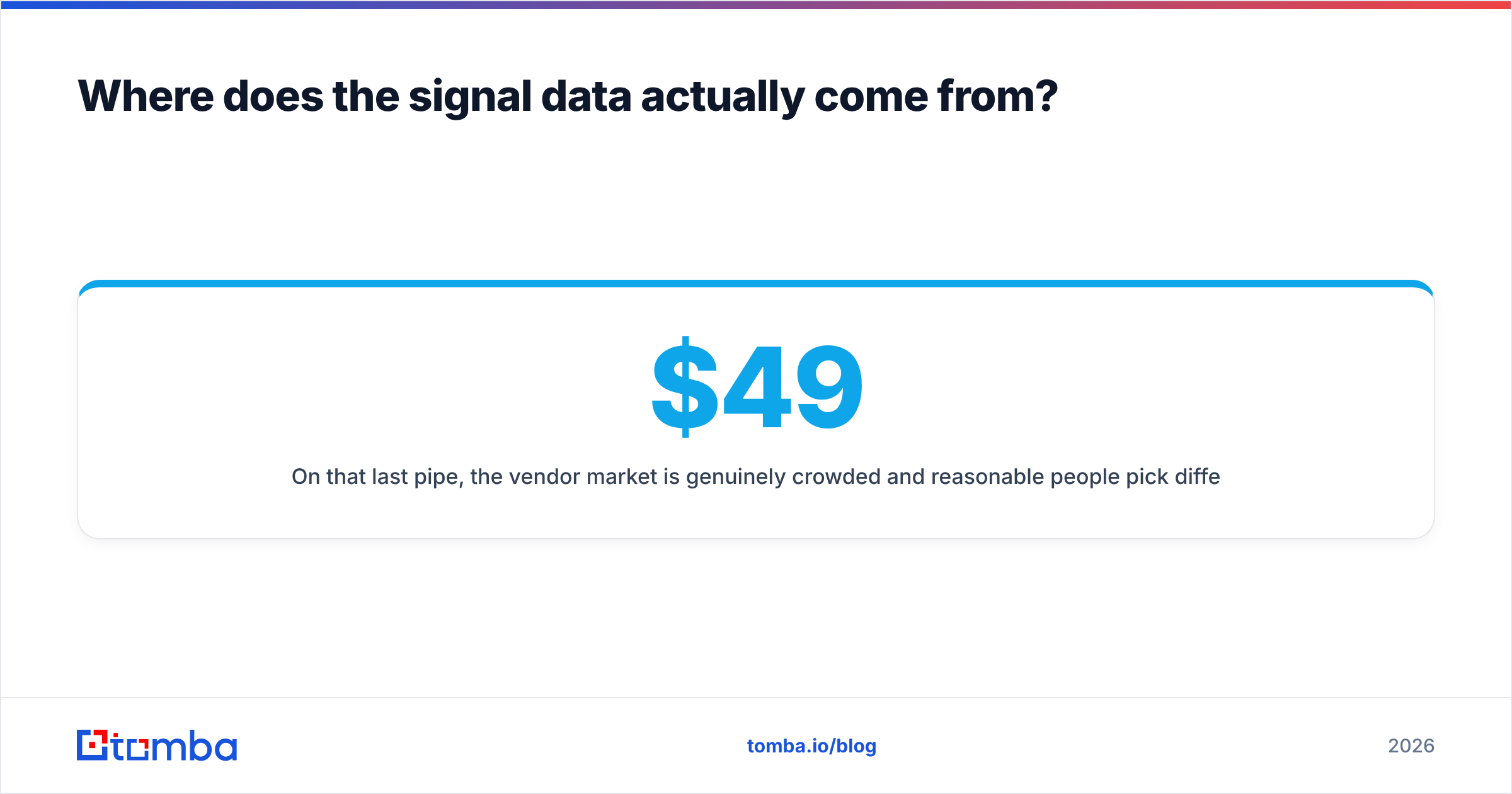
On that last pipe, the vendor market is genuinely crowded and reasonable people pick differently. Tomba is strong when you are resolving signals in real time from a domain or a name — its email finder and domain search both run through a single API, and pricing starts at a free tier of 25 searches per month, then $49/mo Starter, $99/mo Growth, and $249/mo Pro. Static list vendors like BookYourData are a solid fit for a different job — buying a pre-built, filtered contact list up front rather than resolving accounts on demand. Both approaches are legitimate; they just sit at opposite ends of the "known in advance" vs "discovered from a signal" spectrum. Independent user reviews on G2 are the fastest sanity check before you commit budget to either.
What does a combined signal workflow look like end to end?#
A working play, in order:
Step 1 — Detect. Signal fires (three pricing views, new VP of Sales, competitor named in a job post). Push it into a queue with a timestamp, not into a dashboard nobody opens.
Step 2 — Aggregate. Wait for a second signal family or a score threshold. A single implicit signal should almost never trigger outbound; two correlated ones should trigger it within 24 hours.
Step 3 — Resolve. Convert the account into two or three named humans in the relevant function. Pull the title, the verified email, and where possible a direct line via a phone finder. One contact is fragile; three gives you a committee.
Step 4 — Verify. Run addresses through an email verifier before the sequence starts. Signal-based outbound tends to hit newer, less-crawled contacts, and unverified sends against a fresh domain is the fastest way to damage sender reputation.
Step 5 — Reference the signal, do not confess it. "Saw you're hiring an SDR manager — most teams add tooling before that seat lands" works. "Our system noticed you visited our pricing page four times" gets you blocked. Explicit signals earn a direct reference; implicit signals should be paraphrased as a hypothesis about their situation.
Step 6 — Measure by source. Track meeting rate and win rate separately for explicit-sourced and implicit-sourced pipeline. Within a quarter you will know which triggers deserve more points and which are decoration. HubSpot's sales blog has good baseline benchmarks if you need external comparison numbers.
What mistakes kill signal-based selling?#
- Treating every signal as equal. A newsletter open and a pricing request in the same scoring bucket produces a ranked list with no ranking.
- No decay. Without expiry, your "hot" list becomes an archive of everyone who ever visited.
- Account-level signals with no contact. The single most common failure. You identify 400 in-market accounts and email nine of them because that is all the addresses you had.
- Over-personalizing the surveillance. Naming the exact page and visit count reads as creepy, not clever. Reference the inferred problem instead.
- Ignoring negative signals. A cancelled renewal, a headcount drop, or a hiring freeze should subtract points. Most models only add.
- Never validating against closed-won. Every quarter, check which signals actually preceded revenue. Cut the ones that did not. This is basic RevOps hygiene and almost nobody does it.
So which should you build first?#
If you have inbound volume and slow response times, fix explicit signals first — an SLA costs nothing and compounds immediately. If your inbound is thin and your outbound is a static list, build implicit signal detection, because that is where the untapped volume lives.
Either way, the bottleneck ends up in the same place: a signal is only as useful as your ability to reach a real person behind it, quickly, with an address that lands. Start with Tomba Email Finder to turn detected accounts into verified, contactable decision-makers — the free tier gives you 25 searches a month to test the workflow before you commit, and the Tomba API lets you wire resolution directly into whatever fires your signals. Check Tomba pricing when you are ready to scale the play beyond a manual list.
Related guides#
Ready to find emails that actually work?
Join 150,000+ professionals who stopped guessing and started sending. Free credits on signup — no credit card required.
Get the Tomba newsletter
Practical outbound tactics and product updates — once every two weeks.
About the author