Extruct AI vs Generect 2026: Which B2B Data Tool Wins?
Extruct AI researches companies with AI agents. Generect delivers LinkedIn-sourced leads and contacts. They solve different halves of the same problem — here is which one belongs in your stack, and where a dedicated email layer beats both.
TL;DR
- They are not the same category. Extruct AI is an agentic company-research platform (build and enrich lists of companies with AI agents). Generect is a lead-data provider focused on people-level records sourced largely from LinkedIn.
- Pick Extruct AI when your bottleneck is account selection — finding and qualifying the right companies against fuzzy criteria that no static filter can express.
- Pick Generect when your bottleneck is contact supply — you already know the accounts and need names, titles, emails and LinkedIn URLs at volume, via UI or API.
- Neither is a verification layer. Both hand you addresses you still have to validate before an ESP touches them. That is where a dedicated email verifier earns its keep.
- Most teams end up with two tools, not one. Research/targeting on one side, contact discovery plus verification on the other.
What problem does each tool actually solve?#
Start here, because the "vs" framing hides the real difference: these products sit at different stages of the same pipeline.
Extruct AI is built around AI research agents that browse the open web on your behalf. You describe a target profile in natural language — "Series A–B fintechs in the EU that recently launched an embedded-payments product and employ 50–300 people" — and the platform assembles a company table, then fills columns by researching each row. The output is a spreadsheet of accounts with custom, evidence-backed attributes.
Generect is built around a lead database and real-time search. You define filters — industry, headcount, geography, seniority, job title — and get back people: name, role, company, LinkedIn profile, and contact data. It leans heavily on LinkedIn-style search semantics and exposes an API so engineering teams can pull leads programmatically rather than exporting CSVs by hand.
In plain terms: Extruct AI answers "which companies should we go after and why?" Generect answers "who do I email at these companies?"
That distinction drives everything below — pricing logic, accuracy expectations, and where each one breaks.
Extruct AI vs Generect: how do they compare head to head?#
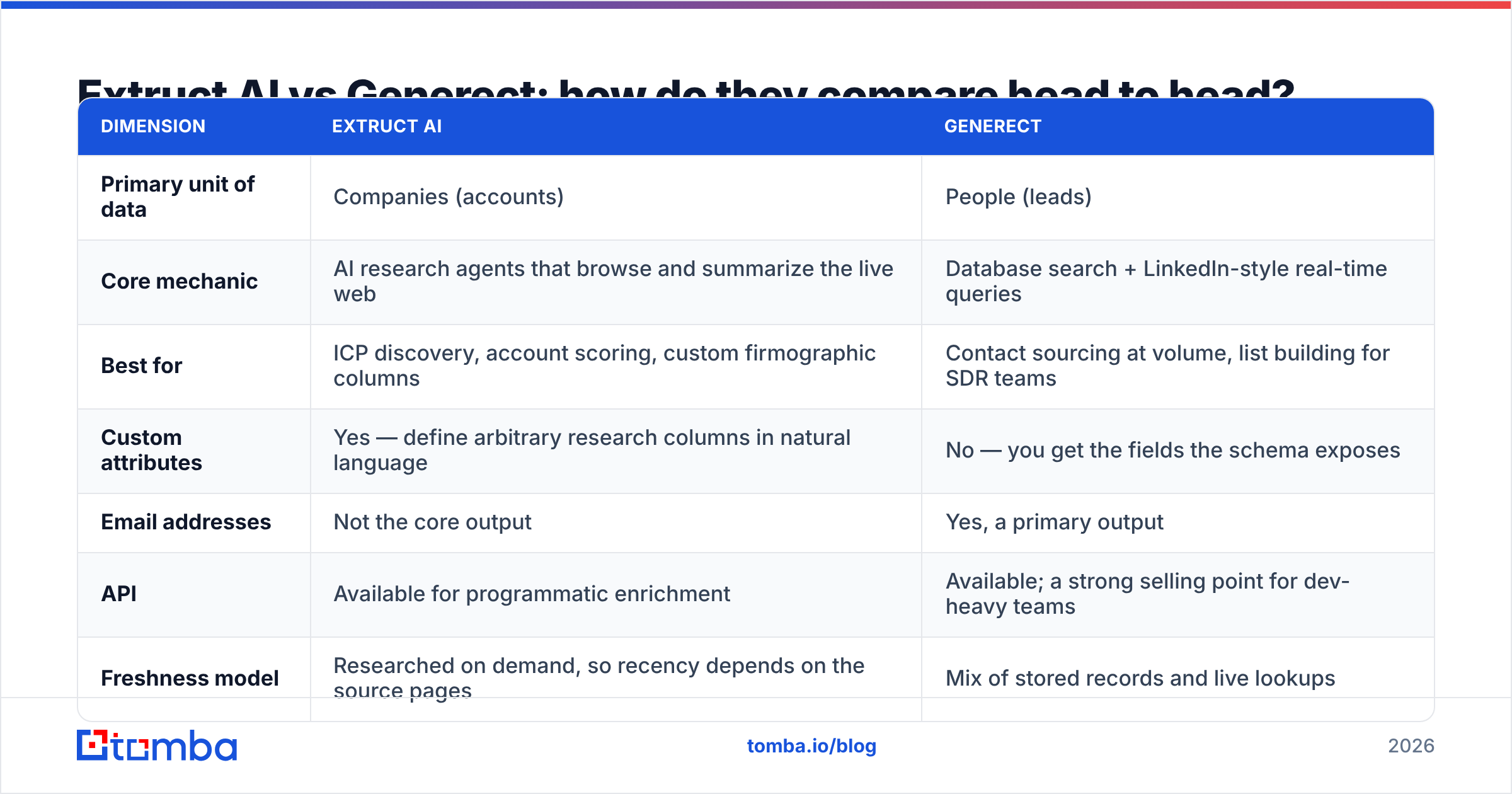
| Dimension | Extruct AI | Generect |
|---|---|---|
| Primary unit of data | Companies (accounts) | People (leads) |
| Core mechanic | AI research agents that browse and summarize the live web | Database search + LinkedIn-style real-time queries |
| Best for | ICP discovery, account scoring, custom firmographic columns | Contact sourcing at volume, list building for SDR teams |
| Custom attributes | Yes — define arbitrary research columns in natural language | No — you get the fields the schema exposes |
| Email addresses | Not the core output | Yes, a primary output |
| API | Available for programmatic enrichment | Available; a strong selling point for dev-heavy teams |
| Freshness model | Researched on demand, so recency depends on the source pages | Mix of stored records and live lookups |
| Typical buyer | Founders, GTM/RevOps, growth teams building targeting logic | SDR managers, agencies, lead-gen shops, developers |
| Learning curve | Higher — you are writing prompts and designing schemas | Lower — filter, preview, export |
| Verification included | No | Limited; treat exports as needing an external check |
Pricing on both sides moves often and is partly quote-based, so check the vendors' own pages before you budget. The pattern to expect: Extruct AI charges around research/agent runs and credits (you pay per column researched, not per name), while Generect charges around lead volume and API usage. Those are fundamentally different meters, and comparing "cost per record" between them is close to meaningless. Compare cost per qualified meeting instead.

Is Extruct AI better than Generect for building a target list?#
For account selection, yes — and it is not particularly close.
Traditional databases force your ICP through a fixed filter set: SIC code, headcount band, tech stack, funding round. That works when your ICP is expressible in those terms. It fails the moment your best-fit signal is something like "has a careers page hiring two or more RevOps roles" or "mentions SOC 2 compliance on the pricing page" or "recently migrated off a competitor."
Extruct AI's agentic approach handles exactly those cases. You add a column, describe what you want found, and the agent goes and reads. The catch is the one that applies to every AI research tool:
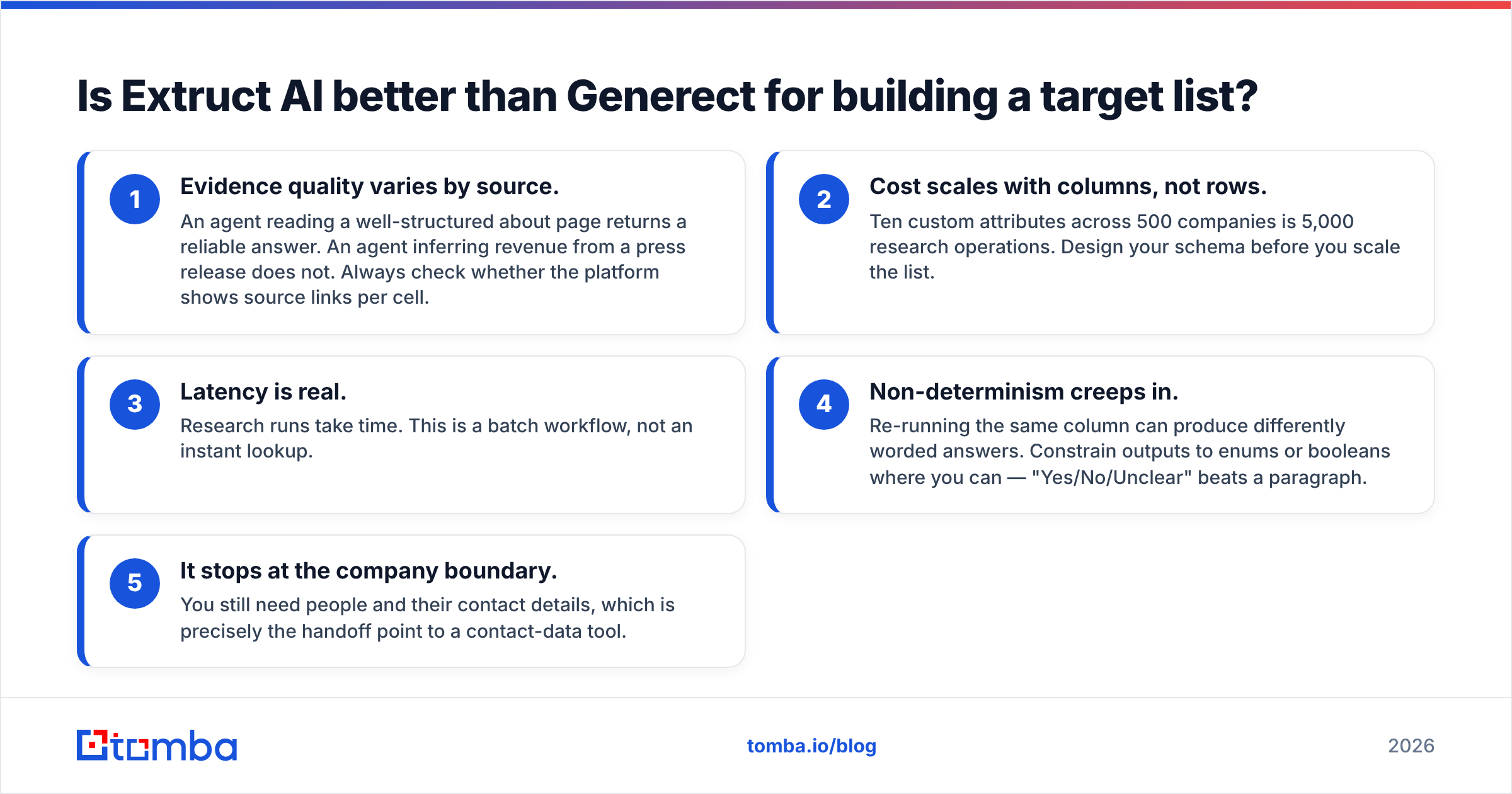
- Evidence quality varies by source. An agent reading a well-structured about page returns a reliable answer. An agent inferring revenue from a press release does not. Always check whether the platform shows source links per cell.
- Cost scales with columns, not rows. Ten custom attributes across 500 companies is 5,000 research operations. Design your schema before you scale the list.
- Latency is real. Research runs take time. This is a batch workflow, not an instant lookup.
- Non-determinism creeps in. Re-running the same column can produce differently worded answers. Constrain outputs to enums or booleans where you can — "Yes/No/Unclear" beats a paragraph.
- It stops at the company boundary. You still need people and their contact details, which is precisely the handoff point to a contact-data tool.
Generect can also produce company-level lists, but it does so with filters, not reasoning. If your ICP fits standard firmographics, that is faster and cheaper. If it does not, no amount of filtering gets you there.
Is Generect better than Extruct AI for contact data?#
Yes, because that is what it is for.
Generect's value is people-level supply: filter by role and seniority, pull the matching contacts, and push them into a sequencer or CRM. The API matters more than the UI for most serious users — teams building an internal prospecting service want to call an endpoint from their own workflow rather than babysit exports. If you have engineers and a data pipeline, that is a genuine advantage over UI-only databases.
Where you should apply pressure during evaluation:
- Ask for the bounce rate, not the "accuracy rate." Vendors define accuracy differently. Bounce rate on your own domain and your own ICP is the only number that pays your bills.
- Test your actual segment. LinkedIn-sourced data skews toward tech, SaaS and English-speaking markets. Manufacturing in Germany or logistics in Brazil will look very different. Run a 200-row sample before signing anything.
- Check catch-all handling. A large share of B2B domains accept every address at the SMTP layer, so "valid" often means "unknown." A catch-all verifier is the only honest way to separate those.
- Ask what happens on a miss. Are you charged for a row with no email? Credit policies on failed lookups quietly determine your real per-lead cost.
- Confirm compliance posture. GDPR/CCPA handling, opt-out flows and data-subject requests are your liability once the data is in your CRM. Peer reviews on G2 are useful here because compliance complaints show up in reviews long before they show up in marketing pages.
Which one fits your team? A decision framework#
Use the shape of your bottleneck, not the feature list.
- You have too few good accounts. Your reps burn time researching whether a company is even worth a touch. → Extruct AI. Encode the research into columns and let the agent do the reading.
- You have too few contacts at known accounts. Targeting is settled; the list is starving. → Generect, or any high-volume contact source with an API.
- You have plenty of contacts but a bounce problem. Deliverability is dropping and replies are flat. → Neither. You need verification and list hygiene, not more data.
- You are a two-person team doing everything manually. → Start with a contact source plus verification. Agentic research is a force multiplier only after your targeting logic exists.
- You are an agency running many client ICPs. → Both, plus an API layer. The research tool defines each client's ICP; the contact tool fills it; a verification API keeps the sending domains alive.
- You are engineering-led and want one integration. → Prioritize whichever vendor's API documentation you can read in ten minutes and test with a curl command.

What do both tools leave out of your stack?#
The same thing: a dependable, verified contact layer that you control.
Extruct AI gives you accounts with rich context and no reliable inbox to write to. Generect gives you inboxes with less context and a verification question mark attached. Neither is a flaw in the product — it is a scope boundary. But it means most teams still need a third component.
That component has three jobs:
- Find the address from a name and domain. Once your research tool has produced the account list and your CRM has the contact name, a dedicated email finder closes the last mile without you buying another full database seat.
- Sweep a domain for whoever exists. When you do not have a specific name, domain search returns the published addresses and the company's email pattern, which is often faster than filtering a database for the same company.
- Verify before you send. Every list — bought, scraped, researched or inferred — gets checked. A bounce rate above roughly 3% starts damaging sender reputation, and reputation damage is far more expensive than verification credits.
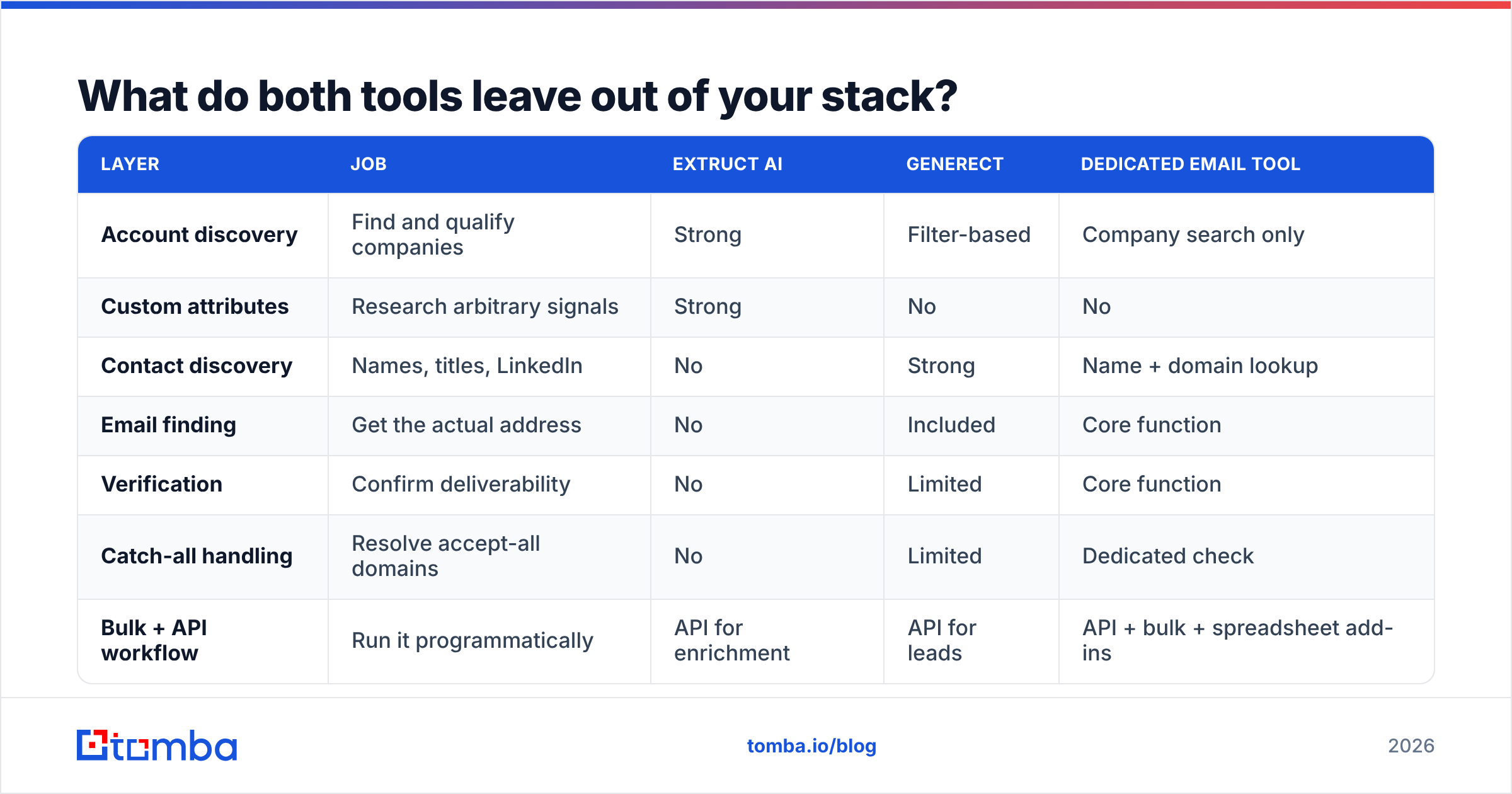
Here is how the layers stack up in practice:
| Layer | Job | Extruct AI | Generect | Dedicated email tool |
|---|---|---|---|---|
| Account discovery | Find and qualify companies | Strong | Filter-based | Company search only |
| Custom attributes | Research arbitrary signals | Strong | No | No |
| Contact discovery | Names, titles, LinkedIn | No | Strong | Name + domain lookup |
| Email finding | Get the actual address | No | Included | Core function |
| Verification | Confirm deliverability | No | Limited | Core function |
| Catch-all handling | Resolve accept-all domains | No | Limited | Dedicated check |
| Bulk + API workflow | Run it programmatically | API for enrichment | API for leads | API + bulk + spreadsheet add-ins |
Costs matter here too. Tomba's own pricing runs a free tier at 25 searches per month, Starter at $49/mo, Growth at $99/mo and Pro at $249/mo, with Enterprise quoted. That sits alongside a research or database platform rather than replacing it — which is exactly the point. You are not paying twice for the same record; you are paying for a different job.
How should you run a fair 30-day evaluation?#
Do not evaluate on demo data. Vendors curate demos toward their strongest segments.
Week 1 — define the test set. Pick 200 real target accounts you already know something about. Include at least 40 that fall outside your comfort segment (wrong geography, non-tech industry, sub-20 headcount). This is where data providers separate.
Week 2 — run both tools on it. In Extruct AI, define three or four research columns that map to actual qualification criteria your reps use today. In Generect, pull contacts for two seniority bands at the same accounts. Track coverage (what percentage of rows came back filled) and credit burn separately.
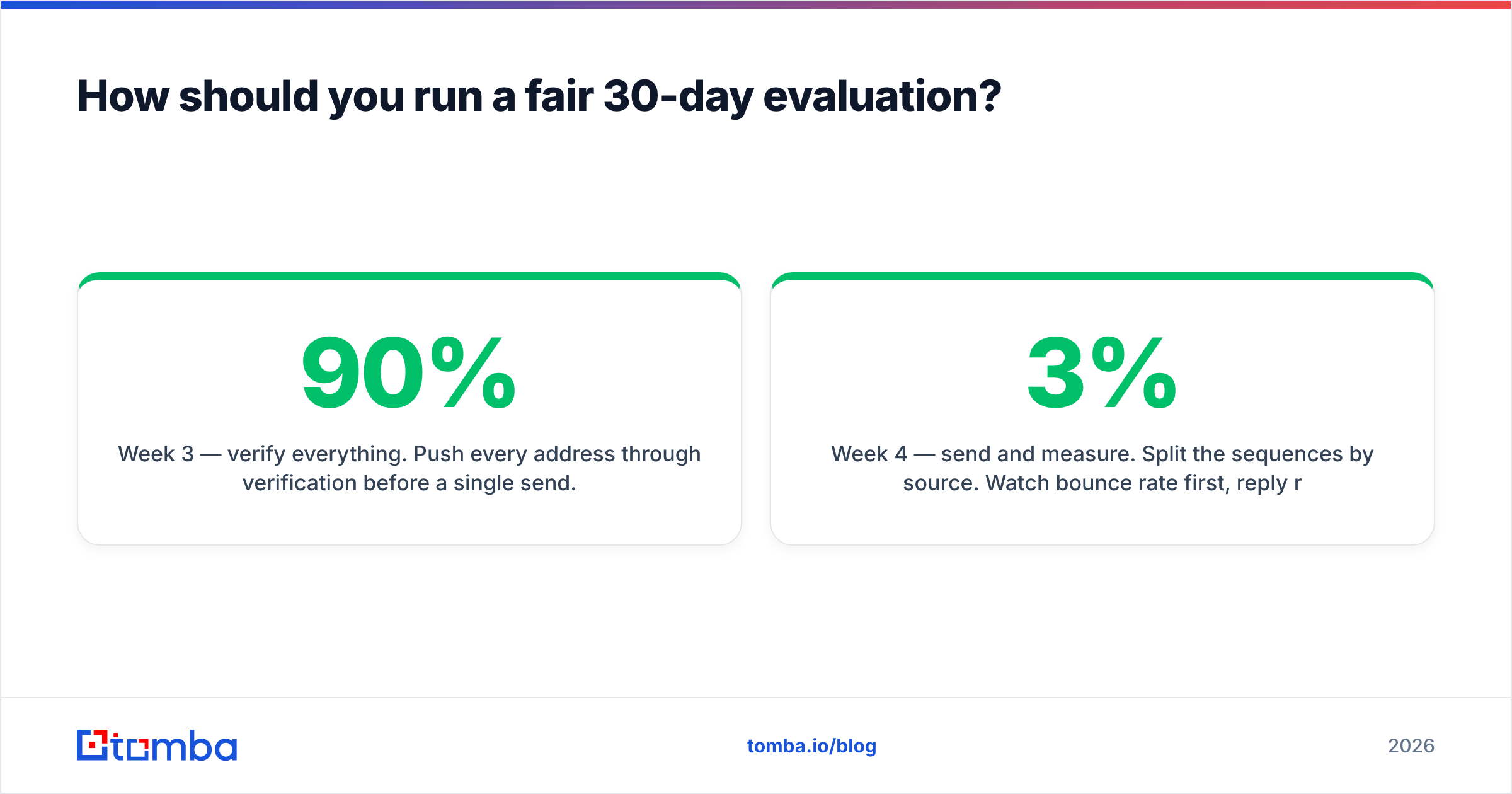
Week 3 — verify everything. Push every address through verification before a single send. Record valid / invalid / catch-all / unknown as four separate buckets. A provider that returns 90% "valid" and 30% catch-alls is not the same as one returning 70% valid with 5% catch-alls — the second is usually better.
Week 4 — send and measure. Split the sequences by source. Watch bounce rate first, reply rate second. If bounce rate crosses 3%, pause and fix the hygiene problem before you judge the copy. Frameworks from teams like HubSpot on list health apply here regardless of which vendor supplied the data.
Score at the end on four numbers: coverage, bounce rate, cost per verified contact, and cost per booked meeting. Only the last one actually matters, but the first three explain it.
What is the verdict on Extruct AI vs Generect?#
Extruct AI wins targeting. Generect wins supply. If you must choose one, choose based on which half of your funnel is starving.
- If your reps are working a list nobody believes in, buy research. Better accounts beat more contacts every time.
- If your targeting is solid and your sequencer is idle, buy contacts. Agentic research on an already-validated ICP is an expensive way to confirm what you know.
- If you are unsure, run the 30-day test above. Four weeks of real data costs less than a year of the wrong subscription.
And whichever you pick, budget for the layer neither one owns. Research tools produce accounts. Databases produce records. Deliverability is produced by verification, and it is the only part of this stack that protects the asset you cannot re-buy: your sending domain.
Ready to close the last mile?#
Add the contact layer that both platforms leave open. Tomba Email Finder turns a name and a domain into a verified, deliverable address — with a free tier at 25 searches per month, Starter at $49/mo, and a Tomba API that drops straight into whatever pipeline you have already built around Extruct AI, Generect, or both. Run your next 200-account test list through it and compare bounce rates against your current source. That single number will settle the tooling debate faster than any feature comparison.
Related guides#
Ready to find emails that actually work?
Join 150,000+ professionals who stopped guessing and started sending. Free credits on signup — no credit card required.
Get the Tomba newsletter
Practical outbound tactics and product updates — once every two weeks.
About the author