Extruct AI vs Lead411: Which B2B Data Tool Wins in 2026?
Extruct AI builds researched company lists with AI agents. Lead411 sells verified contacts with intent signals. They solve different halves of the same problem — here is which one your team actually needs, and where a cheaper finder beats both.
TL;DR
- They are not the same category. Extruct AI is an AI research agent that builds and enriches company lists from the open web. Lead411 is a contact database that sells verified people — emails, direct dials, and buying-intent signals.
- Pick Extruct AI when your ICP is weird, narrow, or unlistable in a standard database ("Series A fintechs in the EU that just shipped a SOC 2 page").
- Pick Lead411 when your ICP is standard, you need direct dials, and you want intent triggers baked into the same seat.
- Neither is a cheap email layer. Both charge database or seat prices for contact data you can source for a fraction of the cost through a dedicated email finder or API.
- The common 2026 stack is company discovery (Extruct or manual) → contact resolution (finder API) → verification → sequencer. Buying one all-in-one seat rarely covers all four well.
What is Extruct AI, and what problem does it actually solve?#
Extruct AI is an AI-agent research tool for building company lists. You describe the kind of company you want, and agents crawl the web — websites, job boards, news, filings, product pages — to return a spreadsheet where each column is a research question you asked in plain English.
That last part matters. A traditional database gives you fixed fields: industry, headcount, revenue band, tech stack. Extruct gives you fields that do not exist in any database, because it goes and reads for them. "Does this company have an in-house SDR team?" "Did they mention AI in their last three blog posts?" "Do they sell to hospitals?" Each becomes a column, filled by an agent that cites what it found.
Think of it as the difference between a phone book and a research assistant. The phone book is faster and cheaper when the name you want is in it. The assistant is the only option when it is not.
Where Extruct is weaker: contact data. It is built around accounts, not people. You will finish a run with 400 exquisitely qualified companies and no reliable way to email anyone at them. That gap is deliberate — it is a company-research product, not a contact database — but it is the single biggest thing buyers get wrong when they compare it against Lead411.
What is Lead411, and who is it built for?#
Lead411 is a long-running B2B sales intelligence provider: a contact and company database with verified emails, direct-dial mobile numbers, growth signals, and Bombora-powered buying intent. It is a seat-based SaaS product with a Chrome extension, CRM sync, and — the thing it markets hardest — "unlimited" contact viewing on its main tier, subject to export caps and fair-use policies.
Its buyer is a mid-market SDR team with a conventional ICP. If you sell to VPs of Engineering at 200–2,000-person US software companies, Lead411 has already indexed most of them. You filter, you export, you dial. The intent layer tells you which accounts are researching your category this week, which is genuinely useful timing data you cannot reconstruct on your own.
Its weaknesses are the standard weaknesses of every static B2B database. Coverage is strongest in North America and thins out fast in EMEA and APAC. Direct-dial accuracy varies by seniority and industry. And the "unlimited" claim is bounded by export limits that most teams hit in month two — read the plan terms before you assume you can bulk-dump 50,000 rows.

Extruct AI vs Lead411: how do they compare head-to-head?#
Here is the honest side-by-side, with a dedicated finder in the third column for cost reference — because most teams end up buying two of these three, not one.
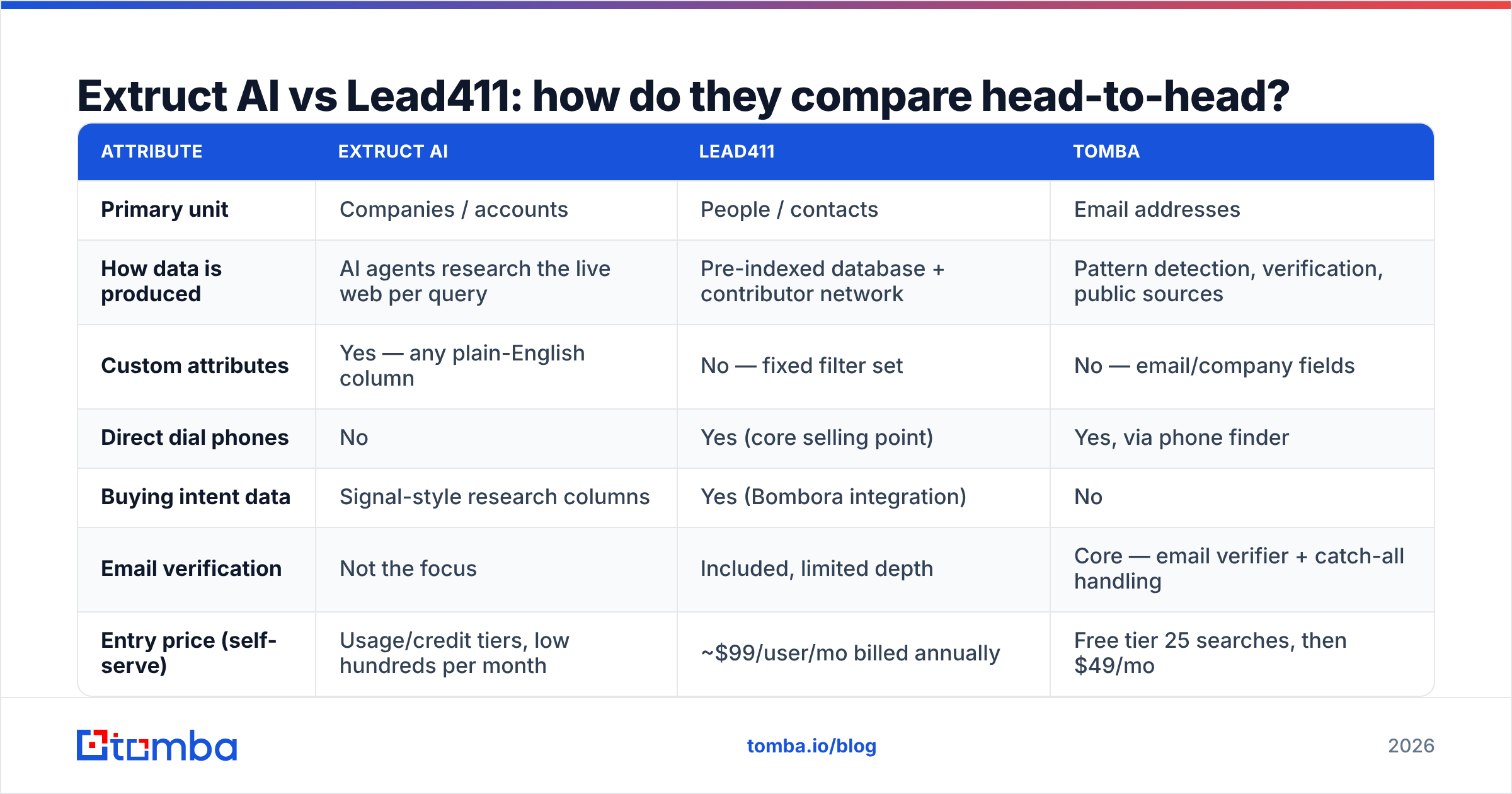
| Attribute | Extruct AI | Lead411 | Tomba |
|---|---|---|---|
| Primary unit | Companies / accounts | People / contacts | Email addresses |
| How data is produced | AI agents research the live web per query | Pre-indexed database + contributor network | Pattern detection, verification, public sources |
| Custom attributes | Yes — any plain-English column | No — fixed filter set | No — email/company fields |
| Direct dial phones | No | Yes (core selling point) | Yes, via phone finder |
| Buying intent data | Signal-style research columns | Yes (Bombora integration) | No |
| Email verification | Not the focus | Included, limited depth | Core — email verifier + catch-all handling |
| Entry price (self-serve) | Usage/credit tiers, low hundreds per month | ~$99/user/mo billed annually | Free tier 25 searches, then $49/mo |
| API access | Yes | On higher tiers | Yes on all paid plans — Tomba API |
| Best at | Finding companies nobody else can list | Dialing standard ICPs with timing signals | Turning a company list into a valid inbox list |
| Weak at | Reaching a named human | Non-US coverage, exotic ICPs | Company discovery and intent |
Pricing on both vendors moves; treat the numbers above as directional and confirm on their own pricing pages before you budget. Public G2 listings are a useful sanity check on how each one actually performs for teams like yours, since both vendors curate their own case studies.
Which one fits your ICP?#
The decision collapses to one question: can a standard filter set describe your buyer?
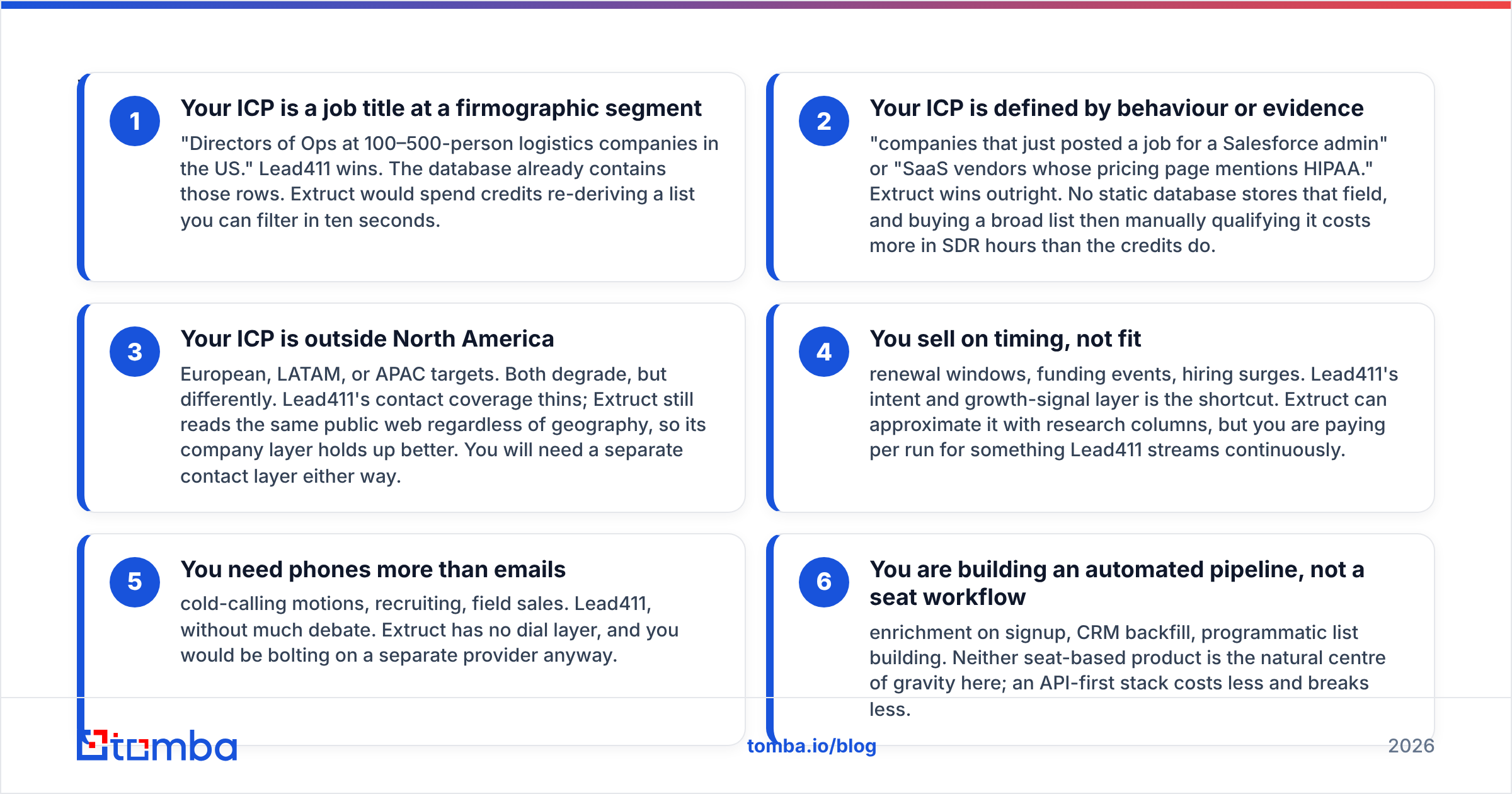
- Your ICP is a job title at a firmographic segment — "Directors of Ops at 100–500-person logistics companies in the US." Lead411 wins. The database already contains those rows. Extruct would spend credits re-deriving a list you can filter in ten seconds.
- Your ICP is defined by behaviour or evidence — "companies that just posted a job for a Salesforce admin" or "SaaS vendors whose pricing page mentions HIPAA." Extruct wins outright. No static database stores that field, and buying a broad list then manually qualifying it costs more in SDR hours than the credits do.
- Your ICP is outside North America — European, LATAM, or APAC targets. Both degrade, but differently. Lead411's contact coverage thins; Extruct still reads the same public web regardless of geography, so its company layer holds up better. You will need a separate contact layer either way.
- You sell on timing, not fit — renewal windows, funding events, hiring surges. Lead411's intent and growth-signal layer is the shortcut. Extruct can approximate it with research columns, but you are paying per run for something Lead411 streams continuously.
- You need phones more than emails — cold-calling motions, recruiting, field sales. Lead411, without much debate. Extruct has no dial layer, and you would be bolting on a separate provider anyway.
- You are building an automated pipeline, not a seat workflow — enrichment on signup, CRM backfill, programmatic list building. Neither seat-based product is the natural centre of gravity here; an API-first stack costs less and breaks less.
Is either one good value for contact data?#
This is where both tools get expensive for the wrong reason.
Lead411 charges per seat, and its value is concentrated in intent plus direct dials. If your team uses neither — you run email-only outbound and ignore intent — you are paying roughly $99 per user per month for email addresses that a dedicated finder returns for a fraction of that. Three seats is about $3,600 a year for a capability you can cover with a $49/mo plan plus an API key.
Extruct charges per research run. Its value is concentrated in the columns, not the contacts. Spending agent credits to guess at email addresses is the most expensive possible way to get them, and accuracy will not match a purpose-built verification pipeline that runs SMTP checks and catch-all logic.
The efficient split looks like this:
- Discovery layer — Extruct AI (or a manual list, or your CRM) decides which companies.
- Contact layer — a finder API resolves which humans, via domain search across each account.
- Quality layer — verification kills invalids and flags catch-alls before they touch your sender reputation.
- Execution layer — your sequencer or dialer.
Lead411 tries to be layers 1–3 in one seat. Extruct is layer 1 done exceptionally well. Neither is layer 3 done well, and layer 3 is what determines whether your domain survives the quarter.

What does the data quality difference look like in practice?#
Run the same ICP through both and you get two different failure modes.
Lead411's failure mode is staleness. The record was accurate when it was indexed. Your prospect changed jobs in March, the database caught it in September, and you emailed a dead mailbox in June. This is not a Lead411-specific flaw — every static B2B database carries it, and the honest industry range for email decay is roughly 22–30% per year. It is why exports should be re-verified at send time regardless of what the vendor's own validity badge says.
Extruct's failure mode is inference. An agent reads a careers page and concludes the company has 40 engineers. Sometimes the page is two years old. Sometimes it is an agency posting on the company's behalf. The output is cited, which is more than most tools offer, but "cited" is not "correct" — you still need spot-checks on any column that drives a spend decision.
Practical mitigation for both: never trust an export unedited. Re-verify every email immediately before it enters a sequence, and treat catch-all domains as a separate bucket rather than a binary valid/invalid — a catch-all verifier will tell you which ones are actually safe to send to instead of forcing you to guess.
Are there better alternatives to both?#
Depends which half of the problem you are solving.
If you want a cheaper Lead411: the sales intelligence market is crowded — Apollo, Cognism, ZoomInfo, and BookYourData all overlap on verified B2B contacts, with BookYourData in particular worth a look if you prefer buying targeted lists outright rather than renting seat access. Compare on export limits and geography, not on total record count, which every vendor inflates the same way.
If you want a cheaper Extruct: there is no true like-for-like at a lower price yet. Agent-driven company research is a young category, and the closest substitutes are scraping stacks you maintain yourself or an analyst on contract. If the custom columns are load-bearing for your GTM, Extruct's credits are usually cheaper than the alternative.
If contacts are the actual bottleneck: skip the platform tax. A dedicated finder with per-search pricing, a real API, and bulk processing covers the same output for a fraction of the seat cost. Compare Tomba pricing against three Lead411 seats and the math is not close for email-led teams.
What is the verdict for 2026?#
Choose Lead411 if you dial, if your ICP is a US firmographic segment, and if buying-intent timing changes what your reps do on a given morning. It is a mature, well-priced product for exactly that motion, and the direct-dial layer is a real moat over any email-only tool.
Choose Extruct AI if your list does not exist yet. When qualification currently means an SDR opening 300 browser tabs, agent research pays for itself in the first month — and no filter-based database will ever produce those columns.
Choose both if you are well funded and your ICP is both narrow and phone-led. They genuinely do not overlap much.
Choose neither if what you actually needed was 5,000 verified email addresses at companies you already identified. That is a solved, commoditised problem, and paying sales-intelligence prices for it is the most common line item waste in outbound budgets.
Whichever discovery layer you land on, the contacts still have to be real. Run your Extruct account list or your Lead411 export through the Tomba Email Finder to resolve and verify addresses at the point of send — free tier covers 25 searches a month, paid plans start at $49/mo, and the API drops straight into whatever pipeline you have already built. Cheaper than a second seat, and your sender reputation will notice the difference.
Related guides#
Ready to find emails that actually work?
Join 150,000+ professionals who stopped guessing and started sending. Free credits on signup — no credit card required.
Get the Tomba newsletter
Practical outbound tactics and product updates — once every two weeks.
About the author