Extruct AI vs Seamless.AI: Which B2B Data Tool Wins in 2026?
Extruct AI builds company lists with research agents. Seamless.AI sells contact records at volume. They solve different halves of the same problem. Here is which one belongs in your stack, and where a dedicated email finder beats both.
TL;DR
- They are not the same category. Extruct AI is an AI research agent that builds and enriches company lists from the open web. Seamless.AI is a contact database that sells you names, emails, and phone numbers at volume.
- Pick Extruct AI when your ICP is hard to filter — "Series A robotics companies with an open hardware role and a SOC 2 badge" — and no static database has that field.
- Pick Seamless.AI when you already know which accounts you want and need a large volume of contacts inside them, fast, with a Chrome extension your SDRs will actually use.
- Neither is a great verifier. Both generate contact data that still needs an independent bounce check before it touches your sending domain.
- Most teams end up with two tools, not one: an account-discovery layer (Extruct AI or manual research) plus a precise, per-contact email finder that verifies before it charges you.
What problem is each tool actually solving?#
Start here, because the "vs" framing hides a category mismatch.
Think of building an outbound list as cooking dinner. Extruct AI is the shopper who walks the market and decides which ingredients are worth buying. Seamless.AI is the warehouse that sells you 10,000 units of an ingredient you already named. One narrows, the other supplies.
Extruct AI positions itself as an AI agent for company research. You define an ICP in plain language, point it at attributes you care about, and it runs agents across websites, job boards, filings, and news to build a spreadsheet of companies with custom columns you defined. The output is an account list with evidence attached.
Seamless.AI is a real-time B2B contact search engine. You filter by title, industry, size, and geography, then export contacts with emails and mobile numbers. It has been in market far longer, carries thousands of reviews on G2, and is built around SDR speed: search, click, push to CRM, dial.
So the honest framing of Extruct AI vs Seamless.AI is not "which is better." It is "which layer of the pipeline are you missing?"
How does Extruct AI work in practice?#
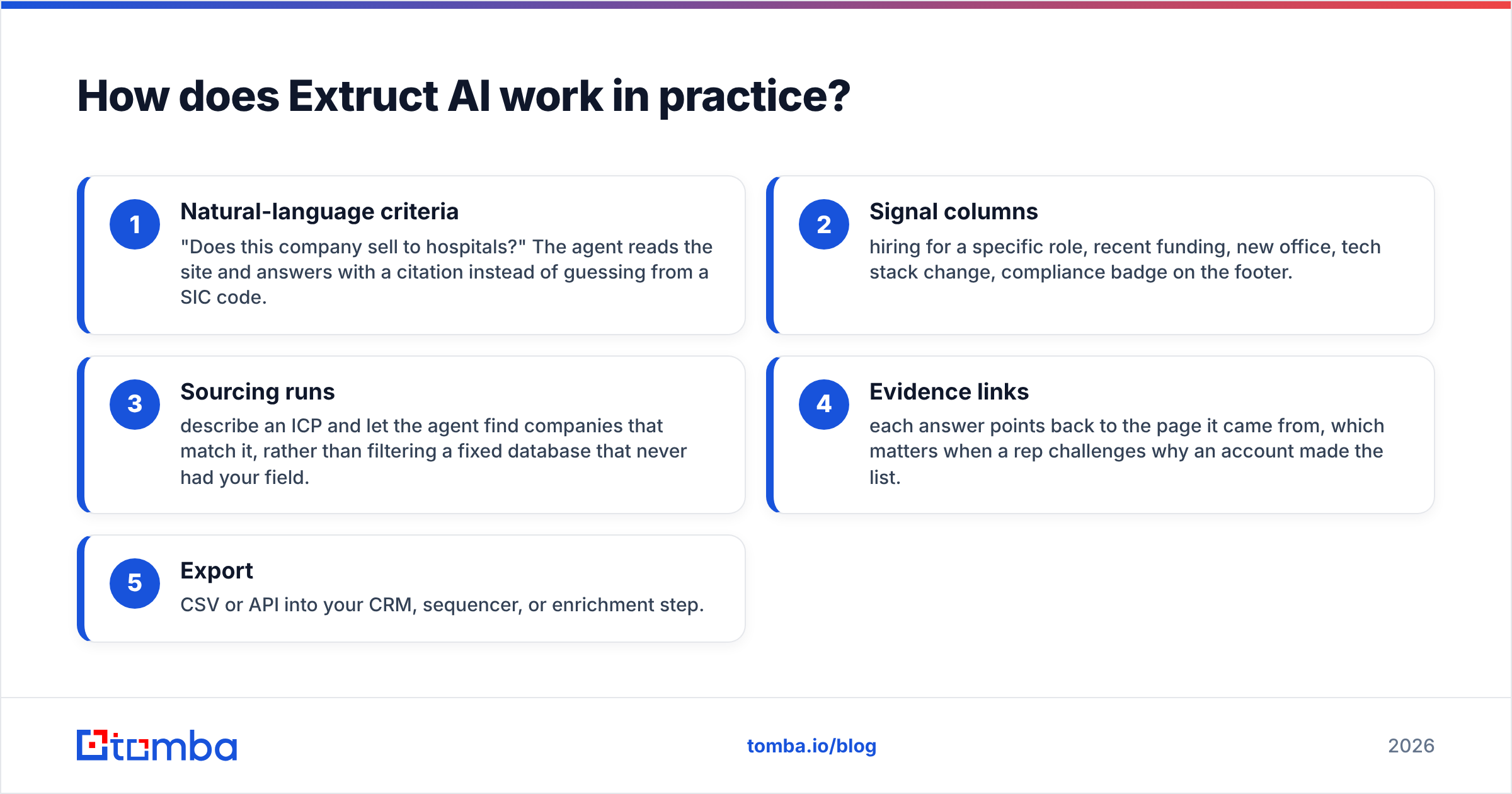
Extruct AI's core unit is the agentic column. You start with a list of companies (or ask it to source one), then add columns like:
- Natural-language criteria — "Does this company sell to hospitals?" The agent reads the site and answers with a citation instead of guessing from a SIC code.
- Signal columns — hiring for a specific role, recent funding, new office, tech stack change, compliance badge on the footer.
- Sourcing runs — describe an ICP and let the agent find companies that match it, rather than filtering a fixed database that never had your field.
- Evidence links — each answer points back to the page it came from, which matters when a rep challenges why an account made the list.
- Export — CSV or API into your CRM, sequencer, or enrichment step.
The trade-off is that agents cost time and tokens. Building a 500-account list with six custom research columns is not instant, and it is not free. You are paying for judgment, not for rows.
What Extruct AI does not do well is hand you a verified work email for the VP of Engineering at each of those 500 accounts. That is a different job, and it is the job Seamless.AI was built for.
How does Seamless.AI work in practice?#
Seamless.AI runs a search-and-append model. Its engine crawls and stitches public data in real time, then presents contacts matching your filters. Reps use the Chrome extension while browsing LinkedIn or a company site, save contacts to a list, and sync them to HubSpot, Salesforce, or an outbound sequencer.
Its strengths are volume, mobile-number coverage, and rep adoption. Its long-standing criticisms — visible in public review sites — cluster around three things: credit consumption that moves faster than expected, data accuracy that varies sharply by segment, and contract terms that are harder to exit than to enter. Pricing is quote-based rather than posted, so the number you pay depends on your negotiation more than on a published tier.
If you are evaluating it seriously, read the reviews by segment rather than the average star rating. Coverage of US mid-market SaaS is a different experience from coverage of European manufacturing or APAC logistics.
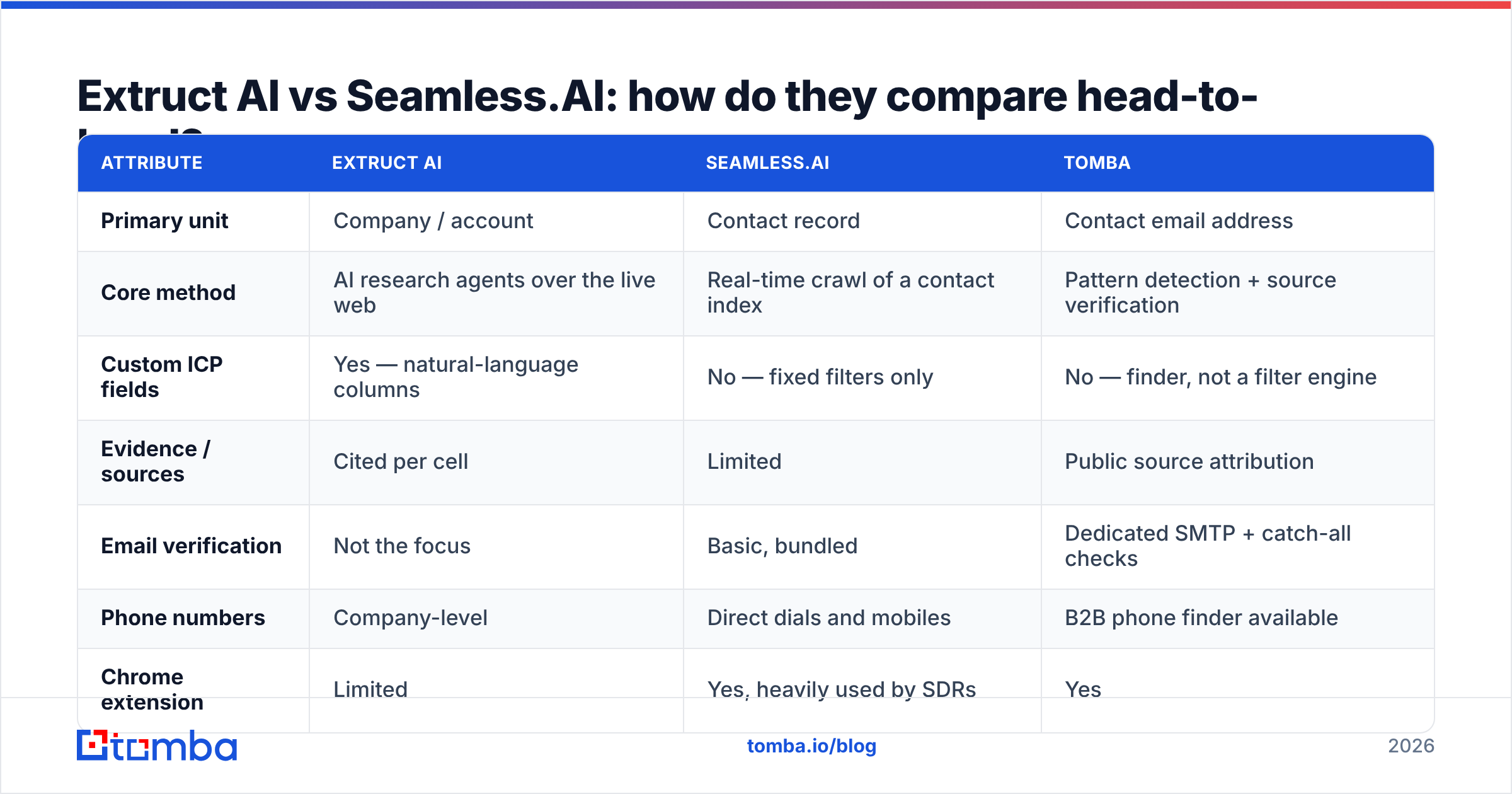
Extruct AI vs Seamless.AI: how do they compare head-to-head?#
| Attribute | Extruct AI | Seamless.AI | Tomba |
|---|---|---|---|
| Primary unit | Company / account | Contact record | Contact email address |
| Core method | AI research agents over the live web | Real-time crawl of a contact index | Pattern detection + source verification |
| Custom ICP fields | Yes — natural-language columns | No — fixed filters only | No — finder, not a filter engine |
| Evidence / sources | Cited per cell | Limited | Public source attribution |
| Email verification | Not the focus | Basic, bundled | Dedicated SMTP + catch-all checks |
| Phone numbers | Company-level | Direct dials and mobiles | B2B phone finder available |
| Chrome extension | Limited | Yes, heavily used by SDRs | Yes |
| API | Yes | Yes | Yes, documented and public |
| Pricing transparency | Partially public | Quote-based, sales-led | Fully public tiers |
| Best for | Finding which accounts to target | Filling accounts with contacts at volume | Getting the right address, verified |
The table makes the split obvious. Extruct AI answers who should be on the list. Seamless.AI answers who works there. A verification-first email finder answers which address will actually deliver.
Which one has better data accuracy?#
The answer depends on what you are measuring, and this is where most comparison posts get lazy.
Extruct AI's accuracy question is "is this claim about the company true?" Because the agent cites its source, you can audit it. In testing patterns reported by users, agent-extracted attributes hold up well when the claim is visible on a public page (pricing model, hiring signals, tech mentions) and degrade when the claim requires inference (revenue estimates, headcount for private companies, buying intent).
Seamless.AI's accuracy question is "will this email bounce?" That is a harder claim, and it is the one buyers get burned on. A record can be perfectly formatted, attached to a real human, and still be dead — the person left in March, the domain moved to a catch-all, or the address was a permutation guess that nobody ever tested.
Three practical rules regardless of which vendor you pick:
- Never trust a "verified" label you did not generate. Vendors define verified differently. Some mean syntax and MX record only.
- Re-verify anything older than 60 days. B2B contact data decays roughly 2–3% per month through job changes alone.
- Treat catch-all domains as a separate bucket. They accept everything at the SMTP layer and then silently drop mail. A catch-all verifier is the only way to score them properly, and a large share of enterprise domains fall here.
If your bounce rate is above 3%, mailbox providers start throttling you well before your rep notices. That is a deliverability problem masquerading as a data problem, which is why an independent email verifier belongs in the pipeline no matter which discovery tool you buy.

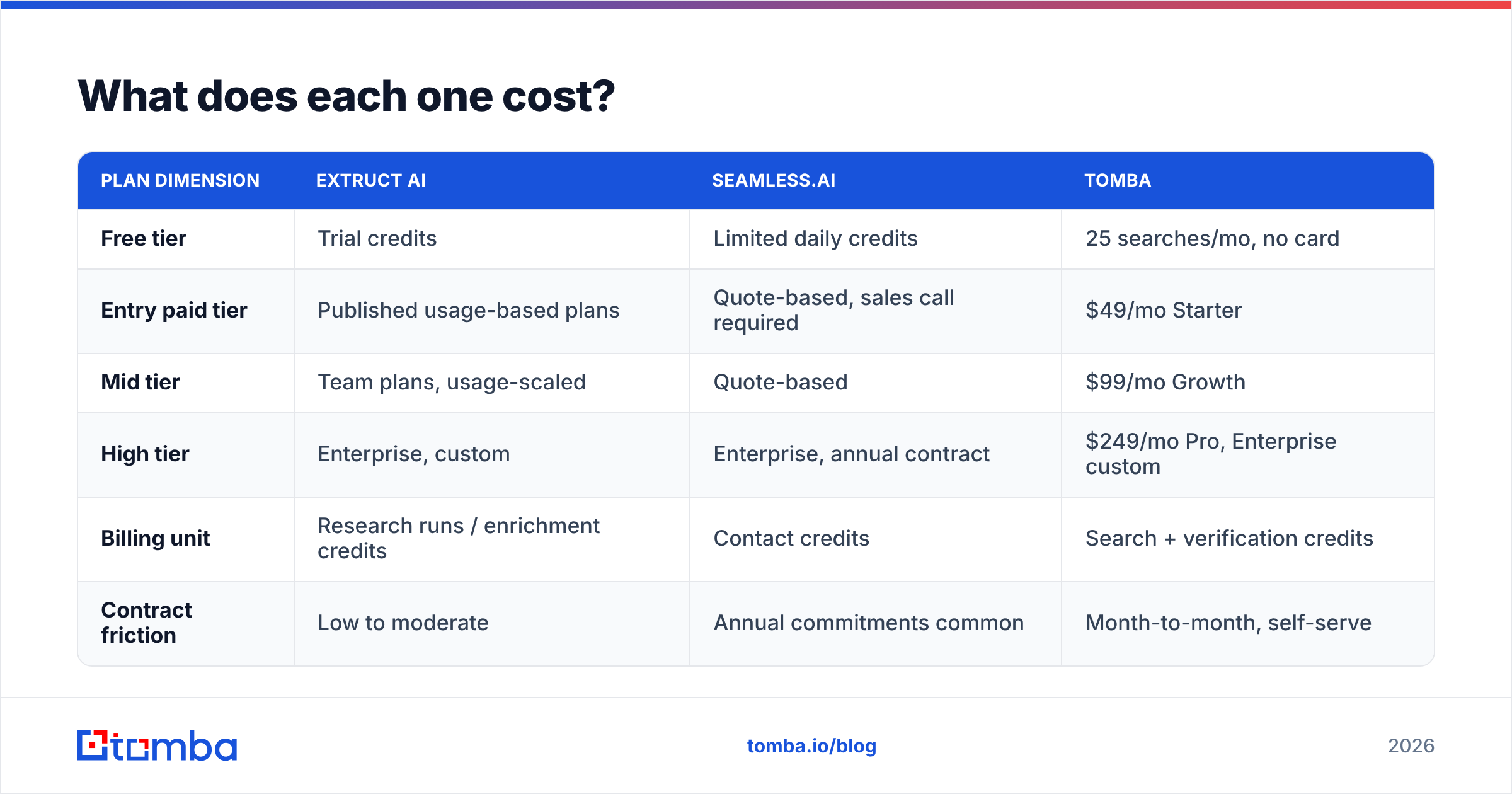
What does each one cost?#
| Plan dimension | Extruct AI | Seamless.AI | Tomba |
|---|---|---|---|
| Free tier | Trial credits | Limited daily credits | 25 searches/mo, no card |
| Entry paid tier | Published usage-based plans | Quote-based, sales call required | $49/mo Starter |
| Mid tier | Team plans, usage-scaled | Quote-based | $99/mo Growth |
| High tier | Enterprise, custom | Enterprise, annual contract | $249/mo Pro, Enterprise custom |
| Billing unit | Research runs / enrichment credits | Contact credits | Search + verification credits |
| Contract friction | Low to moderate | Annual commitments common | Month-to-month, self-serve |
Two things worth naming honestly. First, Extruct AI's agentic runs cost more per row than a database lookup because you are paying for live reading and reasoning, not for a cached record. That is fair value when the field does not exist anywhere else, and poor value when it does. Second, Seamless.AI's quote-based model means your effective cost per usable contact is unknowable until you have run a real campaign — and your usable-contact rate is the only number that matters. A $0.10 contact with a 40% bounce rate costs more than a $0.30 contact at 2%.
Compare that with fully published Tomba pricing, where the tiers are on the page and you can model cost per verified email before you sign anything. Teams specifically shopping the sales-led model often land on a Seamless.AI alternative for exactly that reason.
Which should you pick for your use case?#
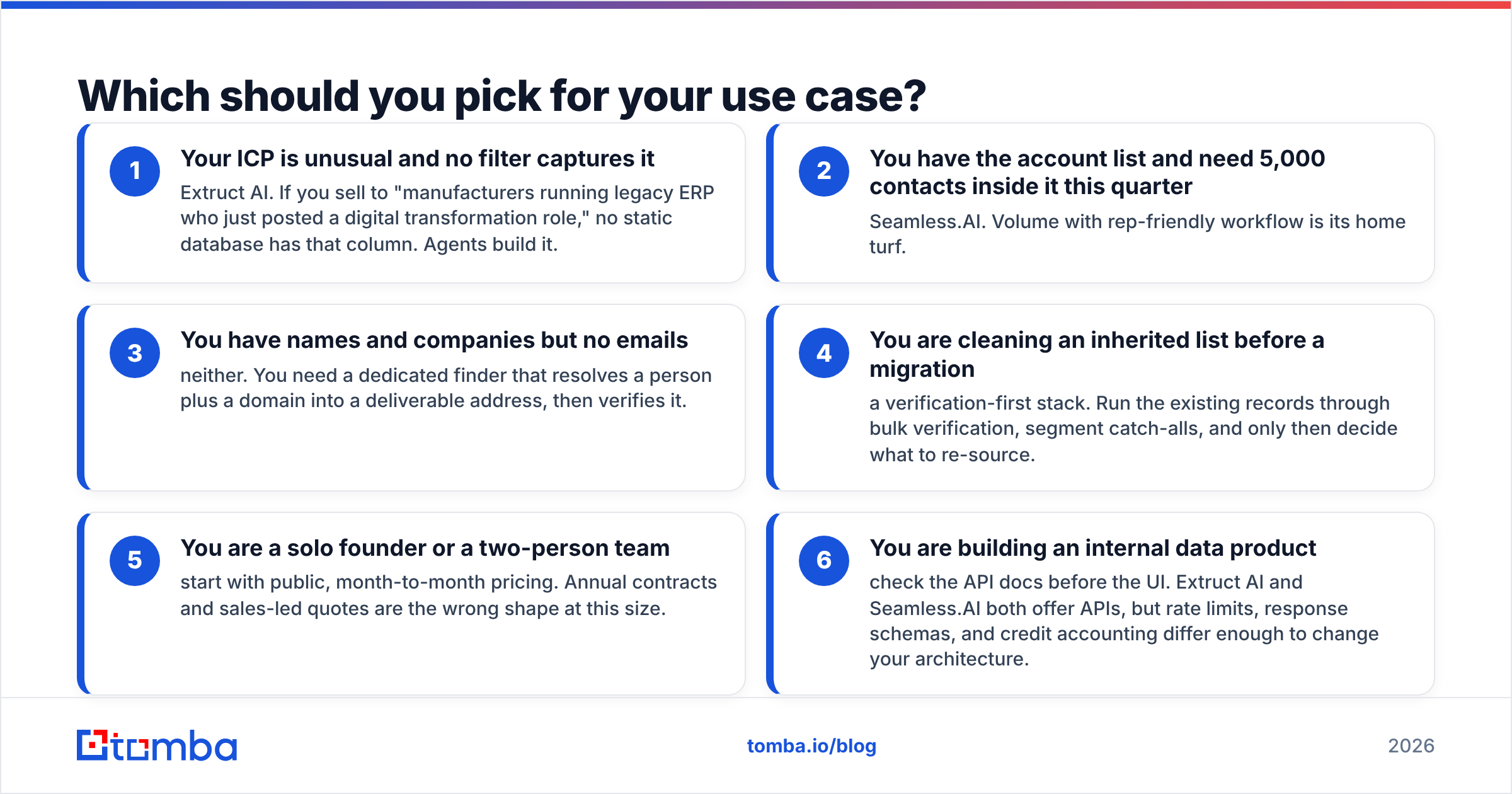
Match the tool to the bottleneck, not to the demo.
- Your ICP is unusual and no filter captures it — Extruct AI. If you sell to "manufacturers running legacy ERP who just posted a digital transformation role," no static database has that column. Agents build it.
- You have the account list and need 5,000 contacts inside it this quarter — Seamless.AI. Volume with rep-friendly workflow is its home turf.
- You have names and companies but no emails — neither. You need a dedicated finder that resolves a person plus a domain into a deliverable address, then verifies it.
- You are cleaning an inherited list before a migration — a verification-first stack. Run the existing records through bulk verification, segment catch-alls, and only then decide what to re-source.
- You are a solo founder or a two-person team — start with public, month-to-month pricing. Annual contracts and sales-led quotes are the wrong shape at this size.
- You are building an internal data product — check the API docs before the UI. Extruct AI and Seamless.AI both offer APIs, but rate limits, response schemas, and credit accounting differ enough to change your architecture.
Where does a dedicated email finder fit alongside them?#
The cleanest modern stack has three distinct layers, and problems start when one tool is asked to do all three:
- Discovery — which accounts belong on the list. Extruct AI, intent tools, or manual research.
- Contact resolution — who at that account, and what is their address. This is where an email finder with per-domain pattern detection outperforms a bulk export, because it resolves a specific person rather than dumping everyone with a matching title.
- Verification and enrichment — will it deliver, and what else do we know. SMTP checks, catch-all scoring, and data enrichment to fill in role, seniority, and social profiles before the sequence starts.
Teams that collapse layers two and three into a single bulk database are the ones filing deliverability tickets three weeks into a campaign. Layer separation costs a little more tooling and saves the domain.
Frequently asked questions#
Is Extruct AI a replacement for Seamless.AI? No. Extruct AI produces account lists with custom research attributes. Seamless.AI produces contact records. Replacing one with the other leaves a hole in the pipeline.
Does Seamless.AI verify emails before export? It applies its own checks, but the definition of verified is vendor-specific. Run an independent verification pass before sending, especially on catch-all domains.
Can I use Extruct AI's output directly in a sequencer? Not without a contact layer. Extruct AI gives you companies and attributes. You still need names and verified addresses to send.
Which is cheaper? Unanswerable in the abstract, because Seamless.AI's pricing is quote-based and Extruct AI charges per research run. Model cost per usable, delivered contact instead of cost per row.
What about free options? Both offer limited trials. If you want a no-commitment baseline, a free tier with real verification — 25 searches a month, no card — tells you more about data quality than a demo call does.
The bottom line#
Extruct AI vs Seamless.AI is a choice between finding the right accounts and filling accounts with contacts. Extruct AI wins when your ICP requires judgment that no filter can express. Seamless.AI wins when you need SDR-friendly volume and direct dials inside accounts you have already chosen. Both leave the same gap: a deliverable, verified address for the specific person you want to reach.
That gap is worth closing before you spend on either. Start with the Tomba Email Finder — public pricing from $49/mo, a free tier with 25 searches, source attribution on every result, and verification built into the same call rather than sold as a separate line item. Point it at the accounts your research layer surfaced, and let the bounce rate settle the argument.
Related guides#
Ready to find emails that actually work?
Join 150,000+ professionals who stopped guessing and started sending. Free credits on signup — no credit card required.
Get the Tomba newsletter
Practical outbound tactics and product updates — once every two weeks.
About the author