Extruct AI vs Tomba: Which B2B Data Tool Wins in 2026?
Extruct AI researches companies with autonomous agents. Tomba finds and verifies the people inside them. Here is where each one actually wins, what they cost, and when you need both.
TL;DR
- Extruct AI and Tomba solve different halves of the same problem. Extruct uses AI research agents to build and enrich company lists from the open web. Tomba finds and verifies the people — email addresses, phone numbers, LinkedIn matches — at those companies.
- If your bottleneck is "which accounts should we even target?", Extruct is the stronger buy. If your bottleneck is "we have the accounts, we cannot reach anyone", Tomba is the stronger buy.
- Pricing models differ in kind, not just amount: Tomba publishes flat tiers (Free 25 searches/mo, Starter $49/mo, Growth $99/mo, Pro $249/mo). Extruct sells credit-based plans with quote-driven upper tiers — budget for variable spend.
- Neither replaces the other. The realistic 2026 stack is agentic account research on top, contact discovery and verification underneath, both wired together by API.
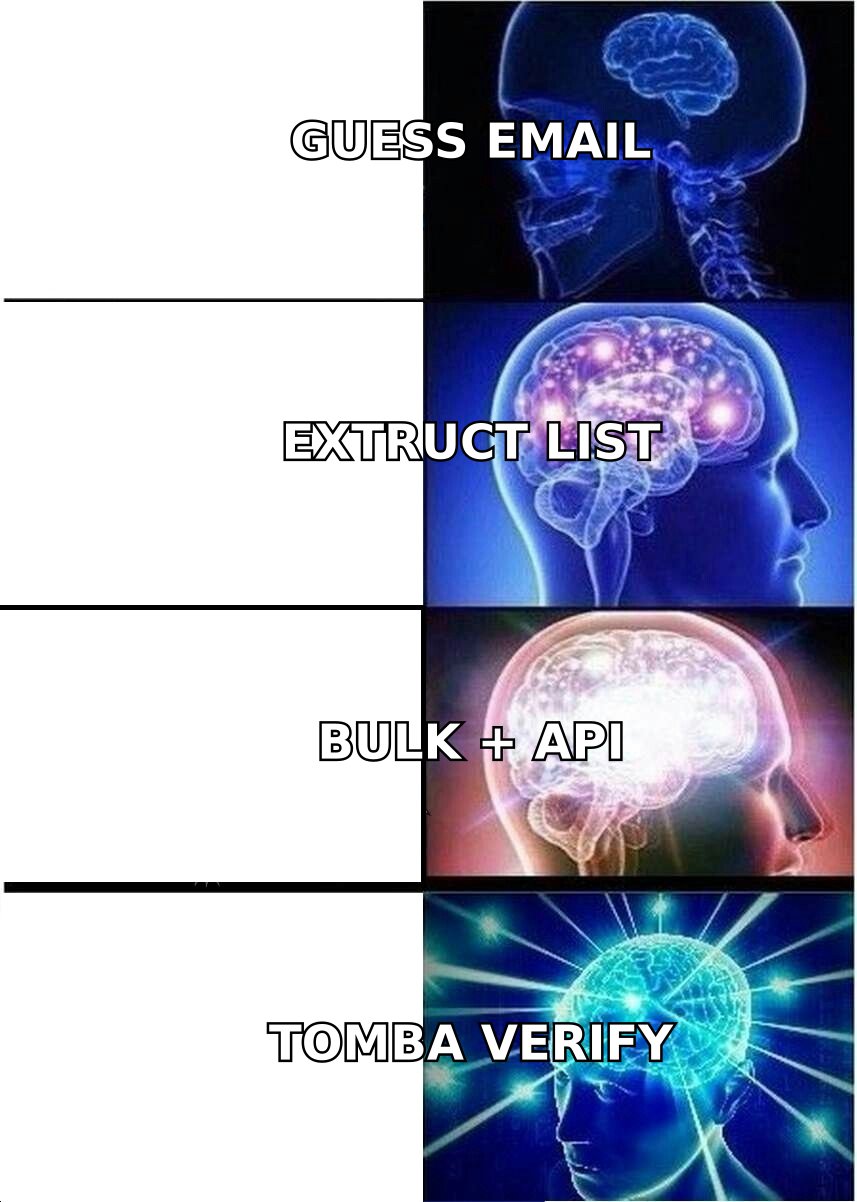
- Do not pay AI-research prices for work a deterministic email finder does for cents. That is the single most common overspend we see in this comparison.
What is Extruct AI?#
Extruct AI is an AI-native company research platform. You describe the kind of company you want in plain language — "Series B fintechs in the EU that recently launched a lending product" — and its agents go read the open web: company sites, news, job boards, filings, and directories. The output is a spreadsheet-style table where every column is itself a prompt: "Do they have an in-house engineering team?", "What CRM do they use?", "Have they mentioned SOC 2 in the last 6 months?"
Think of it as hiring a very fast junior analyst who never gets bored of opening 400 browser tabs. The product's value is judgment at scale — turning fuzzy qualification criteria into structured columns you can filter and score.
What it is not: a contact database. Extruct's center of gravity is the account, not the individual. You will finish a run with a beautifully qualified list of 300 companies and still need a way to reach a named human at each one. You can read more on the official Extruct site.
What is Tomba?#
Tomba is a B2B email finder and contact data platform. Given a domain, a person's name, or a LinkedIn profile, it returns the working email address — plus verification, sources, and a confidence score. Around that core sit a domain search for pulling every discoverable address at a company, an email verifier with catch-all handling, a phone finder, and data enrichment for filling in job titles, seniority, and company firmographics.
The mental model is different. Extruct answers "is this company worth a conversation?" Tomba answers "who do I email, and will it bounce?" One is exploratory and probabilistic. The other is deterministic and verifiable — you can literally test whether the address exists.
Extruct AI vs Tomba: how do they actually compare?#
Here is the head-to-head on the attributes that decide the purchase.
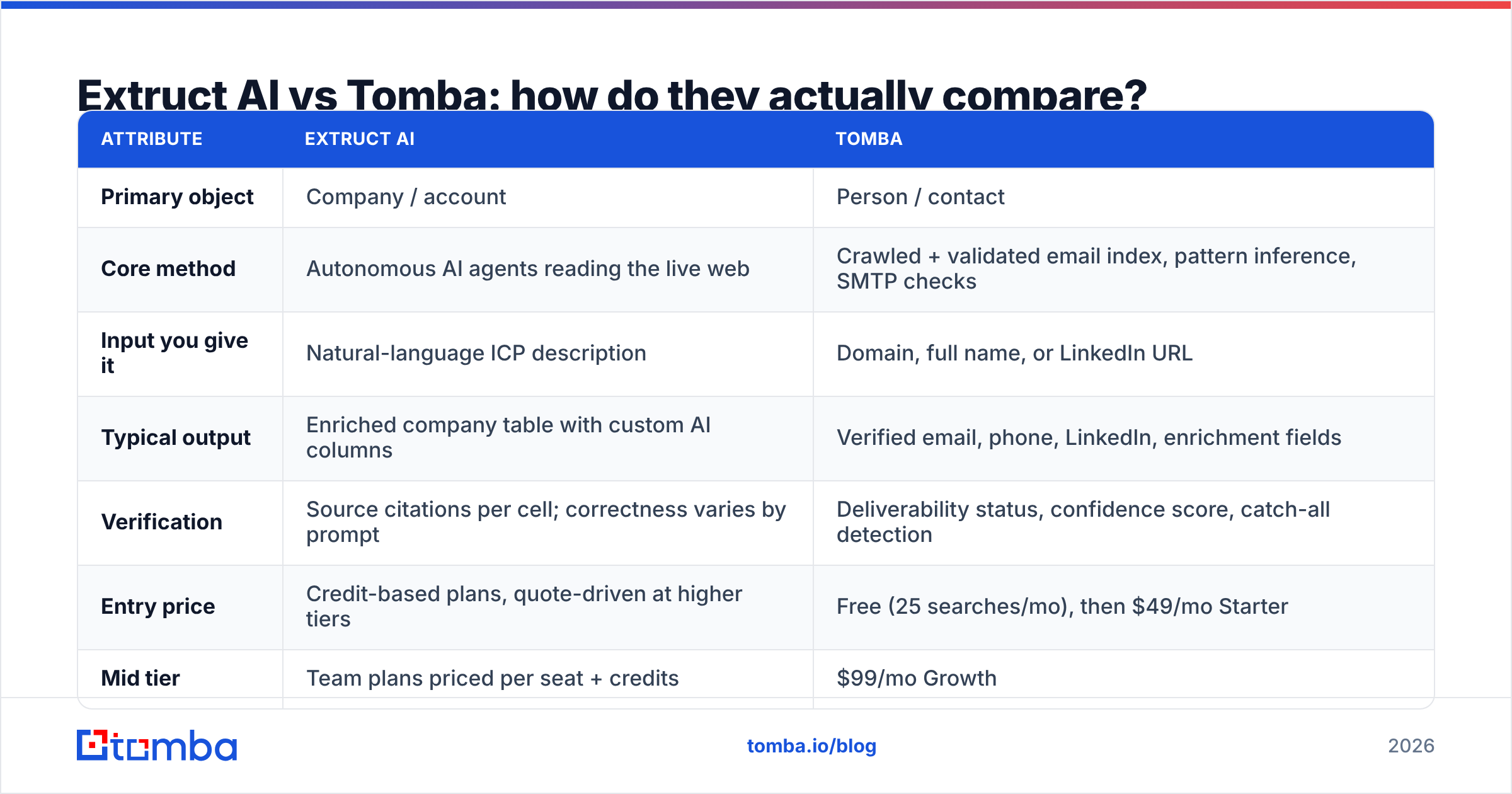
| Attribute | Extruct AI | Tomba |
|---|---|---|
| Primary object | Company / account | Person / contact |
| Core method | Autonomous AI agents reading the live web | Crawled + validated email index, pattern inference, SMTP checks |
| Input you give it | Natural-language ICP description | Domain, full name, or LinkedIn URL |
| Typical output | Enriched company table with custom AI columns | Verified email, phone, LinkedIn, enrichment fields |
| Verification | Source citations per cell; correctness varies by prompt | Deliverability status, confidence score, catch-all detection |
| Entry price | Credit-based plans, quote-driven at higher tiers | Free (25 searches/mo), then $49/mo Starter |
| Mid tier | Team plans priced per seat + credits | $99/mo Growth |
| Bulk workflow | Batch list building and re-runs | Bulk finder and verifier, CSV in / CSV out |
| API | Yes, for programmatic research | Yes — Tomba API, CLI, MCP server, Sheets and Excel add-ins |
| Best for | Defining and qualifying the target account list | Reaching named humans at those accounts |
| Weakest at | Person-level contact data and deliverability | Open-ended "which companies fit?" research |
Vendor pricing on the agentic side moves fast — Extruct's public tiers have changed more than once as credit economics shifted, so confirm current numbers on their pricing page before you model spend. Tomba's tiers are published and stable: see Tomba pricing for the current breakdown.
Which one is more accurate?#
Wrong question — they are accurate about different things, and only one of the two can be checked automatically.
Tomba's accuracy is falsifiable. An email either resolves or it does not. You can run a list, send, and measure bounce rate against the tool's confidence scores. That feedback loop is why email finders converge on measurable quality over time, and why any vendor claim here can be audited by you in an afternoon. Tomba publishes where its data comes from on its data sources page, which matters more than a headline accuracy percentage.
Extruct's accuracy is judgment accuracy. When an AI column says "yes, they run an in-house sales team", that answer is only as good as the pages the agent read and the prompt you wrote. In practice this means:
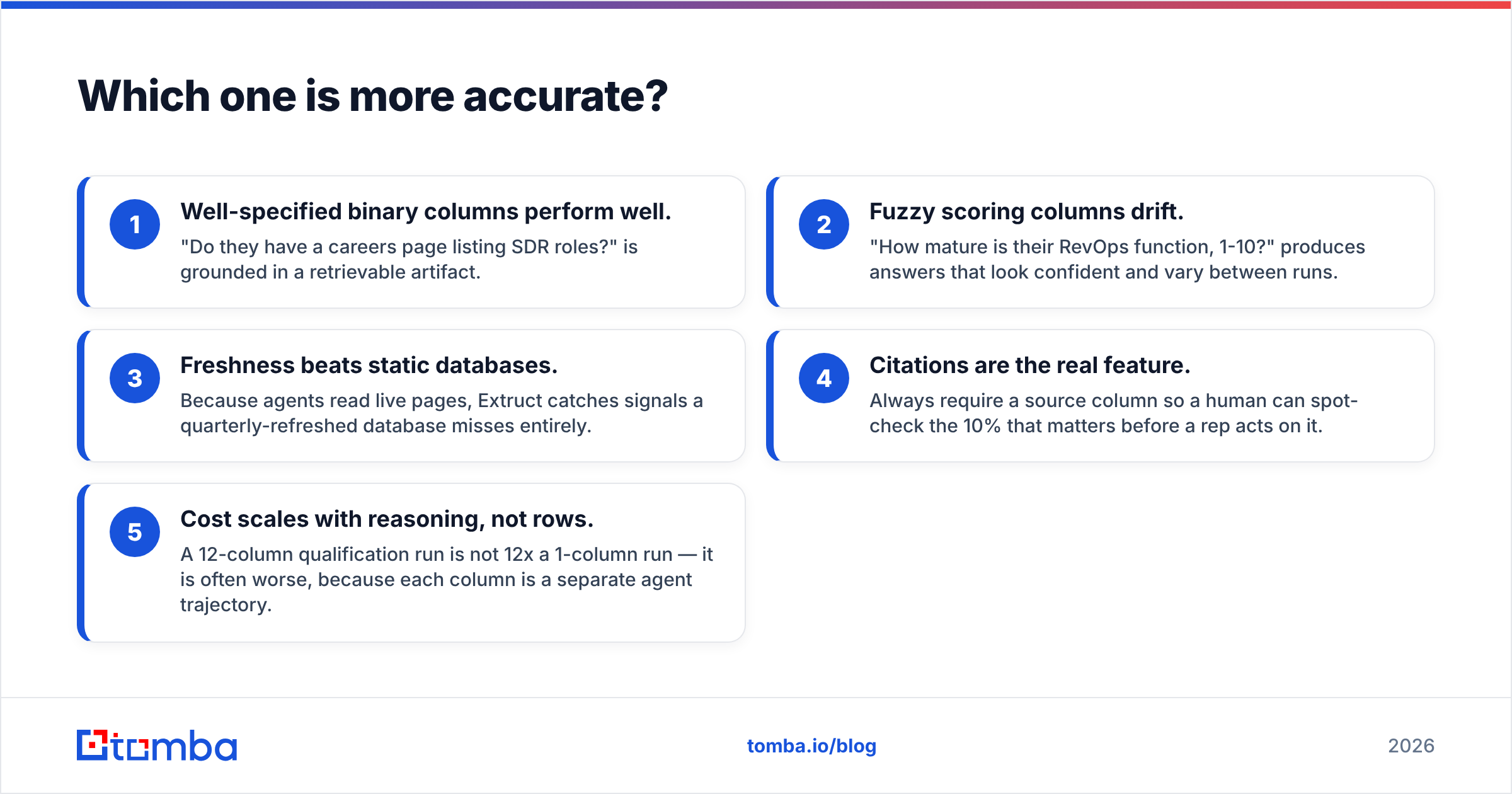
- Well-specified binary columns perform well. "Do they have a careers page listing SDR roles?" is grounded in a retrievable artifact.
- Fuzzy scoring columns drift. "How mature is their RevOps function, 1-10?" produces answers that look confident and vary between runs.
- Freshness beats static databases. Because agents read live pages, Extruct catches signals a quarterly-refreshed database misses entirely.
- Citations are the real feature. Always require a source column so a human can spot-check the 10% that matters before a rep acts on it.
- Cost scales with reasoning, not rows. A 12-column qualification run is not 12x a 1-column run — it is often worse, because each column is a separate agent trajectory.
The practical rule: use agentic research where a human analyst would have been needed, and use deterministic lookup where a human analyst would have been a waste of money.
Is Extruct AI better than Tomba for prospecting?#
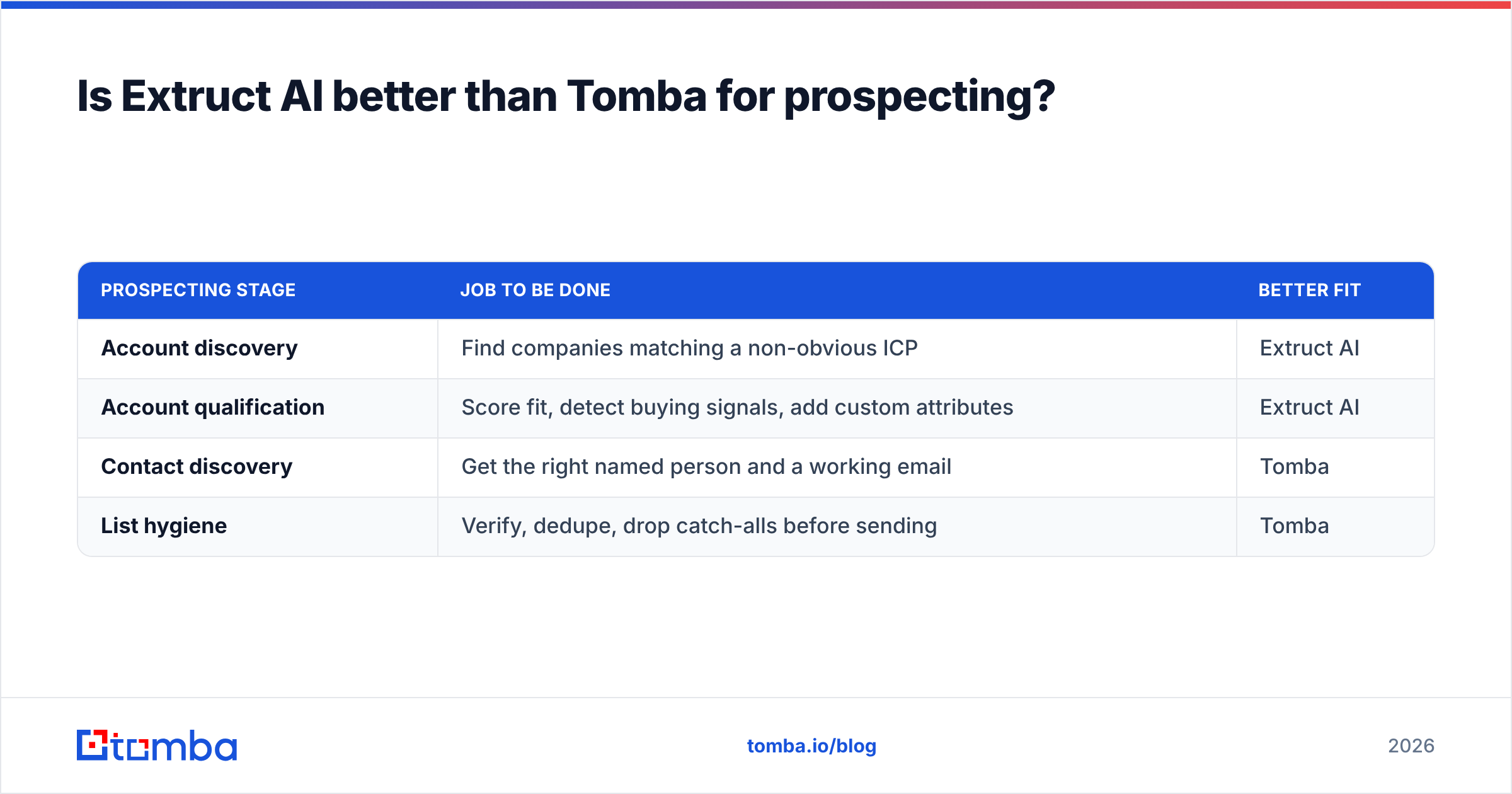
Only for the first mile of it. Prospecting decomposes into four jobs, and the two tools sit in different rows.
| Prospecting stage | Job to be done | Better fit |
|---|---|---|
| Account discovery | Find companies matching a non-obvious ICP | Extruct AI |
| Account qualification | Score fit, detect buying signals, add custom attributes | Extruct AI |
| Contact discovery | Get the right named person and a working email | Tomba |
| List hygiene | Verify, dedupe, drop catch-alls before sending | Tomba |
If you try to force Extruct into rows three and four, you will pay agentic-reasoning prices for something an email finder resolves in a single deterministic call. If you try to force Tomba into rows one and two, you will be doing ICP research by hand and using Tomba only to fill in what you already decided.
There is a third path worth naming: for some segments you do not need discovery at all, because a well-maintained prebuilt list already covers the market — providers like BookYourData are a legitimate shortcut when your ICP is broad and stable, and they sidestep the research spend entirely. Agentic research earns its keep when your ICP is weird — when no filter in any existing database expresses it.
What does each one cost in practice?#
Model total cost per usable contact, not per credit.
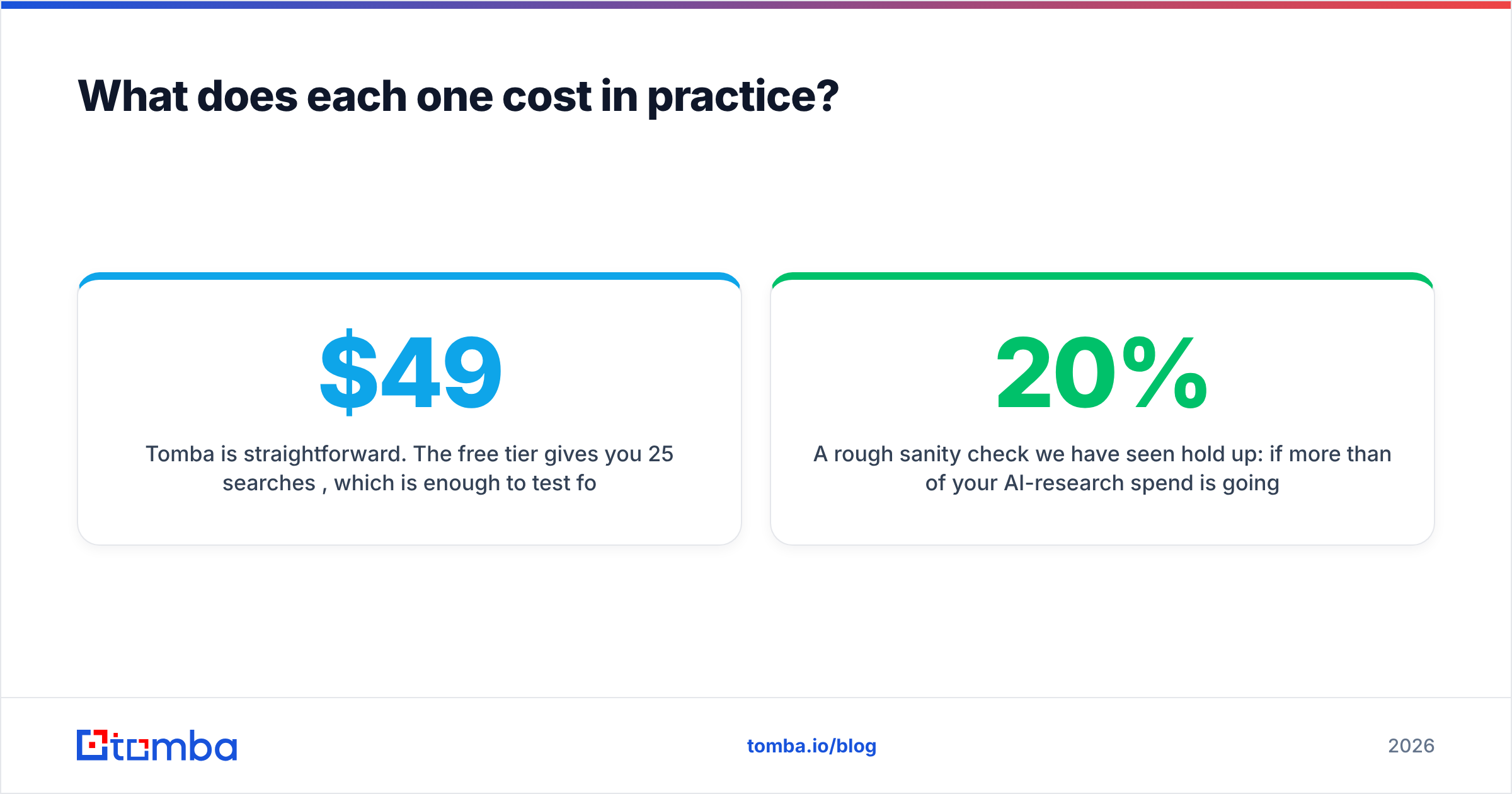
Tomba is straightforward. The free tier gives you 25 searches per month, which is enough to test format accuracy on your own domain list. Starter is $49/mo, Growth $99/mo, Pro $249/mo, with Enterprise custom. Because pricing is search-based and searches are deterministic, your cost per verified contact is predictable within a few percent month over month.
Extruct is credit-based, and credits burn per agent action — which means the same 500-company list can cost wildly different amounts depending on how many AI columns you attach and how deeply each one researches. That is not a criticism; it is the nature of agentic tooling. It does mean you should:
- Pilot before committing. Run 50 companies with your real column set and extrapolate.
- Prune columns ruthlessly. Most teams keep 4-5 columns that actually change a rep's behavior and delete the rest.
- Cache aggressively. Re-running the same qualification monthly is expensive; re-run only on trigger events.
- Never use agents for lookups. Domain-to-email, email verification, and phone lookup are solved deterministic problems — route them to a purpose-built API.
A rough sanity check we have seen hold up: if more than 20% of your AI-research spend is going toward finding contact details rather than qualifying accounts, your stack is misconfigured.
Can you use Extruct AI and Tomba together?#
Yes, and for most teams that is the correct answer. The handoff is clean because the two tools exchange exactly one field: the company domain.
A working pipeline looks like this:
- Define the ICP in natural language in Extruct and let the agents build a raw company list with source-cited qualification columns.
- Filter to accounts that pass your bar — usually 20-40% of the raw list survives a strict filter, which is the whole point of paying for qualification.
- Push the surviving domains to Tomba, via the Tomba API, the Chrome extension, or a Google Sheets sync, and run domain search to pull decision-maker emails by department and seniority.
- Verify everything before send. Run the resulting list through verification, drop invalid addresses, and flag catch-all domains for a separate lower-volume sequence.
- Enrich the survivors with title, seniority, and phone so your sequencing tool can personalize without manual research.
- Write results back to your CRM so the qualification columns are visible to the rep on the call, not stranded in a spreadsheet.
Steps 1-2 are where agentic research is irreplaceable. Steps 3-5 are where it is the wrong tool at the wrong price. Keeping that boundary sharp is the difference between a stack that scales and a credit bill nobody can explain.
Who should choose which?#
Choose Extruct AI if:
- Your ICP cannot be expressed as filters in any existing database
- You currently pay analysts or SDRs to manually research accounts
- Buying signals and freshness matter more than contact volume
- You already have a reliable contact-data source and only need better targeting
Choose Tomba if:
- You know who you want to reach and cannot get working addresses
- Bounce rate is hurting your sender reputation
- You need contact data inside code — API, CLI, MCP, Sheets, or Excel
- You want predictable monthly cost with a free tier to test first
Choose both if: you run outbound at scale against a non-obvious market. Research on top, contact data underneath. This is the shape most teams converge on by their second year of outbound, and it is broadly consistent with how buyers rate tools in the sales intelligence category on G2 — high scores for research depth and high scores for data accuracy rarely come from the same vendor.
What are the risks with each approach?#
Agentic research carries two real risks. The first is confident wrongness: an AI column that returns a plausible answer sourced from a stale page, which a rep then repeats on a call. Mitigate with mandatory source citations and human spot-checks on high-value accounts. The second is cost opacity — credits consumed by reasoning depth are hard to forecast until you have run a full month.
Contact data carries its own risks. Catch-all domains accept everything at SMTP and tell you nothing, which is why a dedicated catch-all verifier matters more than a headline accuracy claim. And no finder has universal coverage — expect meaningfully lower hit rates in regions and industries with thin public web presence, and plan volume accordingly. If you are new to the mechanics of how any of this feeds pipeline, the fundamentals of lead generation are worth 10 minutes before you buy anything.
The verdict#
Extruct AI wins on account research. Tomba wins on contact data. Anyone telling you one replaces the other is selling you something.
The cheapest way to find out which half you are actually missing: take 25 target domains you already believe in and see how many decision-maker emails you can pull and verify today. If you get them all, your problem is targeting — go look at agentic research. If you cannot, your problem is contact data, and that is solvable this afternoon.
Start with the Tomba Email Finder. The free tier gives you 25 searches a month with no card, which is enough to measure real hit rate on your own list before you spend a dollar — on Tomba or on anything else.
Related guides#
Ready to find emails that actually work?
Join 150,000+ professionals who stopped guessing and started sending. Free credits on signup — no credit card required.
Get the Tomba newsletter
Practical outbound tactics and product updates — once every two weeks.
About the author