Extruct AI vs ZoomInfo: Which B2B Data Tool Wins in 2026?
Extruct AI builds custom company lists with research agents. ZoomInfo sells you a giant pre-built database. They solve different halves of the same problem — here's which one your team actually needs.
TL;DR
- They are not the same category. Extruct AI is an agentic company-research tool that builds and enriches lists from live web sources on demand. ZoomInfo is a licensed, pre-built B2B database with contact records, intent data, and a full GTM suite bolted on.
- Pick Extruct AI when your ICP is weird, narrow, or defined by qualitative signals ("Series A robotics companies with an in-house ML team and a SOC 2 badge") that no static database has as a filter.
- Pick ZoomInfo when you need direct dials, verified contact records at scale, org charts, and an enterprise-grade CRM integration that your RevOps team will not have to babysit.
- Cost gap is large. ZoomInfo contracts are commonly reported in the $15,000+/year range with seat minimums and annual terms. Extruct sells self-serve, credit-based plans that a two-person team can expense.
- Neither is a complete stack. Extruct is thin on person-level contact data; ZoomInfo's contact records decay fast. Most teams pair one of them with a dedicated email finder at the last mile.
What is Extruct AI?#
Extruct AI is a company-research platform built on AI agents rather than a fixed schema. Instead of querying a warehouse of pre-scraped rows, you describe the kind of company you want and what you need to know about each one, and the agents go read the live web — websites, job boards, funding announcements, product pages, review sites — to fill in a spreadsheet-shaped result.
The practical difference: a traditional database can only answer questions its schema anticipated. Think of it like a library card catalog — brilliant if you want everything filed under "Software / 51-200 employees / California," useless if you want "companies whose careers page mentions Kubernetes and who shipped a pricing change this quarter." Extruct-style tools are closer to hiring a research intern who reads each site and answers your custom column.
That agentic approach is where the whole GTM data market is drifting in 2026. You can see the same pattern in the rise of research copilots across the sales stack — the value has moved from having the data to asking a better question of it. Extruct's own positioning on extruct.ai leans hard into custom columns, list building, and CRM-ready enrichment rather than "we have 200M contacts."
What Extruct is good at:
- Long-tail ICPs — segments too small or too qualitative for a static filter to capture.
- Custom research columns — "does this company sell to enterprise?", "which cloud do they run on?", "who is their current vendor?"
- Freshness — the agent reads the site today, not whatever a crawler indexed 14 months ago.
- Fast iteration — you can rewrite the ICP definition in plain language and rerun, instead of filing a data request.
Where it is thin: person-level contact data. Agentic research is excellent at company facts and weak at "give me the verified mobile number of the VP of Engineering." That gap matters, and we'll come back to it.
What is ZoomInfo?#
ZoomInfo is the incumbent. It is a licensed B2B database — hundreds of millions of contact and company profiles — wrapped in a GTM platform that now includes intent signals, conversation intelligence, workflow automation, and a sales engagement layer. If you have worked in enterprise SaaS sales in the last decade, you have used it or sat next to someone who did.
Its strengths are structural, not clever:
- Scale of contact records — direct dials, mobile numbers, and titles at a volume no research agent can match by reading websites.
- Org charts and hierarchy — parent/subsidiary mapping that matters for enterprise territory planning.
- Intent data — third-party topic surges that feed account prioritization.
- CRM depth — the Salesforce integration and HubSpot connectors are mature, and RevOps teams know how to govern them.
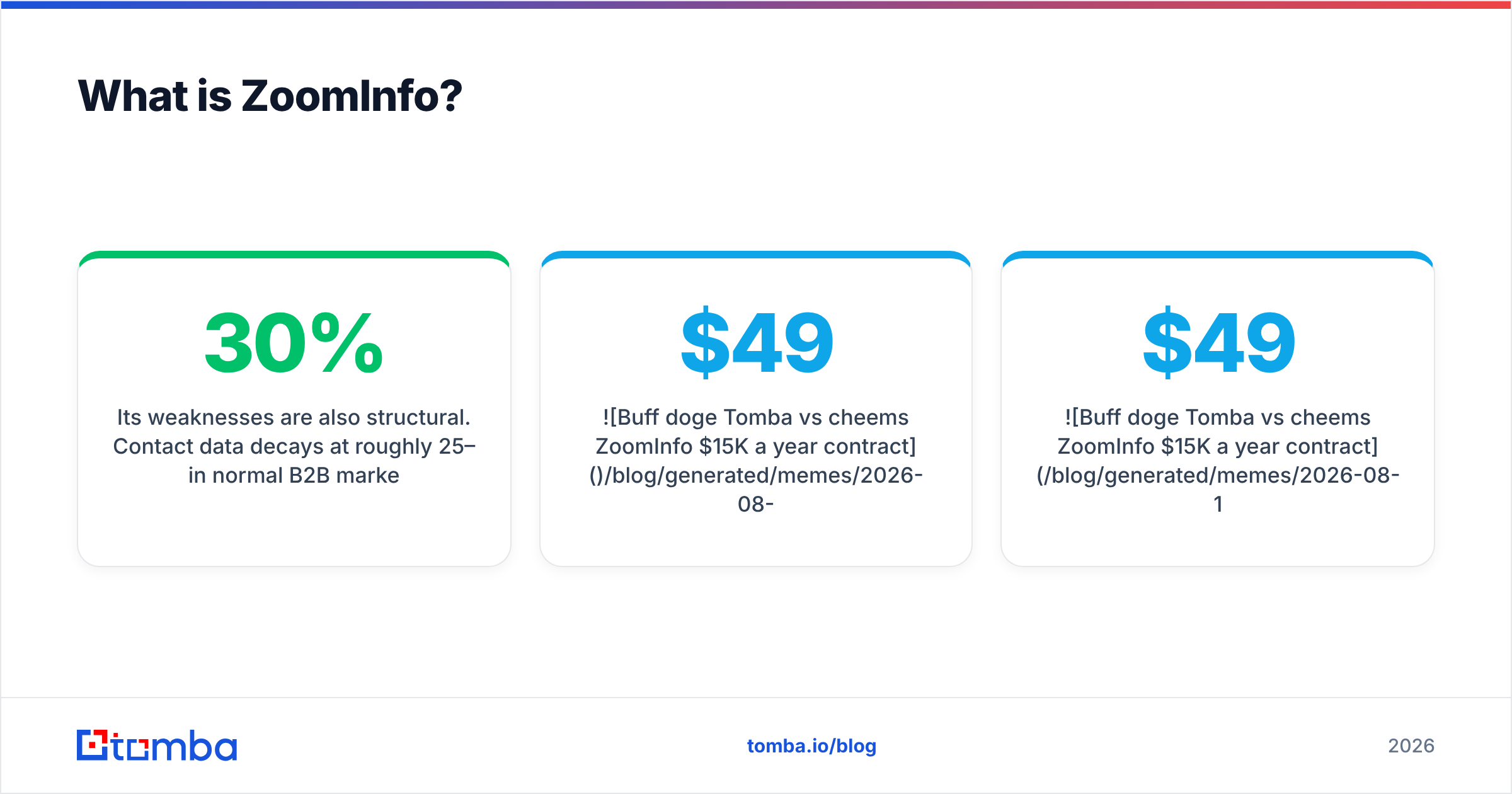
Its weaknesses are also structural. Contact data decays at roughly 25–30% per year in normal B2B markets, and every static database inherits that decay. Pricing is opaque, negotiated, annual, and seat-gated. Buyer reviews on G2 consistently praise coverage and criticize cost, contract rigidity, and data staleness in the same breath. The official product line is documented at zoominfo.com.

How do Extruct AI and ZoomInfo actually differ?#
Here is the head-to-head, with a dedicated email-finding tool as a third reference point so you can see where each one stops.
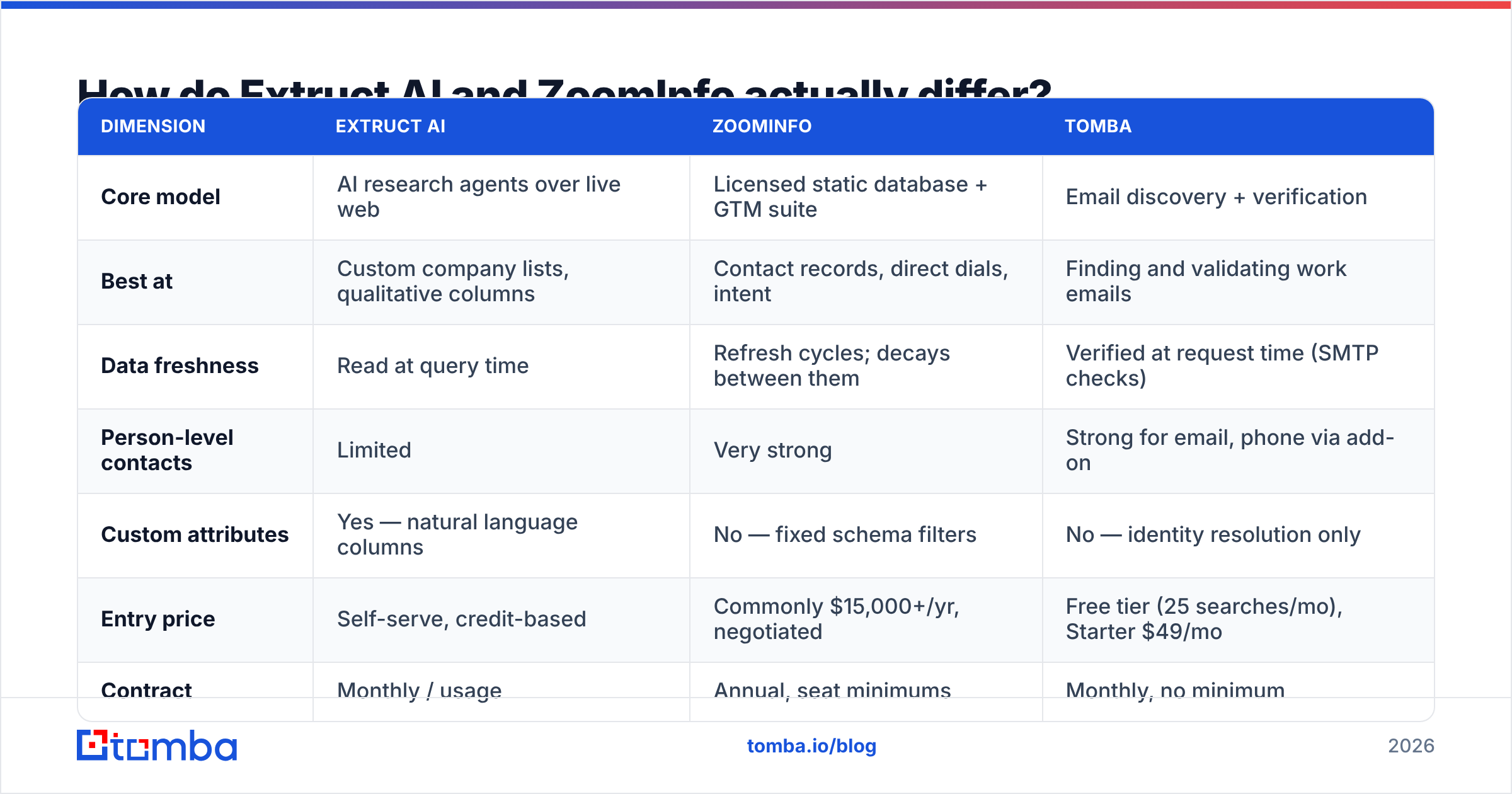
| Dimension | Extruct AI | ZoomInfo | Tomba |
|---|---|---|---|
| Core model | AI research agents over live web | Licensed static database + GTM suite | Email discovery + verification |
| Best at | Custom company lists, qualitative columns | Contact records, direct dials, intent | Finding and validating work emails |
| Data freshness | Read at query time | Refresh cycles; decays between them | Verified at request time (SMTP checks) |
| Person-level contacts | Limited | Very strong | Strong for email, phone via add-on |
| Custom attributes | Yes — natural language columns | No — fixed schema filters | No — identity resolution only |
| Entry price | Self-serve, credit-based | Commonly $15,000+/yr, negotiated | Free tier (25 searches/mo), Starter $49/mo |
| Contract | Monthly / usage | Annual, seat minimums | Monthly, no minimum |
| Time to first list | Minutes | Days (sales cycle + onboarding) | Minutes |
| API access | Yes | Enterprise tiers | Yes, on all paid plans |
| Fit for | Founders, small GTM teams, researchers | Enterprise sales orgs, RevOps | Any team needing deliverable emails |
The table makes the real point: these tools do not compete on the same axis. Extruct competes with a research analyst and a stack of scrapers. ZoomInfo competes with Apollo, Cognism, Lusha, and other database vendors. The overlap is only in the first step — "get me a list of companies" — and diverges immediately after.
Which one is more expensive in practice?#
ZoomInfo, by roughly an order of magnitude, but the comparison needs nuance.
ZoomInfo prices per seat, per year, with credit caps on exports and add-on modules for intent, engagement, and enrichment. Publicly reported entry contracts sit in the mid five figures for a small team, and multi-year terms with auto-renew clauses are standard. There is no meaningful free tier and no self-serve path to production usage. The cost is defensible if you have 20 AEs who each close $80k deals; it is indefensible if you are three people validating a market.
Extruct sells self-serve, credit-metered plans — you pay for research runs and enriched rows, not for chairs. Check the vendor's current pricing page before budgeting, since usage-based tiers move, but the structural difference holds: you can start small and scale spend with output.
The hidden cost nobody quotes you: contact data hygiene. Whichever platform you buy, exported emails need verification before they touch a sending domain. A 12% bounce rate on a database export will do more damage to your email deliverability than any tool's price tag. Budget for an email verifier in the stack regardless of which side of this comparison you land on.
Which one has better data coverage and accuracy?#
Split the question in two, because the answer flips.
Company-level coverage and accuracy: Extruct wins on long-tail and freshness; ZoomInfo wins on breadth and firmographic consistency. If your ICP is "US manufacturers, 200–1000 employees," ZoomInfo will return more rows with cleaner, normalized fields. If your ICP is "companies that just published a job req for a Head of Compliance and use Stripe," Extruct will return rows that ZoomInfo has no filter to express.
Person-level coverage and accuracy: ZoomInfo wins outright, and it isn't close. Its mobile-number coverage in North America is the product's genuine moat. But "coverage" is not "accuracy" — a record can exist and still be wrong, and a contact who changed jobs eight months ago is a bounce waiting to happen.
This is where a lot of teams get burned. They assume a $15k/year contract means deliverable data, run a 5,000-record export straight into a sequencer, and watch the bounce rate hit double digits.

The fix is boring and it works: treat every exported email as a hypothesis and verify it at send time. Real-time SMTP verification, catch-all handling, and role-account filtering catch the majority of what a stale database hands you. A catch-all verifier matters more than most people expect, because catch-all domains are exactly where naive verification tools report "valid" and reality reports "bounce."
Who should choose Extruct AI?#
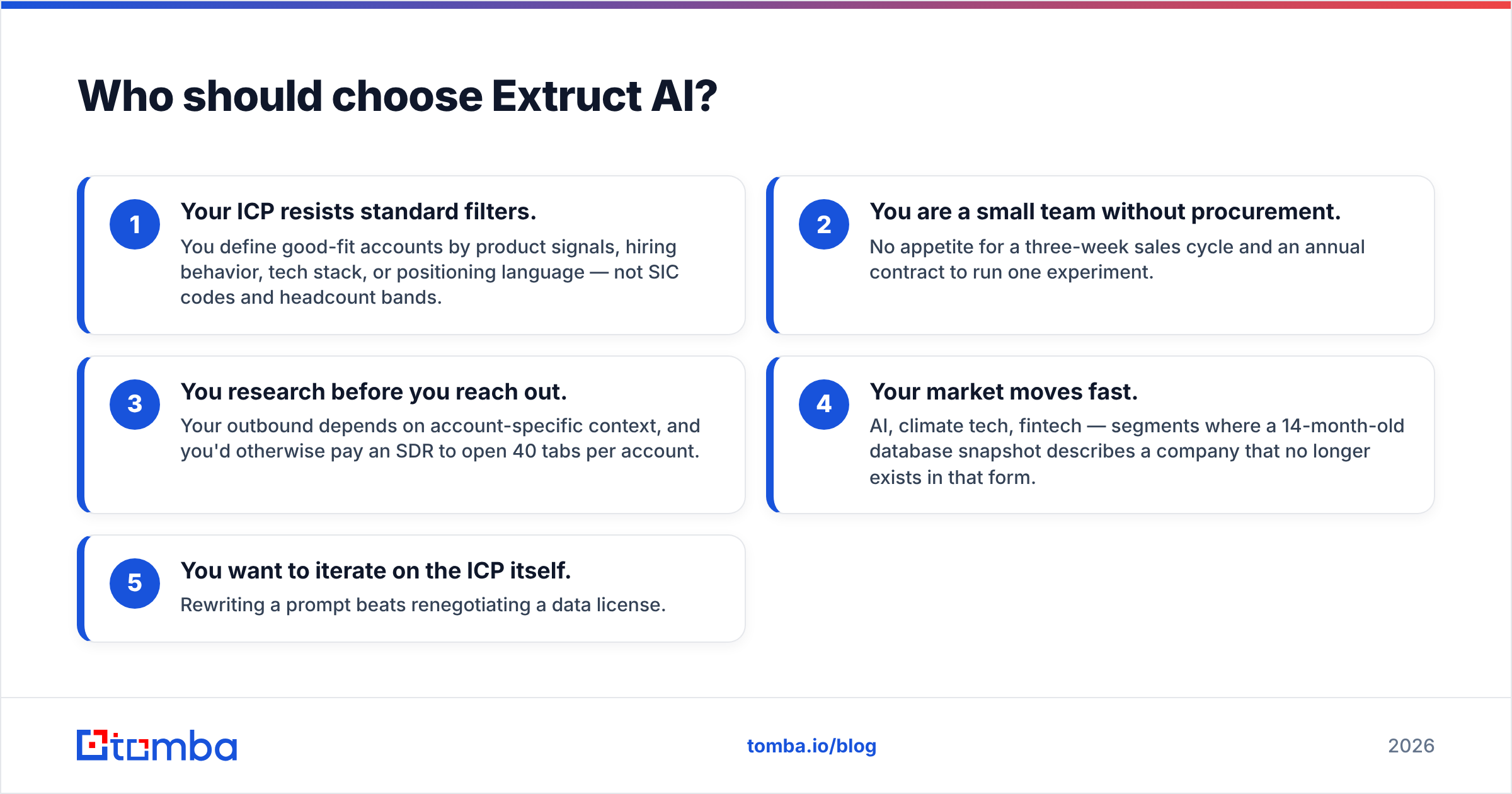
Choose Extruct if three or more of these describe you:
- Your ICP resists standard filters. You define good-fit accounts by product signals, hiring behavior, tech stack, or positioning language — not SIC codes and headcount bands.
- You are a small team without procurement. No appetite for a three-week sales cycle and an annual contract to run one experiment.
- You research before you reach out. Your outbound depends on account-specific context, and you'd otherwise pay an SDR to open 40 tabs per account.
- Your market moves fast. AI, climate tech, fintech — segments where a 14-month-old database snapshot describes a company that no longer exists in that form.
- You want to iterate on the ICP itself. Rewriting a prompt beats renegotiating a data license.
The catch: plan for a separate contact-data layer. Company research plus no emails is a list, not a pipeline.
Who should choose ZoomInfo?#
Choose ZoomInfo if:
- You need phone numbers at scale. Direct dials and verified mobiles for cold calling remain its strongest asset.
- You have enterprise territory complexity. Parent/subsidiary hierarchy, multi-thread org charts, and account hierarchy sync into Salesforce.
- Intent data drives your prioritization. You already have the maturity to act on topic surges rather than just report them.
- RevOps governance is a hard requirement. Audit trails, SSO, admin controls, and data governance that a procurement team will actually sign off on.
- Your deal sizes justify the line item. At $50k+ ACV with a full AE team, the math works. At $5k ACV with two founders selling, it does not.
Where does an email finder fit in either stack?#
At the last mile, and it's the step both platforms under-serve for different reasons.
Extruct hands you excellent company rows and thin person data. ZoomInfo hands you person rows that were correct at some point in the past. In both cases the operation you actually need is: given this company and this person, produce a deliverable email address right now.
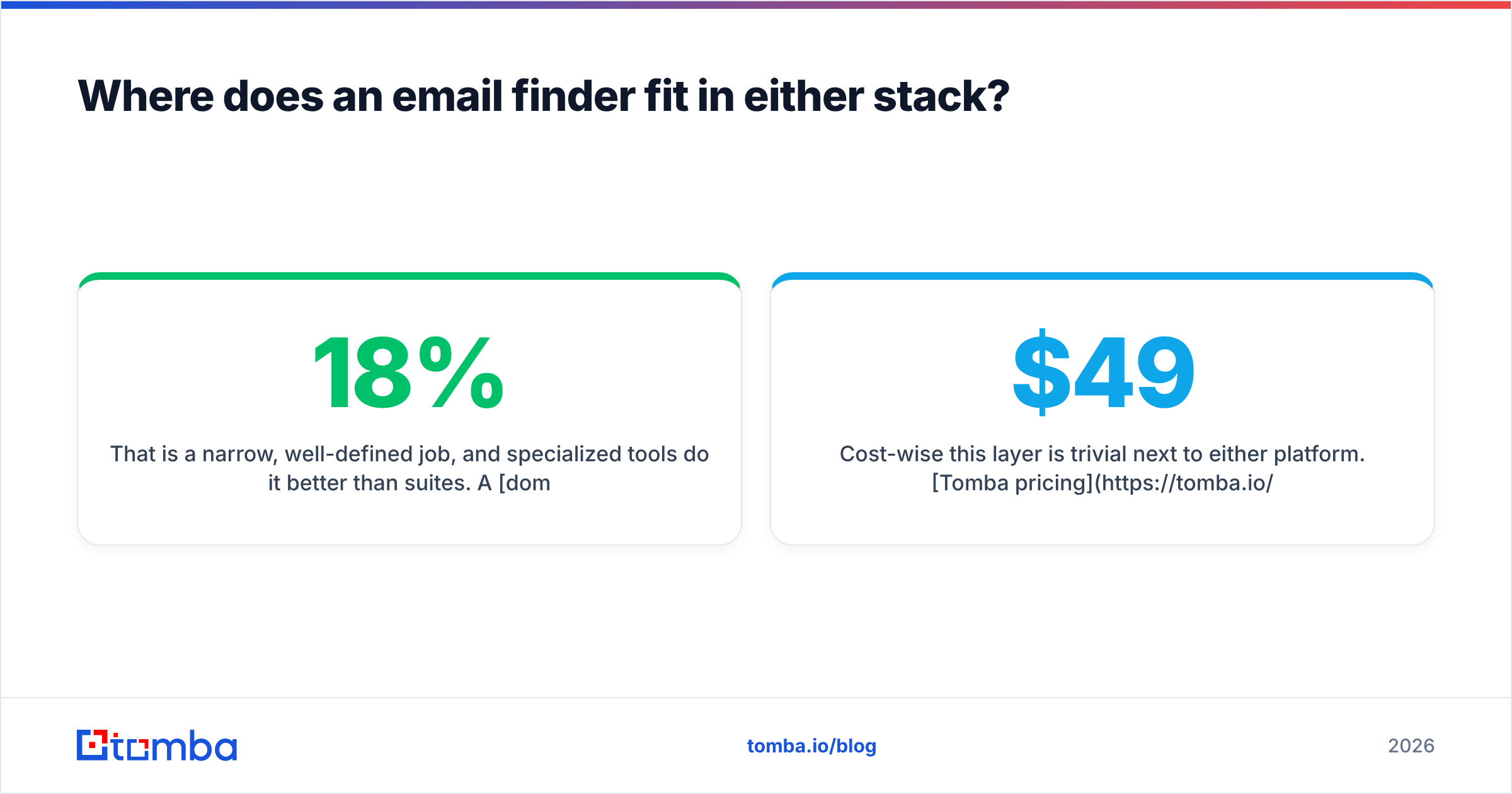
That is a narrow, well-defined job, and specialized tools do it better than suites. A domain search takes a company domain from your Extruct list and returns the people and email patterns behind it. A verification pass takes a ZoomInfo export and tells you which 18% will bounce before your sending domain finds out the hard way. Both run through an email finder API so the step disappears into your enrichment pipeline instead of becoming a manual chore.
For teams building this layer deliberately, the practical pattern is:
- Discovery — Extruct (or ZoomInfo filters) to define the account set.
- Contact resolution — email finder by domain + name, with pattern inference for gaps.
- Verification — SMTP + catch-all checks immediately before sequencing.
- Enrichment — data enrichment to fill titles, LinkedIn URLs, and phone numbers on the survivors.
- Sync — push clean records to CRM; never let unverified rows in.
Cost-wise this layer is trivial next to either platform. Tomba pricing starts with a free tier at 25 searches/month, Starter at $49/mo, Growth at $99/mo, and Pro at $249/mo — which is rounding error against a ZoomInfo contract and cheap insurance against a burned domain.
So which one actually wins in 2026?#
Extruct AI wins for teams whose bottleneck is finding the right accounts. ZoomInfo wins for teams whose bottleneck is reaching the right people at accounts they already know. If you're a founder or a lean GTM team, Extruct plus a dedicated contact layer will get you further per dollar. If you're running a 25-rep enterprise floor with a cold-calling motion, ZoomInfo's phone coverage and CRM governance still justify the invoice.
The wrong answer is buying either one and assuming it closed the loop. It didn't. Both leave you holding a list that needs verified, deliverable addresses before it becomes revenue.
Start with the last mile — it's the cheapest and highest-leverage piece. Run your existing list through the Tomba Email Finder on the free tier, check how many of your current records survive verification, and let that number decide how much platform you actually need to buy.
Related guides#
Ready to find emails that actually work?
Join 150,000+ professionals who stopped guessing and started sending. Free credits on signup — no credit card required.
Get the Tomba newsletter
Practical outbound tactics and product updates — once every two weeks.
About the author