9 Best EZ Texting Alternatives in 2026 (Tested & Priced)
EZ Texting is fine for basic mass texting, but per-segment pricing and thin CRM hooks push teams elsewhere. Here are nine alternatives compared on real cost, two-way inbox, API depth, and 10DLC handling.
TL;DR
- EZ Texting is a solid entry-level mass-texting tool, but teams outgrow it on three fronts: per-segment credit math, a shallow two-way inbox, and CRM/API depth.
- If you want raw cost control and full programmability, Twilio wins. If you want a sales-team inbox, Salesmsg or Heymarket wins. If SMS is an extension of e-commerce email, Klaviyo or Postscript wins.
- Cheapest total cost at 5,000 contacts is rarely the cheapest headline price — carrier fees, 10DLC registration, and per-segment overages decide it.
- No SMS platform fixes bad data. Wrong numbers, dead domains, and unverified contacts burn credits before the first reply lands.
- Pick by workflow, not by feature list: marketing broadcast, sales conversation, or developer-controlled infrastructure. Those three buckets cover almost every migration.
What is EZ Texting, and why do teams look for alternatives?#
EZ Texting is one of the oldest US SMS marketing platforms — founded in 2004, aimed squarely at small businesses that want to blast a promo to a list without touching an API. You upload contacts, pick a keyword or shortcode, schedule a campaign, and watch delivery reports. The official product leans hard into templates, MMS, and drag-and-drop campaign building.
That simplicity is exactly why people leave. The three complaints that show up over and over in G2's SMS marketing category reviews and migration threads:
- Credit math gets expensive fast. Messages are billed per segment (160 characters for GSM-7, 70 for anything with an emoji or curly apostrophe). A 320-character message to 5,000 people is 10,000 segments, not 5,000. Overage pricing on top of a monthly plan surprises teams that budgeted off the sticker price.
- The inbox is a marketing inbox, not a sales inbox. If a rep needs to own a thread, reassign it, add a note, and log it to the CRM, EZ Texting feels thin. It was built for one-to-many, not one-to-one.
- API and integration depth. There is an API, but it is not the reason anyone buys the product. Teams that want SMS as programmable infrastructure — triggered by a webhook, gated by a workflow, logged to a warehouse — end up wanting something closer to the metal.
None of that makes EZ Texting a bad tool. It makes it a specific tool. The question is whether your use case still matches it.
What should you actually compare across EZ Texting alternatives?#
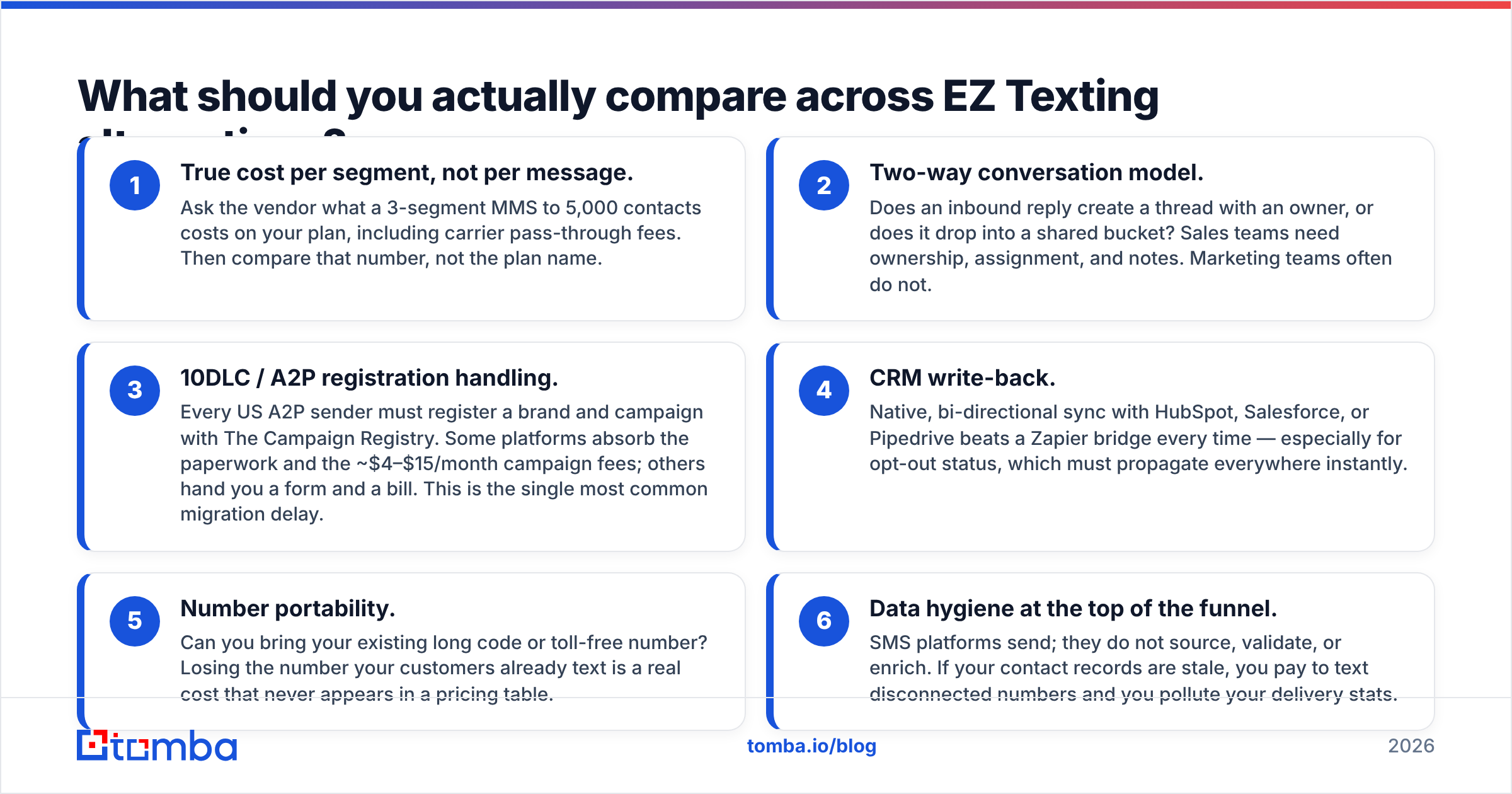
Feature grids lie. These six dimensions predict whether a migration succeeds:
- True cost per segment, not per message. Ask the vendor what a 3-segment MMS to 5,000 contacts costs on your plan, including carrier pass-through fees. Then compare that number, not the plan name.
- Two-way conversation model. Does an inbound reply create a thread with an owner, or does it drop into a shared bucket? Sales teams need ownership, assignment, and notes. Marketing teams often do not.
- 10DLC / A2P registration handling. Every US A2P sender must register a brand and campaign with The Campaign Registry. Some platforms absorb the paperwork and the ~$4–$15/month campaign fees; others hand you a form and a bill. This is the single most common migration delay.
- CRM write-back. Native, bi-directional sync with HubSpot, Salesforce, or Pipedrive beats a Zapier bridge every time — especially for opt-out status, which must propagate everywhere instantly.
- Number portability. Can you bring your existing long code or toll-free number? Losing the number your customers already text is a real cost that never appears in a pricing table.
- Data hygiene at the top of the funnel. SMS platforms send; they do not source, validate, or enrich. If your contact records are stale, you pay to text disconnected numbers and you pollute your delivery stats.
Which EZ Texting alternatives are worth shortlisting in 2026?#
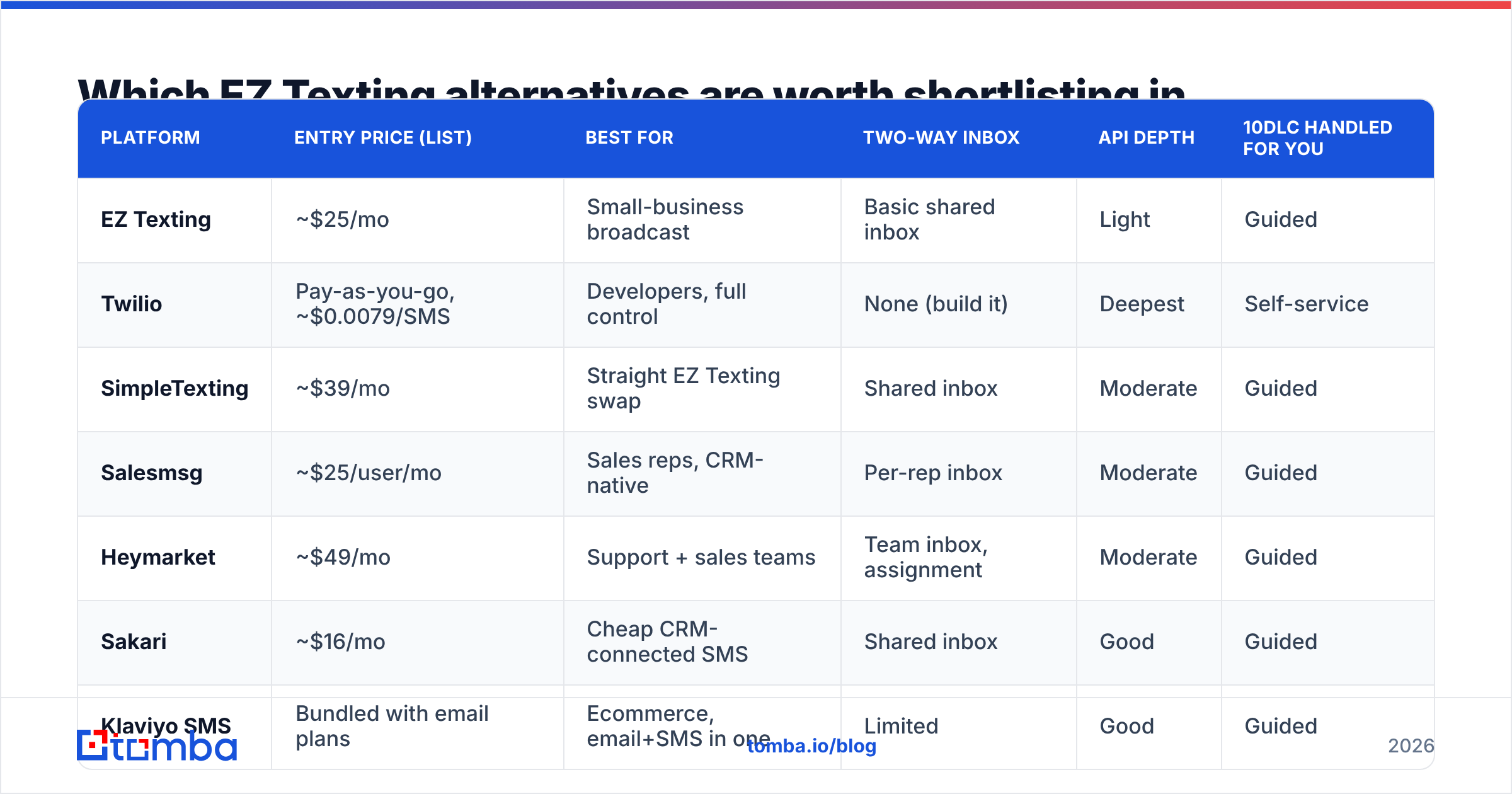
Here is the shortlist, grouped by what they are actually good at. Entry prices are published list prices at the time of writing — always confirm current tiers with the vendor, since SMS pricing moves constantly and carrier fees are billed separately almost everywhere.
| Platform | Entry price (list) | Best for | Two-way inbox | API depth | 10DLC handled for you |
|---|---|---|---|---|---|
| EZ Texting | ~$25/mo | Small-business broadcast | Basic shared inbox | Light | Guided |
| Twilio | Pay-as-you-go, ~$0.0079/SMS | Developers, full control | None (build it) | Deepest | Self-service |
| SimpleTexting | ~$39/mo | Straight EZ Texting swap | Shared inbox | Moderate | Guided |
| Salesmsg | ~$25/user/mo | Sales reps, CRM-native | Per-rep inbox | Moderate | Guided |
| Heymarket | ~$49/mo | Support + sales teams | Team inbox, assignment | Moderate | Guided |
| Sakari | ~$16/mo | Cheap CRM-connected SMS | Shared inbox | Good | Guided |
| Klaviyo SMS | Bundled with email plans | Ecommerce, email+SMS in one | Limited | Good | Guided |
| Postscript | ~$100/mo | Shopify-first ecommerce | Yes | Good | Guided |
| TextMagic | Pay-as-you-go | International, low volume | Shared inbox | Good | Partial |
| Attentive | Custom (enterprise) | Large DTC brands | Yes | Good | Full-service |
Twilio — the infrastructure answer#
Twilio is not an EZ Texting replacement in the "log in and send a campaign" sense. It is the layer underneath most of the tools on this list. You get per-message pricing published openly on Twilio's SMS pricing page, programmable everything, and zero campaign UI unless you build it or bolt on a front-end.
Choose it when you have an engineer, your SMS is triggered by product events, and you want to stop paying a per-contact tax. Skip it when the person sending messages is a marketing coordinator who needs a scheduler by Friday.
SimpleTexting — the closest like-for-like swap#
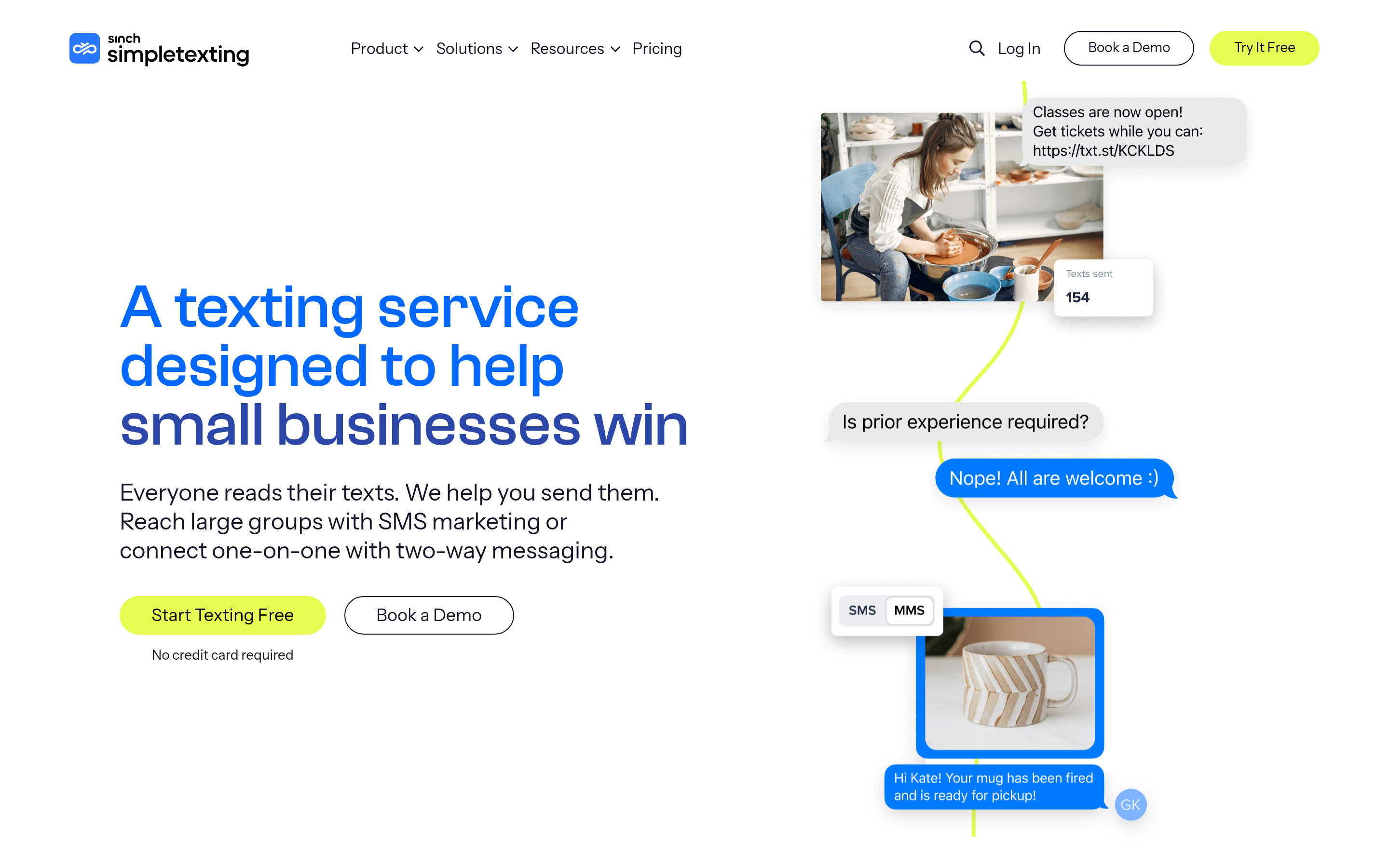
SimpleTexting is the most boring recommendation on this list, and that is a compliment. It does what EZ Texting does — keywords, broadcasts, autoresponders, MMS — with a cleaner interface and a segment-based pricing model that most teams find easier to forecast. Migration is usually a CSV export, a number port request, and a week of parallel running.
Salesmsg and Heymarket — the sales-conversation answer#
If your real problem is "reps want to text prospects and have it show up in HubSpot," neither EZ Texting nor Twilio solves it. Salesmsg gives each rep a number and an inbox, syncs to your CRM both ways, and logs threads against contact records. Heymarket adds team routing, assignment, and templates that support and success teams lean on.
Pricing here is per-user, which flips the math: 5 reps at $25 each is $125/month regardless of volume, versus a volume-priced marketing tool that gets cheaper per message as you scale. Below roughly 20,000 messages a month, per-user pricing usually wins for sales use cases.
Klaviyo and Postscript — the ecommerce answer#
If SMS exists to recover abandoned carts and announce drops, run it where your email lives. Klaviyo folds SMS into the same segmentation engine as email, so a "browsed but didn't buy in 48 hours" audience is one flow, not two tools arguing about who owns the contact. Postscript is Shopify-native and generally deeper on ecommerce-specific automations, but it is Shopify-only in practice.
Sakari and TextMagic — the cost-conscious answer#
Sakari is the value pick for teams that want CRM integrations without per-user pricing. TextMagic is pay-as-you-go with genuinely good international coverage, which matters if a chunk of your list sits outside North America — where 10DLC does not apply but local sender ID rules do.
How much does each option really cost at 5,000 contacts?#
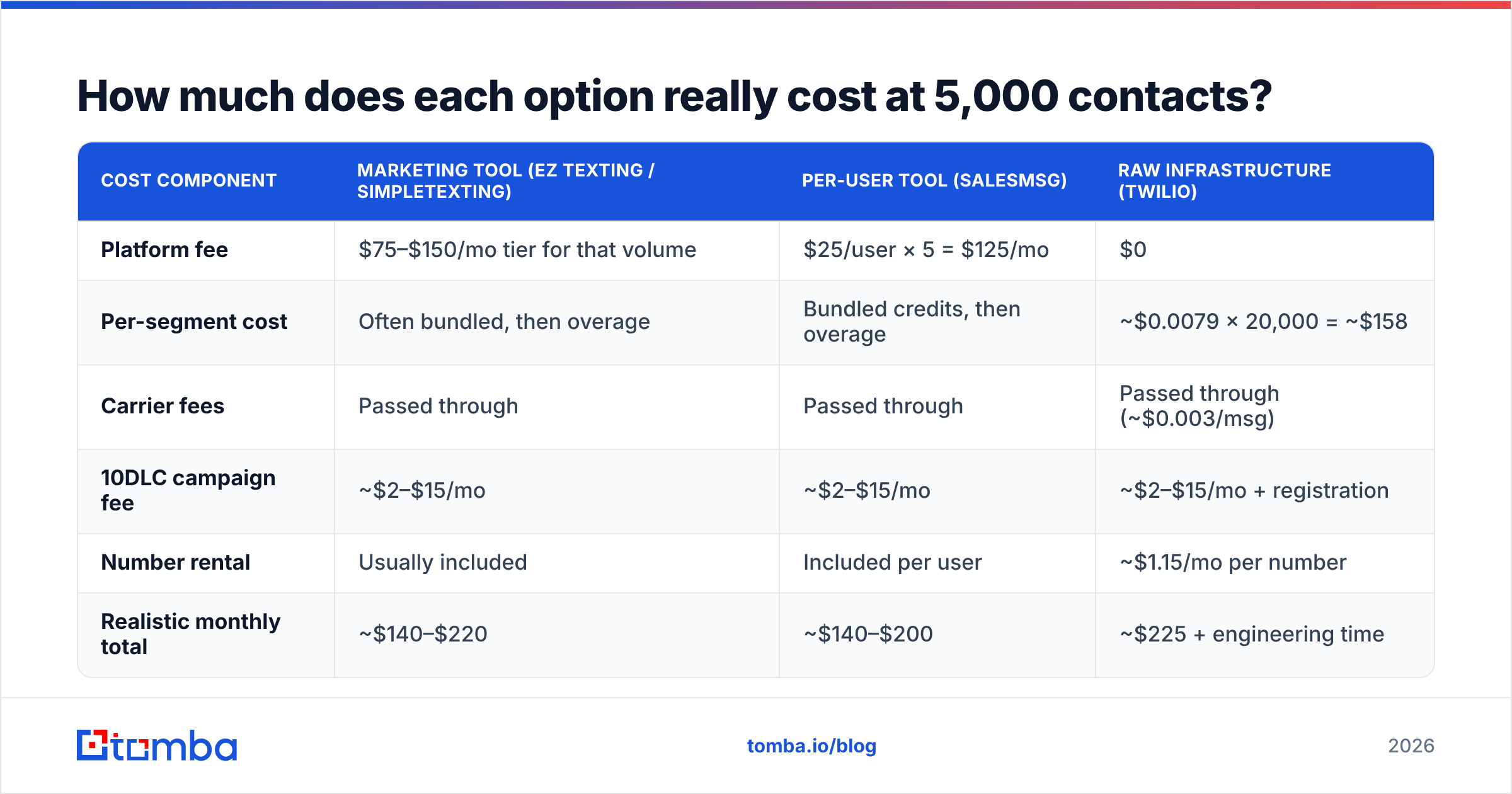
Run this calculation before you sign anything. Assume a 2-segment message (about 250 characters, which is a normal promo) sent twice a month to 5,000 opted-in contacts. That is 20,000 segments a month.
| Cost component | Marketing tool (EZ Texting / SimpleTexting) | Per-user tool (Salesmsg) | Raw infrastructure (Twilio) |
|---|---|---|---|
| Platform fee | $75–$150/mo tier for that volume | $25/user × 5 = $125/mo | $0 |
| Per-segment cost | Often bundled, then overage | Bundled credits, then overage | ~$0.0079 × 20,000 = ~$158 |
| Carrier fees | Passed through | Passed through | Passed through (~$0.003/msg) |
| 10DLC campaign fee | ~$2–$15/mo | ~$2–$15/mo | ~$2–$15/mo + registration |
| Number rental | Usually included | Included per user | ~$1.15/mo per number |
| Realistic monthly total | ~$140–$220 | ~$140–$200 | ~$225 + engineering time |
The honest conclusion: at moderate volume, the three models land within a hundred dollars of each other. Cost is not the deciding factor — workflow is. Twilio only pulls decisively ahead at high volume or when SMS is product infrastructure rather than marketing.
Does switching SMS platforms fix a low reply rate?#
Usually not. Deliverability problems in SMS split into two categories, and only one of them is the platform's fault.
Platform-side: unregistered 10DLC campaigns, a shared shortcode with a bad neighbor, or content that trips carrier filtering (URL shorteners like bit.ly are the classic offender — use a branded domain instead). Switching vendors can genuinely help here.
Data-side: the number is wrong, disconnected, a landline, or belongs to someone who never opted in. No vendor fixes that. You just pay a different company to fail.
This is where most "our SMS stopped working" investigations actually end. Before you migrate, validate the list. A phone validator pass will tell you which numbers are live, which are landlines that cannot receive SMS, and which carrier they sit on. Running that once typically removes 8–15% of an aging list — and that is 8–15% of your segment spend recovered immediately.

Where should the contacts come from in the first place?#
Be clear-eyed here: US SMS requires prior express written consent under the TCPA. You cannot buy a list of mobile numbers and start texting. Anyone selling you "SMS-ready B2B numbers" for cold outreach is selling you a compliance problem.
What sourced data is legitimately for:
- Email-first outreach that earns the opt-in. Run the cold sequence over email, get the reply, then ask for SMS consent as part of the conversation. Tools like the email finder and domain search build that top-of-funnel list from public professional sources.
- Enriching contacts you already have consent from. If someone opted in with a phone number and nothing else, data enrichment fills in company, role, and seniority so your segmentation is not guesswork.
- Direct-dial research for outbound calling, where the rules differ from SMS. A phone finder supports that motion, with your own DNC and consent checks layered on top.
The stack that actually works looks like this: sourced and verified email addresses at the top, an SMS platform for the consented middle, and a CRM holding the opt-out status as the single source of truth. Tools like BookYourData and Tomba solve the first half; EZ Texting and its alternatives solve the second. They are not competitors — they are different layers.
How do you migrate off EZ Texting without breaking anything?#
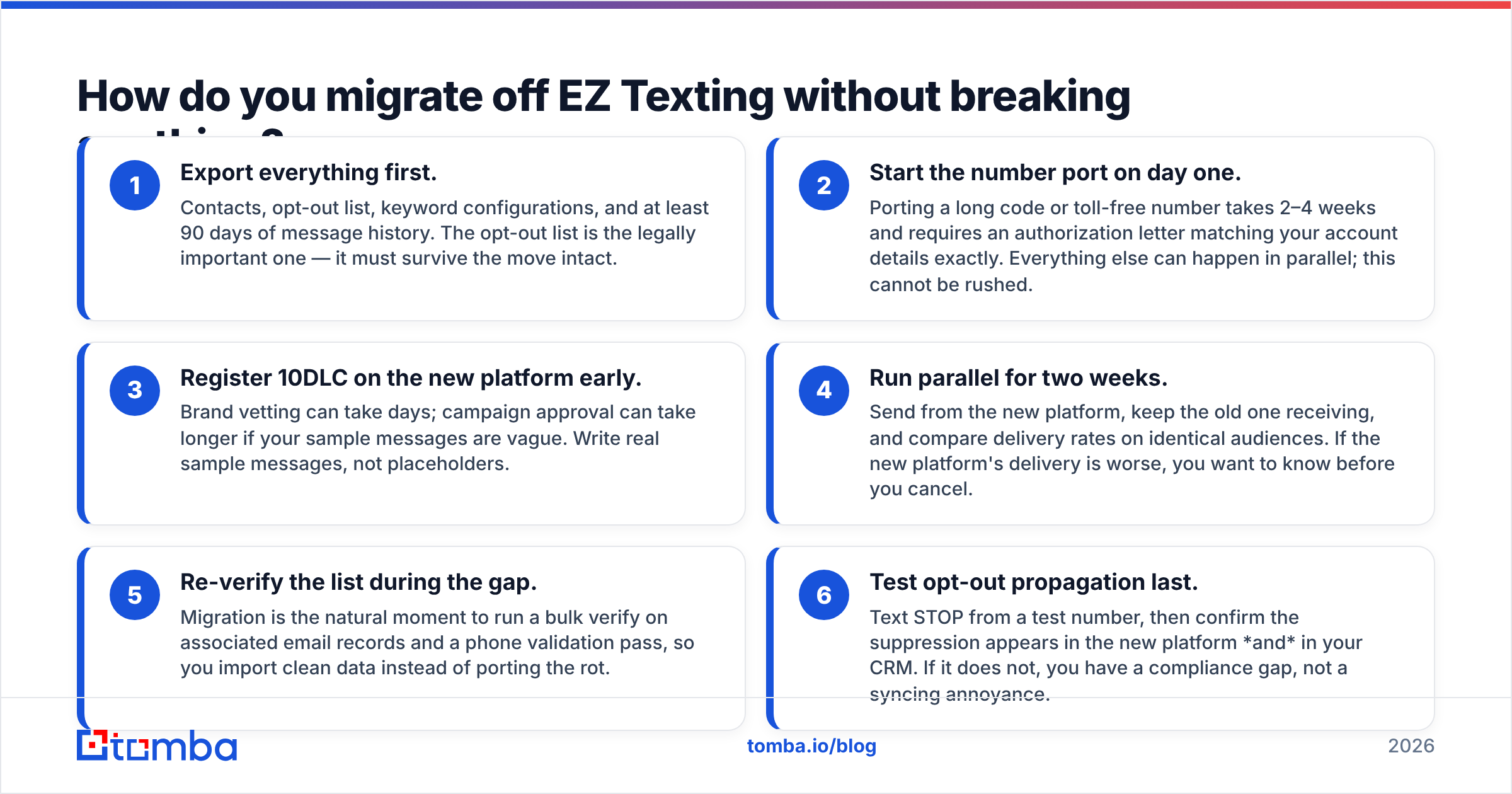
A clean migration takes about two weeks. A messy one takes two months because someone forgot the number port.
- Export everything first. Contacts, opt-out list, keyword configurations, and at least 90 days of message history. The opt-out list is the legally important one — it must survive the move intact.
- Start the number port on day one. Porting a long code or toll-free number takes 2–4 weeks and requires an authorization letter matching your account details exactly. Everything else can happen in parallel; this cannot be rushed.
- Register 10DLC on the new platform early. Brand vetting can take days; campaign approval can take longer if your sample messages are vague. Write real sample messages, not placeholders.
- Run parallel for two weeks. Send from the new platform, keep the old one receiving, and compare delivery rates on identical audiences. If the new platform's delivery is worse, you want to know before you cancel.
- Re-verify the list during the gap. Migration is the natural moment to run a bulk verify on associated email records and a phone validation pass, so you import clean data instead of porting the rot.
- Test opt-out propagation last. Text STOP from a test number, then confirm the suppression appears in the new platform and in your CRM. If it does not, you have a compliance gap, not a syncing annoyance.
So which EZ Texting alternative should you pick?#
Match the tool to the job, in one line each:
- You just want EZ Texting but nicer: SimpleTexting.
- Your reps need to own conversations inside the CRM: Salesmsg, or Heymarket if support shares the queue.
- SMS is triggered by your product: Twilio, and budget engineering time honestly.
- SMS is an extension of your email program: Klaviyo, or Postscript if you are Shopify-native.
- You are volume-light and international: TextMagic or Sakari.
- You are enterprise DTC with a seven-figure SMS program: Attentive, and negotiate hard.
And regardless of which you choose, treat the data layer as a separate decision. The platform controls how a message is delivered. Your data controls whether it should have been sent at all.
Build the list before you build the campaign#
Every SMS platform on this list charges you for messages sent, not messages that landed with the right person. That makes contact accuracy the cheapest optimization available to you — it costs nothing per message and it compounds across every channel you run.
Start at the top of the funnel: use the Tomba Email Finder to build a verified list of the decision-makers you actually want to reach, run outreach that earns an explicit SMS opt-in, then let your chosen EZ Texting alternative handle the send. The free tier gives you 25 searches a month to test the data quality against your own known contacts, and paid plans start at $49/mo — see full Tomba pricing for volume tiers and API access. Verify first, text second, and the platform decision gets a lot less stressful.
Related guides#
Ready to find emails that actually work?
Join 150,000+ professionals who stopped guessing and started sending. Free credits on signup — no credit card required.
Get the Tomba newsletter
Practical outbound tactics and product updates — once every two weeks.
About the author