FAC Intelligence vs GetProspect: Honest 2026 Comparison
Both promise verified B2B emails, but they solve different problems. Here's how FAC Intelligence and GetProspect actually compare on data accuracy, pricing, LinkedIn workflows, and API depth in 2026 — plus when neither is the right pick.
FAC Intelligence vs GetProspect is really a choice between two different jobs. GetProspect turns LinkedIn profiles into email addresses. FAC Intelligence sells context about accounts. Here is how the two stack up on data quality, price, and daily workflow in 2026.
TL;DR
- GetProspect is the more established tool. It is a LinkedIn-first email finder with a Chrome extension, a large B2B contact database, and a free tier you can actually use. It suits SDRs who prospect inside LinkedIn all day.
- FAC Intelligence sells lead intelligence and enrichment rather than a pure email finder. Public docs and pricing are thin, which is a buying signal on its own. Verify everything before you commit.
- Pricing is where the two split fastest. GetProspect publishes credit tiers you can model in a spreadsheet. FAC Intelligence prefers a quote and a sales call.
- If your workflow is API-first or verification-heavy, neither is the obvious default. A dedicated email finder with a documented API and a separate verification endpoint usually costs less per usable contact.
- The only test that matters is a 100-contact bake-off on your own list. Both tools look great on their own sample data.
What are FAC Intelligence and GetProspect?#
Both are sold as "B2B contact data". They are not the same kind of product.
GetProspect is an email finder and prospecting database. You give it a name plus a company domain, or you browse a LinkedIn search page with its extension on. It returns a work email address, usually with a confidence score.
Around that core it adds list management, simple CRM-style fields, email verification, and a searchable contact database. You can filter that database by industry, headcount, tech stack, and country. It has been on the market for years, has a large G2 review footprint, and publishes its plans openly at getprospect.com.
FAC Intelligence is harder to pin down, and I would rather say that plainly. It markets itself around lead intelligence, company data, and enrichment. That is the "who should we talk to, and why now" layer, not the narrow "give me this person's email" job.
Public documentation, changelogs, and independent reviews are thin next to GetProspect. That does not make the product bad. It does make it hard to check from the outside. So weight your own trial results far above any comparison article, including this one.
The practical split is simple. GetProspect is a contact acquisition tool. FAC Intelligence sits closer to account intelligence. Buy one expecting the other and you will be unhappy for reasons that have nothing to do with quality.
FAC Intelligence vs GetProspect: how do the features compare?#
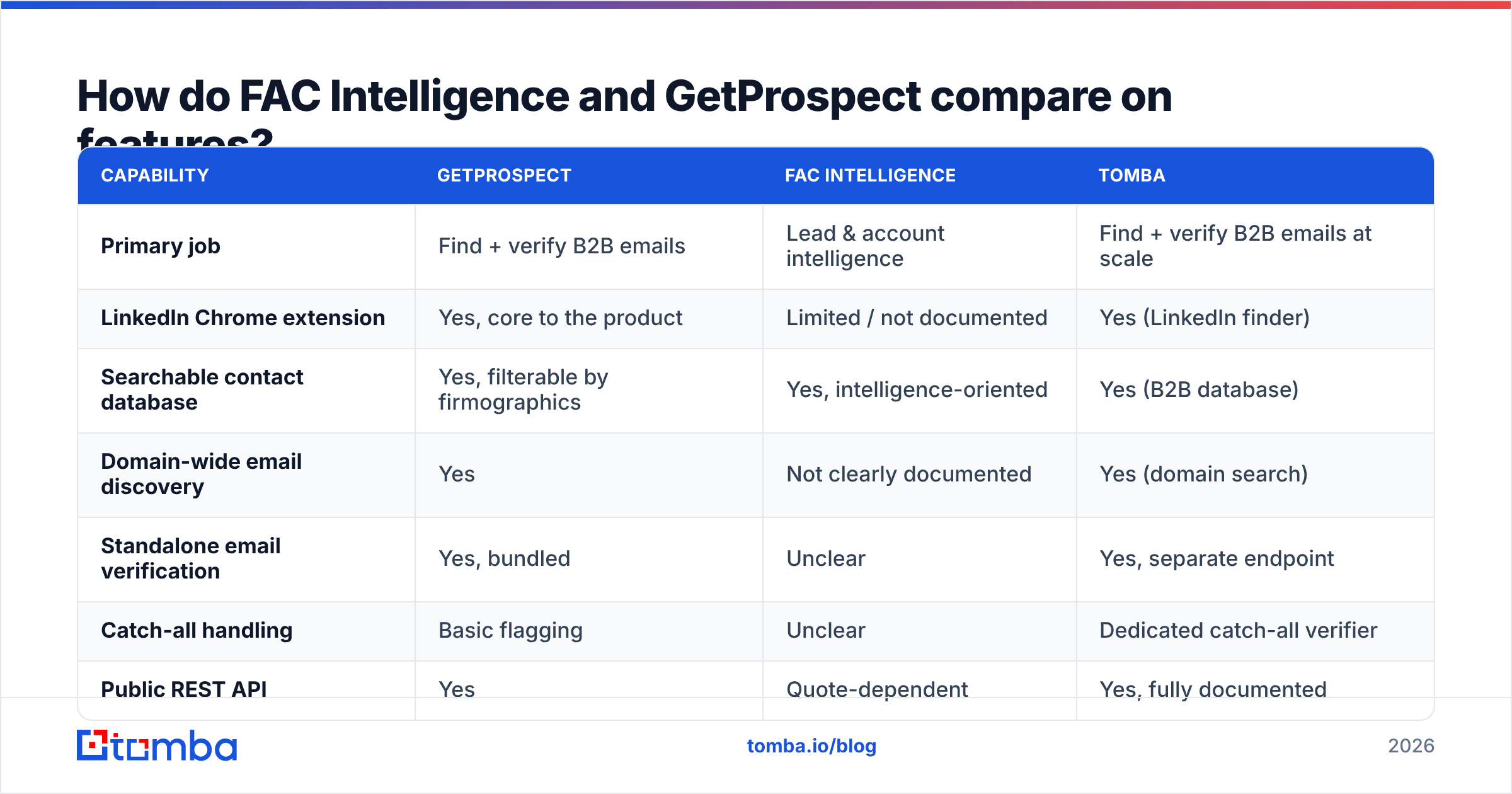
Here is the honest side-by-side. Where I am inferring rather than confirming, I have marked it.
| Capability | GetProspect | FAC Intelligence | Tomba |
|---|---|---|---|
| Primary job | Find + verify B2B emails | Lead & account intelligence | Find + verify B2B emails at scale |
| LinkedIn Chrome extension | Yes, core to the product | Limited / not documented | Yes (LinkedIn finder) |
| Searchable contact database | Yes, filterable by firmographics | Yes, intelligence-oriented | Yes (B2B database) |
| Domain-wide email discovery | Yes | Not clearly documented | Yes (domain search) |
| Standalone email verification | Yes, bundled | Unclear | Yes, separate endpoint |
| Catch-all handling | Basic flagging | Unclear | Dedicated catch-all verifier |
| Public REST API | Yes | Quote-dependent | Yes, fully documented |
| Published pricing | Yes | Largely quote-based | Yes, from free to $249/mo |
| Free tier | Yes, limited monthly credits | Not publicly documented | Yes, 25 searches/mo |
| Phone numbers | Limited | Positioned as a strength | Yes, phone finder |
The pattern is clear enough. GetProspect wins on transparency and on the LinkedIn-to-inbox workflow. FAC Intelligence pitches depth of signal instead: company context and intent-style data. That is worth more to an ABM team than to an SDR making 80 touches a day.
Which one has better data accuracy?#
Nobody can answer this for you from the outside. Any article that hands you a confident percentage is making it up.
What you can do is learn where accuracy leaks. In practice, three things decide whether a contact bounces:
- Source freshness. A contact scraped 18 months ago is a coin flip. B2B contact data goes stale at roughly 25–30% per year, mostly because people change jobs. HubSpot and most CRM vendors have published versions of that number for a decade.
- Guessed vs. seen. Many tools guess
first.last@domain.combecause that is the company's usual pattern. Then they dress the guess up with a confidence score. An address actually seen in a public source is a different class of data. - Verification quality. A tool that pings the mail server and flags catch-all domains correctly will save you far more money than one that calls every catch-all address "valid".
That third point is where cheap tools quietly hurt you. About a fifth of business domains are catch-all. The server accepts every address and tells you nothing.
If your provider marks those as valid, your reported deliverability looks fine for a while. Then your sender reputation falls off a cliff.

GetProspect is fairly open that its verification is a bundled convenience, not a specialist product. FAC Intelligence does not publish enough detail to judge.
If bounce rate is your real constraint, run every list through a dedicated email verifier no matter which finder you buy. Treating find and verify as one step is the most common reason cold campaigns die in month two.
What does each one cost in 2026?#
Pricing is the cleanest difference in the FAC Intelligence vs GetProspect matchup, and it is not subtle.
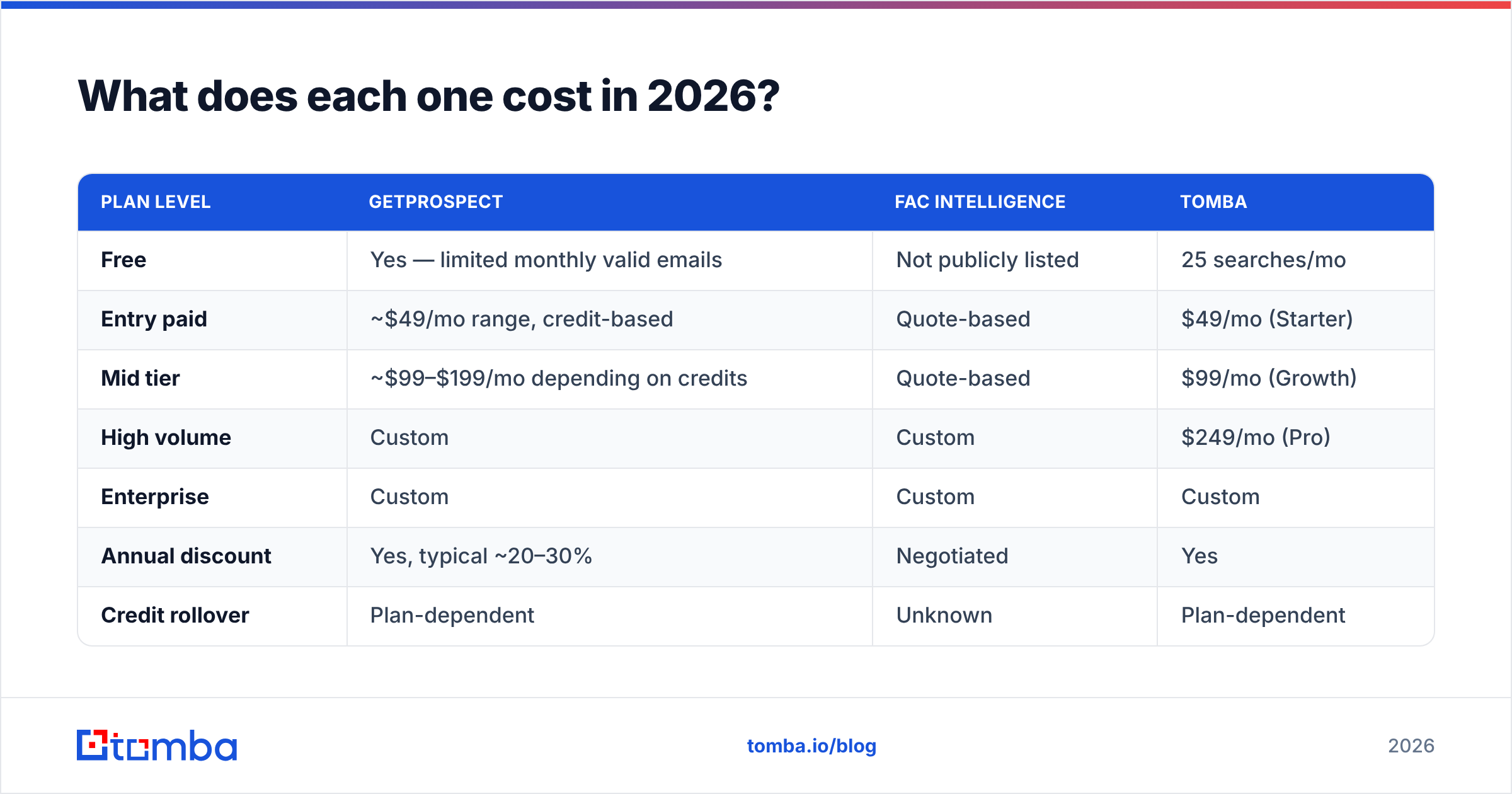
| Plan level | GetProspect | FAC Intelligence | Tomba |
|---|---|---|---|
| Free | Yes — limited monthly valid emails | Not publicly listed | 25 searches/mo |
| Entry paid | ~$49/mo range, credit-based | Quote-based | $49/mo (Starter) |
| Mid tier | ~$99–$199/mo depending on credits | Quote-based | $99/mo (Growth) |
| High volume | Custom | Custom | $249/mo (Pro) |
| Enterprise | Custom | Custom | Custom |
| Annual discount | Yes, typical ~20–30% | Negotiated | Yes |
| Credit rollover | Plan-dependent | Unknown | Plan-dependent |
Check getprospect.com before you budget. Credit vendors change tiers often, and the number that matters is credits per dollar, not the headline price.
Price in two traps before you sign anything:
- Credits burned on failures. Ask whether a search that returns nothing still costs a credit. Some vendors charge for the attempt. On a 10,000-row job with a 55% hit rate, that one rule is the whole negotiation.
- The verification tax. If you have to run the output through a second tool, add that bill to the finder's price. A $49/mo finder plus a $60/mo verifier is a $109/mo stack, and you should compare it as one.
Quote-based pricing is not a red flag by itself. Plenty of good enterprise data vendors work that way, because contract shape really does vary.
It does mean you cannot benchmark FAC Intelligence without booking a call. That friction is real when you are testing five tools in a week. Tomba's pricing is public for the same reason GetProspect's is: buyers who can model cost in a spreadsheet decide faster.

Which tool fits which team?#
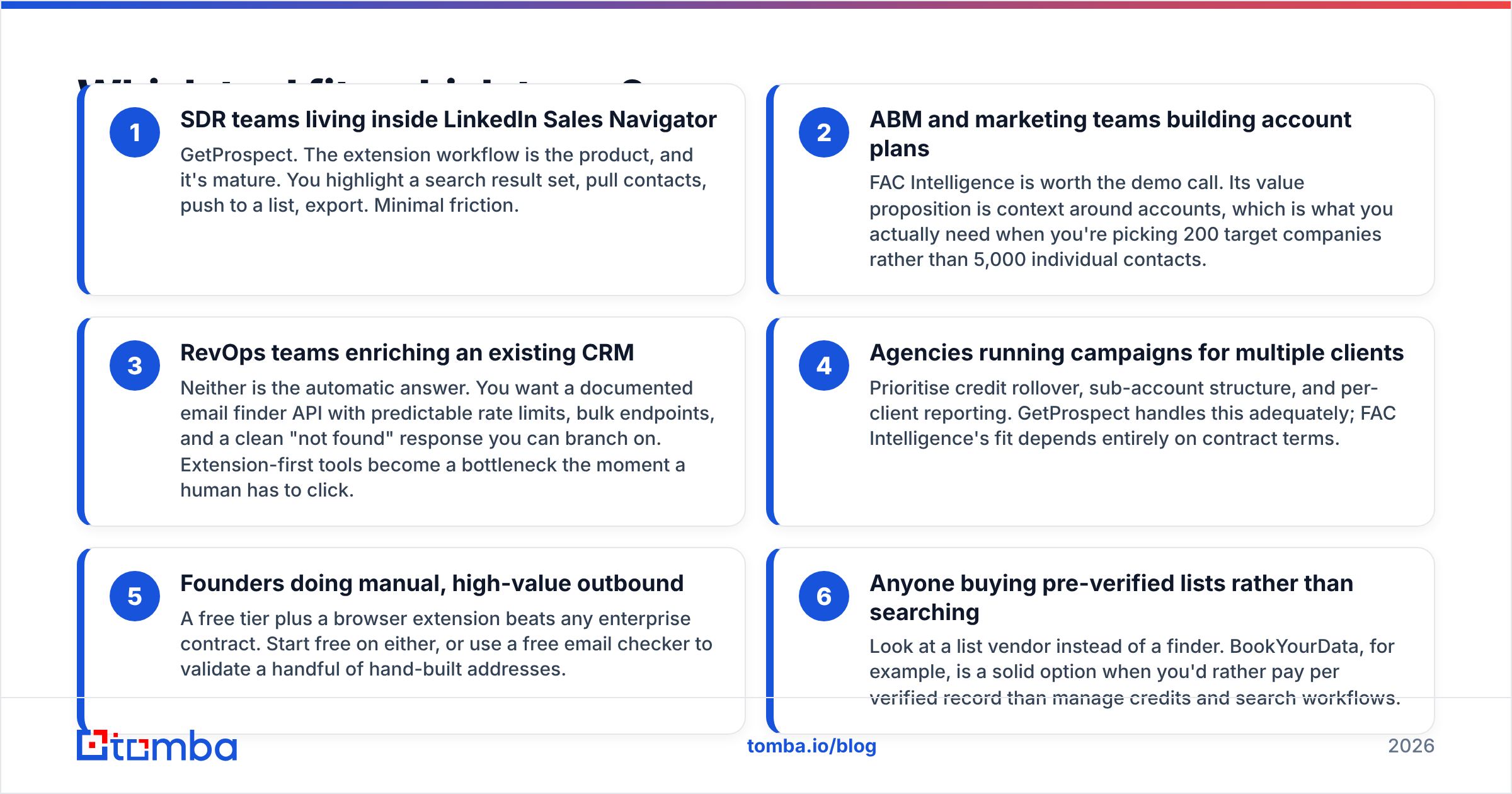
Match the tool to the motion, not to the feature list.
- SDR teams living inside LinkedIn Sales Navigator — GetProspect. The extension workflow is the product, and it is mature. Highlight a result set, pull contacts, push to a list, export.
- ABM and marketing teams building account plans — FAC Intelligence is worth the demo call. It sells context around accounts. That is what you need when you pick 200 target companies instead of 5,000 people.
- RevOps teams enriching a CRM — Neither is the automatic answer. You want a documented email finder API with clear rate limits, bulk endpoints, and a clean "not found" response. Extension-first tools stall the moment a human has to click.
- Agencies running campaigns for several clients — Look at credit rollover, sub-accounts, and per-client reporting. GetProspect handles this well enough. FAC Intelligence depends on your contract.
- Founders doing manual, high-value outbound — A free tier plus a browser extension beats any enterprise contract. Start free on either, or use a free email checker on a handful of hand-built addresses.
- Anyone buying pre-verified lists — Use a list vendor, not a finder. BookYourData is a solid option when you would rather pay per verified record than manage credits.
What are the trade-offs nobody mentions in the demo?#
GetProspect's trade-off is depth. It is very good at one job and merely fine at everything next to it. The bundled verification works for a first pass, but it is not a real verification pipeline.
The database filters help, yet they are not as fine-grained as a dedicated intelligence platform. If your target is "any SaaS company with 50–200 staff in North America", great. If it is "companies that just hired a VP of Compliance and run Snowflake", you will hit the ceiling fast.
FAC Intelligence's trade-off is proof. Light public docs, few independent reviews, and quote-only pricing mean you buy on a sales conversation rather than evidence you gathered yourself.
You can manage that risk. Insist on a trial with your accounts. Ask for a written accuracy guarantee. Check the contract for data-source provenance, because GDPR and CCPA exposure sits with you, not the vendor, when a prospect complains.
The shared trade-off is coverage. Both will show strong numbers on well-documented US tech companies. Coverage on a 40-person German manufacturer or a Brazilian logistics firm is another story. Test your hardest segment first, not your easiest.
How do you run a fair FAC Intelligence vs GetProspect bake-off?#
Thirty minutes of structured testing beats three weeks of reading comparison posts. Here is the protocol:
- Build one gold-standard list of 100 contacts from your real target market. Include at least 20 from your hardest segment: small companies, non-English markets, or non-technical roles.
- Run the same list through every tool on the same day. Record hit rate and the spread of confidence scores.
- Verify all output through one neutral verifier so the scoring stays consistent. Do not let a vendor grade its own homework.
- Send a real 50-contact campaign from a warmed domain. Measure hard bounces, not the vendor's predicted validity.
- Work out cost per usable contact: monthly cost ÷ (contacts found × verified-valid rate). This is the number that survives your CFO.
- Time the workflow. If tool A takes 12 seconds per contact and tool B takes 3, that is 45 minutes a day for an SDR working 300 records a week.
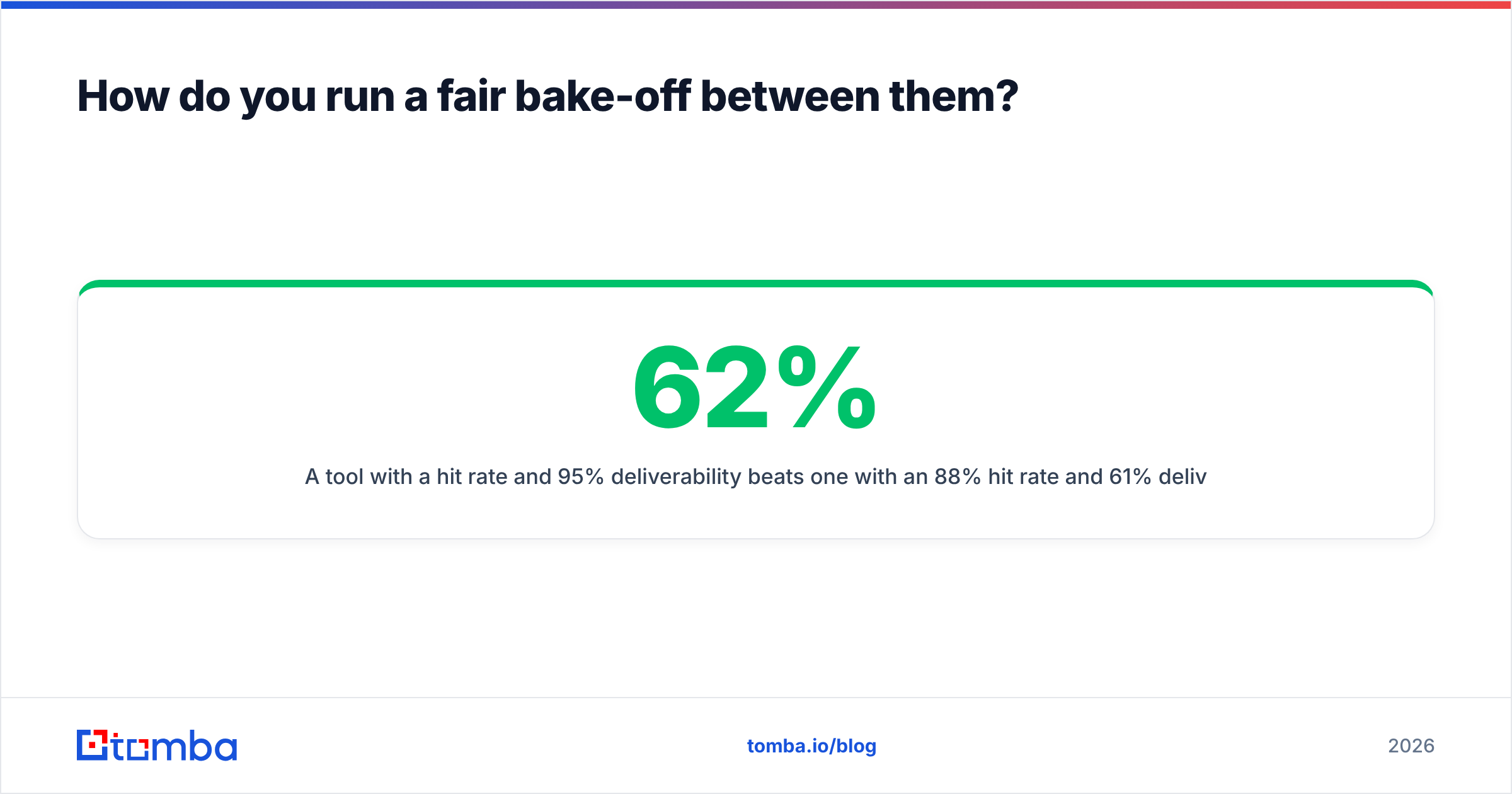
A tool with a 62% hit rate and 95% deliverability beats one with an 88% hit rate and 61% deliverability. Every time.
Volume metrics flatter vendors. Deliverability metrics tell the truth. If you want a repeatable process, push the whole test through a bulk email finder so you compare like with like instead of clicking by hand.
So which one should you pick?#
Pick GetProspect if your team prospects in LinkedIn, wants published pricing, and mainly needs to turn a profile into a working email address. It is proven and transparent, and the free tier lets you test the fit before you spend.
Pick FAC Intelligence if you sell to accounts rather than individuals, you can wait out a quote-based sales cycle, and the demo shows coverage on your accounts. Get the accuracy commitment in writing.
Pick neither if your bottleneck is engineering or verification quality. That calls for a different shape of product: documented API, separate verify endpoint, real catch-all handling, and pricing that does not punish a failed lookup.
That last case is where Tomba fits. The Tomba Email Finder is built around domain-wide discovery and confirmed-source addresses instead of pattern guessing. Verification is a first-class step, not a bundled afterthought.
The free tier is 25 searches a month. Starter is $49/mo and Growth is $99/mo, with no call needed to see the number. Run your 100-contact bake-off against Tomba alongside FAC Intelligence vs GetProspect, compare cost per verified contact, and let your own bounce rate pick the winner.
Related guides#
Ready to find emails that actually work?
Join 150,000+ professionals who stopped guessing and started sending. Free credits on signup — no credit card required.
Get the Tomba newsletter
Practical outbound tactics and product updates — once every two weeks.
About the author