Fac Intelligence vs Warpleads: Honest 2026 Comparison
Fac Intelligence and Warpleads both promise more B2B contacts for less money — but they solve different problems. Here's how they compare on data model, accuracy, exports, and cost, plus which one fits your outbound motion.
TL;DR
- Warpleads is built around volume: large exportable B2B lists, bulk email lookup, and flat-rate style plans aimed at agencies and high-send outbound teams.
- Fac Intelligence leans toward intelligence and enrichment: fewer, better-described records with firmographic and intent-style context wrapped around them.
- Neither replaces a verification layer. Both ship data that decays 2–3% per month, and neither guarantees inbox-safe sends on its own.
- If your bottleneck is list size, Warpleads wins. If it's targeting precision, Fac Intelligence wins. If it's bounce rate, neither is the fix — a dedicated finder/verifier is.
- Pricing on both moves frequently. Treat every number below as "verify on the vendor page before you buy."
What are Fac Intelligence and Warpleads?#
Short answer: they're both B2B contact-data platforms, but they were designed for opposite ends of the same funnel.
Warpleads (warpleads.com) markets itself to outbound operators who need a lot of leads, quickly, without per-record anxiety. The pitch is export-heavy: filter a database by industry, geography, headcount, and title, then pull thousands of rows into a CSV or straight into a sequencer. It also offers an on-demand email lookup path for lists you already have — you bring the names and companies, it returns addresses.
Fac Intelligence sits closer to the sales-intelligence category. Rather than optimizing for raw export ceilings, it emphasizes the context around a contact: what the company does, how it's structured, signals that suggest timing. In practice that means smaller working lists with more attributes attached, and a workflow that looks more like account research than list-building.
The distinction matters more than any feature checklist. A team running 4,000 sends a week has a fundamentally different data problem than a team running 60 highly researched touches a week. Buying the wrong shape of tool is the most common — and most expensive — mistake in this category.
How do the two data models actually differ?#
Here's the structural breakdown, which is where most of the practical difference lives:
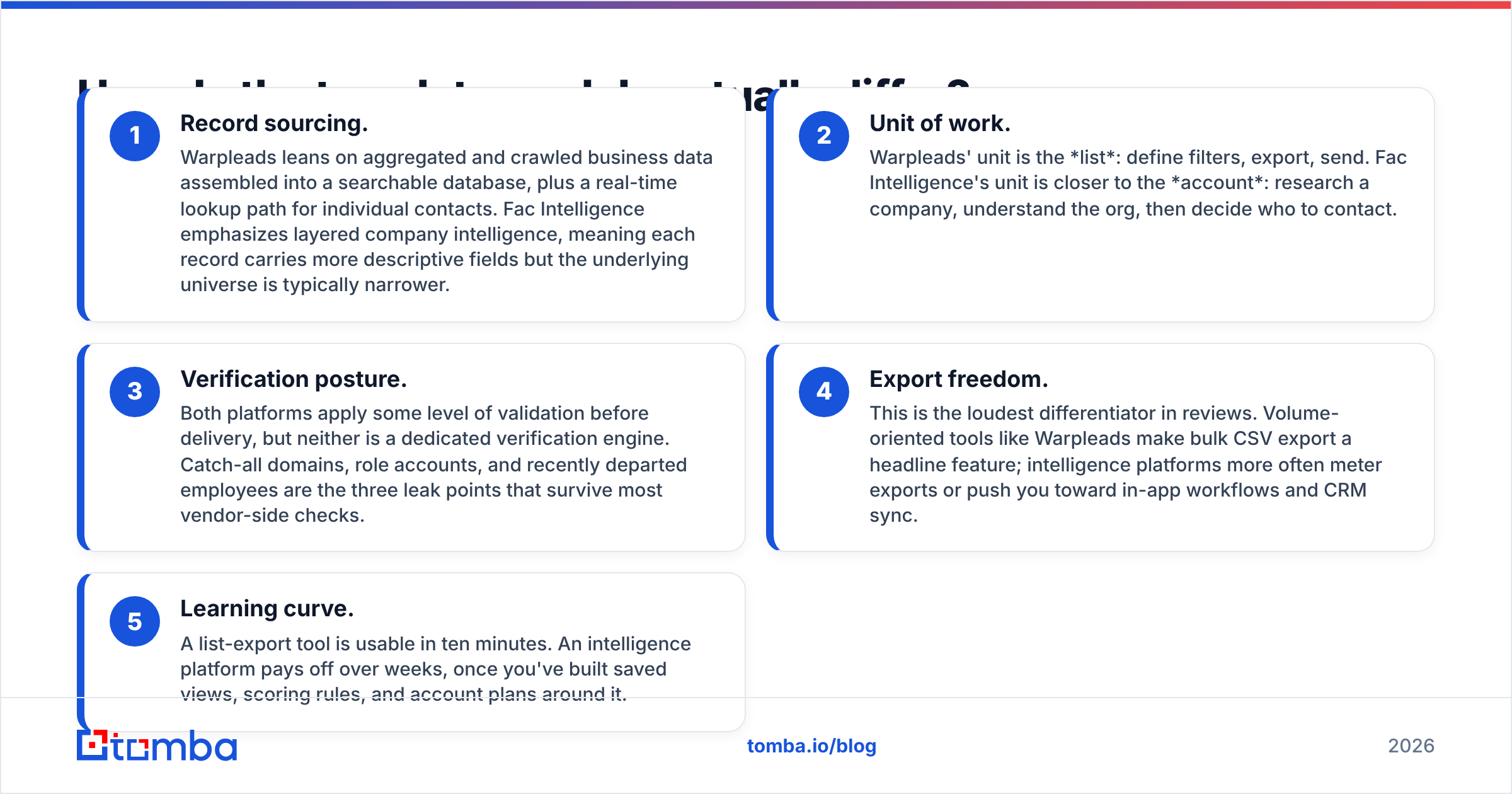
- Record sourcing. Warpleads leans on aggregated and crawled business data assembled into a searchable database, plus a real-time lookup path for individual contacts. Fac Intelligence emphasizes layered company intelligence, meaning each record carries more descriptive fields but the underlying universe is typically narrower.
- Unit of work. Warpleads' unit is the list: define filters, export, send. Fac Intelligence's unit is closer to the account: research a company, understand the org, then decide who to contact.
- Verification posture. Both platforms apply some level of validation before delivery, but neither is a dedicated verification engine. Catch-all domains, role accounts, and recently departed employees are the three leak points that survive most vendor-side checks.
- Export freedom. This is the loudest differentiator in reviews. Volume-oriented tools like Warpleads make bulk CSV export a headline feature; intelligence platforms more often meter exports or push you toward in-app workflows and CRM sync.
- Learning curve. A list-export tool is usable in ten minutes. An intelligence platform pays off over weeks, once you've built saved views, scoring rules, and account plans around it.
If you can't tell which of those five matters most to your team, that's the diagnostic question — not "which one has more contacts."
Which one has better data accuracy?#
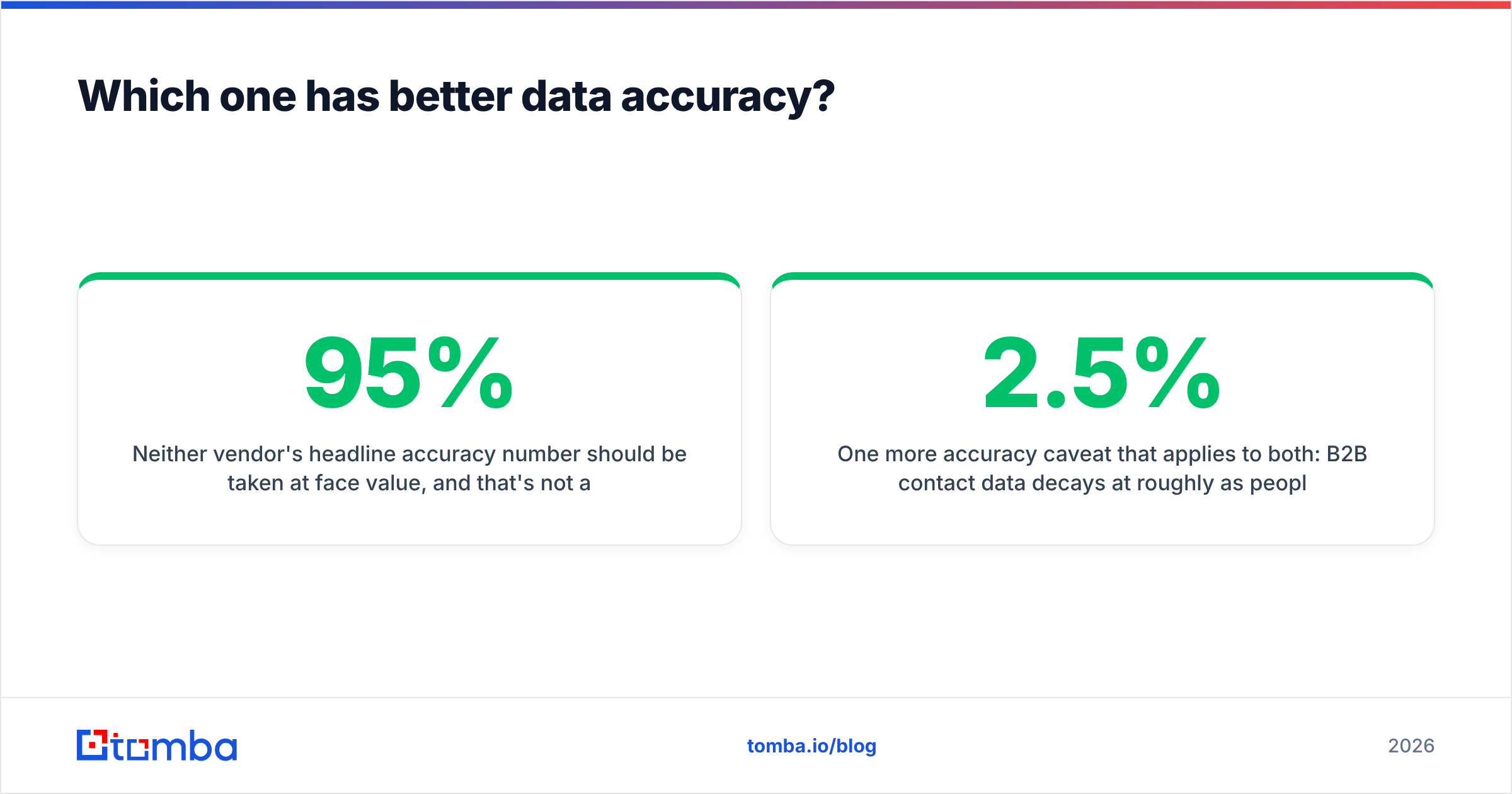
Neither vendor's headline accuracy number should be taken at face value, and that's not a knock on either of them — it's how the category works. "95% accuracy" usually means 95% of the addresses we chose to return passed our internal syntax and MX checks, not 95% of the people you want are findable and reachable. Two numbers get conflated: hit rate (did the tool return anything for this person?) and validity rate (was what it returned correct?).
A tool can post a superb validity rate by simply refusing to guess on hard records. That's honest behaviour, but it shows up in your pipeline as a thin list. Conversely, a tool with an enormous hit rate is often returning pattern-guessed addresses that were never observed in the wild.

The practical test takes an afternoon:
- Pull 100 contacts you already know are correct — current customers, past deals, people who've replied to you.
- Strip the email addresses out and feed the names + domains to each tool.
- Score three columns: returned an address, returned the right address, flagged uncertainty correctly.
Run that, and the marketing claims stop mattering. In most head-to-head tests we've seen readers run, volume-first tools score higher on coverage and lower on precision, while intelligence-first tools do the reverse. Sub-1,000-employee companies, non-US domains, and anyone at a company using a catch-all mail server are where the gaps open up.
One more accuracy caveat that applies to both: B2B contact data decays at roughly 2.5% per month as people change jobs. A list exported in January is meaningfully worse by June regardless of who sold it to you. Re-verification before each campaign isn't optional hygiene — it's the difference between a 1% bounce rate and a 7% one, and email deliverability collapses fast past 3%.
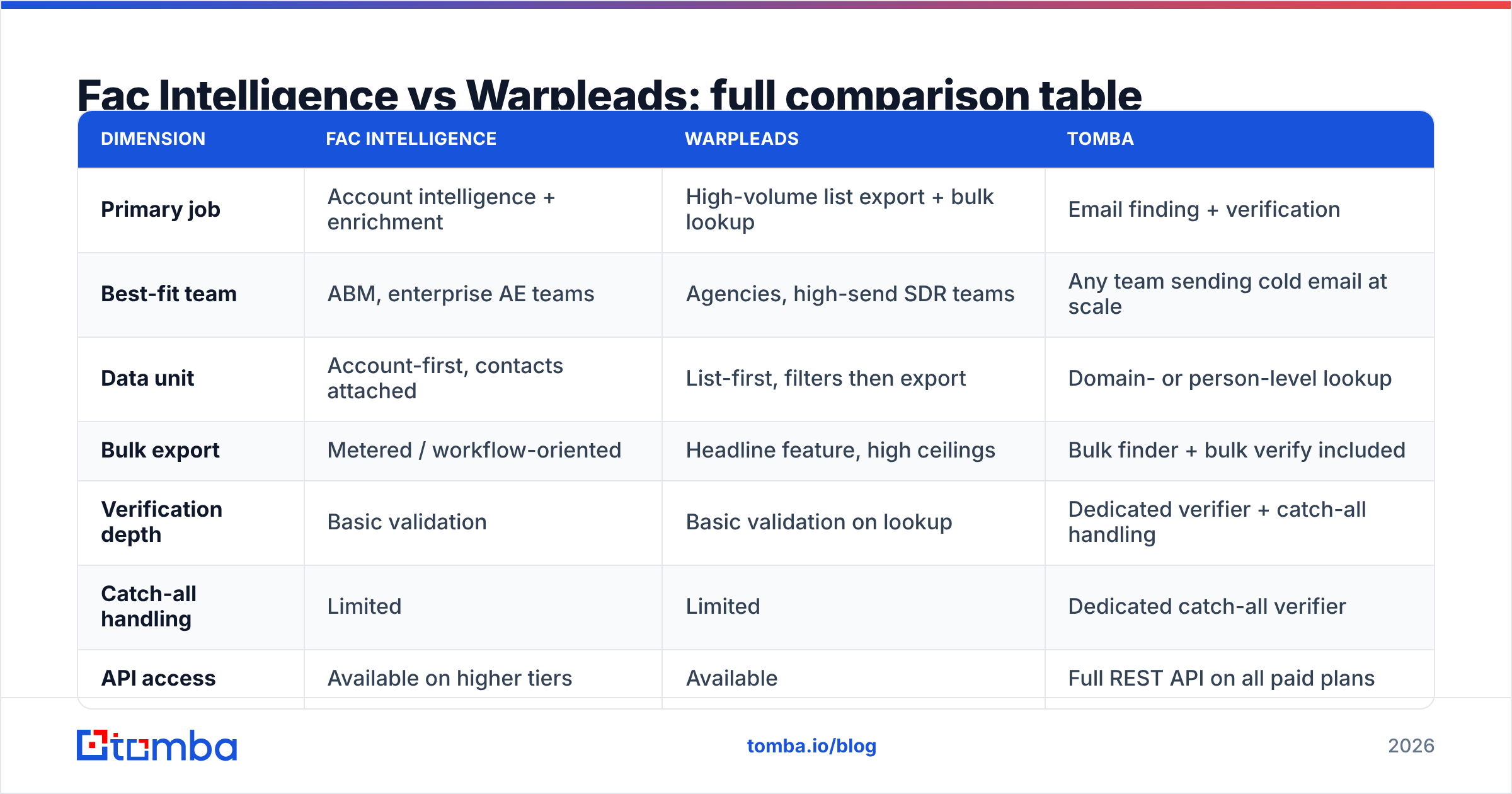
Fac Intelligence vs Warpleads: full comparison table#

| Dimension | Fac Intelligence | Warpleads | Tomba |
|---|---|---|---|
| Primary job | Account intelligence + enrichment | High-volume list export + bulk lookup | Email finding + verification |
| Best-fit team | ABM, enterprise AE teams | Agencies, high-send SDR teams | Any team sending cold email at scale |
| Data unit | Account-first, contacts attached | List-first, filters then export | Domain- or person-level lookup |
| Bulk export | Metered / workflow-oriented | Headline feature, high ceilings | Bulk finder + bulk verify included |
| Verification depth | Basic validation | Basic validation on lookup | Dedicated verifier + catch-all handling |
| Catch-all handling | Limited | Limited | Dedicated catch-all verifier |
| API access | Available on higher tiers | Available | Full REST API on all paid plans |
| Free tier | Trial / demo-gated | Limited trial | 25 free searches/month |
| Entry paid price | Quote-based / mid-tier | Volume-tiered | $49/mo Starter |
| Spreadsheet workflow | CRM-centric | CSV-centric | Sheets, Excel, Airtable add-ons |
| Transparent public pricing | Partial | Partial | Yes — Tomba pricing |
Two honest caveats about that table. First, both vendors change packaging often; the "quote-based" and "volume-tiered" entries reflect how each company was presenting itself at the time of writing, not a permanent state. Second, we've included Tomba as a third column not to declare a winner but because the verification row is where most Fac-vs-Warpleads debates actually get decided — and neither of the two is designed to own it.
How do the pricing models compare?#
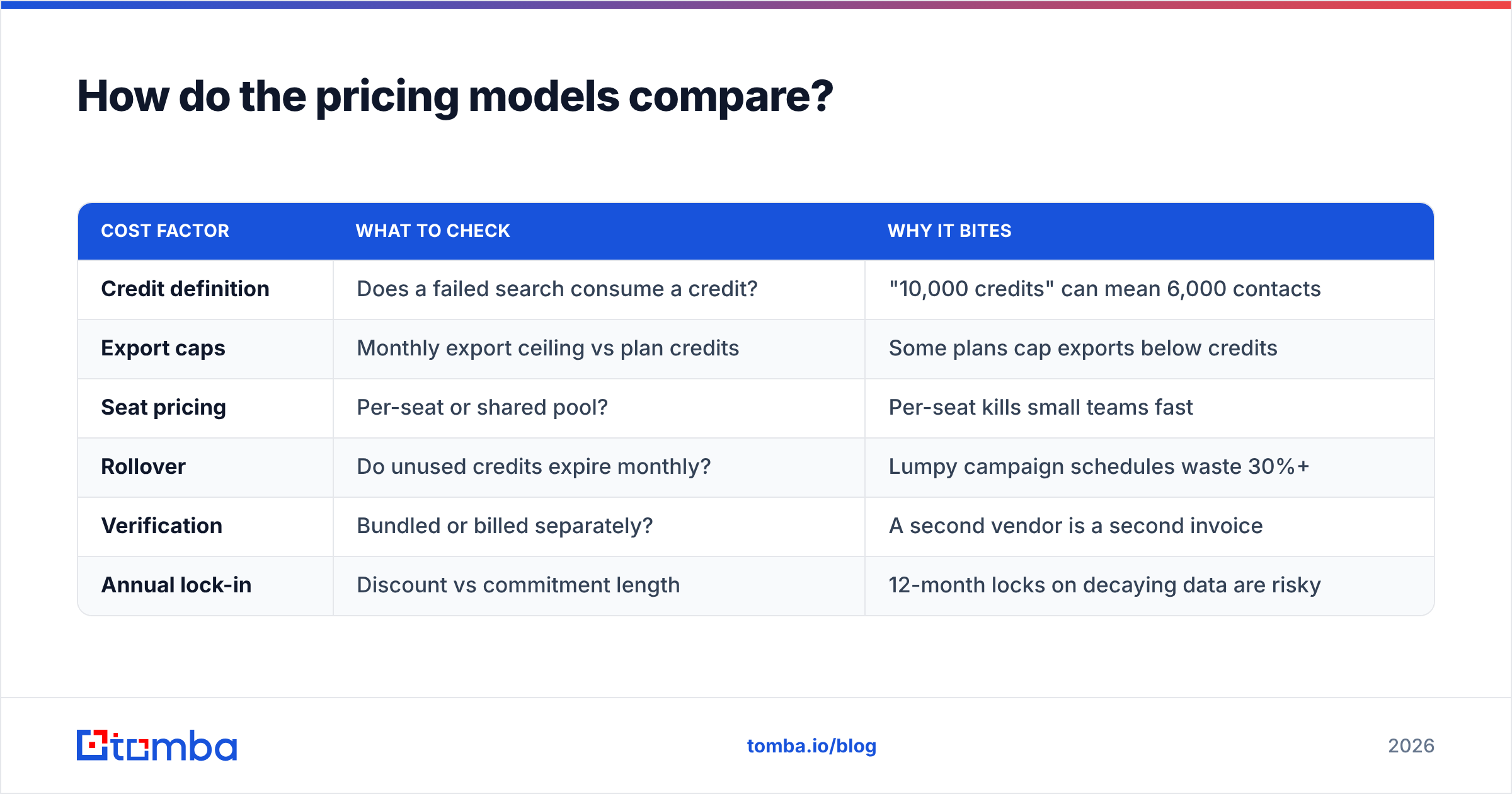
The pricing question is really a cost-per-usable-contact question, and that's rarely what appears on a pricing page.
| Cost factor | What to check | Why it bites |
|---|---|---|
| Credit definition | Does a failed search consume a credit? | "10,000 credits" can mean 6,000 contacts |
| Export caps | Monthly export ceiling vs plan credits | Some plans cap exports below credits |
| Seat pricing | Per-seat or shared pool? | Per-seat kills small teams fast |
| Rollover | Do unused credits expire monthly? | Lumpy campaign schedules waste 30%+ |
| Verification | Bundled or billed separately? | A second vendor is a second invoice |
| Annual lock-in | Discount vs commitment length | 12-month locks on decaying data are risky |
Run the math on the metric that matters: take your monthly spend, divide by the number of contacts that (a) returned an address, (b) passed verification, and (c) matched your ICP. A $99/month plan yielding 1,800 usable contacts beats a $59 plan yielding 700. Volume tools usually win on raw cost-per-row; intelligence tools usually win on cost-per-qualified-row. Which one is cheaper depends entirely on how tight your ICP is.
For reference points on where each vendor sits with real buyers, G2's lead-intelligence category is the least-filtered source available — read the 3-star reviews specifically, since those are where export limits and support response times get named.
Who should choose Warpleads?#
Pick Warpleads if three or more of these describe you:
- You send more than 2,000 cold emails a month. Volume economics are its whole thesis, and per-record pricing punishes you at that scale.
- You run an agency or serve multiple ICPs. Broad filters plus generous exports beat deep intelligence when you're rebuilding lists monthly for different clients.
- Your sequencer is the center of your stack. If everything lands in Instantly, Smartlead, or a similar tool, you want CSVs, not another dashboard to live in.
- Your ICP is broad. "SaaS companies, 10–200 employees, US and UK" is a filter query. "Manufacturing firms that just opened a second facility" is not.
- You're testing messaging, not targeting. Wide lists are how you find which segment responds before you invest in depth.
The failure mode to watch: bulk exports plus an unwarmed domain is the fastest route to a burned sending reputation. If you go this route, budget for a bulk verify pass and check sender reputation weekly.
Who should choose Fac Intelligence?#
Pick Fac Intelligence if the following sound familiar:
- Your ACV is above roughly $20,000. When one deal pays for a year of tooling, research depth beats list size.
- You sell into committees. Multi-threading a six-person buying group needs org context, not just more addresses.
- Timing signals drive your outreach. Funding, hiring, expansion, and tech-stack changes are what intelligence platforms exist to surface.
- Your reps write bespoke emails. Personalization has to be fed by something. A CSV of names and titles doesn't feed it.
- Compliance review is part of your buying process. Enterprise-oriented vendors tend to have the documentation your legal team will ask for.
The failure mode here is different: teams buy an intelligence platform, use it as an expensive list exporter, and conclude the category is overpriced. If your reps aren't actually reading the intelligence, you're paying for a feature you've decided not to use.
Where does a dedicated email finder fit in the stack?#
Here's the part most comparison posts skip: the Fac Intelligence vs Warpleads decision is about sourcing, and sourcing is only half the job.
Both platforms hand you addresses. Neither is architected to answer "is this address still deliverable today, and if the domain is catch-all, can you tell me anything useful?" That's a specialist function, and running it as a separate layer is standard practice for teams sending at any real volume.
That's the slot a dedicated finder-verifier fills. Tomba's email verifier runs SMTP-level checks and flags role accounts and disposables; the catch-all verifier handles the domains where a naive SMTP ping returns "accepted" for literally any address — the single biggest source of false-positive bounces in cold email. Alongside them, domain search pulls every discoverable address at a company, which is often faster than filtering a database when you already know your target accounts.
A workable three-layer stack looks like this:
- Source — Warpleads or Fac Intelligence, depending on whether you need breadth or depth.
- Fill and verify — a finder/verifier to close gaps in the export and score every address before it enters the sequencer.
- Send — your sequencer, with a warmed domain and a bounce threshold that pauses campaigns automatically.
Skip layer two and layers one and three both underperform. HubSpot's sales research has been consistent on this point for years: reply rates track deliverability far more closely than they track list size.
What about the API and automation path?#
If you're building rather than clicking, evaluate three things on both vendors:
- Rate limits per plan tier — the number that decides whether a nightly enrichment job finishes.
- Response shape — does the API return confidence scores, or just a string? Scores let you set your own thresholds; strings force you to trust the vendor's.
- Idempotency and credit behaviour on failure — a retry loop against a vendor that charges for empty responses is a budget leak.
For teams gluing systems together, an email finder API with predictable per-request semantics is usually easier to reason about than a platform API that assumes you're operating inside its UI. Check whether native integrations cover your CRM before you commit to writing middleware.
Frequently asked questions#
Is Warpleads or Fac Intelligence better for GDPR compliance? Both should provide a data-processing agreement and documentation of lawful basis. Ask for these in writing during the trial. Legitimate interest is the usual basis for B2B outreach in the EU, but it requires you to honour opt-outs and to have a defensible relevance argument for each contact.
Can I use both? Yes, and larger teams often do — an intelligence platform for named accounts, a volume tool for top-of-funnel tests. It only makes sense above roughly 5 reps; below that, the overhead eats the benefit.
Which has better support? This varies by plan tier more than by vendor. Test it during the trial: send a real question at 4pm on a Friday and see what comes back.
How do I switch without losing data? Export everything to CSV first, dedupe against your CRM, then re-verify before importing. Contact data you exported six months ago should be treated as unverified regardless of who supplied it.
Which one should you actually buy?#
Decide with one question: is my pipeline problem that I don't have enough names, or that I don't know enough about the names I have?
Not enough names, broad ICP, high send volume → Warpleads. Enough names, tight ICP, big deals, committee selling → Fac Intelligence. Bouncing at 5%+ regardless of source → neither of the above is your fix.
Whichever you pick, put a verification layer between the export and the send. Start with Tomba Email Finder on the free tier — 25 searches a month is enough to run the 100-contact accuracy test described above against both vendors before you sign anything. Paid plans start at $49/month, include bulk finding and verification in the same credit pool, and the API is available on every tier, so the layer you build during evaluation is the same one you run in production.
Related guides#
Ready to find emails that actually work?
Join 150,000+ professionals who stopped guessing and started sending. Free credits on signup — no credit card required.
Get the Tomba newsletter
Practical outbound tactics and product updates — once every two weeks.
About the author