Fac Intelligence vs ZoomInfo: Which B2B Data Tool Wins?
ZoomInfo is the incumbent with the biggest database and the biggest invoice. Fac Intelligence is the lean challenger. Here is how they actually compare on coverage, email accuracy, contracts, and what most teams should buy instead.
TL;DR
- ZoomInfo is the incumbent: the largest commercially available B2B contact database, deep intent and technographic layers, and an annual contract that commonly lands in five figures.
- Fac Intelligence is the lean challenger: smaller footprint, quote-based pricing, much less public documentation, and a sales motion that depends heavily on talking to a rep.
- The honest answer for most teams is neither at full price. If you already know which accounts you want, a targeted email finder plus verification costs a fraction of a seat-based intelligence platform.
- Buy ZoomInfo when you need intent signals, org charts, and CRM-wide enrichment across a large SDR team. Buy a challenger when your list is defined and you just need contactable, verified data.
- Whatever you pick, test on your own ICP before signing. Vendor-published accuracy numbers are marketing; a 200-row bake-off on your actual target accounts is evidence.
What are Fac Intelligence and ZoomInfo?#
ZoomInfo (formerly DiscoverOrg, now trading as ZoomInfo) is the category-defining B2B data platform. It sells a contact and company database, buyer-intent signals, conversation intelligence, a sales engagement layer, and CRM enrichment — bundled into annual contracts and sold per seat with credit caps layered on top. It is publicly traded, heavily reviewed on G2, and used by most enterprise outbound teams you can name.
Fac Intelligence sits in the challenger tier: a smaller B2B data and prospecting vendor positioning itself as a cheaper, faster route to the same contact records. Like most vendors in this bracket, it does not publish a full price list, and independent third-party coverage is thin compared with the incumbents. That is not automatically a red flag — plenty of good data vendors are small — but it does change how you should evaluate it. With ZoomInfo you can read hundreds of reviews before your first call. With Fac Intelligence you are largely evaluating the trial.
That asymmetry is the real story of this comparison. You are not choosing between two equally documented products. You are choosing between a known, expensive quantity and a less-known, presumably cheaper one — and the only way to close that gap is testing.
How do Fac Intelligence and ZoomInfo actually differ?#
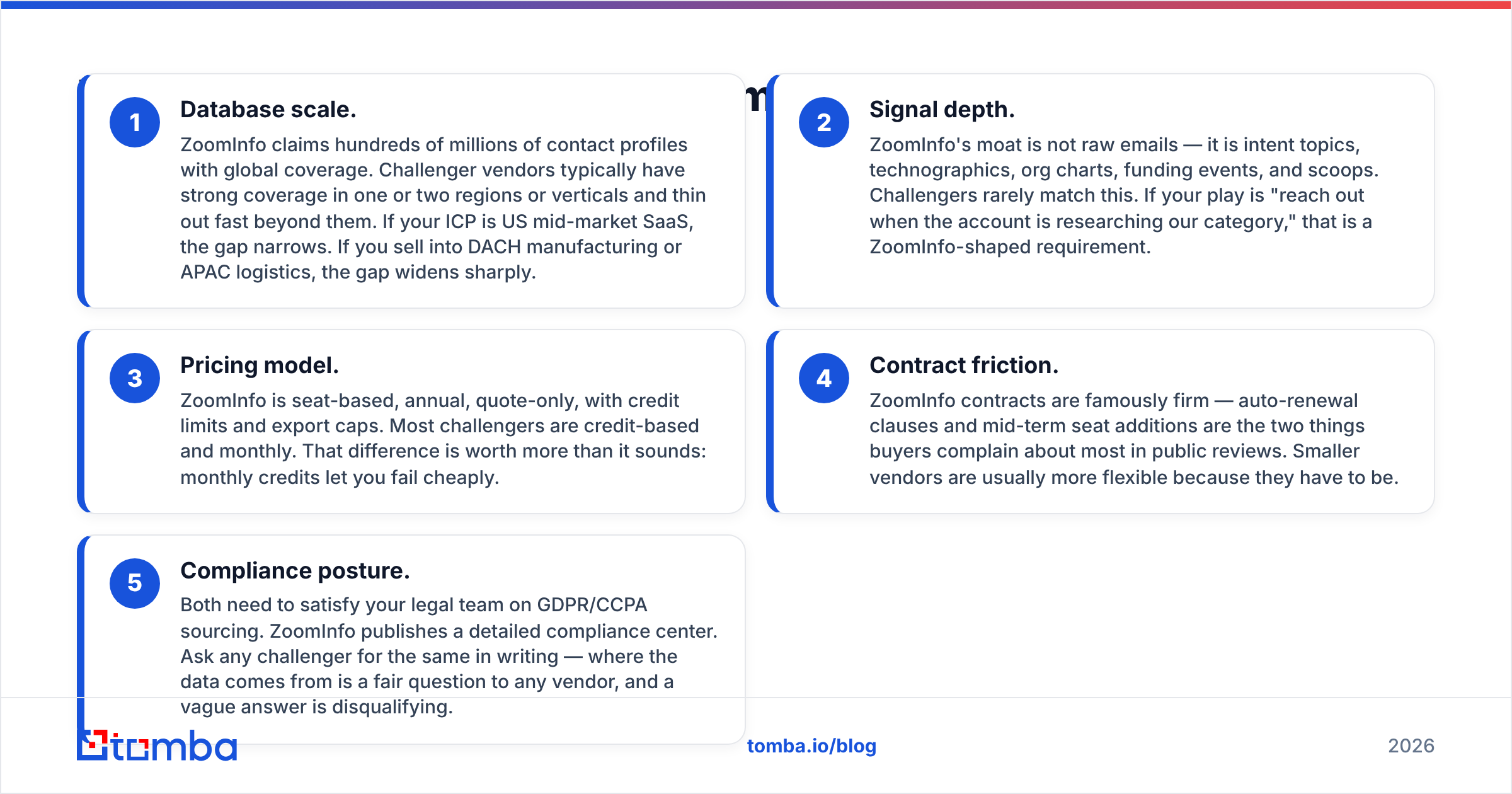
Five differences matter more than the feature grid:
- Database scale. ZoomInfo claims hundreds of millions of contact profiles with global coverage. Challenger vendors typically have strong coverage in one or two regions or verticals and thin out fast beyond them. If your ICP is US mid-market SaaS, the gap narrows. If you sell into DACH manufacturing or APAC logistics, the gap widens sharply.
- Signal depth. ZoomInfo's moat is not raw emails — it is intent topics, technographics, org charts, funding events, and scoops. Challengers rarely match this. If your play is "reach out when the account is researching our category," that is a ZoomInfo-shaped requirement.
- Pricing model. ZoomInfo is seat-based, annual, quote-only, with credit limits and export caps. Most challengers are credit-based and monthly. That difference is worth more than it sounds: monthly credits let you fail cheaply.
- Contract friction. ZoomInfo contracts are famously firm — auto-renewal clauses and mid-term seat additions are the two things buyers complain about most in public reviews. Smaller vendors are usually more flexible because they have to be.
- Compliance posture. Both need to satisfy your legal team on GDPR/CCPA sourcing. ZoomInfo publishes a detailed compliance center. Ask any challenger for the same in writing — where the data comes from is a fair question to any vendor, and a vague answer is disqualifying.

Which one has better email accuracy?#
Accuracy claims are the least trustworthy part of any data vendor's site — including the challenger's, including the incumbent's. Every vendor measures on its own sample. What you care about is your sample.
Two things go wrong when teams skip this step:
- Coverage is confused with accuracy. A tool that returns an email for 90% of your list looks great until you find that 22% of those addresses bounce. Match rate and validity are different metrics, and only the second one protects your sender reputation.
- Catch-all domains get scored as "valid." Most large enterprises run catch-all mail servers that accept everything at the SMTP layer. A lazy verifier marks these green. A serious one flags them separately so you can decide whether to risk the send — which is exactly what a dedicated catch-all verifier is for.

ZoomInfo's contact data is generally strong at the enterprise end and weaker on small companies, freelancers, and recently changed roles — a structural consequence of how contributory network data ages. Challenger vendors often invert this: fresher on smaller domains where they scrape and verify in real time, thinner on the Fortune 500 org chart.
The practical test: pull 200 rows from your actual pipeline, run them through both tools, then run every returned address through a neutral third-party email verifier that has no stake in the result. Score on verified deliverable, not "found." That number is usually 15–30 points below what the marketing page says, for everybody.
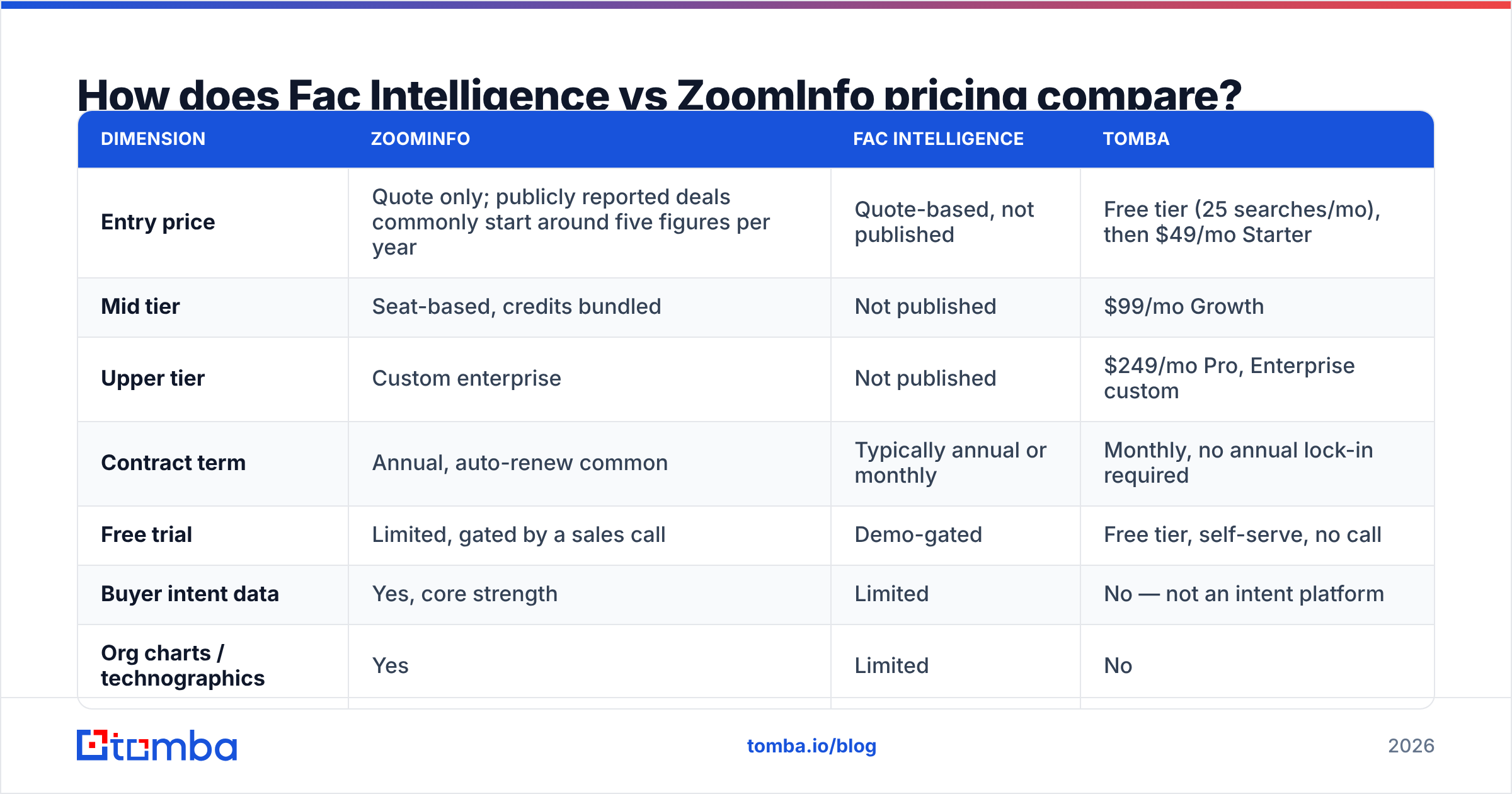
How does Fac Intelligence vs ZoomInfo pricing compare?#
Here is the practical shape of the market, including the option most teams end up preferring once they run the math.

| Dimension | ZoomInfo | Fac Intelligence | Tomba |
|---|---|---|---|
| Entry price | Quote only; publicly reported deals commonly start around five figures per year | Quote-based, not published | Free tier (25 searches/mo), then $49/mo Starter |
| Mid tier | Seat-based, credits bundled | Not published | $99/mo Growth |
| Upper tier | Custom enterprise | Not published | $249/mo Pro, Enterprise custom |
| Contract term | Annual, auto-renew common | Typically annual or monthly | Monthly, no annual lock-in required |
| Free trial | Limited, gated by a sales call | Demo-gated | Free tier, self-serve, no call |
| Buyer intent data | Yes, core strength | Limited | No — not an intent platform |
| Org charts / technographics | Yes | Limited | No |
| Email verification included | Yes, bundled | Yes | Yes, standalone and bulk |
| Catch-all handling | Basic flagging | Varies | Dedicated catch-all verification |
| API access | Enterprise tiers | Available on request | Included from paid tiers |
| Best fit | 10+ rep teams needing intent + CRM enrichment | Teams wanting incumbent-style data at a lower quote | Teams that know their accounts and need verified contacts |
The critical line is contract term. A $12,000 annual ZoomInfo commitment is not "$1,000/month" — it is $12,000 whether or not your outbound motion survives Q2. A monthly plan is a different risk profile entirely, and for a team still finding product-market fit, that flexibility is worth more than intent data it will not action.
Check Tomba pricing against whatever quote you receive. If a vendor's pitch is "cheaper than ZoomInfo," the relevant question is cheaper than what alternative — not cheaper than the most expensive option in the category.
Who should actually buy ZoomInfo?#
ZoomInfo earns its price in four specific situations:
- You have 10+ reps and a RevOps function. Someone has to own the credit budget, the CRM sync hygiene, and the intent-to-play mapping. Without that owner, you are paying enterprise prices for a search box.
- Intent data drives your territory planning. If SDRs prioritize accounts by surging topics, that capability is genuinely hard to replicate with point tools. Gartner research on buying-group behavior is the strategic backdrop here — multi-threading into six-plus stakeholders is much easier with an org chart than without one.
- You sell into large enterprises. ZoomInfo's coverage advantage is real at the top of the market.
- Your CRM needs continuous enrichment. Automated field refresh across 100,000 records is a platform job, not a script job.
If none of those four apply, you are subsidizing capabilities you do not use.

Who should consider Fac Intelligence?#
The challenger case is straightforward: you want incumbent-adjacent contact data without the incumbent's contract, and you are willing to do your own diligence because there is less public evidence to lean on.
That means your evaluation has to be harder, not softer. Before you sign anything with a lightly documented vendor, get written answers to these:
- Where does the data originate? Contributory network, public sources, licensed panels, or real-time verification at query time? Each ages differently.
- How often is a record re-verified? "Continuously" is not an answer. Ask for the median record age in your target segment.
- What is the refund or credit-back policy on invalid emails? Serious vendors credit bounces back. Ask what counts as a bounce and who adjudicates.
- Can you export? Some contracts restrict bulk export, which turns your "database" into a rented window.
- Is there an API and what are the rate limits? If you plan to automate, this decides everything downstream.
- What happens at renewal? Get the auto-renew notice period in writing before, not after.
Ask ZoomInfo the same six questions. The answers will be more documented, and the price will reflect that.
Is there a better third option for most teams?#
For a large share of buyers, yes — because the underlying job is smaller than the platform being sold.
Most outbound teams do not need a market intelligence suite. They need to take a list of target companies and roles, and end up with verified, deliverable contact details. That is a narrower job, and narrow tools do it for one-tenth the price.
The unbundled stack looks like this:
- Domain search to pull every known contact at a target company, plus the company's email pattern.
- Email finder to resolve a specific first name, last name, and domain into an address.
- Verification and catch-all checks before anything hits your sequence.
- Data enrichment to backfill job titles, seniority, and company attributes into your CRM.
- Bulk processing or the API for anything above a few hundred rows.
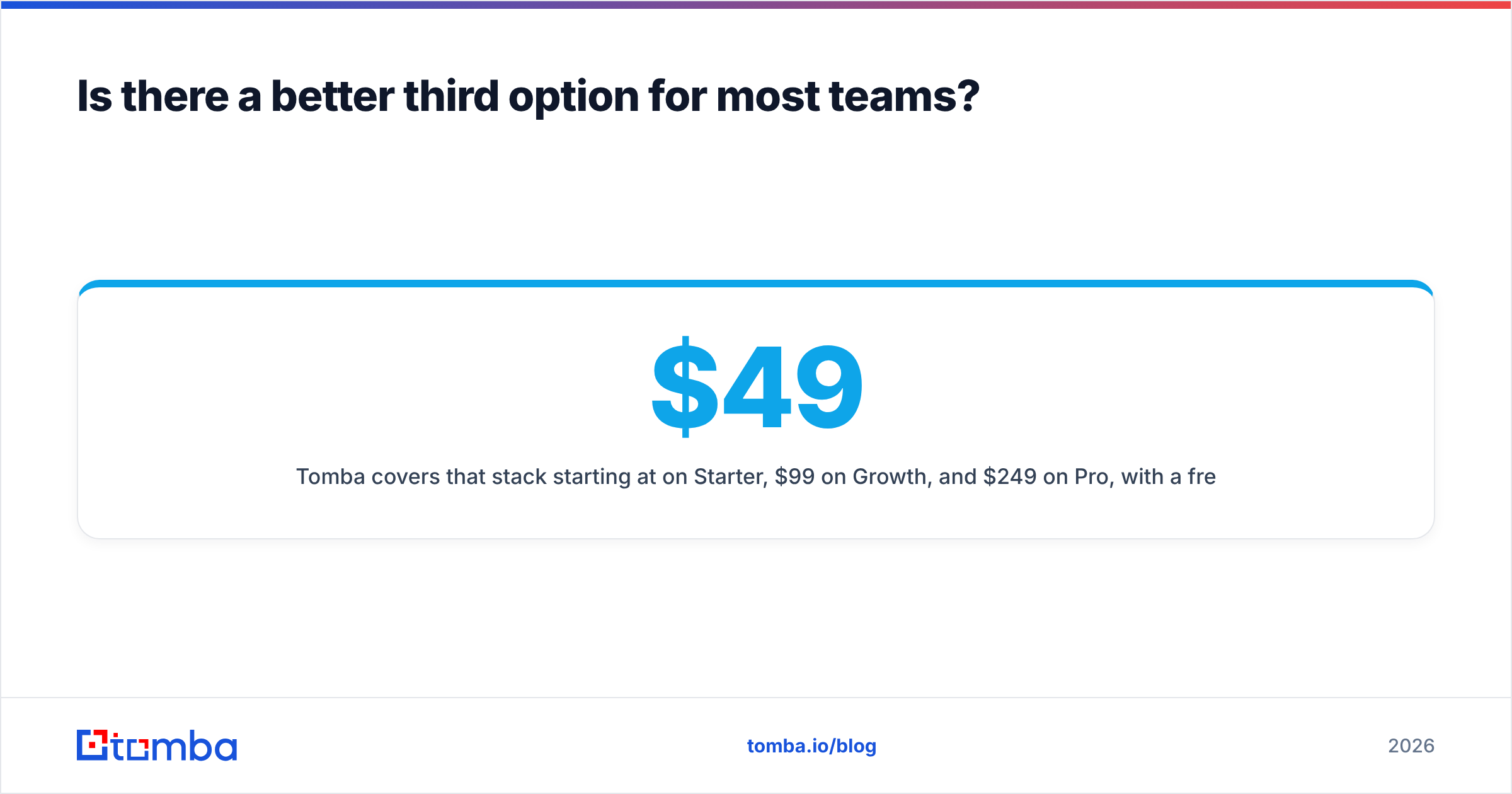
Tomba covers that stack starting at $49/mo on Starter, $99/mo on Growth, and $249/mo on Pro, with a free tier at 25 searches per month so you can benchmark against a ZoomInfo trial before either contract exists. Peers worth benchmarking in the same bake-off include BookYourData for pre-built list purchase and the usual verification specialists — run three vendors on the same 200 rows and let the bounce rate decide.
What you give up is intent, org charts, and conversation intelligence. If you are not currently actioning those signals, you are giving up nothing.
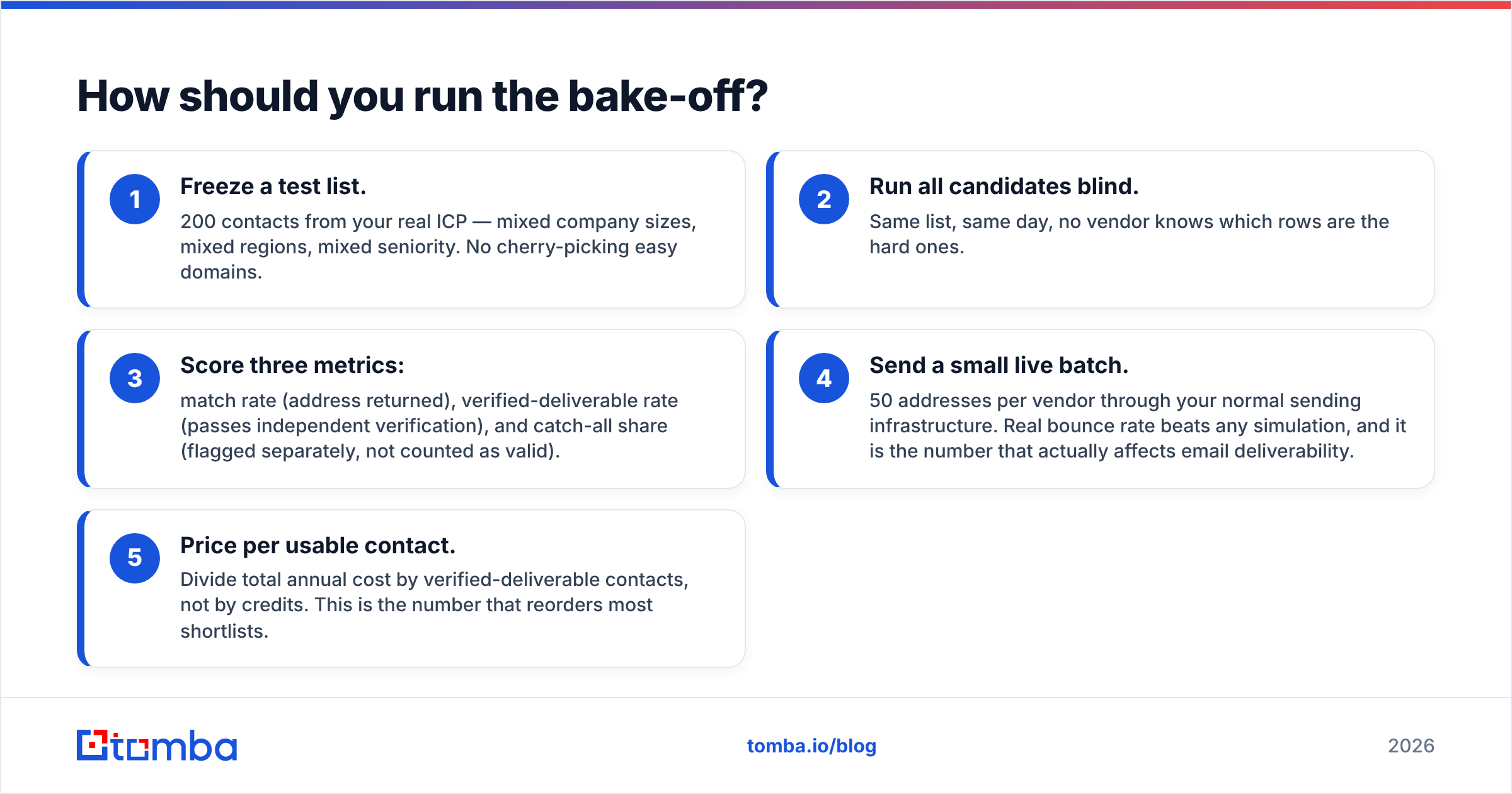
How should you run the bake-off?#
Do this before any contract conversation gets serious:
- Freeze a test list. 200 contacts from your real ICP — mixed company sizes, mixed regions, mixed seniority. No cherry-picking easy domains.
- Run all candidates blind. Same list, same day, no vendor knows which rows are the hard ones.
- Score three metrics: match rate (address returned), verified-deliverable rate (passes independent verification), and catch-all share (flagged separately, not counted as valid).
- Send a small live batch. 50 addresses per vendor through your normal sending infrastructure. Real bounce rate beats any simulation, and it is the number that actually affects email deliverability.
- Price per usable contact. Divide total annual cost by verified-deliverable contacts, not by credits. This is the number that reorders most shortlists.
Teams that run this test usually discover two things: the incumbent's advantage is smaller than the price gap implies, and the challenger's advantage is real but region-dependent.
The verdict#
Choose ZoomInfo if you have a funded, staffed outbound org that will actually use intent data, org charts, and continuous CRM enrichment — and if your finance team is comfortable with an annual commitment.
Choose Fac Intelligence if you want comparable contact coverage at a lower quote, your ICP sits inside its strongest region, and you have done the diligence the missing public documentation makes necessary.
Choose an unbundled stack if — like most teams — you already know your target accounts and the real job is turning names and domains into verified, contactable emails.
Start with the free tier of Tomba Email Finder, run your 200-row test against whatever quote lands in your inbox, and compare cost per verified-deliverable contact. If a five-figure contract still wins on that number, sign it with confidence. If it does not, you just saved a year of budget on a fifteen-minute test.
Related guides#
Ready to find emails that actually work?
Join 150,000+ professionals who stopped guessing and started sending. Free credits on signup — no credit card required.
Get the Tomba newsletter
Practical outbound tactics and product updates — once every two weeks.
About the author