Fastbase Pricing 2026: Reviews, Pros and Cons, Real Costs
Fastbase sells anonymous website visitors as leads. Here is how its pricing actually works in 2026, what real reviews say, where the data breaks down, and when a cheaper contact-data stack beats it outright.
TL;DR
- Fastbase sells website visitor identification plus a B2B company/contact database. Its published plans start free and climb into three figures per month, with the meaningful jump happening when you need contact-level data instead of company-level data.
- The headline price is not the real cost. Match limits, credit rollover rules, seat counts, and annual-only discounts are where budgets actually go.
- Reviews cluster around one theme: the analytics layer is useful, but the identified "leads" are companies and generic contacts, not verified inboxes you can email today.
- Fastbase is a decent fit if you get real traffic (5,000+ monthly B2B visits) and want to see which accounts are browsing. It is a poor fit if you have low traffic or need outbound contact data on demand.
- If your bottleneck is finding and verifying decision-maker emails rather than watching traffic, a dedicated email finder at $49/mo does more per dollar.
What is Fastbase and who actually buys it?#
Fastbase is a website visitor intelligence company. It connects to your Google Analytics data (and its own tracking script) to identify which companies visited your site, what they looked at, and how long they stayed. On top of that it layers a B2B database of companies and contacts so you can go from "Acme Corp read your pricing page" to "here is someone at Acme to contact."
The pitch is simple and genuinely appealing: roughly 97-98% of your site traffic never fills out a form. Fastbase's job is to convert some of that anonymous traffic into a named list. You can see the current product lineup on the official Fastbase site.
Three buyer profiles show up repeatedly:
- Mid-market B2B marketing teams with content programs that pull 10,000+ monthly sessions and no idea who those sessions belong to.
- Agencies that want a visible "look what we found" deliverable for retainer clients.
- Small outbound teams hoping visitor data will replace cold list building. This is the group most likely to be disappointed — more on why below.
If you are in group three, read the cons section twice before you buy.
How does Fastbase pricing work in 2026?#
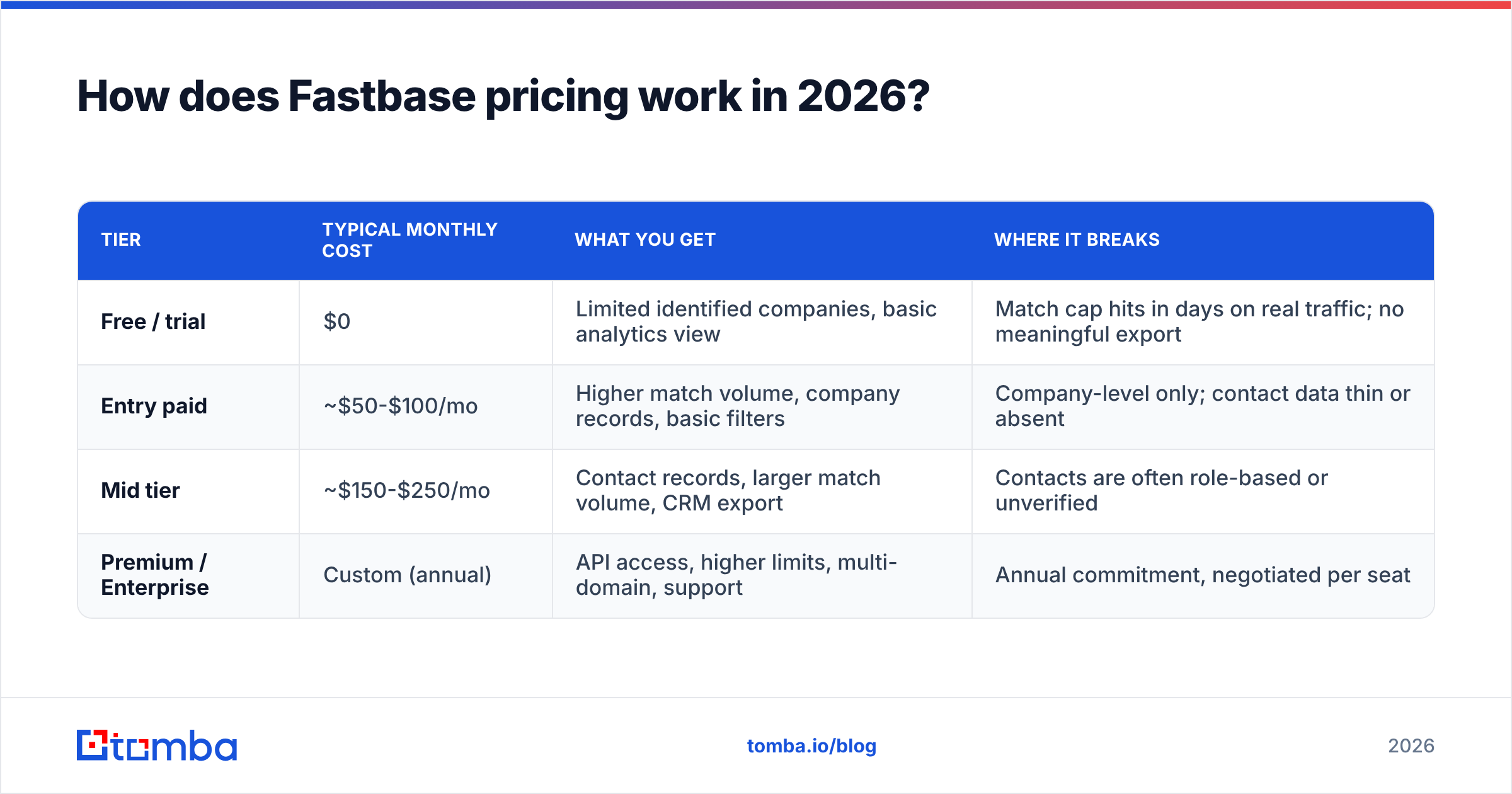
Fastbase uses a tiered subscription model built around two variables: how many identified visitors (matches) you get per month, and whether you can access contact-level records or only company-level records. Everything else — seats, exports, integrations, historical lookback — is packaged around those two levers.
Here is the shape of the offer. Treat the dollar figures as a planning range, not a quote — Fastbase adjusts tiers and regional pricing, so confirm current numbers on its own pricing page before you commit.
| Tier | Typical monthly cost | What you get | Where it breaks |
|---|---|---|---|
| Free / trial | $0 | Limited identified companies, basic analytics view | Match cap hits in days on real traffic; no meaningful export |
| Entry paid | ~$50-$100/mo | Higher match volume, company records, basic filters | Company-level only; contact data thin or absent |
| Mid tier | ~$150-$250/mo | Contact records, larger match volume, CRM export | Contacts are often role-based or unverified |
| Premium / Enterprise | Custom (annual) | API access, higher limits, multi-domain, support | Annual commitment, negotiated per seat |
Four pricing mechanics matter more than the sticker price:
- Matches, not visits. You are billed against identified companies, not raw sessions. A site with 20,000 monthly visits might only produce 1,200-2,500 identifiable B2B companies once you strip out consumer ISPs, VPNs, and mobile traffic. Do not size your plan off Google Analytics session counts.
- Credits usually do not roll over. A slow August does not bank capacity for a busy September. Size to your median month, not your peak.
- Annual billing is where the discount lives. Monthly plans carry a premium. That is standard, but it means the "starting at" number you see is often the annual-equivalent price.
- Contact unlocks are the real upsell. Company identification is commodity technology in 2026. The tier that gives you named humans is the tier that costs money, and it is the tier where accuracy complaints concentrate.

What do Fastbase reviews actually say?#
Public review coverage on G2 and Capterra is thinner than for category leaders, which is itself a data point — you are buying with less social proof than you would get from a Leadfeeder or Albacross. Reading across what exists, the sentiment splits cleanly.
What reviewers consistently like:
- The Google Analytics integration is genuinely low-friction. If you already have GA running, setup is measured in minutes.
- The company-level identification works. Reviewers confirm they see recognizable accounts, especially larger organizations with owned IP ranges.
- Price-to-value at the entry tier compares favorably to enterprise intent platforms that start at four figures per month.
- The dashboard is readable. Non-technical marketers can use it without training.
What reviewers consistently criticize:
- Contact quality. The most common complaint: the contacts attached to identified companies are frequently generic (info@, sales@), out of date, or simply the wrong department. You get a company and a name; you do not reliably get a person who owns the problem you solve.
- Match rates below expectation. Remote work broke IP-to-company mapping. Employees on home broadband and mobile networks resolve to consumer ISPs, not their employer. Reviewers report identification rates well under what the marketing implies.
- Cancellation and billing friction. Several reviews mention difficulty downgrading or getting a straight answer on renewal terms. Read your contract.
- Support responsiveness. Mixed at best on lower tiers.
None of this makes Fastbase a bad product. It makes it a specific product: a traffic intelligence tool with a contact database bolted on, not a contact database with analytics bolted on. Buy it for the first job, not the second.
What are the real pros of Fastbase?#
Being fair to the product, here is where it genuinely earns its price:
- Account-level demand signal you cannot get anywhere else. Knowing that three people from a target account read your integration docs last week is a real, actionable signal. No amount of cold list building produces that.
- Cheap relative to the intent-data category. Enterprise ABM platforms are priced for enterprise budgets. Fastbase sits an order of magnitude below them for the core "who visited" job.
- Fast time to value. GA connection, script install, results within a day. Compare that to a six-week ABM platform onboarding.
- Useful for retargeting and ABM list building. Even company-only data is enough to build a LinkedIn matched audience or a target account list you then enrich elsewhere.
- Historical lookback. Because it reads existing analytics data, you can often see backwards, not just forwards from install day.
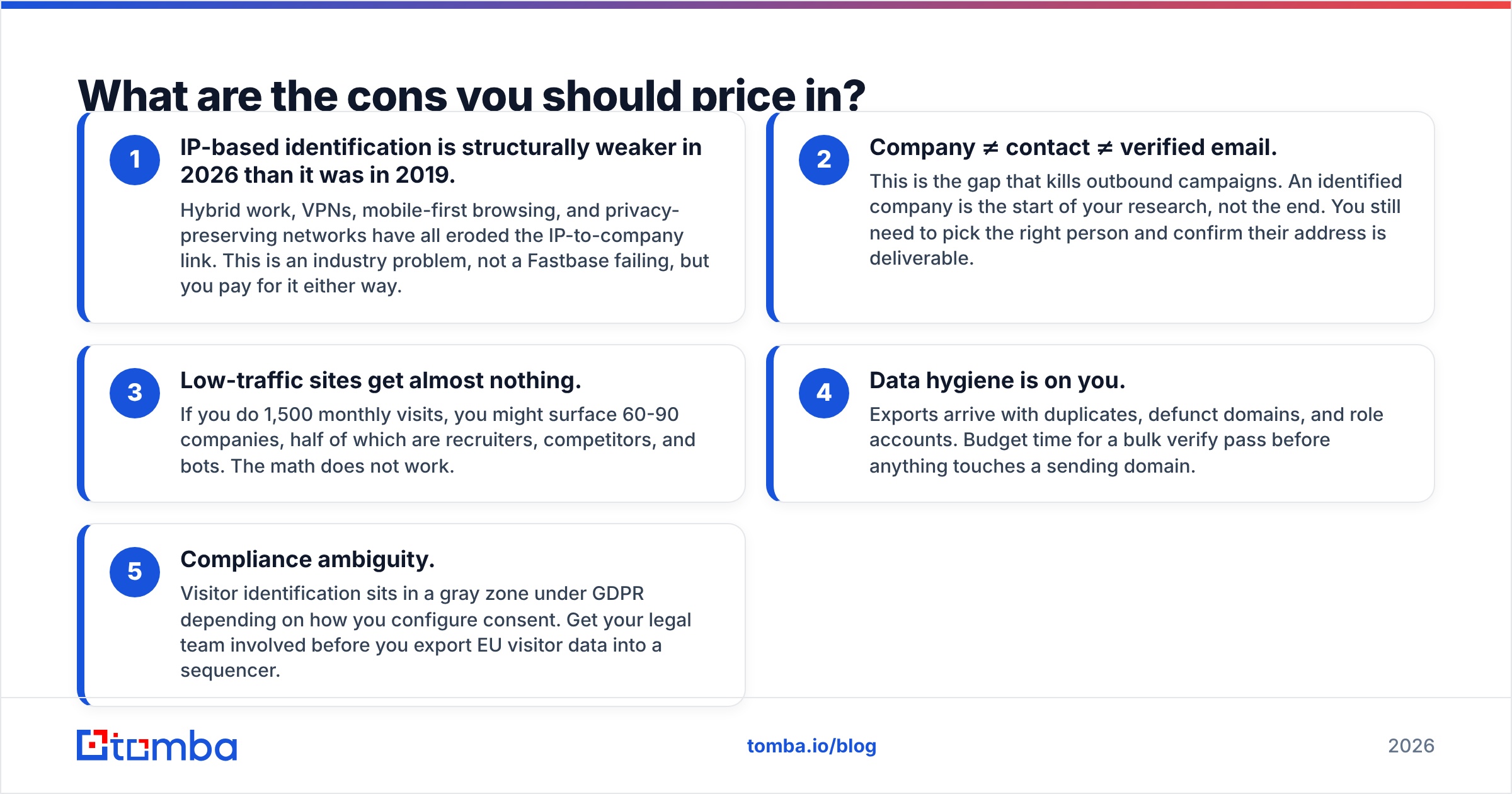
What are the cons you should price in?#
- IP-based identification is structurally weaker in 2026 than it was in 2019. Hybrid work, VPNs, mobile-first browsing, and privacy-preserving networks have all eroded the IP-to-company link. This is an industry problem, not a Fastbase failing, but you pay for it either way.
- Company ≠ contact ≠ verified email. This is the gap that kills outbound campaigns. An identified company is the start of your research, not the end. You still need to pick the right person and confirm their address is deliverable.
- Low-traffic sites get almost nothing. If you do 1,500 monthly visits, you might surface 60-90 companies, half of which are recruiters, competitors, and bots. The math does not work.
- Data hygiene is on you. Exports arrive with duplicates, defunct domains, and role accounts. Budget time for a bulk verify pass before anything touches a sending domain.
- Compliance ambiguity. Visitor identification sits in a gray zone under GDPR depending on how you configure consent. Get your legal team involved before you export EU visitor data into a sequencer.

How does Fastbase compare to the alternatives?#
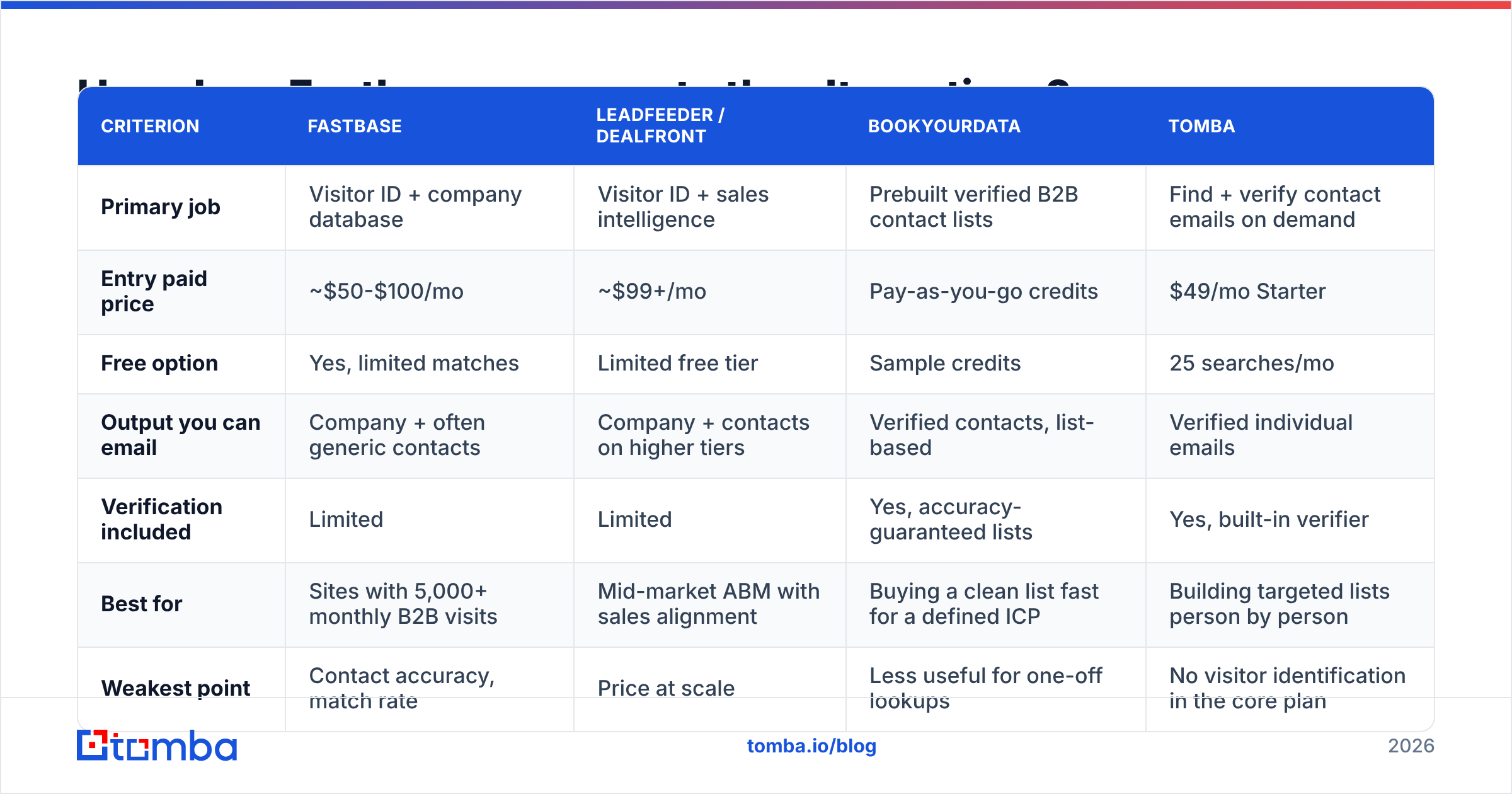
The honest framing: visitor identification and contact-data sourcing are two different purchases. Most teams that think they need the first actually need the second, or need both and only budgeted for one.
| Criterion | Fastbase | Leadfeeder / Dealfront | BookYourData | Tomba |
|---|---|---|---|---|
| Primary job | Visitor ID + company database | Visitor ID + sales intelligence | Prebuilt verified B2B contact lists | Find + verify contact emails on demand |
| Entry paid price | ~$50-$100/mo | ~$99+/mo | Pay-as-you-go credits | $49/mo Starter |
| Free option | Yes, limited matches | Limited free tier | Sample credits | 25 searches/mo |
| Output you can email | Company + often generic contacts | Company + contacts on higher tiers | Verified contacts, list-based | Verified individual emails |
| Verification included | Limited | Limited | Yes, accuracy-guaranteed lists | Yes, built-in verifier |
| Best for | Sites with 5,000+ monthly B2B visits | Mid-market ABM with sales alignment | Buying a clean list fast for a defined ICP | Building targeted lists person by person |
| Weakest point | Contact accuracy, match rate | Price at scale | Less useful for one-off lookups | No visitor identification in the core plan |
BookYourData deserves a fair mention here: if your problem is "I need 2,000 verified contacts in a defined segment by Friday," a purpose-built list vendor with an accuracy guarantee solves that more directly than any visitor-ID tool, and the unit economics are usually better than paying a subscription to slowly accumulate matches.
Tomba solves the other half. When you have a company name — from Fastbase, from a conference list, from LinkedIn — and need the actual person and the actual working address, that is a domain search and email verification problem, not an analytics problem.
Which stack should you actually buy?#
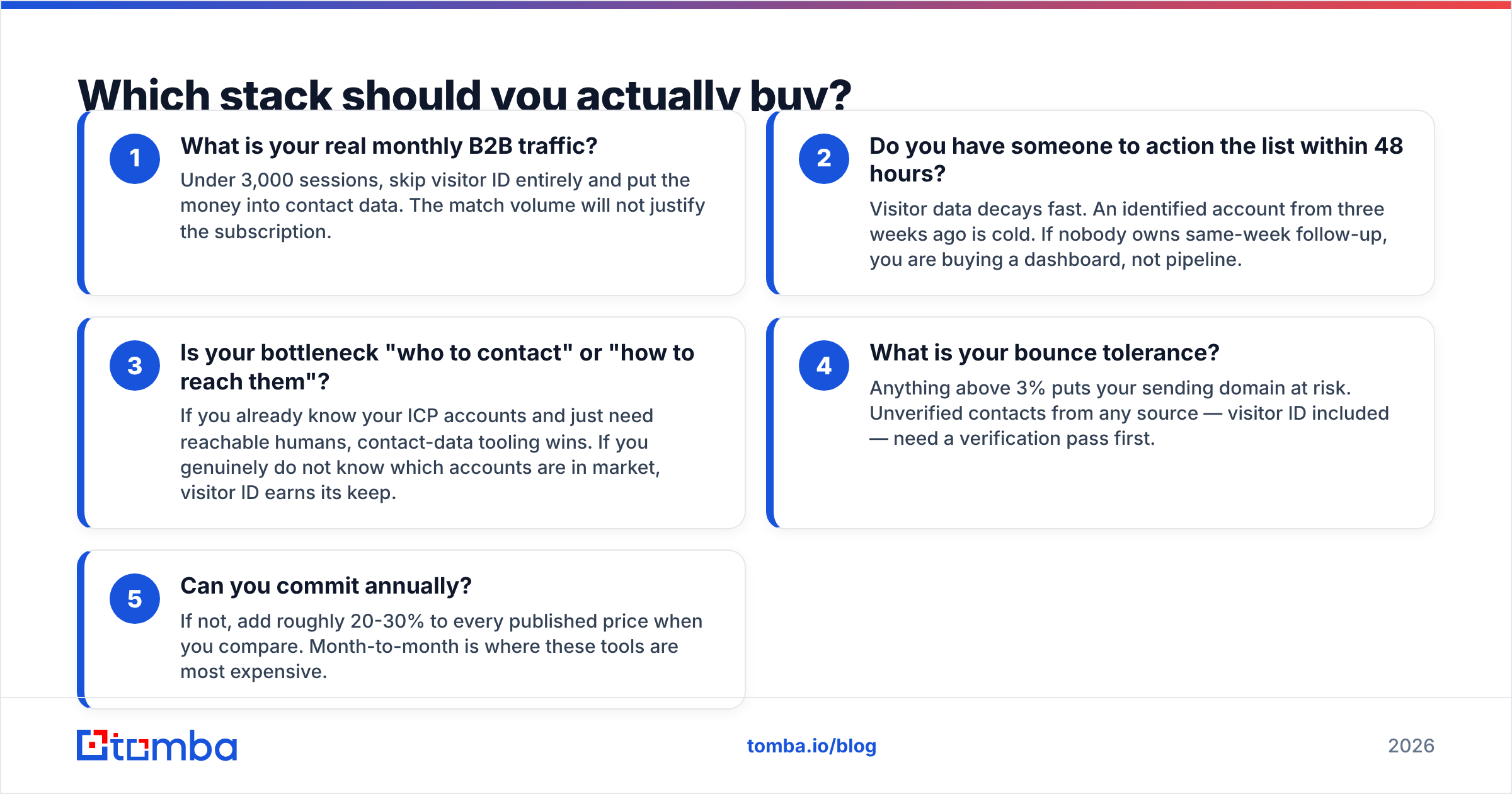
Work through these five questions in order. They will settle it faster than another demo call.
- What is your real monthly B2B traffic? Under 3,000 sessions, skip visitor ID entirely and put the money into contact data. The match volume will not justify the subscription.
- Do you have someone to action the list within 48 hours? Visitor data decays fast. An identified account from three weeks ago is cold. If nobody owns same-week follow-up, you are buying a dashboard, not pipeline.
- Is your bottleneck "who to contact" or "how to reach them"? If you already know your ICP accounts and just need reachable humans, contact-data tooling wins. If you genuinely do not know which accounts are in market, visitor ID earns its keep.
- What is your bounce tolerance? Anything above 3% puts your sending domain at risk. Unverified contacts from any source — visitor ID included — need a verification pass first.
- Can you commit annually? If not, add roughly 20-30% to every published price when you compare. Month-to-month is where these tools are most expensive.
A pragmatic hybrid that a lot of teams land on: keep Fastbase (or a competitor) on the entry tier purely for account-level signal, then run those company domains through a dedicated finder to get verified decision-maker addresses. You pay the visitor-ID tool for intelligence and the finder for deliverability, instead of overpaying one vendor to do both jobs at a mediocre level.
What should you check before you sign?#
- Ask for your actual match rate on a two-week trial, measured against your own analytics — not a case study average.
- Ask whether contact records are verified at export time or at ingest time. Data verified 14 months ago is not verified data.
- Ask what happens to unused credits and what the downgrade path looks like mid-term.
- Ask whether API access is on your tier. If you plan to pipe data into a CRM automatically, an export-only plan will cost you a headcount's worth of manual work.
- Ask for the cancellation clause in writing. This is where the review complaints concentrate.
The bottom line on Fastbase pricing#
Fastbase is fairly priced for what it actually is — an accessible visitor intelligence tool with a serviceable company database — and overpriced for what buyers often hope it is: a source of verified, ready-to-email decision makers. The distinction is worth real money. Size your plan off identifiable B2B companies rather than raw sessions, assume you will need a separate verification step, and refuse to pay the contact-tier upgrade until you have tested contact accuracy on your own segment.
If you work through that and conclude that your actual gap is reaching the right person rather than spotting the right account, start there instead. The Tomba Email Finder turns a company domain and a name into a verified, deliverable address, with a free tier at 25 searches per month and paid plans from $49/mo — see full Tomba pricing for volume tiers. Run your visitor-ID exports through it, verify before you send, and you will get more replies from a clean 200-contact list than from 2,000 unverified rows.
Related guides#
Ready to find emails that actually work?
Join 150,000+ professionals who stopped guessing and started sending. Free credits on signup — no credit card required.
Get the Tomba newsletter
Practical outbound tactics and product updates — once every two weeks.
About the author