Feature Dumping in Sales: How to Stop Killing Your Demos
Feature dumping is the fastest way to lose a deal you already won. Here's how to spot it in your calls and emails, and the exact rewrites that turn a features list into a reason to buy.
TL;DR
- Feature dumping is what happens when you answer "why should I care?" with a list of things your product does. The buyer hears noise, not value.
- It usually comes from insecurity, not ignorance: weak discovery, product-marketing pressure, and a demo script built by engineers.
- The cost is measurable — longer cycles, more stakeholders pulled in late, and "we decided to stay with what we have" emails four weeks after a great-feeling call.
- The fix is structural, not motivational. Cap the number of features per conversation, tie each one to a diagnosed problem, and make your reps earn the right to demo.
- The same rule applies to cold email: one feature, one outcome, one ask. Every extra capability you mention lowers your reply rate.
What is feature dumping?#
Feature dumping is the habit of listing what your product does instead of explaining what changes for the buyer. It shows up as a 40-minute demo where you click through every tab, a cold email with five bullet points of capabilities, or a discovery call where the buyer asks one question and you answer with the full product tour.
The tell is simple. If you removed the buyer from the conversation entirely, would your pitch still make sense? If yes, you're feature dumping. A real sales conversation is unrepeatable — it only works for the person in front of you, because it's built from what they told you.
The trap is that feature dumping feels productive. You covered a lot. You sounded knowledgeable. The buyer nodded and said "this is great." Then they went dark, because "great" is what people say when they don't have a reason to say no or yes.
Why do reps feature dump in the first place?#
It's rarely laziness. Four forces push otherwise good reps into it:
- Discovery was too thin to support anything else. If you don't know what's broken, features are the only thing left to talk about. A rep who learned three real problems has three things to demo. A rep who learned nothing has to demo everything.
- Product marketing rewards coverage. New release, new enablement deck, new slide. The implicit instruction is "mention this," and reps comply. Nobody is measured on what they left out.
- Fear of the missing feature. Reps dump because they're scared the one thing they skipped was the deal-breaker. So they cover all of it, and drown the two things that actually mattered.
- The demo environment was built by engineers. Demo instances tend to be organized by product architecture, not by buyer job. If your sandbox is laid out as Settings → Integrations → Reports, you'll present it that way.
Gartner's sales research has consistently found that B2B buyers spend a small fraction of their buying journey with any single vendor — most of the time goes to internal work and independent research. Your share of attention is small. Spending it on a capability inventory is a poor trade.
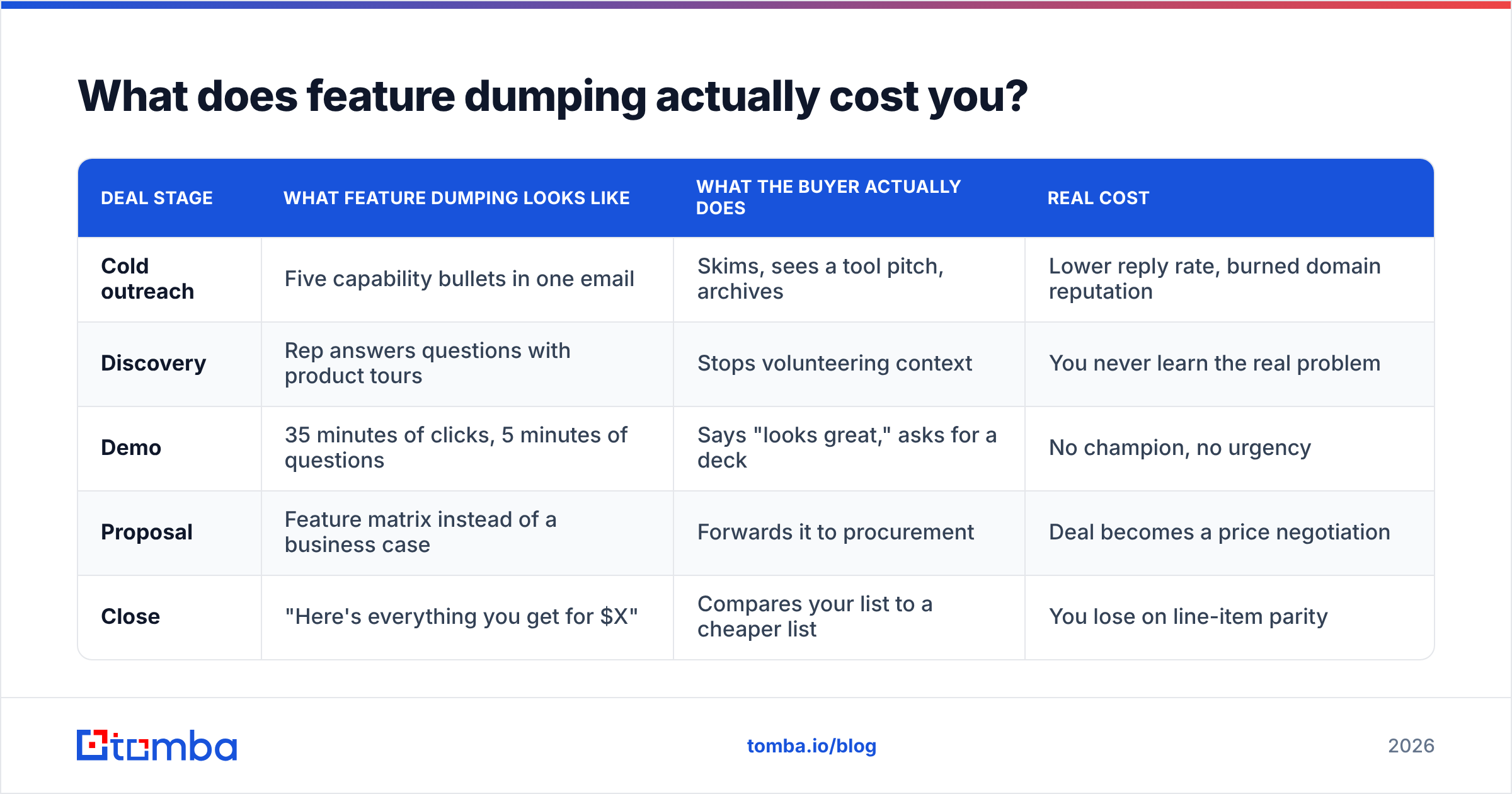
What does feature dumping actually cost you?#
The damage isn't a lost deal on the call. It's a slow leak across the pipeline.
| Deal stage | What feature dumping looks like | What the buyer actually does | Real cost |
|---|---|---|---|
| Cold outreach | Five capability bullets in one email | Skims, sees a tool pitch, archives | Lower reply rate, burned domain reputation |
| Discovery | Rep answers questions with product tours | Stops volunteering context | You never learn the real problem |
| Demo | 35 minutes of clicks, 5 minutes of questions | Says "looks great," asks for a deck | No champion, no urgency |
| Proposal | Feature matrix instead of a business case | Forwards it to procurement | Deal becomes a price negotiation |
| Close | "Here's everything you get for $X" | Compares your list to a cheaper list | You lose on line-item parity |
That last row is the one that hurts. When your differentiation is expressed as a list, buyers evaluate you as a list — and there is always a competitor with a longer one, or a cheaper one with 80% of it. Feature dumping trains buyers to shop on parity.
Feature dumping vs outcome-led selling: what actually changes?#
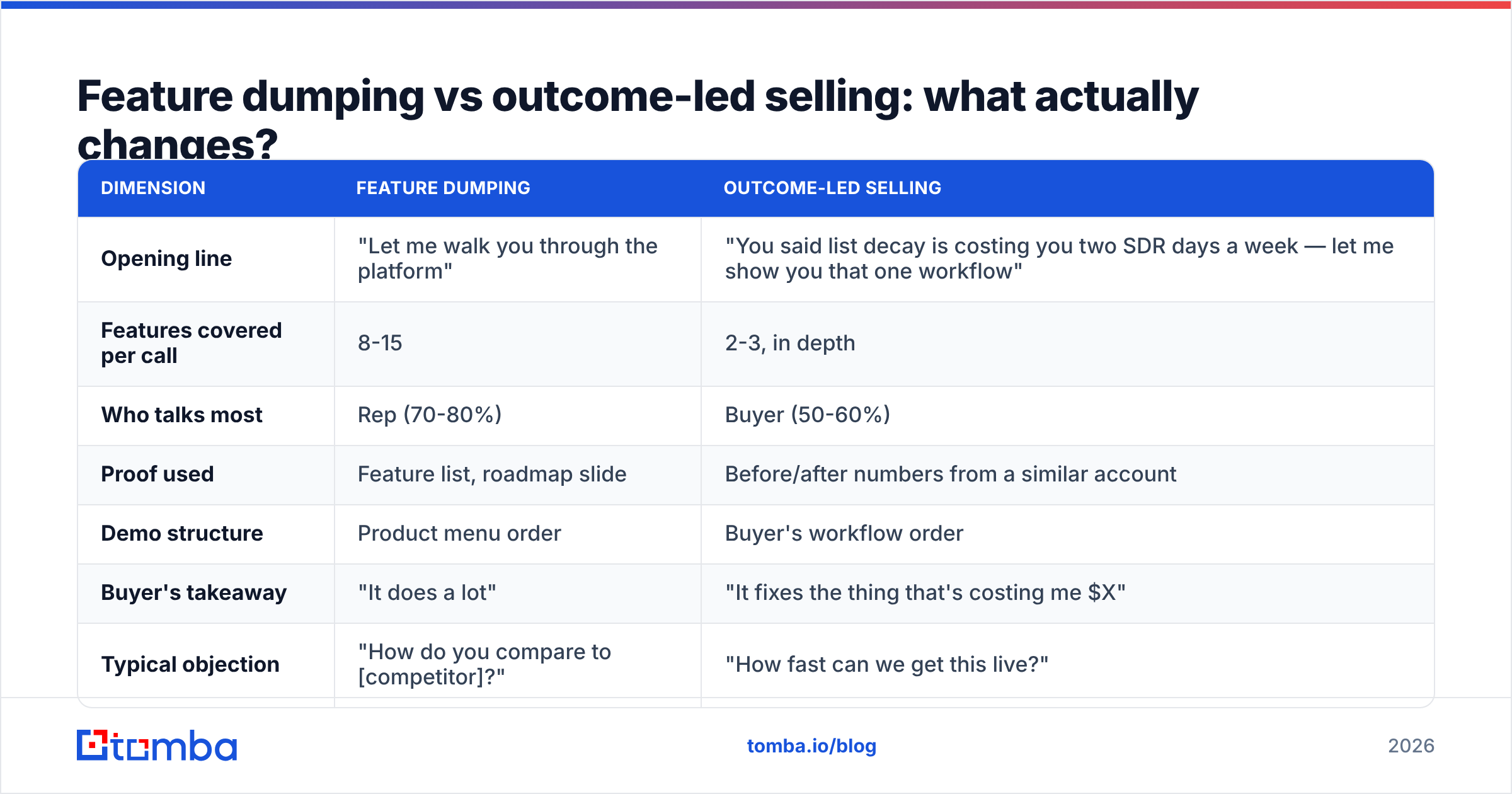
The alternative isn't "talk about benefits instead of features." That advice is old and useless because it produces vague fluff ("save time, increase efficiency"). Outcome-led selling is more specific than feature dumping, not less.
| Dimension | Feature dumping | Outcome-led selling |
|---|---|---|
| Opening line | "Let me walk you through the platform" | "You said list decay is costing you two SDR days a week — let me show you that one workflow" |
| Features covered per call | 8-15 | 2-3, in depth |
| Who talks most | Rep (70-80%) | Buyer (50-60%) |
| Proof used | Feature list, roadmap slide | Before/after numbers from a similar account |
| Demo structure | Product menu order | Buyer's workflow order |
| Buyer's takeaway | "It does a lot" | "It fixes the thing that's costing me $X" |
| Typical objection | "How do you compare to [competitor]?" | "How fast can we get this live?" |
| Next-step quality | "Send me a deck" | "Can you present this to my VP Thursday?" |
Read the last two rows again. The objection you get is a diagnostic. If buyers consistently pull you into competitor comparisons, they don't have a problem framing — they have a shopping list, and you handed it to them.
How do you spot feature dumping in your own calls?#
Run these five checks on your last three recorded calls. You don't need a coaching program to do it.
- Count the features you named. More than four in a 30-minute call and you're dumping. Write them down and mark which ones tied back to something the buyer said out loud.
- Measure talk-time ratio. Most conversation-intelligence tools surface this. Above 65% rep talk time on a discovery call is a red flag; on a demo, above 70%.
- Find the first question you asked. If it came after minute eight, the call was a presentation with a Q&A section.
- Check for "and also." That phrase is the audible sound of a feature dump starting. So are "one more thing you'll love" and "while we're here."
- Look at the next step you booked. "I'll send over some materials" is what buyers offer when nothing landed. A real next step has a name, a date, and another human on it.
If four of five come back red, the problem isn't the rep's enthusiasm — it's that your call structure has no gate between "hello" and "here's the product."
Is feature dumping ever the right move?#
Occasionally, yes, and pretending otherwise makes this advice unusable.
- Late-stage technical validation. When a security or IT reviewer asks for a complete capability inventory, give them one. That's not a pitch, it's a checklist, and they want it exhaustive.
- RFP responses. Procurement documents are scored on coverage. Answer every line. Save the narrative for the presentation round.
- Renewal and expansion conversations with an admin who already owns the tool and wants to know what shipped last quarter. Your changelog is the right artifact there.
- Highly technical buyers who explicitly ask. When a developer says "just show me the API," show them the API and stop talking.
The distinction: feature dumping is bad when the buyer hasn't told you what they need yet. Once they have — or once they're explicitly asking for the full list — completeness is a service, not a sin.
How do you rewrite a feature dump into something that lands?#
Here's a real pattern from prospecting tools, since it's an easy category to over-list.
Feature dump version:
"Our platform includes an email finder, bulk enrichment, catch-all verification, a Chrome extension, a REST API, Google Sheets and Excel add-ins, phone lookup, reverse email search, and 20+ CRM integrations."
Nine capabilities. Zero reasons to reply. The buyer's brain files it under "another data tool."
Outcome-led version, for an SDR manager whose team is burning time on bad lists:
"Your team is exporting from LinkedIn and losing roughly a quarter of those addresses to bounces. Run the export through a bulk email finder first and the bad rows never reach your sequencer — most teams get their bounce rate back under 2% in the first week, which also protects the sending domain you've spent months warming."
Same product. One capability instead of nine. It works because it names a specific cost the buyer already feels, then attaches exactly one feature to it.
The rewrite formula, applied to any feature:
- Name the observable symptom. Not "inefficiency" — "your reps spend Monday mornings cleaning a CSV."
- Quantify it in their units. Hours, bounce percentage, days of cycle time, dollars of wasted spend.
- Attach one feature. The single mechanism that removes the symptom.
- State the changed state. What Monday morning looks like after.
- Stop. Do not append "and it also does X."
That last step is the hardest and the most valuable. Every additional capability you tack on dilutes the one you just made concrete.
What does feature dumping look like in cold email?#
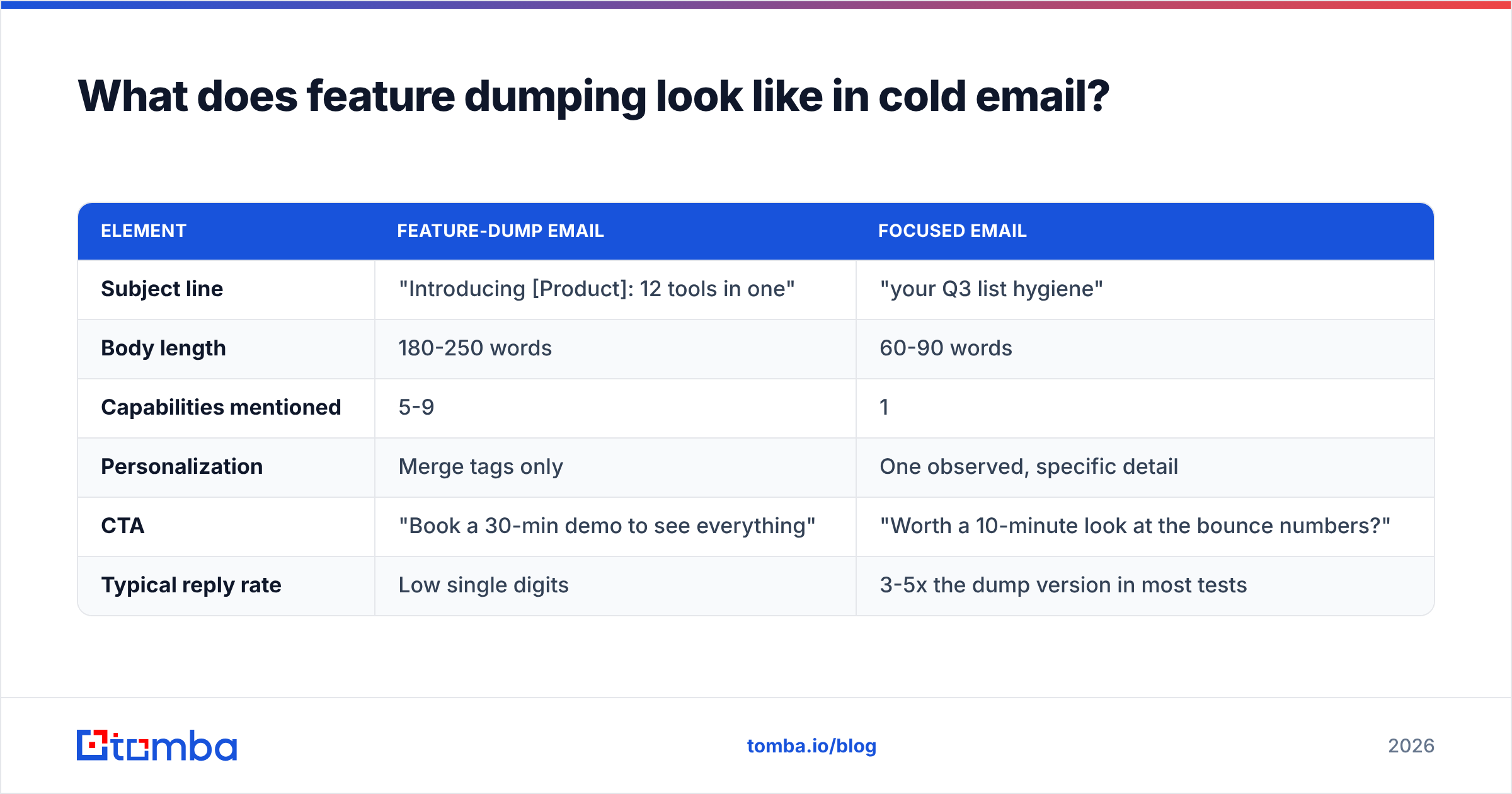
Worse than on calls, because you have no ability to recover. A prospect reading a nine-bullet capability email makes a one-second decision.
| Element | Feature-dump email | Focused email |
|---|---|---|
| Subject line | "Introducing [Product]: 12 tools in one" | "your Q3 list hygiene" |
| Body length | 180-250 words | 60-90 words |
| Capabilities mentioned | 5-9 | 1 |
| Personalization | Merge tags only | One observed, specific detail |
| CTA | "Book a 30-min demo to see everything" | "Worth a 10-minute look at the bounce numbers?" |
| Typical reply rate | Low single digits | 3-5x the dump version in most tests |
Two structural rules keep cold email honest. First, one feature per email — if you have three things to say, you have a three-email sequence, not a longer email. Second, get your data right before you optimize copy: a perfectly written message to a stale address still bounces. Clean the list with an email verifier before you touch the wording, or you'll misread your own results and blame the copy. HubSpot's sales blog has solid teardowns of outreach structure if you want more before/after examples.
It's also worth being blunt about what a strong value proposition is: a claim about the buyer's world, not a description of yours. If your positioning statement is a list of nouns, your reps will dump, because you gave them nothing else to say.
How do you stop feature dumping across a whole team?#
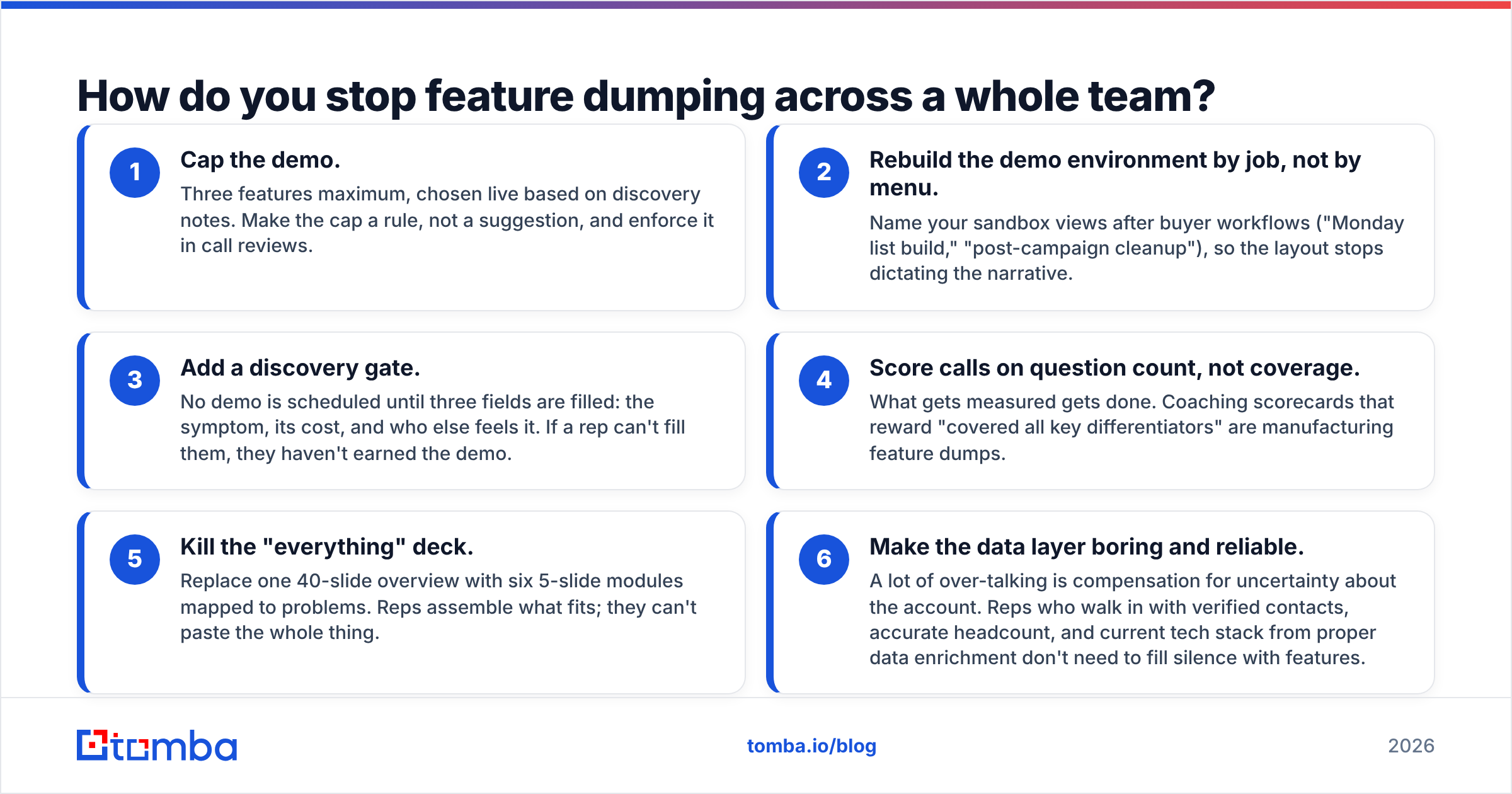
Individual willpower fails here. Reps dump because the system rewards it. Change the system:
- Cap the demo. Three features maximum, chosen live based on discovery notes. Make the cap a rule, not a suggestion, and enforce it in call reviews.
- Rebuild the demo environment by job, not by menu. Name your sandbox views after buyer workflows ("Monday list build," "post-campaign cleanup"), so the layout stops dictating the narrative.
- Add a discovery gate. No demo is scheduled until three fields are filled: the symptom, its cost, and who else feels it. If a rep can't fill them, they haven't earned the demo.
- Score calls on question count, not coverage. What gets measured gets done. Coaching scorecards that reward "covered all key differentiators" are manufacturing feature dumps.
- Kill the "everything" deck. Replace one 40-slide overview with six 5-slide modules mapped to problems. Reps assemble what fits; they can't paste the whole thing.
- Make the data layer boring and reliable. A lot of over-talking is compensation for uncertainty about the account. Reps who walk in with verified contacts, accurate headcount, and current tech stack from proper data enrichment don't need to fill silence with features.
Expect a dip before the improvement. Reps who've built their identity on product knowledge will feel exposed when you take the list away. Give them a replacement script — the five-step rewrite formula above works fine as a coaching artifact — and back it with call reviews for a full quarter. Peer review on G2 and similar sites is another useful mirror: read what buyers actually praise about tools in your category, and you'll notice it's almost never a feature count.
What should you do next week?#
Pick your three most recent closed-lost deals where the buyer went quiet after a demo. Pull the recordings. Count the features. Then find the one problem the buyer named in discovery and ask whether your demo was built around it or around your product menu.
That exercise usually settles the argument faster than any framework. Feature dumping isn't a communication style — it's evidence that discovery didn't produce enough material to sell with.
And when the problem turns out to be upstream — reps guessing at contacts, sequences bouncing, lists half-dead before the first send — fix the inputs first. The Tomba Email Finder gets you verified professional addresses by domain, name, or company, so your team walks into every conversation with real contacts instead of improvising. The free tier covers 25 searches a month, Starter runs $49/mo, and Growth is $99/mo — full Tomba pricing is public, no demo required. Get the data clean, then spend your calls on the two features that actually matter to the person in front of you.
Related guides#
Ready to find emails that actually work?
Join 150,000+ professionals who stopped guessing and started sending. Free credits on signup — no credit card required.
Get the Tomba newsletter
Practical outbound tactics and product updates — once every two weeks.
About the author