FidForward Alternatives: 7 AI Feedback Tools Compared
FidForward makes feedback easier to collect, but it is not the only option. Here are seven FidForward alternatives compared on price, AI drafting quality, review depth, and how long each one takes to roll out.
TL;DR
- FidForward is an AI feedback assistant: it nudges people to give feedback, drafts it from context, and rolls it into review cycles. It is narrow on purpose.
- Most teams searching for FidForward alternatives want one of three things: a full performance-management suite, a cheaper per-seat price, or a free tier for a team under 25 people.
- Lattice and Culture Amp are the heavyweight replacements. Leapsome and 15Five sit in the middle. Effy AI and Small Improvements are the budget picks.
- Per-user list prices in this category run from free to roughly $16/user/month before add-ons. The real cost is admin time, not licence fees.
- If you manage a sales team, feedback tooling only pays off when reps have enough pipeline to be coached on. Fix the data problem first.
What is FidForward, and who actually uses it?#
FidForward is an AI feedback assistant. Instead of asking employees to sit down and write a 360 review from a blank page, it watches the work signals a team already produces, prompts people at the moment feedback is relevant, and drafts a first version they can edit. The pitch is simple: organisations do not have a feedback intent problem, they have a feedback volume problem, and an assistant that removes the blank page raises volume.
That focus is why people go looking for FidForward alternatives. It is a feedback layer, not a full HR platform. If you need goal cascading, engagement surveys with benchmarking, compensation review cycles, or a headcount planning module, you are shopping in a different aisle.
Think of it like a coffee grinder versus an espresso machine. The grinder does one job extremely well and takes ten minutes to set up. The machine does five jobs, costs six times as much, and someone on your team now owns cleaning it. Neither is wrong. The mistake is buying the machine when all you wanted was better grounds.
Typical FidForward buyers are 20–200 person companies where managers are drowning, review season is a fire drill, and nobody wants to run a six-month HRIS migration to fix it. Typical churners are the same companies eighteen months later, once HR wants engagement data, goal tracking, and compensation in one system.
Why do teams look for FidForward alternatives?#
From vendor review threads on G2 and the usual procurement complaints, the reasons cluster tightly:
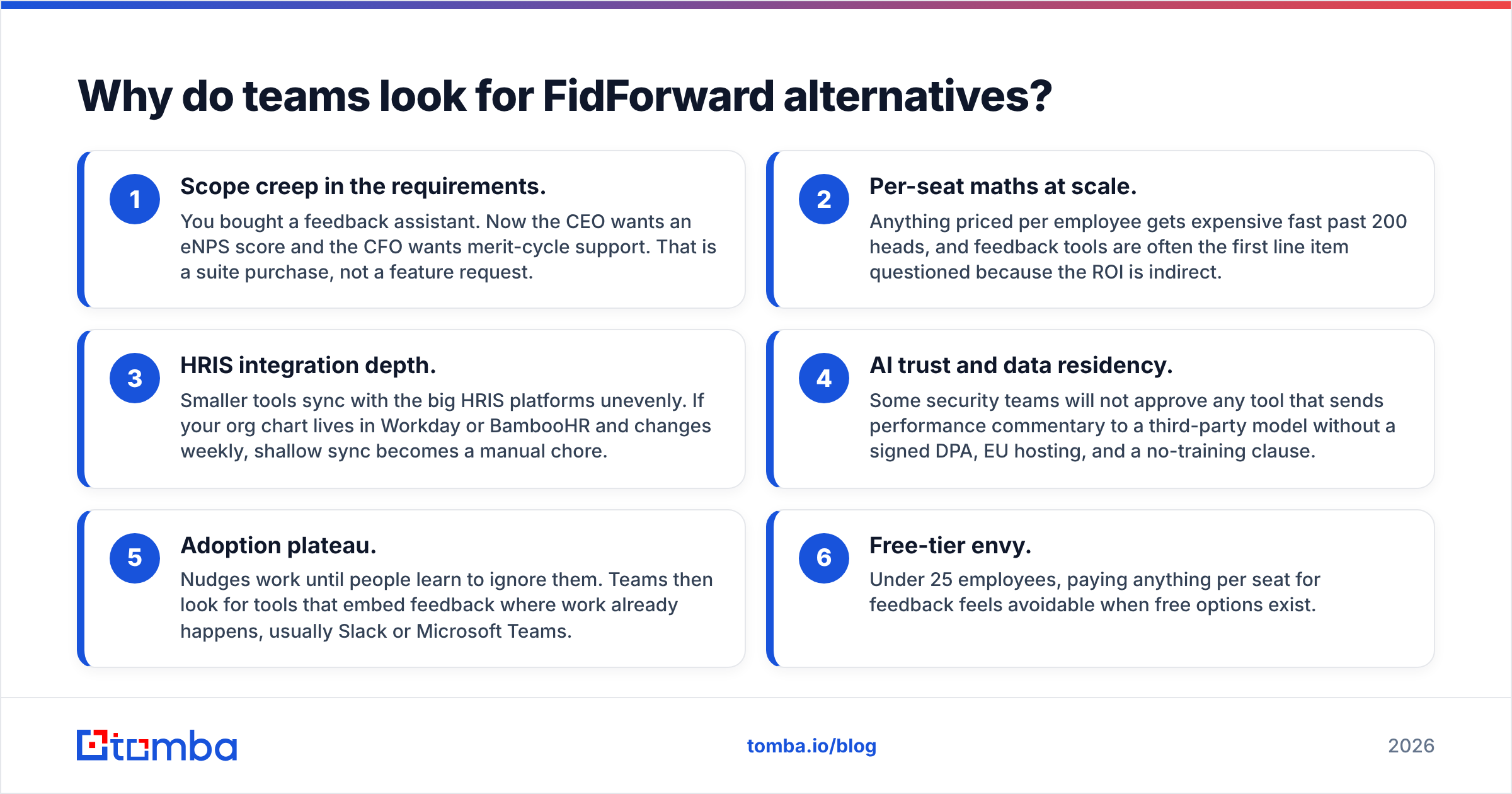
- Scope creep in the requirements. You bought a feedback assistant. Now the CEO wants an eNPS score and the CFO wants merit-cycle support. That is a suite purchase, not a feature request.
- Per-seat maths at scale. Anything priced per employee gets expensive fast past 200 heads, and feedback tools are often the first line item questioned because the ROI is indirect.
- HRIS integration depth. Smaller tools sync with the big HRIS platforms unevenly. If your org chart lives in Workday or BambooHR and changes weekly, shallow sync becomes a manual chore.
- AI trust and data residency. Some security teams will not approve any tool that sends performance commentary to a third-party model without a signed DPA, EU hosting, and a no-training clause.
- Adoption plateau. Nudges work until people learn to ignore them. Teams then look for tools that embed feedback where work already happens, usually Slack or Microsoft Teams.
- Free-tier envy. Under 25 employees, paying anything per seat for feedback feels avoidable when free options exist.
What should you compare before switching?#
Ignore feature checklists for a minute. Five variables decide whether a feedback tool survives its first year:
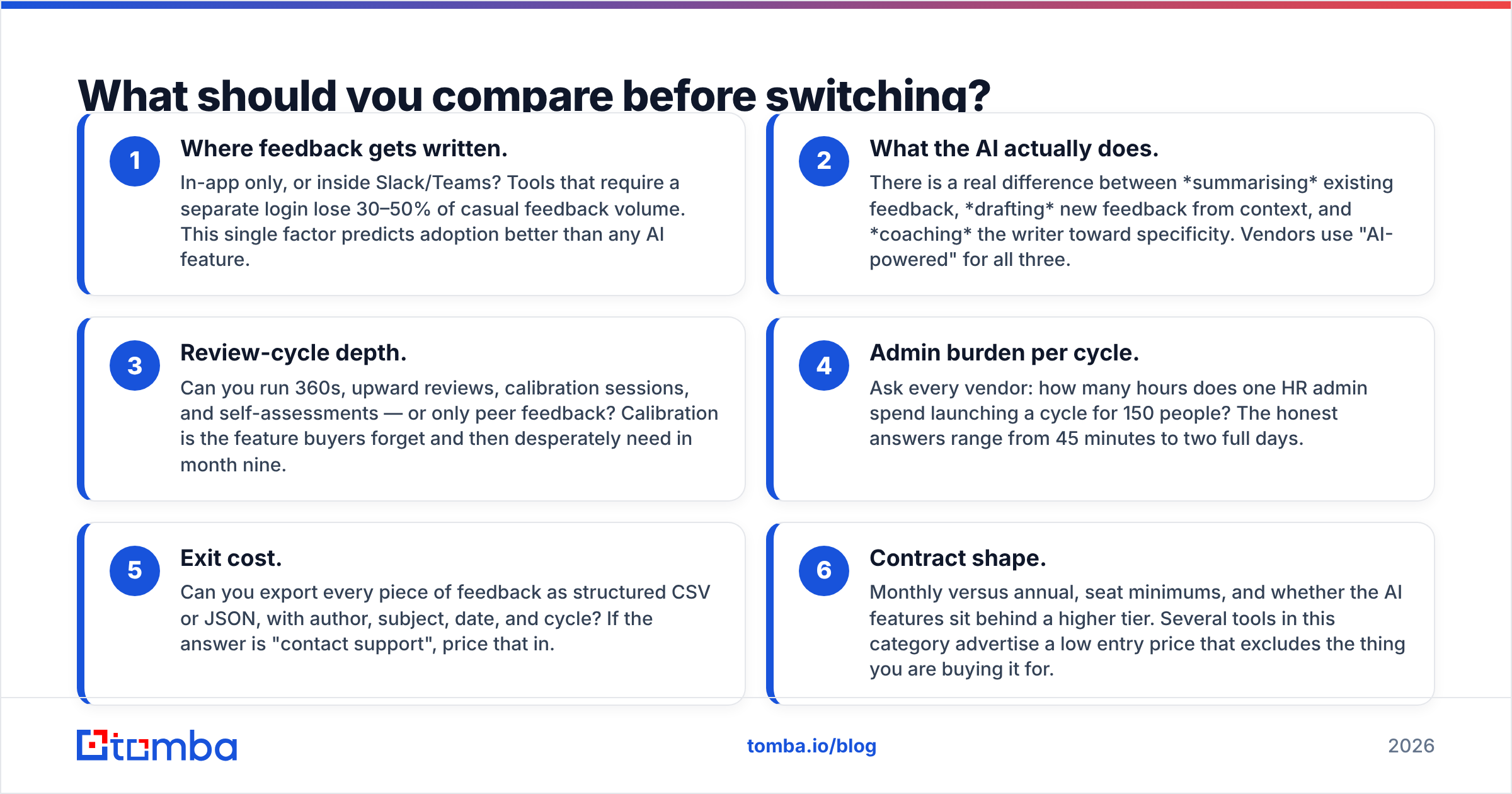
- Where feedback gets written. In-app only, or inside Slack/Teams? Tools that require a separate login lose 30–50% of casual feedback volume. This single factor predicts adoption better than any AI feature.
- What the AI actually does. There is a real difference between summarising existing feedback, drafting new feedback from context, and coaching the writer toward specificity. Vendors use "AI-powered" for all three.
- Review-cycle depth. Can you run 360s, upward reviews, calibration sessions, and self-assessments — or only peer feedback? Calibration is the feature buyers forget and then desperately need in month nine.
- Admin burden per cycle. Ask every vendor: how many hours does one HR admin spend launching a cycle for 150 people? The honest answers range from 45 minutes to two full days.
- Exit cost. Can you export every piece of feedback as structured CSV or JSON, with author, subject, date, and cycle? If the answer is "contact support", price that in.
- Contract shape. Monthly versus annual, seat minimums, and whether the AI features sit behind a higher tier. Several tools in this category advertise a low entry price that excludes the thing you are buying it for.
Which FidForward alternatives are worth shortlisting in 2026?#
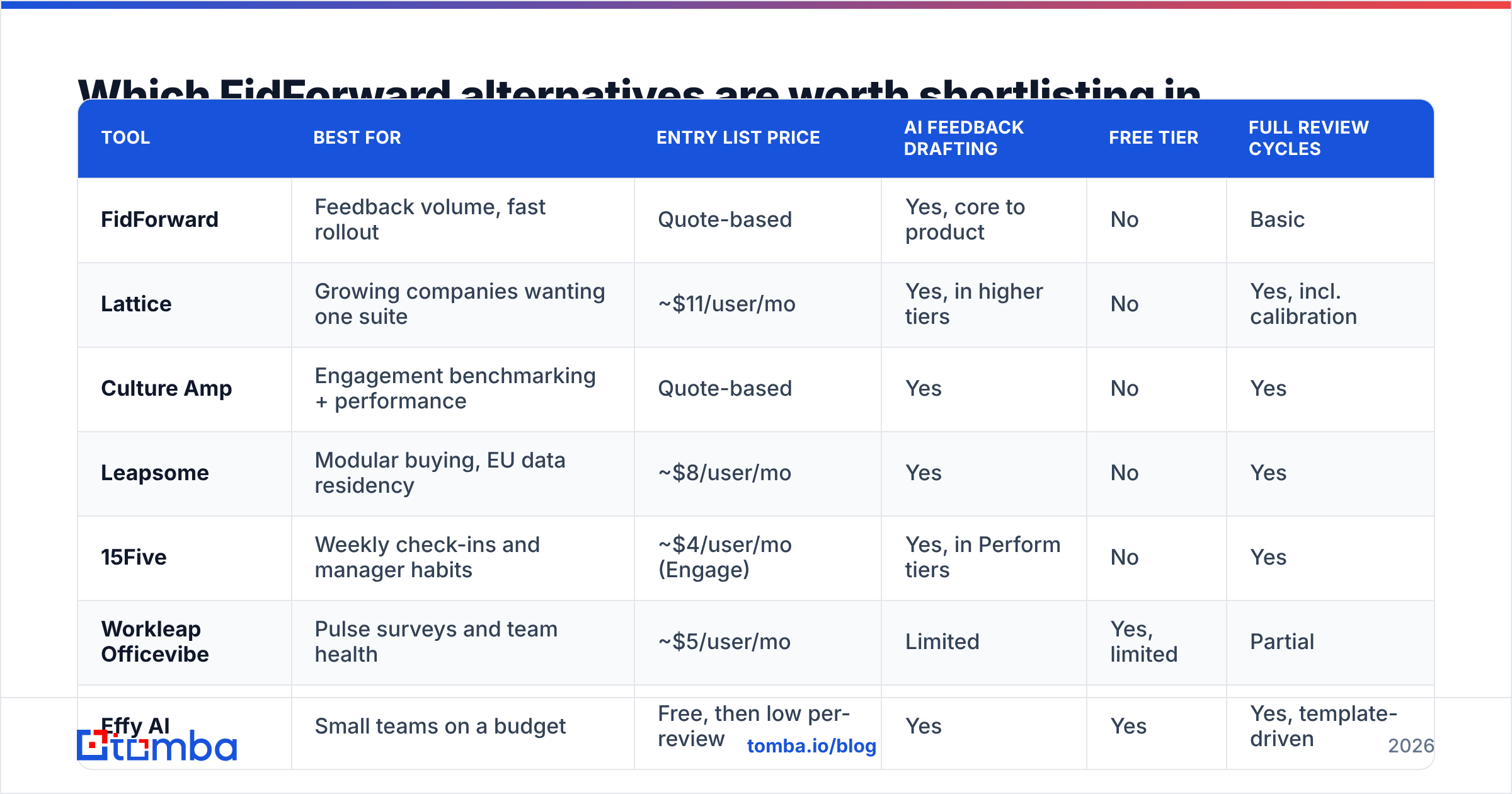
Here is the shortlist, compared on the things that actually differ. Prices are published list prices at the time of writing and exclude annual discounts, seat minimums, and implementation fees — always confirm on the vendor's own pricing page before you build a business case.
| Tool | Best for | Entry list price | AI feedback drafting | Free tier | Full review cycles |
|---|---|---|---|---|---|
| FidForward | Feedback volume, fast rollout | Quote-based | Yes, core to product | No | Basic |
| Lattice | Growing companies wanting one suite | ~$11/user/mo | Yes, in higher tiers | No | Yes, incl. calibration |
| Culture Amp | Engagement benchmarking + performance | Quote-based | Yes | No | Yes |
| Leapsome | Modular buying, EU data residency | ~$8/user/mo | Yes | No | Yes |
| 15Five | Weekly check-ins and manager habits | ~$4/user/mo (Engage) | Yes, in Perform tiers | No | Yes |
| Workleap Officevibe | Pulse surveys and team health | ~$5/user/mo | Limited | Yes, limited | Partial |
| Effy AI | Small teams on a budget | Free, then low per-review | Yes | Yes | Yes, template-driven |
| Small Improvements | Simple 360s without the suite | ~$7/user/mo | Limited | No | Yes |
Lattice — the default suite replacement#
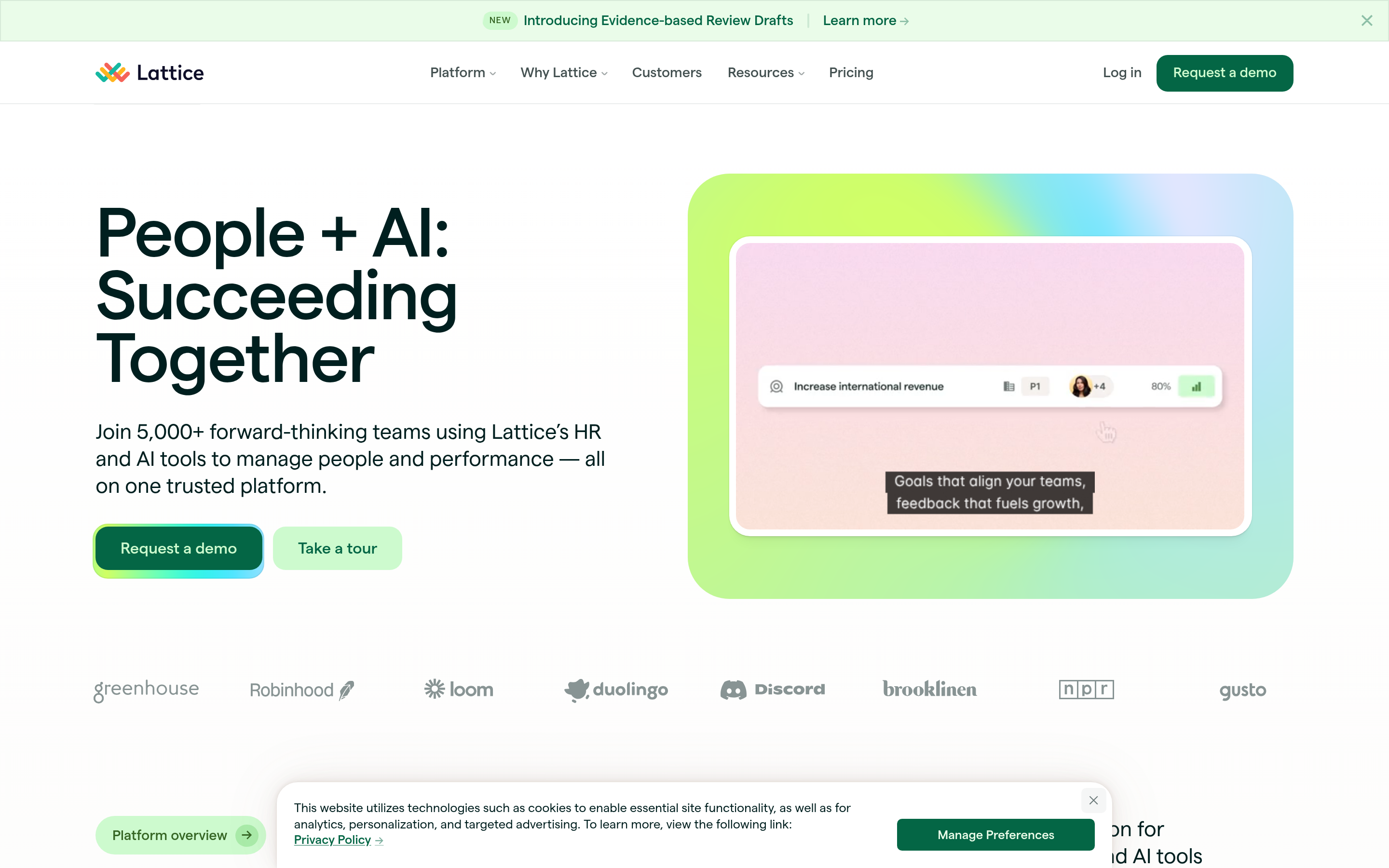
Lattice is what most companies land on when the feedback tool has to grow into a performance platform. Reviews, goals, 1:1 agendas, engagement surveys, and a growing HRIS layer all live in one place. Calibration and review analytics are genuinely strong, and the Slack integration is mature enough that feedback volume does not collapse.
The trade-offs are honest ones: it costs more, the module pricing stacks up, and implementation is a project rather than an afternoon. If you have fewer than 40 employees and no dedicated HR owner, Lattice is more platform than you can feed.
Culture Amp — buy it for the benchmarks#
Culture Amp's differentiator is not the review builder, it is the comparative dataset. When your engagement score comes back at 71, the platform tells you what 71 means against companies of your size and stage. For a people team that has to defend a budget to a board, that context is the product.
Performance features have matured a lot, but the pricing is quote-based and skewed toward mid-market and enterprise. If all you wanted was more peer feedback, this is a large purchase.
Leapsome — the modular middle#
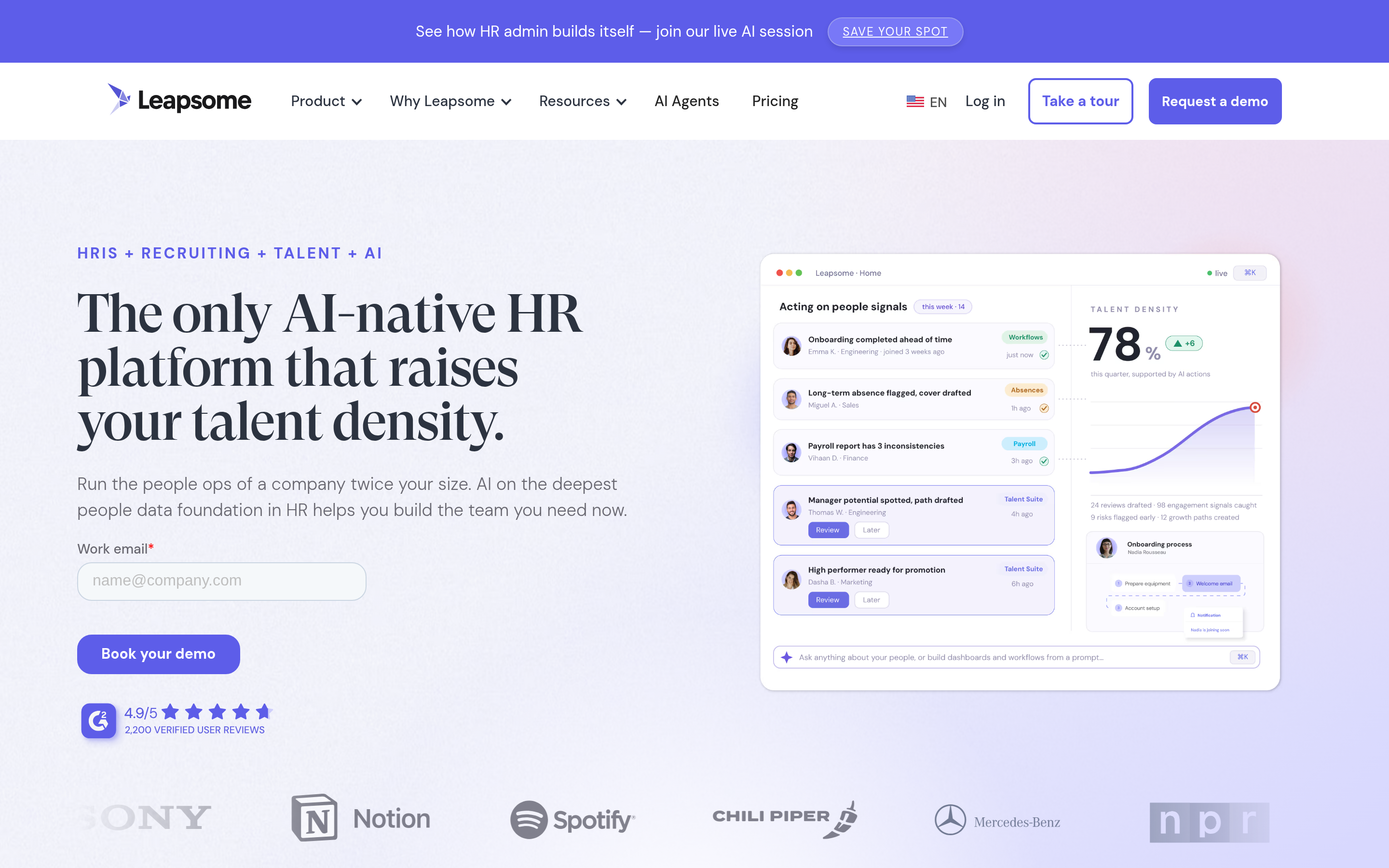
Leapsome sells feedback, reviews, goals, learning, and surveys as separate modules, which means you can start narrow and expand. European data hosting and a fairly direct approach to GDPR make it a common shortlist entry for EU teams that stalled on FidForward's security review.
The interface is dense. Expect to spend a cycle teaching managers where things live.
15Five — habits over paperwork#
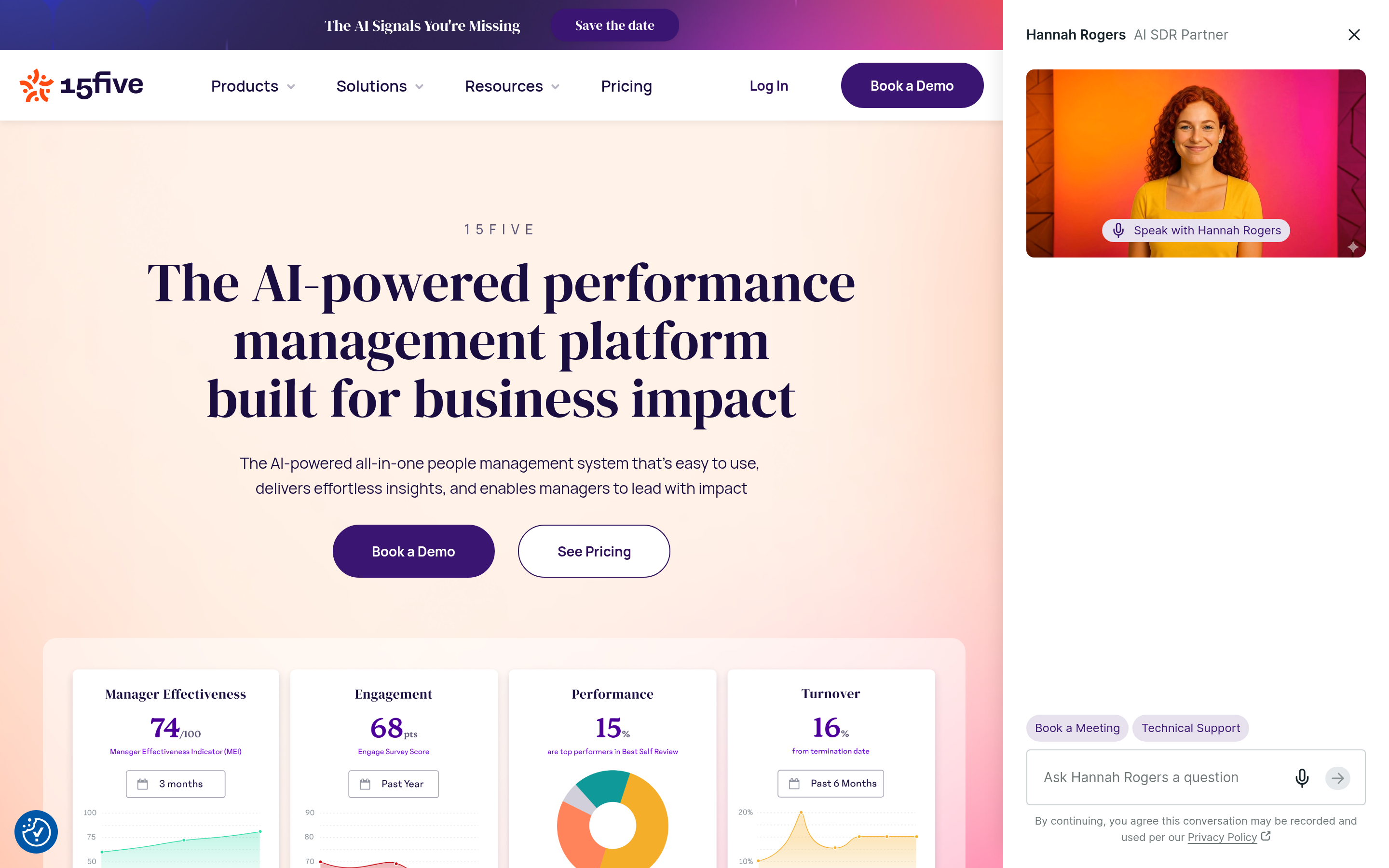
15Five is built around a weekly rhythm: a short check-in, a 1:1 agenda, and a lightweight praise loop. Reviews sit on top of that habit rather than replacing it. If your actual problem is that managers do not talk to their people between quarters, this is the most direct fix on the list.
Watch the tier structure. The headline price is the engagement tier; performance reviews and the manager-coaching content sit higher up.
Workleap Officevibe — pulse-first, cheap to start#
Officevibe leads with anonymous pulse surveys and team health signals, with feedback and recognition around them. There is a genuinely usable free tier for small teams, and the per-seat price is among the lowest here. It is not a full review engine, so treat it as a complement rather than a like-for-like FidForward swap.
Effy AI — the budget pick with real AI#
Effy AI is the tool most likely to undercut everything else on this list. It runs 360s and performance reviews from templates, uses AI to summarise and draft, works inside Slack, and has a free tier that covers small teams outright. The ceiling is lower — you will not run compensation calibration here — but for a 30-person company that needs a review cycle next month, the value is hard to argue with.
Small Improvements — 360s without the suite#
Small Improvements has been doing lightweight reviews, praise, and 1:1s for over a decade. It is not flashy and the AI story is thin, but it is stable, transparently priced, and does not try to become your HRIS. For teams that explicitly do not want a platform, that restraint is the feature.

Is a lightweight tool better than a full performance platform?#
Below roughly 75 employees, yes, almost always. Above 200, almost never.
The reason is administrative gravity. A feedback tool with no goals module and no calibration means those processes live in spreadsheets. At 40 people, a spreadsheet is fine. At 250 people across four departments, the spreadsheet becomes a part-time job, and the licence savings evaporate into the salary of whoever maintains it.
The honest test: count how many distinct people-processes you run each year. Reviews, engagement surveys, goal setting, compensation, promotions, onboarding feedback. If the number is two, buy the narrow tool. If it is five or more, buy the suite and stop paying the integration tax in human hours.
One more thing buyers under-weight: manager training. Every tool here will happily collect vague feedback. "Great team player" is worthless in a review packet regardless of which vendor stored it. The tools with coaching prompts — nudging the writer toward a specific behaviour and a specific outcome — produce measurably more usable input, and that quality gap matters more than any pricing difference.
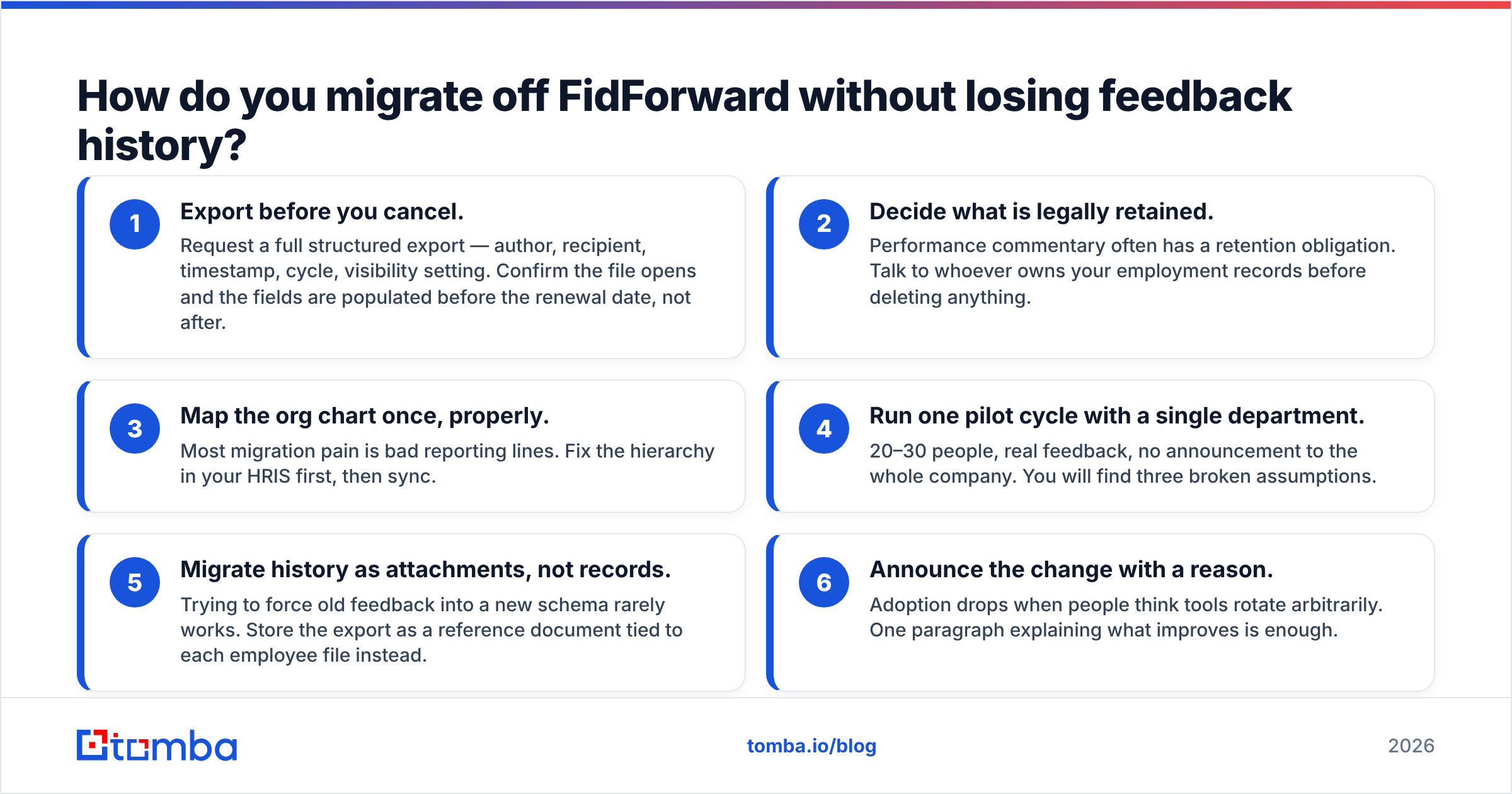
How do you migrate off FidForward without losing feedback history?#
Run it in this order. Skipping step one is how companies end up with two years of orphaned performance data.
- Export before you cancel. Request a full structured export — author, recipient, timestamp, cycle, visibility setting. Confirm the file opens and the fields are populated before the renewal date, not after.
- Decide what is legally retained. Performance commentary often has a retention obligation. Talk to whoever owns your employment records before deleting anything.
- Map the org chart once, properly. Most migration pain is bad reporting lines. Fix the hierarchy in your HRIS first, then sync.
- Run one pilot cycle with a single department. 20–30 people, real feedback, no announcement to the whole company. You will find three broken assumptions.
- Migrate history as attachments, not records. Trying to force old feedback into a new schema rarely works. Store the export as a reference document tied to each employee file instead.
- Announce the change with a reason. Adoption drops when people think tools rotate arbitrarily. One paragraph explaining what improves is enough.
Which FidForward alternative fits your team?#
- Under 25 people, no budget: Effy AI's free tier, or Officevibe if you care more about pulse surveys than reviews.
- 25–75 people, one HR generalist: Small Improvements for simplicity, 15Five if manager habits are the real gap.
- 75–250 people, growing fast: Lattice or Leapsome. Pick Leapsome if EU data residency or modular buying matters, Lattice if you want the broadest single platform.
- 250+ people with a people-analytics function: Culture Amp, for the benchmarking data you cannot generate internally.
- You genuinely just want more feedback, faster: Stay on FidForward. It is good at the narrow job it does, and switching to a suite to solve a volume problem usually makes the volume problem worse.
What does any of this have to do with your sales team?#
More than it looks. Feedback and coaching tools raise rep performance on the activities reps are already doing. They do nothing about the input side of the funnel. Coaching a rep on discovery calls is valuable; coaching a rep who has eleven prospects in their pipeline is theatre.
If your sales org is the reason you are evaluating feedback tooling — reps missing quota, inconsistent win rate across the team, managers with nothing concrete to coach on — audit the pipeline before you audit the humans. A rep working from a stale CRM full of bounced contacts will look like a performance problem in every dashboard you build, and no review cycle will fix it.
That is the split worth naming clearly. Feedback tools improve how your team executes. Data tools decide whether there is anything to execute on.
Get the input side right first#
If your reps are burning hours hunting for contact details instead of running the conversations you want to coach them on, start there. Tomba Email Finder returns verified professional email addresses by name, company, or domain, with confidence scoring so reps stop guessing at patterns and stop torching sender reputation on bounces. The free tier covers 25 searches a month, and paid plans start at $49/month — see Tomba pricing for the full breakdown.
Pick your feedback tool from the table above. Then make sure the pipeline your managers are coaching against is actually real.
Related guides#
Ready to find emails that actually work?
Join 150,000+ professionals who stopped guessing and started sending. Free credits on signup — no credit card required.
Get the Tomba newsletter
Practical outbound tactics and product updates — once every two weeks.
About the author