Filling the Funnel: The 2026 Playbook for Pipeline Coverage
Most teams fill the funnel with volume and wonder why pipeline still stalls. Here is the math, the data stack, and the channel mix that actually produce qualified pipeline in 2026.
TL;DR
- Filling the funnel is a coverage problem, not a volume problem. Work backward from your quota to the number of qualified accounts you need in play, then buy or build only that much data.
- The single largest leak is bad contact data. A 25% bounce rate doesn't just waste sends — it drags your sender reputation down and quietly suppresses the 75% that were deliverable.
- A three-source data stack (a verified email finder, an intent or trigger layer, and your own first-party signals) beats a single mega-database at roughly a third of the cost.
- Multichannel isn't optional anymore. Email-only sequences convert at roughly half the rate of email + phone + LinkedIn touch patterns in most B2B teams' own reporting.
- Measure funnel fill by qualified-opportunity coverage against quota, not by leads created. Leads created is the metric that lies.
What does "filling the funnel" actually mean in 2026?#
Filling the funnel means keeping enough qualified opportunities moving through each stage that your forecasted close rate produces your revenue target — with margin for slippage.
That definition matters because most teams operationalize something else entirely. They set an activity target (500 emails a week), hit it, and then act surprised when pipeline coverage sits at 1.8x instead of 3x. Volume is an input. Coverage is the outcome.
Here's the everyday version: filling the funnel is like filling a bathtub with the drain half open. You can turn the tap harder, or you can plug the drain. Most teams spend their entire budget on the tap. The drain — bad data, wrong ICP, no follow-up, bounced sends — is where the water actually goes.
The math is unforgiving and worth doing on paper before you spend a dollar on tooling:
- Start at the revenue number. $2M in new ARR, $25K average deal size = 80 closed-won deals.
- Divide by win rate. At a 22% win rate, you need 364 qualified opportunities.
- Apply pipeline coverage. Most B2B teams plan at 3x coverage to absorb slippage, so you're targeting ~1,090 opportunities in play across the year.
- Divide by meeting-to-opportunity rate. At 40%, that's ~2,725 first meetings.
- Divide by reply-to-meeting rate. At 25%, ~10,900 positive-ish replies.
- Divide by reply rate. At a healthy 6% response rate, you need ~181,000 deliverable touches — which at a 22% bounce rate means you'd have to source 232,000 contacts instead of 181,000.
That last line is the whole argument. A 22-point bounce rate doesn't cost you 22% more data budget — it costs you data budget plus domain reputation plus the deliverability tax on every message you send afterward.
Why do most funnel-filling efforts fail?#
They fail at the input layer, not the execution layer. Five failure modes account for nearly everything I see in pipeline reviews:
- ICP drift. The list was built for "SaaS companies, 50-200 employees" but the actual buyers who close are 200-500 with a dedicated RevOps hire. Nobody updated the definition, so 60% of outbound targets were never going to buy.
- Unverified contact data. Scraped or stale records get pushed straight into a sequence. Bounces spike, the domain gets throttled, and the reps blame the copy.
- Single-channel dependence. Email-only motions collapse the moment inbox filtering tightens. Teams with phone and LinkedIn in the same cadence absorb that shock; email-only teams watch pipeline halve.
- No trigger layer. Reaching out to a perfect-fit account with no reason to talk today converts about as well as reaching out to a bad-fit account. Timing is half of qualification.
- Follow-up collapse. The median B2B sequence stops at 3 touches. A meaningful share of positive replies arrive on touches 4 through 8. Teams that stop early are leaving the cheapest pipeline they'll ever get on the table.
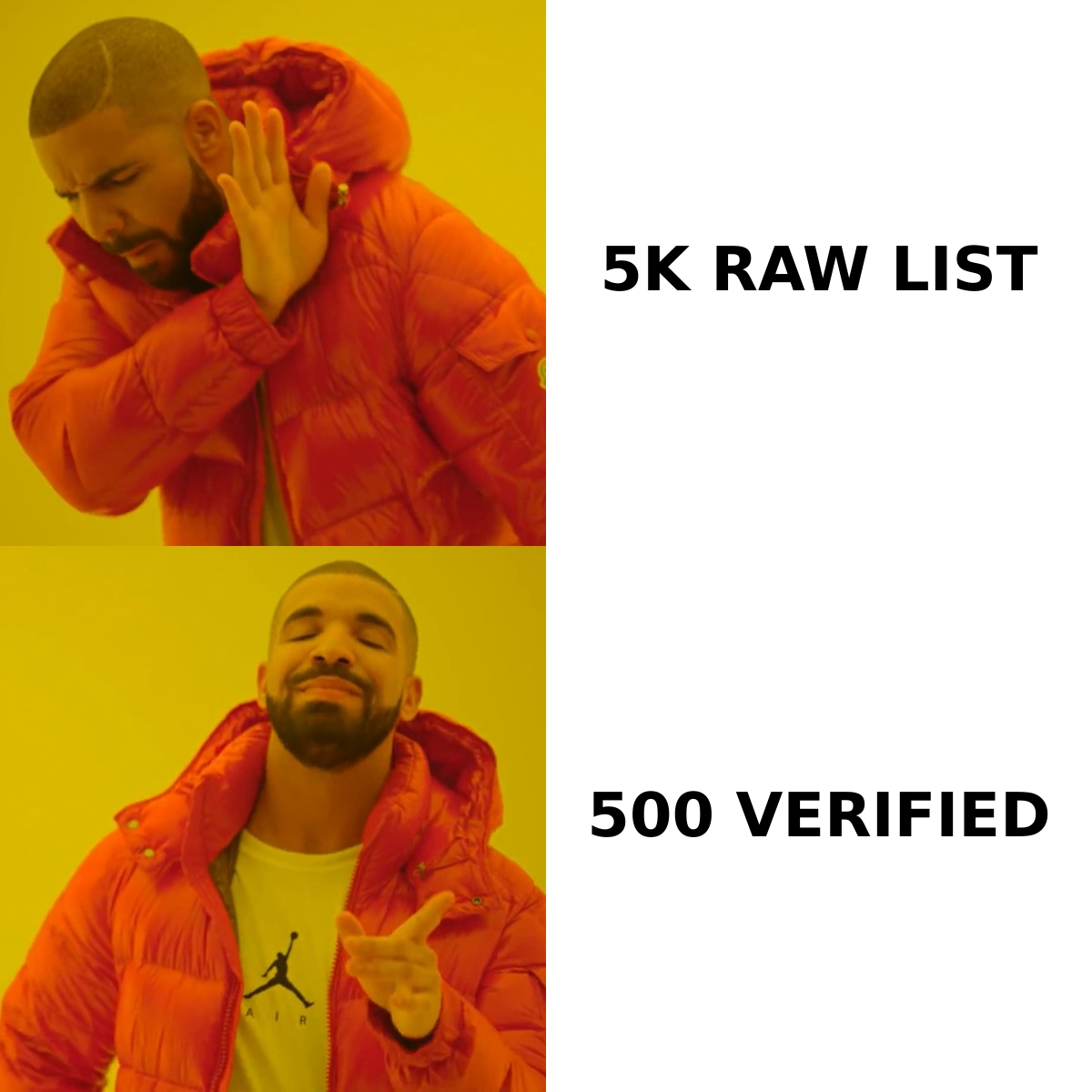
Notice that four of the five are data or sequencing problems. Copy matters, but copy is what you optimize after the inputs are correct. Fixing subject lines on a list that's 30% dead is rearranging deck chairs.
What data stack do you need to fill the funnel?#
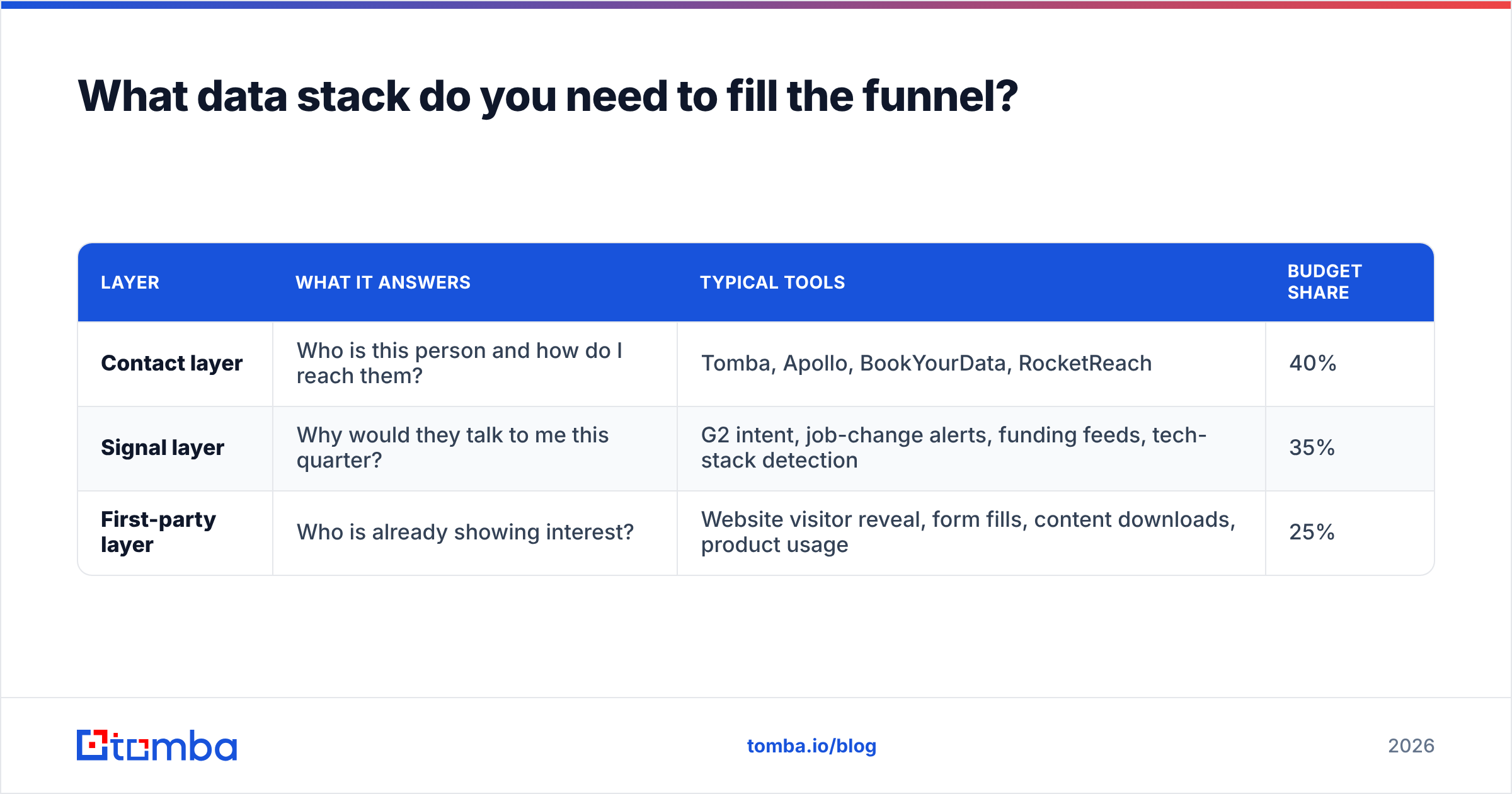
Three layers, and you genuinely need all three. Buying one enormous all-in-one database and calling it a stack is the most common overspend in B2B sales.
| Layer | What it answers | Typical tools | Budget share |
|---|---|---|---|
| Contact layer | Who is this person and how do I reach them? | Tomba, Apollo, BookYourData, RocketReach | 40% |
| Signal layer | Why would they talk to me this quarter? | G2 intent, job-change alerts, funding feeds, tech-stack detection | 35% |
| First-party layer | Who is already showing interest? | Website visitor reveal, form fills, content downloads, product usage | 25% |
The contact layer is the one most teams get wrong by treating "number of records" as the buying criterion. A database with 200M contacts and 65% accuracy is strictly worse for outbound than a 50M-record source at 92% accuracy — because the bad 35% doesn't sit inertly in a spreadsheet, it actively degrades the deliverability of everything else you send.
Practical build: use a domain search to map every reachable contact at a target account, run the output through an email verifier before anything touches your sending domain, and layer B2B phone numbers for the accounts scoring highest on your signal layer. That order matters — verify before enrich, enrich before sequence.
For the signal layer, the cheapest starting point is job changes within your existing closed-won contacts. A champion who moves to a new company is the highest-converting outbound segment most teams have, and it costs nothing but a monthly LinkedIn or CRM check to build.
How do you choose an email finder that won't wreck deliverability?#
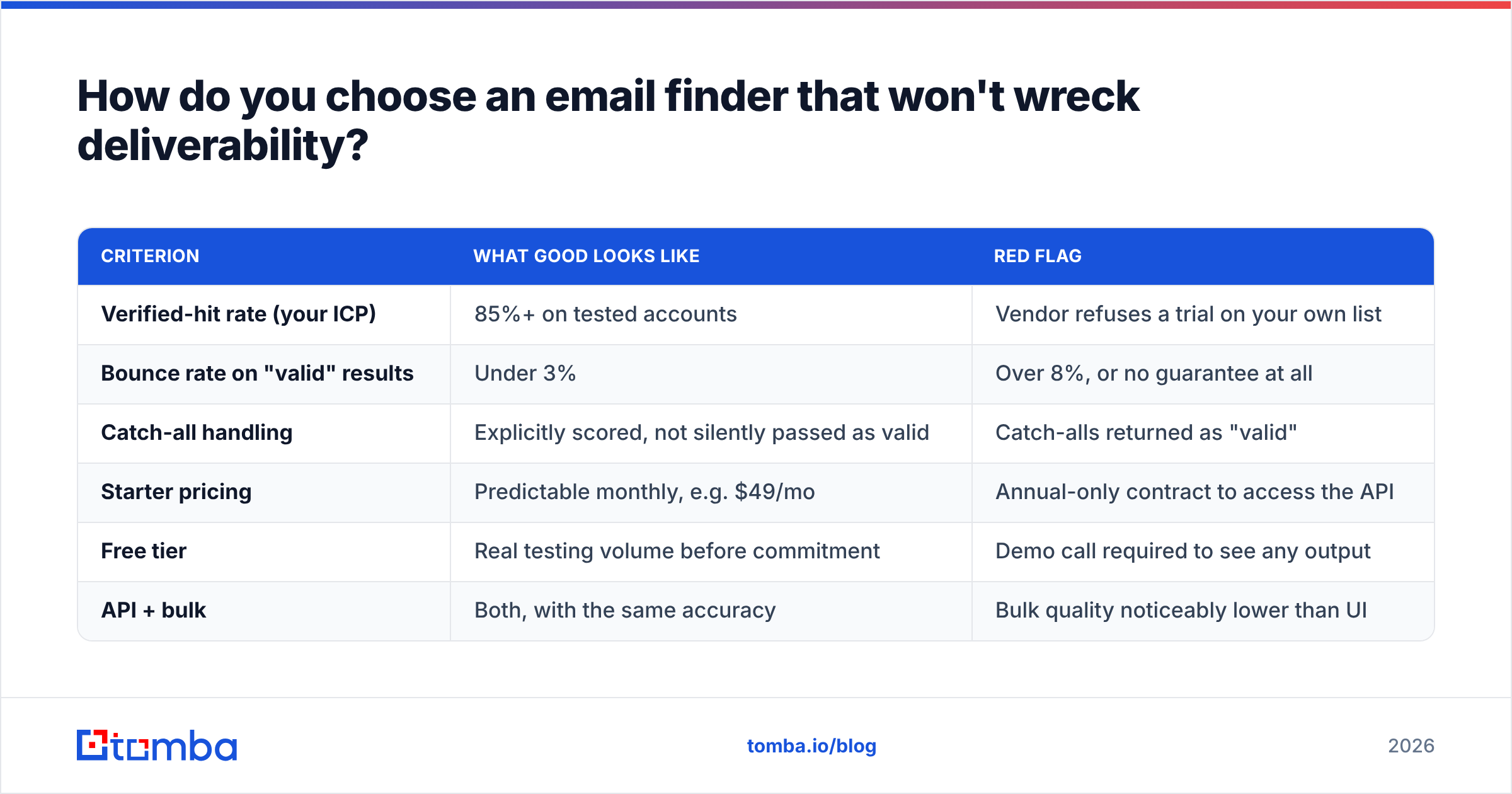
Judge on three numbers: verified-hit rate on your ICP, bounce rate on delivered addresses, and cost per verified contact — not headline credit price.

Run the same 100-account test list through every tool you're evaluating. Not their sample list — yours. Vendors optimize marketing benchmarks against large, well-indexed public companies; your ICP is probably 40-person consultancies in a niche vertical, where hit rates diverge by 30+ points between providers.
The cost-per-verified-contact math trips people up. A tool at $0.02 per credit with a 45% verified-hit rate costs $0.044 per usable contact. A tool at $0.05 per credit with a 90% hit rate costs $0.055 — nearly identical, except the second one didn't hand you 55 dead addresses to burn your domain on.

| Criterion | What good looks like | Red flag |
|---|---|---|
| Verified-hit rate (your ICP) | 85%+ on tested accounts | Vendor refuses a trial on your own list |
| Bounce rate on "valid" results | Under 3% | Over 8%, or no guarantee at all |
| Catch-all handling | Explicitly scored, not silently passed as valid | Catch-alls returned as "valid" |
| Starter pricing | Predictable monthly, e.g. $49/mo | Annual-only contract to access the API |
| Free tier | Real testing volume before commitment | Demo call required to see any output |
| API + bulk | Both, with the same accuracy | Bulk quality noticeably lower than UI |
Catch-all domains deserve their own paragraph because they're where most "accurate" tools quietly cheat. A catch-all server accepts every address at the domain, so a naive verifier marks everything valid. Then you send, and the real filtering happens at the inbox layer — as spam complaints and silent drops. Any serious stack needs a dedicated catch-all verifier step, or you should treat catch-all results as a separate, lower-confidence segment with its own sending pool.
On pricing, the market has settled into a fairly readable band. Tomba pricing starts with a free tier at 25 searches/month, then Starter at $49/mo, Growth at $99/mo, and Pro at $249/mo — which is roughly where credible mid-market email finders sit. BookYourData takes a different approach with pay-as-you-go verified B2B lists and a bounce guarantee, which suits teams that want a one-time list rather than an ongoing API. Apollo bundles finding with sequencing, so the comparison there is really "platform vs. best-of-breed," not price-per-credit. Pick the shape that matches how your team actually works; all three are defensible choices depending on whether you want a list, an API, or a full platform.
Which channels actually fill the funnel fastest?#
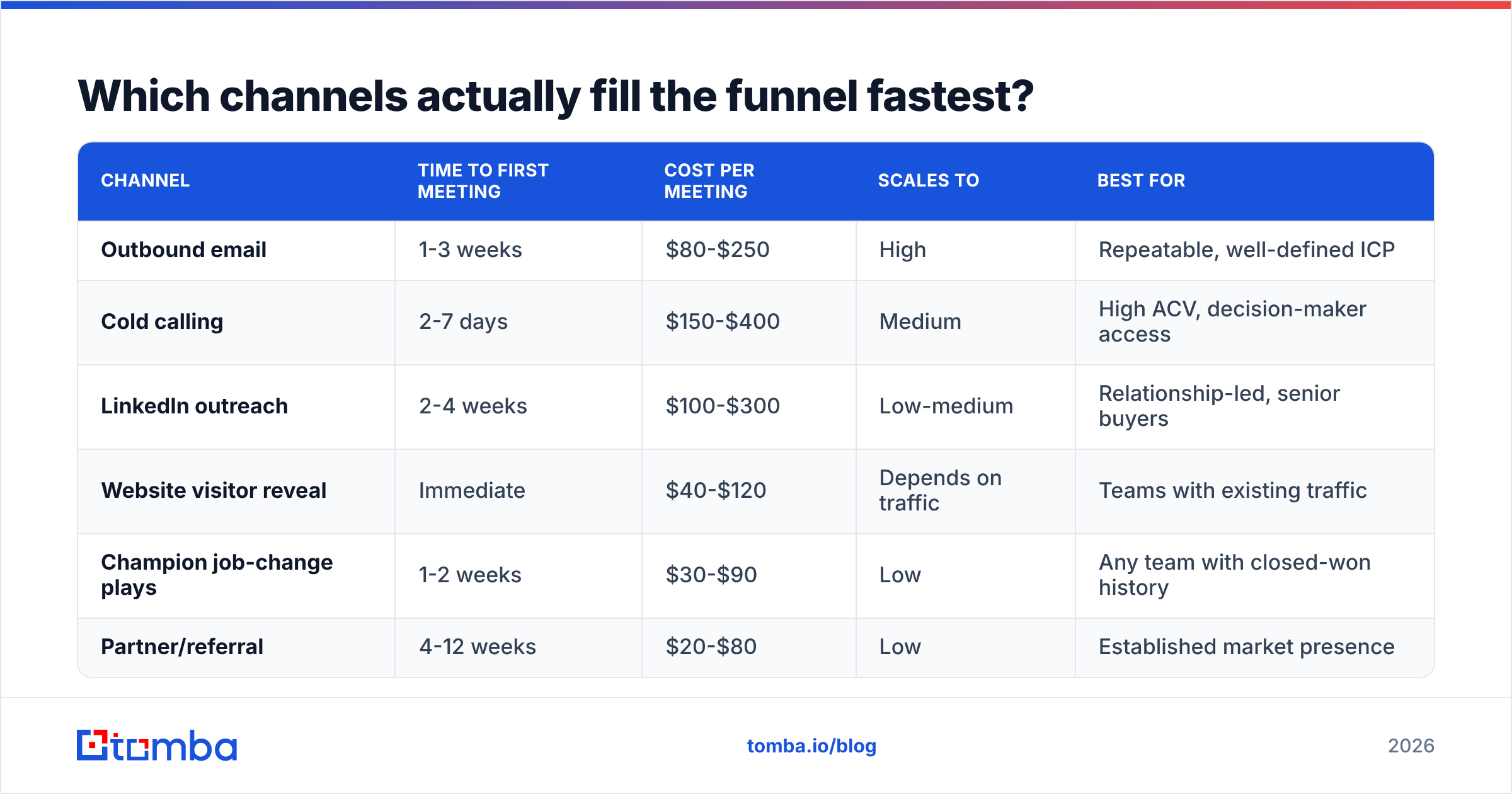
Ranked by realistic time-to-first-meeting for a team starting from zero:
| Channel | Time to first meeting | Cost per meeting | Scales to | Best for |
|---|---|---|---|---|
| Outbound email | 1-3 weeks | $80-$250 | High | Repeatable, well-defined ICP |
| Cold calling | 2-7 days | $150-$400 | Medium | High ACV, decision-maker access |
| LinkedIn outreach | 2-4 weeks | $100-$300 | Low-medium | Relationship-led, senior buyers |
| Website visitor reveal | Immediate | $40-$120 | Depends on traffic | Teams with existing traffic |
| Champion job-change plays | 1-2 weeks | $30-$90 | Low | Any team with closed-won history |
| Partner/referral | 4-12 weeks | $20-$80 | Low | Established market presence |
Two things stand out. First, the cheapest sources — job changes, referrals, visitor reveal — don't scale, but they should be exhausted before you spend on cold volume. Nobody's outbound program should be running at full volume while their website visitor reveal data sits unworked.
Second, cold calling is dramatically faster to first meeting than email, and most teams under-index on it because it's uncomfortable. If you need pipeline in 30 days, not 90, calling is the lever. That requires actual phone numbers, which is why a phone validator belongs in the stack alongside email tooling.
The multichannel finding is consistent across most published vendor and analyst reporting: sequences combining email, phone, and social touches outperform email-only by a wide margin — commonly reported at roughly 2x reply rate. HubSpot's sales research and G2's category data both point the same direction, and it matches what most teams find when they instrument it themselves.
How should you sequence and measure funnel fill?#
Build sequences around 8-12 touches over 21-28 days, mixing channels, with a hard rule: no touch goes out to an unverified address.
A workable default structure:
- Day 1 — Email. Trigger-based, one specific observation about their business, one question. No pitch deck, no calendar link.
- Day 2 — LinkedIn view + connect. No message attached to the connect request.
- Day 4 — Call. Reference the email loosely; don't read it aloud.
- Day 7 — Email. Different angle entirely, not a "just bumping this."
- Day 10 — Call + voicemail. Voicemail under 20 seconds, states exactly why you called.
- Day 14 — LinkedIn message. Short, references something they posted or their company published.
- Day 18 — Email. Case study or proof point relevant to their segment.
- Day 24 — Breakup email. Genuinely closes the loop; it converts better than any of the middle touches.
On measurement, replace "leads created" with four metrics that can't be gamed by activity:
- Qualified pipeline coverage — open qualified pipeline ÷ remaining quota. Target 3x+.
- Cost per qualified opportunity — total spend (data + tools + loaded rep cost) ÷ qualified opps. This is the number that tells you whether the funnel-filling program is worth running.
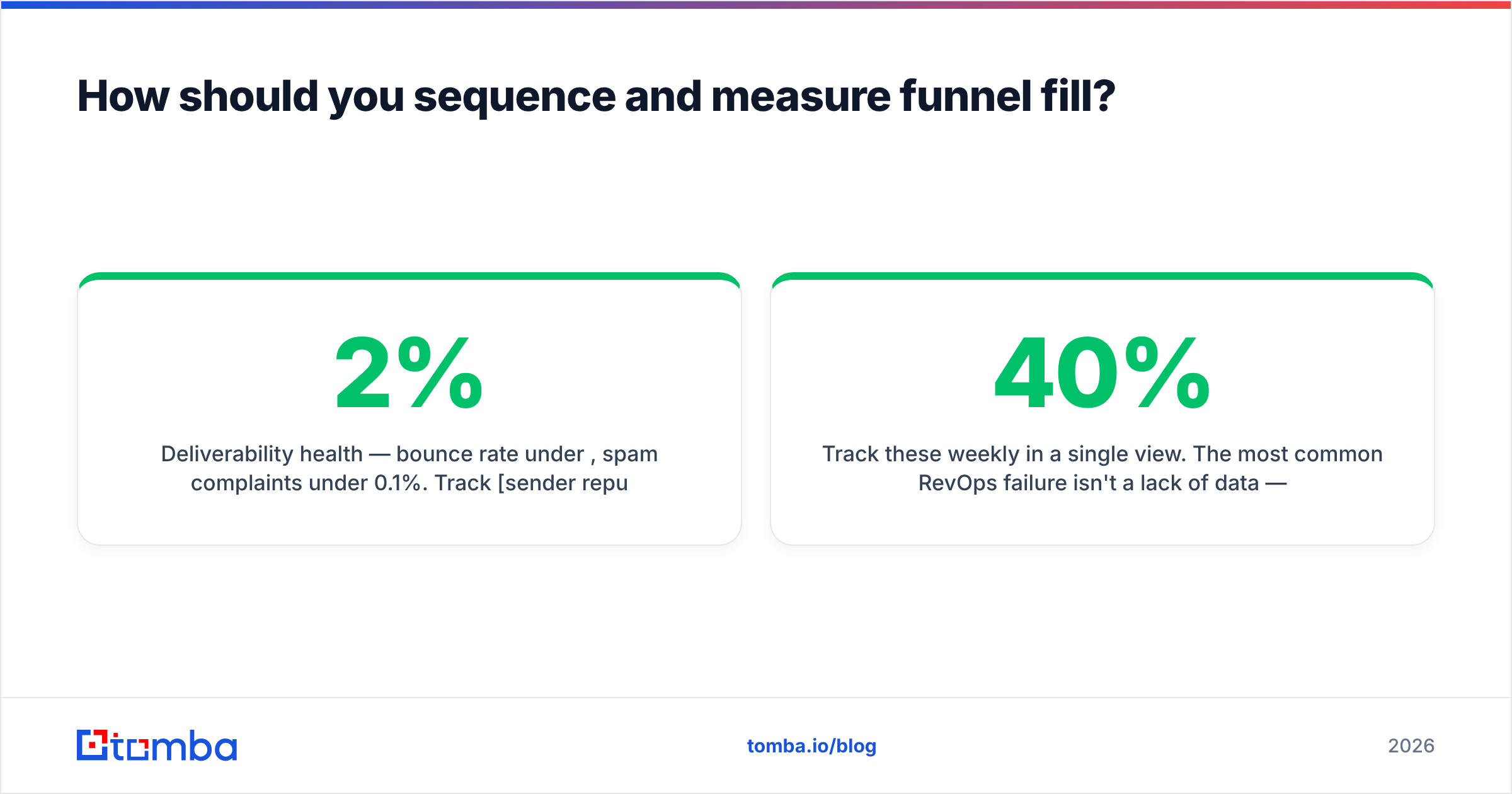
- Deliverability health — bounce rate under 2%, spam complaints under 0.1%. Track sender reputation weekly, not when something breaks.
- Stage-conversion by source — a source producing lots of meetings that never reach proposal is worse than a source producing half as many that do.
Track these weekly in a single view. The most common RevOps failure isn't a lack of data — it's four dashboards nobody reconciles, so nobody notices that the source producing 40% of meetings produces 4% of closed-won.
What does a 90-day funnel-fill plan look like?#
Days 1-30: fix the inputs. Rewrite the ICP definition using closed-won data only, not aspiration. Audit your existing contact list — verify everything, quarantine catch-alls, delete anything older than 18 months without a re-verification pass. Run a 100-account bake-off across two or three data vendors on your real ICP.
Days 31-60: build the motion. Launch one sequence against one segment with one clear trigger. Keep volume deliberately low — 40-60 contacts a week — so you can read the signal. Instrument reply rate, meeting rate, and bounce rate separately by source. Warm any new sending domains properly before they carry real volume.
Days 61-90: scale what converts. Only now increase volume, and only on the segment-and-trigger combination that produced qualified opportunities, not just replies. Add the second channel to the winning sequence before you add a second segment. Use bulk email finder workflows to scale sourcing once you know exactly what a good record looks like.
The discipline that makes this work is refusing to scale before day 61. Almost every failed outbound program scaled a broken motion in week two and spent the next quarter trying to diagnose it through noise.
Where should you start?#
Start with the data, because everything downstream inherits its quality. If your contact layer is 70% accurate, no amount of copywriting, sequencing, or channel-mixing recovers the 30% — it just spreads the damage across your sending reputation.
Build your list from a source that verifies before it delivers. The Tomba Email Finder returns confidence-scored professional addresses from a domain, name, or company, with a free tier at 25 searches/month so you can run your own 100-account accuracy test before committing to anything. Pair it with domain search for account mapping and the verifier for the pre-send gate, and your funnel-filling program starts from clean inputs instead of hopeful ones.
Run the coverage math first. Then buy exactly the data that math calls for — and not a record more.
Related guides#
Ready to find emails that actually work?
Join 150,000+ professionals who stopped guessing and started sending. Free credits on signup — no credit card required.
Get the Tomba newsletter
Practical outbound tactics and product updates — once every two weeks.
About the author