FinalScout vs FullCircl (2026): Which B2B Data Tool Wins?
FinalScout scrapes LinkedIn for emails. FullCircl scores UK companies for risk and fit. They get compared constantly, but they solve opposite halves of the same pipeline. Here is the honest breakdown.
TL;DR
- FinalScout is a LinkedIn-first contact extractor: install a Chrome extension, pull emails off profiles and Sales Navigator lists, and draft outreach with AI. It sells to individual reps and small teams.
- FullCircl is a company intelligence and onboarding platform built around UK and Irish company data (credit, risk, ownership, trigger events). It sells to banks, insurers, and enterprise sales teams on annual contracts.
- They are not really substitutes. FinalScout answers "what is this person's email?" FullCircl answers "is this company worth onboarding, and is it safe to?"
- Cost gap is enormous: FinalScout starts in the low tens of dollars per month; FullCircl is quote-only and typically lands in four or five figures annually.
- If what you actually need is verified work emails at scale with an API and predictable per-credit pricing, neither is the natural fit — a dedicated email finder is.
Why do people compare FinalScout vs FullCircl at all?#
Because both show up when you search "B2B contact data," and both promise to fill a CRM. That is where the overlap ends.
FinalScout (finalscout.com) is a browser-based prospecting tool. Its center of gravity is LinkedIn: you browse a profile or a search result page, the extension surfaces a likely email address, and you export to CSV or push into a sequence. It bolts an AI writer on top so you can generate a first-touch email from the profile you just scraped.
FullCircl (fullcircl.com) grew out of the 2021 merger of Artesian Solutions and DueDil, and was acquired by nCino in 2025. Its center of gravity is the company record: filings, financials, directorships, group structures, credit signals, and news-based trigger events, wrapped in workflows for customer onboarding and KYB/AML checks. Person-level email discovery is not what it is built for.
So the honest framing for FinalScout vs FullCircl is not "which is better." It is "which layer of the funnel are you trying to fix?"
What does each tool actually do?#
Here is the split in plain terms:
- Contact discovery (FinalScout's job). Turn a name plus a company into a reachable email address. Volume matters, accuracy matters, and the workflow is one prospect at a time or one list at a time.
- Company intelligence (FullCircl's job). Decide whether an account is worth pursuing, creditworthy, and compliant to onboard. Depth matters more than volume.
- Verification (neither does well). Confirming that an address will actually accept mail before you send. FinalScout claims high deliverability; FullCircl does not play here at all.
- Enrichment and sync (both partially). Pushing data into HubSpot, Salesforce, or a sequencer. FullCircl is stronger on CRM-native workflows; FinalScout is stronger on quick CSV throughput.
- Geography. FinalScout is global because LinkedIn is global. FullCircl is deepest in the UK and Ireland, where its filings-level data is genuinely hard to replicate.
That last point decides more deals than any feature chart. If your ICP is US mid-market SaaS, FullCircl's core advantage largely evaporates. If your ICP is UK SMEs applying for a business account, FinalScout's LinkedIn-scraped emails are close to irrelevant to the underwriting question.
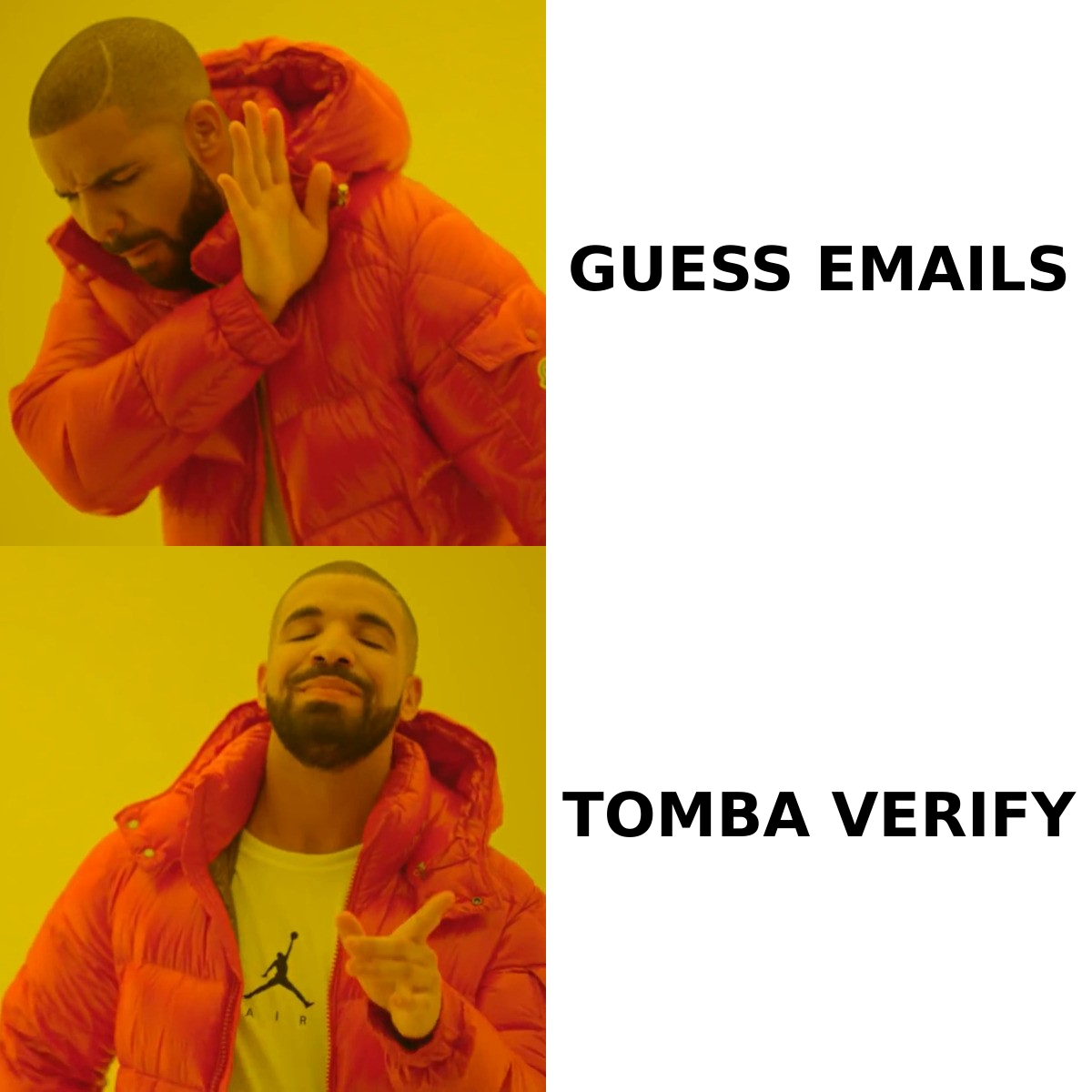
How do FinalScout and FullCircl compare feature by feature?#

| Dimension | FinalScout | FullCircl | Tomba |
|---|---|---|---|
| Primary job | LinkedIn email extraction | Company intelligence + onboarding | Email finding + verification |
| Core unit of data | Person (profile → email) | Company (filings, risk, structure) | Person + domain |
| Geographic strength | Global (LinkedIn coverage) | UK & Ireland, deep | Global |
| Bulk workflow | CSV export, list scraping | CRM-embedded workflows | Bulk finder + bulk verify |
| Verification built in | Basic validity check | Not applicable | Dedicated SMTP-level verifier |
| Public API | Limited | Yes, enterprise-oriented | Yes, documented and self-serve |
| Free tier | Yes, small monthly credit pool | No | Yes, 25 searches/mo |
| Entry paid price | Roughly $35–$50/mo band | Quote only, annual | $49/mo Starter |
| Contract | Monthly, self-serve | Annual, sales-led | Monthly, self-serve |
| Best for | SDRs and founders prospecting on LinkedIn | Banks, insurers, UK enterprise sales | Teams needing verified emails at scale |
Two things jump out. First, the buying motion is completely different — you can be running FinalScout in four minutes and it will take four weeks to get FullCircl live. Second, neither tool treats verification as a first-class product, which is where most cold outreach programs actually bleed money.
Check current numbers on each vendor's own pricing page before you budget; both have changed tiers more than once, and FullCircl does not publish list prices at all.
Which one gives you more usable email addresses?#
FinalScout, by a wide margin — but "more" is not the same as "usable."

LinkedIn-based extractors work in two modes. When the address is genuinely in a database or exposed by the profile, you get a real hit. When it is not, the tool falls back to pattern inference: it knows the company uses first.last@domain.com, so it constructs one and ships it with a confidence score. That second mode is where bounce rates come from.
FinalScout advertises high deliverability, and in practice its hit rate on well-known companies is solid. Where it degrades — like every LinkedIn scraper — is on:
- Small companies with irregular patterns. A 12-person agency using nicknames breaks pattern inference immediately.
- Catch-all domains. The mail server accepts everything, so a simple validity ping tells you nothing. You need a real catch-all verifier to separate live mailboxes from black holes.
- Recently changed roles. The profile says one company; the mailbox is still at the old one, or already deprovisioned.
- Non-English-market domains. Coverage thins fast outside the major English-speaking markets.
FullCircl, meanwhile, will happily tell you that a company filed accounts late, has a county court judgment against it, and is majority-owned by a holding company in Jersey. It will not reliably tell you the head of ops' email address. Those are different products wearing the same "B2B data" label.
The practical fix, whichever tool you use for discovery, is to run every list through an independent email verifier before it touches a sequencer. Discovery tools grade their own homework; a separate verification pass does not.
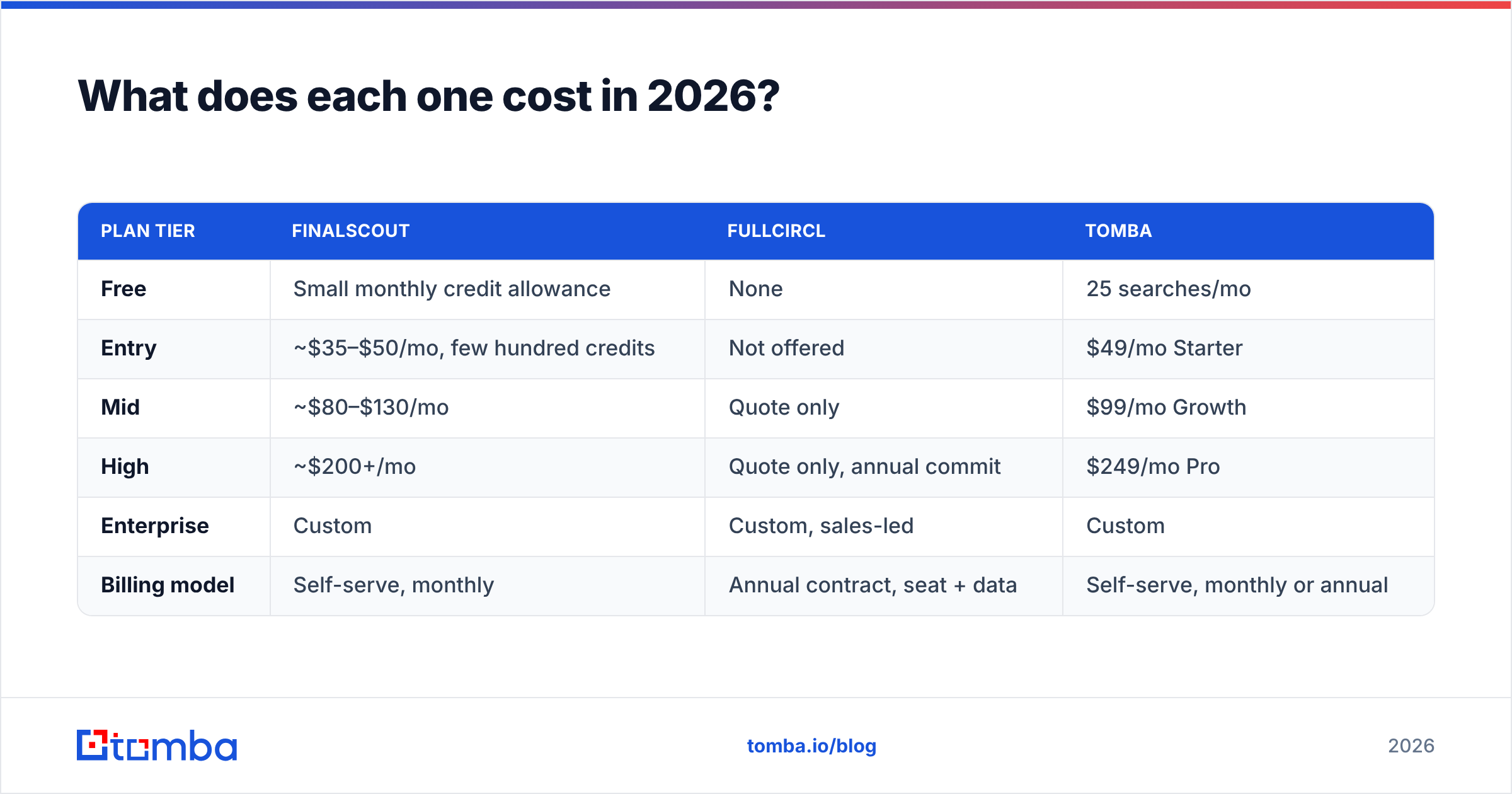
What does each one cost in 2026?#
| Plan tier | FinalScout | FullCircl | Tomba |
|---|---|---|---|
| Free | Small monthly credit allowance | None | 25 searches/mo |
| Entry | ~$35–$50/mo, few hundred credits | Not offered | $49/mo Starter |
| Mid | ~$80–$130/mo | Quote only | $99/mo Growth |
| High | ~$200+/mo | Quote only, annual commit | $249/mo Pro |
| Enterprise | Custom | Custom, sales-led | Custom |
| Billing model | Self-serve, monthly | Annual contract, seat + data | Self-serve, monthly or annual |
FinalScout's tiers move around, so treat the bands above as directional and confirm on their site. FullCircl publishes nothing — expect a discovery call, a scoping exercise, and a proposal. That is normal for regulated-industry data, but it means you cannot pilot it on a Tuesday afternoon.
For reference, Tomba pricing runs Free (25 searches/mo), Starter $49/mo, Growth $99/mo, Pro $249/mo, and custom Enterprise — with the same credit pool covering finding, verification, and enrichment rather than splitting them into separate SKUs.
The budget question worth asking: what is a bounced email costing you? At a 5% bounce rate on 10,000 sends a month, you are burning domain reputation to save maybe $40 in verification credits. That math is bad in every direction.
Who should choose FinalScout?#
Pick FinalScout if most of these are true:
- LinkedIn is your prospecting surface. You live in Sales Navigator, and you want emails without leaving the tab.
- You are one to five people. Self-serve monthly billing and no procurement cycle actually matter at that size.
- Volume is moderate. A few hundred to a few thousand contacts a month, not hundreds of thousands.
- You want AI drafting bundled. The built-in writer is convenient if you do not already run a sequencer with templates.
Where it will frustrate you: bulk operations beyond CSV, programmatic access for engineering-led workflows, and any situation where you need auditable proof that an address is deliverable. Extensions are also structurally fragile — they depend on a platform that periodically changes its DOM and its enforcement posture.
If the extension workflow is what you like but you want a harder verification layer underneath, a dedicated LinkedIn finder plus a verification step covers the same ground with fewer surprises.
Who should choose FullCircl?#
Pick FullCircl if most of these are true:
- You sell into or onboard UK/Irish businesses. Companies House-grade depth, group structures, and credit signals are the product.
- Compliance is part of the workflow. KYB and AML checks sitting alongside sales intelligence is genuinely rare, and it is FullCircl's real moat — especially post-nCino, where onboarding is the strategic direction.
- You are enterprise. Annual contracts, CRM integration projects, and admin ownership are assumed.
- Trigger events drive your outreach. News, filings, and funding signals feed account prioritization rather than raw contact volume.
Where it will frustrate you: person-level contactability. FullCircl tells you which accounts to chase and whether they are safe to sign. You will still need something else to find and verify the human you email. That is not a criticism — it is the category boundary.

Do you actually need a third tool?#
Usually, yes — and this is the part most head-to-head posts skip.
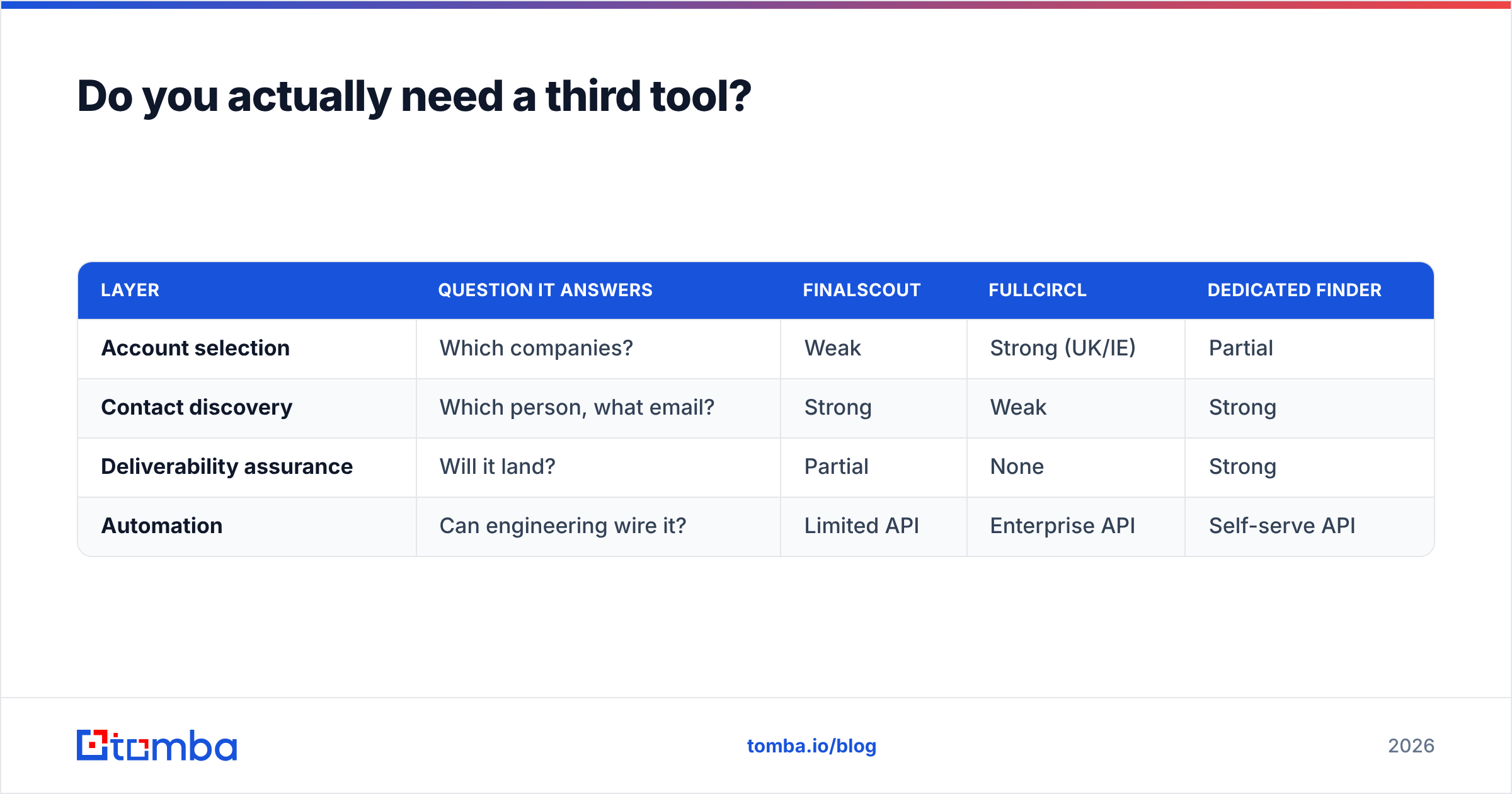
A functioning outbound stack has three layers, and FinalScout and FullCircl each own one of them:
| Layer | Question it answers | FinalScout | FullCircl | Dedicated finder |
|---|---|---|---|---|
| Account selection | Which companies? | Weak | Strong (UK/IE) | Partial |
| Contact discovery | Which person, what email? | Strong | Weak | Strong |
| Deliverability assurance | Will it land? | Partial | None | Strong |
| Automation | Can engineering wire it? | Limited API | Enterprise API | Self-serve API |
Run FullCircl for targeting and you still have a contact gap. Run FinalScout for contacts and you still have a bounce problem plus a targeting gap. Most teams that compare these two end up buying one of them and pairing it with a finder-plus-verifier that has a real API and per-credit economics.
That third slot is where Tomba is designed to sit. Domain search pulls every published address on a company domain, the verifier checks each one at the SMTP level, data enrichment fills in role and seniority, and the Tomba API lets you run the whole thing from your own scripts instead of a browser tab. Same credit pool across all of it, no seat minimums, no annual commit.
How should you evaluate this in practice?#
Do not read feature lists. Run a bake-off on 200 rows of your real ICP:
- Build the test list first. 200 named contacts at companies you genuinely want, exported from wherever your ICP definition lives. Never let a vendor supply the sample.
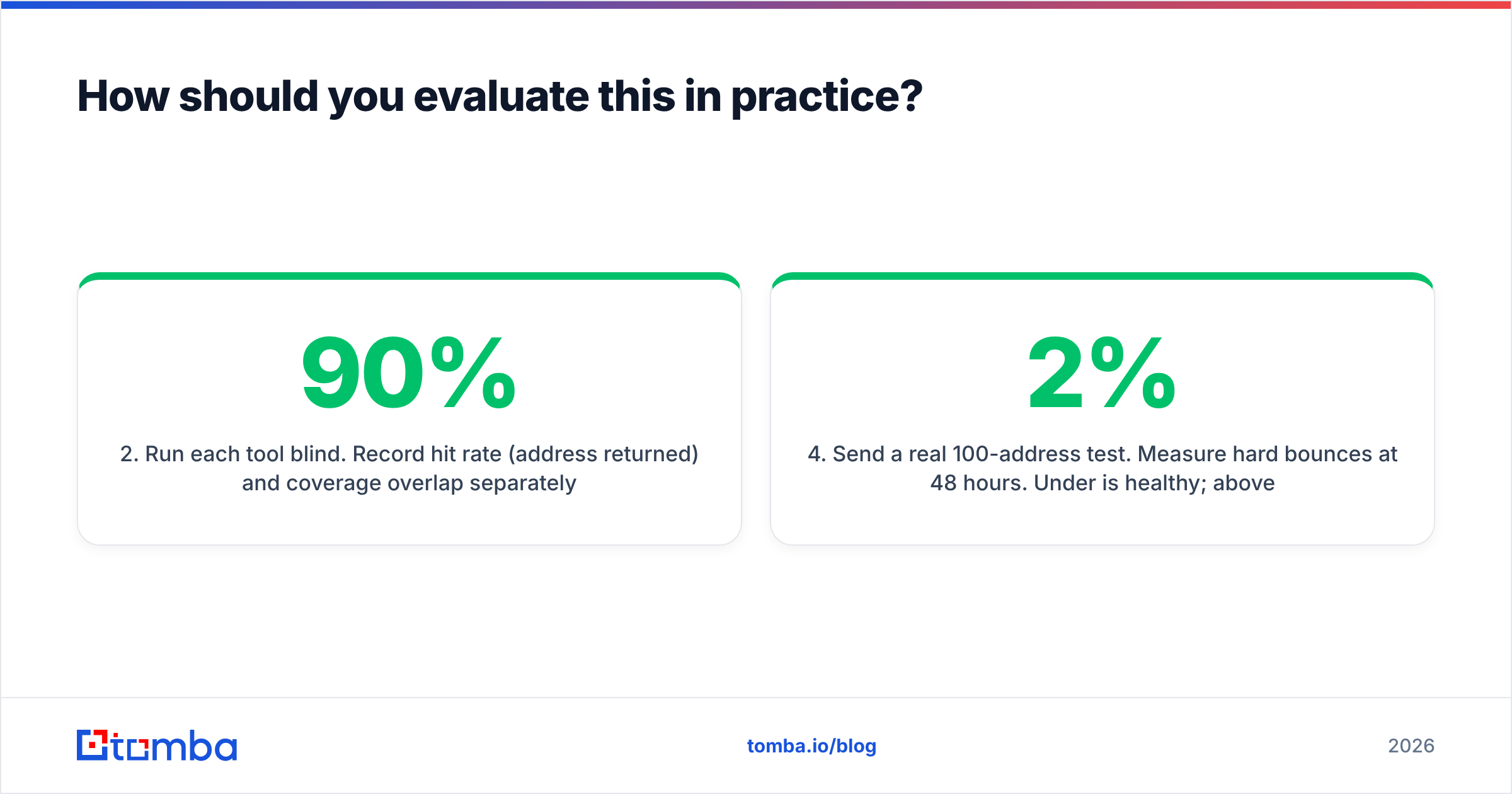
- Run each tool blind. Record hit rate (address returned) and coverage overlap separately. A tool that returns 90% of rows with 30% guesses is worse than one that returns 65% with 95% precision.
- Verify with a neutral third party. Push every result through a verifier that did not source the data. This is the step that exposes pattern-guessing.
- Send a real 100-address test. Measure hard bounces at 48 hours. Under 2% is healthy; above 4% is actively damaging your sender reputation.
- Price the winner at your real monthly volume, including overages. Entry tiers are designed to look cheap at volumes nobody actually runs.
- Check the exit. Can you export everything you paid for? Annual enterprise contracts sometimes make this awkward.
Peer reviews on G2 are useful for spotting support and billing complaints, but they are close to useless for accuracy claims — nobody benchmarks their vendor properly before writing a review.
The verdict#
FinalScout vs FullCircl is not a fair fight because it is not the same fight. FinalScout is a fast, cheap, LinkedIn-shaped contact extractor for small teams doing self-serve outbound. FullCircl is a serious company-intelligence and onboarding platform for regulated UK and Irish business, sold on annual contracts to organizations with a compliance function.
Choose FinalScout if your bottleneck is "I cannot get email addresses fast enough." Choose FullCircl if your bottleneck is "I do not know which accounts are worth pursuing, and I need to prove they are safe to onboard." If your bottleneck is actually "half of what I send bounces," neither one is your answer — and adding a bigger contact database will make it worse, not better.
Start with the layer that is leaking. Then buy exactly that.
Ready to fix the contact layer? Try the Tomba Email Finder free — 25 searches a month, no card, with SMTP-level verification and catch-all detection built into the same credit pool. Run it against the same 200-row list you test FinalScout on and compare bounce rates at 48 hours. That number, not a feature table, is what decides this.
Related guides#
Ready to find emails that actually work?
Join 150,000+ professionals who stopped guessing and started sending. Free credits on signup — no credit card required.
Get the Tomba newsletter
Practical outbound tactics and product updates — once every two weeks.
About the author