FinalScout vs Istari.ai: Which B2B Data Tool Wins in 2026
FinalScout vs Istari.ai is not a fair fight. One tool pulls emails off LinkedIn profiles. The other scores whole markets with web-mining AI. Here is where they overlap, where they don't, and which one belongs in your stack.

FinalScout vs Istari.ai looks like a fair fight. It is not. One tool finds a person's email on LinkedIn. The other reads company websites and scores whole markets. This guide shows where each one wins, and what both leave for you to solve.
TL;DR
- They are not the same category. FinalScout is a LinkedIn-first contact finder with an AI email writer. Istari.ai is a web-mining platform. It reads public company sites and scores firms. Comparing them is like comparing a scalpel to a map.
- Pick FinalScout if your work starts with a LinkedIn profile or a Sales Navigator list and ends with a sent email today.
- Pick Istari.ai if your problem is which companies to target. Think market sizing, technology adoption signals, and segment scores across thousands of firms.
- Neither is a full data layer. FinalScout is thin outside LinkedIn and light on bulk API work. Istari.ai rarely hands you a verified personal email.
- The shared gap is verified contact data. An email finder and an email verifier sit under either choice. That is where bounce rate is won or lost.
FinalScout vs Istari.ai: what does each tool do?#
Short version: FinalScout answers "how do I email this person?" Istari.ai answers "which companies should I care about?"
Here is the split in plain terms.
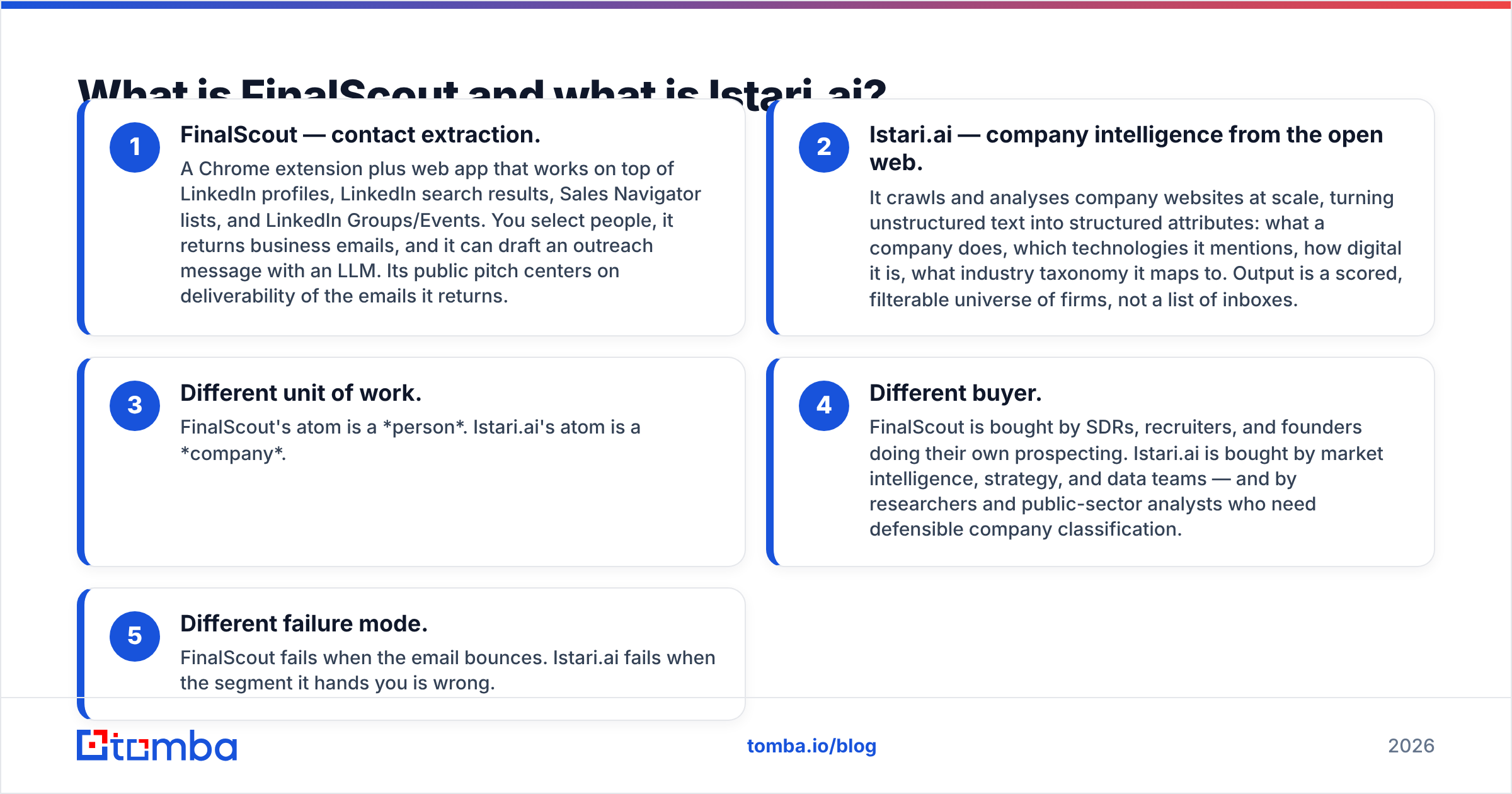
- FinalScout — contact extraction. It is a Chrome extension plus a web app. It works on LinkedIn profiles, search results, Sales Navigator lists, and Groups or Events. You pick people. It returns business emails. It can also draft an outreach message with an AI model. Its public pitch centers on deliverability.
- Istari.ai — company intelligence from the open web. It crawls company websites at scale. It turns raw text into structured facts: what a firm does, which technologies it names, how digital it is, and where it sits in an industry taxonomy. You get a scored, filterable list of firms. You do not get inboxes.
- Different unit of work. FinalScout counts people. Istari.ai counts companies.
- Different buyer. SDRs, recruiters, and founders buy FinalScout. Market intelligence, strategy, and data teams buy Istari.ai. So do researchers and public-sector analysts who need company labels they can defend.
- Different failure mode. FinalScout fails when the email bounces. Istari.ai fails when the segment it hands you is wrong.
Were you expecting two interchangeable email finders? That is the first thing to fix. You can genuinely run both. Use Istari.ai to draw the target universe. Then use a contact tool to fill it with people.

FinalScout vs Istari.ai: how do they compare head to head?#
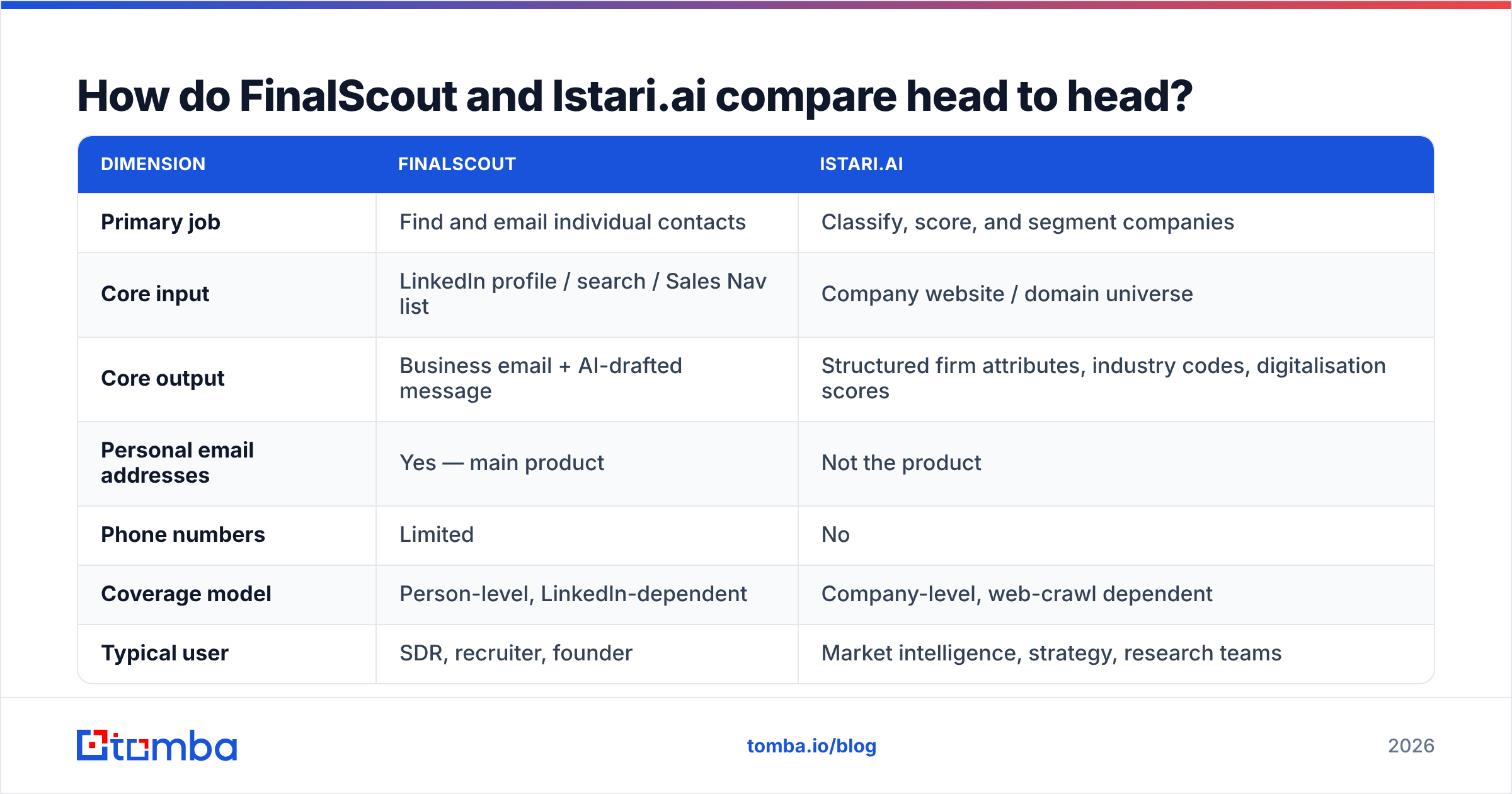
| Dimension | FinalScout | Istari.ai |
|---|---|---|
| Primary job | Find and email individual contacts | Classify, score, and segment companies |
| Core input | LinkedIn profile / search / Sales Nav list | Company website / domain universe |
| Core output | Business email + AI-drafted message | Structured firm attributes, industry codes, digital maturity scores |
| Personal email addresses | Yes — main product | Not the product |
| Phone numbers | Limited | No |
| Coverage model | Person-level, LinkedIn-dependent | Company-level, web-crawl dependent |
| Typical user | SDR, recruiter, founder | Market intelligence, strategy, research teams |
| Bulk workflow | CSV export, extension-driven | Dataset delivery / platform queries |
| API-first | Secondary | Central to the enterprise use case |
| Buying motion | Self-serve subscription | Quote / enterprise contract |
| Best at | Speed from profile to send | Breadth of company data you can defend |
| Weakest at | Non-LinkedIn sourcing, verification depth | Anything person-level |
Read the table as a routing decision, not a scoreboard. A tool that scores 12,000 German mid-market manufacturers on digital maturity is not losing because it never returns jane@acme.com. That was never its job.
Who should actually buy FinalScout?#
Buy FinalScout if three things are true at once.
One: LinkedIn is really your source of truth. FinalScout is strongest when you already have a filtered Sales Navigator list. Do you build target lists from funding databases, review sites, or job boards? Then you are working against the grain of the product. You end up pasting names in one at a time.
Two: your volumes are moderate. Extension-driven extraction is fine at a few hundred contacts per week. At tens of thousands per month, you want an email finder API instead. The same is true when the work has to run inside a pipeline. A browser tab that must stay open is not a pipeline.
Three: you want drafting and finding in one place. The AI writer is a real convenience for solo founders and small teams with no sequencer. Do you already own Instantly, Smartlead, or Outreach? Then that half of FinalScout is wasted spend.
Two honest caveats. First, any LinkedIn-attached tool inherits LinkedIn's platform risk. Rate limits, session checks, and terms-of-service enforcement change without notice. Every vendor in this space is exposed to it.
Second, treat vendor deliverability numbers as directional. FinalScout's marketing has long led with a very high figure. Every vendor measures that figure on its own sample. The only number that matters is the bounce rate on your list, from your sending domain.
Who should actually buy Istari.ai?#
Istari.ai makes sense when the expensive question is targeting, not contacting.
Concrete cases where it earns its keep:
- Market sizing and TAM work. You need to know how many companies in a region really do X. You want that based on what they say today, not on a self-reported SIC code from a decade ago.
- Technology and capability signals. Screen thousands of firms for mentions of automation, AI, certifications, or product categories.
- Research and policy work. Web-mined firm data shows up in academic and public-sector studies. The method is repeatable and documented.
- Territory and ICP design. Hand RevOps a scored universe so account assignment is not based on vibes.
Where it will disappoint you: you are an SDR with a quota this month. A company-classification platform will not get you to a reply any faster. You still need contact data, sequencing, and a sender that is not burning. Istari.ai sits upstream. Judged as a prospecting tool it looks slow. Judged as a segmentation engine it is the only serious option on this page.
FinalScout vs Istari.ai: what does each one cost in 2026?#
Pricing is the messiest part of this comparison. The two vendors sell in very different ways. Check current numbers on the vendor sites before you budget. Self-serve tiers move often, and data contracts are always negotiated.
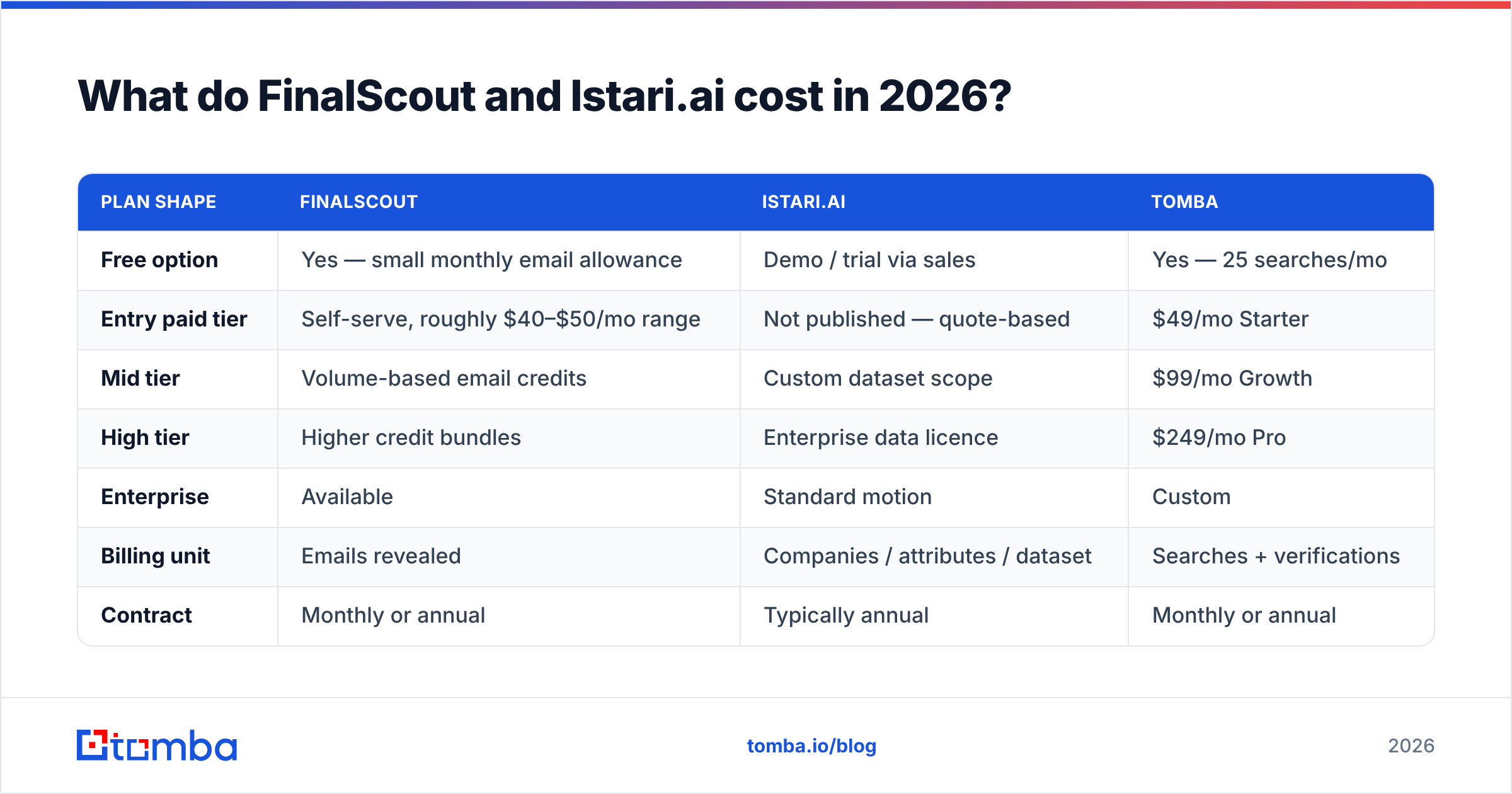
| Plan shape | FinalScout | Istari.ai | Tomba |
|---|---|---|---|
| Free option | Yes — small monthly email allowance | Demo / trial via sales | Yes — 25 searches/mo |
| Entry paid tier | Self-serve, roughly $40–$50/mo range | Not published — quote-based | $49/mo Starter |
| Mid tier | Volume-based email credits | Custom dataset scope | $99/mo Growth |
| High tier | Higher credit bundles | Enterprise data licence | $249/mo Pro |
| Enterprise | Available | Standard motion | Custom |
| Billing unit | Emails revealed | Companies / attributes / dataset | Searches + verifications |
| Contract | Monthly or annual | Typically annual | Monthly or annual |
| API included | Limited | Yes, central | Yes, on paid plans |
The structure matters more than the exact dollars. FinalScout charges you per revealed email. Istari.ai charges you per slice of the company universe. A data platform like Tomba charges per search and per verification. Those three units do not line up side by side.
So build the comparison on cost per usable contact instead. A cheap credit that returns an unverified guess is not cheap. You pay for it later in bounces and in domain reputation. Use Tomba pricing as a baseline for that math.
FinalScout vs Istari.ai: which one gives you more accurate data?#
It is the wrong question. The two tools are accurate about different things. Still, accuracy is what most people mean when they compare tools. So here is how to test it properly.
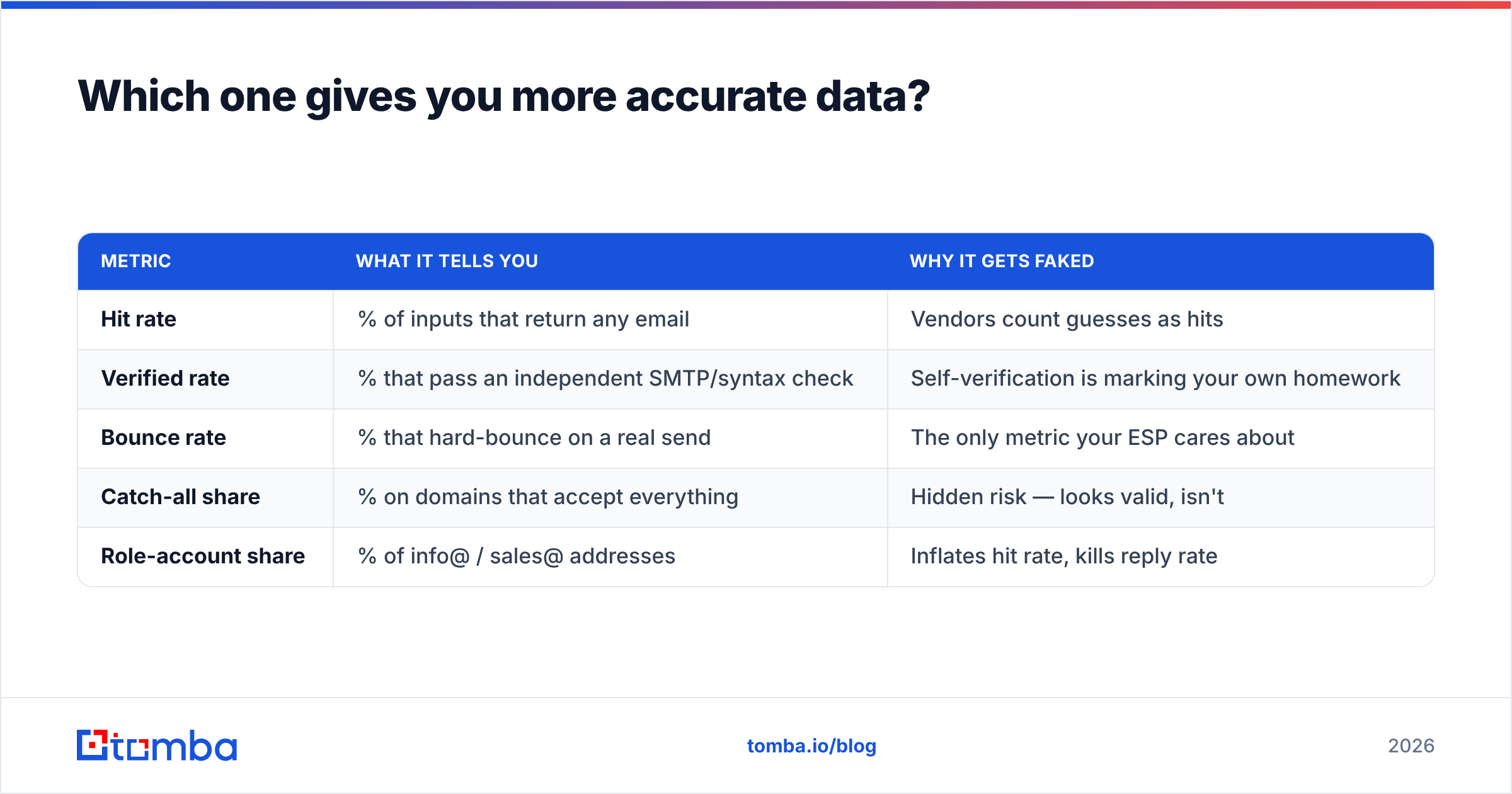
Run a blind bake-off. Take 200 real target contacts you can confirm on your own. Push them through each tool. Then measure:
| Metric | What it tells you | Why it gets faked |
|---|---|---|
| Hit rate | % of inputs that return any email | Vendors count guesses as hits |
| Verified rate | % that pass an independent SMTP/syntax check | Self-verification is marking your own homework |
| Bounce rate | % that hard-bounce on a real send | The only metric your ESP cares about |
| Catch-all share | % on domains that accept everything | Hidden risk — looks valid, isn't |
| Role-account share | % of info@ / sales@ addresses | Inflates hit rate, kills reply rate |
Two traps show up again and again.
The first is catch-all domains. A catch-all server accepts mail sent to any address. A naive verifier then marks every guess as valid. About one in five business domains work this way. A tool that ignores them is quietly inflating its own accuracy. Run those addresses through a catch-all verifier before they enter a sequence.
The second trap is role accounts. Addresses like info@, contact@, and hello@ are trivially easy to find. They almost never reply.
Neither tool is built to be your verification layer. FinalScout verifies enough to protect its own accuracy claim. Istari.ai does not play here at all. Is bounce rate a KPI you own? Then keep verification as a separate step you control.
Can you use both — and where does an email data layer fit?#
Yes. For a mid-market GTM team, that is the sturdiest setup. The three jobs are genuinely separate:
- Universe definition — decide which companies matter. Istari.ai or a similar source does the heavy lifting. Output: a list of domains with scores and attributes.
- Contact resolution — turn domains into named people with verified addresses. That is domain search plus person-level lookup. Run it through an API so it works on a schedule, not in a browser session. FinalScout covers LinkedIn-sourced people. A data platform covers everything else.
- Activation — sequencing, sending, warmup, and reply handling. Neither tool on this page is your sender of record.
Teams often buy one tool and expect all three jobs. That is how you end up with a beautifully scored market segment and no way to reach anyone in it. Or with a pile of LinkedIn emails for companies you should never have targeted.
For step two at volume, the needs are dull but real: a proper REST API, bulk processing for lists you already have, dedupe, and verification on the same platform. Otherwise you stitch two vendors together with a spreadsheet. Is your sourcing LinkedIn-heavy? A LinkedIn finder takes the same input FinalScout does. It also keeps the rest of your enrichment open.
What are the honest alternatives to consider?#
Before you sign either contract, price these against your actual motion:
- Apollo — a huge contact database plus sequencing. Data quality varies by region, and the platform nudges you toward its own sender. Good if you want one bill. Frustrating if you want clean data you can move.
- Clay / BetterContact-style waterfalls — chain several providers and take the first verified hit. Best raw coverage. Highest complexity and cost per record.
- ZoomInfo — the enterprise default for company and contact data, priced to match. It overlaps Istari.ai on companies and FinalScout on people, at several times the cost.
- BookYourData — a solid choice when you want pre-built, pay-as-you-go verified B2B lists instead of a per-lookup subscription. Strong fit if you want to own the data without a seat-based platform.
- Tomba — narrow on purpose: find, verify, enrich. Use the UI, API, CLI, or a spreadsheet add-on. A free tier lets you test coverage on your own domains first.
Check current independent reviews on G2 rather than any vendor's own comparison page, this one included. Read the source pages too: FinalScout and Istari.ai both explain their scope well.
FinalScout vs Istari.ai: which should you choose in 2026?#
Choose FinalScout if you are a small team. LinkedIn is your list-building surface, you send in the hundreds and not the tens of thousands, and you want drafting bundled in. It is a fast, cheap, self-serve way to get from a profile to a sent email.
Choose Istari.ai if your bottleneck is knowing which companies deserve attention. It fits company-level scale and work you have to defend to a stakeholder. It is not a prospecting tool, so do not judge it as one.
Choose neither as your only data layer. Either way, the verified-contact problem stays yours to solve. It shows up in your bounce rate, your sender reputation, and in the end your domain health.
Test before you commit. Take 100 target contacts. Run them through each candidate. Verify the results on your own. Then compare cost per deliverable address, not cost per credit. That one spreadsheet will settle FinalScout vs Istari.ai for your business faster than any review will.
Start with the contact layer. Tomba's Email Finder gives you 25 free searches a month. That is enough to benchmark hit rate and bounce rate against whatever you use now. No card, no sales call. If the numbers hold up, paid plans start at $49/mo. The same data runs through the API, CLI, Chrome extension, and Google Sheets, so it slots under FinalScout, Istari.ai, or both.
Related guides#
Ready to find emails that actually work?
Join 150,000+ professionals who stopped guessing and started sending. Free credits on signup — no credit card required.
Get the Tomba newsletter
Practical outbound tactics and product updates — once every two weeks.
About the author