FinalScout vs Salutary Data: Which B2B Data Tool Wins?
One is a $30-a-month LinkedIn scraper you install in Chrome. The other is a licensed US contact database sold on annual contracts. Here is how FinalScout and Salutary Data actually compare — and when neither is the right buy.
FinalScout vs Salutary Data is an odd matchup. One is a $30-a-month Chrome extension. The other is a licensed US contact database sold by the record. Here is what each one does, what it costs, and who should buy it.
TL;DR
- FinalScout is a LinkedIn-first email finder. You get a Chrome extension and an AI writing layer for tens of dollars a month. You work one profile at a time.
- Salutary Data sells licensed US B2B contact data as files, an API, or platform access. Deals are yearly, with a minimum spend. You buy records, not a browser button.
- The two barely compete. One is a tool for a single rep. The other is a data contract for an ops team.
- Both accuracy claims are marketing numbers. Run any list through an independent email verifier before you send.
- Want broad coverage without a yearly contract? An API-first finder with a real free tier usually wins on cost per usable contact. Tomba starts free and moves to $49/mo.
What is FinalScout?#
FinalScout is a browser-based email finder built around LinkedIn. You install the Chrome extension and open a profile or a Sales Navigator search. The tool then finds work email addresses for the people on screen. An AI writing assistant sits on top, so you can draft a first email in the same tab.
The design tells you who it is for. Picture one SDR, founder, or recruiter who already lives inside LinkedIn. Pricing is self-serve. There is a small free allowance, and paid tiers scale by monthly email credits. Check current tiers on finalscout.com, because the plans change often.
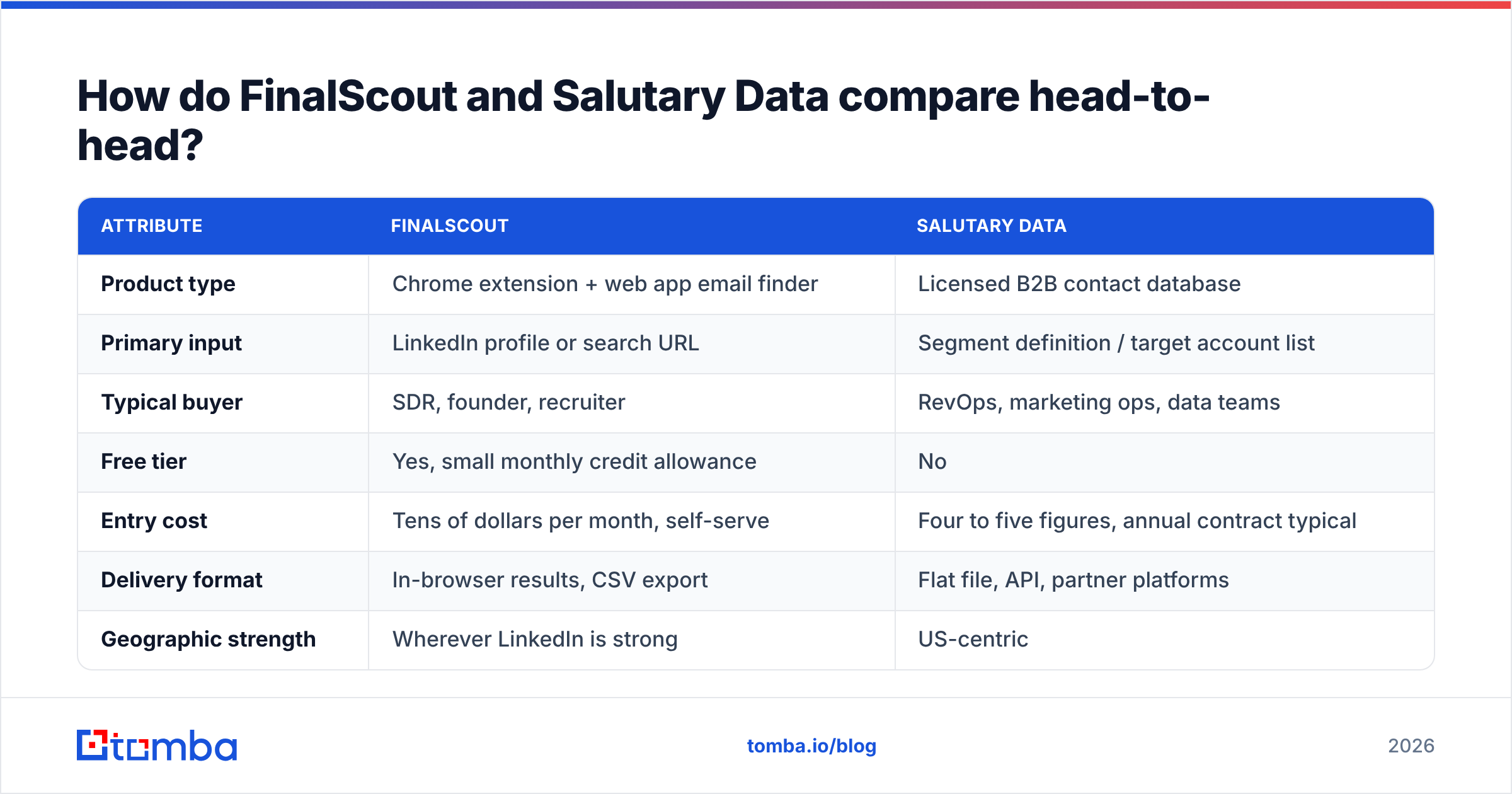
FinalScout markets a high deliverability number, usually around 98%. Treat it like any vendor stat. It describes the emails the tool chooses to return. It does not tell you how many profiles it can solve. Coverage and accuracy are two different numbers, and vendors quote the prettier one.
What is Salutary Data?#
Salutary Data is a B2B contact and company data provider, not a browser add-on. It sells a compiled US database: business emails, direct dials, mobile numbers, plus firmographic and technographic fields. You get it as a file, an API feed, or through enrichment partners. Coverage claims live on salutarydata.com.
The buying motion is not the same at all. There is no free tier and no install-and-go. You scope a segment, agree on record volume, sign a term, then push the data into your CRM, your waterfall, or your ABM platform. Many teams use Salutary as one supplier among several rather than as their only source.
That matters. Salutary competes with ZoomInfo, Cognism, and BookYourData — firms that sell contact data at scale to ops teams. BookYourData sits closest. It offers a strong verified-email guarantee and a more self-serve checkout, so look at it if you like the database model but want to skip a long negotiation.
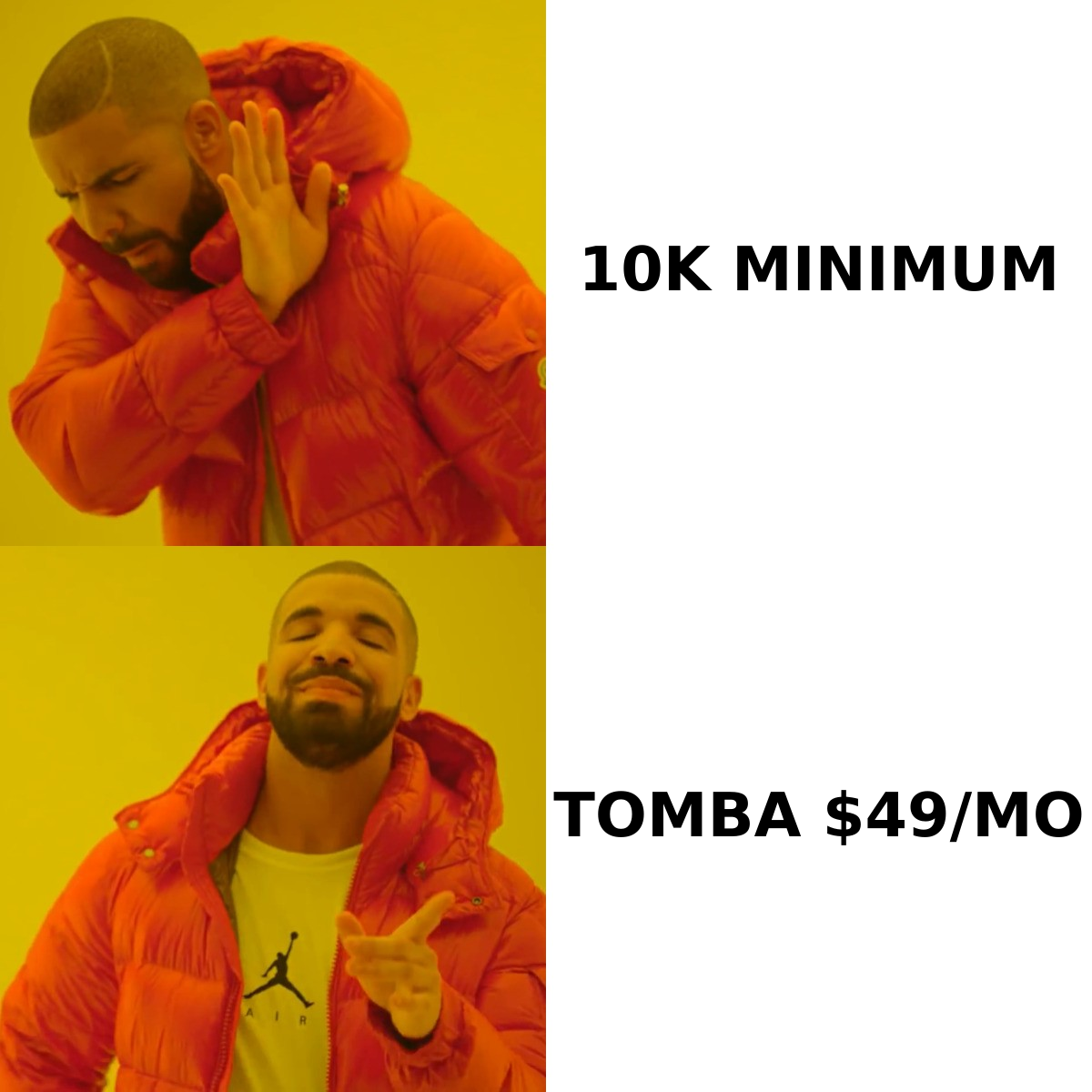
FinalScout vs Salutary Data: the head-to-head table#
| Attribute | FinalScout | Salutary Data |
|---|---|---|
| Product type | Chrome extension + web app email finder | Licensed B2B contact database |
| Primary input | LinkedIn profile or search URL | Segment definition / target account list |
| Typical buyer | SDR, founder, recruiter | RevOps, marketing ops, data teams |
| Free tier | Yes, small monthly credit allowance | No |
| Entry cost | Tens of dollars per month, self-serve | Four to five figures, annual contract typical |
| Delivery format | In-browser results, CSV export | Flat file, API, partner platforms |
| Geographic strength | Wherever LinkedIn is strong | US-centric |
| Phone numbers | Limited | Core strength (direct dials, mobiles) |
| AI email drafting | Built in | Not applicable |
| Bulk enrichment at scale | Constrained by credits and browser workflow | Designed for it |
| Contract commitment | Month to month | Term agreement, volume minimums |
Read the table as a fork, not a scoreboard. Need 200 emails this month from accounts you picked by hand on LinkedIn? Salutary is the wrong buy at any price. Need mobile numbers on 80,000 CRM records before a Q1 campaign? The FinalScout browser workflow will stall long before you finish.

FinalScout vs Salutary Data: which one is more accurate?#
Neither vendor publishes a method you can audit. So test both on your own ICP. Measure two things, and keep them apart.
Coverage rate — out of 100 target contacts, how many got an email at all? This is where most tools fail quietly. A vendor can post 98% "accuracy" by returning only the easy 40% of your list.
Bounce rate — of the emails you got back, how many were accepted? Send a small, warm, slow batch and count hard bounces.
The two products break in different spots. FinalScout leans on LinkedIn as its anchor. It does well on people with active, full profiles at firms with clear email patterns. It does poorly in trades, local services, much of manufacturing, and the public sector. Salutary is a compiled database. It does well on US firms inside its build scope. It thins out on records abroad, on very small firms, and on roles with high churn.

Two risks apply either way:
- Catch-all domains. About a fifth of B2B domains accept any address at the SMTP layer. A "valid" result there means little. Run those through a catch-all verifier instead of trusting the source.
- Data decay. B2B contact data rots by roughly 25–30% a year, per industry studies summed up on review sites like G2. A file bought in January is much worse by September. Fresh data beats a big record count every time.
What does each one cost?#
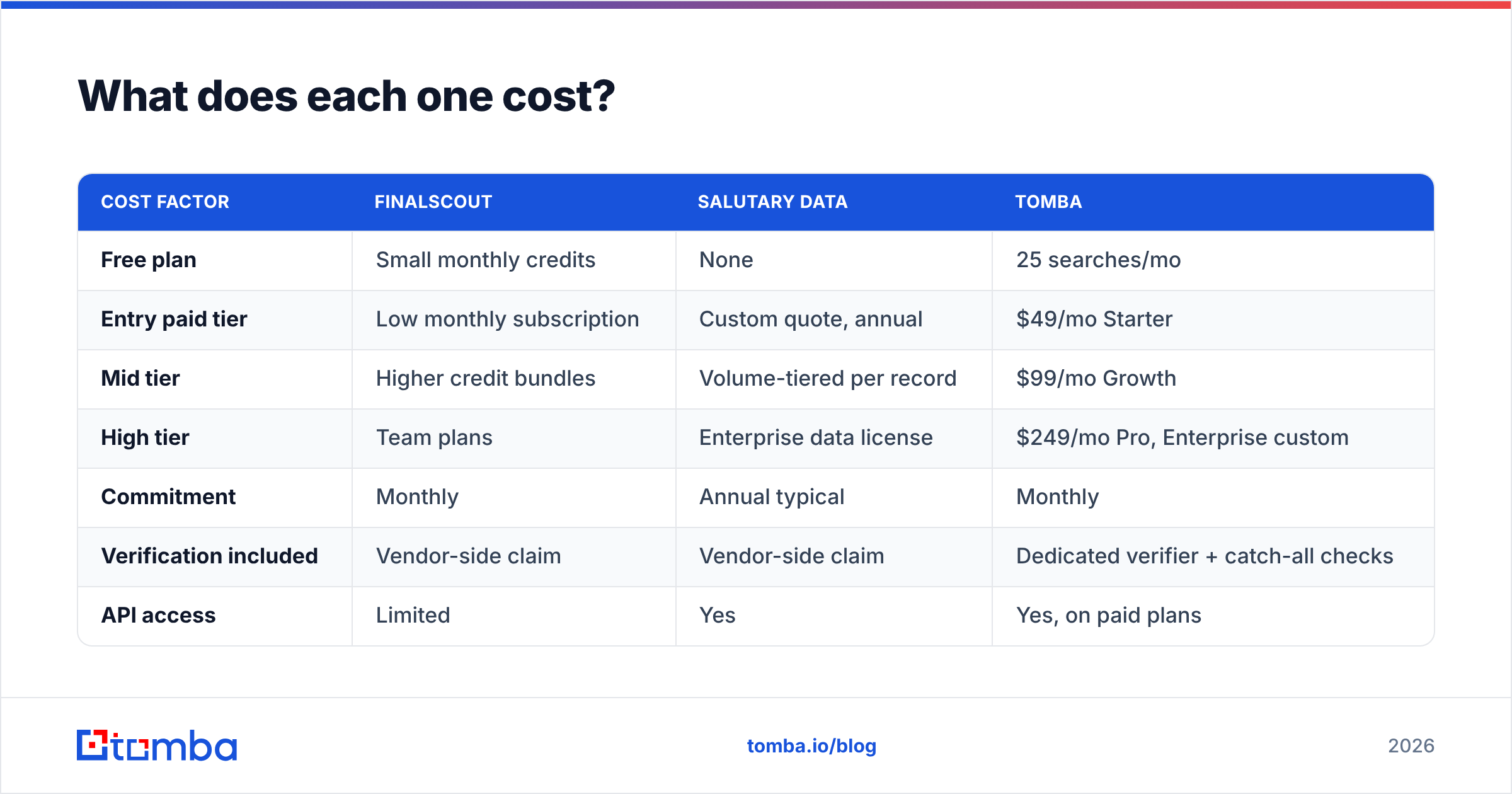
FinalScout is priced like software. You pay a monthly per-user fee, credits are included, and you can cancel any time. Cost per email is high, but the total risk is one month's fee.
Salutary is priced like data. You pay per record, the number is negotiated, and there are volume minimums and a term. Per-record cost drops fast with volume — that is the whole point. But you commit budget before you know the data fits your ICP. Ask for a sample file scoped to your exact segment, not a generic one. Verify it yourself before you sign.
| Cost factor | FinalScout | Salutary Data | Tomba |
|---|---|---|---|
| Free plan | Small monthly credits | None | 25 searches/mo |
| Entry paid tier | Low monthly subscription | Custom quote, annual | $49/mo Starter |
| Mid tier | Higher credit bundles | Volume-tiered per record | $99/mo Growth |
| High tier | Team plans | Enterprise data license | $249/mo Pro, Enterprise custom |
| Commitment | Monthly | Annual typical | Monthly |
| Verification included | Vendor-side claim | Vendor-side claim | Dedicated verifier + catch-all checks |
| API access | Limited | Yes | Yes, on paid plans |
Full Tomba pricing is public. That is a useful signal on its own. A vendor who hides numbers until you talk to sales is telling you the price depends on what they think you will pay.

Which should you choose?#
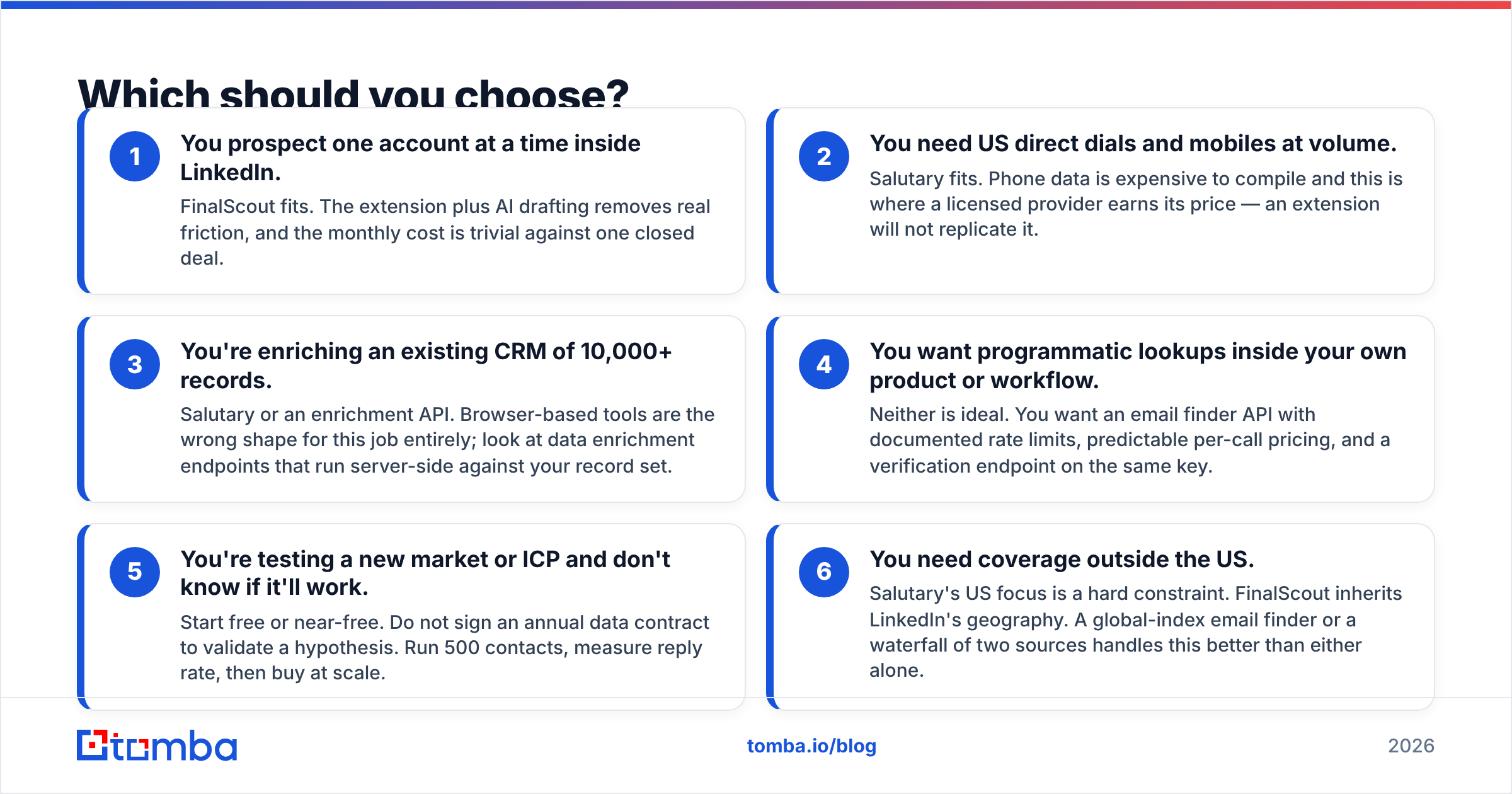
Pick by workflow, not by feature list. Start with the three most common cases.
- You prospect one account at a time inside LinkedIn. FinalScout fits. The extension and the AI drafting cut real friction. The monthly fee is small next to one closed deal.
- You need US direct dials and mobiles at volume. Salutary fits. Phone data is costly to compile, and a licensed provider earns its price here. An extension cannot match it.
- You are enriching a CRM of 10,000+ records. Salutary or an enrichment API. Browser tools are the wrong shape for the job. Look at data enrichment endpoints that run server-side.
Three more cases push you away from both vendors.
- You want lookups inside your own product. Neither is ideal. You want an email finder API with clear rate limits, set per-call pricing, and a verify endpoint on the same key.
- You are testing a new market and do not know if it works. Start free or near-free. Never sign a yearly data contract to test a hunch. Run 500 contacts, check reply rate, then buy at scale.
- You need coverage outside the US. The Salutary US focus is a hard limit. FinalScout inherits the LinkedIn map. A global email finder, or two sources in a waterfall, handles this better.
What are the best alternatives to both?#
For most teams the answer is a stack, not a winner.
Tomba sits between the two models. You get domain and person lookups, a real free tier, public pricing from $49/mo, an API, and a Chrome extension. Verification is built into the same platform instead of sold apart. If your job is "find emails for named people, cheaply and by API," it covers the FinalScout use case with better automation. It also covers the light end of the Salutary use case with no contract. The LinkedIn finder handles profile lookups, and the bulk email finder handles lists.
BookYourData is the closest peer to Salutary if you want database-grade data you can buy yourself. It posts verified-email guarantees and skips the procurement cycle. That is a fair middle path between a monthly tool and an enterprise license.
Clay, Apollo, or a waterfall builder make sense once you run several providers and want fallback logic. That is an upgrade you earn after you know your gaps. It is not a first buy.
Free pattern tools cover the long tail. If you know a company's format, an email permutator plus a verify step solves one-off lookups for free. It does not scale, but it costs nothing.
How should you run the evaluation?#
Do this before you spend real money.
- Build a 100-contact benchmark list from your real ICP. Use named people at real target accounts. Include the hard segments, not just easy logos.
- Run it through each tool. Record coverage rate and cost per returned contact as two separate numbers.
- Verify every address with a third-party checker. Self-graded homework is not evidence. A free email checker works for a spot audit.
- Send a throttled batch of 50 and count hard bounces. Above 3% is unsafe for your sending domain. Read up on email deliverability first.
- Recheck at 90 days. Decay is the number nobody quotes you. A source that looks great in month one and reads 60% valid in month four is a bad source.
That takes about a day. It often saves five figures of wasted data budget.
The verdict#
FinalScout wins for solo reps who prospect inside LinkedIn and want speed over scale. Salutary Data wins for ops teams buying US contact and phone data at volume. In the FinalScout vs Salutary Data debate, the two are not substitutes. Any verdict that calls one "better" without naming the workflow is selling you something.
Most teams sit in the middle. They need email discovery, verification, and enrichment by API, with no yearly commitment. Start with a tool you can test for free and scale by use. Run the Tomba Email Finder on your benchmark list. You get 25 free searches a month, no card, and verification on the same platform. Measure coverage and bounce rate in one pass before you spend a dollar on either vendor above.
Related guides#
Ready to find emails that actually work?
Join 150,000+ professionals who stopped guessing and started sending. Free credits on signup — no credit card required.
Get the Tomba newsletter
Practical outbound tactics and product updates — once every two weeks.
About the author