FinalScout vs Span Global Services: 2026 Data Comparison
One is a LinkedIn-based email finder you run yourself. The other sells you a licensed B2B list. Here is how FinalScout and Span Global Services actually compare on accuracy, cost per usable contact, and compliance risk.
TL;DR
- These are not the same category. FinalScout is a self-serve, LinkedIn-first email finder you operate one profile or one list at a time. Span Global Services is a data brokerage that sells you a licensed contact file built to your spec.
- FinalScout wins on speed and unit economics for teams under ~20 reps who prospect account by account. You pay a monthly credit fee, see the result instantly, and can stop any time.
- Span Global Services wins on breadth and hand-holding for campaigns that need 50,000+ records across a defined firmographic slice, plus data appends and postal/phone fields a browser extension will never give you.
- Neither one removes the need to verify. Bought lists decay ~22–30% a year, and extension-scraped emails are pattern guesses until an SMTP check proves otherwise. Budget for verification separately.
- Best combined setup for most B2B teams in 2026: a per-search finder with a verification layer and an API (Tomba, Findymail, Hunter class) for daily prospecting, and a purchased file only when you genuinely need scale you cannot build.
What is FinalScout, and who actually uses it?#
FinalScout is a Chrome-extension email finder built around LinkedIn. You browse a profile, a Sales Navigator search, or a group member list, and the extension attempts to resolve each person's work email. It layers an AI writing assistant on top, so the same tool that finds the address will draft the first-touch message.
The people who get real value from it are usually solo founders, agency prospectors, and one-to-three-person SDR pods who live inside LinkedIn. The workflow is honest and fast: find the person on LinkedIn, click, get an address, push it into a sequencer. There is no procurement cycle, no data contract, and no minimum spend.
The limits show up in three places. First, coverage is bound to LinkedIn presence — if your buyer is a plant manager in industrial manufacturing who last logged in during 2021, the profile is a dead end. Second, extension-based scraping carries account risk; LinkedIn's terms restrict automated data extraction, and heavy usage on a personal account is not risk-free. Third, credit accounting on finder tools is the usual gotcha: a "found" email is charged even when it is a pattern guess that later hard-bounces, unless the vendor explicitly bills only for verified results. Read the credit policy on finalscout.com before you buy an annual plan.

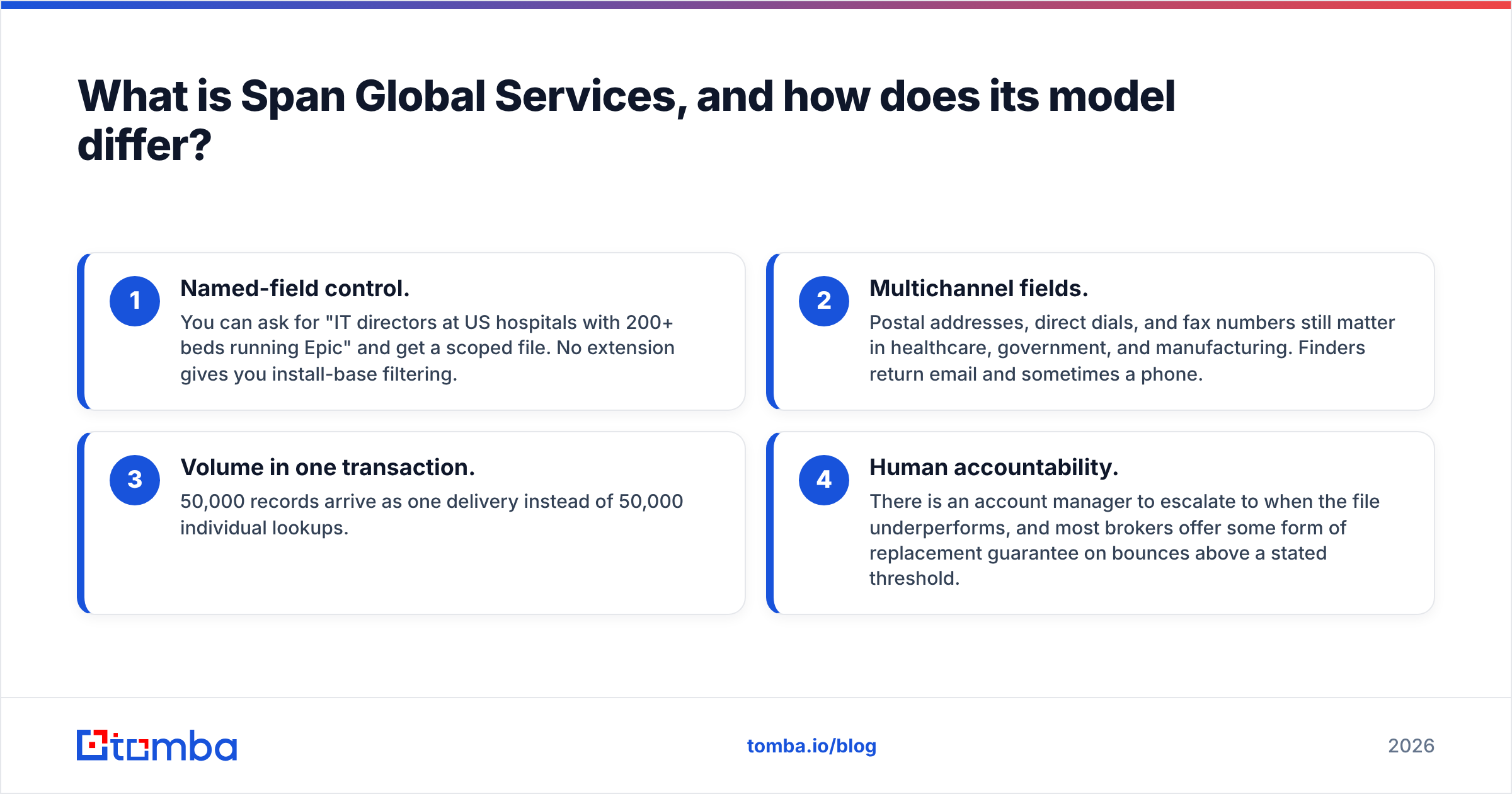
What is Span Global Services, and how does its model differ?#
Span Global Services is a B2B data and marketing services company. You do not log in and search. You brief a rep — industry, title, geography, employee count, install base — and they scope a file, quote a price, run their verification cycle, and deliver a CSV or a direct CRM push. They also sell data appends (you send incomplete records, they fill in missing emails, phones, or firmographics), technology-install lists, and healthcare-specific segments that are hard to assemble from public web sources.
That model has genuine advantages a self-serve tool cannot match:
- Named-field control. You can ask for "IT directors at US hospitals with 200+ beds running Epic" and get a scoped file. No extension gives you install-base filtering.
- Multichannel fields. Postal addresses, direct dials, and fax numbers still matter in healthcare, government, and manufacturing. Finders return email and sometimes a phone.
- Volume in one transaction. 50,000 records arrive as one delivery instead of 50,000 individual lookups.
- Human accountability. There is an account manager to escalate to when the file underperforms, and most brokers offer some form of replacement guarantee on bounces above a stated threshold.
The trade-offs are equally real. Pricing is quote-based, which means you cannot benchmark it against a public rate card, and minimum orders typically start in the low thousands of dollars. Delivery is not instant — expect days, not seconds. And the most important one: a purchased file is a snapshot. It was accurate on the day it was verified. By the time it clears your review cycle and enters your sequencer, some percentage has already churned. Check current service scope on spanglobalservices.com and read recent buyer reviews on G2 before committing to a spend of that size.
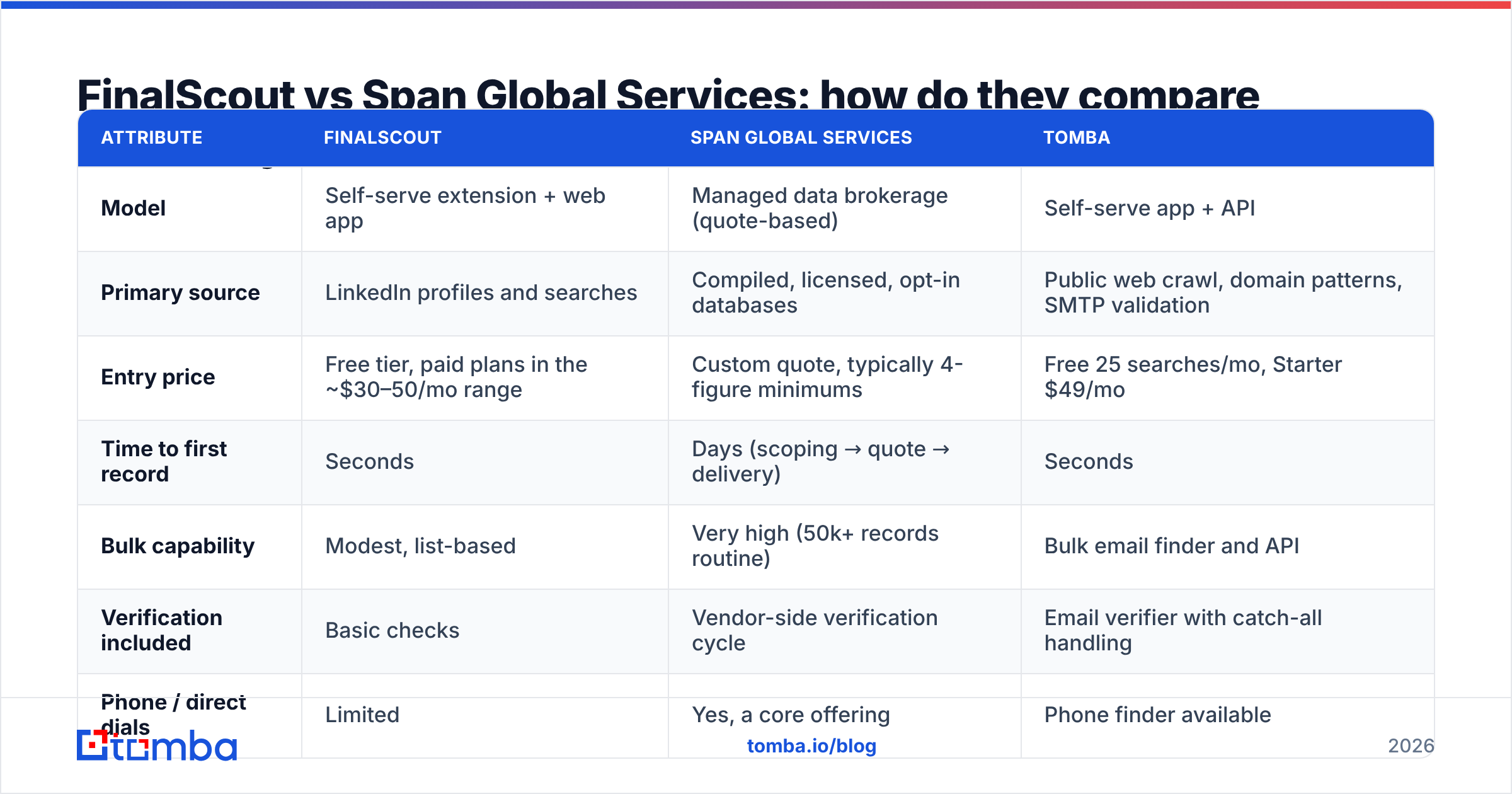
FinalScout vs Span Global Services: how do they compare feature by feature?#
| Attribute | FinalScout | Span Global Services | Tomba |
|---|---|---|---|
| Model | Self-serve extension + web app | Managed data brokerage (quote-based) | Self-serve app + API |
| Primary source | LinkedIn profiles and searches | Compiled, licensed, opt-in databases | Public web crawl, domain patterns, SMTP validation |
| Entry price | Free tier, paid plans in the ~$30–50/mo range | Custom quote, typically 4-figure minimums | Free 25 searches/mo, Starter $49/mo |
| Time to first record | Seconds | Days (scoping → quote → delivery) | Seconds |
| Bulk capability | Modest, list-based | Very high (50k+ records routine) | Bulk email finder and API |
| Verification included | Basic checks | Vendor-side verification cycle | Email verifier with catch-all handling |
| Phone / direct dials | Limited | Yes, a core offering | Phone finder available |
| API access | Limited | Data delivery, not a live API | Full Tomba API, CLI, MCP |
| Best fit | Solo prospector living in LinkedIn | Enterprise campaign needing a scoped file | Repeatable, verified pipeline building |
| Contract flexibility | Monthly, cancel any time | Per-order or annual agreement | Monthly, cancel any time |
Read that table as a decision about procurement style first and features second. If your bottleneck is "I need 40 good contacts at 12 target accounts this week," a broker relationship is overkill. If your bottleneck is "we're launching into a vertical where we have zero coverage and need 30,000 records by month-end," an extension will not close that gap in time.
Which one produces more accurate email data?#

Accuracy claims in this market are close to useless unless you know what is being measured. Vendors publish three different numbers and call them all "accuracy":
- Hit rate / coverage — of 1,000 inputs, how many returned any email at all. High numbers here are easy to fake by returning pattern guesses.
- Deliverability rate — of the emails returned, how many actually landed. This is the number that predicts your bounce rate.
- Verified-only rate — how many returns passed a live SMTP handshake, not just a syntax and MX check.
FinalScout markets a high deliverability figure, as does nearly every finder. What matters in practice is whether the tool distinguishes verified from guessed. A first.last@domain.com pattern guess with no SMTP confirmation is a coin flip, and coin flips are what push you past the 2% bounce threshold that Google and Yahoo bulk-sender rules made consequential in 2024 and enforce harder now.
Span Global's accuracy is a function of file age and refresh cadence. Broker data is verified in cycles, so the quality of what you receive depends heavily on when your segment was last touched. Ask a direct question before you sign: "When was this specific segment last re-verified, and what is your bounce replacement policy?" A vendor that answers precisely is worth more than one quoting a blanket 95%.
Regardless of which side you pick, run the file through an independent email verifier before it reaches your sending domain. Treat vendor verification as a first pass, not a final one — the vendor has no stake in your sender reputation, and you have all of it.
What does each option really cost per usable contact?#
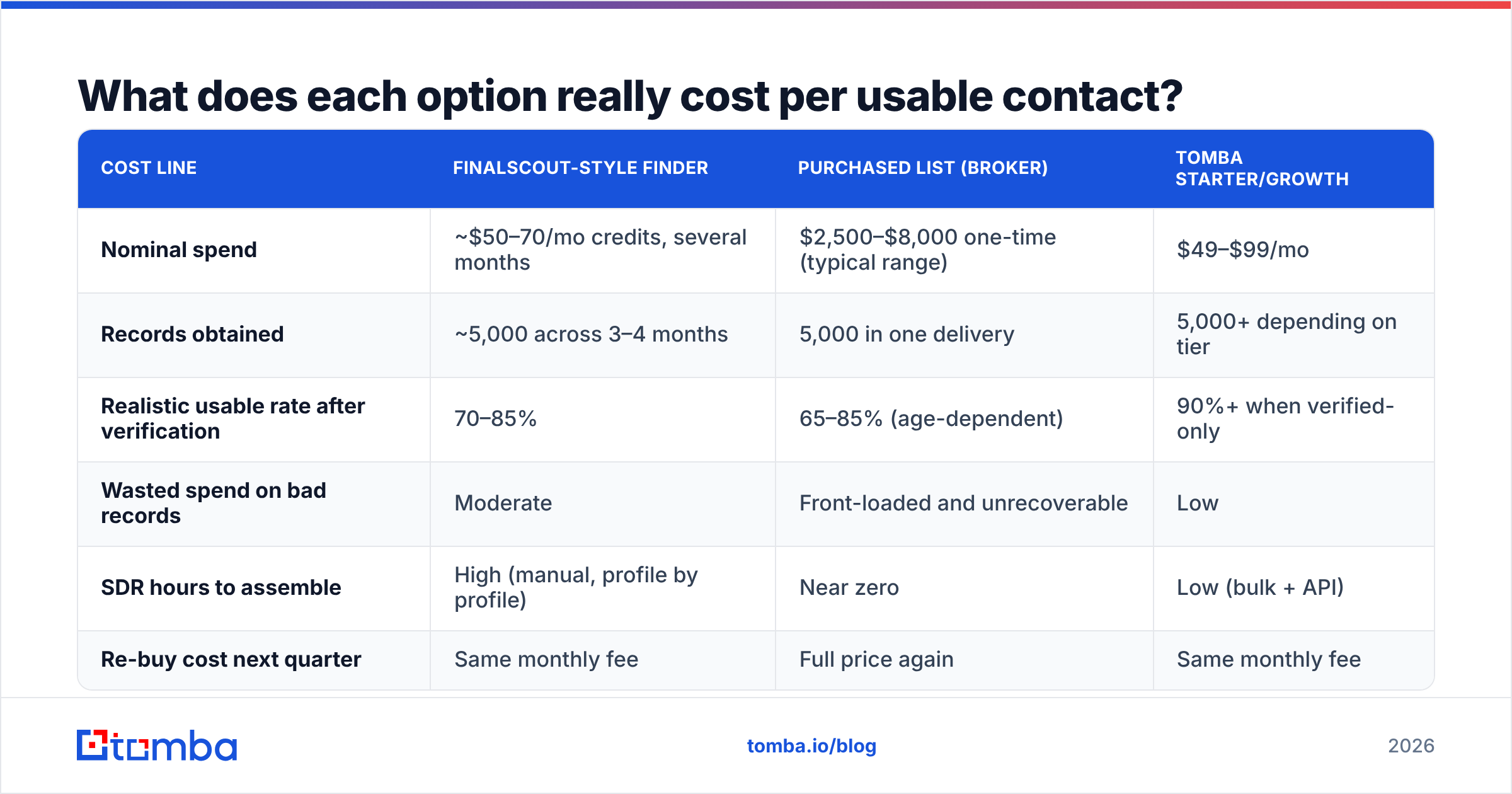
This is where the comparison stops being close. Model it on 5,000 target contacts.
| Cost line | FinalScout-style finder | Purchased list (broker) | Tomba Starter/Growth |
|---|---|---|---|
| Nominal spend | ~$50–70/mo credits, several months | $2,500–$8,000 one-time (typical range) | $49–$99/mo |
| Records obtained | ~5,000 across 3–4 months | 5,000 in one delivery | 5,000+ depending on tier |
| Realistic usable rate after verification | 70–85% | 65–85% (age-dependent) | 90%+ when verified-only |
| Wasted spend on bad records | Moderate | Front-loaded and unrecoverable | Low |
| SDR hours to assemble | High (manual, profile by profile) | Near zero | Low (bulk + API) |
| Re-buy cost next quarter | Same monthly fee | Full price again | Same monthly fee |
Two conclusions fall out of that math.
Broker files look cheap per record and expensive per usable record. A $4,000 file at 5,000 records is $0.80 each. Strip out the 20% that bounces or has churned and you are at $1.00, with no recourse unless you negotiated a replacement clause. And you pay again next quarter because the file keeps decaying.
Extension finders look cheap per month and expensive per SDR hour. Manually resolving 5,000 contacts one profile at a time is weeks of rep time that should have gone to conversations. The credit fee is not the real cost; the labor is.
The middle path — a searchable finder with real bulk and API access — is why per-search platforms with published pricing have taken so much of this market. Tomba pricing is public: Free at 25 searches/mo, Starter $49/mo, Growth $99/mo, Pro $249/mo, Enterprise custom. You can benchmark that against a quote in about thirty seconds, which is exactly what brokers dislike about it.
Which is safer for compliance and sender reputation?#
Neither model is automatically compliant, and both can be used compliantly. The variables that matter:
- Lawful basis under GDPR. For EU contacts, legitimate interest for B2B outreach is defensible when the message is relevant to the recipient's professional role and opt-out is trivial. That is your responsibility, not the vendor's, no matter who sourced the record.
- Provenance documentation. A broker should tell you where records came from and how consent or opt-out status is tracked. Ask for it in writing. Extension-scraped data has thinner provenance by definition.
- Platform terms. LinkedIn's user agreement restricts automated extraction. Tools that operate through your logged-in session put your personal account in the blast radius, not the vendor's.
- Suppression handling. Any purchased file needs to be run against your existing CRM, unsubscribe list, and do-not-contact records before send. Skipping this step is the fastest route to a complaint.
- Bounce discipline. Mailbox providers now treat elevated bounce and complaint rates as a hard signal. A single 5,000-record blast off an unverified file can measurably damage a domain you spent a year warming.
Practical rule: whichever source you use, verify immediately before send, not at purchase. A record verified 45 days ago is a different asset from one verified this morning. If you are working LinkedIn-sourced prospects specifically, a purpose-built LinkedIn finder that resolves and verifies in the same step removes the gap between "found" and "safe to send."
When should you choose each one?#
Choose FinalScout when:
- LinkedIn is genuinely where your buyers live and are active.
- You prospect in small, targeted batches — dozens per week, not thousands.
- You want AI drafting bundled into the same tool as the finding.
- Monthly flexibility matters more than depth of coverage.
Choose Span Global Services when:
- You need a scoped file across a firmographic slice you cannot build yourself — install base, NAICS depth, healthcare specialty codes.
- Postal addresses or direct dials are part of the campaign, not an afterthought.
- Budget exists for a four-figure data purchase and someone internally owns list hygiene.
- You want an account manager and a contractual replacement policy.
Choose a verified per-search platform when:
- You want repeatable, ongoing pipeline building rather than a one-time file.
- Your workflow lives in a CRM or a script and needs an API, not a CSV.
- You want to pay for confirmed addresses and skip the guesses.
- You need transparent, comparable pricing you can defend to finance.
What is the practical verdict for 2026?#

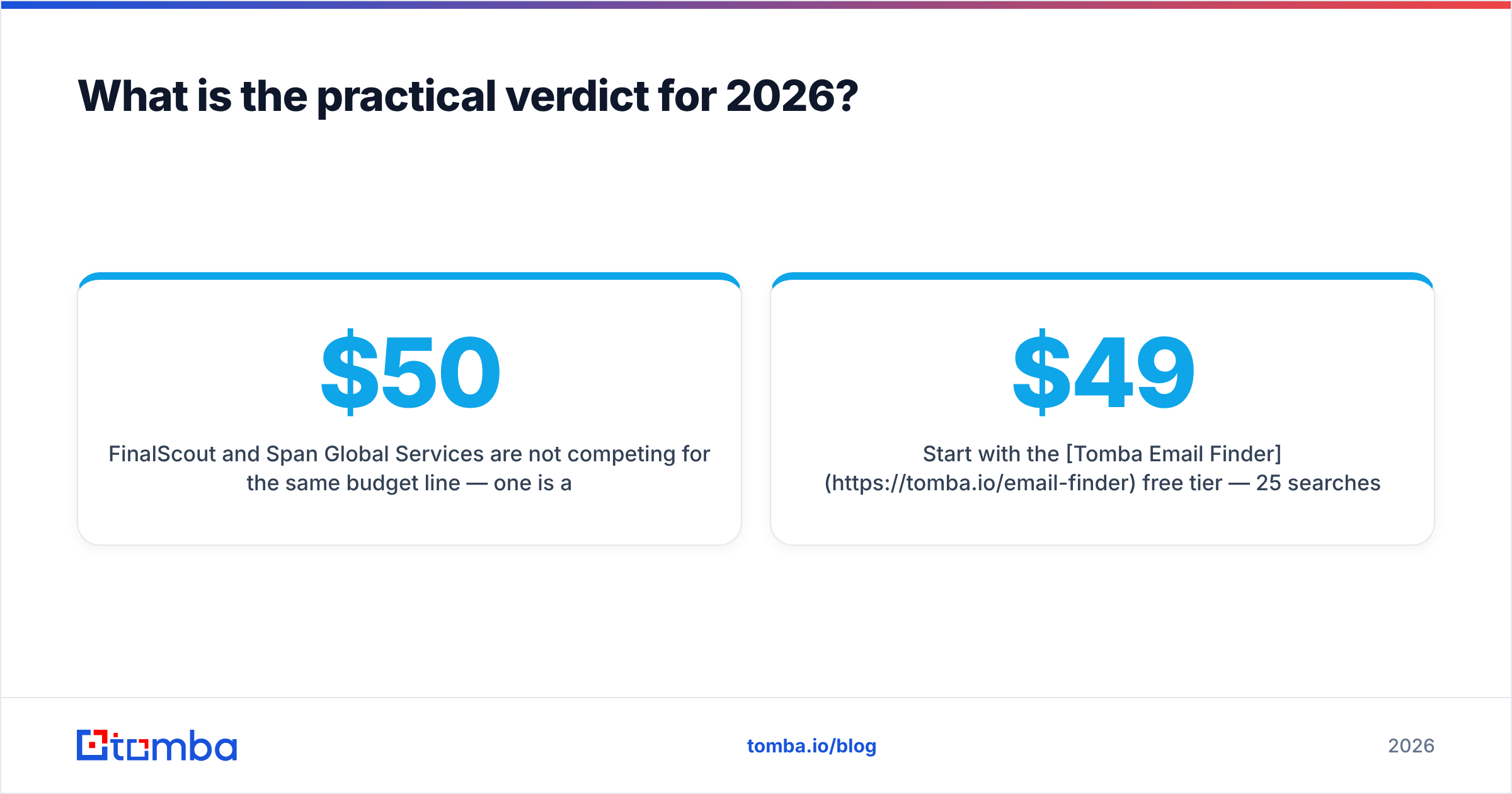
FinalScout and Span Global Services are not competing for the same budget line — one is a $50 tool expense, the other is a data purchase that goes through procurement. Framing this as "which is better" is the wrong question. The right one is: does my bottleneck look like effort, or does it look like coverage?
If it's effort — reps burning hours hunting addresses one at a time — a finder solves it, and the deciding factor should be whether the tool charges for verified results or for guesses. If it's coverage — you have no data at all in a segment you must enter — a broker file is a legitimate accelerant, provided you verify it, suppress against it, and treat the number of usable records as materially lower than the number delivered.
For most B2B teams, the honest answer is that neither extreme fits well. You need contacts continuously, not once. You need them verified, not merely returned. You need them reachable from a CRM, a spreadsheet, and a script without re-buying anything. That's the shape of the problem a per-search platform with published pricing and a real API is built for.
Start with the Tomba Email Finder free tier — 25 searches a month, no card — and run it against 25 contacts you already know are valid. Compare the hit rate and the verification status against whatever quote or credit pack you were about to buy. If the numbers hold up, Starter is $49/mo and scales through Growth at $99/mo, with bulk processing, catch-all handling, and API access included rather than sold as a separate line item. Test it against your own data before you sign anything larger.
Related guides#
Ready to find emails that actually work?
Join 150,000+ professionals who stopped guessing and started sending. Free credits on signup — no credit card required.
Get the Tomba newsletter
Practical outbound tactics and product updates — once every two weeks.
About the author