FinalScout vs Warpleads (2026): Which Lead Data Tool Wins?
One scrapes LinkedIn profile by profile. The other sells you millions of exportable rows. We break down FinalScout vs Warpleads on accuracy, export limits, pricing, and the workflows each one actually fits.
TL;DR
- FinalScout is a LinkedIn-first extractor. You browse profiles, search results, groups, or events in the browser, and it pulls emails for the people already in front of you. Great precision, low volume.
- Warpleads is a bulk database play. You filter a large prospect index and export rows — its pitch is unlimited or very high export volume rather than per-profile precision.
- They are not really substitutes. FinalScout competes with Chrome-extension scrapers; Warpleads competes with static B2B databases. Buying one when you needed the other is the most common mistake.
- Neither is a verification layer. Both hand you addresses; you still need an independent email verifier before you load anything into a sending tool.
- If you need API-grade lookups plus verification in one place, a finder like Tomba (free tier at 25 searches/mo, Starter $49/mo) covers the gap both leave open.
What is FinalScout and who is it built for?#
FinalScout is a browser-based email finder that sits on top of LinkedIn. You install the extension, open a profile, a search result page, a group member list, or an event attendee list, and it resolves work email addresses for those people. It also bundles AI email drafting, which is the feature the marketing leans on hardest.
The mental model: FinalScout is a metal detector. You walk a specific beach — a shortlist of accounts, a set of event attendees, a Sales Navigator search — and it beeps on the contacts you already decided you wanted. It is not designed to hand you 200,000 rows on Monday morning.
That shapes everything downstream. Costs scale per email revealed. Volume is capped by how fast a human (or the extension) can move through pages. And your addressable universe is whatever LinkedIn surfaces to your account, which means Sales Navigator limits, connection degrees, and search result caps all become your data ceiling. Check the current feature set on the official FinalScout site before you commit — extension products change fast.
Best fit: founder-led sales, recruiters, agencies working named-account lists, and anyone whose ICP is defined by a person's role and activity rather than firmographics alone.
What is Warpleads and who is it built for?#
Warpleads approaches the same problem from the opposite end. Instead of resolving contacts one profile at a time, it gives you a large pre-built B2B prospect index you filter by industry, geography, headcount, title, and similar attributes, then export. Its differentiator in marketing has consistently been export volume — the promise that you are not nickel-and-dimed per row the way most databases do it.
The mental model: Warpleads is a bulk grocery run. You are buying volume at a predictable price, and you accept that some of what is in the cart will be past its expiry date. See the Warpleads homepage for current plan structure, because unlimited-export vendors adjust their fair-use terms regularly.
That model suits high-volume outbound: cold email at scale, list building for paid audiences, market sizing, and any motion where the cost of one stale row is close to zero because you are sending thousands.
Best fit: agencies running outbound for multiple clients, high-volume SDR teams, and anyone whose bottleneck is list quantity rather than list precision.
How do FinalScout and Warpleads compare head-to-head?#
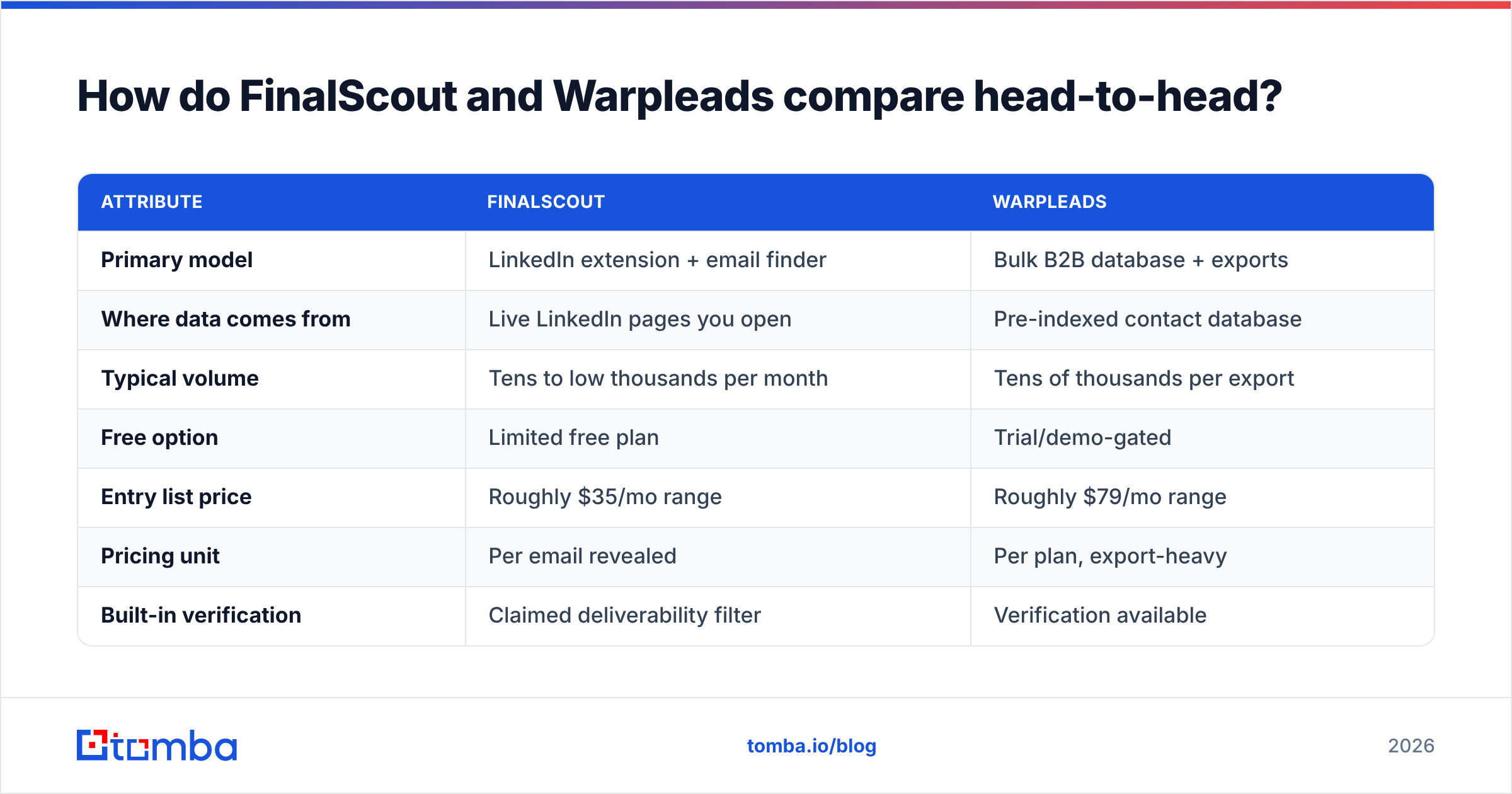
Here is the practical breakdown. Treat pricing as list price at the time of writing — both vendors adjust tiers, and you should verify on their own pages before you buy.
| Attribute | FinalScout | Warpleads |
|---|---|---|
| Primary model | LinkedIn extension + email finder | Bulk B2B database + exports |
| Where data comes from | Live LinkedIn pages you open | Pre-indexed contact database |
| Typical volume | Tens to low thousands per month | Tens of thousands per export |
| Free option | Limited free plan | Trial/demo-gated |
| Entry list price | Roughly $35/mo range | Roughly $79/mo range |
| Pricing unit | Per email revealed | Per plan, export-heavy |
| Built-in verification | Claimed deliverability filter | Verification available |
| AI email writing | Yes, core feature | Not the focus |
| API access | Limited | Limited |
| Best for | Named-account precision | High-volume list building |
| Weak spot | Volume ceiling, LinkedIn dependency | Row freshness at scale |
Two rows deserve extra attention.
Pricing unit is where most buyers get burned. FinalScout charges against emails found. If your workflow involves discarding 60% of results because the title was wrong, you paid for the discards. Warpleads charges against a plan, so a bad filter costs you time rather than credits — but a bad filter at export scale also fills your CRM with junk you now have to clean.
Data source determines your recency profile. Live-page extraction inherits LinkedIn's freshness: if someone updated their title yesterday, you see it. A pre-built index inherits the freshness of its last crawl, which for the long tail of small companies can be many months.
Which one gives you more accurate data?#
Accuracy is two different questions, and vendors deliberately blur them.
The first is deliverability — will this address bounce? The second is correctness — is this address actually the person you targeted, at the company you targeted, in the role you targeted? A tool can score 97% on the first and fail badly on the second by handing you an address that belongs to someone who left the company in 2024.

FinalScout's structural advantage is on correctness. Because you are looking at a live profile when the lookup fires, the person-to-company mapping is as current as LinkedIn is. That is a meaningful edge for anyone selling into roles with high turnover.
Warpleads' structural advantage is on coverage. A large index will return contacts at companies too small or too obscure to have a well-populated LinkedIn footprint, and it will return them in bulk instead of one at a time.
Where both leave you exposed is the same place every finder does: catch-all domains. When a mail server accepts everything, standard SMTP checks return "valid" for addresses that will hard-bounce or land in a black hole. If a meaningful slice of your ICP sits on Microsoft 365 tenants configured this way — and in enterprise it usually does — you need a dedicated catch-all verifier as a separate step. No amount of vendor accuracy marketing removes that requirement.
A practical test before you commit to either: pull 100 contacts you can independently confirm — your own customers, your LinkedIn first-degree network, people whose addresses you already have in your CRM. Run them through the tool. Measure three numbers separately: the percentage found, the percentage correct, and the percentage that actually delivers. Vendors quote the third number. Your pipeline depends on the second.
How does pricing really compare?#
The sticker price is the least interesting part of this comparison. What matters is cost per usable contact after you strip out bounces, wrong-person matches, and rows outside your ICP.
Work it out this way:
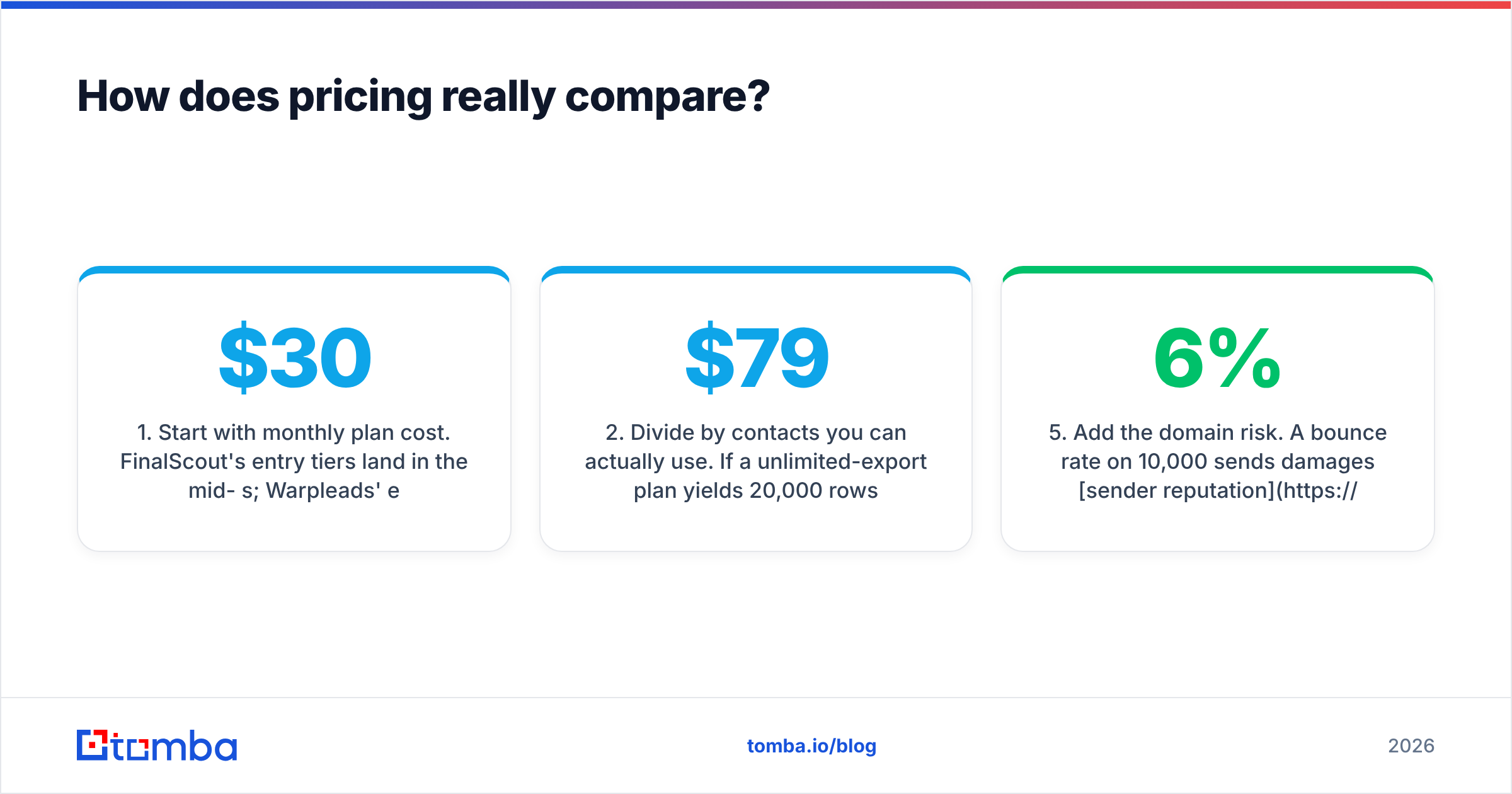
- Start with monthly plan cost. FinalScout's entry tiers land in the mid-$30s; Warpleads' entry sits near $79. Both scale up sharply for real team usage.
- Divide by contacts you can actually use. If a $79 unlimited-export plan yields 20,000 rows but only 6,000 match your ICP and verify clean, your real cost is $0.013 per usable contact — still excellent. If a $35 plan yields 800 contacts and 700 are usable, that is $0.05 each, with far less cleanup labor.
- Add the verification bill. Almost nobody sends straight from a finder's export. Budget for a verification pass on every list, every time, and count it as part of the tool's true cost.
- Add the cleanup hour. Deduplication, title normalization, and CRM mapping are real labor. Bulk exports carry more of it. If an ops person spends four hours a week cleaning rows, that is the most expensive line item in the whole stack.
- Add the domain risk. A 6% bounce rate on 10,000 sends damages sender reputation in a way no credit refund compensates for. Price that as insurance you are buying by verifying, not as an optional extra.

Run those five steps and the answer usually flips from what the pricing page suggested. High-volume teams with an ops function get more from the bulk model. Small teams without one get more from precision, because their scarce resource is attention, not credits.
When should you pick FinalScout over Warpleads?#
Pick FinalScout when your list is already defined by human judgment rather than filters.
- You sell into a named account list. Fifty target logos, three personas each. You do not want 40,000 rows; you want 150 correct ones.
- Your ICP is behavioral. People who commented on a specific post, attended a specific event, or joined a specific group. Firmographic filters cannot express that; LinkedIn surfaces can.
- You are a recruiter. Candidate sourcing is inherently profile-by-profile, and the current-role accuracy matters more than volume.
- You are a one-to-three person team. Nobody is going to clean a 30,000-row CSV. Precision beats volume when headcount is the constraint.
If LinkedIn is where your prospecting genuinely happens, a dedicated LinkedIn finder workflow — extension plus verification plus CRM push — will nearly always outperform a bulk export you never fully work through.
When should you pick Warpleads over FinalScout?#
Pick Warpleads when volume is the actual bottleneck and you have the operational muscle to process it.
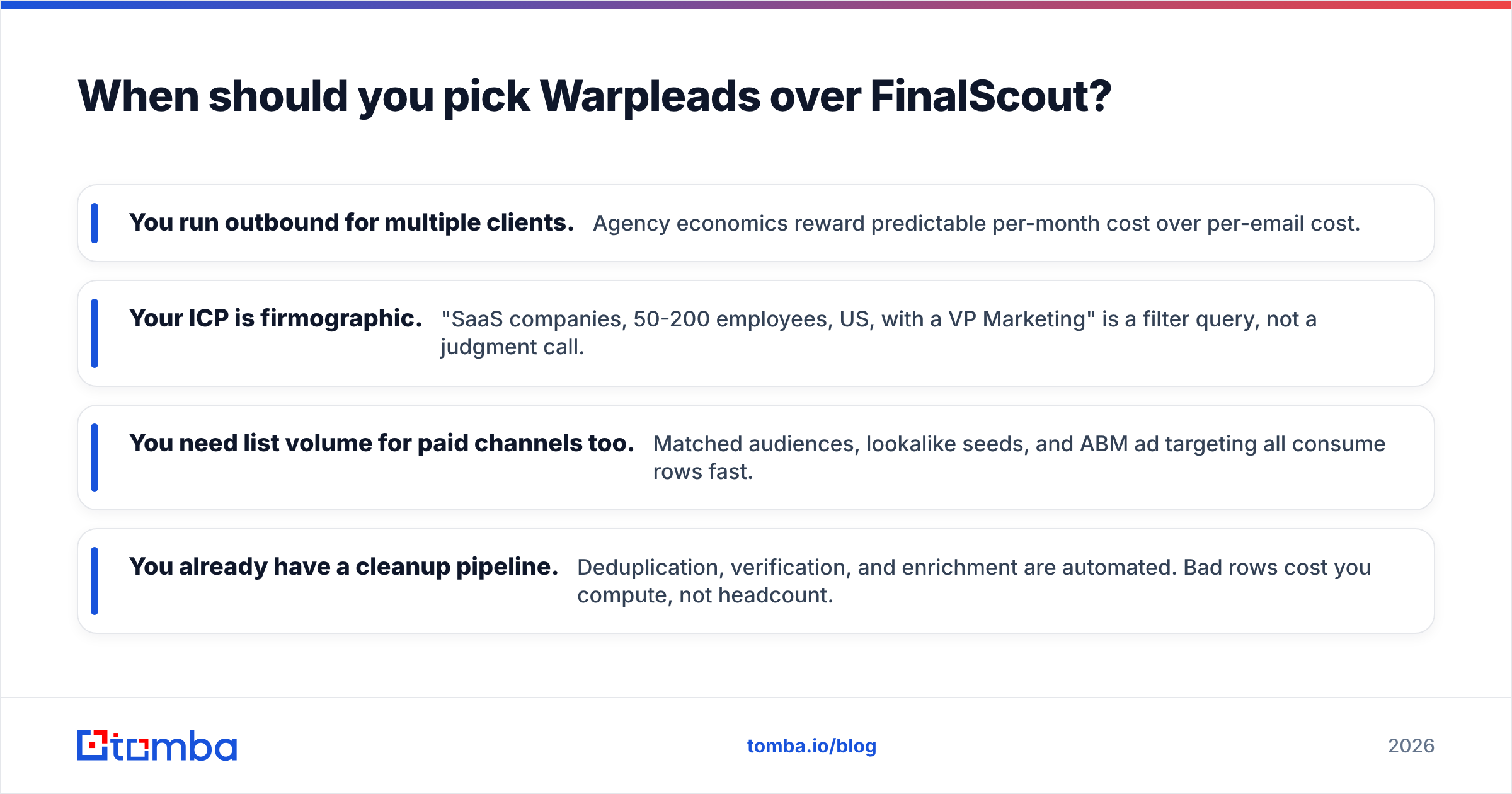
- You run outbound for multiple clients. Agency economics reward predictable per-month cost over per-email cost.
- Your ICP is firmographic. "SaaS companies, 50-200 employees, US, with a VP Marketing" is a filter query, not a judgment call.
- You need list volume for paid channels too. Matched audiences, lookalike seeds, and ABM ad targeting all consume rows fast.
- You already have a cleanup pipeline. Deduplication, verification, and enrichment are automated. Bad rows cost you compute, not headcount.

The failure mode here is buying unlimited exports and treating "unlimited" as a strategy. Volume without a verification and dedupe step is how teams end up on blocklists. Whatever you export, push it through bulk verification before it touches a sequencer.
Where do both tools leave a gap?#
Honest answer: in the middle, and in the plumbing.
No serious API layer. Both are built around a UI — an extension or a dashboard. If you want lookups to fire from your own product, from a workflow automation, or from an enrichment job that runs nightly on new CRM records, neither is the natural home for that. A proper email finder API is a different category of tool.
Verification is treated as a feature, not a discipline. Bundled verification is convenient but rarely independent. The vendor that found the address is grading its own homework. Separating find from verify — different systems, different logic — is the single highest-return change most teams can make to their data process.
Catch-all domains stay unsolved. As covered above, this is where the majority of enterprise bounces originate, and neither product's default flow addresses it head-on.
Compliance is your problem. Scraped and indexed B2B contact data carries GDPR and CAN-SPAM obligations regardless of which vendor supplied it. Read the vendor's stated data sourcing practices — from any vendor — before you send into the EU. Third-party review sites like G2 are useful for spotting where users report sourcing or refund friction that never appears on a pricing page.
Neither is a system of record. They feed your CRM; they are not your CRM. Any workflow that depends on manual CSV handoffs between a finder and your CRM will degrade the moment volume increases.
So which one should you actually buy?#
The verdict, stated plainly: FinalScout wins on precision and current-role accuracy; Warpleads wins on cost-per-row at volume. If you can only describe your ICP by looking at people, take FinalScout. If you can describe it as a filter query and you have someone to clean the output, take Warpleads.
But test both against the same 100-contact control list before committing to an annual plan. Ignore the marketing accuracy percentages entirely and measure your own. A tool that is 91% correct on your specific ICP beats one that is 98% correct on a benchmark built from Fortune 500 contacts you will never sell to.
And if what you actually need is neither a browser extension nor a bulk CSV — but reliable, programmatic lookups you can call from anywhere — that is a third category. Tomba Email Finder finds professional addresses by domain, name, or company, with verification, domain search, and catch-all handling in the same platform and behind the same API. Start on the free tier at 25 searches per month, then move to Starter at $49/mo when the workflow proves out; full Tomba pricing runs to Growth at $99/mo and Pro at $249/mo. Run your own 100-contact control test against it alongside FinalScout and Warpleads, and let the delivery numbers decide.
Related guides#
Ready to find emails that actually work?
Join 150,000+ professionals who stopped guessing and started sending. Free credits on signup — no credit card required.
Get the Tomba newsletter
Practical outbound tactics and product updates — once every two weeks.
About the author