FinalScout vs Zintlr (2026): Which Email Finder Wins?
FinalScout scrapes LinkedIn and writes your emails. Zintlr sells a B2B database with personality intel. They solve different problems — here is which one actually fits your pipeline, and what both cost you at scale.
FinalScout vs Zintlr is a choice between two very different tools. One scrapes LinkedIn. The other sells you a searchable contact database. Below is how they compare on price, accuracy, and fit — plus a cheaper third option most outbound teams end up buying anyway.
TL;DR
- FinalScout is a LinkedIn-first extension. It pulls emails from profiles and drafts outreach with AI. Off LinkedIn, it stalls.
- Zintlr is a database play. You search stored contacts by title, industry, and region. It adds personality intel called Zintellect.
- Neither tool verifies well. Both hand you addresses. Neither handles catch-all domains or SMTP-level checks.
- Costs climb with seats. Three reps on either tool often pass $150–$250 a month, before any verification.
- A finder with a built-in verifier wins on cost per valid contact. Tomba Starter is $49/mo.
What is FinalScout, and who is it for?#
FinalScout is a Chrome extension and web app built around LinkedIn. Open a profile, a company page, an event list, or a Sales Navigator result. FinalScout pulls the person and a best-guess work email. It also ships an AI writer that drafts a first email from that profile.
The pitch is speed for one motion. A rep lives in LinkedIn all day and wants the contact and the copy in one click. FinalScout markets a deliverability figure near 98%. In practice, the extension does well on rich English-language profiles at mid-size and large companies.
The limit is just as narrow. Take LinkedIn away and FinalScout has little to search. Say your ICP list arrives as a spreadsheet of company domains from a conference or your CRM. You are back to hunting profiles by hand first. There is also account risk. Heavy extension use has gotten LinkedIn accounts restricted for years, and no vendor can protect you from that.
What is Zintlr, and how is it different?#
Zintlr starts from the other end. It is a B2B contact database. You query it, and it returns people. The pitch centers on a large stored pool of profiles, filters for title, function, industry, company size, and location, plus a Chrome extension for enrichment.
Its differentiator is Zintellect. It attaches personality and behavior notes to a contact. The idea is to tell you whether a prospect prefers data, warmth, or a direct ask. It demos well. Whether it lifts your reply rate is another matter. It only helps if reps read the profile before they write, and most do not.
Zintlr also sells local intel and prospect intel modules for territory sellers. Next to FinalScout, Zintlr looks closer to a light Apollo or Lusha than to a browser scraper.
So the honest framing of FinalScout vs Zintlr is not "which is better." It is simpler: do you need a harvester bolted to LinkedIn, or a database you can query cold?

FinalScout vs Zintlr: how do they compare head to head?#
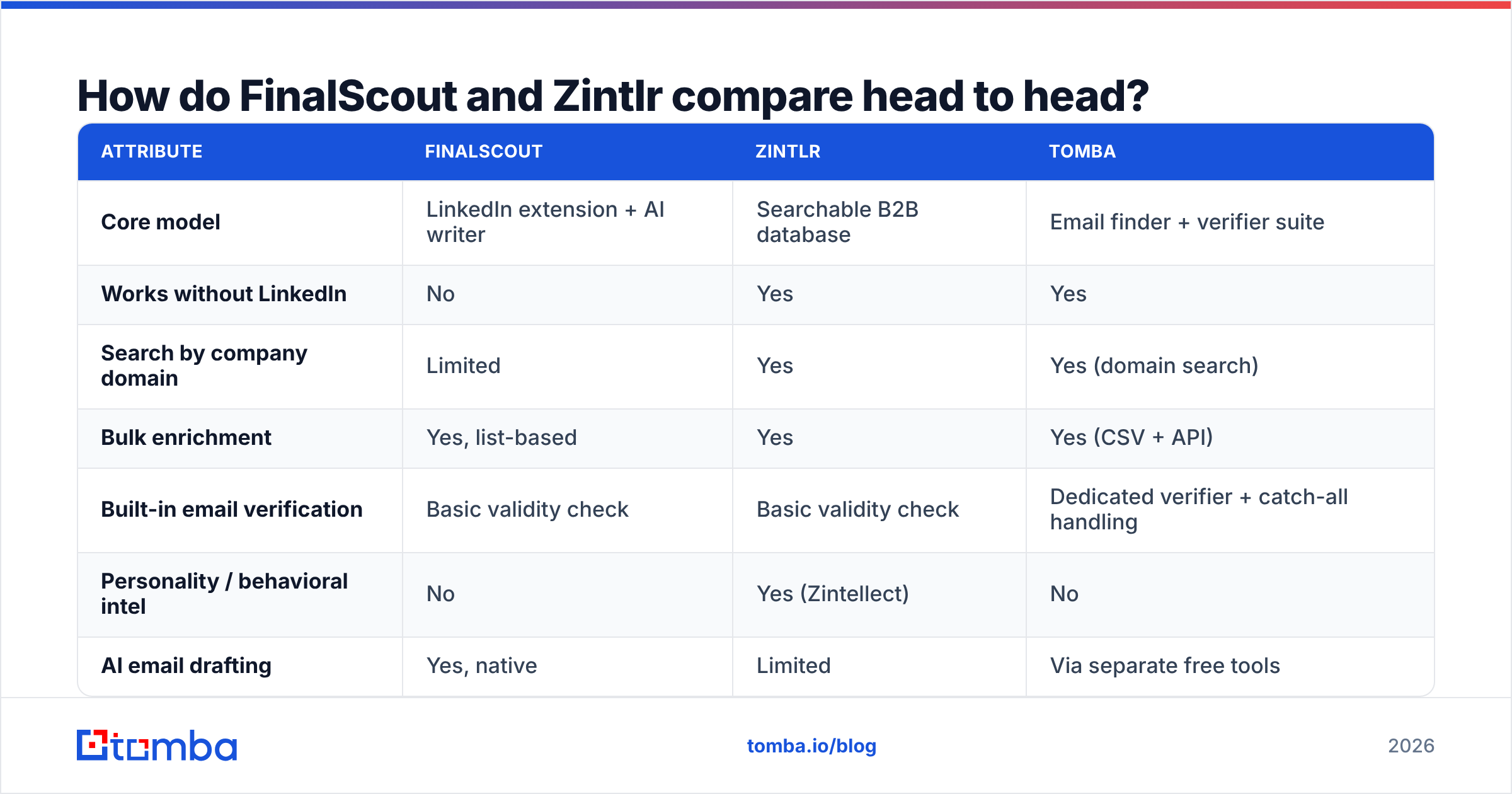
Here is the side by side. A dedicated email finder sits in a third column, so you can see where a pure-play tool lands on the same axes.
| Attribute | FinalScout | Zintlr | Tomba |
|---|---|---|---|
| Core model | LinkedIn extension + AI writer | Searchable B2B database | Email finder + verifier suite |
| Works without LinkedIn | No | Yes | Yes |
| Search by company domain | Limited | Yes | Yes (domain search) |
| Bulk enrichment | Yes, list-based | Yes | Yes (CSV + API) |
| Built-in email verification | Basic validity check | Basic validity check | Dedicated verifier + catch-all handling |
| Personality / behavioral intel | No | Yes (Zintellect) | No |
| AI email drafting | Yes, native | Limited | Via separate free tools |
| Public API | Limited | Available on higher tiers | Full REST API on all paid plans |
| Phone numbers | Limited | Yes | Yes (phone finder) |
| Entry paid price | ~$35–$40/mo (varies by plan) | ~$20–$50/user/mo (varies by tier) | $49/mo Starter |
| Free tier | Yes, small monthly credit pool | Yes, limited | Yes, 25 searches/mo |
Prices in this category move often, and both vendors run promo tiers. Treat the two left price rows as directional. Confirm them on finalscout.com and zintlr.com before you buy. Tomba's numbers are fixed and public on the Tomba pricing page.

One row decides most evaluations: "works without LinkedIn." Teams that build lists from LinkedIn saved searches will be fine with FinalScout. Teams that build lists anywhere else will not. Think G2 categories, job boards, funding news, tech-stack signals, or inbound domains. FinalScout simply cannot serve half of that pipeline.
Which one actually finds more valid emails?#
Accuracy here is measured badly and marketed worse. Every vendor quotes a number. Almost none publish the method. The numbers rarely compare, because the denominators differ. "Of emails we returned" and "of contacts you asked for" are not the same claim.

Two metrics matter. Test both on your own list before you sign anything.
- Hit rate. Of 500 target contacts, how many come back with any address? Databases like Zintlr often win on well-covered segments, such as US mid-market SaaS. They lose on niche regions and small companies. Scrapers like FinalScout follow whatever LinkedIn shows, so their hit rate tracks LinkedIn density instead.
- Valid rate. Of the addresses returned, how many survive an independent check? Neither tool ships a serious verification layer. A returned address may be a pattern guess that was never SMTP-tested.
The failure mode is the same for both: catch-all domains. Some mail servers accept every address at the gateway. A naive check then marks the address "valid." You learn the truth when the bounce report lands. Serious outbound stacks run every result through a dedicated email verifier and a catch-all verifier before the first send.
Here is a test protocol you can run inside both free tiers:
- Pick 100 real ICP contacts across three company-size bands. No cherry-picking.
- Run them through both tools. Record found or not found for each one.
- Export both result sets into a neutral verifier. Record valid, risky, or invalid.
- Compute cost per valid contact, not cost per credit. That is the only number a CFO accepts.
- Repeat on a non-US segment if your territory reaches outside North America. Coverage gaps show up there first.

FinalScout vs Zintlr pricing: what does each cost at team scale?#
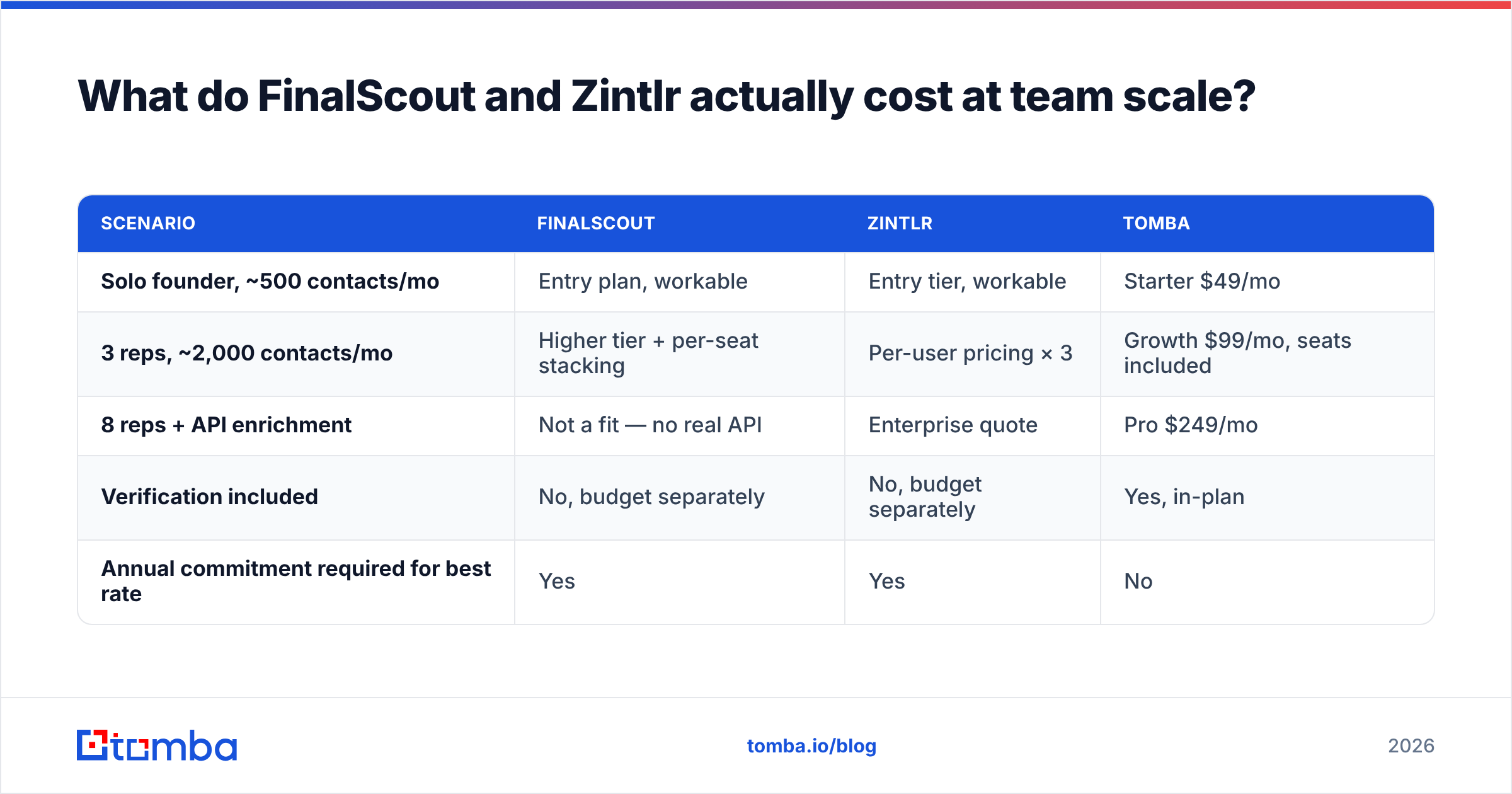
Both vendors publish friendly entry prices. Both get expensive the same way: seats and credit ceilings.
| Scenario | FinalScout | Zintlr | Tomba |
|---|---|---|---|
| Solo founder, ~500 contacts/mo | Entry plan, workable | Entry tier, workable | Starter $49/mo |
| 3 reps, ~2,000 contacts/mo | Higher tier + per-seat stacking | Per-user pricing × 3 | Growth $99/mo, seats included |
| 8 reps + API enrichment | Not a fit — no real API | Enterprise quote | Pro $249/mo |
| Verification included | No, budget separately | No, budget separately | Yes, in-plan |
| Annual commitment required for best rate | Yes | Yes | No |
Two cost traps are worth naming, because they break most evaluations:
- Credits burn on failure. Some tools debit a credit even when a search returns nothing useful. Read the fine print. On a niche list, this can double your real cost.
- Verification is a second invoice. Add a standalone verifier at market rates and your cost per valid contact rises 30–60%. A finder with verification included removes that line item.
Where does each tool break down?#
FinalScout's limits:
- LinkedIn dependency. No LinkedIn session, no workflow. Account restrictions are a real risk for heavy users.
- No serious API. You cannot wire it into a CRM job or a nightly sync. It is built for a human in the loop.
- Generic AI copy. The drafts work as a starting point, not as a send-ready sequence. Most teams rewrite them.
- Weak on domain-first work. Hand it 400 company domains and it has no way in.
Zintlr's limits:
- Uneven coverage. Strong in some segments, thin in others. Test your exact ICP, not a generic sample.
- Data freshness. Stored data decays. Roughly 25–30% of B2B contact data goes stale each year as people change jobs. Ask when records were last refreshed.
- Zintellect is a nice-to-have. Personality intel only pays off if reps use it. Treat it as a bonus, not a reason to buy.
- Per-user pricing scales linearly. Five seats cost five times one seat. That is fine at 3 reps and painful at 15.
Neither tool does deep verification, catch-all resolution, or enrichment across many sources. If those matter to you, you will buy a third tool either way. That changes the math on the whole comparison.
FinalScout vs Zintlr: which should you pick?#
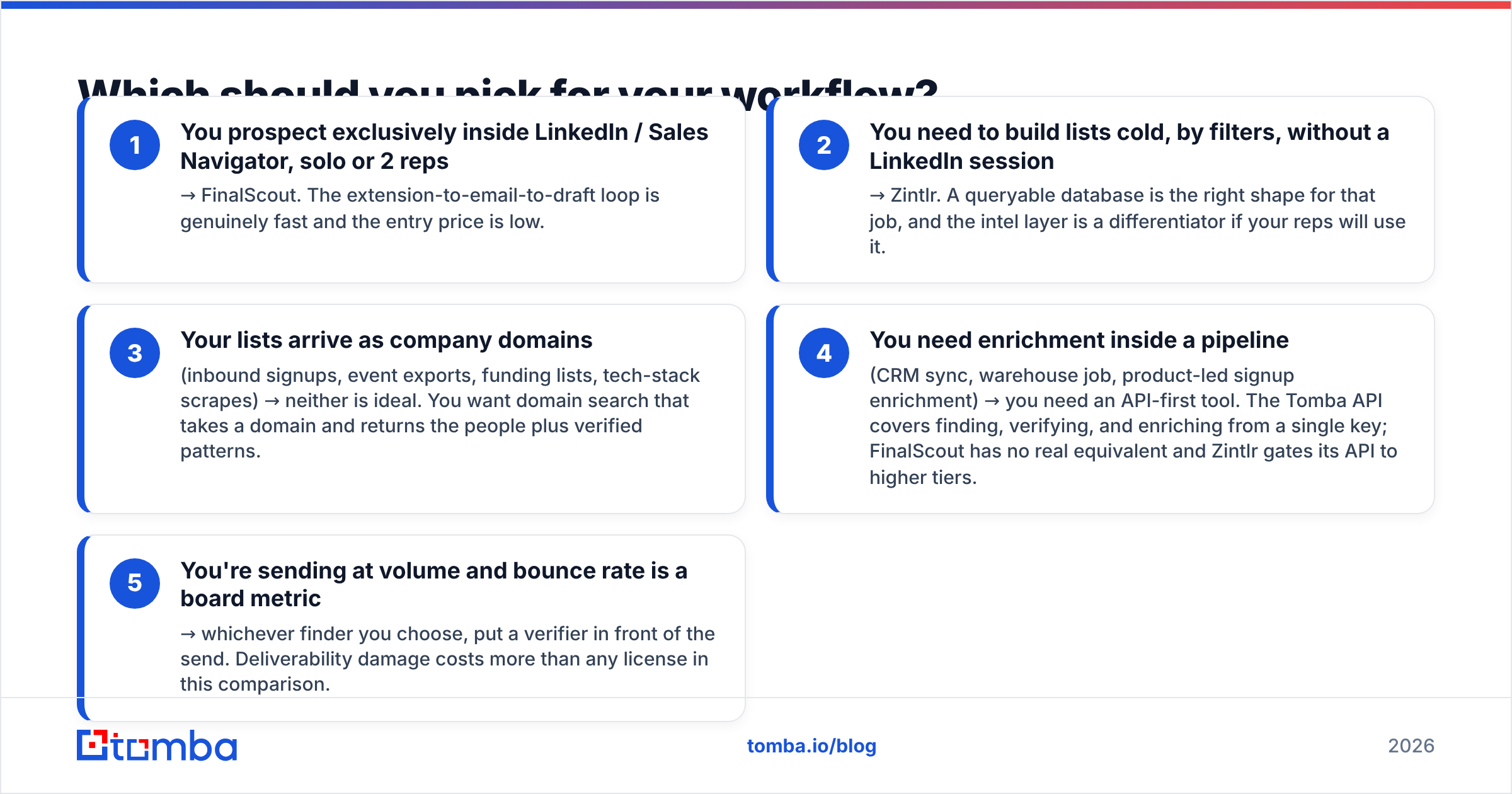
Match the tool to how your list gets built:
- You prospect only inside LinkedIn, solo or with one teammate. Pick FinalScout. The extension-to-email-to-draft loop is fast, and the entry price is low.
- You need to build lists cold, by filters. Pick Zintlr. A queryable database fits that job, and the intel layer helps if reps use it.
- Your lists arrive as company domains. Neither fits. You want domain search, which takes a domain and returns people plus verified patterns.
- You need enrichment inside a pipeline. You need an API-first tool. The Tomba API finds, verifies, and enriches from one key. FinalScout has no real equal, and Zintlr gates its API to higher tiers.
- You send at volume and bounce rate is a board metric. Put a verifier in front of the send, whichever finder you choose. Deliverability damage costs more than any license here.
Is there a better third option?#
For most teams weighing FinalScout vs Zintlr, both are point solutions. You will buy a second tool to cover the gap. That is the real cost comparison.
A combined finder and verifier closes that gap. Tomba sits in that slot. You can find email addresses by name, company, or domain. You can verify them, catch-all domains included, on the same plan. You can enrich in bulk from CSV or API, and pull LinkedIn emails when LinkedIn is your source. Pricing is flat and public: Free (25 searches a month), Starter $49/mo, Growth $99/mo, Pro $249/mo, Enterprise custom. There is no per-seat multiplier.
Where Tomba does not win: there is no AI writer in a LinkedIn sidebar, and no personality layer. Those are the real edges FinalScout and Zintlr hold. If one of them decides it for your team, buy that tool. Just budget for the verification you will still need.
For an outside read, check G2. Reviewer volume and recency tell you more about a vendor today than any comparison post, this one included.
What should you do next?#
Run the 100-contact test on all three free tiers this week. It takes about an hour and costs nothing. You get a cost-per-valid-contact number that ends the debate faster than any feature matrix. Whatever wins on your list is the right answer, even if it disagrees with the table above.
If your bottleneck is finding accurate addresses at volume, start with the Tomba Email Finder. The free tier gives you 25 searches a month with verification included. That is enough to benchmark it against FinalScout vs Zintlr results on the same list. Test it on your own data, not a demo set, and let the bounce report pick the winner.
Related guides#
Ready to find emails that actually work?
Join 150,000+ professionals who stopped guessing and started sending. Free credits on signup — no credit card required.
Get the Tomba newsletter
Practical outbound tactics and product updates — once every two weeks.
About the author