FinalScout vs ZoomInfo (2026): Which Data Tool Wins?
One is a $40/month LinkedIn Chrome extension. The other is a five-figure annual contract with a sales rep attached. Here is how FinalScout and ZoomInfo actually compare on coverage, accuracy, export rights, and total cost.
TL;DR
- FinalScout is a LinkedIn-first email finder. You browse profiles or Sales Navigator lists, click the extension, and it returns work emails. Entry pricing sits in the $35–$50/month range depending on plan and billing cycle.
- ZoomInfo is an enterprise data platform. No public pricing, no self-serve checkout, annual contracts that commonly land between $15,000 and $40,000+ per year once you add seats, intent data, and export credits.
- They are not really competitors. FinalScout solves "get me the email of this specific person." ZoomInfo solves "build me a territory, score it with intent signals, and sync it to Salesforce."
- The biggest hidden cost in ZoomInfo is export credits, not seats. The biggest hidden cost in FinalScout is coverage gaps outside LinkedIn.
- If you mostly need verified work emails at API-level cost, a dedicated email finder like Tomba ($49/mo Starter, free tier at 25 searches) covers the same job for a fraction of either.
If you searched "FinalScout vs ZoomInfo," you are probably in one of two situations: your ZoomInfo renewal quote just landed and you are looking for an escape hatch, or you have been scraping LinkedIn manually and want to know whether the enterprise tier is worth it. This post answers both, without pretending the two tools do the same thing.
What is FinalScout and what is ZoomInfo?#
The fastest way to understand the gap is to look at where the data comes from.
- FinalScout — LinkedIn-sourced email finder. It works as a Chrome extension over LinkedIn profiles, search results, Sales Navigator lists, and group members. You point it at a person or a list, and it resolves work email addresses, with AI-assisted email drafting bolted on. Its whole value proposition depends on you already having a LinkedIn profile in front of you.
- ZoomInfo — contributory B2B database. ZoomInfo maintains its own contact and company graph built from contributory networks (email plugin data), web crawling, licensed sources, and a research team. You query the database directly; no source profile required. It also layers on intent data, org charts, technographics, and a workflow engine (Copilot, Engage, Operations).
- Different unit of work. FinalScout is per-contact. ZoomInfo is per-segment. That distinction drives every pricing and workflow difference below.
- Different buyer. FinalScout is bought with a credit card by a founder, recruiter, or two-person SDR team. ZoomInfo is bought by a RevOps or sales leader with procurement involved and a 12-month minimum.
- Different failure modes. FinalScout fails when the prospect is not on LinkedIn or their profile is thin. ZoomInfo fails on stale records — job changes are the number-one complaint in G2 reviews of any large static database.

How do FinalScout and ZoomInfo compare on price?#
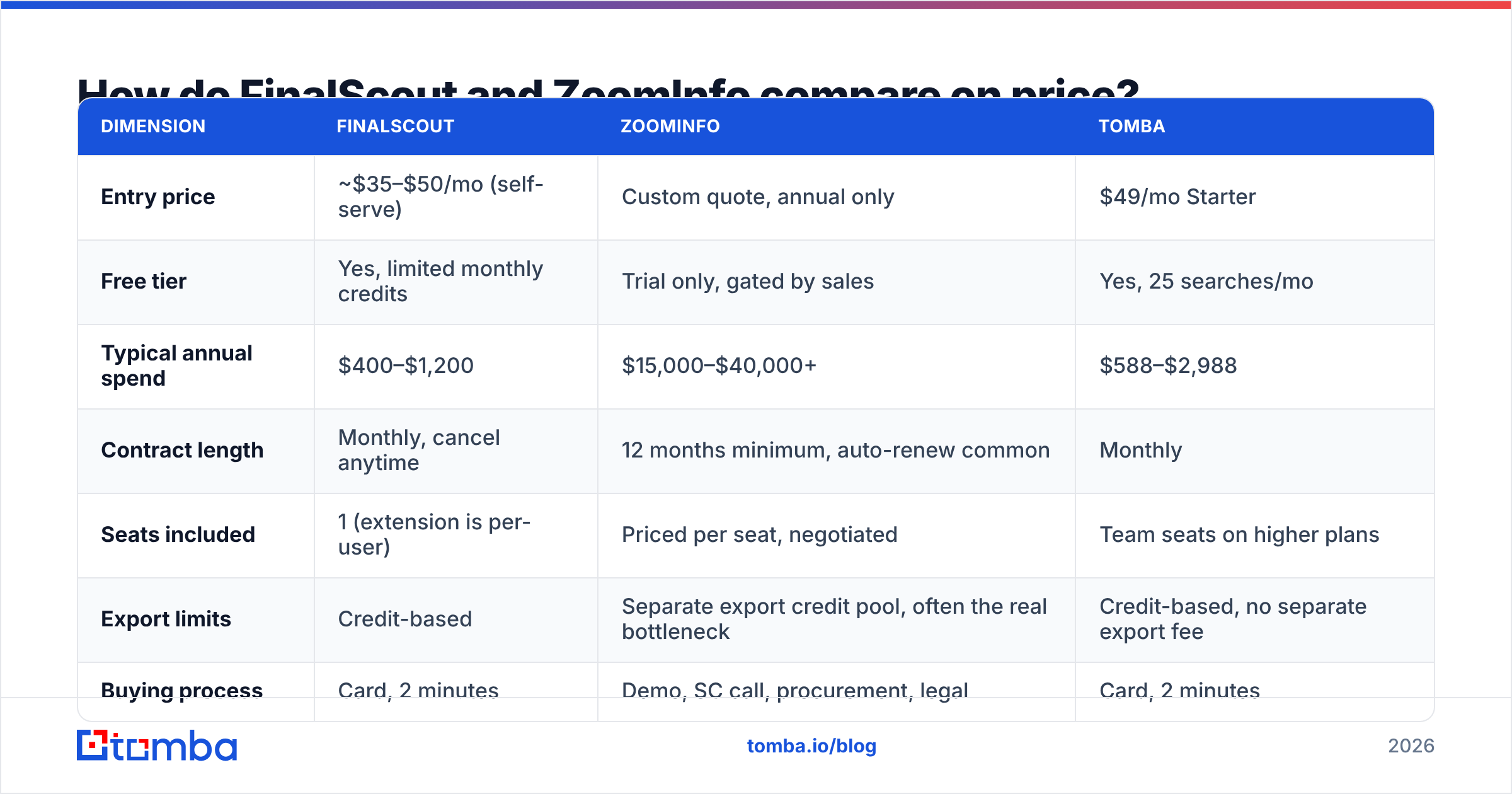
This is where the comparison stops being close. FinalScout publishes pricing. ZoomInfo does not — every number below is a directional range based on publicly reported contracts and buyer reports, not a quote. Always get your own.
| Dimension | FinalScout | ZoomInfo | Tomba |
|---|---|---|---|
| Entry price | ~$35–$50/mo (self-serve) | Custom quote, annual only | $49/mo Starter |
| Free tier | Yes, limited monthly credits | Trial only, gated by sales | Yes, 25 searches/mo |
| Typical annual spend | $400–$1,200 | $15,000–$40,000+ | $588–$2,988 |
| Contract length | Monthly, cancel anytime | 12 months minimum, auto-renew common | Monthly |
| Seats included | 1 (extension is per-user) | Priced per seat, negotiated | Team seats on higher plans |
| Export limits | Credit-based | Separate export credit pool, often the real bottleneck | Credit-based, no separate export fee |
| Buying process | Card, 2 minutes | Demo, SC call, procurement, legal | Card, 2 minutes |
The line that catches most ZoomInfo buyers is export credits. Platform access and record export are metered separately in many ZoomInfo agreements. You can see 4,000 contacts in the UI and be allowed to push only a fraction of them to your CRM without a credit top-up. Budget for it in year one instead of discovering it in month four.
FinalScout's cost trap is different and much smaller: credits burn on failed lookups in some plans, and a contact you cannot find on LinkedIn is a contact you cannot find at all.
Which one finds more accurate emails?#
Accuracy in this category is not one number. Split it into three:
- Coverage — what percentage of your target list returns any email at all.
- Validity — what percentage of returned emails do not bounce.
- Freshness — how recently the record was confirmed against a live source.
ZoomInfo generally wins coverage in North American mid-market and enterprise, because it does not depend on a LinkedIn profile existing. FinalScout can win freshness on LinkedIn-active personas, because it resolves against the profile you are looking at right now rather than a row written 14 months ago.
Neither wins validity by default. Both return emails that need a verification pass before you load them into a sequence, and any vendor quoting a flat "98% accurate" without defining the denominator is quoting a marketing number. Run your own sample: take 200 known-good contacts from closed-won accounts, run them through each tool, and measure hit rate and bounce rate yourself. That two-hour test is worth more than any review site.

Where dedicated finders pull ahead is the verification layer. An email verifier that does real SMTP checks, plus a catch-all verifier for domains that accept everything, changes the bounce math more than switching databases does. Roughly 20–30% of B2B domains are catch-all, and both FinalScout and ZoomInfo will happily hand you addresses on those domains with no signal about whether the mailbox actually exists.
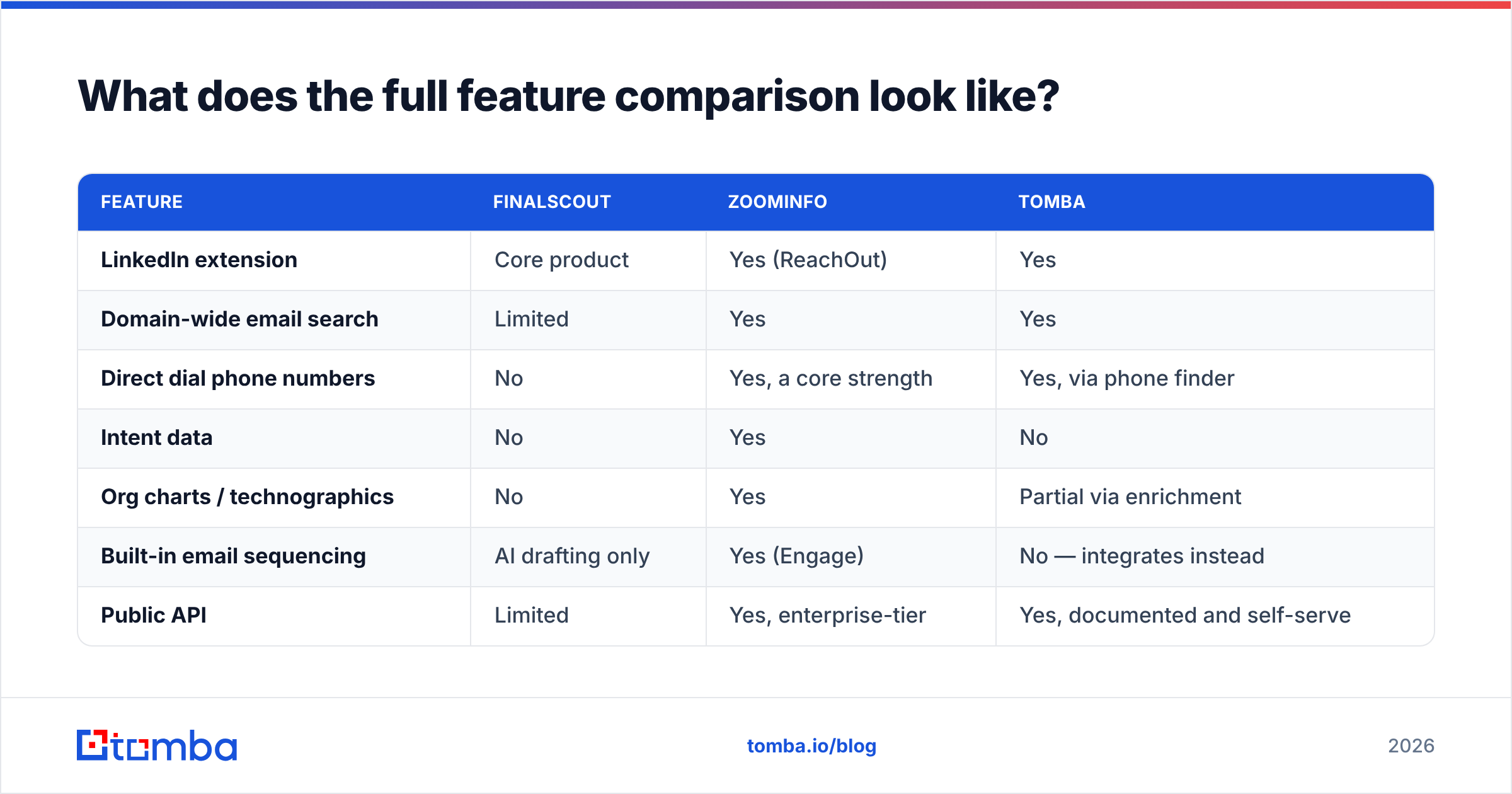
What does the full feature comparison look like?#
| Feature | FinalScout | ZoomInfo | Tomba |
|---|---|---|---|
| LinkedIn extension | Core product | Yes (ReachOut) | Yes |
| Domain-wide email search | Limited | Yes | Yes |
| Direct dial phone numbers | No | Yes, a core strength | Yes, via phone finder |
| Intent data | No | Yes | No |
| Org charts / technographics | No | Yes | Partial via enrichment |
| Built-in email sequencing | AI drafting only | Yes (Engage) | No — integrates instead |
| Public API | Limited | Yes, enterprise-tier | Yes, documented and self-serve |
| CRM sync | Via export | Native Salesforce/HubSpot | Native + Zapier/Make |
| Bulk processing | Yes, credit-capped | Yes, export-credit-capped | Yes, bulk finder + verifier |
| Time to first email | Minutes | Days to weeks | Minutes |

Read that table as a shape, not a scoreboard. ZoomInfo has more rows checked because it is a platform. The question is not "which has more features" — it is "am I going to use the extra $30,000 worth of them."
Who should choose FinalScout?#
Pick FinalScout if all of these are true:
- Your ICP lives on LinkedIn. Software, agencies, consulting, recruiting, most VC-backed tech. If you sell to plant managers, franchise owners, or municipal buyers, LinkedIn coverage collapses and so does FinalScout's hit rate.
- You prospect one profile at a time. Founder-led sales, recruiters sourcing candidates, agency owners running 30 outbound touches a week.
- You want zero procurement. Card in, working in five minutes, cancel whenever.
- You do not need phone numbers. FinalScout is email-first. If cold calling is half your motion, this is a hard stop.
Who should actually pay for ZoomInfo?#
ZoomInfo earns its price in a narrower set of cases than its sales team suggests:
- You run a multi-rep outbound team with a territory model. When 12 SDRs need non-overlapping, CRM-synced lists with ownership rules, the platform layer is the product.
- Intent data changes your prioritization. If your team genuinely reworks its call list based on surging accounts — and can prove lift — that signal is hard to replicate cheaply.
- You need direct dials at scale. ZoomInfo's mobile number coverage remains one of the strongest in the market, and this is the single most common reason teams renew despite the price.
- Data governance matters. Enterprise buyers with legal review, DPAs, and compliance requirements get a mature answer here that most point tools cannot match.
If you cannot check at least two of those boxes, you are buying a database and using 10% of it.
What are the hidden costs nobody quotes you?#
ZoomInfo:
- Export credits metered separately from seats.
- Auto-renewal clauses with notice windows — miss the window and you are in for another year. Read the renewal terms before signing, not before renewing.
- Per-module pricing: Intent, Engage, Operations, and Copilot are frequently separate line items.
- Onboarding and admin time. Someone owns this tool internally, and that is a real 5–10 hours a month.
FinalScout:
- Credit burn on unresolved lookups.
- No phone data, so you end up buying a second tool anyway.
- Extension-based workflows do not scale past a few hundred contacts a week without babysitting.
- LinkedIn's own rate limiting and account-safety risk when you push volume through automation on your personal profile.
Is there a middle option between the two?#
Yes, and this is where most teams actually land. The honest framing: a large share of "we need ZoomInfo" requirements are really "we need verified work emails, some phone numbers, and an API that does not require a procurement cycle."
That job is served by focused providers at a fraction of the cost:
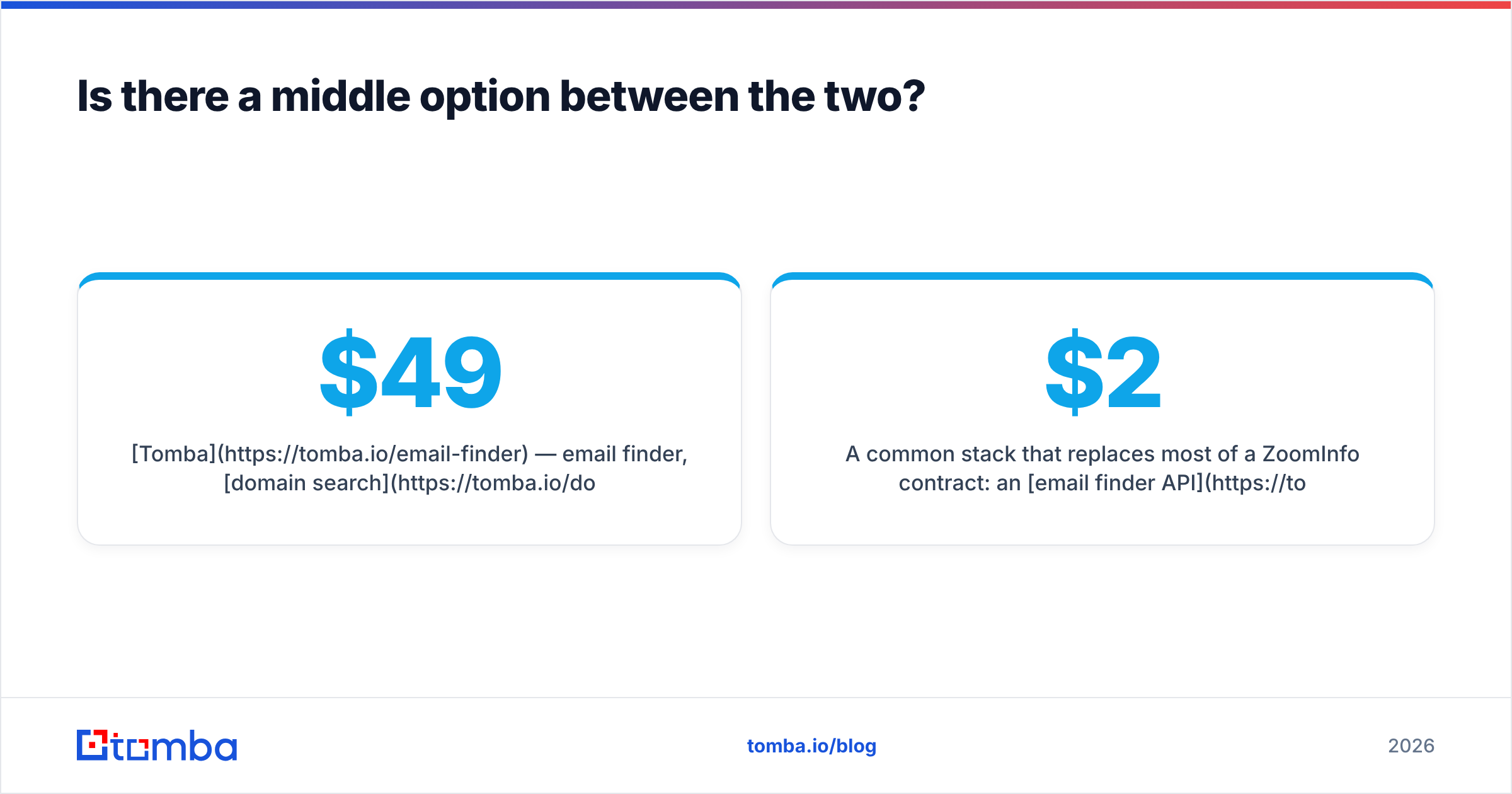
- Tomba — email finder, domain search, verifier, catch-all handling, phone finder, and a documented API. Free tier at 25 searches/month, Starter $49/mo, Growth $99/mo, Pro $249/mo. Monthly billing, no annual lock-in. See full Tomba pricing for credit allocations.
- BookYourData — a strong option when you want a pre-built, pay-as-you-go contact list rather than a lookup workflow. Its accuracy guarantee and one-time-purchase model suit teams that buy a defined segment once rather than searching continuously.
- Apollo, Clay, and similar orchestration layers — worth it if you want waterfall enrichment across multiple providers, though you pay a coordination premium.
A common stack that replaces most of a ZoomInfo contract: an email finder API for resolution, a verification pass before every send, and your existing sequencer. Total cost typically lands under $2,000/year for a small team. You lose intent data and org charts. If you were not using those anyway, you lose nothing that touched pipeline.
How should you run the evaluation?#
Do not evaluate on demos. Evaluate on your own list.
- Build a 200-row test set from accounts you already closed or lost. You know the correct answers.
- Run it through each tool on trial or free tier. Record hit rate, not the vendor's claimed rate.
- Verify every returned address through an independent verifier so you are measuring deliverable emails, not returned strings.
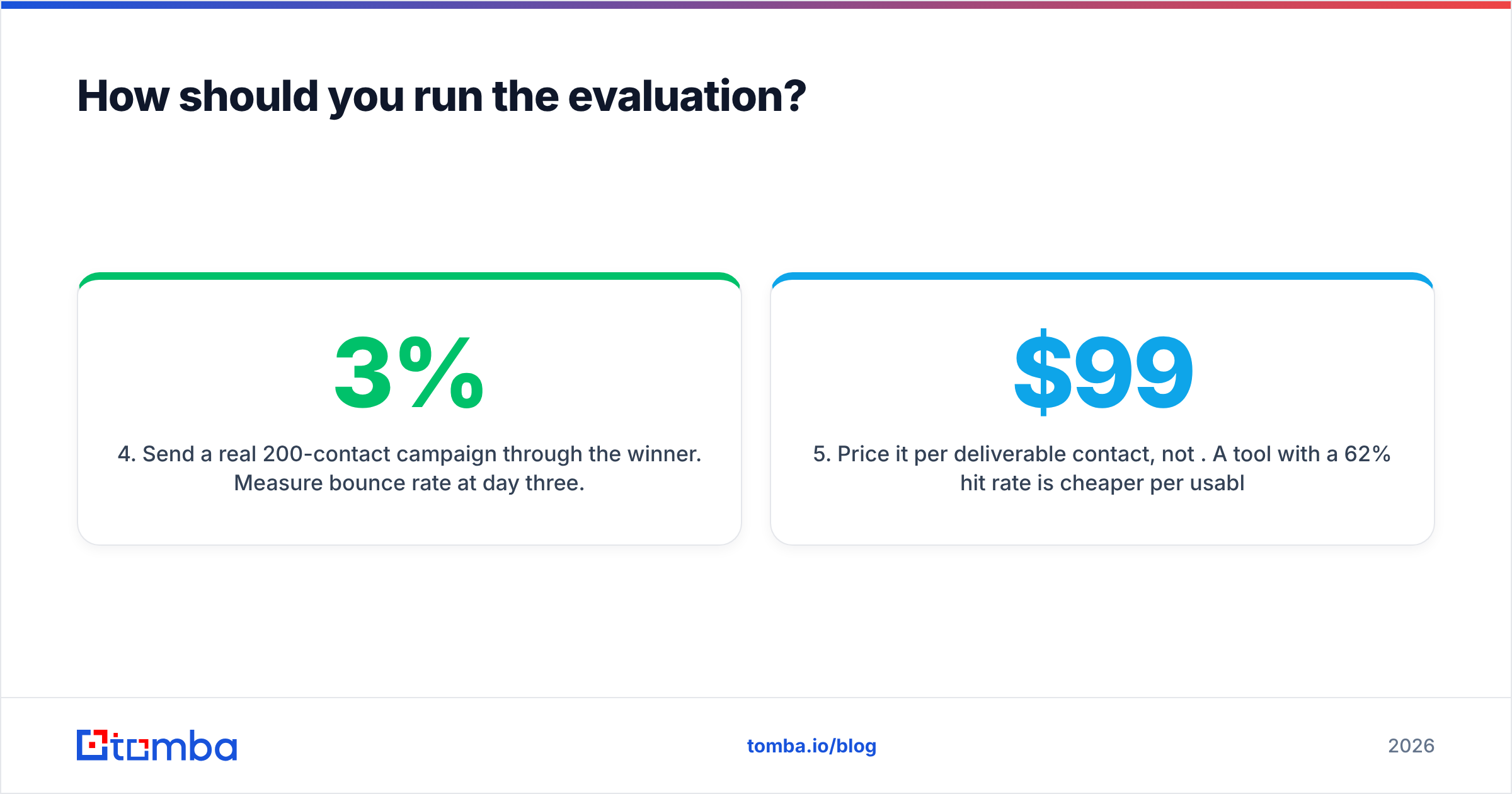
- Send a real 200-contact campaign through the winner. Measure bounce rate at day three. Anything over 3% means the data or the verification is failing.
- Price it per deliverable contact, not per month. A $99/month tool with a 62% hit rate is cheaper per usable contact than a $2,000/month tool at 71%.
FAQ#
Is FinalScout a real ZoomInfo alternative? Only for the email-finding slice. If your ZoomInfo usage is 90% "look up a contact and export it," yes. If you use intent, org charts, or Engage, no.
Does ZoomInfo offer a free plan? No self-serve free tier. There is a gated trial that routes through sales. Expect a discovery call before access.
Can I cancel ZoomInfo mid-contract? Generally not. Standard agreements are annual with auto-renew. Set a calendar reminder 60 days before renewal.
Which has better data for Europe? Both weaken outside North America. GDPR constrains contributory data collection, and coverage in DACH, France, and the Nordics is noticeably thinner across every US-based provider. Test your specific region before committing.
Do I still need an email verifier? Yes. Every provider, including the expensive one. Verification is a separate step from discovery, and skipping it is the fastest way to damage sender reputation.
Which should you pick?#
If you are a small team that mostly needs deliverable work emails, start with the cheapest tool that clears your accuracy bar and reinvest the difference in sending infrastructure and copy. If you run a multi-rep outbound org where territory, intent, and CRM governance drive the motion, ZoomInfo is a defensible spend — just negotiate export credits hard and read the renewal clause.
For everyone in between: run the 200-row test with the Tomba Email Finder free tier before you take another ZoomInfo demo. Twenty-five searches is enough to see the hit rate on your own ICP, the verifier tells you what would actually land, and if the numbers hold up you have your answer for $49/month instead of $15,000 a year.
Related guides#
Ready to find emails that actually work?
Join 150,000+ professionals who stopped guessing and started sending. Free credits on signup — no credit card required.
Get the Tomba newsletter
Practical outbound tactics and product updates — once every two weeks.
About the author