Financial Advisor Leads: How to Find and Qualify Them in 2026
Most financial advisor lead sources sell you the same recycled list. Here's how the channels actually compare on cost per client, compliance risk, and close rate — with the math to pick yours.
TL;DR
- Financial advisor leads are priced per lead but should be judged per closed client. A $40 lead that closes at 1% costs $4,000 per client; a $12 self-sourced contact that closes at 6% costs $200.
- Shared "appointment-setting" leads from aggregators are the most expensive channel once you price in the 4-6 advisors receiving the same name.
- The highest-margin channel for most RIAs and independent advisors is niche self-sourced outbound: pick a vertical (dentists, engineers at one employer, business owners post-exit), build the list yourself, verify it, and run a compliant multi-touch sequence.
- Compliance is a real cost line. The SEC Marketing Rule treats paid lead endorsements as testimonials/endorsements requiring disclosure — factor that into vendor selection, not after.
- Verification matters more here than in almost any other vertical: bounced email on a financial-services domain damages sender reputation fast, and reputation damage compounds across every campaign you run.
What are financial advisor leads, really?#
A financial advisor lead is any contact record with enough information to start a suitability conversation — a name, a reachable channel, and at least one signal that the person has investable assets or a triggering life event.
That definition sounds obvious, but it's where most advisors lose money. The industry sells "leads" as a single commodity when there are actually four distinct products under that label, each with a wildly different economic profile:
- Aggregator leads — SmartAsset, Zoe Financial, Datalign and similar platforms capture consumers via calculators and quizzes, then sell that name to multiple advisors. You pay per lead or per closed relationship.
- Appointment-set leads — a vendor's SDR team books a calendar slot for you. Priced at $150-$600 per appointment. Show rates are the hidden variable.
- Purchased list data — B2B or consumer records with firmographic or wealth-proxy attributes. Cheap per record, cold, and only as good as the enrichment behind it.
- Self-sourced leads — you define the segment, build the list from public and licensed data, verify contactability, and own the sequence end to end.
The first two are outsourced demand. The last two are owned demand. Owned demand is slower to start and dramatically cheaper at steady state, which is why the advisors with the healthiest marketing P&Ls almost always run a hybrid: buy while you build, then shift budget as your owned pipeline compounds.
How do the lead channels actually compare?#
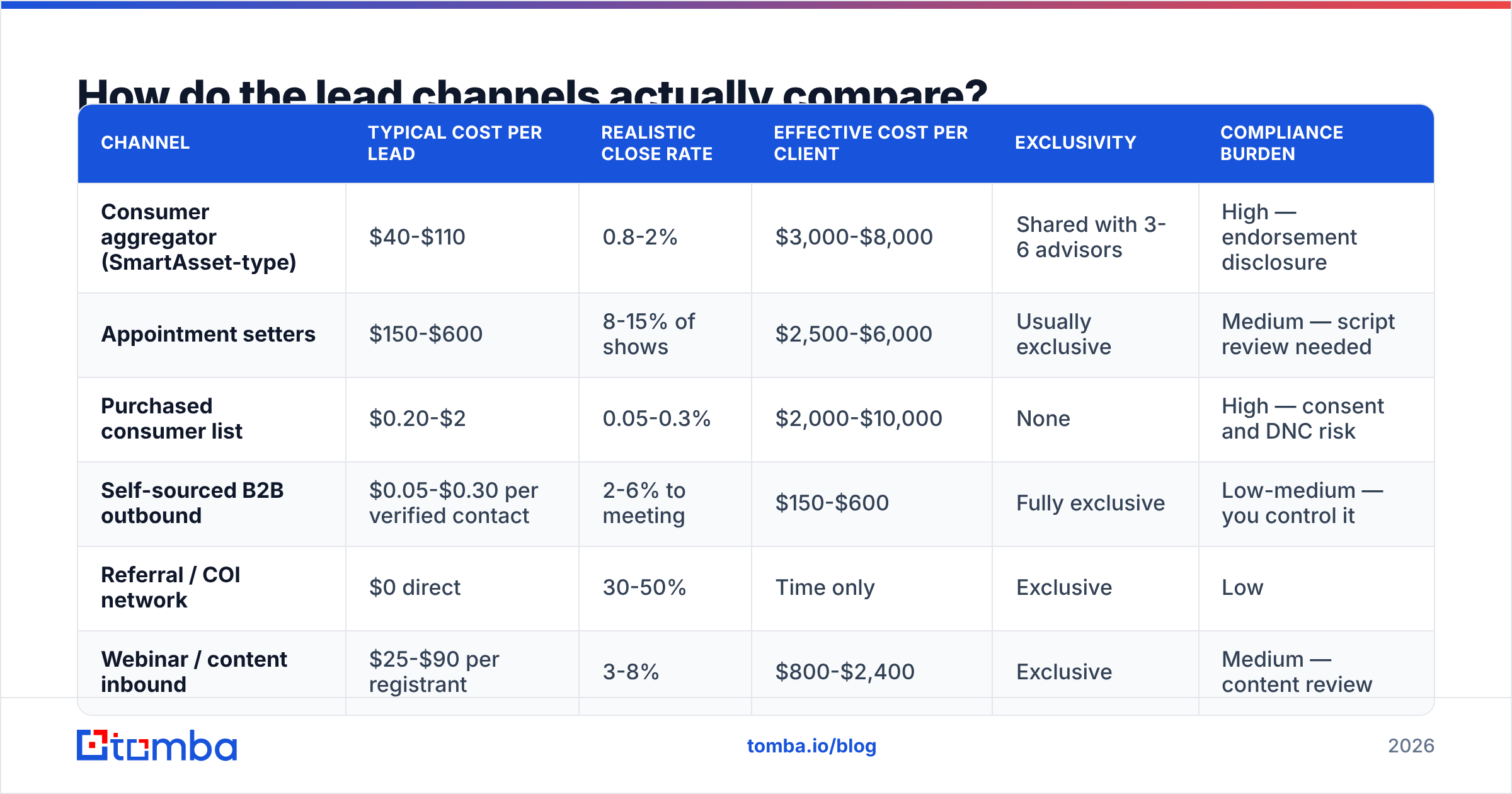
Here's the comparison most vendor pages won't put in front of you. The numbers below are realistic mid-range figures for a solo-to-small RIA targeting $500K+ investable assets; your segment will shift them, but the relative ordering holds remarkably well across firm sizes.
| Channel | Typical cost per lead | Realistic close rate | Effective cost per client | Exclusivity | Compliance burden |
|---|---|---|---|---|---|
| Consumer aggregator (SmartAsset-type) | $40-$110 | 0.8-2% | $3,000-$8,000 | Shared with 3-6 advisors | High — endorsement disclosure |
| Appointment setters | $150-$600 | 8-15% of shows | $2,500-$6,000 | Usually exclusive | Medium — script review needed |
| Purchased consumer list | $0.20-$2 | 0.05-0.3% | $2,000-$10,000 | None | High — consent and DNC risk |
| Self-sourced B2B outbound | $0.05-$0.30 per verified contact | 2-6% to meeting | $150-$600 | Fully exclusive | Low-medium — you control it |
| Referral / COI network | $0 direct | 30-50% | Time only | Exclusive | Low |
| Webinar / content inbound | $25-$90 per registrant | 3-8% | $800-$2,400 | Exclusive | Medium — content review |
Two things jump out.
First, exclusivity dominates cost per lead. A $45 shared lead going to five advisors is functionally a $45 entry into a five-way race you win 20% of the time at best. A $0.20 self-sourced contact nobody else is calling has structurally better unit economics even at a lower response rate.
Second, referrals still crush everything — and nothing in this article should convince you otherwise. Outbound and paid leads exist to fill the gap while your referral engine matures, and to let you choose your niche instead of inheriting whoever your existing clients happen to know.
Is buying financial advisor leads worth it in 2026?#
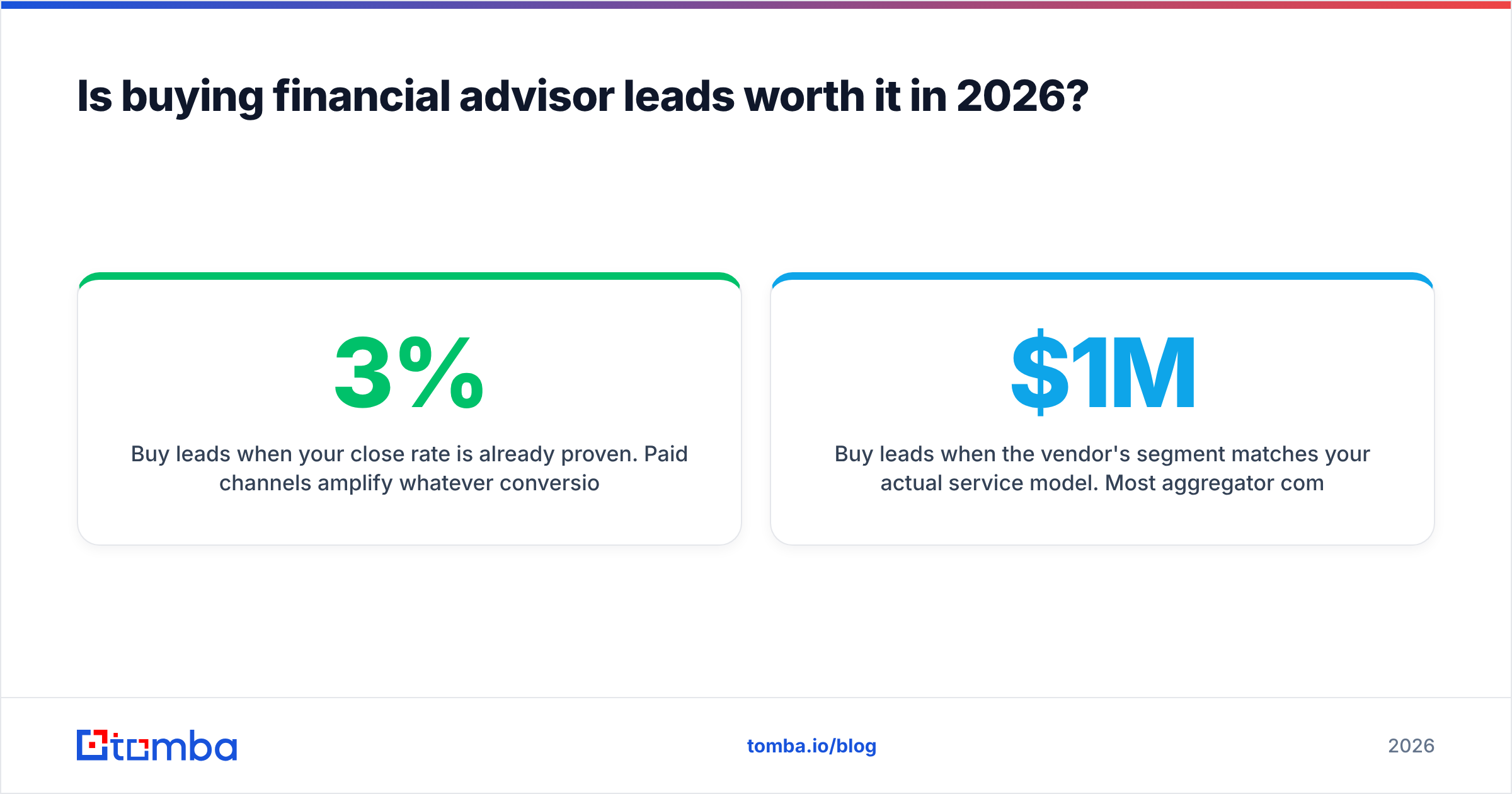
Sometimes — but only under three specific conditions.
Buy leads when you have spare capacity and no pipeline. A new advisor with 20 open hours a week and zero prospects should absolutely buy leads. The alternative isn't cheaper leads; it's an empty calendar. Paid leads buy you reps, objection-handling experience, and a feel for which segments respond.
Buy leads when your close rate is already proven. Paid channels amplify whatever conversion machine you already have. If you close 3% of self-sourced conversations, paid leads will produce a number you can model. If you've never closed a cold prospect, buying 200 of them will teach you that you can't close cold prospects — an expensive lesson available for free.
Buy leads when the vendor's segment matches your actual service model. Most aggregator complaints trace back to mismatch: an advisor with a $1M minimum receiving leads with $150K rollovers. Read the qualification criteria before the pricing page.
Skip paid leads when you're pre-process. If your CRM is a spreadsheet, your follow-up is inconsistent, and your onboarding takes six weeks, buying leads just accelerates the rate at which you waste money. Fix the sales process first.
How do you build your own financial advisor lead list?#
This is the part that compounds. Building an owned list is a five-step process, and each step has a failure mode that kills the whole thing.
Define a niche narrow enough to write to specifically. "High net worth individuals" isn't a niche. "Radiologists in private practice in Texas within 10 years of retirement" is. Specificity is what makes cold outreach read as relevant instead of spam, and it's what lets you reuse research across 200 prospects instead of one.
Find the population, not the individuals. Professional associations, state license registries, conference attendee lists, company leadership pages, LinkedIn Sales Navigator saved searches, local business journals' "40 under 40" archives. You're looking for a repeatable source that regenerates — a directory beats a one-time scrape.
Resolve contact data. This is where a purpose-built email finder does the work a VA used to do badly. Feed in a name plus a company domain and get back the professional address with a confidence score. For company-wide sweeps — say every partner at a 14-person accounting firm you want as a COI — a domain search returns the full roster and the firm's email pattern in one call.
Verify before you send. Non-negotiable. Financial services domains run aggressive filtering, and a bounce rate above 3% will start throttling your deliverability inside a week. Run every address through an email verifier and drop anything that doesn't come back valid. For domains that accept everything, a catch-all verifier tells you whether the mailbox is genuinely reachable or just swallowing your mail.
Enrich for personalization hooks. Title, tenure, recent role change, firm headcount, funding events for business owners. One true, specific detail per prospect is worth more than four paragraphs of generic value proposition. Data enrichment is what turns a list into a segment you can actually write to.
Step 4 is the one advisors skip, and it's the one that quietly destroys the other four. You can do everything else right and still land in spam because 8% of your list was stale.
What compliance rules apply to advisor lead generation?#
Short answer: the SEC's Marketing Rule reshaped this space, and most advisors still under-account for it.
Under the SEC Marketing Rule (Rule 206(4)-1), when a third party refers a prospect to you and receives compensation, that's generally treated as an endorsement. Endorsements require disclosure of the compensation arrangement and any material conflicts, at or before the time of the endorsement. That obligation sits with you as the adviser, not the vendor.
Practical implications for how you buy leads:
- Ask vendors for their disclosure language in writing before you sign. Reputable platforms have this prepared. Ones that get evasive are telling you something.
- Keep records. Books-and-records requirements extend to marketing materials and lead-source arrangements. Your CRM should log which channel each client arrived through.
- Cold email is not exempt from anything. CAN-SPAM requires accurate headers, a physical address, and a working opt-out. State-level consumer privacy laws add data-subject rights on top. B2B outreach has more latitude than consumer, which is one more reason niche B2B outbound tends to be the cleaner path.
- Phone outreach carries the highest exposure. DNC list scrubbing and consent requirements around automated dialing are strictly enforced. If you're calling, validate the numbers and scrub against DNC before every campaign — a phone validator at least ensures you're not burning dials on disconnected lines.
None of this is a reason to avoid outbound. It's a reason to run outbound with the same documentation discipline you apply to trade records.
Which tools do you actually need in the stack?#
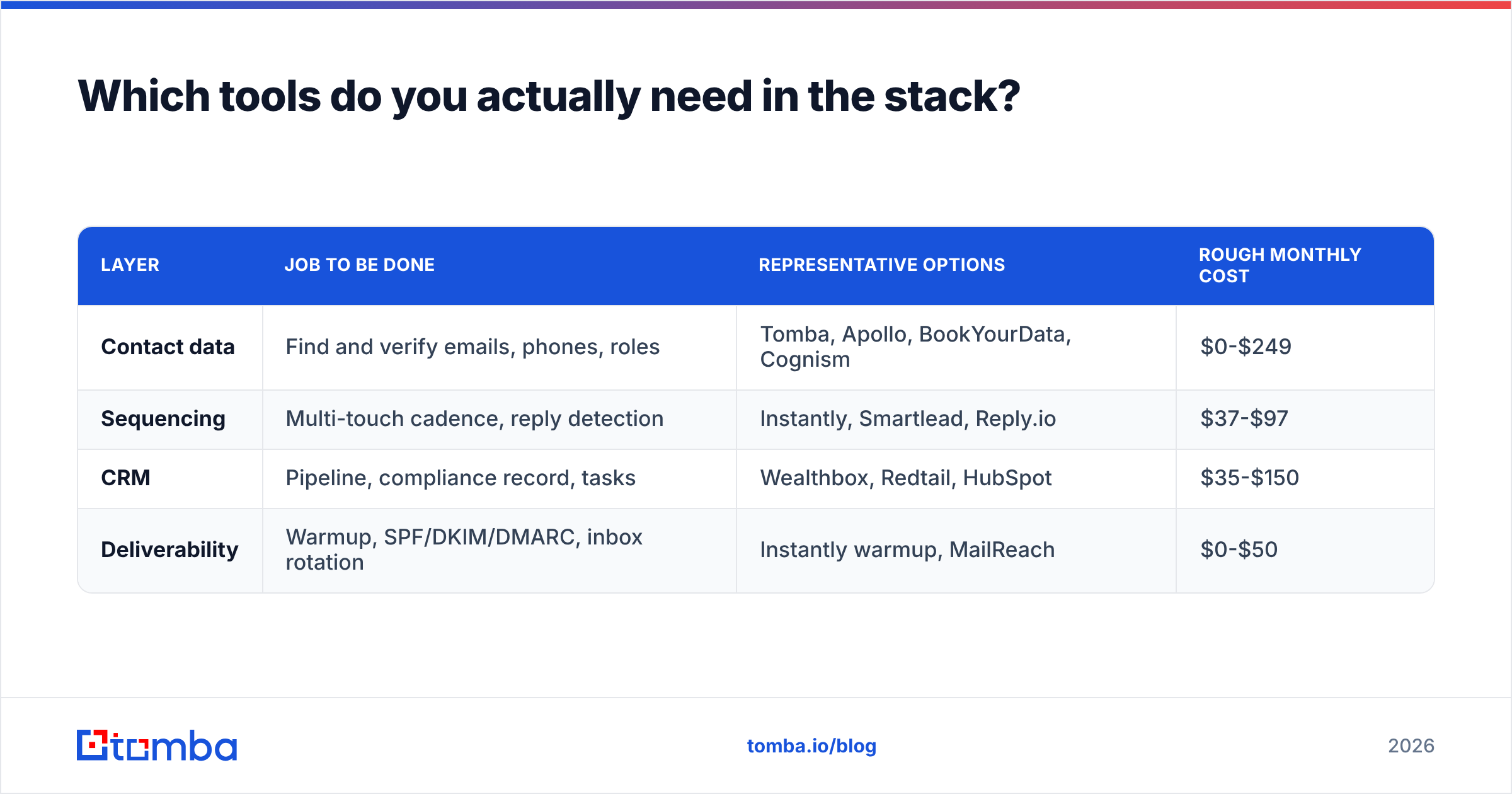
Fewer than the vendor landscape suggests. A working advisor prospecting stack has four layers, and you can staff each one without an enterprise contract.
| Layer | Job to be done | Representative options | Rough monthly cost |
|---|---|---|---|
| Contact data | Find and verify emails, phones, roles | Tomba, Apollo, BookYourData, Cognism | $0-$249 |
| Sequencing | Multi-touch cadence, reply detection | Instantly, Smartlead, Reply.io | $37-$97 |
| CRM | Pipeline, compliance record, tasks | Wealthbox, Redtail, HubSpot | $35-$150 |
| Deliverability | Warmup, SPF/DKIM/DMARC, inbox rotation | Instantly warmup, MailReach | $0-$50 |
On the data layer specifically: aggregate-database tools like Apollo give you breadth and a searchable universe, which is useful when you don't yet know your niche. Verification-first tools optimize for accuracy on a defined list, which is what you want once you do. BookYourData is a solid option when you want pre-built, pay-as-you-go B2B lists with no subscription commitment — a genuinely different buying model that suits advisors doing episodic campaigns rather than continuous outbound.
Tomba pricing sits in the accessible range for solo advisors: a free tier at 25 searches per month to test your niche hypothesis, Starter at $49/mo, Growth at $99/mo, and Pro at $249/mo when you're running bulk campaigns. The practical advantage for advisor workflows is the combination — finder, verifier, catch-all handling, and enrichment in one credit pool, so you're not stitching three subscriptions together to get one clean list.
If you're comparing options broadly, G2's lead intelligence category is a reasonable neutral starting point for reviews across the segment.
How do you convert financial advisor leads once you have them?#
Sourcing is half the job. The conversion side has three levers that matter more than anything else you'll read about email copy.
Speed to lead. Research across sales organizations consistently shows response time is the single strongest predictor of contact rate — the difference between five minutes and thirty minutes is dramatic, and by 24 hours the lead is functionally cold. If you're buying leads and checking your inbox twice a day, you're paying aggregator prices for referral-quality neglect.
Touch count. Most advisors quit after two attempts. Meaningful reply rates on cold B2B outreach typically require 6-9 touches across email, phone, and LinkedIn over three to four weeks. This isn't about being annoying; it's about arriving at the moment the prospect happens to be thinking about the problem. Track your response rate per touch number and you'll see the curve for yourself.
A first message about them, not you. The failure pattern is universal: three paragraphs on your fiduciary philosophy, your CFP, your planning process. The prospect's question is "why are you in my inbox." Answer it in one sentence with a specific, verifiable reason — their firm's recent acquisition, a role change, a plan-provider transition at their employer — then ask one small question.
For phone-forward practices, pairing verified email with direct dials materially lifts connect rates. A phone finder that returns mobile numbers alongside your email data means one prospect record supports both channels instead of two separate sourcing efforts.
What does a realistic 90-day plan look like?#
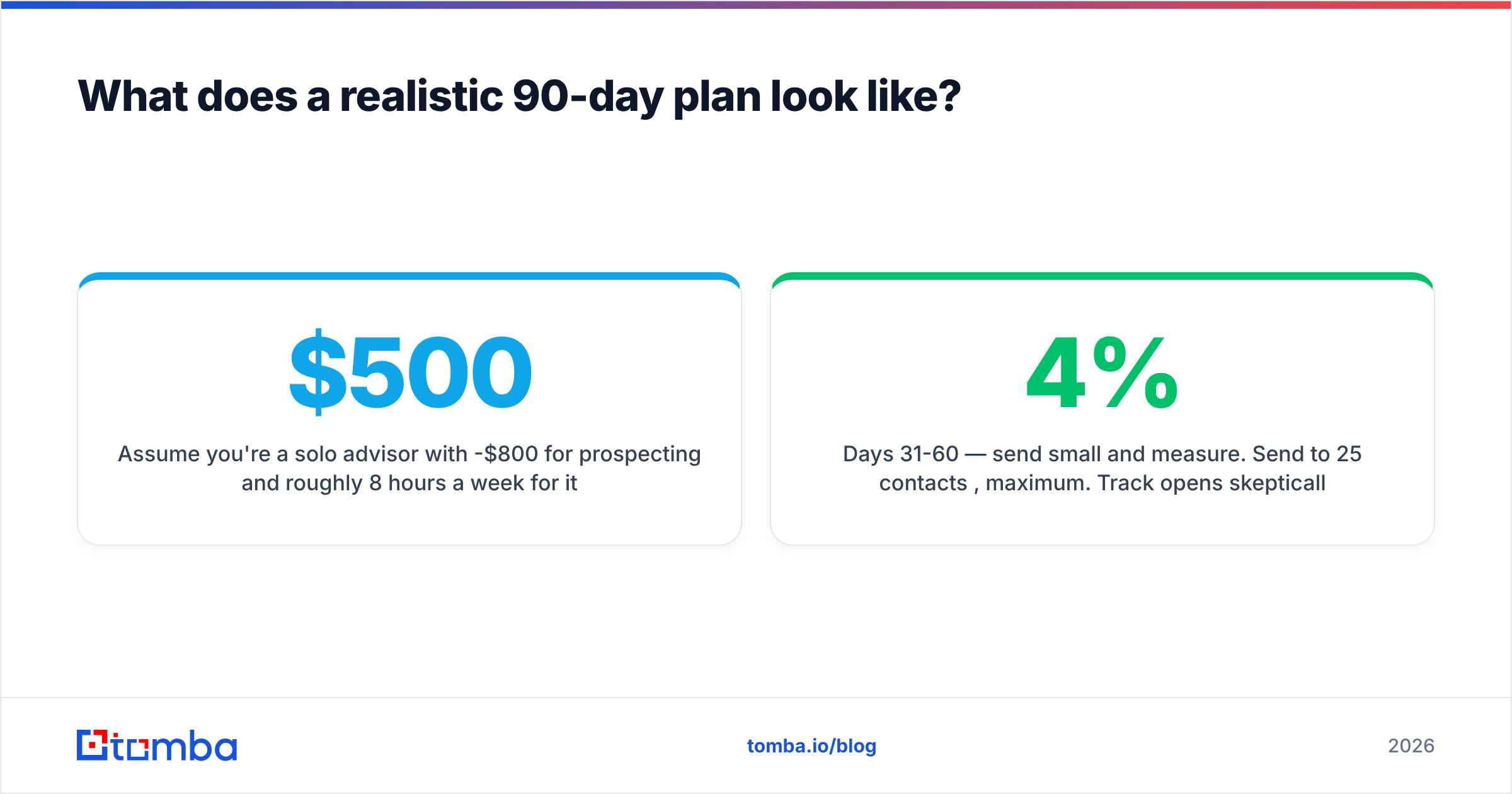
Assume you're a solo advisor with $500-$800/month for prospecting and roughly 8 hours a week for it.
Days 1-30 — build the machine. Pick one niche. Build a 400-contact list from a repeatable source. Verify all of it. Set up a dedicated sending domain, configure SPF/DKIM/DMARC, and start warmup. Do not send campaign mail yet. Write three sequence variants targeted at your one niche.
Days 31-60 — send small and measure. Send to 25 contacts per day, maximum. Track opens skeptically (privacy features distort them), track replies religiously. Your target is a 4%+ positive reply rate. Below 2% means the segment or the message is wrong — fix the message first, it's cheaper. Simultaneously, buy 20-30 leads from one aggregator as a control group so you have a real cost comparison rather than a theoretical one.
Days 61-90 — double down on what worked. Compare cost per booked meeting across both channels. Kill the loser. Scale the winner to 50-75 sends a day if it's outbound, or increase the buy if the aggregator genuinely outperformed for your segment. Add a second niche only after the first one produces two closed relationships.
The discipline that makes this work is refusing to run both channels at half attention. Advisors who split focus across six channels get six sets of mediocre data and no conclusion.
Start with a clean list#
The cheapest financial advisor leads you'll ever get are the ones you build yourself from a niche you actually understand — but only if the contact data is accurate enough to reach. Bad data doesn't just waste sends; it degrades the sender reputation that every future campaign depends on.
Start with the Tomba Email Finder to resolve names and company domains into verified professional addresses, then run the list through verification before your first send. The free tier gives you 25 searches to test whether your niche hypothesis produces reachable contacts — enough to validate the segment before you commit a budget to it. Build the list once, verify it properly, and the same 400 records will outperform four aggregator invoices.
Related guides#
Ready to find emails that actually work?
Join 150,000+ professionals who stopped guessing and started sending. Free credits on signup — no credit card required.
Get the Tomba newsletter
Practical outbound tactics and product updates — once every two weeks.
About the author